Reverse or not reverse percentages Dr Irina Tolchenova

- Slides: 10
Reverse or not reverse percentages Dr. Irina Tolchenova Lead Practitioner Maths, The Nobel School Secondary Mastery Maths Lead, Matrix Essex and Herts Hub
Reverse or not reverse percentages Pre-learning required: confident use of multipliers when an amount is decreased or increased. The learning point of this lesson is choosing the correct strategy when dealing with the questions where an amount was changed by a certain percentage. The aim is to highlight the differences in the approach when students have to find either the original or changed amount. Some mastery elements such as variation were used to highlight the most important elements.
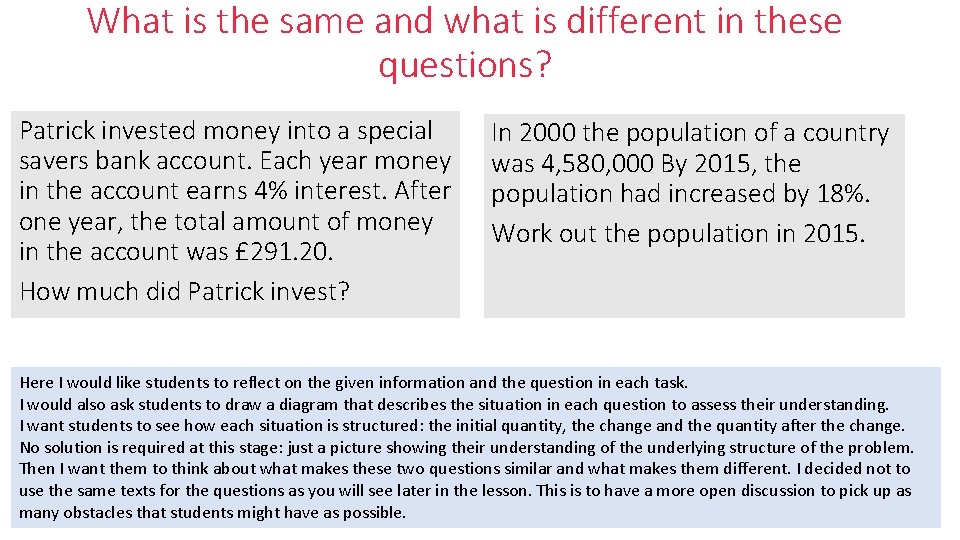
What is the same and what is different in these questions? Patrick invested money into a special savers bank account. Each year money in the account earns 4% interest. After one year, the total amount of money in the account was £ 291. 20. How much did Patrick invest? In 2000 the population of a country was 4, 580, 000 By 2015, the population had increased by 18%. Work out the population in 2015. Here I would like students to reflect on the given information and the question in each task. I would also ask students to draw a diagram that describes the situation in each question to assess their understanding. I want students to see how each situation is structured: the initial quantity, the change and the quantity after the change. No solution is required at this stage: just a picture showing their understanding of the underlying structure of the problem. Then I want them to think about what makes these two questions similar and what makes them different. I decided not to use the same texts for the questions as you will see later in the lesson. This is to have a more open discussion to pick up as many obstacles that students might have as possible.
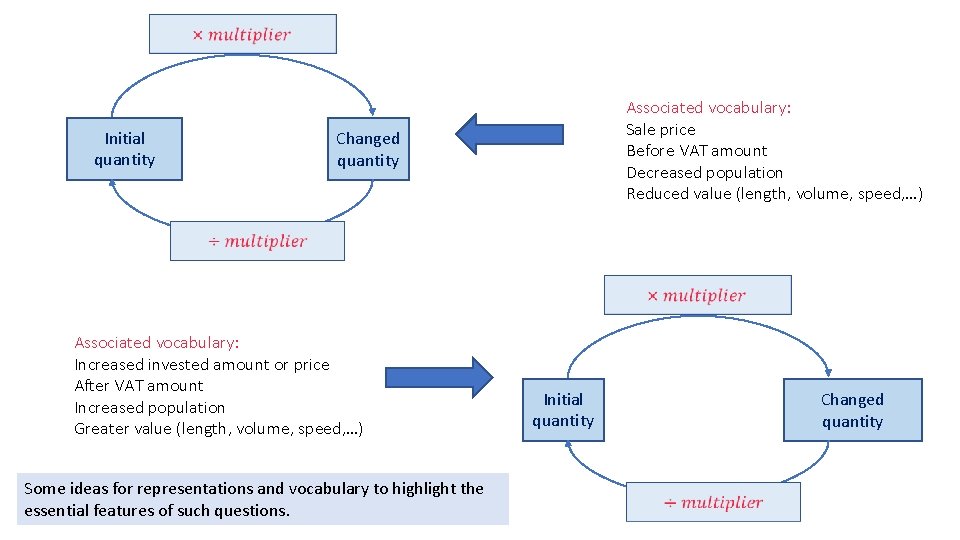
Initial quantity Associated vocabulary: Sale price Before VAT amount Decreased population Reduced value (length, volume, speed, …) Changed quantity Associated vocabulary: Increased invested amount or price After VAT amount Increased population Greater value (length, volume, speed, …) Some ideas for representations and vocabulary to highlight the essential features of such questions. Initial quantity Changed quantity
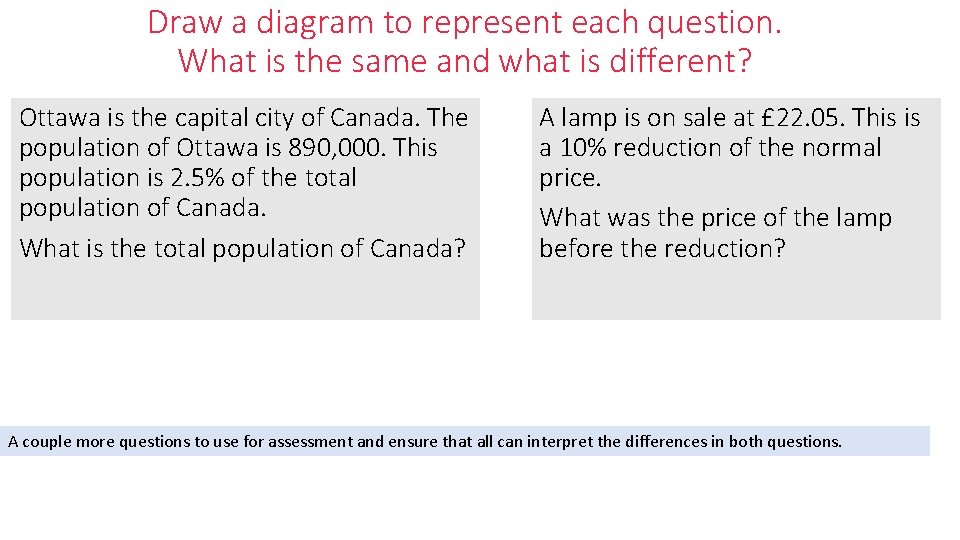
Draw a diagram to represent each question. What is the same and what is different? Ottawa is the capital city of Canada. The population of Ottawa is 890, 000. This population is 2. 5% of the total population of Canada. What is the total population of Canada? A lamp is on sale at £ 22. 05. This is a 10% reduction of the normal price. What was the price of the lamp before the reduction? A couple more questions to use for assessment and ensure that all can interpret the differences in both questions.
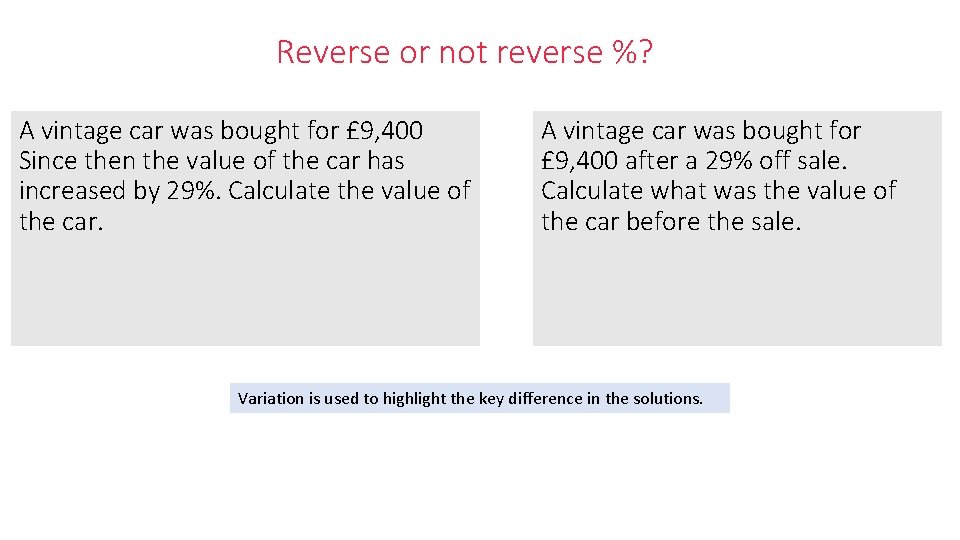
Reverse or not reverse %? A vintage car was bought for £ 9, 400 Since then the value of the car has increased by 29%. Calculate the value of the car. A vintage car was bought for £ 9, 400 after a 29% off sale. Calculate what was the value of the car before the sale. Variation is used to highlight the key difference in the solutions.
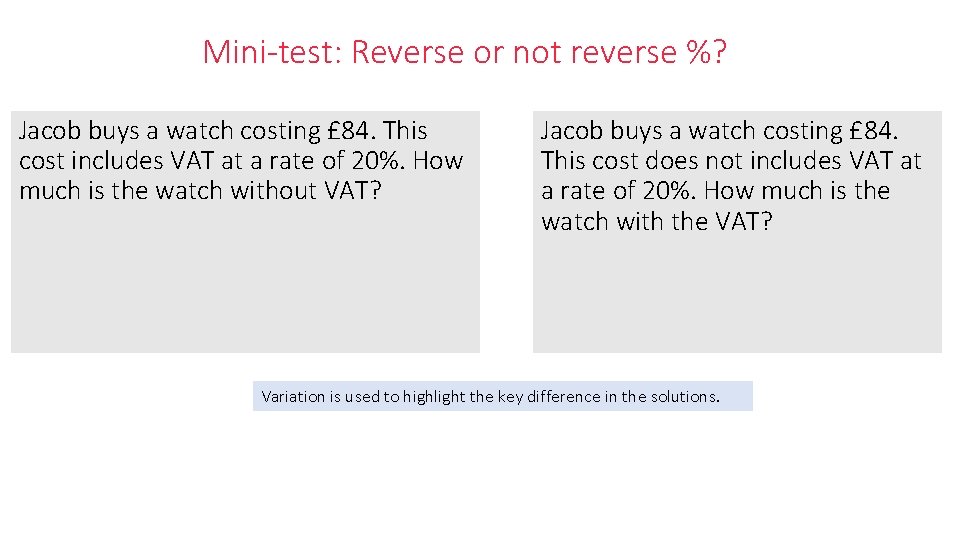
Mini-test: Reverse or not reverse %? Jacob buys a watch costing £ 84. This cost includes VAT at a rate of 20%. How much is the watch without VAT? Jacob buys a watch costing £ 84. This cost does not includes VAT at a rate of 20%. How much is the watch with the VAT? Variation is used to highlight the key difference in the solutions.
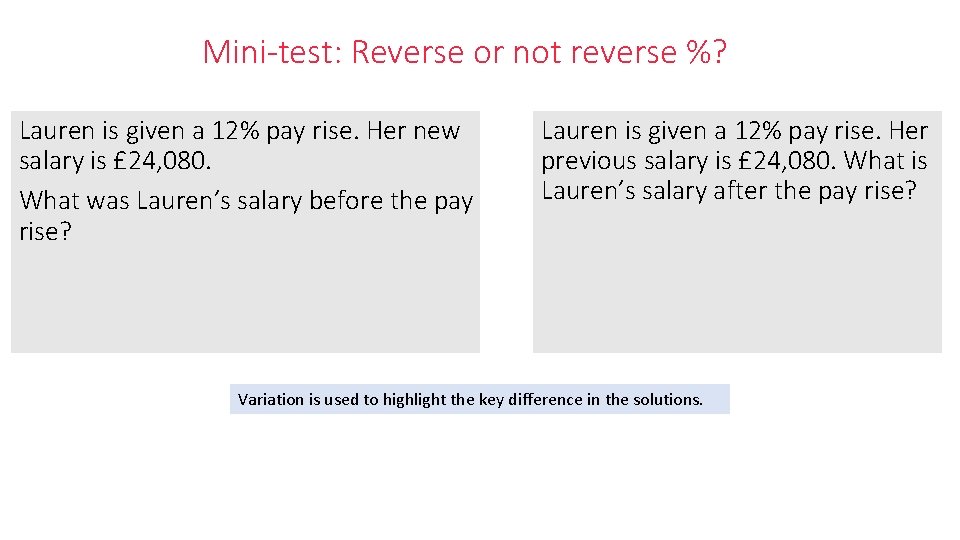
Mini-test: Reverse or not reverse %? Lauren is given a 12% pay rise. Her new salary is £ 24, 080. What was Laurenʼs salary before the pay rise? Lauren is given a 12% pay rise. Her previous salary is £ 24, 080. What is Laurenʼs salary after the pay rise? Variation is used to highlight the key difference in the solutions.
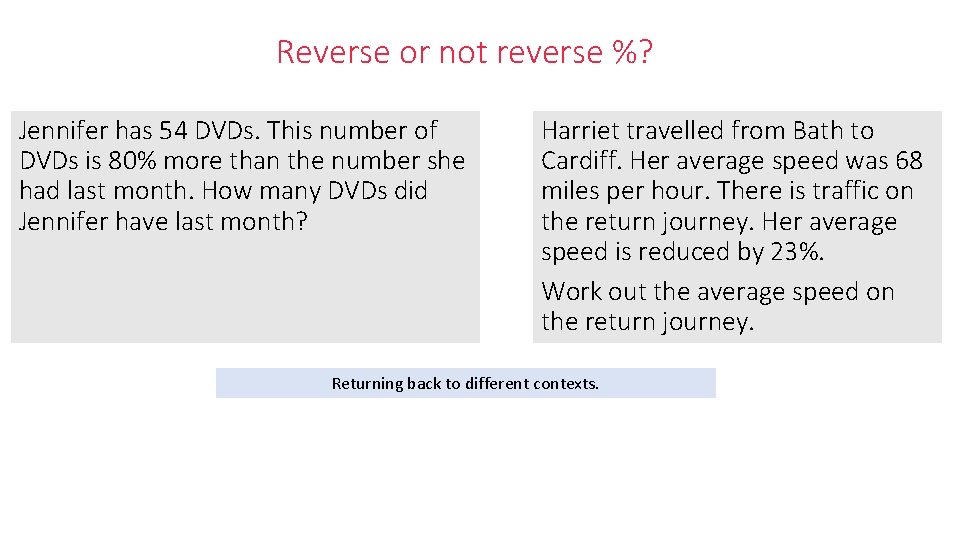
Reverse or not reverse %? Jennifer has 54 DVDs. This number of DVDs is 80% more than the number she had last month. How many DVDs did Jennifer have last month? Harriet travelled from Bath to Cardiff. Her average speed was 68 miles per hour. There is traffic on the return journey. Her average speed is reduced by 23%. Work out the average speed on the return journey. Returning back to different contexts.
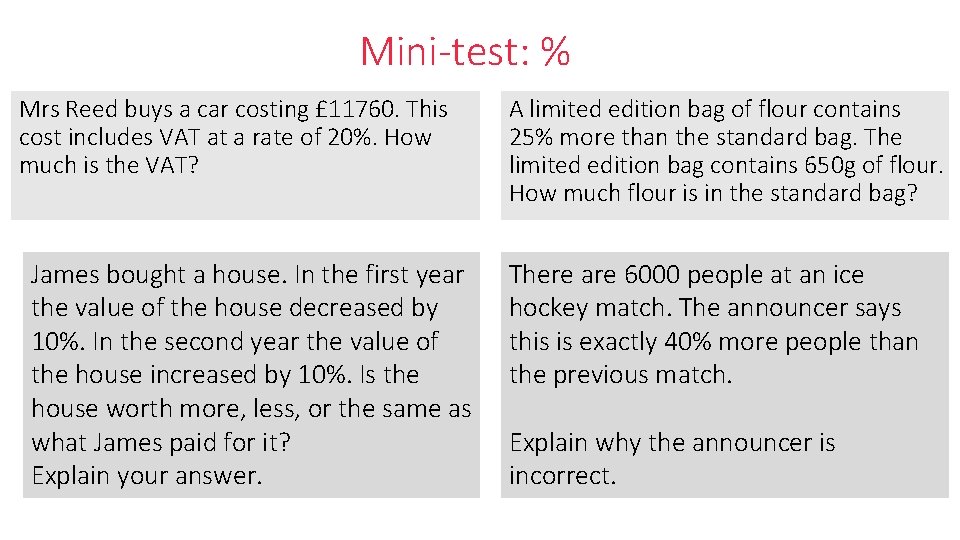
Mini-test: % Mrs Reed buys a car costing £ 11760. This cost includes VAT at a rate of 20%. How much is the VAT? James bought a house. In the first year the value of the house decreased by 10%. In the second year the value of the house increased by 10%. Is the house worth more, less, or the same as what James paid for it? Explain your answer. A limited edition bag of flour contains 25% more than the standard bag. The limited edition bag contains 650 g of flour. How much flour is in the standard bag? There are 6000 people at an ice hockey match. The announcer says this is exactly 40% more people than the previous match. Explain why the announcer is incorrect.