
COMBINATORIAL GAMES Silvia Heubach Department of Mathematics NSS

COMBINATORIAL GAMES Silvia Heubach Department of Mathematics NSS Retreat, May 25, 2017

Games are an integral part of all cultures Royal Game of Ur, southern Iraq, about 2600 -2400 BCE Indian Ambassadors present Chaturanga to Khosrau I, from "A treatise on chess", 14 th century Hnefatafl – Northern European, from about 400 BC – 1200 AD
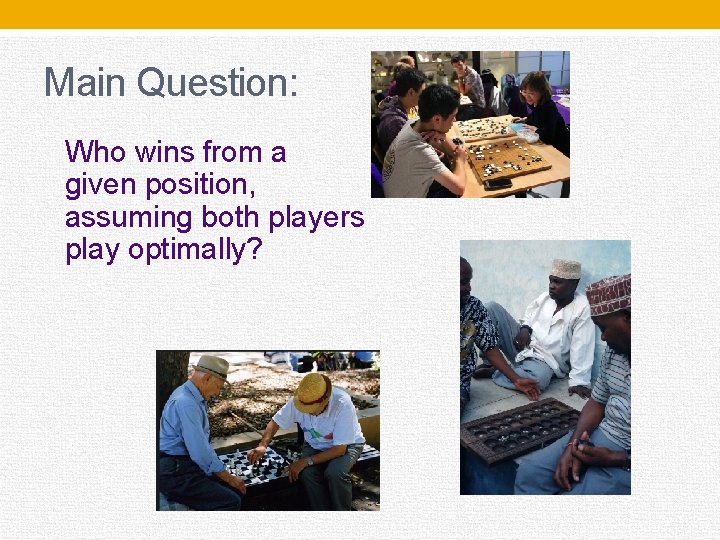
Main Question: Who wins from a given position, assuming both players play optimally?
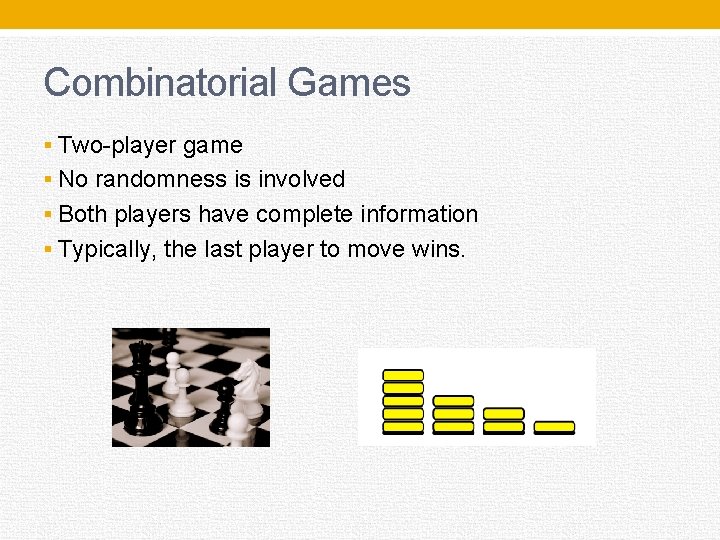
Combinatorial Games § Two-player game § No randomness is involved § Both players have complete information § Typically, the last player to move wins.
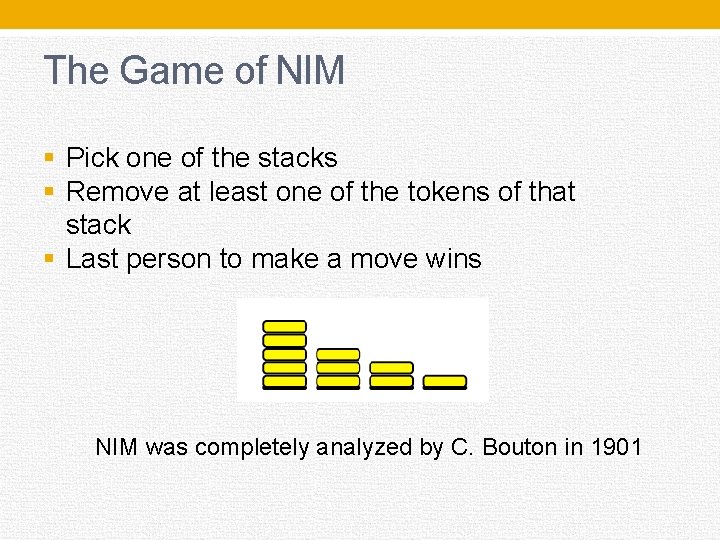
The Game of NIM § Pick one of the stacks § Remove at least one of the tokens of that stack § Last person to make a move wins NIM was completely analyzed by C. Bouton in 1901
Impartial Games Only two possible outcome classes: • Losing positions • Winning positions Characterization of positions • A losing position is one where ALL allowed moves lead to a winning position • A winning position is one where there is at least one move to a losing position.
Impartial Games Only two possible outcome classes: • Losing positions • Winning positions Characterization of positions • A losing position is one where ALL allowed moves lead to a winning position • A winning position is one where there is at least one move to a losing position.
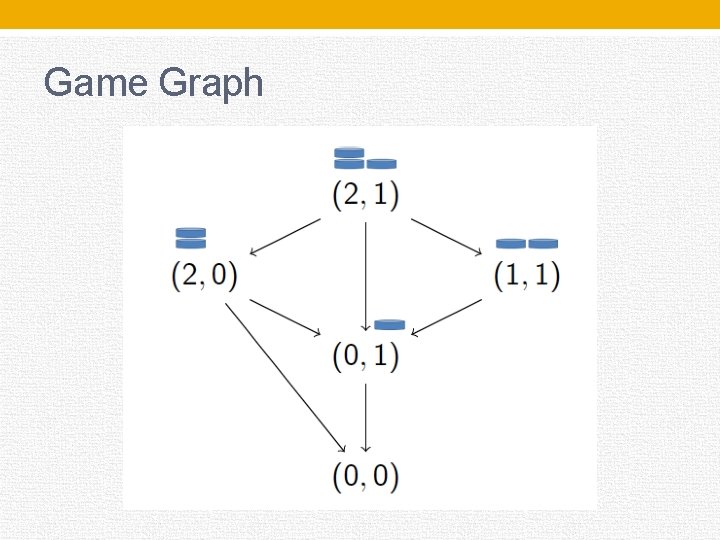
Game Graph
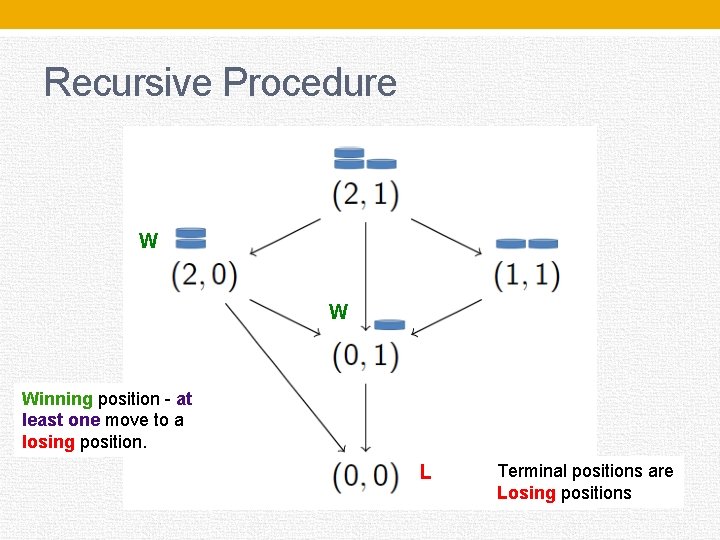
Recursive Procedure W W Winning position - at least one move to a losing position. L Terminal positions are Losing positions
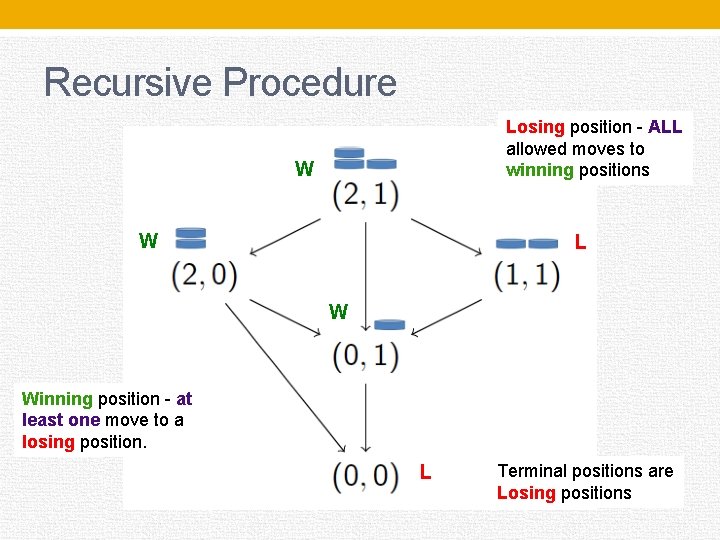
Recursive Procedure Losing position - ALL allowed moves to winning positions W W L W Winning position - at least one move to a losing position. L Terminal positions are Losing positions
Finding the Pattern of the Losing Positions • Write a computer program to implement recursive procedure • Produce a list of losing positions • Stare at them and find a PATTERN that seems to describe the losing positions • Describe the pattern mathematically • Then prove that the pattern is correct
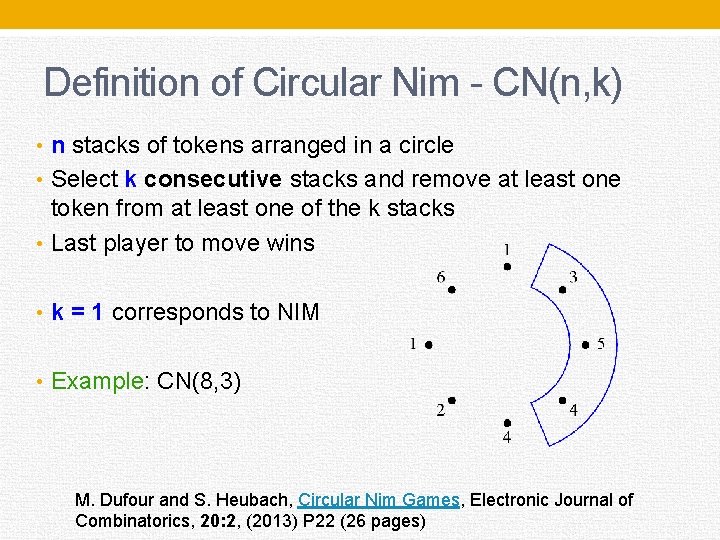
Definition of Circular Nim - CN(n, k) • n stacks of tokens arranged in a circle • Select k consecutive stacks and remove at least one token from at least one of the k stacks • Last player to move wins • k = 1 corresponds to NIM • Example: CN(8, 3) M. Dufour and S. Heubach, Circular Nim Games, Electronic Journal of Combinatorics, 20: 2, (2013) P 22 (26 pages)
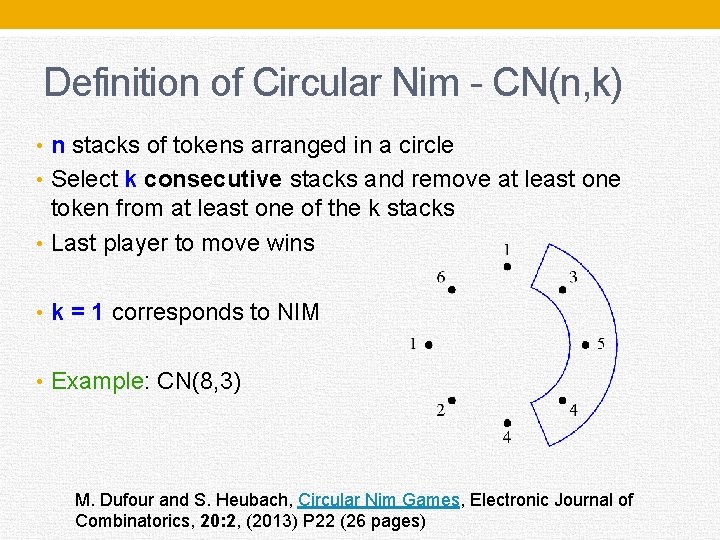
Definition of Circular Nim - CN(n, k) • n stacks of tokens arranged in a circle • Select k consecutive stacks and remove at least one token from at least one of the k stacks • Last player to move wins • k = 1 corresponds to NIM • Example: CN(8, 3) M. Dufour and S. Heubach, Circular Nim Games, Electronic Journal of Combinatorics, 20: 2, (2013) P 22 (26 pages)
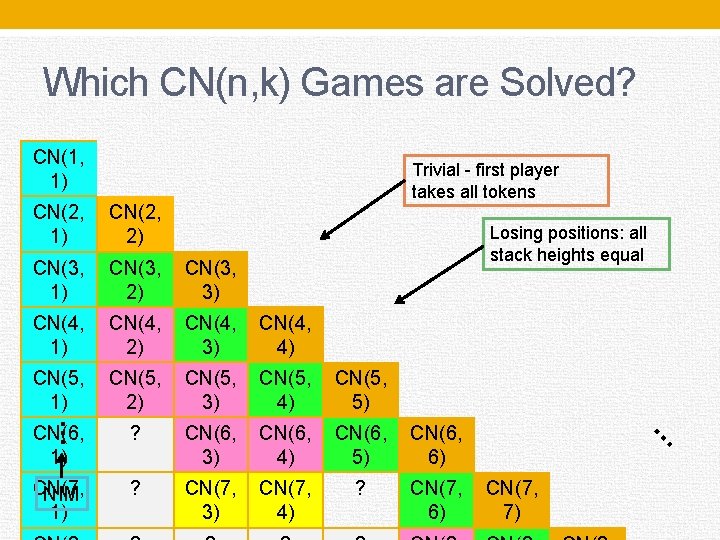
Which CN(n, k) Games are Solved? CN(1, 1) CN(2, 2) CN(3, 1) CN(3, 2) CN(3, 3) CN(4, 1) CN(4, 2) CN(4, 3) CN(4, 4) CN(5, 1) CN(5, 2) CN(5, 3) CN(5, 4) CN(5, 5) … Trivial - first player takes all tokens CN(6, 1) ? CN(6, 3) CN(6, 4) CN(6, 5) CN(6, 6) CN(7, NIM 1) ? CN(7, 3) CN(7, 4) ? CN(7, 6) Losing positions: all stack heights equal … CN(7, 7)
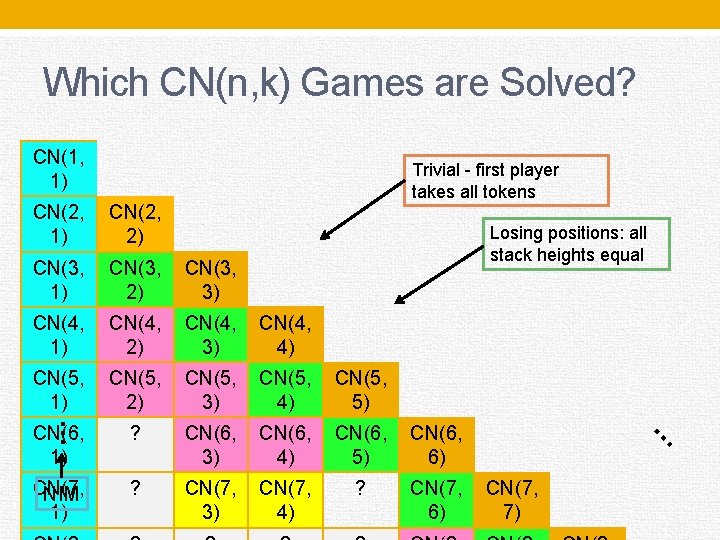
Which CN(n, k) Games are Solved? CN(1, 1) CN(2, 2) CN(3, 1) CN(3, 2) CN(3, 3) CN(4, 1) CN(4, 2) CN(4, 3) CN(4, 4) CN(5, 1) CN(5, 2) CN(5, 3) CN(5, 4) CN(5, 5) … Trivial - first player takes all tokens CN(6, 1) ? CN(6, 3) CN(6, 4) CN(6, 5) CN(6, 6) CN(7, NIM 1) ? CN(7, 3) CN(7, 4) ? CN(7, 6) Losing positions: all stack heights equal … CN(7, 7)
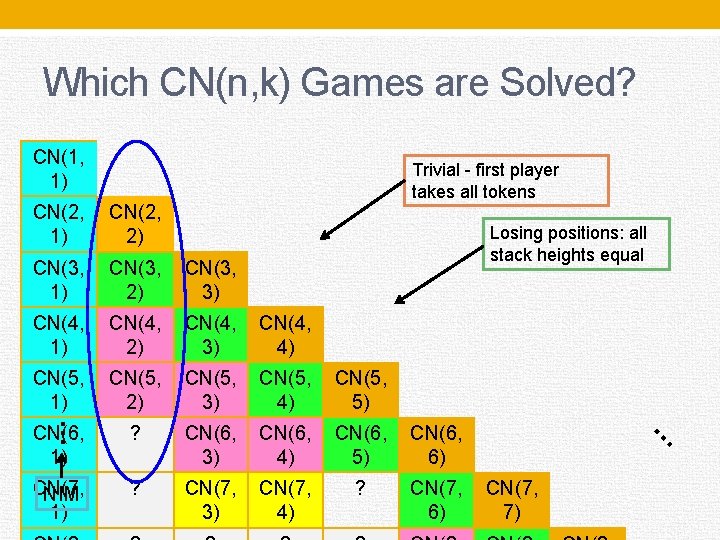
Which CN(n, k) Games are Solved? CN(1, 1) CN(2, 2) CN(3, 1) CN(3, 2) CN(3, 3) CN(4, 1) CN(4, 2) CN(4, 3) CN(4, 4) CN(5, 1) CN(5, 2) CN(5, 3) CN(5, 4) CN(5, 5) … Trivial - first player takes all tokens CN(6, 1) ? CN(6, 3) CN(6, 4) CN(6, 5) CN(6, 6) CN(7, NIM 1) ? CN(7, 3) CN(7, 4) ? CN(7, 6) Losing positions: all stack heights equal … CN(7, 7)
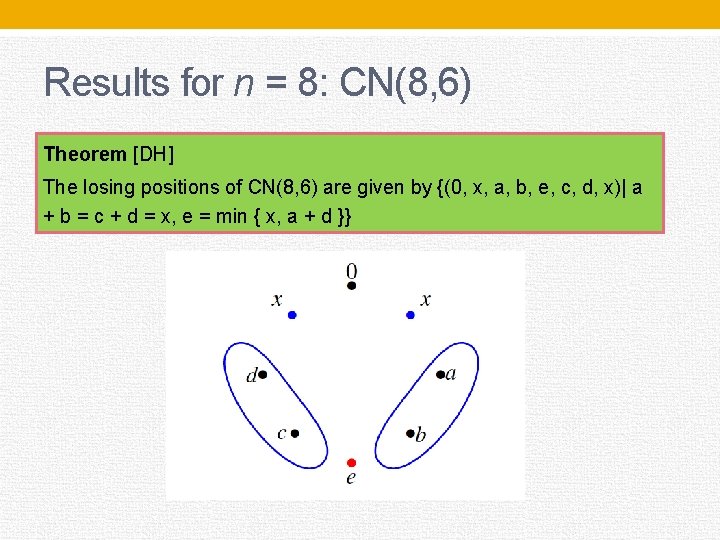
Results for n = 8: CN(8, 6) Theorem [DH] The losing positions of CN(8, 6) are given by {(0, x, a, b, e, c, d, x)| a + b = c + d = x, e = min { x, a + d }}
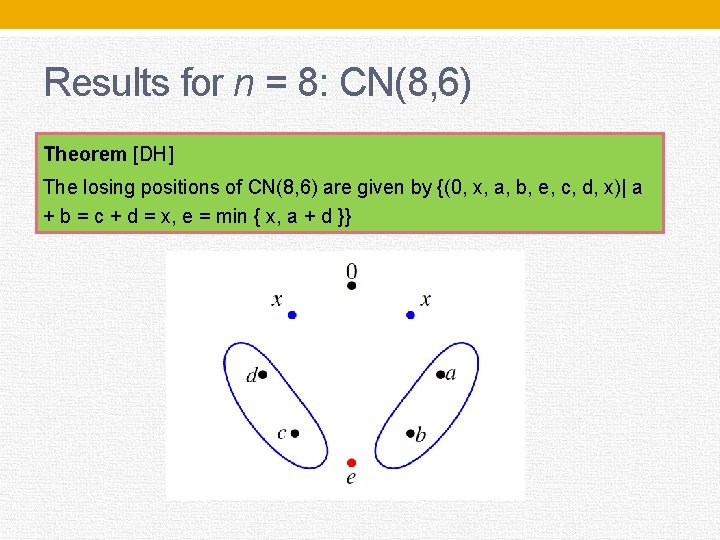
Results for n = 8: CN(8, 6) Theorem [DH] The losing positions of CN(8, 6) are given by {(0, x, a, b, e, c, d, x)| a + b = c + d = x, e = min { x, a + d }}
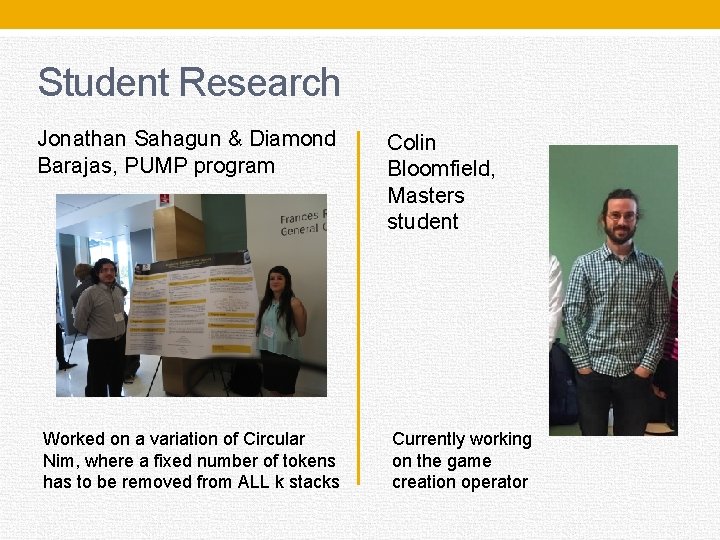
Student Research Jonathan Sahagun & Diamond Barajas, PUMP program Worked on a variation of Circular Nim, where a fixed number of tokens has to be removed from ALL k stacks Colin Bloomfield, Masters student Currently working on the game creation operator
THANK YOU! Image citation • By Firdausi - http: //history. chess. free. fr/sources. htm, Public Domain https: //commons. wikimedia. org/w/index. php? curid=13374161 • Royal Game of Ur, southern Iraq, about 2600 -2400 BCE, By Babel. Stone (Own work), CC 0, https: //commons. wikimedia. org/w/index. php? curid=10861909 • Hnefatafl reconstruction, By Matěj Baťha - Own work, CC BY-SA 3. 0, https: //commons. wikimedia. org/w/index. php? curid=25070387 • http: //www. britgo. org/node/4812 • https: //en. wikipedia. org/wiki/Mancala#/media/File: Bao_players_in_stone_town_zanzibar. jpg
- Slides: 20