Jet Physics at CDF Sally Seidel University of



- Slides: 36
Jet Physics at CDF Sally Seidel University of New Mexico APS’ 99 24 March 1999
1. Jets at CDF 2. The Inclusive Jet Cross Section 3. The Dijet Mass Cross Section 4. The Differential Dijet Cross Section
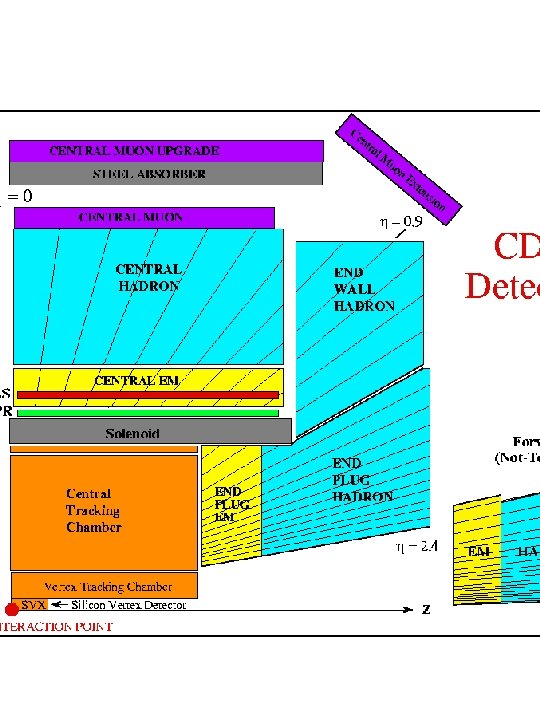
CDF: A multi-purpose detector for studying hadronic collisions at the Fermilab Tevatron:
The motivation: Jet distributions at colliders can: • signal new particles • test QCD predictions • check parton distribution functions
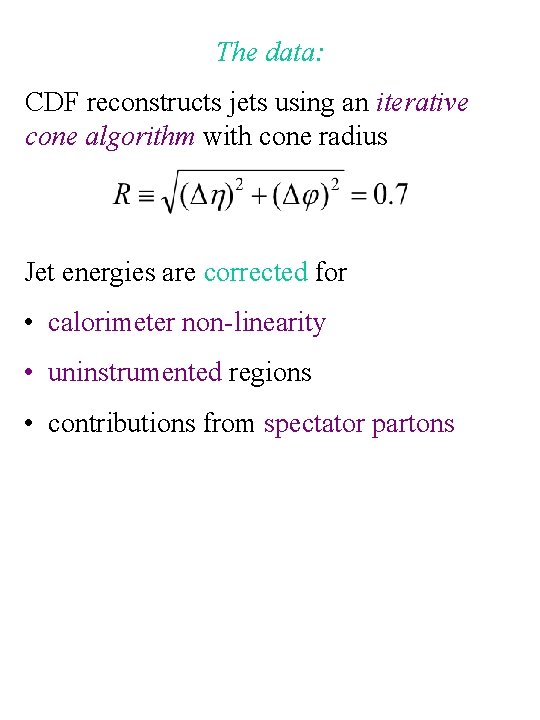
The data: CDF reconstructs jets using an iterative cone algorithm with cone radius Jet energies are corrected for • calorimeter non-linearity • uninstrumented regions • contributions from spectator partons
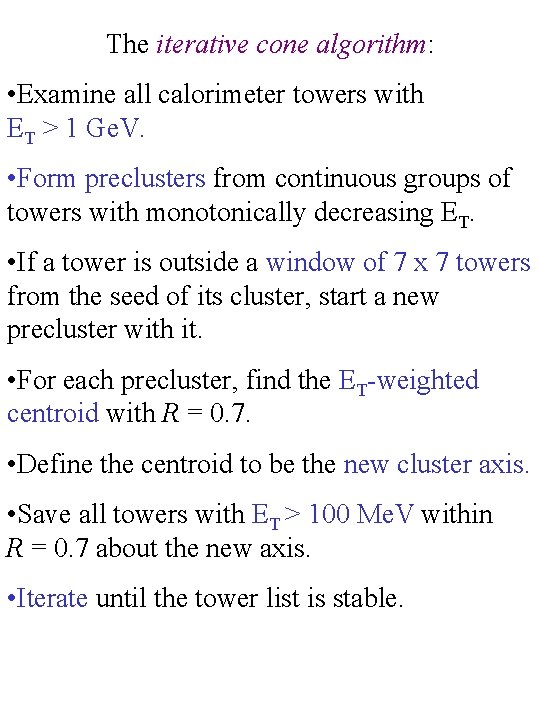
The iterative cone algorithm: • Examine all calorimeter towers with ET > 1 Ge. V. • Form preclusters from continuous groups of towers with monotonically decreasing ET. • If a tower is outside a window of 7 x 7 towers from the seed of its cluster, start a new precluster with it. • For each precluster, find the ET-weighted centroid with R = 0. 7. • Define the centroid to be the new cluster axis. • Save all towers with ET > 100 Me. V within R = 0. 7 about the new axis. • Iterate until the tower list is stable.
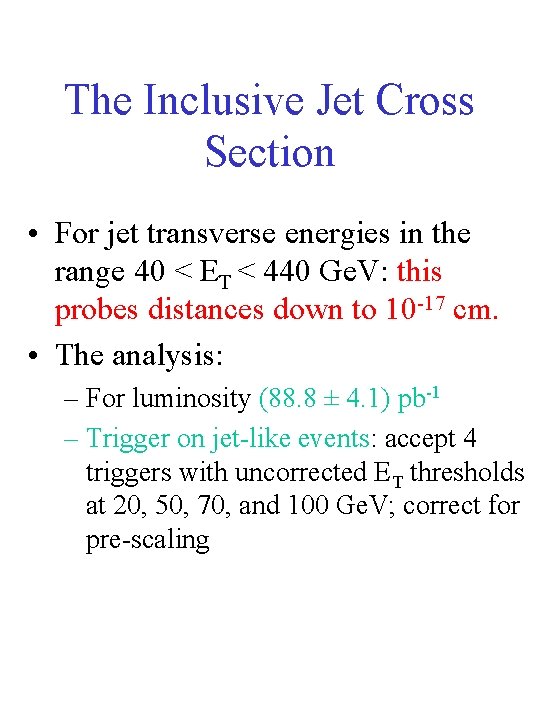
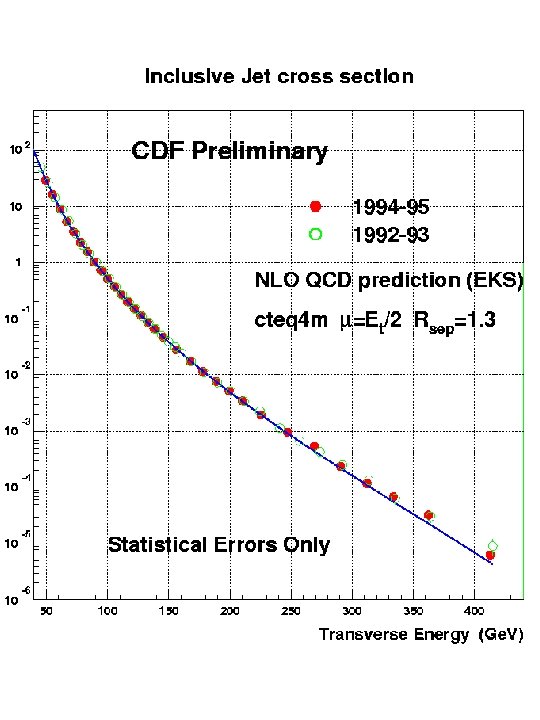
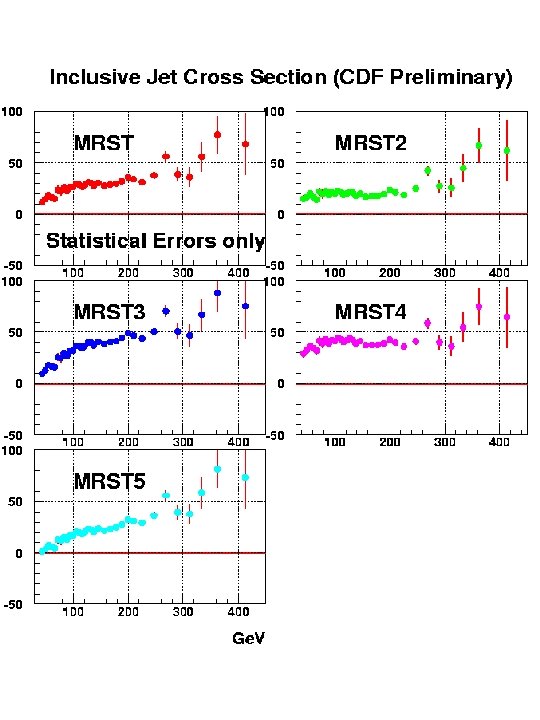
The Inclusive Jet Cross Section • For jet transverse energies in the range 40 < ET < 440 Ge. V: this probes distances down to 10 -17 cm. • The analysis: – For luminosity (88. 8 ± 4. 1) pb-1 – Trigger on jet-like events: accept 4 triggers with uncorrected ET thresholds at 20, 50, 70, and 100 Ge. V; correct for pre-scaling
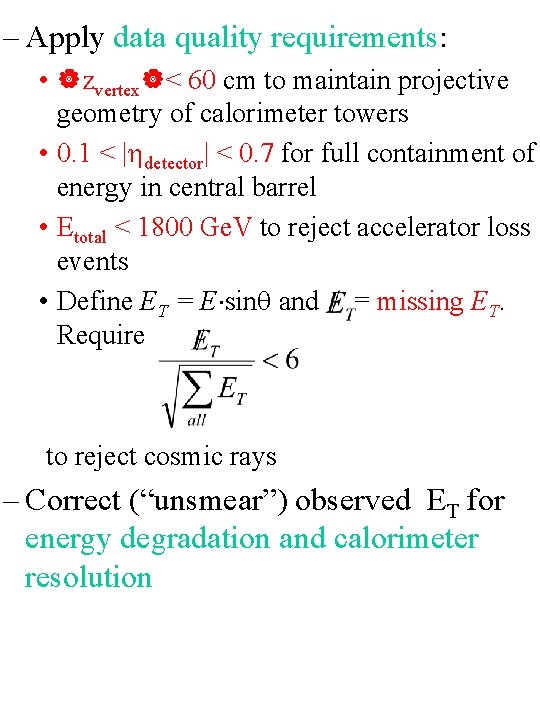
– Apply data quality requirements: • zvertex < 60 cm to maintain projective geometry of calorimeter towers • 0. 1 < | detector| < 0. 7 for full containment of energy in central barrel • Etotal < 1800 Ge. V to reject accelerator loss events • Define ET = E sin and = missing ET. Require to reject cosmic rays – Correct (“unsmear”) observed ET for energy degradation and calorimeter resolution
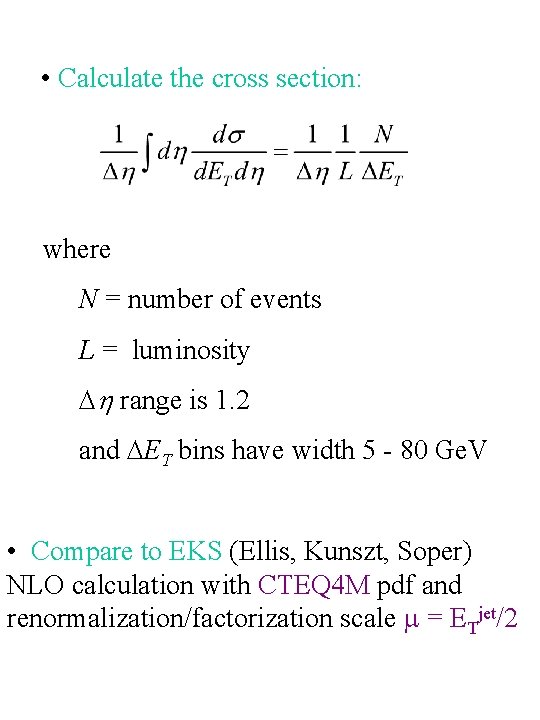
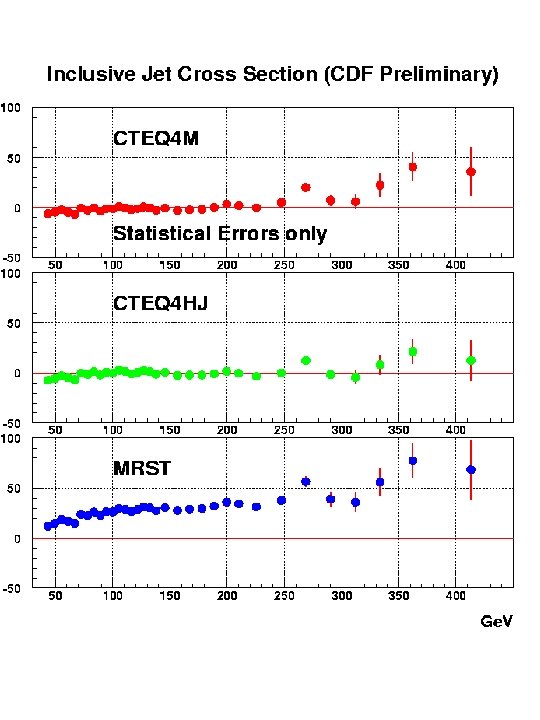
• Calculate the cross section: where N = number of events L = luminosity range is 1. 2 and ET bins have width 5 - 80 Ge. V • Compare to EKS (Ellis, Kunszt, Soper) NLO calculation with CTEQ 4 M pdf and renormalization/factorization scale = ETjet/2
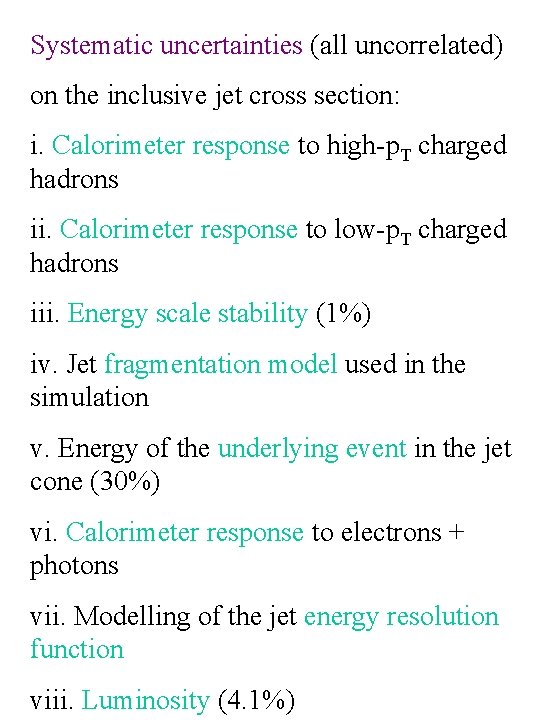
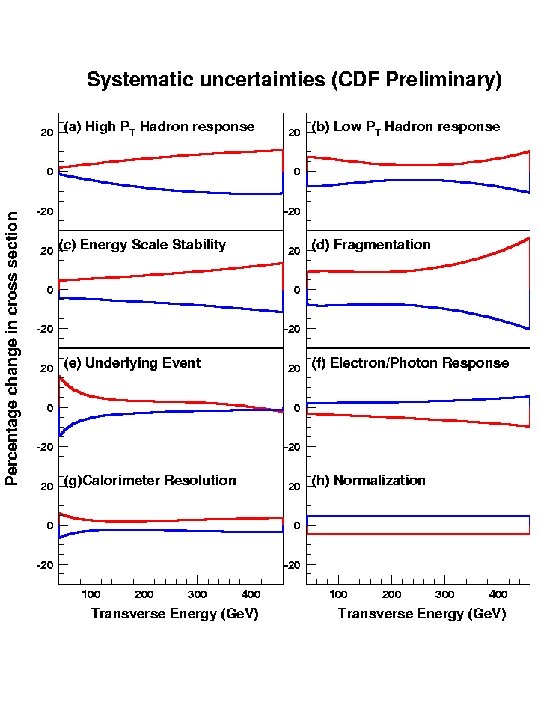
Systematic uncertainties (all uncorrelated) on the inclusive jet cross section: i. Calorimeter response to high-p. T charged hadrons ii. Calorimeter response to low-p. T charged hadrons iii. Energy scale stability (1%) iv. Jet fragmentation model used in the simulation v. Energy of the underlying event in the jet cone (30%) vi. Calorimeter response to electrons + photons vii. Modelling of the jet energy resolution function viii. Luminosity (4. 1%)
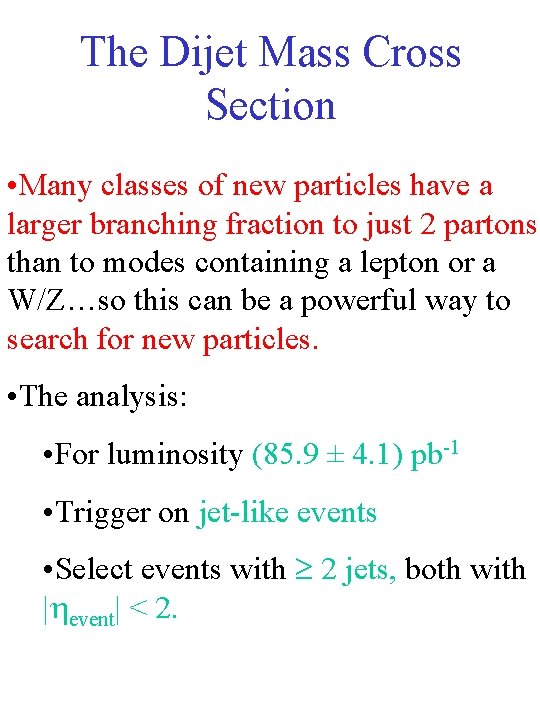
The Dijet Mass Cross Section • Many classes of new particles have a larger branching fraction to just 2 partons than to modes containing a lepton or a W/Z…so this can be a powerful way to search for new particles. • The analysis: • For luminosity (85. 9 ± 4. 1) pb-1 • Trigger on jet-like events • Select events with 2 jets, both with | event| < 2.
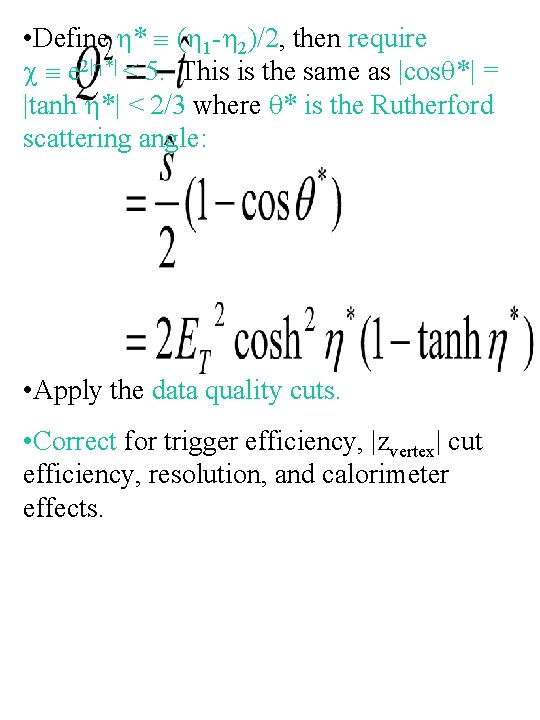
• Define * ( 1 - 2)/2, then require e 2| *| < 5. This is the same as |cos *| = |tanh *| < 2/3 where * is the Rutherford scattering angle: • Apply the data quality cuts. • Correct for trigger efficiency, |zvertex| cut efficiency, resolution, and calorimeter effects.
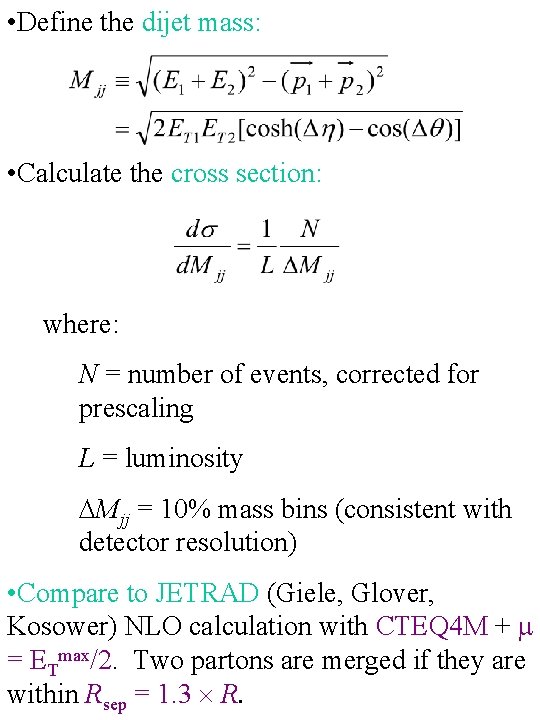
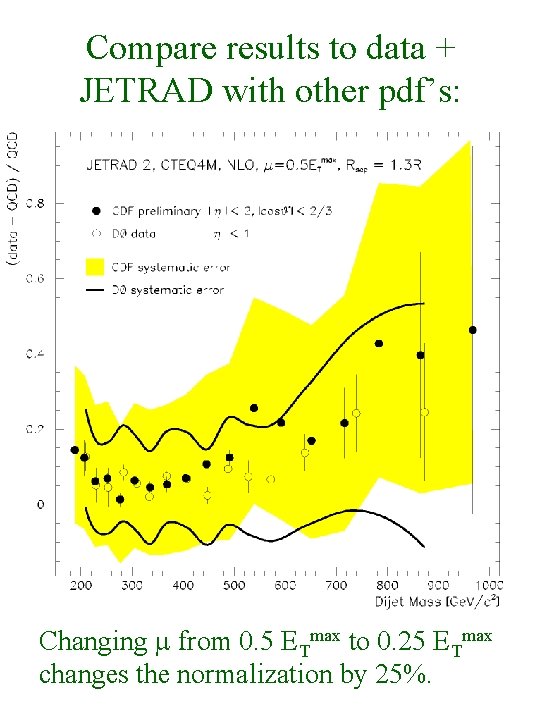
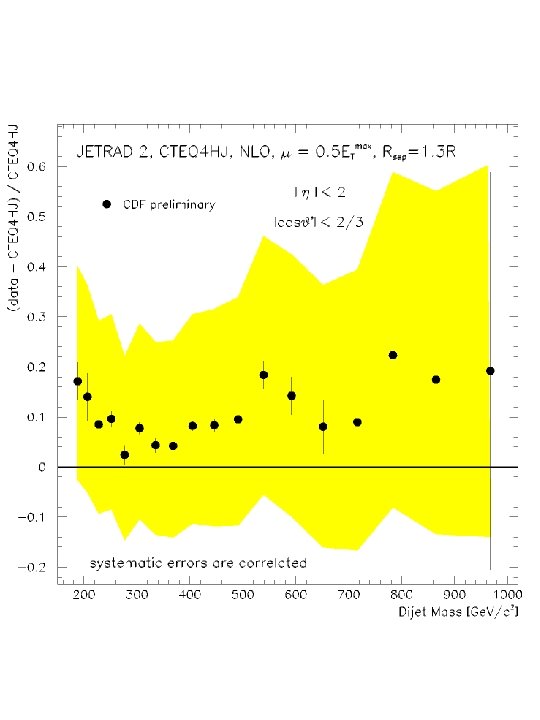
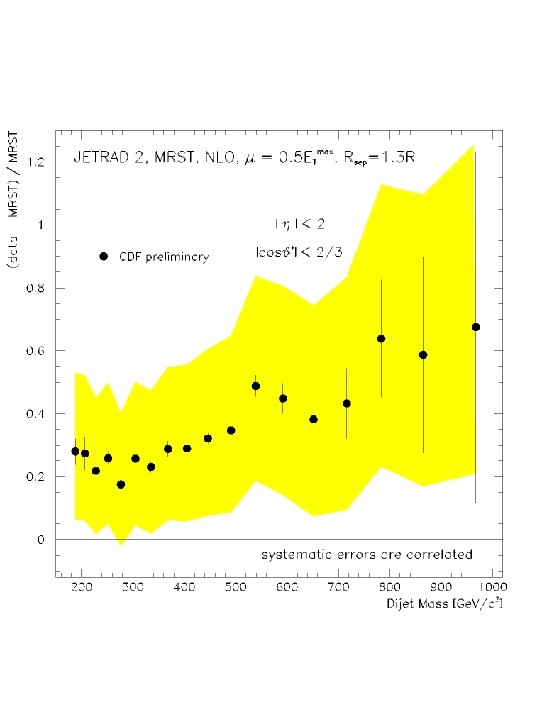
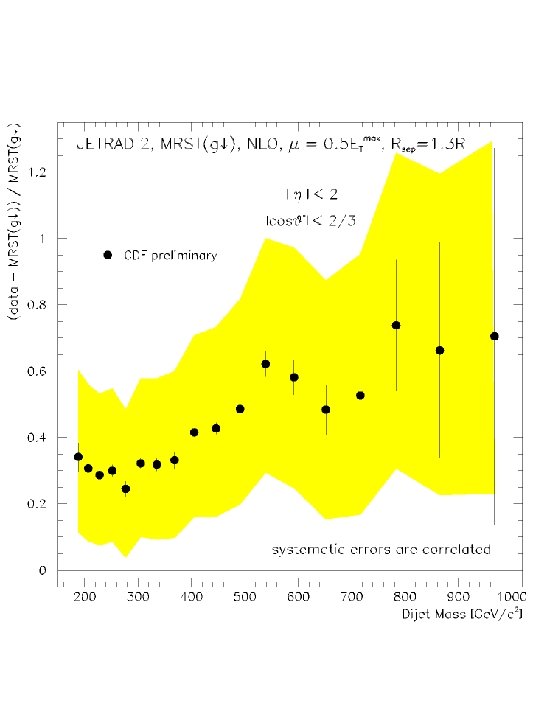
• Define the dijet mass: • Calculate the cross section: where: N = number of events, corrected for prescaling L = luminosity Mjj = 10% mass bins (consistent with detector resolution) • Compare to JETRAD (Giele, Glover, Kosower) NLO calculation with CTEQ 4 M + = ETmax/2. Two partons are merged if they are within Rsep = 1. 3 R.
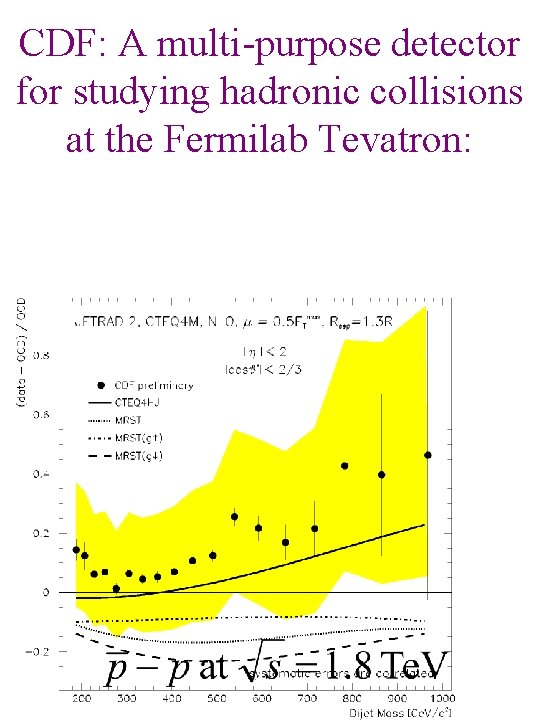
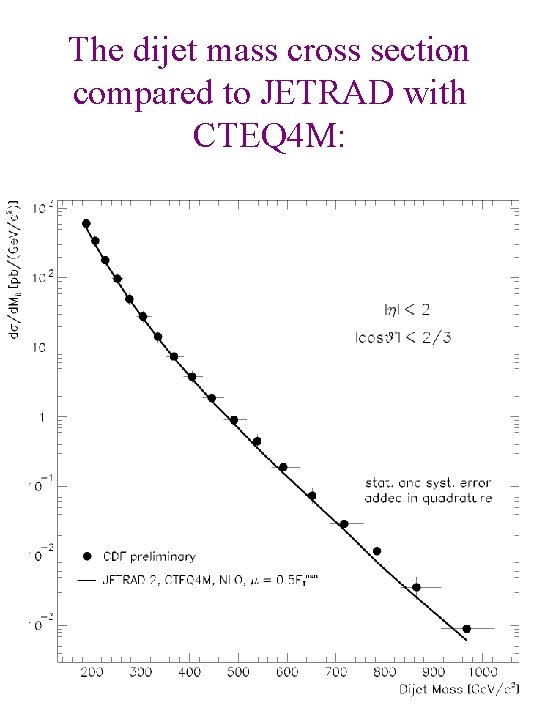
The dijet mass cross section compared to JETRAD with CTEQ 4 M:
Compare results to data + JETRAD with other pdf’s: Changing from 0. 5 ETmax to 0. 25 ETmax changes the normalization by 25%.
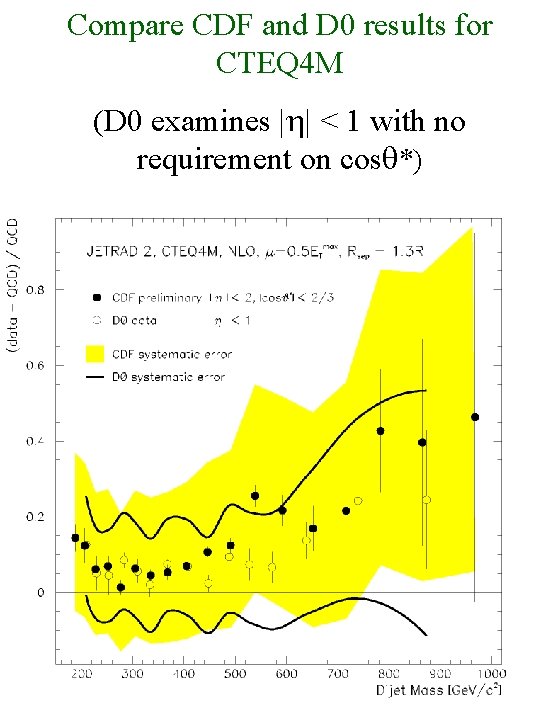
Compare CDF and D 0 results for CTEQ 4 M (D 0 examines | | < 1 with no requirement on cos *)
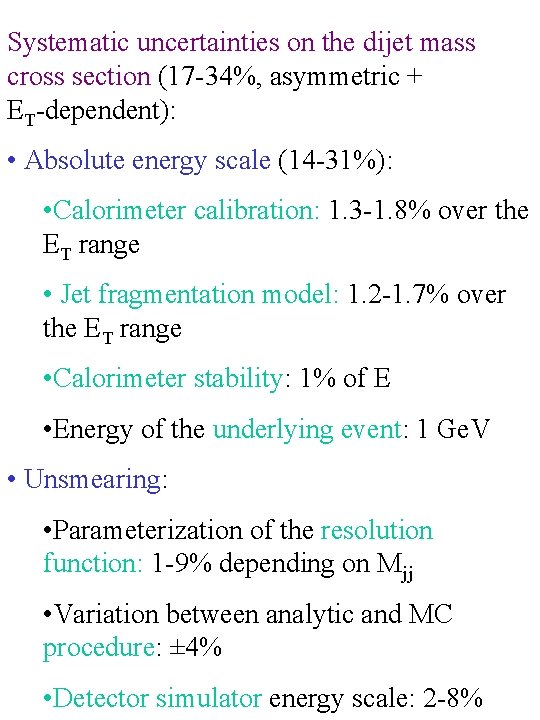
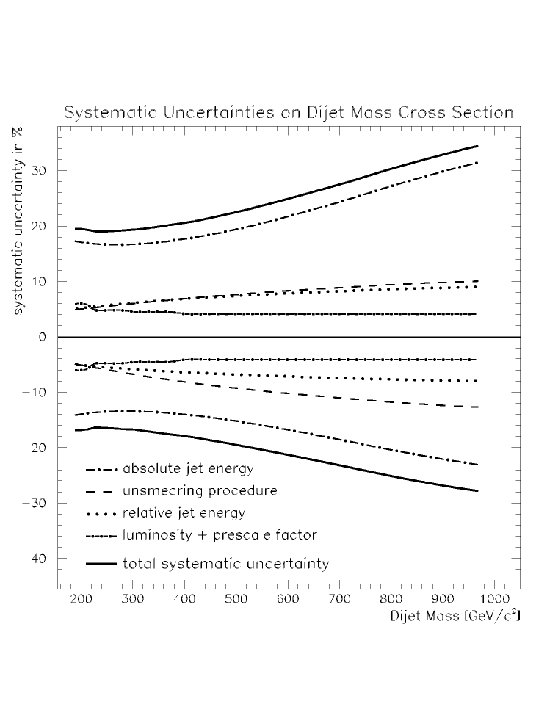
Systematic uncertainties on the dijet mass cross section (17 -34%, asymmetric + ET-dependent): • Absolute energy scale (14 -31%): • Calorimeter calibration: 1. 3 -1. 8% over the ET range • Jet fragmentation model: 1. 2 -1. 7% over the ET range • Calorimeter stability: 1% of E • Energy of the underlying event: 1 Ge. V • Unsmearing: • Parameterization of the resolution function: 1 -9% depending on Mjj • Variation between analytic and MC procedure: ± 4% • Detector simulator energy scale: 2 -8%
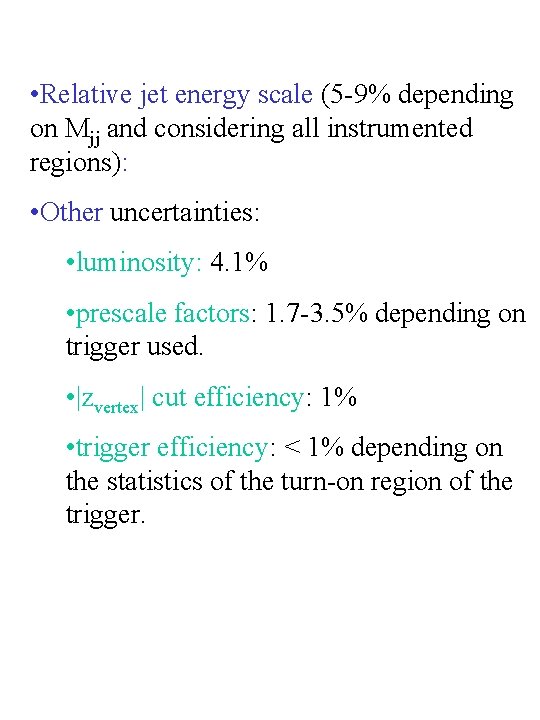
• Relative jet energy scale (5 -9% depending on Mjj and considering all instrumented regions): • Other uncertainties: • luminosity: 4. 1% • prescale factors: 1. 7 -3. 5% depending on trigger used. • |zvertex| cut efficiency: 1% • trigger efficiency: < 1% depending on the statistics of the turn-on region of the trigger.
The Dijet Differential Cross Section • The rapidity dependence of the cross section probes the parton momentum fractions. • The analysis: • For luminosity (86. 0 ± 4. 1) pb-1 • Trigger on jet-like events; select events with 2 jets • Apply data quality cuts
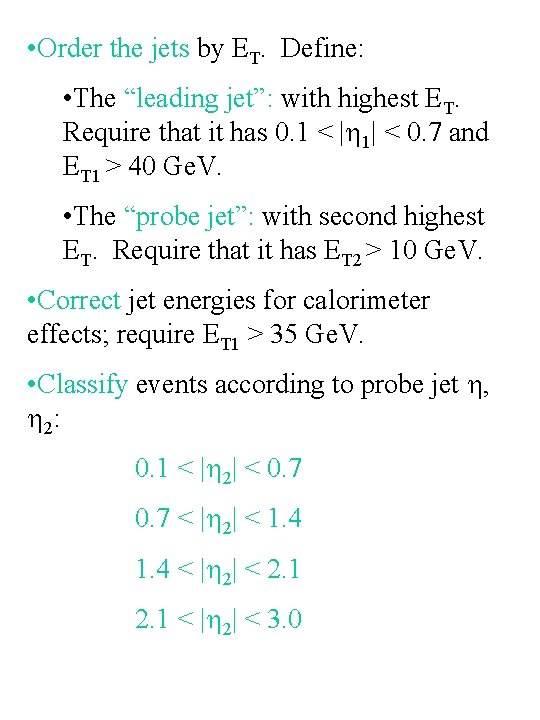
• Order the jets by ET. Define: • The “leading jet”: with highest ET. Require that it has 0. 1 < | 1| < 0. 7 and ET 1 > 40 Ge. V. • The “probe jet”: with second highest ET. Require that it has ET 2 > 10 Ge. V. • Correct jet energies for calorimeter effects; require ET 1 > 35 Ge. V. • Classify events according to probe jet , 2: 0. 1 < | 2| < 0. 7 < | 2| < 1. 4 < | 2| < 2. 1 < | 2| < 3. 0
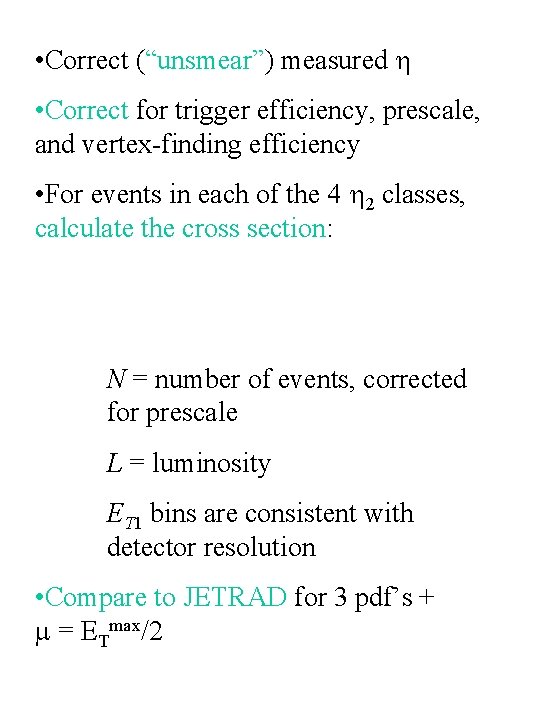
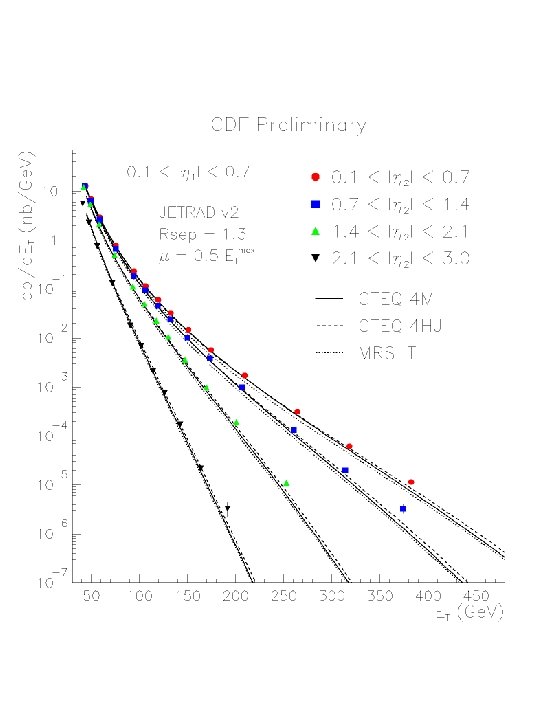
• Correct (“unsmear”) measured • Correct for trigger efficiency, prescale, and vertex-finding efficiency • For events in each of the 4 2 classes, calculate the cross section: N = number of events, corrected for prescale L = luminosity ET 1 bins are consistent with detector resolution • Compare to JETRAD for 3 pdf’s + = ETmax/2
Sources of systematic errors on the dijet differential cross section: Same as for inclusive cross section + resolution
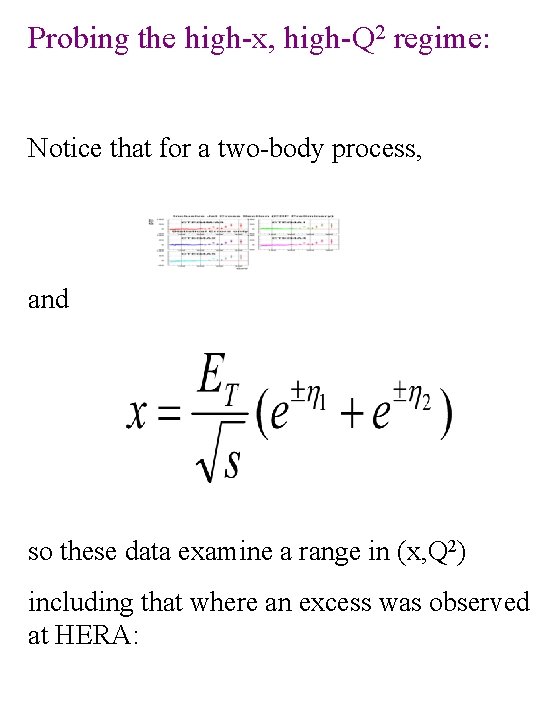
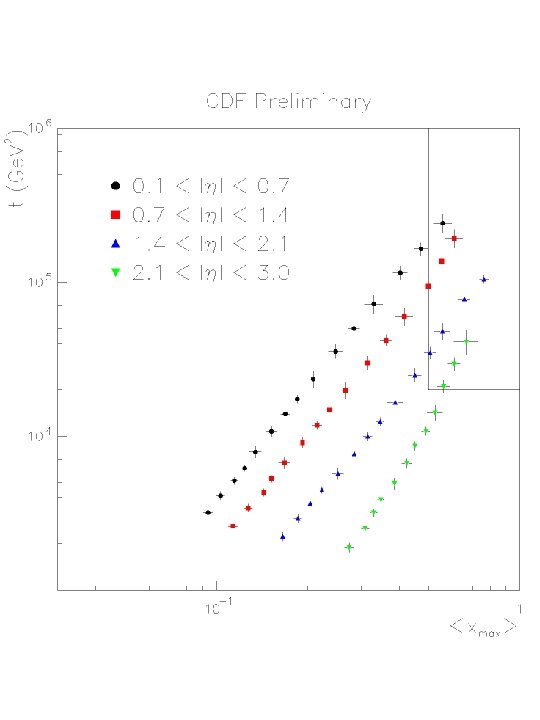
Probing the high-x, high-Q 2 regime: Notice that for a two-body process, and so these data examine a range in (x, Q 2) including that where an excess was observed at HERA: