
The Latest Results of the CDF Experiment Kazuhiro
- Slides: 35
The Latest Results of the CDF Experiment Kazuhiro Yamamoto (Osaka City University) For the CDF Collaboration March 26, 2007 JPS Meeting at Tokyo Metropolitan University
CDF Experiment • Being performed at Tevatron accelerator in Fermilab. • Proton-antiproton collision at s = 1. 96 Te. V. • Run II operation started in March 2001.
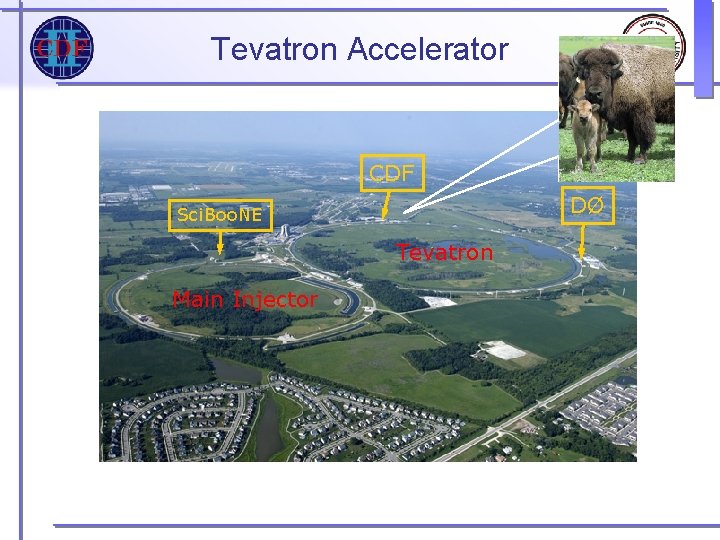
Tevatron Accelerator CDF DØ Sci. Boo. NE Tevatron Main Injector
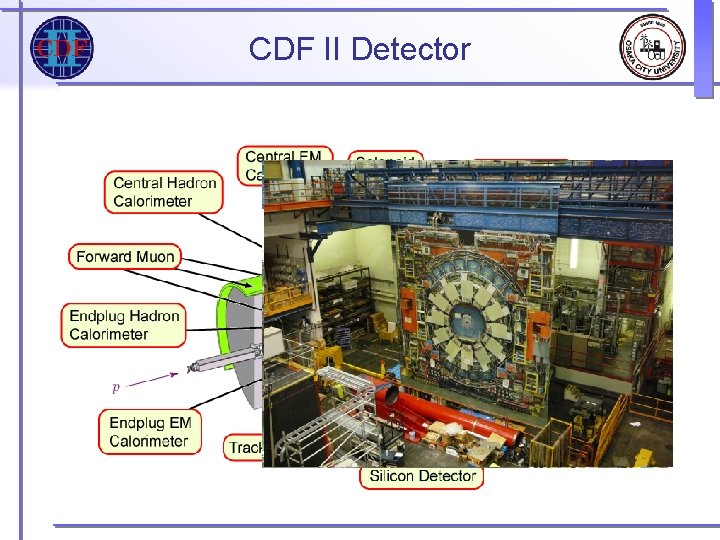
CDF II Detector
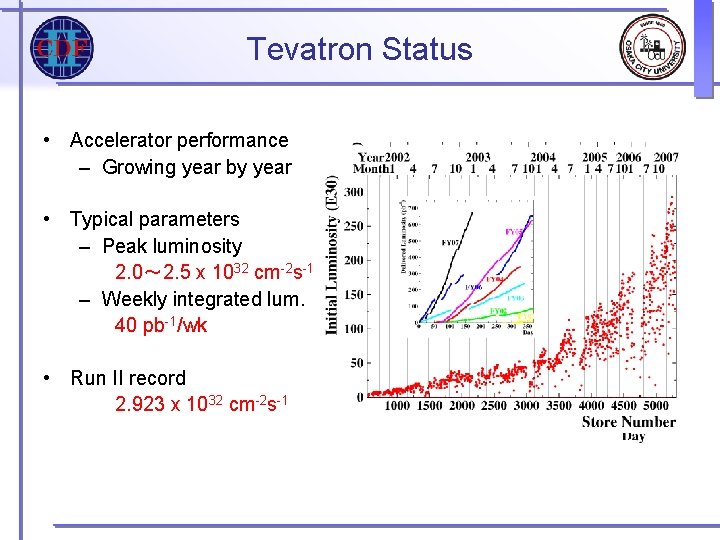
Tevatron Status • Accelerator performance – Growing year by year • Typical parameters – Peak luminosity 2. 0~ 2. 5 x 1032 cm-2 s-1 – Weekly integrated lum. 40 pb-1/wk • Run II record 2. 923 x 1032 cm-2 s-1
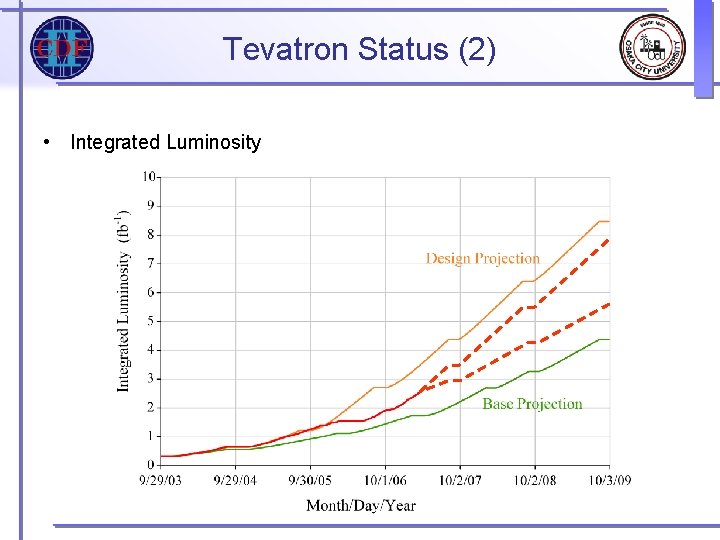
Tevatron Status (2) • Integrated Luminosity
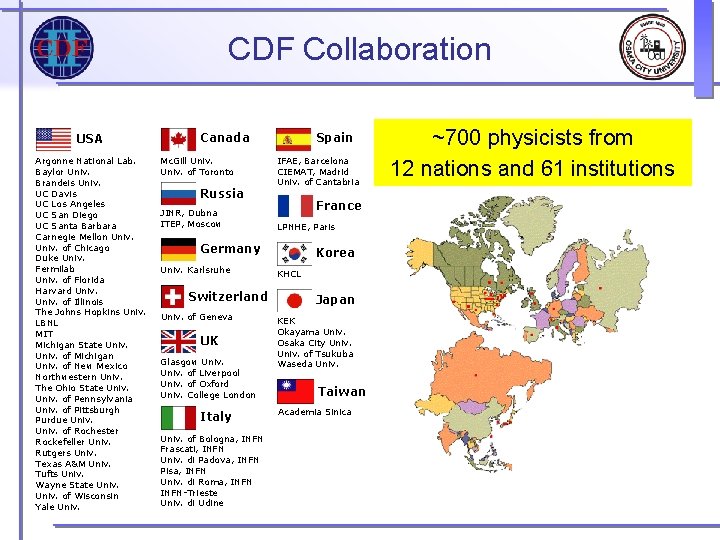
CDF Collaboration USA Argonne National Lab. Baylor Univ. Brandeis Univ. UC Davis UC Los Angeles UC San Diego UC Santa Barbara Carnegie Mellon Univ. of Chicago Duke Univ. Fermilab Univ. of Florida Harvard Univ. of Illinois The Johns Hopkins Univ. LBNL MIT Michigan State Univ. of Michigan Univ. of New Mexico Northwestern Univ. The Ohio State Univ. of Pennsylvania Univ. of Pittsburgh Purdue Univ. of Rochester Rockefeller Univ. Rutgers Univ. Texas A&M Univ. Tufts Univ. Wayne State Univ. of Wisconsin Yale Univ. Canada Mc. Gill Univ. of Toronto Russia JINR, Dubna ITEP, Moscow Spain IFAE, Barcelona CIEMAT, Madrid Univ. of Cantabria France LPNHE, Paris Germany Univ. Karlsruhe Switzerland Univ. of Geneva UK Glasgow Univ. of Liverpool Univ. of Oxford Univ. College London Italy Univ. of Bologna, INFN Frascati, INFN Univ. di Padova, INFN Pisa, INFN Univ. di Roma, INFN-Trieste Univ. di Udine Korea KHCL Japan KEK Okayama Univ. Osaka City Univ. of Tsukuba Waseda Univ. Taiwan Academia Sinica ~700 physicists from 12 nations and 61 institutions
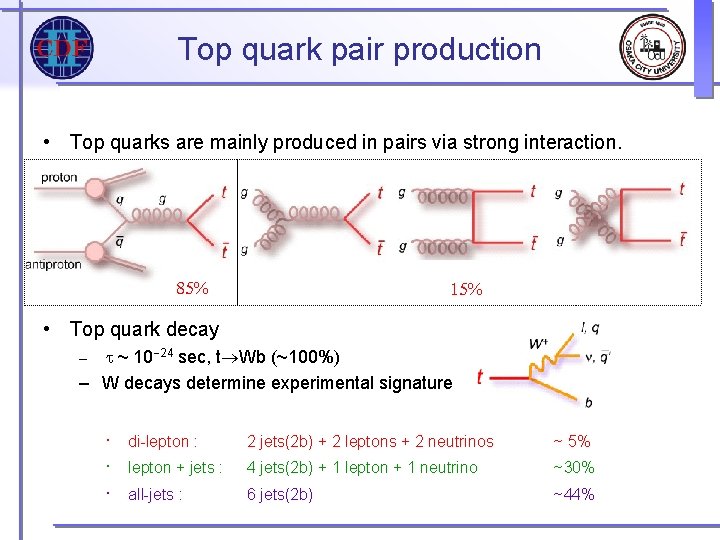
Top quark pair production • Top quarks are mainly produced in pairs via strong interaction. 85% 15% • Top quark decay – t ~ 10 -24 sec, t Wb (~100%) – W decays determine experimental signature ・ di-lepton : 2 jets(2 b) + 2 leptons + 2 neutrinos ~ 5% ・ lepton + jets : 4 jets(2 b) + 1 lepton + 1 neutrino ~30% ・ all-jets : 6 jets(2 b) ~44%
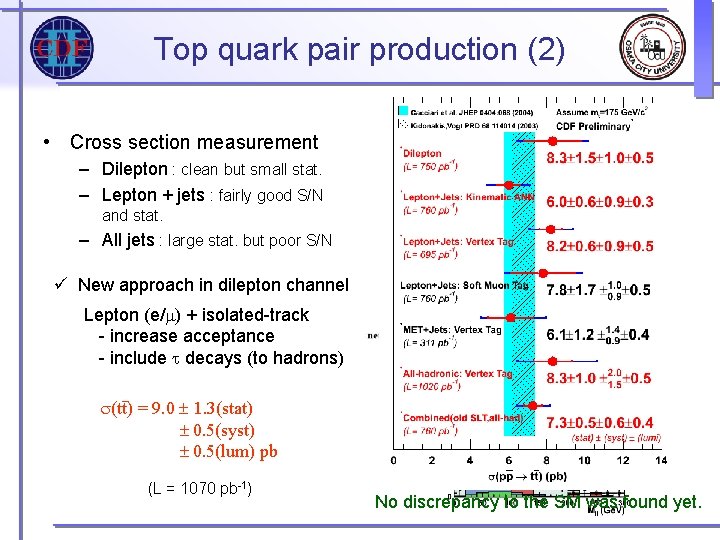
Top quark pair production (2) • Cross section measurement – Dilepton : clean but small stat. – Lepton + jets : fairly good S/N and stat. – All jets : large stat. but poor S/N ü New approach in dilepton channel Lepton (e/m) + isolated-track - increase acceptance - include t decays (to hadrons) s(tt) = 9. 0 1. 3(stat) 0. 5(syst) 0. 5(lum) pb (L = 1070 pb-1) No discrepancy to the SM was found yet.
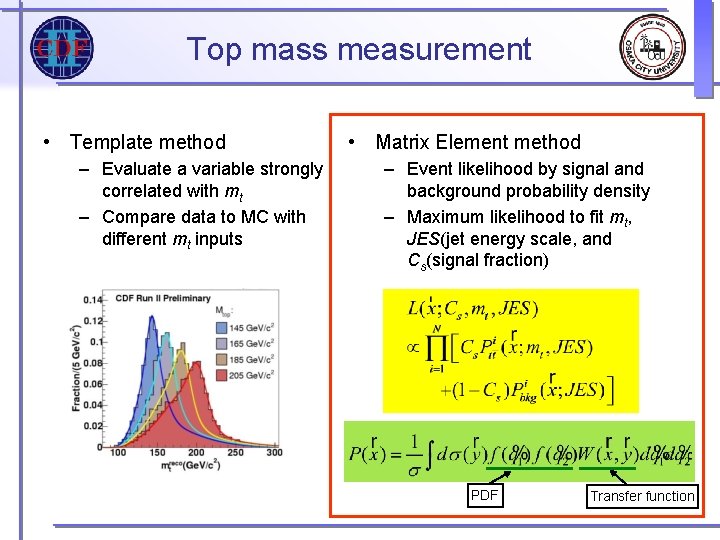
Top mass measurement • Template method – Evaluate a variable strongly correlated with mt – Compare data to MC with different mt inputs • Matrix Element method – Event likelihood by signal and background probability density – Maximum likelihood to fit mt, JES(jet energy scale, and Cs(signal fraction) PDF Transfer function
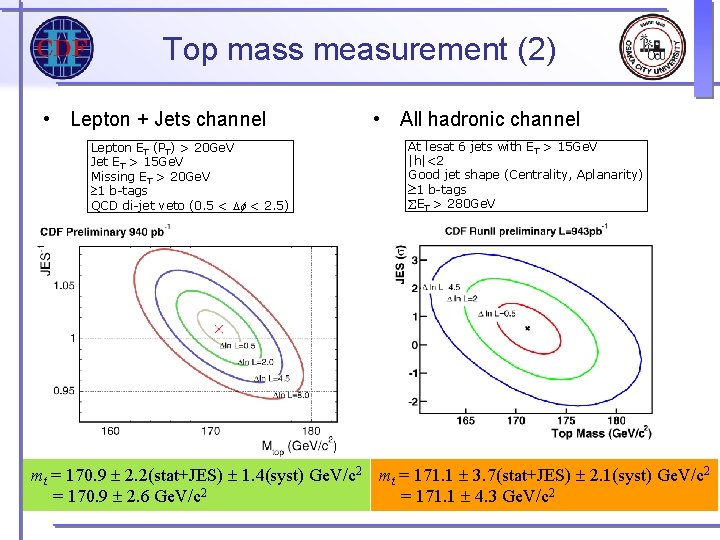
Top mass measurement (2) • Lepton + Jets channel Lepton ET (PT) > 20 Ge. V Jet ET > 15 Ge. V Missing ET > 20 Ge. V 1 b-tags QCD di-jet veto (0. 5 < Df < 2. 5) • All hadronic channel At lesat 6 jets with ET > 15 Ge. V |h|<2 Good jet shape (Centrality, Aplanarity) 1 b-tags ET > 280 Ge. V mt = 170. 9 2. 2(stat+JES) 1. 4(syst) Ge. V/c 2 mt = 171. 1 3. 7(stat+JES) 2. 1(syst) Ge. V/c 2 = 170. 9 2. 6 Ge. V/c 2 = 171. 1 4. 3 Ge. V/c 2
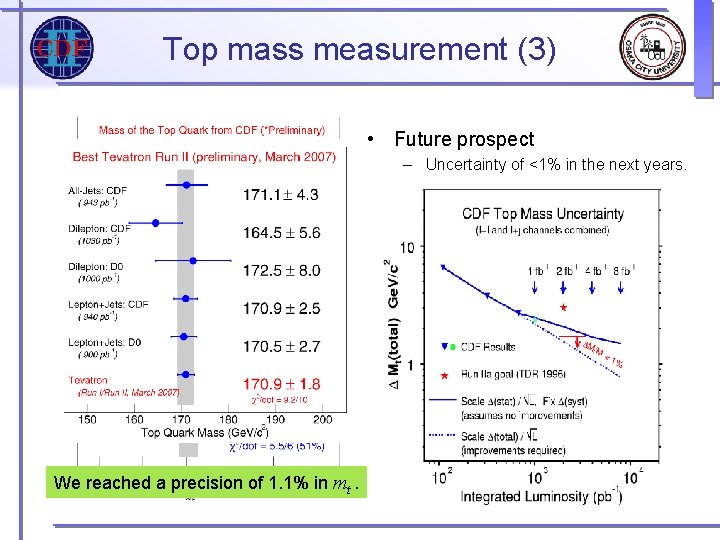
Top mass measurement (3) • Future prospect – Uncertainty of <1% in the next years. We reached a precision of 1. 1% in mt.
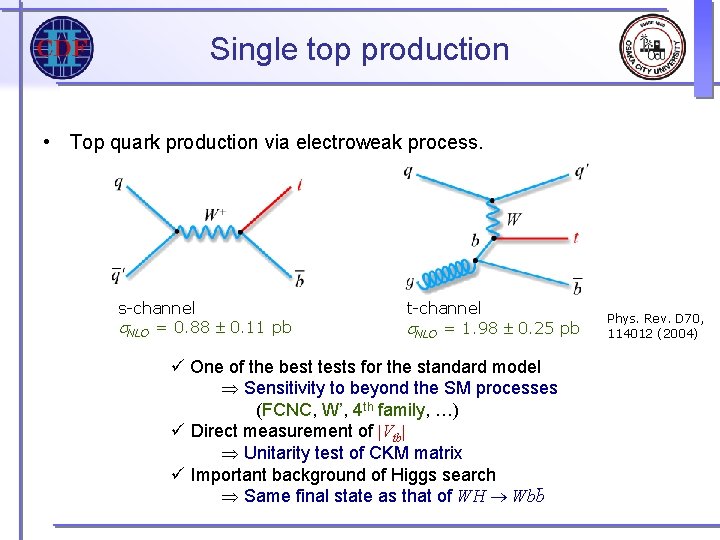
Single top production • Top quark production via electroweak process. s-channel s. NLO = 0. 88 0. 11 pb t-channel s. NLO = 1. 98 0. 25 pb ü One of the best tests for the standard model Sensitivity to beyond the SM processes (FCNC, W’, 4 th family, …) ü Direct measurement of |Vtb| Unitarity test of CKM matrix ü Important background of Higgs search Same final state as that of WH Wbb Phys. Rev. D 70, 114012 (2004)
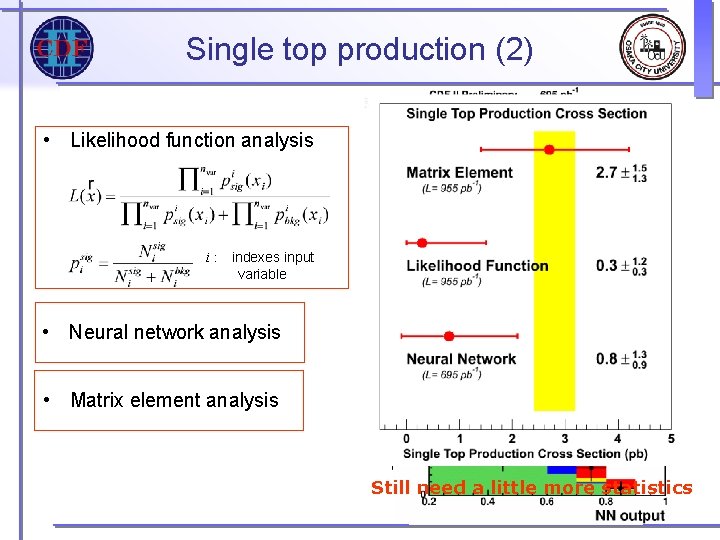
Single top production (2) • Likelihood function analysis i: Single top hidden behind background uncertainty � Makes counting experiment difficult t-channel indexes input variable • Neural network analysis • Matrix element analysis s-channel Still need a little more statistics
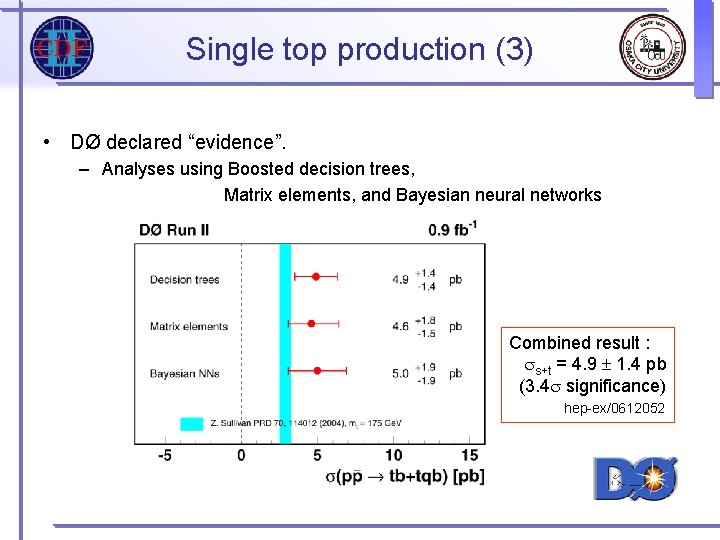
Single top production (3) • DØ declared “evidence”. – Analyses using Boosted decision trees, Matrix elements, and Bayesian neural networks Combined result : ss+t = 4. 9 1. 4 pb (3. 4 s significance) hep-ex/0612052
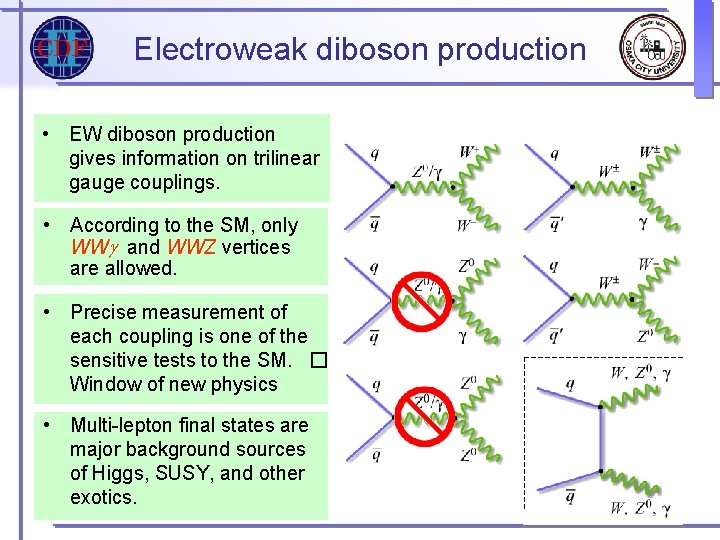
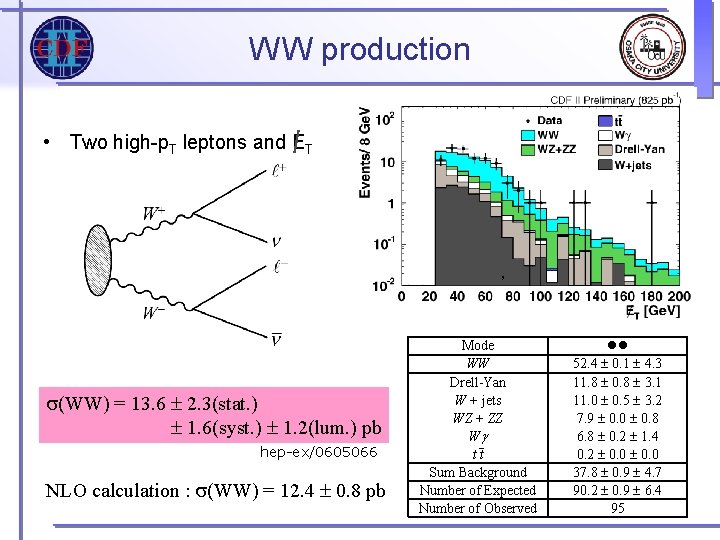
Electroweak diboson production • EW diboson production gives information on trilinear gauge couplings. • According to the SM, only WWg and WWZ vertices are allowed. • Precise measurement of each coupling is one of the sensitive tests to the SM. � Window of new physics • Multi-lepton final states are major background sources of Higgs, SUSY, and other exotics.
W W production • Two high-p. T leptons and ET , s(WW) = 13. 6 2. 3(stat. ) 1. 6(syst. ) 1. 2(lum. ) pb hep-ex/0605066 NLO calculation : s(WW) = 12. 4 0. 8 pb Mode WW Drell-Yan W + jets WZ + ZZ Wg tt Sum Background Number of Expected Number of Observed 52. 4 0. 1 4. 3 11. 8 0. 8 3. 1 11. 0 0. 5 3. 2 7. 9 0. 0 0. 8 6. 8 0. 2 1. 4 0. 2 0. 0 37. 8 0. 9 4. 7 90. 2 0. 9 6. 4 95
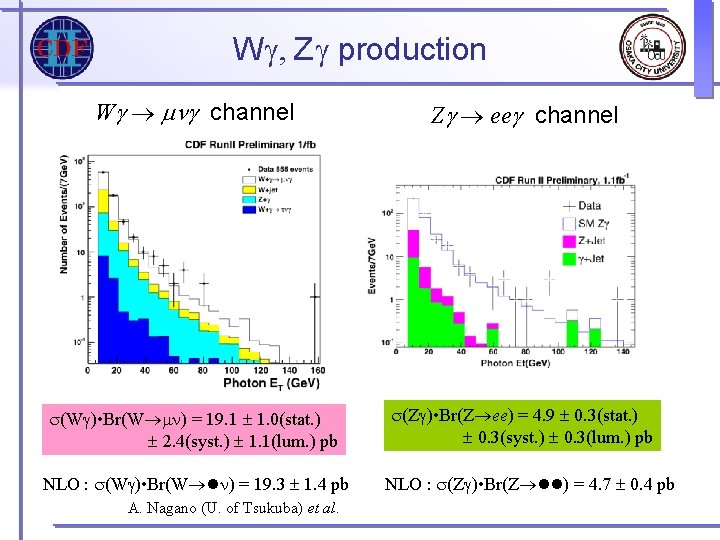
W g, Z g production Wg mng channel Zg eeg channel s(Wg) • Br(W mn) = 19. 1 1. 0(stat. ) 2. 4(syst. ) 1. 1(lum. ) pb s(Zg) • Br(Z ee) = 4. 9 0. 3(stat. ) 0. 3(syst. ) 0. 3(lum. ) pb NLO : s(Wg) • Br(W n) = 19. 3 1. 4 pb A. Nagano (U. of Tsukuba) et al. NLO : s(Zg) • Br(Z ) = 4. 7 0. 4 pb
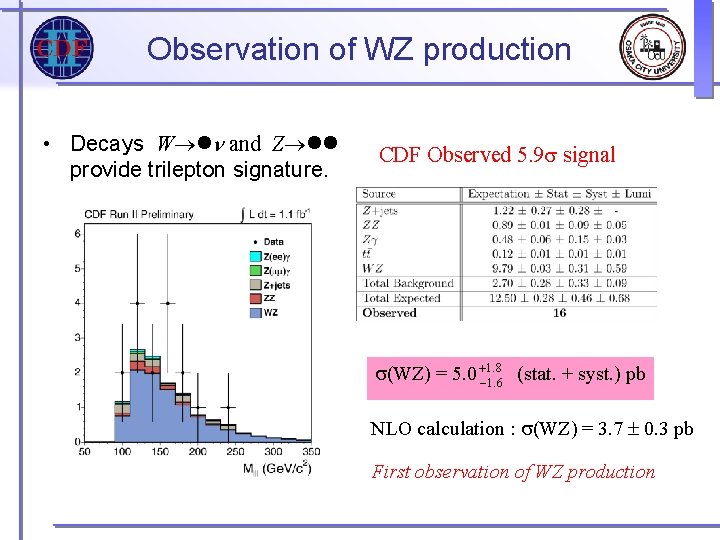
Observation of WZ production • Decays W n and Z provide trilepton signature. CDF Observed 5. 9 s signal s(WZ) = 5. 0 +1. 8 (stat. + syst. ) pb -1. 6 NLO calculation : s(WZ) = 3. 7 0. 3 pb First observation of WZ production
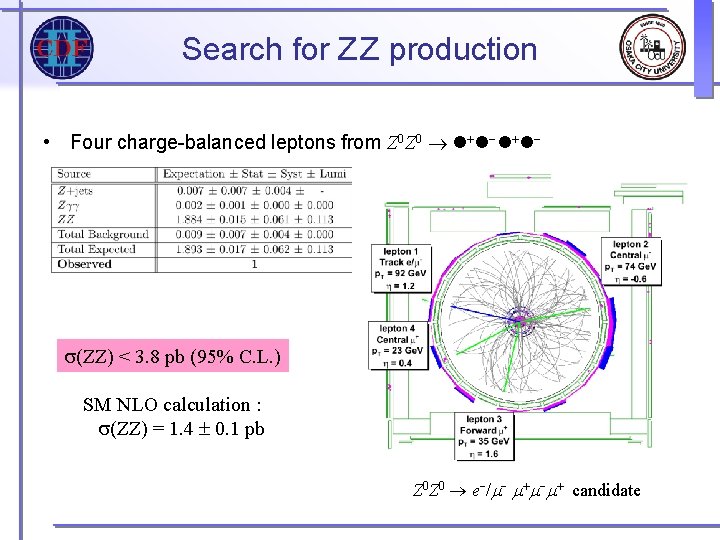
Search for Z Z production • Four charge-balanced leptons from Z 0 Z 0 + - s(ZZ) < 3. 8 pb (95% C. L. ) SM NLO calculation : s(ZZ) = 1. 4 0. 1 pb Z 0 Z 0 e-/m- m+m-m+ candidate
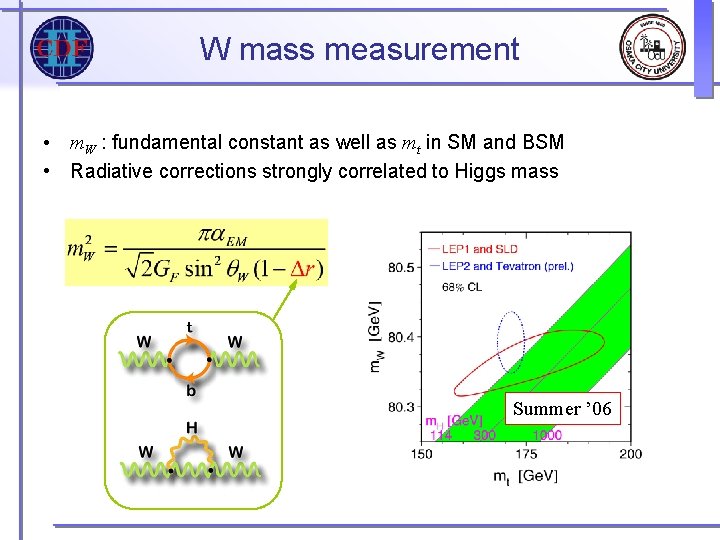
W mass measurement • m. W : fundamental constant as well as mt in SM and BSM • Radiative corrections strongly correlated to Higgs mass Summer ’ 06
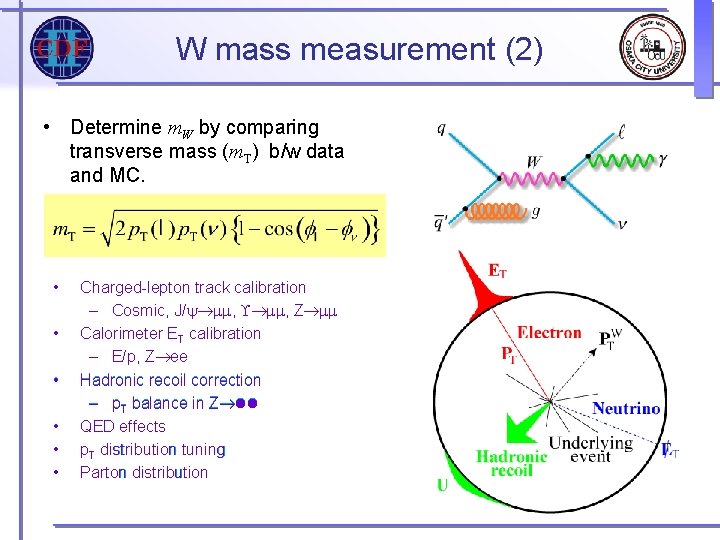
W mass measurement (2) • Determine m. W by comparing transverse mass (m. T) b/w data and MC. • • • Charged-lepton track calibration – Cosmic, J/y mm, Z mm Calorimeter ET calibration – E/p, Z ee Hadronic recoil correction – p. T balance in Z QED effects p. T distribution tuning Parton distribution
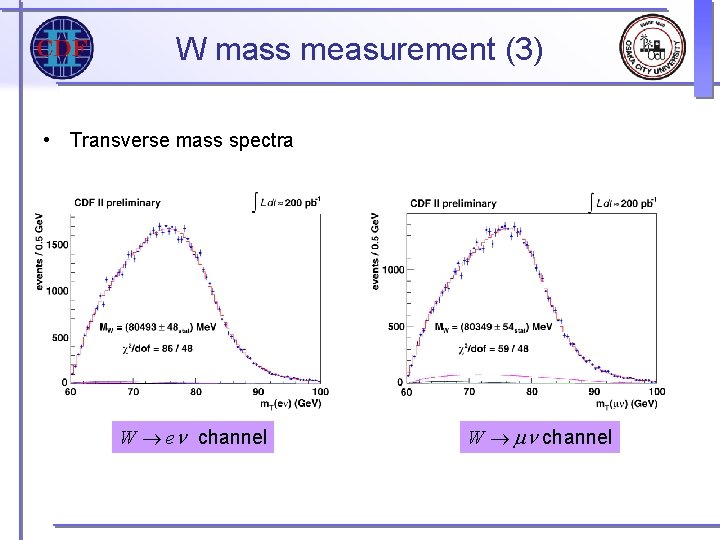
W mass measurement (3) • Transverse mass spectra W en channel W mn channel
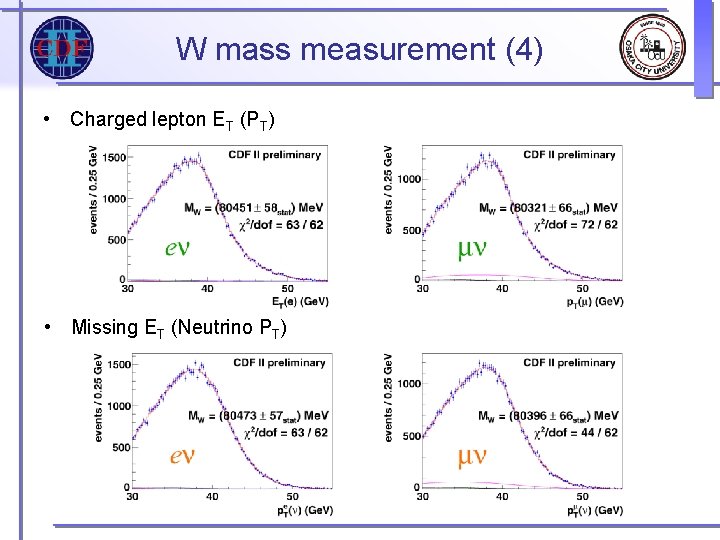
W mass measurement (4) • Charged lepton ET (PT) • Missing ET (Neutrino PT)
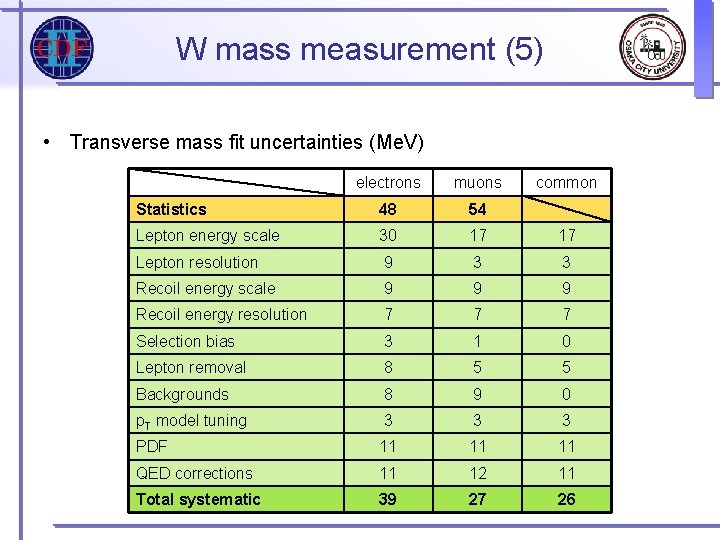
W mass measurement (5) • Transverse mass fit uncertainties (Me. V) electrons muons common Statistics 48 54 Lepton energy scale 30 17 17 Lepton resolution 9 3 3 Recoil energy scale 9 9 9 Recoil energy resolution 7 7 7 Selection bias 3 1 0 Lepton removal 8 5 5 Backgrounds 8 9 0 p. T model tuning 3 3 3 PDF 11 11 11 QED corrections 11 12 11 Total systematic 39 27 26
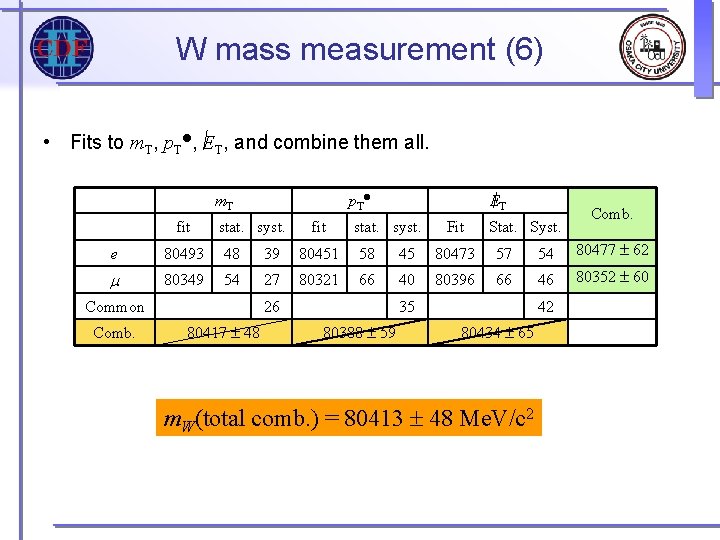
W mass measurement (6) • Fits to m. T, p. T , ET, and combine them all. p. T m. T fit stat. syst. fit ET stat. syst. Fit Stat. Syst. Comb. e 80493 48 39 80451 58 45 80473 57 54 80477 62 m 80349 54 27 80321 66 40 80396 66 46 80352 60 Common Comb. 26 80417 48 35 80388 59 42 80434 65 m. W(total comb. ) = 80413 48 Me. V/c 2
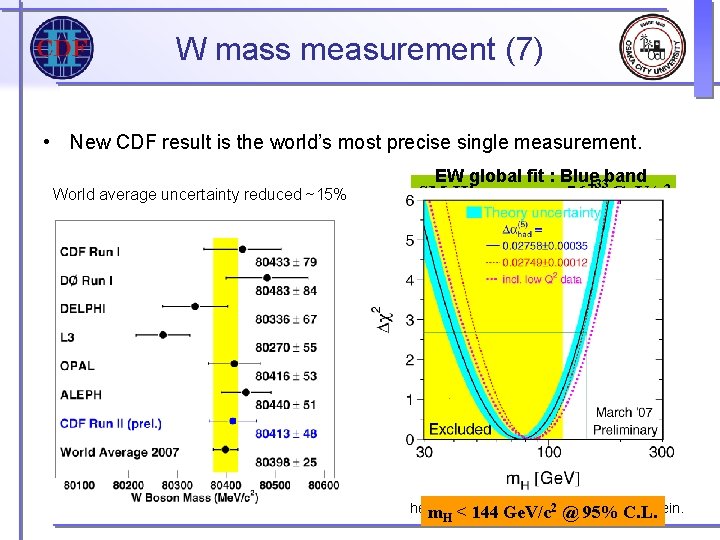
W mass measurement (7) • New CDF result is the world’s most precise single measurement. World average uncertainty reduced ~15% EW global fit : Blue +33 band 2 SMSM Higgs masscomparison : 76 -24 Ge. V/c / MSSM hep-ph/0604147 and references are therein. m < 144 Ge. V/c 2 @ 95% C. L. H
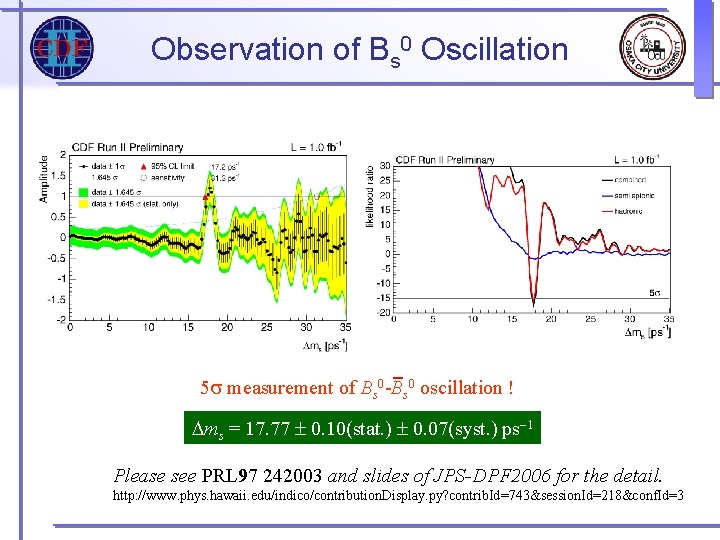
Observation of Bs 0 Oscillation 5 s measurement of Bs 0 -Bs 0 oscillation ! Dms = 17. 77 0. 10(stat. ) 0. 07(syst. ) ps-1 Please see PRL 97 242003 and slides of JPS-DPF 2006 for the detail. http: //www. phys. hawaii. edu/indico/contribution. Display. py? contrib. Id=743&session. Id=218&conf. Id=3
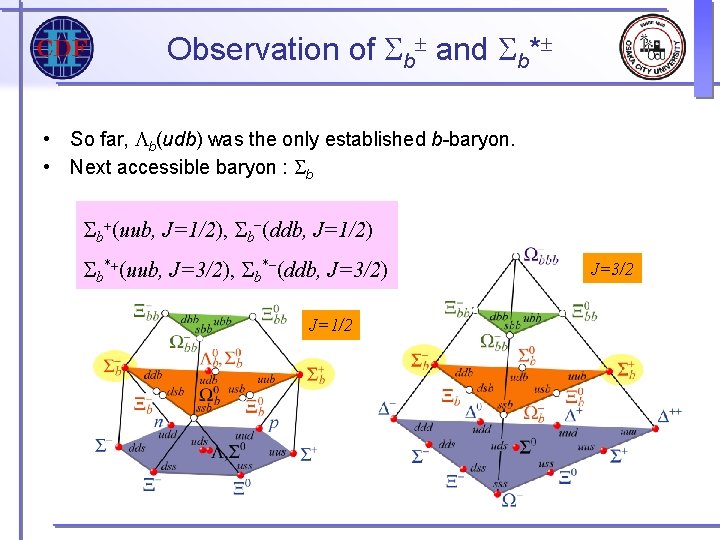
Observation of Sb and Sb* • So far, Lb(udb) was the only established b-baryon. • Next accessible baryon : Sb Sb+(uub, J=1/2), Sb-(ddb, J=1/2) Sb*+(uub, J=3/2), Sb*-(ddb, J=3/2) J=1/2 J=3/2
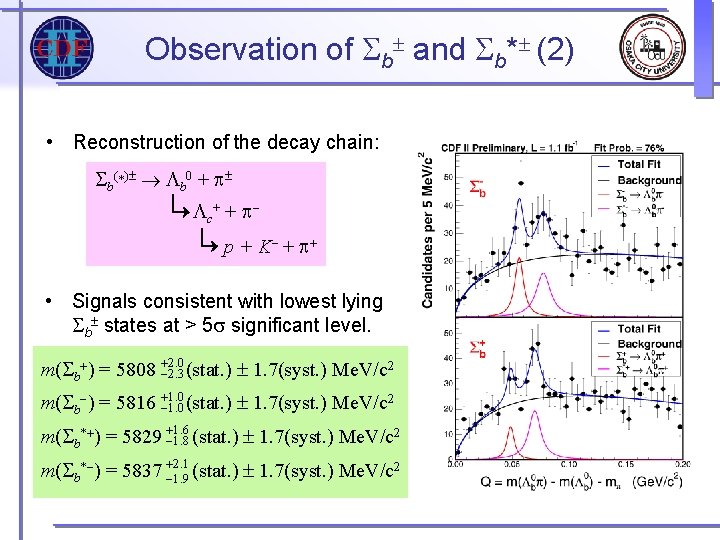
Observation of Sb and Sb* (2) • Reconstruction of the decay chain: Sb(*) Lb 0 + p Lc + + p p + K - + p+ • Signals consistent with lowest lying Sb states at > 5 s significant level. 2 m(Sb+) = 5808 +2. 0 -2. 3 (stat. ) 1. 7(syst. ) Me. V/c 2 m(Sb-) = 5816 +1. 0 -1. 0 (stat. ) 1. 7(syst. ) Me. V/c 2 m(Sb*+) = 5829 +1. 6 -1. 8 (stat. ) 1. 7(syst. ) Me. V/c 2 m(Sb*-) = 5837 +2. 1 -1. 9 (stat. ) 1. 7(syst. ) Me. V/c Lb 0 reconstruction
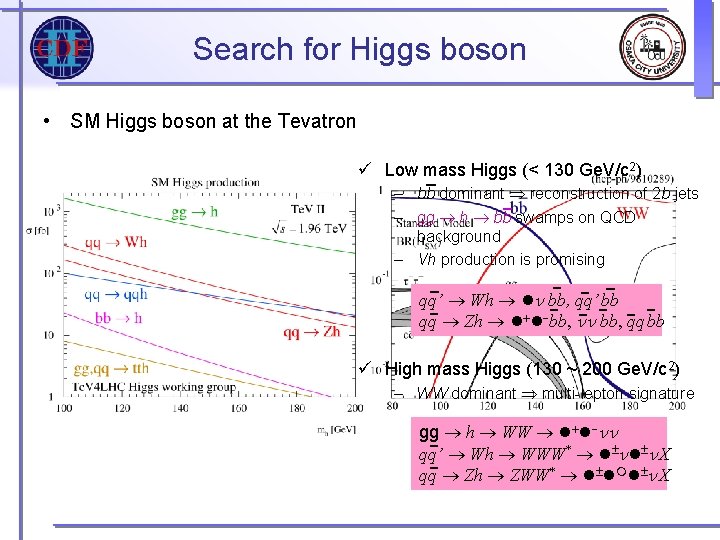
Search for Higgs boson • SM Higgs boson at the Tevatron ü Low mass Higgs (< 130 Ge. V/c 2) – bb dominant reconstruction of 2 b jets – gg h bb swamps on QCD background – Vh production is promising qq’ Wh n bb, qq’ bb qq Zh + -bb, nn bb, qq bb ü High mass Higgs (130 ~ 200 Ge. V/c 2) – WW dominant multi-lepton signature gg h WW + -nn qq’ Wh WWW* n n X qq Zh ZWW* n X
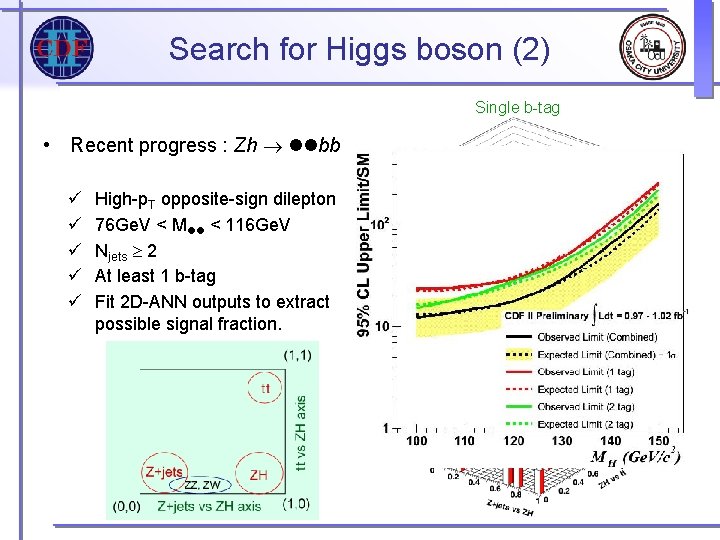
Search for Higgs boson (2) Single b-tag • Recent progress : Zh bb ü ü ü High-p. T opposite-sign dilepton 76 Ge. V < M < 116 Ge. V Njets 2 At least 1 b-tag Fit 2 D-ANN outputs to extract possible signal fraction. Double b-tag
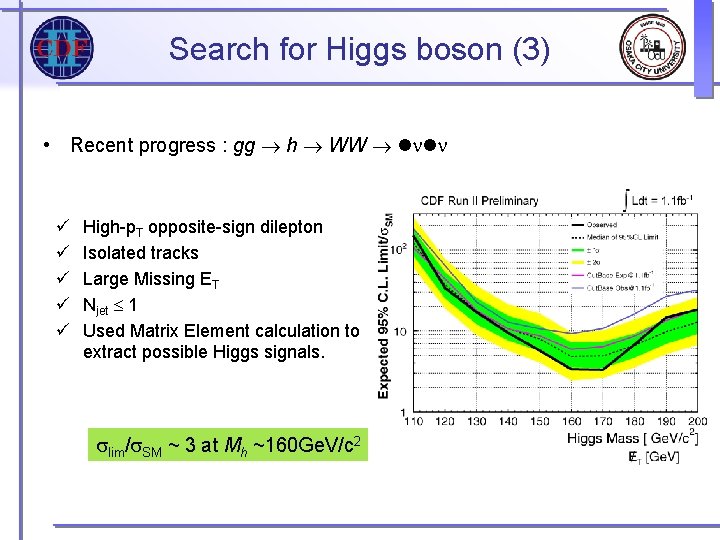
Search for Higgs boson (3) • Recent progress : gg h WW n n ü ü ü High-p. T opposite-sign dilepton Isolated tracks Large Missing ET Njet 1 Used Matrix Element calculation to extract possible Higgs signals. slim/s. SM ~ 3 at Mh ~160 Ge. V/c 2
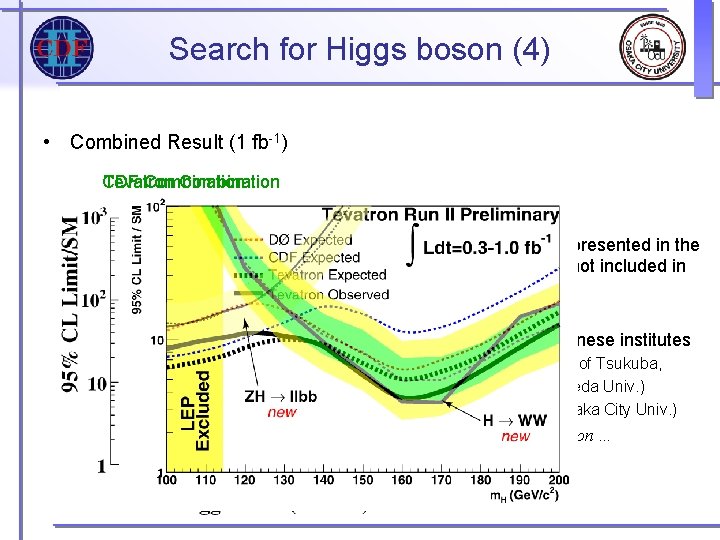
Search for Higgs boson (4) • Combined Result (1 fb-1) CDF Combination Tevatron Combination • Recent progresses presented in the previous slides are not included in this plot. • Contribution of Japanese institutes § WH lnbb (Univ. of Tsukuba, Waseda Univ. ) § WH WWW (Osaka City Univ. ) Summer ’ 06 Updates coming soon …
Summary • The Tevatron collider and detectors (CDF and DØ) are running in pretty good shape ! • 2. 2 fb-1 has been recorded and ~1. 1 fb-1 was analyzed. – Some of the latest results were presented. • Tevatron Run II is scheduled to continue till the end of FY 2009, and 6~8 fb-1 of integrated luminosity is expected to be obtained. – Can we see any signs of Higgs/SUSY before LHC ?