The Islamic University of Gaza Faculty of Engineering

- Slides: 21
The Islamic University of Gaza Faculty of Engineering Civil Engineering Department Numerical Analysis ECIV 3306 Chapter 11 Special Matrices and Gauss-Siedel
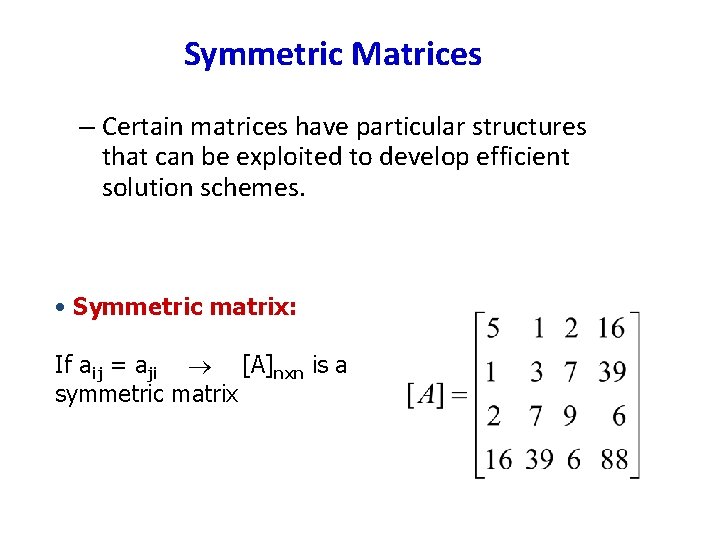
Symmetric Matrices – Certain matrices have particular structures that can be exploited to develop efficient solution schemes. • Symmetric matrix: If aij = aji [A]nxn is a symmetric matrix
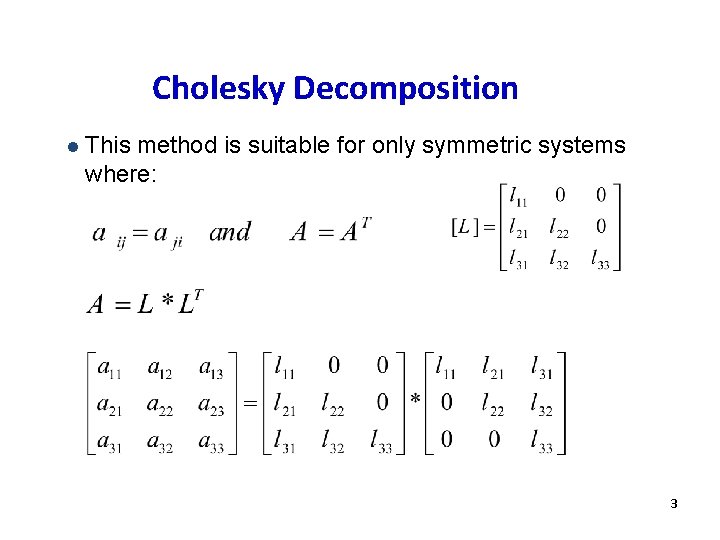
Cholesky Decomposition l This method is suitable for only symmetric systems where: 3
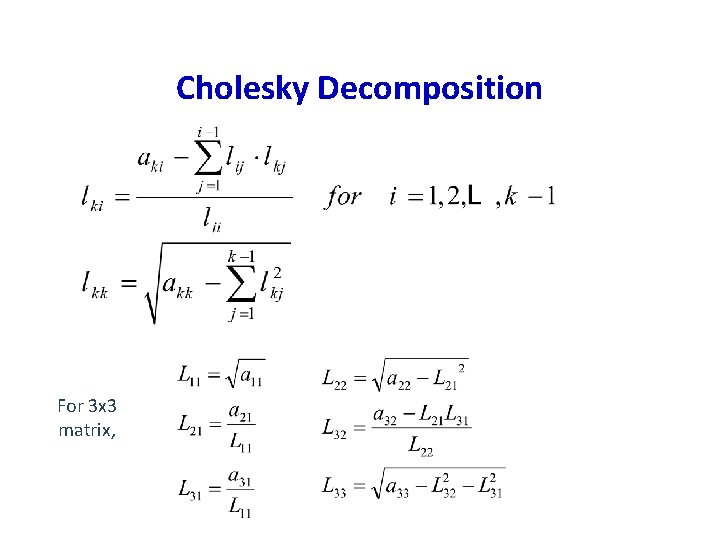
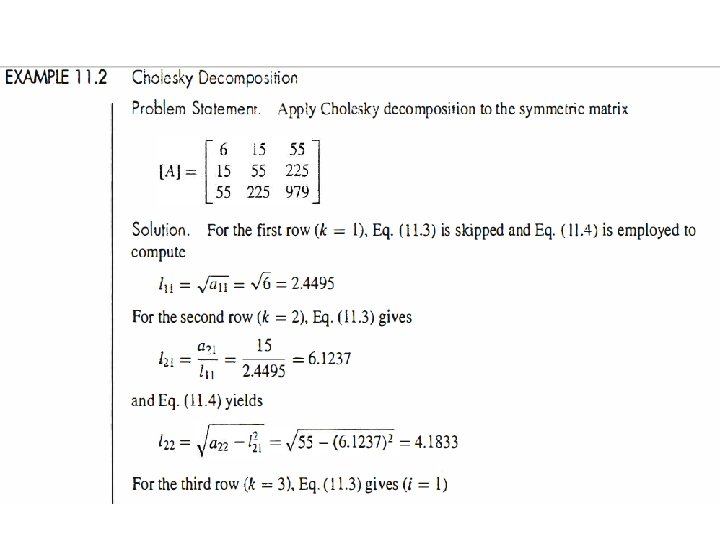
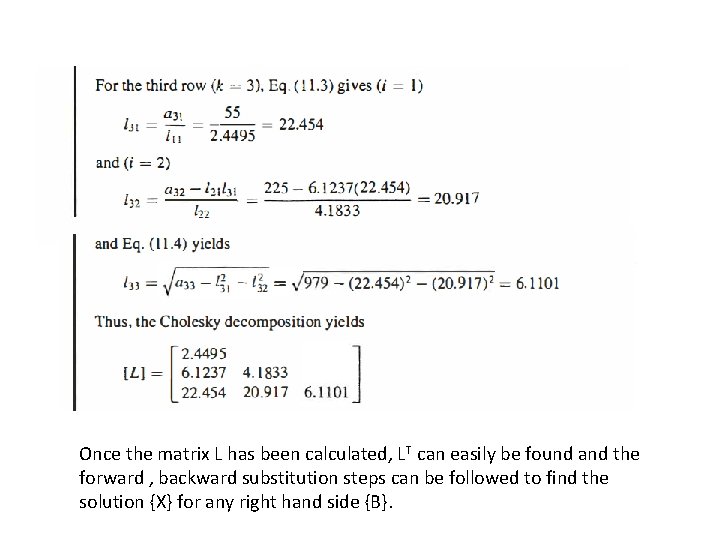
Cholesky Decomposition For 3 x 3 matrix,
Once the matrix L has been calculated, LT can easily be found and the forward , backward substitution steps can be followed to find the solution {X} for any right hand side {B}.
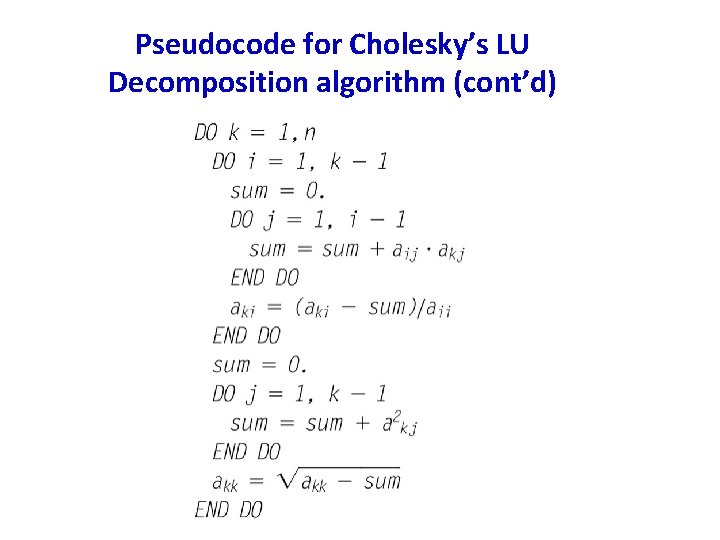
Pseudocode for Cholesky’s LU Decomposition algorithm (cont’d)
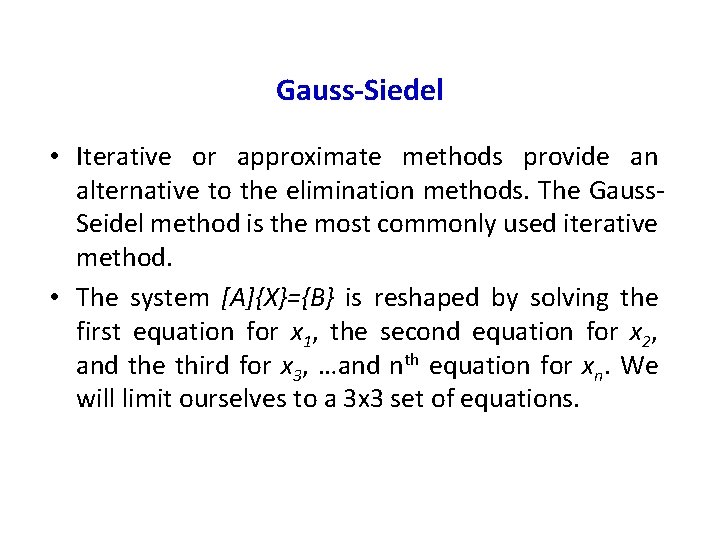
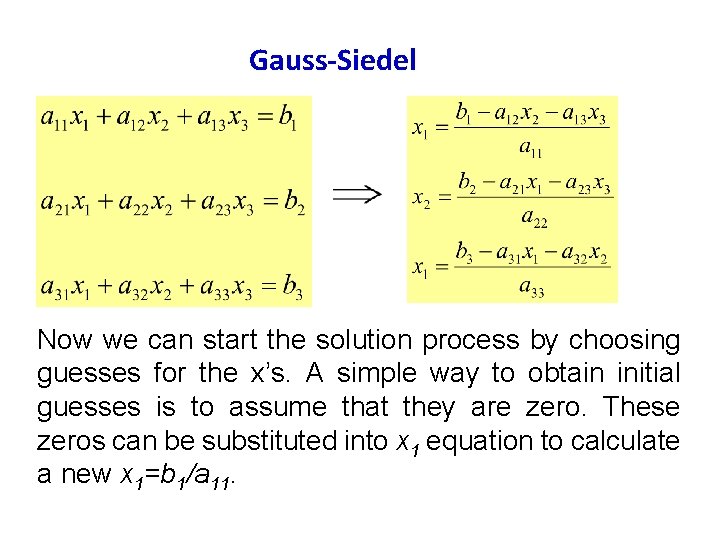
Gauss-Siedel • Iterative or approximate methods provide an alternative to the elimination methods. The Gauss. Seidel method is the most commonly used iterative method. • The system [A]{X}={B} is reshaped by solving the first equation for x 1, the second equation for x 2, and the third for x 3, …and nth equation for xn. We will limit ourselves to a 3 x 3 set of equations.
Gauss-Siedel Now we can start the solution process by choosing guesses for the x’s. A simple way to obtain initial guesses is to assume that they are zero. These zeros can be substituted into x 1 equation to calculate a new x 1=b 1/a 11.
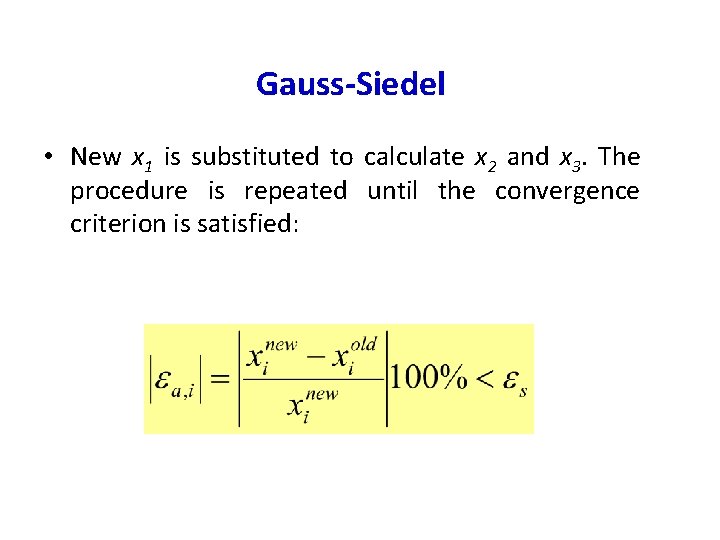
Gauss-Siedel • New x 1 is substituted to calculate x 2 and x 3. The procedure is repeated until the convergence criterion is satisfied:
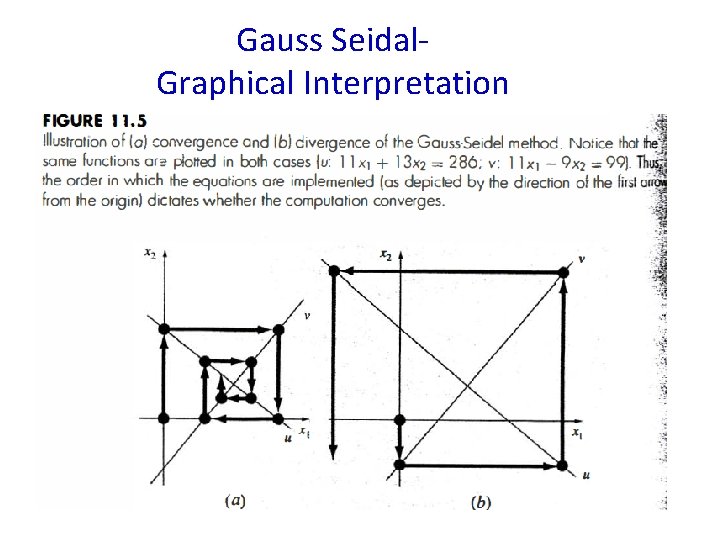
Gauss Seidal. Graphical Interpretation
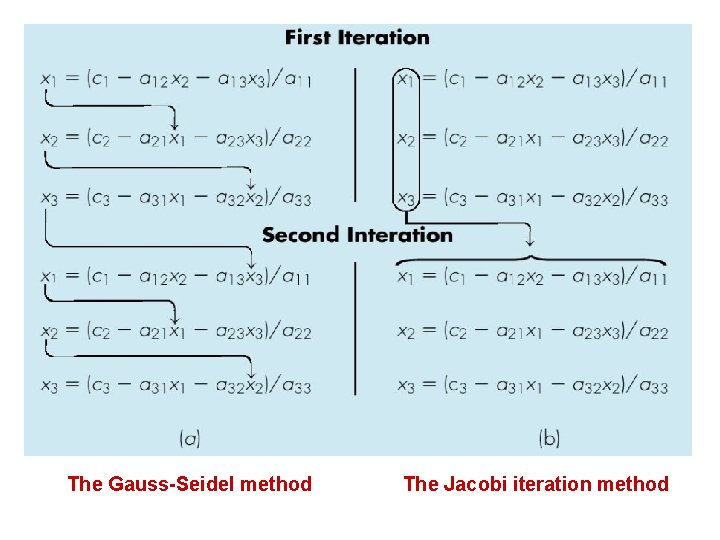
Jacobi iteration Method An alternative approach, called Jacobi iteration, utilizes a somewhat different technique. This technique includes computing a set of new x’s on the basis of a set of old x’s. Thus, as the new values are generated, they are not immediately used but are retained for the next iteration.
Gauss-Siedel The Gauss-Seidel method The Jacobi iteration method
Convergence Criterion for Gauss-Seidel Method • • The gauss-siedel method is similar to the technique of fixed-point iteration. The Gauss-Seidel method has two fundamental problems as any iterative method: 1. It is sometimes non-convergent, and 2. If it converges, converges very slowly. • Sufficient conditions for convergence of two linear equations, u(x, y) and v(x, y) are:
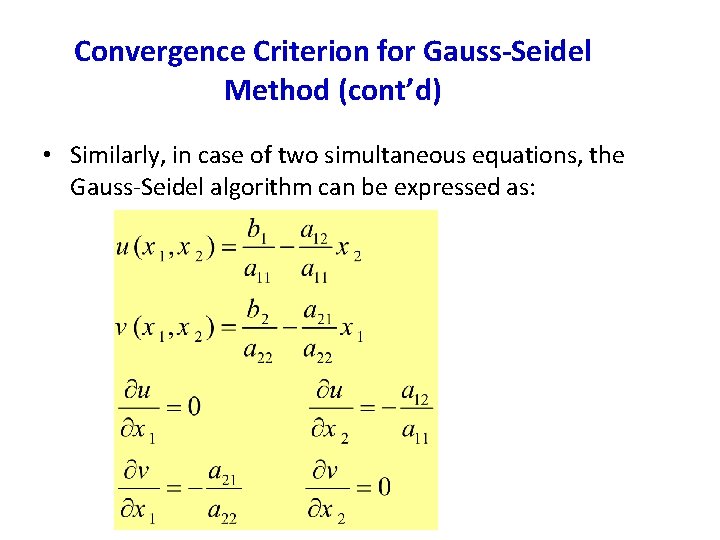
Convergence Criterion for Gauss-Seidel Method (cont’d) • Similarly, in case of two simultaneous equations, the Gauss-Seidel algorithm can be expressed as:
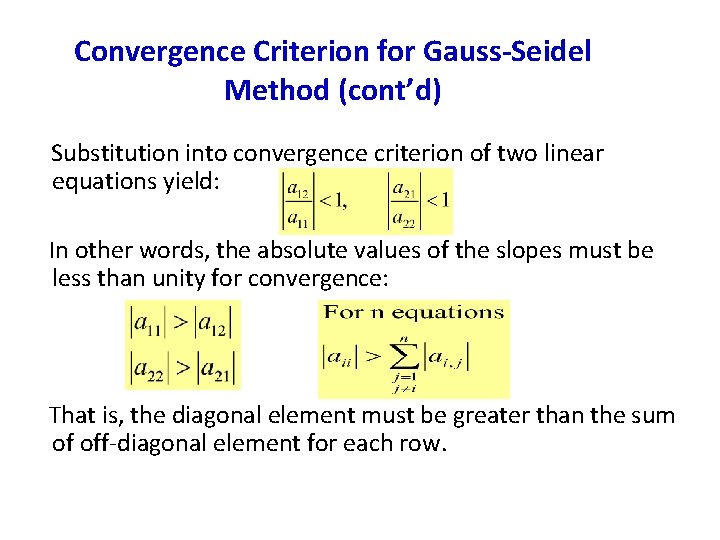
Convergence Criterion for Gauss-Seidel Method (cont’d) Substitution into convergence criterion of two linear equations yield: In other words, the absolute values of the slopes must be less than unity for convergence: That is, the diagonal element must be greater than the sum of off-diagonal element for each row.
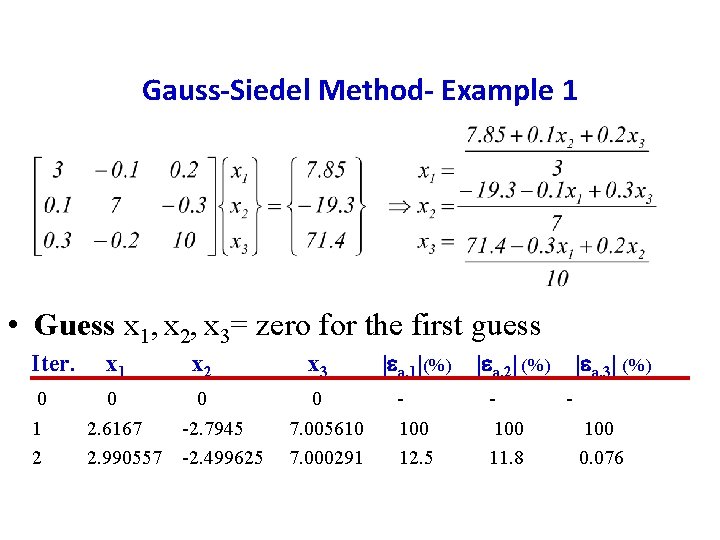
Gauss-Siedel Method- Example 1 • Guess x 1, x 2, x 3= zero for the first guess Iter. 0 1 2 x 1 x 2 0 0 2. 6167 -2. 7945 2. 990557 -2. 499625 x 3 0 7. 005610 7. 000291 |ea, 1|(%) |ea, 2| (%) 100 12. 5 100 11. 8 |ea, 3| (%) 100 0. 076
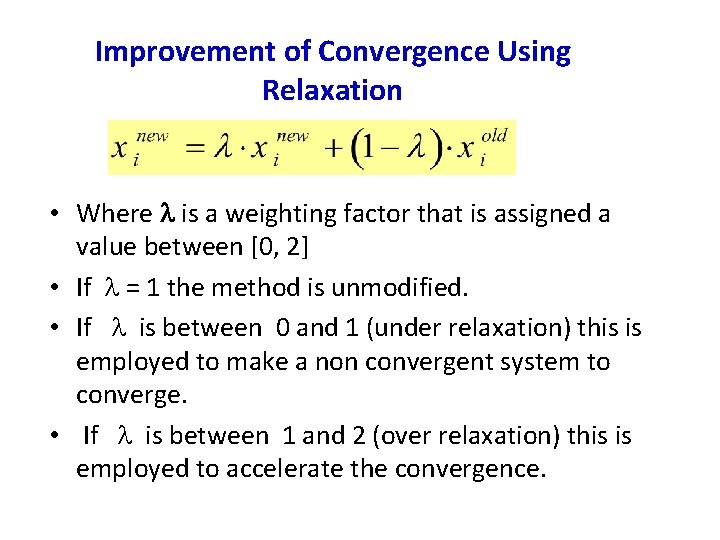
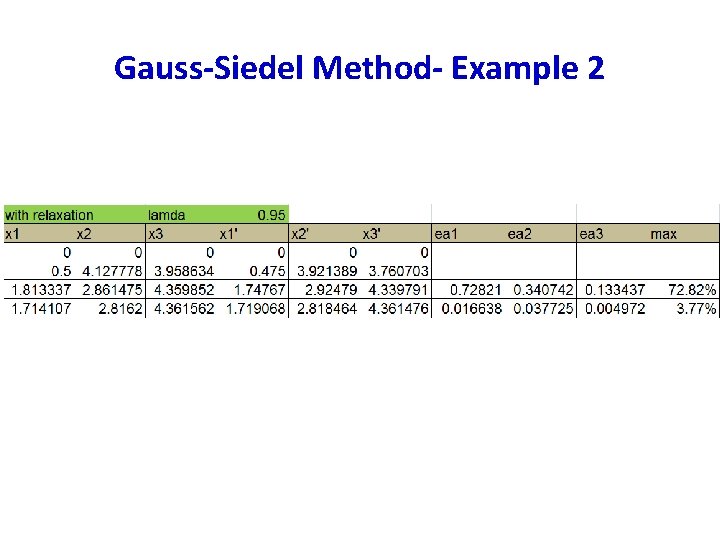
Improvement of Convergence Using Relaxation • Where is a weighting factor that is assigned a value between [0, 2] • If = 1 the method is unmodified. • If is between 0 and 1 (under relaxation) this is employed to make a non convergent system to converge. • If is between 1 and 2 (over relaxation) this is employed to accelerate the convergence.
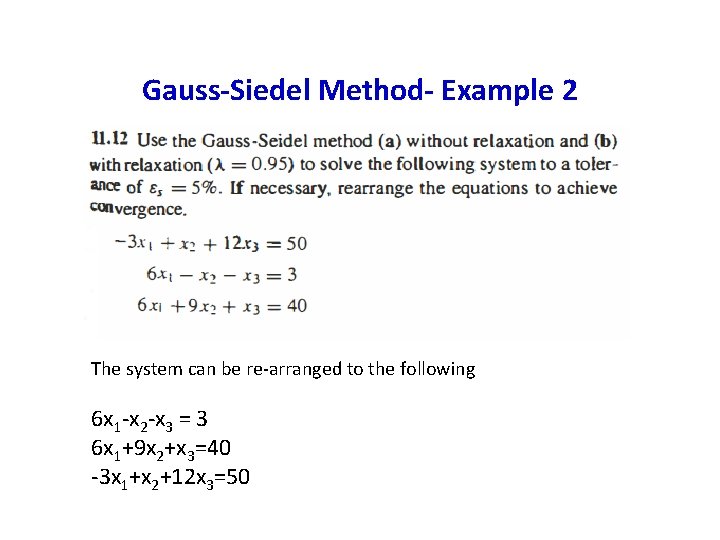
Gauss-Siedel Method- Example 2 The system can be re-arranged to the following 6 x 1 -x 2 -x 3 = 3 6 x 1+9 x 2+x 3=40 -3 x 1+x 2+12 x 3=50
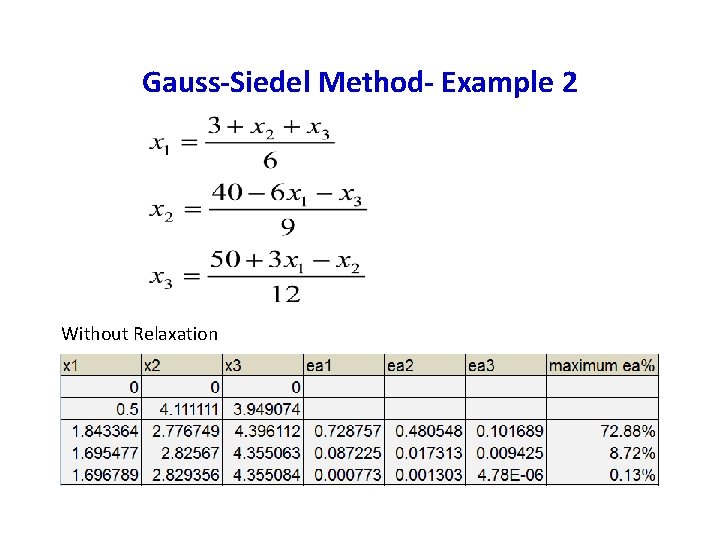
Gauss-Siedel Method- Example 2 Without Relaxation
Gauss-Siedel Method- Example 2