Israel Alfonso MD Jeffrey Horstmyer MD Daniel A

- Slides: 28
Israel Alfonso, MD Jeffrey Horstmyer, MD Daniel A. Castellanos, Ph. D
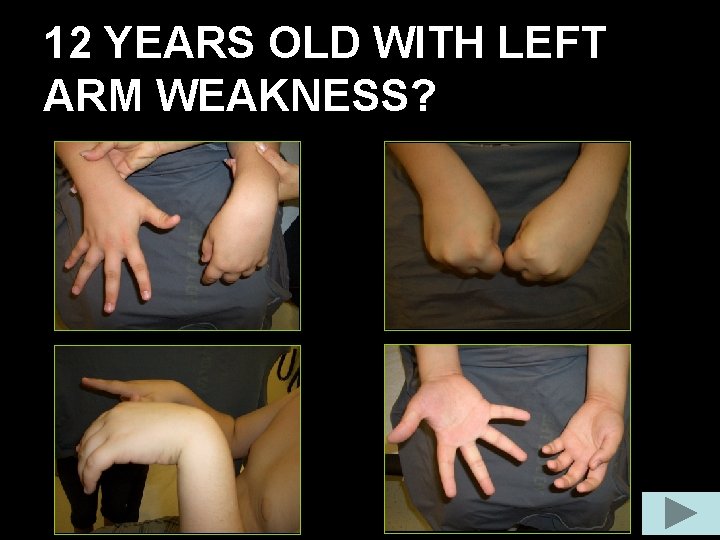
12 YEARS OLD WITH LEFT ARM WEAKNESS?
1. Which of the following nerves is affected in this patient? a. median nerve b. peroneal nerve c. radial nerve d. ulnar nerve
I WANT TO TRY AGAIN GIVE ME A CLUE JUST GIVE ME THE ANSWER
SHOW ME THE QUESTION AGAIN I WANT TO SEE A CLUE, ANYWAY GO TO THE NEXT QUESTION
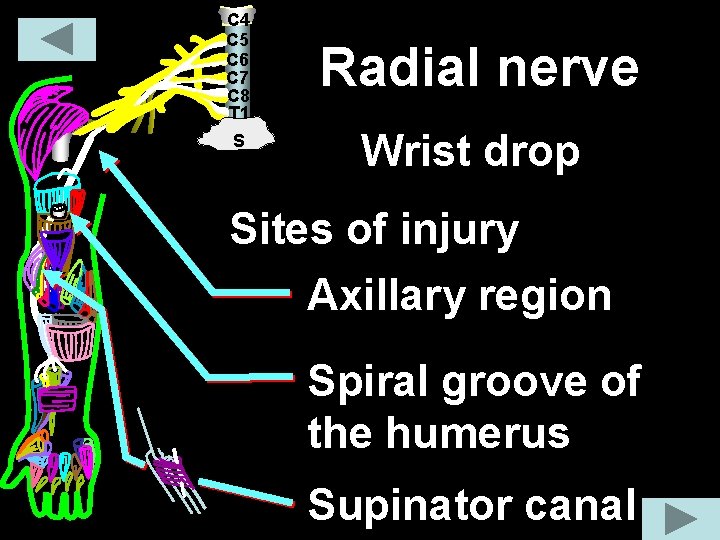
C 4 C 5 C 6 C 7 C 8 T 1 S Radial nerve Wrist drop Sites of injury Axillary region Spiral groove of the humerus Supinator canal
1. Which of the following nerves is affected in this patient? a. median nerve b. peroneal nerve c. radial nerve d. ulnar nerve
2. On physical examination you determine: (1) no sensory deficit, (2) no weakness flexing elbow, (3) no weakness extending the forearm. Where is the injury? a. Carpal tunnel b. Supinator canal c. Axillary region d. Spiral groove of the humerus
I WANT TO TRY AGAIN GIVE ME A CLUE JUST GIVE ME THE ANSWER
SHOW ME THE QUESTION AGAIN I WANT TO SEE A CLUE, ANYWAY GO TO THE NEXT QUESTION
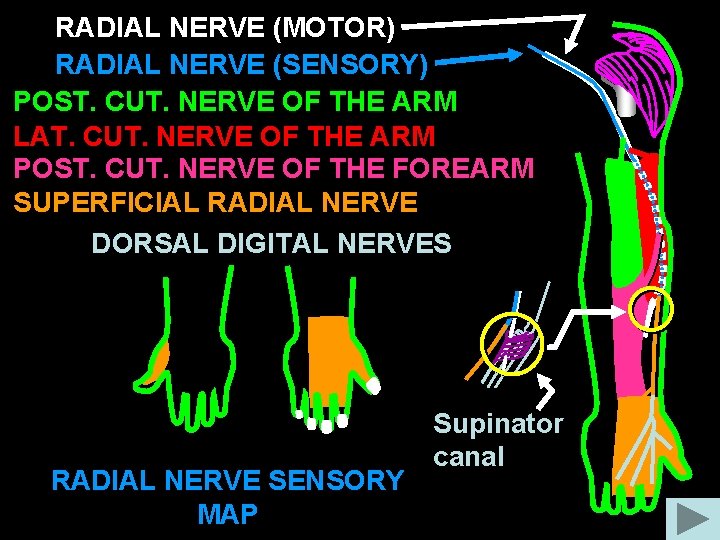
RADIAL NERVE (MOTOR) RADIAL NERVE (SENSORY) POST. CUT. NERVE OF THE ARM LAT. CUT. NERVE OF THE ARM POST. CUT. NERVE OF THE FOREARM SUPERFICIAL RADIAL NERVE DORSAL DIGITAL NERVES RADIAL NERVE SENSORY MAP Supinator canal
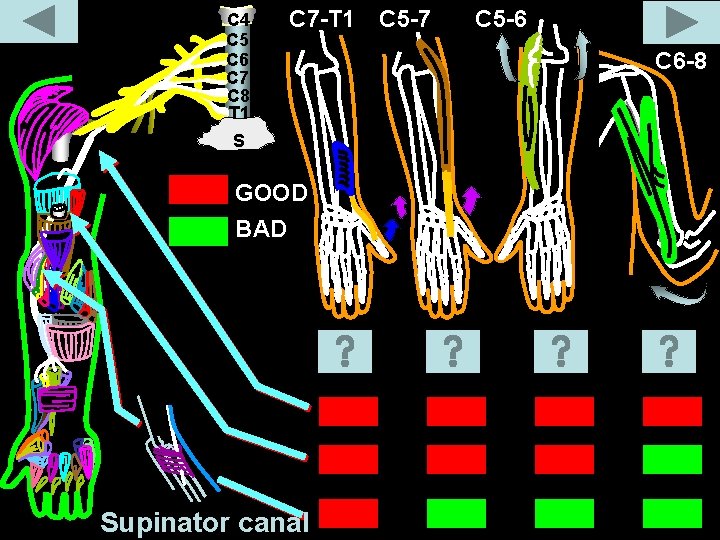
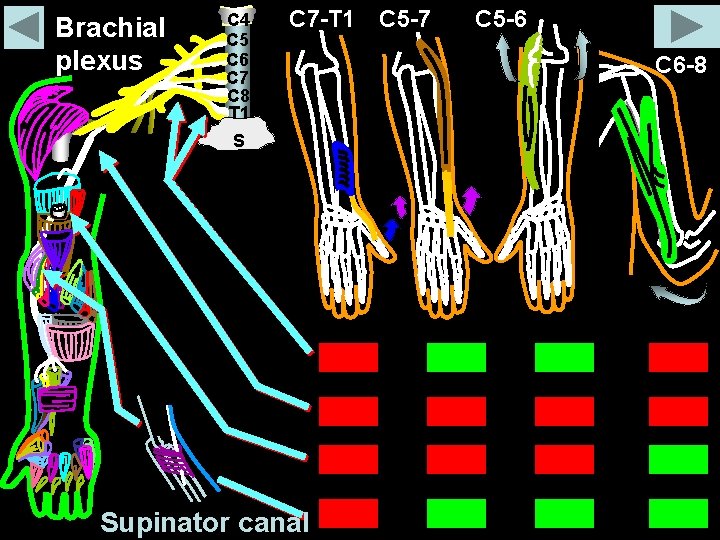
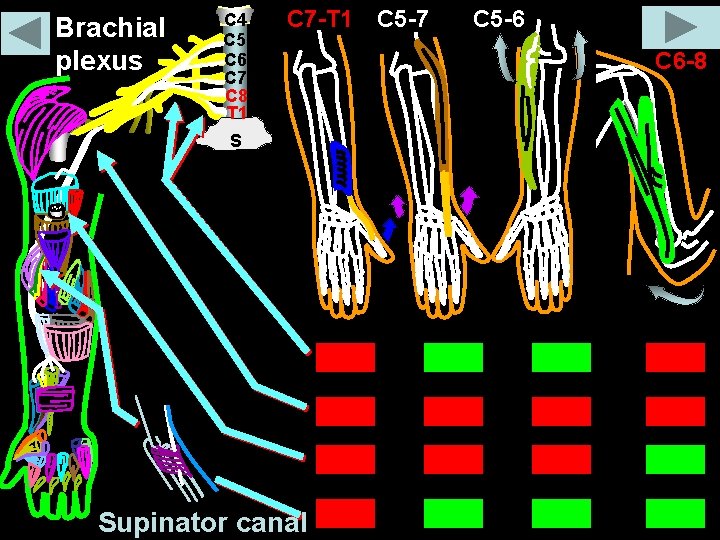
C 4 C 5 C 6 C 7 C 8 T 1 C 7 -T 1 C 5 -7 S GOOD BAD Supinator canal C 5 -6 C 6 -8
2. On physical examination you determine: (1) no sensory deficit, (2) no weakness flexing elbow, (3) no weakness extending the forearm. Where is the injury? a. Carpal tunnel b. Supinator canal c. Axillary region d. Spiral groove of the humerus
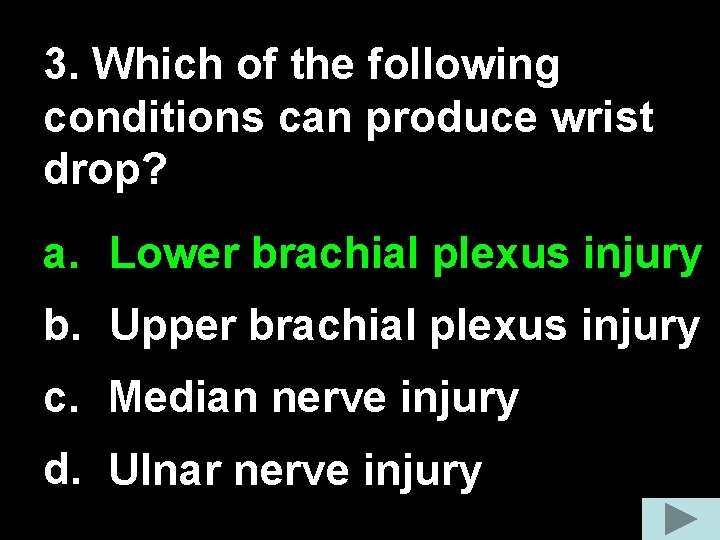
3. Which of the following conditions can produce wrist drop? a. Lower brachial plexus injury b. Upper brachial plexus injury c. Median nerve injury d. Ulnar nerve injury
I WANT TO TRY AGAIN GIVE ME A CLUE JUST GIVE ME THE ANSWER
SHOW ME THE QUESTION AGAIN I WANT TO SEE A CLUE, ANYWAY GO TO THE NEXT QUESTION
Brachial plexus C 4 C 5 C 6 C 7 C 8 T 1 C 7 -T 1 C 5 -7 S Supinator canal C 5 -6 C 6 -8
3. Which of the following conditions can produce wrist drop? a. Lower brachial plexus injury b. Upper brachial plexus injury c. Median nerve injury d. Ulnar nerve injury
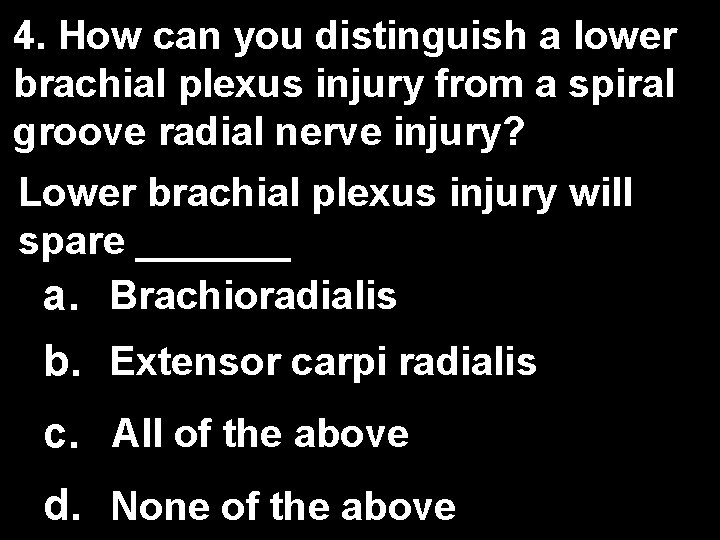
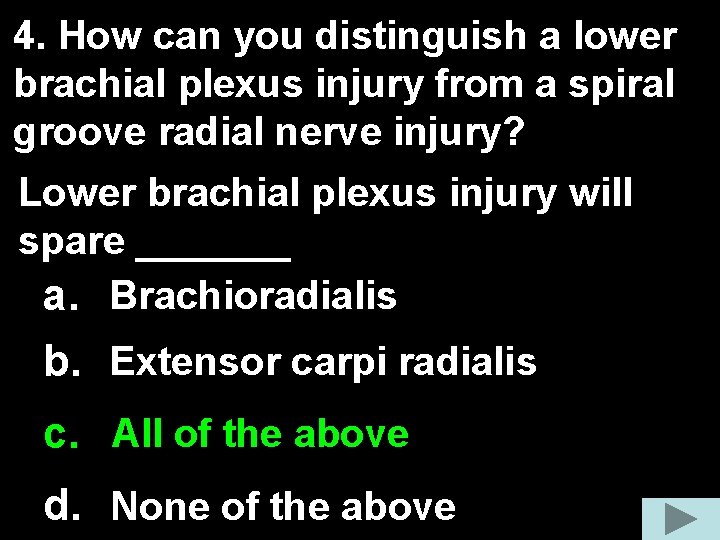
4. How can you distinguish a lower brachial plexus injury from a spiral groove radial nerve injury? Lower brachial plexus injury will spare _______ a. Brachioradialis b. Extensor carpi radialis c. All of the above d. None of the above
I WANT TO TRY AGAIN GIVE ME A CLUE JUST GIVE ME THE ANSWER
SHOW ME THE QUESTION AGAIN I WANT TO SEE A CLUE, ANYWAY
Brachial plexus C 4 C 5 C 6 C 7 C 8 T 1 C 7 -T 1 C 5 -7 S Supinator canal C 5 -6 C 6 -8
4. How can you distinguish a lower brachial plexus injury from a spiral groove radial nerve injury? Lower brachial plexus injury will spare _______ a. Brachioradialis b. Extensor carpi radialis c. All of the above d. None of the above
THANK YOU
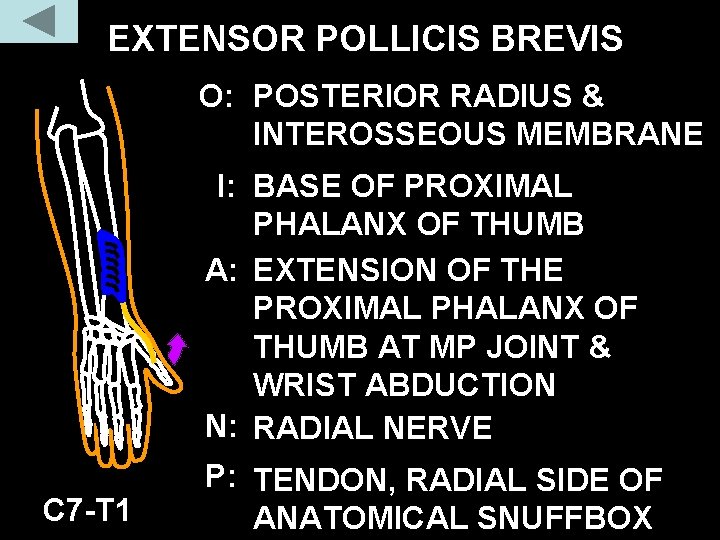
EXTENSOR POLLICIS BREVIS O: POSTERIOR RADIUS & INTEROSSEOUS MEMBRANE C 7 -T 1 I: BASE OF PROXIMAL PHALANX OF THUMB A: EXTENSION OF THE PROXIMAL PHALANX OF THUMB AT MP JOINT & WRIST ABDUCTION N: RADIAL NERVE P: TENDON, RADIAL SIDE OF ANATOMICAL SNUFFBOX
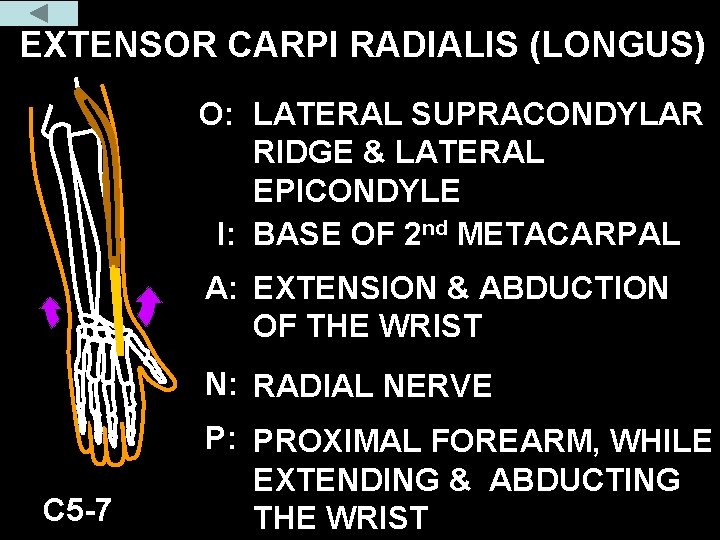
EXTENSOR CARPI RADIALIS (LONGUS) O: LATERAL SUPRACONDYLAR RIDGE & LATERAL EPICONDYLE I: BASE OF 2 nd METACARPAL A: EXTENSION & ABDUCTION OF THE WRIST N: RADIAL NERVE C 5 -7 P: PROXIMAL FOREARM, WHILE EXTENDING & ABDUCTING THE WRIST
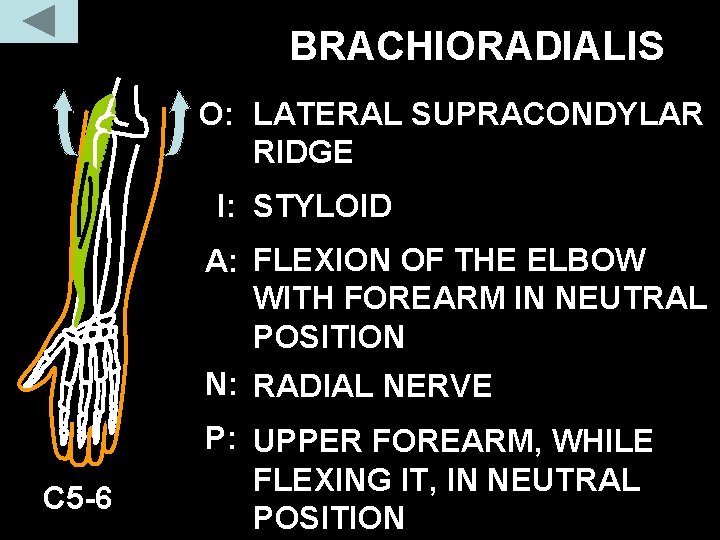
BRACHIORADIALIS O: LATERAL SUPRACONDYLAR RIDGE I: STYLOID A: FLEXION OF THE ELBOW WITH FOREARM IN NEUTRAL POSITION N: RADIAL NERVE C 5 -6 P: UPPER FOREARM, WHILE FLEXING IT, IN NEUTRAL POSITION
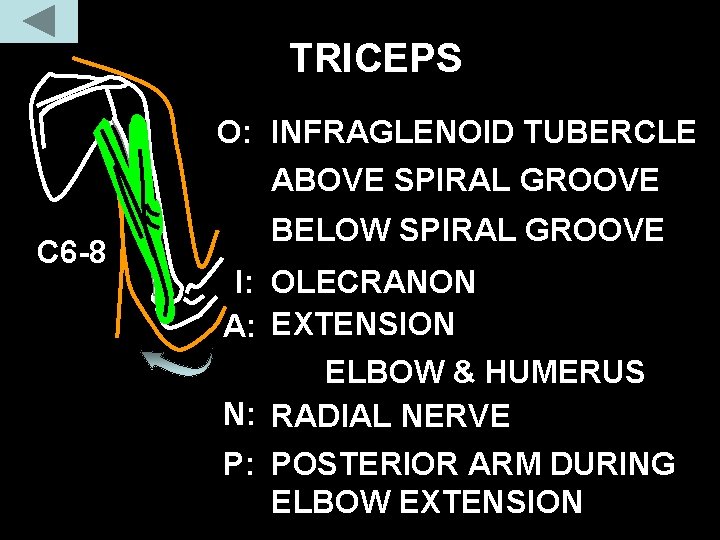
TRICEPS O: INFRAGLENOID TUBERCLE ABOVE SPIRAL GROOVE C 6 -8 BELOW SPIRAL GROOVE I: OLECRANON A: EXTENSION ELBOW & HUMERUS N: RADIAL NERVE P: POSTERIOR ARM DURING ELBOW EXTENSION