IS 2150 TEL 2810 Introduction to Computer Security

- Slides: 42
IS 2150 / TEL 2810 Introduction to Computer Security August 30, 2005 IS 2150/TEL 2810: Introduction of Computer Security 1
IS 2150 / TEL 2810 l The objective of the course is to cover the fundamental issues of information system security and assurance. ¡ Develop broad understanding of diverse issues l Core course for (Security Assured Information Systems Track) SAIS track l Certified by NSA IS 2150 / TEL 2810: Introduction to Computer Security 2
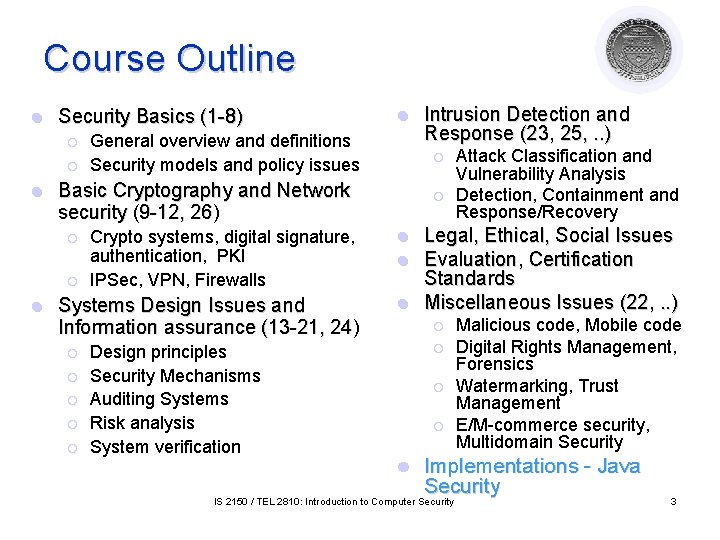
Course Outline l Security Basics (1 -8) ¡ ¡ l General overview and definitions Security models and policy issues ¡ Crypto systems, digital signature, authentication, PKI IPSec, VPN, Firewalls Systems Design Issues and Information assurance (13 -21, 24) ¡ ¡ ¡ Intrusion Detection and Response (23, 25, . . ) ¡ Basic Cryptography and Network security (9 -12, 26) ¡ l l ¡ Attack Classification and Vulnerability Analysis Detection, Containment and Response/Recovery Legal, Ethical, Social Issues Evaluation, Certification Standards l Miscellaneous Issues (22, . . ) l l ¡ ¡ Design principles Security Mechanisms Auditing Systems Risk analysis System verification ¡ ¡ l Malicious code, Mobile code Digital Rights Management, Forensics Watermarking, Trust Management E/M-commerce security, Multidomain Security Implementations - Java Security IS 2150 / TEL 2810: Introduction to Computer Security 3
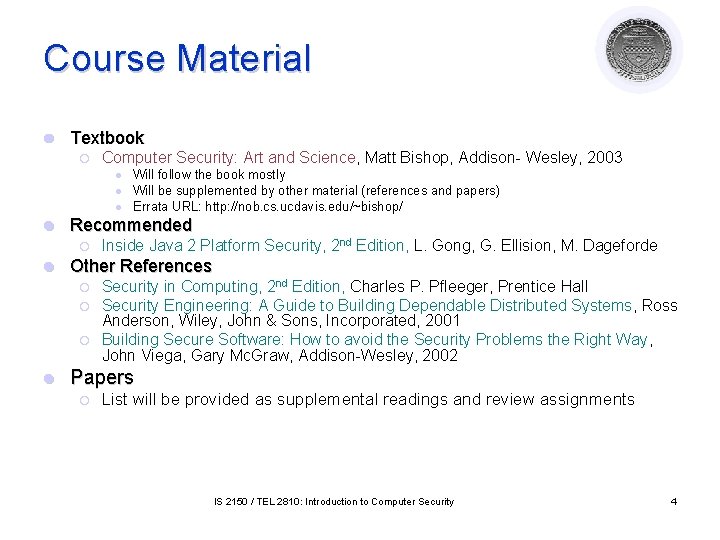
Course Material l Textbook ¡ Computer Security: Art and Science, Matt Bishop, Addison- Wesley, 2003 l l Recommended ¡ l Inside Java 2 Platform Security, 2 nd Edition, L. Gong, G. Ellision, M. Dageforde Other References ¡ ¡ ¡ l Will follow the book mostly Will be supplemented by other material (references and papers) Errata URL: http: //nob. cs. ucdavis. edu/~bishop/ Security in Computing, 2 nd Edition, Charles P. Pfleeger, Prentice Hall Security Engineering: A Guide to Building Dependable Distributed Systems, Ross Anderson, Wiley, John & Sons, Incorporated, 2001 Building Secure Software: How to avoid the Security Problems the Right Way, John Viega, Gary Mc. Graw, Addison-Wesley, 2002 Papers ¡ List will be provided as supplemental readings and review assignments IS 2150 / TEL 2810: Introduction to Computer Security 4
Prerequisites l Assumes the following background ¡ Programming skill ¡ Working knowledge of l Operating systems, algorithms and data structures, database systems, and networks ¡ Basic Mathematics l Not sure? SEE ME IS 2150 / TEL 2810: Introduction to Computer Security 5
Grading Lab + Homework/Quiz/Paper review 40% l Exams 20% includes l ¡ ¡ l Paper/Project 20% ¡ ¡ l Midterm 20% Final 20% List of suggested topics will be posted; Encouraged to think of a project/topic of your interest Some other ¡ ¡ LERSAIS-SIG (Student Interest Group) Seminar and participation IS 2150 / TEL 2810: Introduction to Computer Security 6
Contact l l l James Joshi 721, IS Building (New number is 706 A) Phone: 412 -624 -9982 E-mail: jjoshi@mail. sis. pitt. edu Web: http: //www. sis. pitt. edu/~ Office Hours: ¡ ¡ l Mondays: 2. 00 – 4. 00 p. m. By appointments GSA ¡ Saubhagya R. Joshi (srjoshi@mail. sis. pitt. edu) ¡ Suroop M. Chandran (suroopmc@yahoo. com) IS 2150 / TEL 2810: Introduction to Computer Security 7
Course Policies l Your work MUST be your own ¡ ¡ l Homework ¡ ¡ ¡ l Zero tolerance for cheating You get an F for the course if you cheat in anything however small – NO DISCUSSION There will be penalty for late assignments (15% each day) Ensure clarity in your answers – no credit will be given for vague answers Solutions will be posted in the library OR Webpage Check webpage for everything! ¡ You are responsible for checking the webpage for updates IS 2150 / TEL 2810: Introduction to Computer Security 8
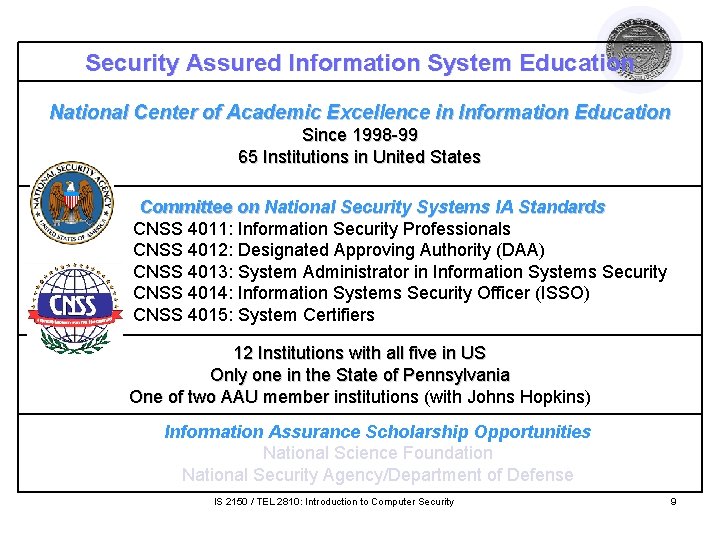
Security Assured Information System Education National Center of Academic Excellence in Information Education Since 1998 -99 65 Institutions in United States Committee on National Security Systems IA Standards CNSS 4011: Information Security Professionals CNSS 4012: Designated Approving Authority (DAA) CNSS 4013: System Administrator in Information Systems Security CNSS 4014: Information Systems Security Officer (ISSO) CNSS 4015: System Certifiers 12 Institutions with all five in US Only one in the State of Pennsylvania One of two AAU member institutions (with Johns Hopkins) Information Assurance Scholarship Opportunities National Science Foundation National Security Agency/Department of Defense IS 2150 / TEL 2810: Introduction to Computer Security 9
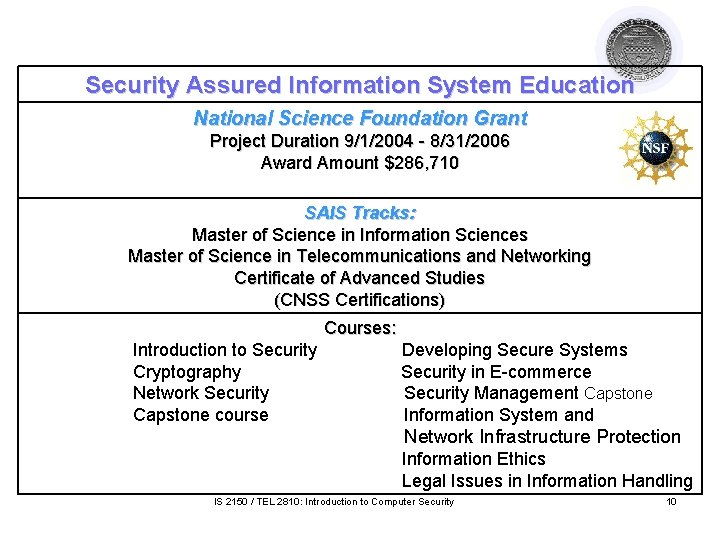
Security Assured Information System Education National Science Foundation Grant Project Duration 9/1/2004 - 8/31/2006 Award Amount $286, 710 SAIS Tracks: Master of Science in Information Sciences Master of Science in Telecommunications and Networking Certificate of Advanced Studies (CNSS Certifications) Courses: Introduction to Security Cryptography Network Security Capstone course Developing Secure Systems Security in E-commerce Security Management Capstone Information System and Network Infrastructure Protection Information Ethics Legal Issues in Information Handling IS 2150 / TEL 2810: Introduction to Computer Security 10
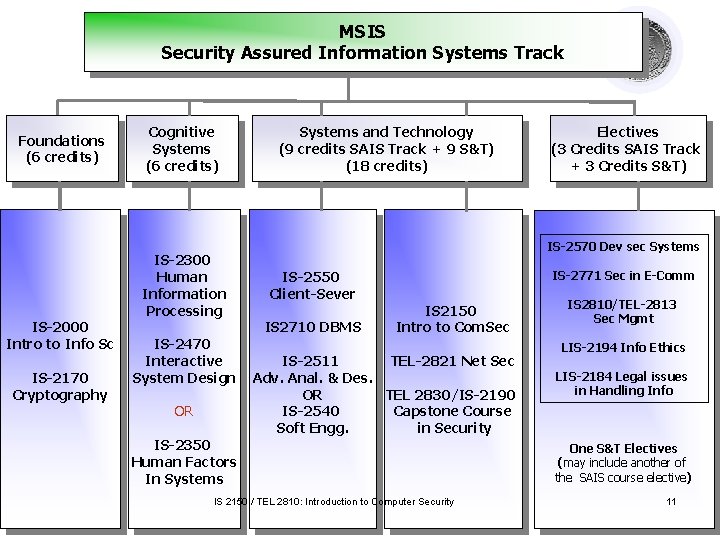
MSIS Security Assured Information Systems Track Foundations (6 credits) IS-2000 Intro to Info Sc IS-2170 Cryptography Cognitive Systems (6 credits) IS-2300 Human Information Processing IS-2470 Interactive System Design OR IS-2350 Human Factors In Systems and Technology (9 credits SAIS Track + 9 S&T) (18 credits) Electives (3 Credits SAIS Track + 3 Credits S&T) IS-2570 Dev sec Systems IS-2550 Client-Sever IS 2710 DBMS IS-2771 Sec in E-Comm IS 2150 Intro to Com. Sec IS-2511 TEL-2821 Net Sec Adv. Anal. & Des. OR TEL 2830/IS-2190 IS-2540 Capstone Course Soft Engg. in Security IS 2150 / TEL 2810: Introduction to Computer Security IS 2810/TEL-2813 Sec Mgmt LIS-2194 Info Ethics LIS-2184 Legal issues in Handling Info One S&T Electives (may include another of the SAIS course elective) 11
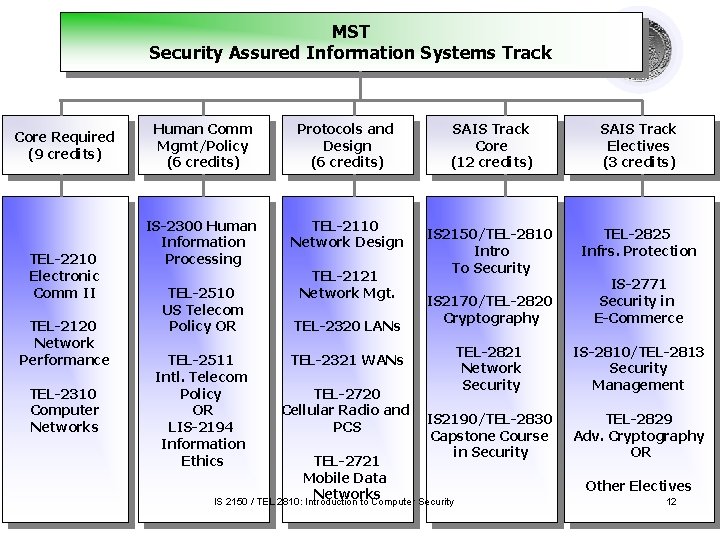
MST Security Assured Information Systems Track Core Required (9 credits) TEL-2210 Electronic Comm II TEL-2120 Network Performance TEL-2310 Computer Networks Human Comm Mgmt/Policy (6 credits) Protocols and Design (6 credits) IS-2300 Human Information Processing TEL-2110 Network Design TEL-2510 US Telecom Policy OR TEL-2511 Intl. Telecom Policy OR LIS-2194 Information Ethics TEL-2121 Network Mgt. TEL-2320 LANs SAIS Track Core (12 credits) SAIS Track Electives (3 credits) IS 2150/TEL-2810 Intro To Security TEL-2825 Infrs. Protection IS 2170/TEL-2820 Cryptography IS-2771 Security in E-Commerce TEL-2821 Network Security IS-2810/TEL-2813 Security Management IS 2190/TEL-2830 Capstone Course in Security TEL-2829 Adv. Cryptography OR TEL-2321 WANs TEL-2720 Cellular Radio and PCS TEL-2721 Mobile Data Networks IS 2150 / TEL 2810: Introduction to Computer Security Other Electives 12
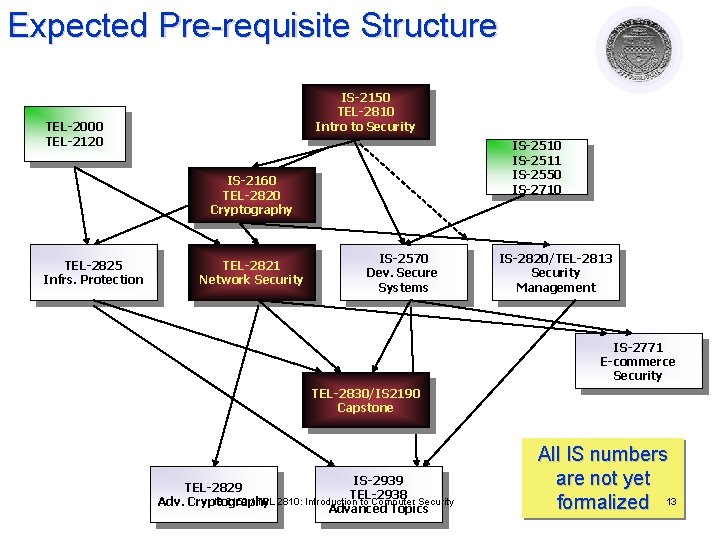
Expected Pre-requisite Structure IS-2150 TEL-2810 Intro to Security TEL-2000 TEL-2120 IS-2511 IS-2550 IS-2710 IS-2160 TEL-2820 Cryptography TEL-2825 Infrs. Protection TEL-2821 Network Security IS-2570 Dev. Secure Systems IS-2820/TEL-2813 Security Management IS-2771 E-commerce Security TEL-2830/IS 2190 Capstone IS-2939 TEL-2829 TEL-2938 IS 2150 / TEL 2810: Introduction to Computer Security Adv. Cryptography Advanced Topics All IS numbers are not yet formalized 13
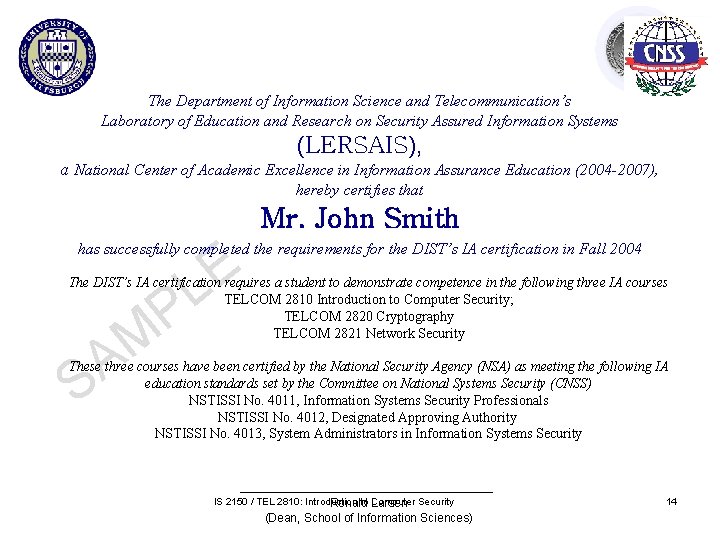
The Department of Information Science and Telecommunication’s Laboratory of Education and Research on Security Assured Information Systems (LERSAIS), a National Center of Academic Excellence in Information Assurance Education (2004 -2007), hereby certifies that Mr. John Smith has successfully completed the requirements for the DIST’s IA certification in Fall 2004 E L The DIST’s IA certification requires a student to demonstrate competence in the following three IA courses TELCOM 2810 Introduction to Computer Security; TELCOM 2820 Cryptography TELCOM 2821 Network Security P M A S These three courses have been certified by the National Security Agency (NSA) as meeting the following IA education standards set by the Committee on National Systems Security (CNSS) NSTISSI No. 4011, Information Systems Security Professionals NSTISSI No. 4012, Designated Approving Authority NSTISSI No. 4013, System Administrators in Information Systems Security IS 2150 / TEL 2810: Introduction to Larsen Computer Security Ronald (Dean, School of Information Sciences) 14
Other Important Information l In the process of setting up scholarships for IA education (Do. D and/or NSF) ¡ 2 -years support (MS degree, 2 years of Ph. D) ¡ US Citizens only ¡ Requires 2 years work with federal agency l NSA people visit DIST ¡ Discuss internship/job opportunities l Other internship opportunities ¡ Vigilant. Minds, NCFTA, CSSD, PWC IS 2150 / TEL 2810: Introduction to Computer Security 15
Introduction to Security Overview of Computer Security IS 2150/TEL 2810: Introduction of Computer Security 16
Information Systems Security l Deals with ¡ Security of (end) systems l ¡ Examples: Operating system, files in a host, records, databases, accounting information, logs, etc. Security of information in transit over a network l Examples: e-commerce transactions, online banking, confidential e-mails, file transfers, record transfers, authorization messages, etc. “Using encryption on the internet is the equivalent of arranging an armored car to deliver credit card information from someone living in a cardboard box to someone living on a park bench” – Gene Spafford IS 2150 / TEL 2810: Introduction to Computer Security 17
Basic Components of Security l Confidentiality ¡ l Keeping data and resources secret or hidden Integrity ¡ ¡ ¡ Ensuring authorized modifications; Includes correctness and trustworthiness May refer to l l l Data integrity Origin integrity Availability ¡ Ensuring authorized access to data and resources when desired (Additional from NIST) l Accountability ¡ l Ensuring that an entity’s action is traceable uniquely to that entity Security assurance ¡ Assurance that all four objectives are met IS 2150 / TEL 2810: Introduction to Computer Security 18
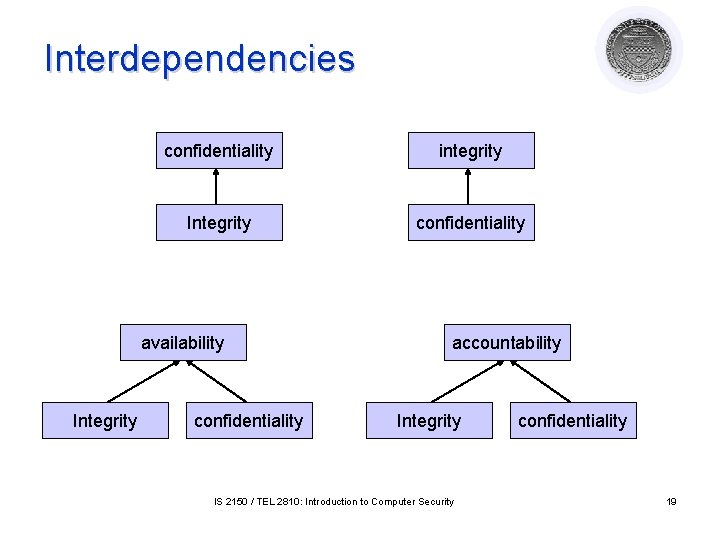
Interdependencies confidentiality integrity Integrity confidentiality availability Integrity confidentiality accountability Integrity IS 2150 / TEL 2810: Introduction to Computer Security confidentiality 19
Information Security 20 years back l Physical security ¡ Information was primarily on paper ¡ Lock and key ¡ Safe transmission l Administrative security ¡ Control access to materials ¡ Personnel screening ¡ Auditing IS 2150 / TEL 2810: Introduction to Computer Security 20
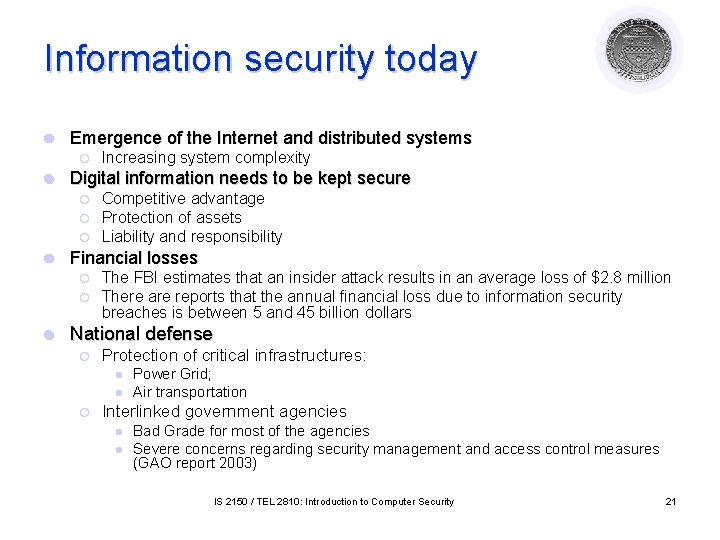
Information security today l Emergence of the Internet and distributed systems ¡ l Digital information needs to be kept secure ¡ ¡ ¡ l Competitive advantage Protection of assets Liability and responsibility Financial losses ¡ ¡ l Increasing system complexity The FBI estimates that an insider attack results in an average loss of $2. 8 million There are reports that the annual financial loss due to information security breaches is between 5 and 45 billion dollars National defense ¡ Protection of critical infrastructures: l l ¡ Power Grid; Air transportation Interlinked government agencies l l Bad Grade for most of the agencies Severe concerns regarding security management and access control measures (GAO report 2003) IS 2150 / TEL 2810: Introduction to Computer Security 21
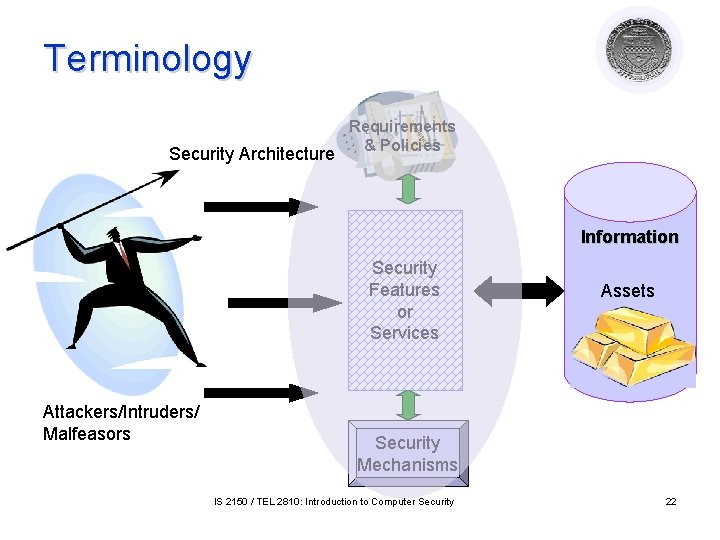
Terminology Security Architecture Requirements & Policies Information Security Features or Services Attackers/Intruders/ Malfeasors Assets Security Mechanisms IS 2150 / TEL 2810: Introduction to Computer Security 22
Attack Vs Threat l A threat is a “potential” violation of security ¡ The violation need not actually occur ¡ The fact that the violation might occur makes it a threat ¡ It is important to guard against threats and be prepared for the actual violation l The actual violation of security is called an attack IS 2150 / TEL 2810: Introduction to Computer Security 23
Common security attacks l Interruption, delay, denial of receipt or denial of service ¡ l Interception or snooping ¡ l Unauthorized party changes information in transit or information stored for subsequent access Fabrication, masquerade, or spoofing ¡ l Unauthorized party gains access to information by browsing through files or reading communications Modification or alteration ¡ l System assets or information become unavailable or are rendered unavailable Spurious information is inserted into the system or network by making it appear as if it is from a legitimate entity Repudiation of origin ¡ False denial that an entity created something IS 2150 / TEL 2810: Introduction to Computer Security 24
Classes of Threats (Shirley) l Disclosure: unauthorized access to information ¡ l Deception: acceptance of false data ¡ l Modification, masquerading/spoofing, repudiation of origin, denial of receipt Disruption: interruption/prevention of correct operation ¡ l Snooping Modification Usurpation: unauthorized control of a system component ¡ Modification, masquerading/spoofing, delay, denial of service IS 2150 / TEL 2810: Introduction to Computer Security 25
Policies and Mechanisms l A security policy states what is, and is not, allowed ¡ This defines “security” for the site/system/etc. ¡ Policy definition: Informal? Formal? l Mechanisms enforce policies l Composition of policies ¡ If policies conflict, discrepancies may create security vulnerabilities IS 2150 / TEL 2810: Introduction to Computer Security 26
Goals of Security l Prevention ¡ l Detection ¡ ¡ l To prevent someone from violating a security policy To detect activities in violation of a security policy Verify the efficacy of the prevention mechanism Recovery ¡ Stop policy violations (attacks) Assess and repair damage Ensure availability in presence of an ongoing attack Fix vulnerabilities for preventing future attack ¡ Retaliation against the attacker ¡ ¡ ¡ IS 2150 / TEL 2810: Introduction to Computer Security 27
Assumptions and Trust Policies and mechanisms have implicit assumptions l Assumptions regarding policies l ¡ ¡ l Unambiguously partition system states into “secure” and “nonsecure” states Correctly capture security requirements Mechanisms ¡ ¡ Assumed to enforce policy; i. e. , ensure that the system does not enter “nonsecure” state Support mechanisms work correctly IS 2150 / TEL 2810: Introduction to Computer Security 28
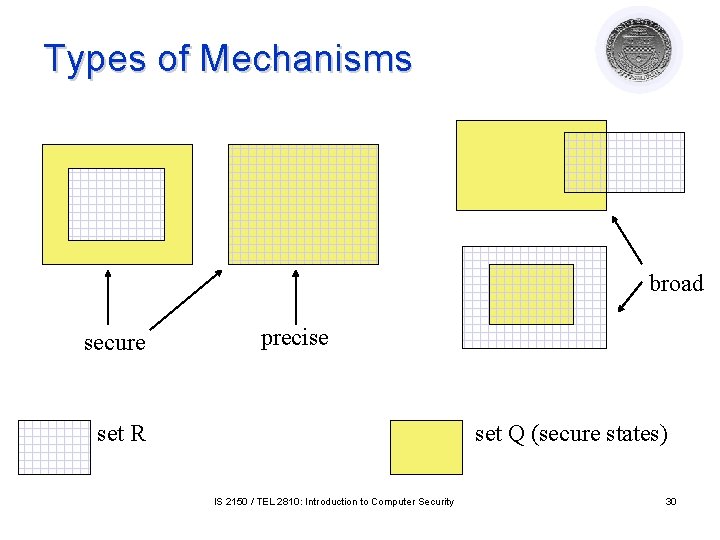
Types of Mechanisms Let P be the set of all the reachable states l Let Q be a set of secure states identified by a policy: Q P l Let the set of states that an enforcement mechanism restricts a system to be R l The enforcement mechanism is l ¡ ¡ ¡ Secure if R Q Precise if R = Q Broad if there are some states in R that are not in Q IS 2150 / TEL 2810: Introduction to Computer Security 29
Types of Mechanisms broad secure precise set R set Q (secure states) IS 2150 / TEL 2810: Introduction to Computer Security 30
Information Assurance Advisory Council (IAAC): “Operations undertaken to protect and defend information and information systems by ensuring their availability, integrity, authentication, confidentiality and nonrepudiation” l National Institute of Standards Technology “Assurance is the basis for confidence that the security measures, both technical and operational, work as intended to protect the system and the information it processes” l IS 2150 / TEL 2810: Introduction to Computer Security 31
Assurance l Assurance is to indicate “how much” to trust a system and is achieved by ensuring that ¡ ¡ ¡ l The required functionality is present and correctly implemented There is sufficient protection against unintentional errors There is sufficient resistance to intentional penetration or by-pass Basis for determining this aspect of trust ¡ Specification l l ¡ Design l ¡ Requirements analysis Statement of desired functionality Translate specification into components that satisfy the specification Implementation l Programs/systems that satisfy a design IS 2150 / TEL 2810: Introduction to Computer Security 32
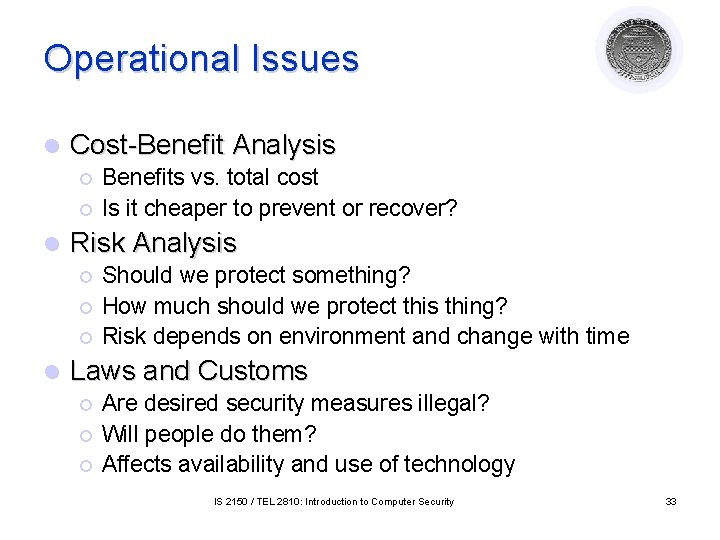
Operational Issues l Cost-Benefit Analysis ¡ ¡ l Risk Analysis ¡ ¡ ¡ l Benefits vs. total cost Is it cheaper to prevent or recover? Should we protect something? How much should we protect this thing? Risk depends on environment and change with time Laws and Customs ¡ ¡ ¡ Are desired security measures illegal? Will people do them? Affects availability and use of technology IS 2150 / TEL 2810: Introduction to Computer Security 33
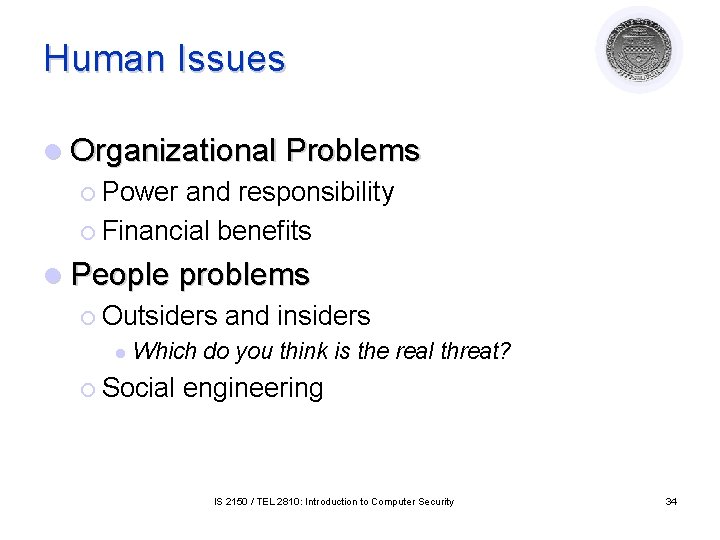
Human Issues l Organizational Problems ¡ Power and responsibility ¡ Financial benefits l People problems ¡ Outsiders and insiders l Which do you think is the real threat? ¡ Social engineering IS 2150 / TEL 2810: Introduction to Computer Security 34
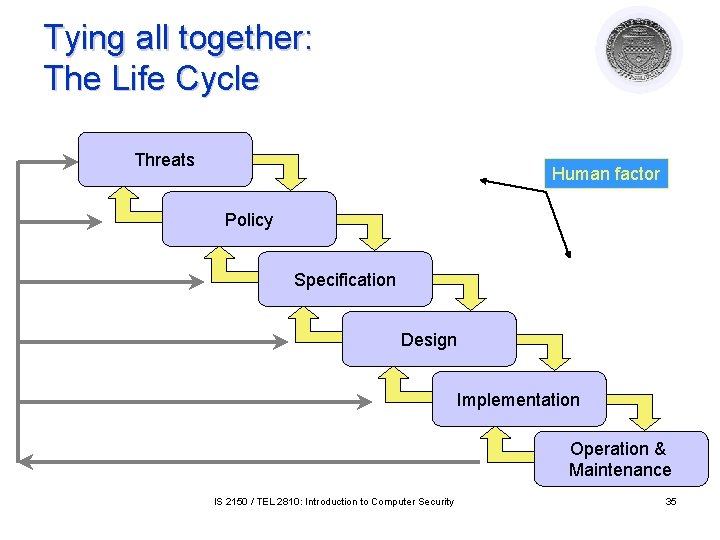
Tying all together: The Life Cycle Threats Human factor Policy Specification Design Implementation Operation & Maintenance IS 2150 / TEL 2810: Introduction to Computer Security 35
Mathematics Review IS 2150/TEL 2810: Introduction of Computer Security 36
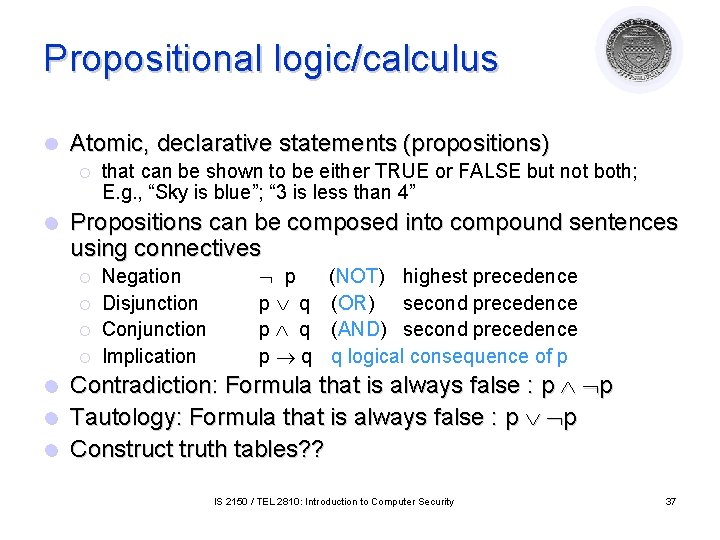
Propositional logic/calculus l Atomic, declarative statements (propositions) ¡ l that can be shown to be either TRUE or FALSE but not both; E. g. , “Sky is blue”; “ 3 is less than 4” Propositions can be composed into compound sentences using connectives ¡ ¡ Negation Disjunction Conjunction Implication p p q p q (NOT) highest precedence (OR) second precedence (AND) second precedence q logical consequence of p Contradiction: Formula that is always false : p p l Tautology: Formula that is always false : p p l Construct truth tables? ? l IS 2150 / TEL 2810: Introduction to Computer Security 37
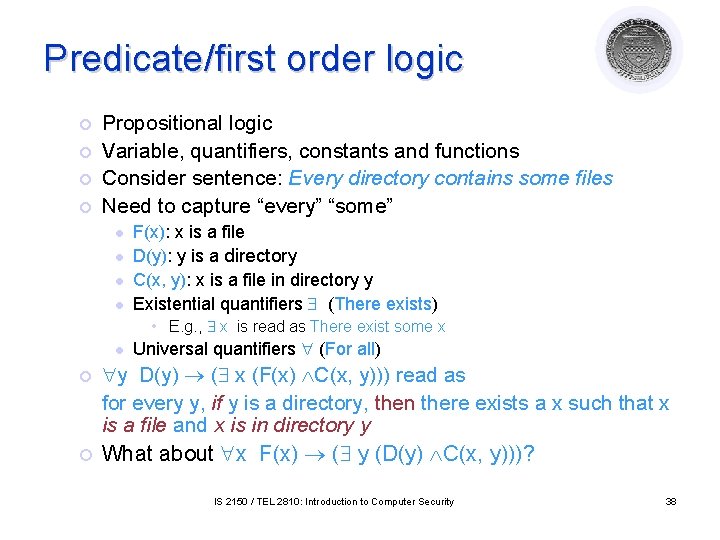
Predicate/first order logic ¡ ¡ Propositional logic Variable, quantifiers, constants and functions Consider sentence: Every directory contains some files Need to capture “every” “some” l l F(x): x is a file D(y): y is a directory C(x, y): x is a file in directory y Existential quantifiers (There exists) • E. g. , x is read as There exist some x l ¡ ¡ Universal quantifiers (For all) y D(y) ( x (F(x) C(x, y))) read as for every y, if y is a directory, then there exists a x such that x is a file and x is in directory y What about x F(x) ( y (D(y) C(x, y)))? IS 2150 / TEL 2810: Introduction to Computer Security 38
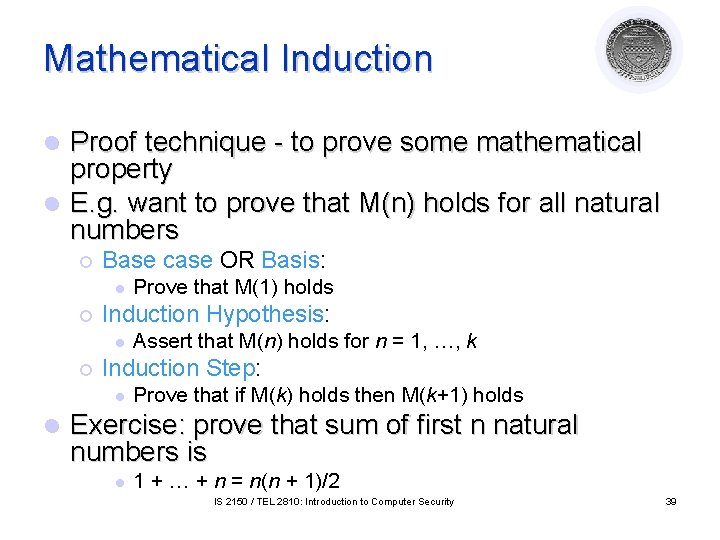
Mathematical Induction Proof technique - to prove some mathematical property l E. g. want to prove that M(n) holds for all natural numbers l ¡ Base case OR Basis: l ¡ Induction Hypothesis: l ¡ Assert that M(n) holds for n = 1, …, k Induction Step: l l Prove that M(1) holds Prove that if M(k) holds then M(k+1) holds Exercise: prove that sum of first n natural numbers is l 1 + … + n = n(n + 1)/2 IS 2150 / TEL 2810: Introduction to Computer Security 39
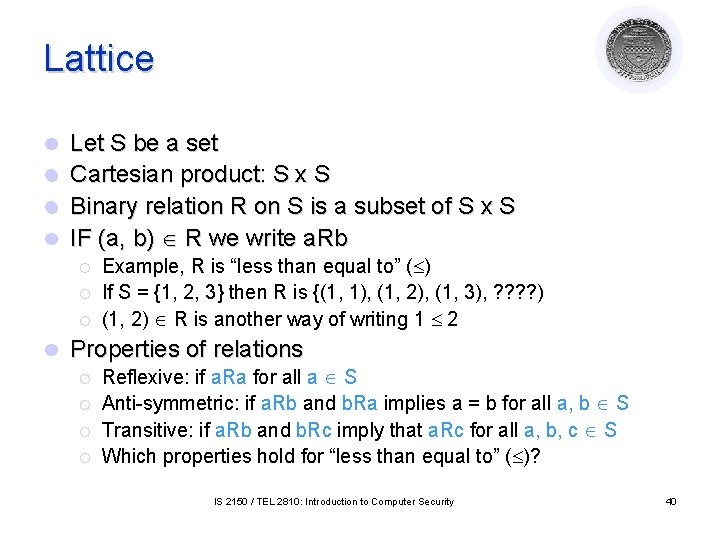
Lattice Let S be a set l Cartesian product: S x S l Binary relation R on S is a subset of S x S l IF (a, b) R we write a. Rb l ¡ ¡ ¡ l Example, R is “less than equal to” ( ) If S = {1, 2, 3} then R is {(1, 1), (1, 2), (1, 3), ? ? ) (1, 2) R is another way of writing 1 2 Properties of relations ¡ ¡ Reflexive: if a. Ra for all a S Anti-symmetric: if a. Rb and b. Ra implies a = b for all a, b S Transitive: if a. Rb and b. Rc imply that a. Rc for all a, b, c S Which properties hold for “less than equal to” ( )? IS 2150 / TEL 2810: Introduction to Computer Security 40
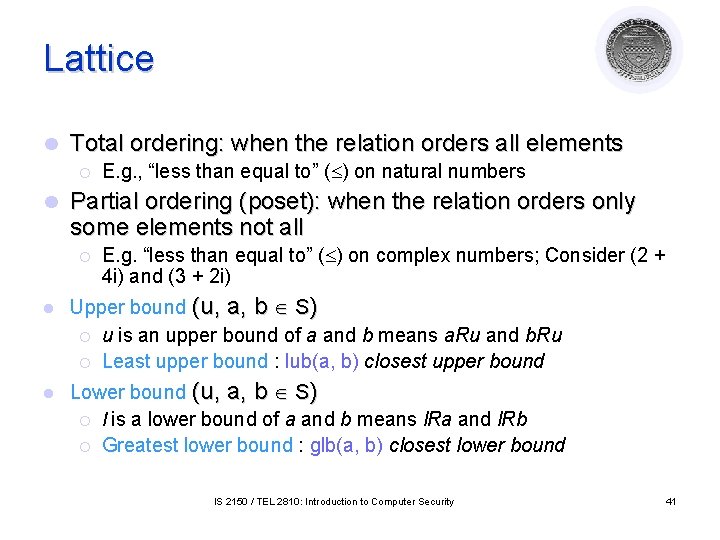
Lattice l Total ordering: when the relation orders all elements ¡ l E. g. , “less than equal to” ( ) on natural numbers Partial ordering (poset): when the relation orders only some elements not all ¡ E. g. “less than equal to” ( ) on complex numbers; Consider (2 + 4 i) and (3 + 2 i) l Upper bound (u, a, b S) ¡ u is an upper bound of a and b means a. Ru and b. Ru ¡ Least upper bound : lub(a, b) closest upper bound l Lower bound (u, a, b S) ¡ l is a lower bound of a and b means l. Ra and l. Rb ¡ Greatest lower bound : glb(a, b) closest lower bound IS 2150 / TEL 2810: Introduction to Computer Security 41
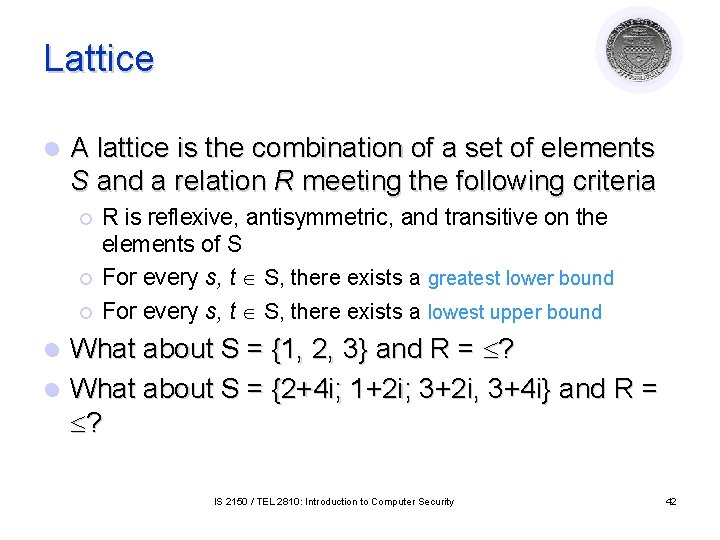
Lattice l A lattice is the combination of a set of elements S and a relation R meeting the following criteria ¡ ¡ ¡ R is reflexive, antisymmetric, and transitive on the elements of S For every s, t S, there exists a greatest lower bound For every s, t S, there exists a lowest upper bound What about S = {1, 2, 3} and R = ? l What about S = {2+4 i; 1+2 i; 3+2 i, 3+4 i} and R = ? l IS 2150 / TEL 2810: Introduction to Computer Security 42