INVERSIONS UPDATE John R Wilson Holland Hart LLP
- Slides: 65
INVERSIONS UPDATE John R. Wilson Holland & Hart LLP University of Denver Graduate Tax Program December 4, 2014 Revised: January 4, 2016
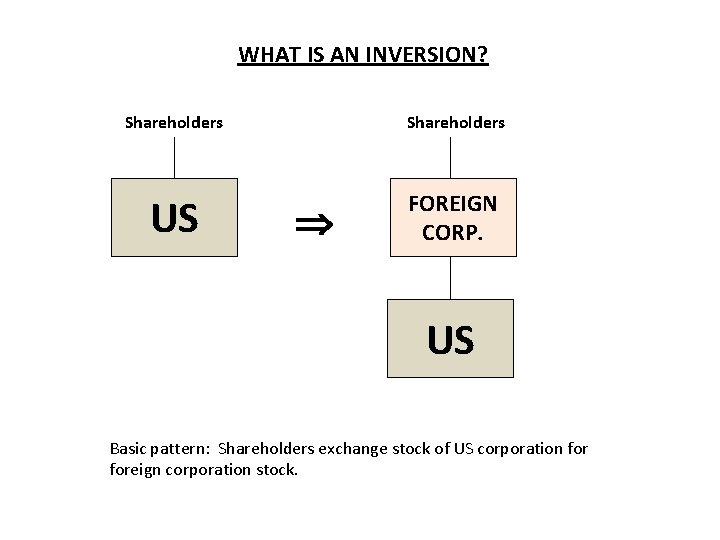
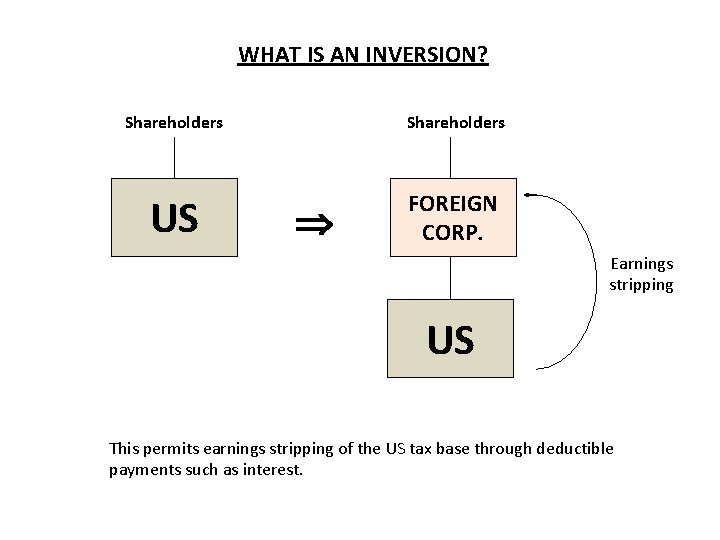
WHAT IS AN INVERSION? Shareholders US FOREIGN CORP. US Basic pattern: Shareholders exchange stock of US corporation foreign corporation stock.
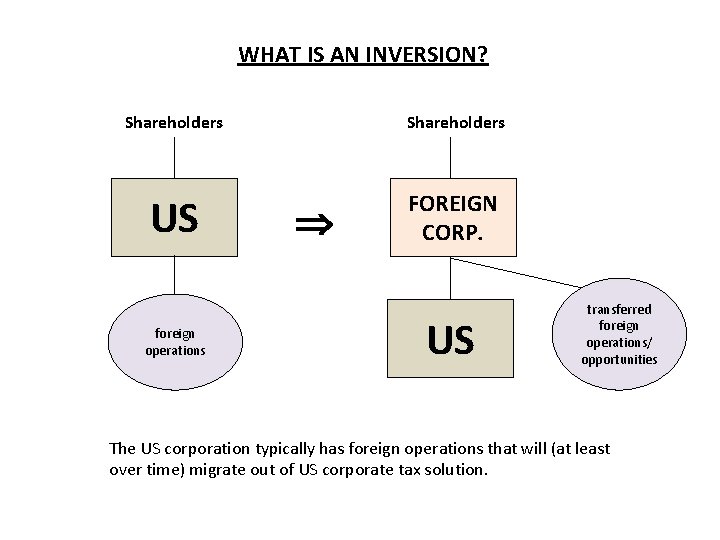
WHAT IS AN INVERSION? Shareholders US FOREIGN CORP. foreign operations US transferred foreign operations/ opportunities The US corporation typically has foreign operations that will (at least over time) migrate out of US corporate tax solution.
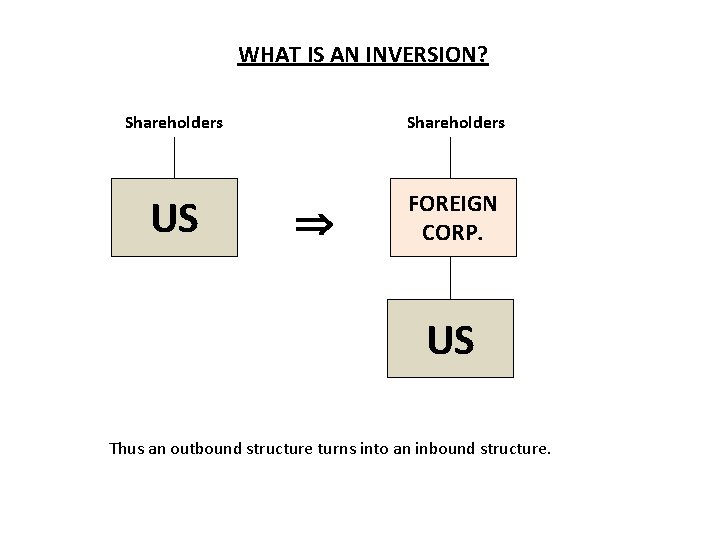
WHAT IS AN INVERSION? Shareholders US FOREIGN CORP. US Thus an outbound structure turns into an inbound structure.
WHAT IS AN INVERSION? Shareholders US FOREIGN CORP. Earnings stripping US This permits earnings stripping of the US tax base through deductible payments such as interest.
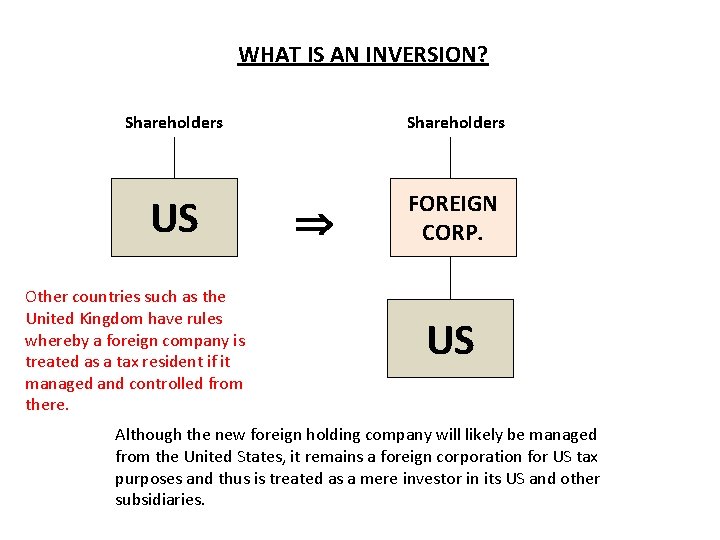
WHAT IS AN INVERSION? Shareholders US FOREIGN CORP. Other countries such as the United Kingdom have rules whereby a foreign company is treated as a tax resident if it managed and controlled from there. US Although the new foreign holding company will likely be managed from the United States, it remains a foreign corporation for US tax purposes and thus is treated as a mere investor in its US and other subsidiaries.
WHY INVERT? – Lower effective tax rate § Avoid US tax on foreign expansion § Earnings stripping possibilities § Access foreign earnings without triggering US dividend – Nontax reasons § Accounting standards § Corporate governance § Securities law requirements
LEGISLATIVE AND REGULATORY RESPONSES – To counteract inversions, there have been various legislative and regulatory responses under Sections 367 and 7874. – These rules attempt to stop inversions by making the tax results either prohibitive or ineffective.
SECTION 367 Four conditions for tax-free treatment at the US shareholder level (in addition to domestic Subchapter C rules): 1. Fifty percent or less of the stock of the transferee foreign corporation (by voting power and value) is received by US transferors. This test includes all shareholders, e. g. , de minimis US public shareholders of the acquired domestic corporation. For this purpose, transferors are rebuttably presumed to be US persons. 2. No more than 50 percent of the stock of the transferee foreign corporation (by voting power and value) is owned immediately after the transaction by US persons who were officers, directors, or 5 -percent-or-greater shareholders of the domestic corporation immediately before the transaction.
SECTION 367 (CONT’D) 3. The transferee foreign corporation or an affiliate must have been engaged in the active conduct of a trade or business (substantial in comparison with the trade or business of the domestic corporation) for the entire 36 months preceding the transaction, and intend to continue such business. The substantiality test generally requires that, at the time of the transfer, the fair market value of the transferee foreign corporation be at least equal to the fair market value of the US target, subject to special rules for assets acquired by the foreign corporation outside the ordinary course of business in the past 36 months. 4. Either the US shareholder is not a 5 -percent-or-greater shareholder of the transferee foreign corporation, or the US shareholder enters into a 5 -year “gain recognition agreement” (“GRA”). See Form 8838. This requirement applies on shareholder-by-shareholder basis.
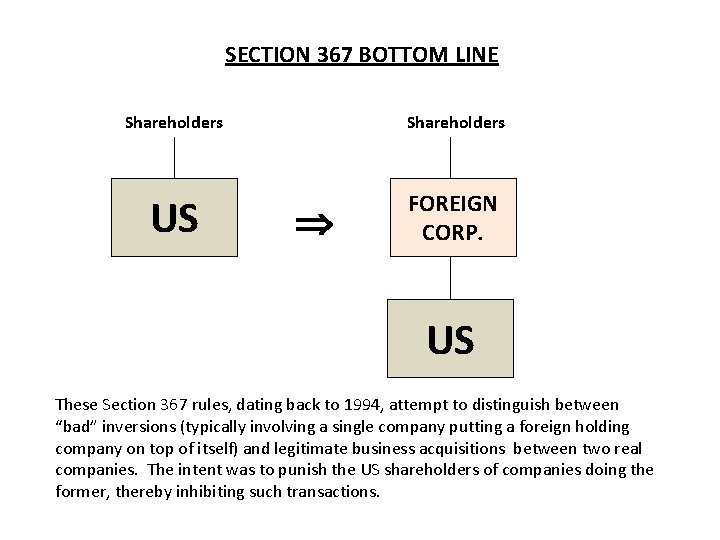
SECTION 367 BOTTOM LINE Shareholders US FOREIGN CORP. US These Section 367 rules, dating back to 1994, attempt to distinguish between “bad” inversions (typically involving a single company putting a foreign holding company on top of itself) and legitimate business acquisitions between two real companies. The intent was to punish the US shareholders of companies doing the former, thereby inhibiting such transactions.
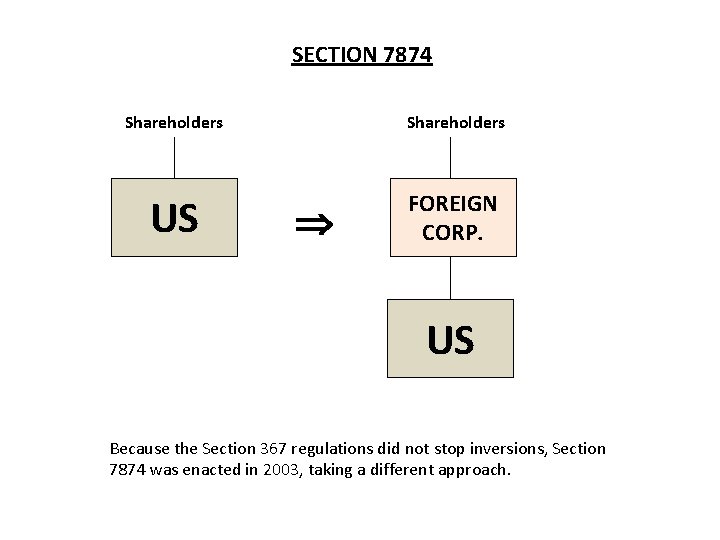
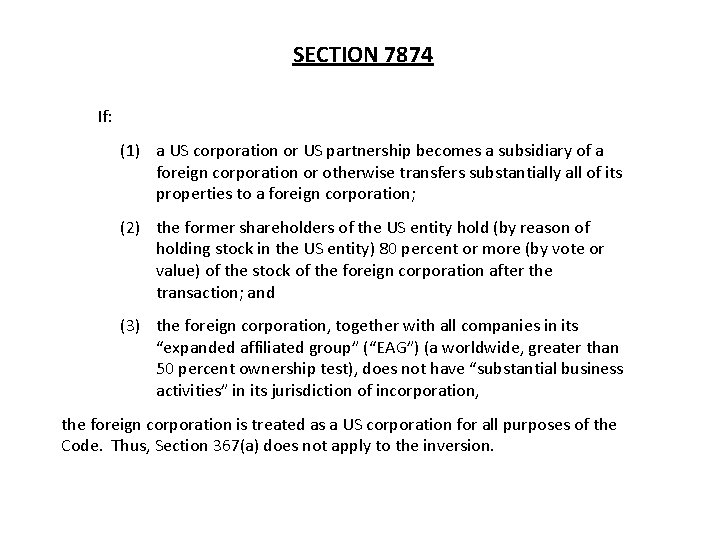
SECTION 7874 Shareholders US FOREIGN CORP. US Because the Section 367 regulations did not stop inversions, Section 7874 was enacted in 2003, taking a different approach.
SECTION 7874 If: (1) a US corporation or US partnership becomes a subsidiary of a foreign corporation or otherwise transfers substantially all of its properties to a foreign corporation; (2) the former shareholders of the US entity hold (by reason of holding stock in the US entity) 80 percent or more (by vote or value) of the stock of the foreign corporation after the transaction; and (3) the foreign corporation, together with all companies in its “expanded affiliated group” (“EAG”) (a worldwide, greater than 50 percent ownership test), does not have “substantial business activities” in its jurisdiction of incorporation, the foreign corporation is treated as a US corporation for all purposes of the Code. Thus, Section 367(a) does not apply to the inversion.
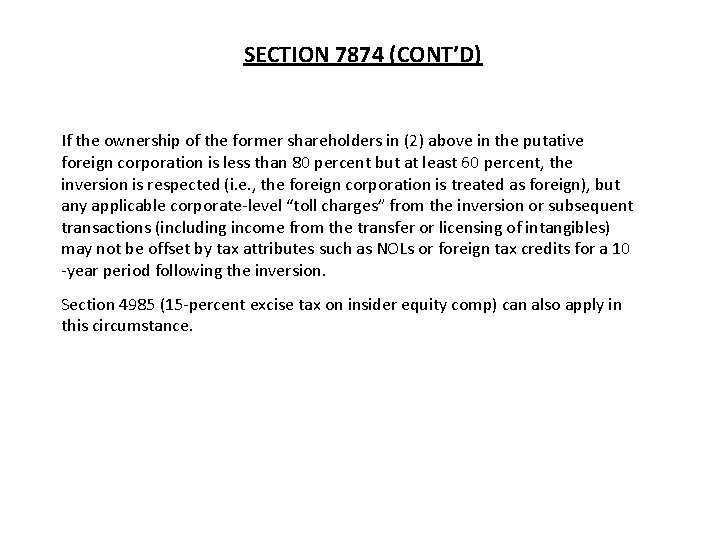
SECTION 7874 (CONT’D) If the ownership of the former shareholders in (2) above in the putative foreign corporation is less than 80 percent but at least 60 percent, the inversion is respected (i. e. , the foreign corporation is treated as foreign), but any applicable corporate-level “toll charges” from the inversion or subsequent transactions (including income from the transfer or licensing of intangibles) may not be offset by tax attributes such as NOLs or foreign tax credits for a 10 -year period following the inversion. Section 4985 (15 -percent excise tax on insider equity comp) can also apply in this circumstance.
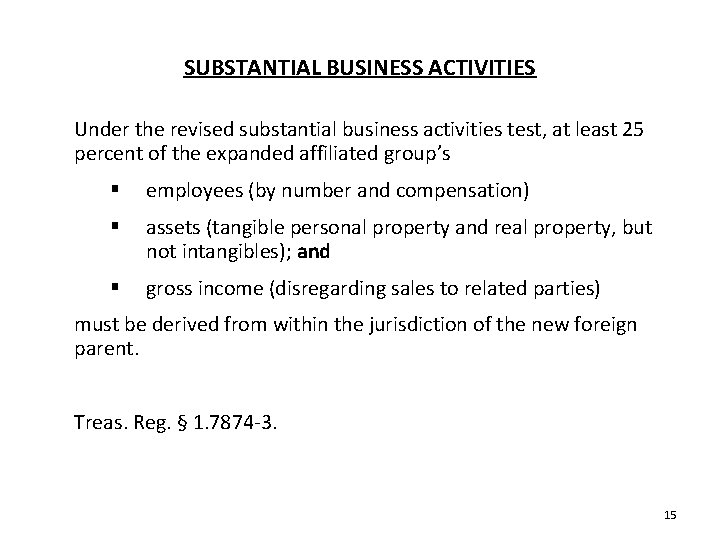
SUBSTANTIAL BUSINESS ACTIVITIES Under the revised substantial business activities test, at least 25 percent of the expanded affiliated group’s § employees (by number and compensation) § assets (tangible personal property and real property, but not intangibles); and § gross income (disregarding sales to related parties) must be derived from within the jurisdiction of the new foreign parent. Treas. Reg. § 1. 7874 -3. 15
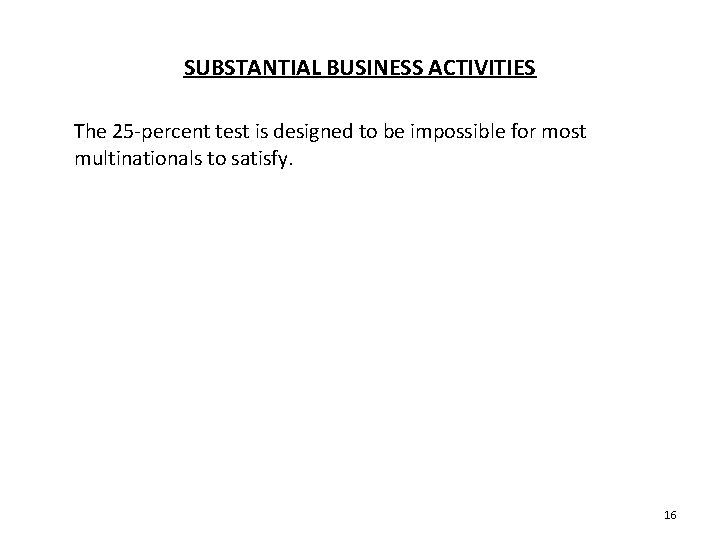
SUBSTANTIAL BUSINESS ACTIVITIES The 25 -percent test is designed to be impossible for most multinationals to satisfy. 16
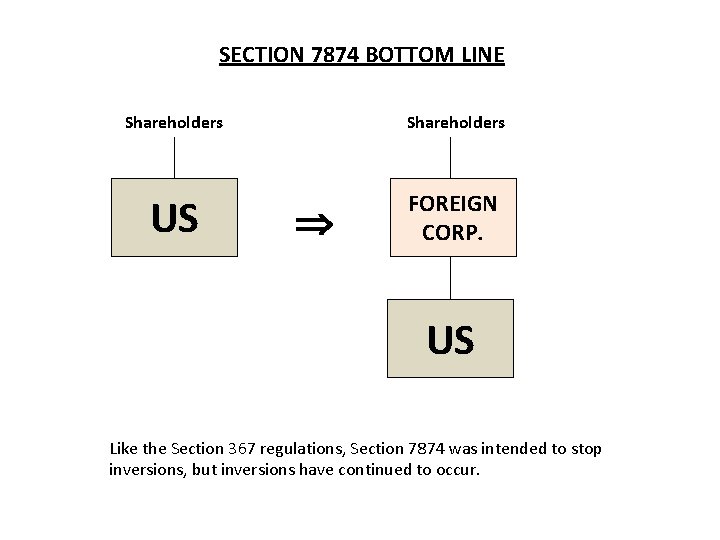
SECTION 7874 BOTTOM LINE Shareholders US FOREIGN CORP. US Like the Section 367 regulations, Section 7874 was intended to stop inversions, but inversions have continued to occur.
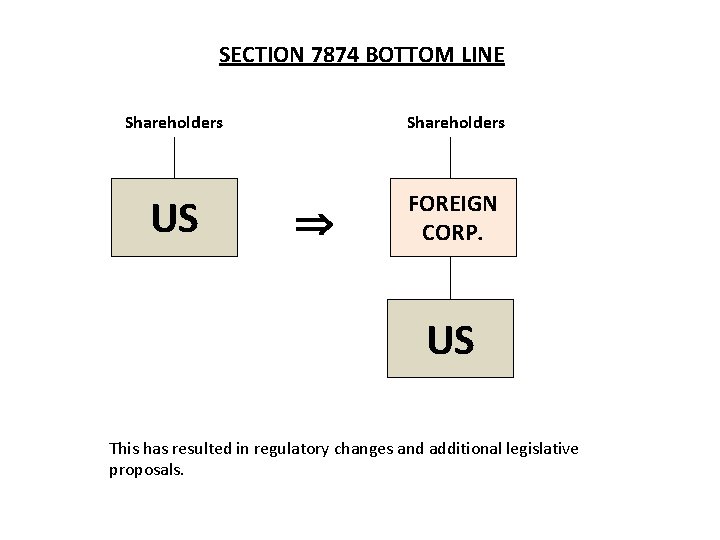
SECTION 7874 BOTTOM LINE Shareholders US FOREIGN CORP. US This has resulted in regulatory changes and additional legislative proposals.
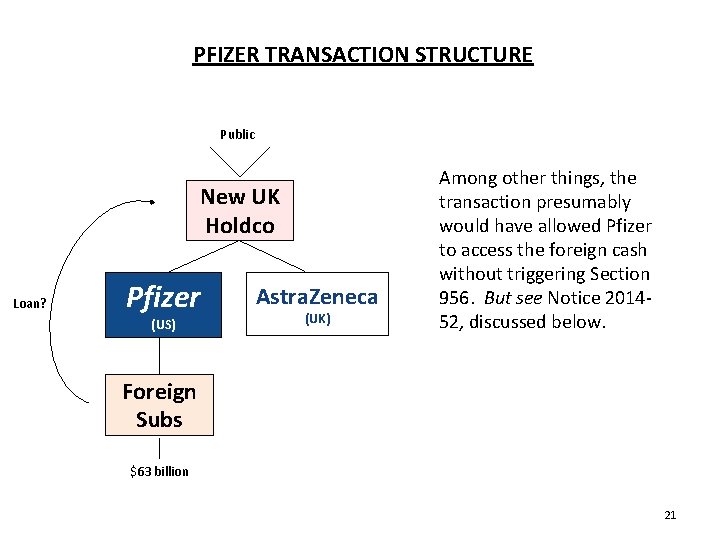
EXAMPLE: PFIZER • Pfizer, the US pharmaceutical company, reportedly has accumulated $63 billion in offshore cash. • In 2014, Pfizer proposed an acquisition of Astra. Zeneca, a UK company, in an inversion transaction designed (among other things) to allow Pfizer to access this cash. • This transaction did not go forward, but Pfizer has recently announced an inversion transaction with Allergan, an Irish company that itself inverted some time ago. 19
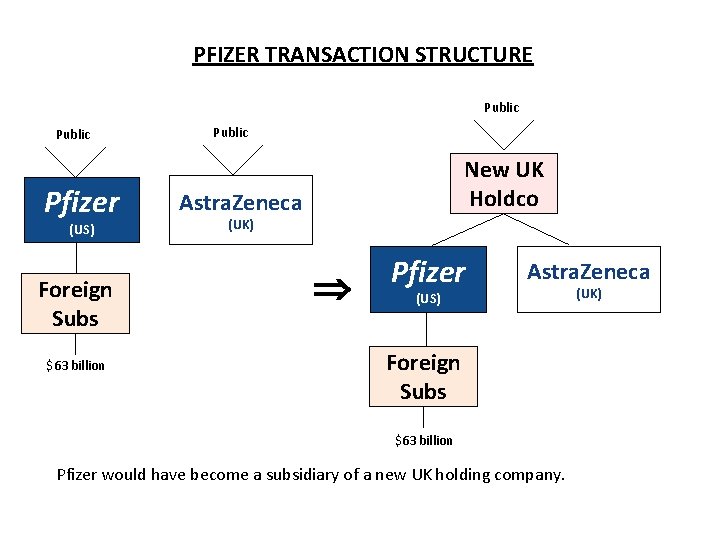
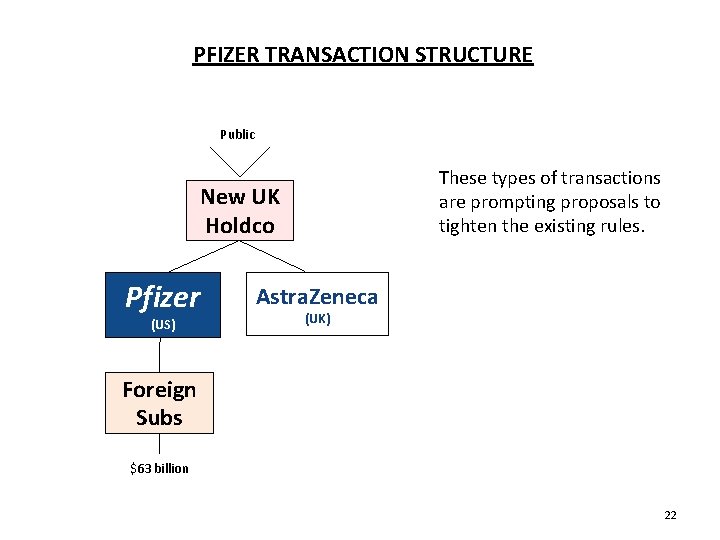
PFIZER TRANSACTION STRUCTURE Public Pfizer (US) Foreign Subs $63 billion Public New UK Holdco Astra. Zeneca (UK) Pfizer Astra. Zeneca (US) Foreign Subs $63 billion Pfizer would have become a subsidiary of a new UK holding company. (UK)
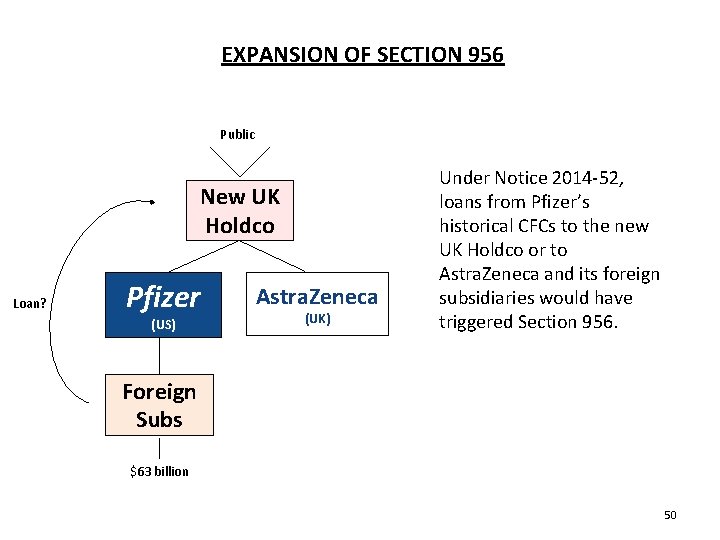
PFIZER TRANSACTION STRUCTURE Public New UK Holdco Loan? Pfizer (US) Astra. Zeneca (UK) Among other things, the transaction presumably would have allowed Pfizer to access the foreign cash without triggering Section 956. But see Notice 201452, discussed below. Foreign Subs $63 billion 21
PFIZER TRANSACTION STRUCTURE Public These types of transactions are prompting proposals to tighten the existing rules. New UK Holdco Pfizer (US) Astra. Zeneca (UK) Foreign Subs $63 billion 22
PFIZER TRANSACTION STRUCTURE – The “sweet spot” under the existing rules is a business combination with a substantial foreign company, with the top surviving entity being a foreign corporation. – This is exactly what Pfizer proposed to Astra. Zeneca.
PFIZER TRANSACTION STRUCTURE Pfizer proposed a transaction that would be taxable to its shareholders under Section 367 but avoids treatment of the new UK holding company as a US corporation under Section 7874. Pfizer shareholders would have held 76 percent of the combined company after the transaction. Pfizer presumably would have grossed up its US managers for any applicable 15 -percent excise tax on the value of their equity comp (Section 4985).
NOTICES 2014 -52 AND 2015 -79 Notice 2014 -52, issued in September 2014, consists of two parts: A. Expand reach of inversion transactions. B. Limit post-inversion tax avoidance. Notice 2015 -79, issued in November 2015, expands upon each of these parts.
NOTICE 2014 -52 (PART 1) A. Expand reach of inversion transactions: 1. Disregard certain foreign corporation stock attributable to passive assets (no foreign cash box). 2. Disregard certain non-ordinary course distributions by domestic entity (no slimming). 3. Guidance on treatment of certain post-transaction transfers of foreign acquiring corporation stock (through spinoff or otherwise).
NO FOREIGN CASH BOX The “no foreign cash box” rules of Notice 2014 -52 expand upon the existing rules for “disqualified stock”.
DISQUALIFIED STOCK “Disqualified stock” of the foreign acquirer is excluded from the denominator of the 60 and 80 percent tests. Disqualified stock generally includes stock issued for: • Cash • Marketable securities • Property itself acquired with a principal purpose of avoiding Section 7874 in a transaction related to the acquisition. See Notice 2009 -78; Temp. Reg. § 1. 7874 -4 T.
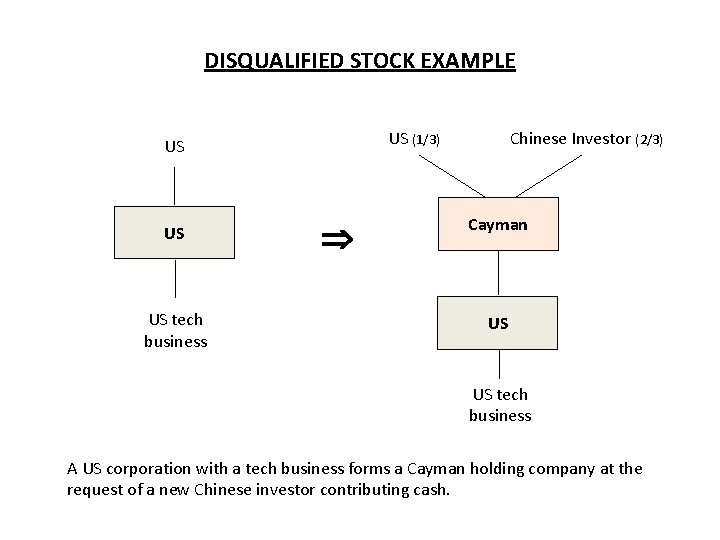
DISQUALIFIED STOCK EXAMPLE US (1/3) US US US tech business Chinese Investor (2/3) Cayman US US tech business A US corporation with a tech business forms a Cayman holding company at the request of a new Chinese investor contributing cash.
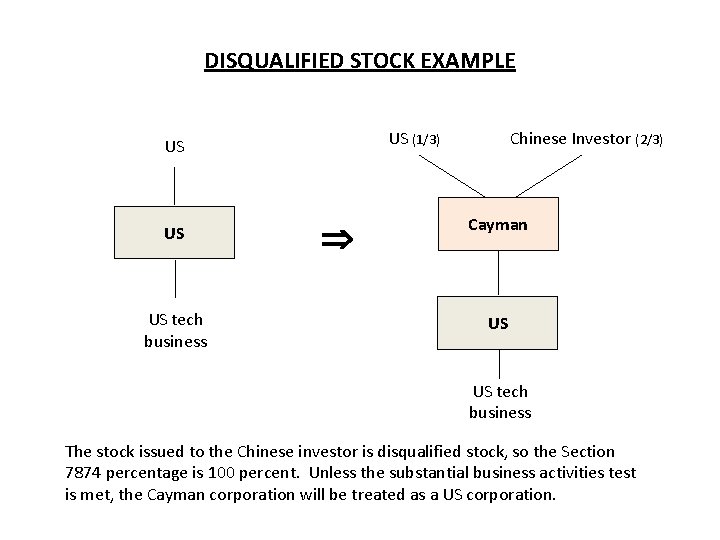
DISQUALIFIED STOCK EXAMPLE US (1/3) US US US tech business Chinese Investor (2/3) Cayman US US tech business The stock issued to the Chinese investor is disqualified stock, so the Section 7874 percentage is 100 percent. Unless the substantial business activities test is met, the Cayman corporation will be treated as a US corporation.
NO FOREIGN CASH BOX Under Notice 2014 -52, if more than 50 percent of the gross value of “foreign group property” constitutes “foreign group nonqualified property”, a portion of the stock of the foreign acquiring corporation will be excluded from the denominator of the ownership fraction. The 50 -percent test is applied after the acquisition and all transactions related to the acquisition, if any, are completed.
APPLICATION OF EXCLUSION If the 50 -percent threshold is satisfied, the excluded portion of the stock of the foreign corporation is that attributable to the foreign group nonqualified property.
FOREIGN GROUP PROPERTY For these purposes, “foreign group property” means any property (including property giving rise to disqualified stock) held by the EAG after the acquisition, other than: • Property acquired in the acquisition that was directly or indirectly held by the domestic corporation; and • To avoid double counting, stock or a partnership interest (and certain obligations) in a member of the EAG.
FOREIGN GROUP NONQUALIFIED PROPERTY “Foreign group nonqualified property” means foreign group property that is: • Cash • Marketable securities • Property itself acquired with a principal purpose of avoiding Section 7874 other than property that gives rise to income described in CFC/PFIC active financial business exceptions.
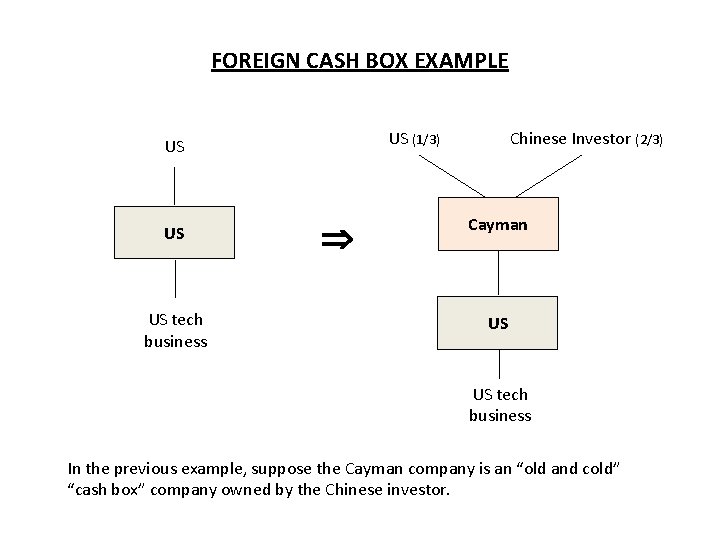
FOREIGN CASH BOX EXAMPLE US (1/3) US US US tech business Chinese Investor (2/3) Cayman US US tech business In the previous example, suppose the Cayman company is an “old and cold” “cash box” company owned by the Chinese investor.
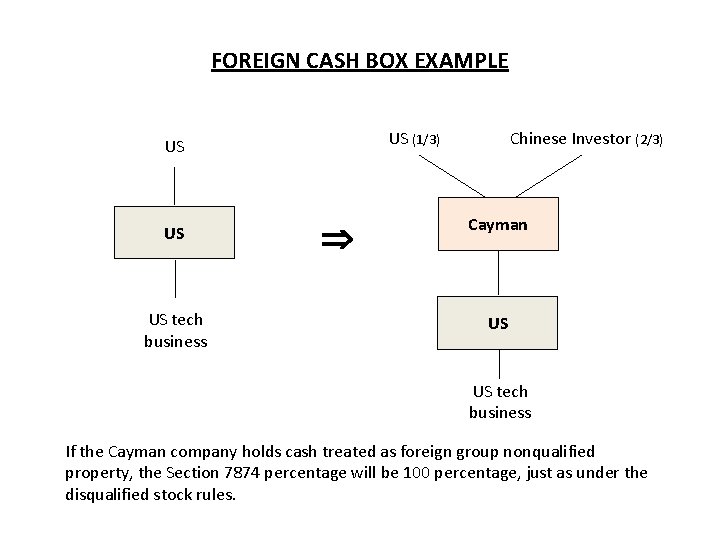
FOREIGN CASH BOX EXAMPLE US (1/3) US US US tech business Chinese Investor (2/3) Cayman US US tech business If the Cayman company holds cash treated as foreign group nonqualified property, the Section 7874 percentage will be 100 percentage, just as under the disqualified stock rules.
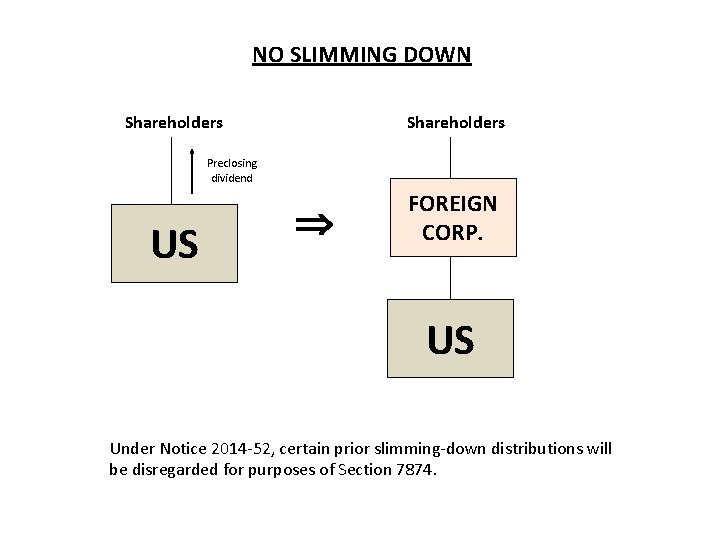
NO SLIMMING DOWN Shareholders Preclosing dividend US FOREIGN CORP. US Under Notice 2014 -52, certain prior slimming-down distributions will be disregarded for purposes of Section 7874.
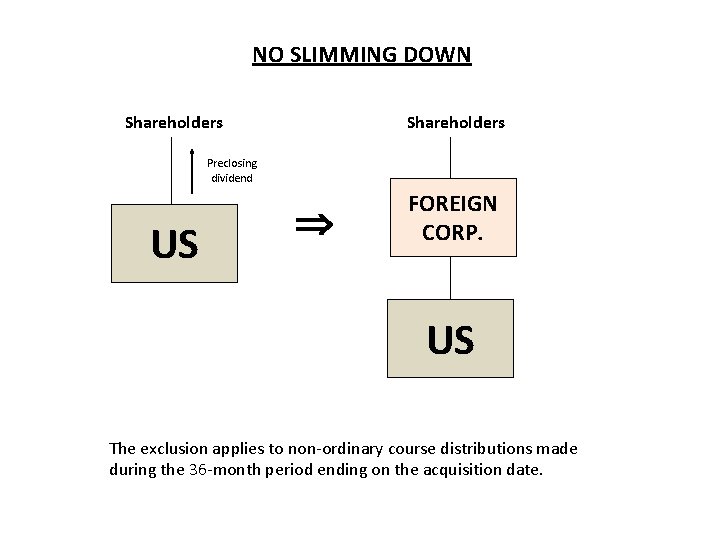
NO SLIMMING DOWN Shareholders Preclosing dividend US FOREIGN CORP. US The exclusion applies to non-ordinary course distributions made during the 36 -month period ending on the acquisition date.
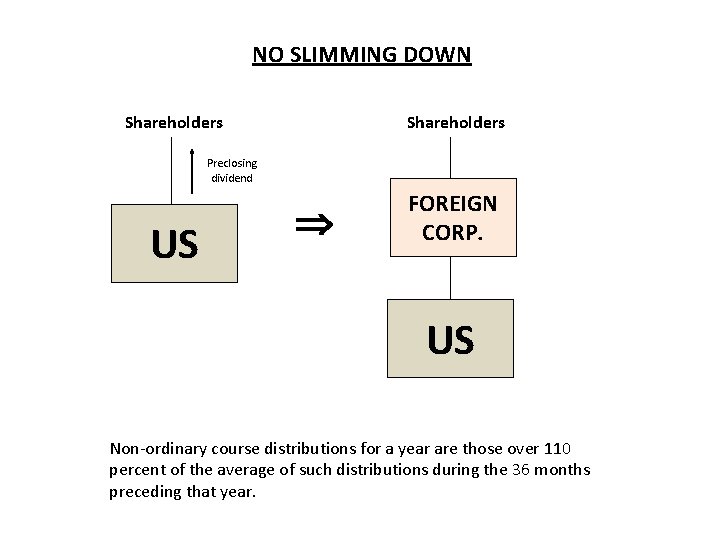
NO SLIMMING DOWN Shareholders Preclosing dividend US FOREIGN CORP. US Non-ordinary course distributions for a year are those over 110 percent of the average of such distributions during the 36 months preceding that year.
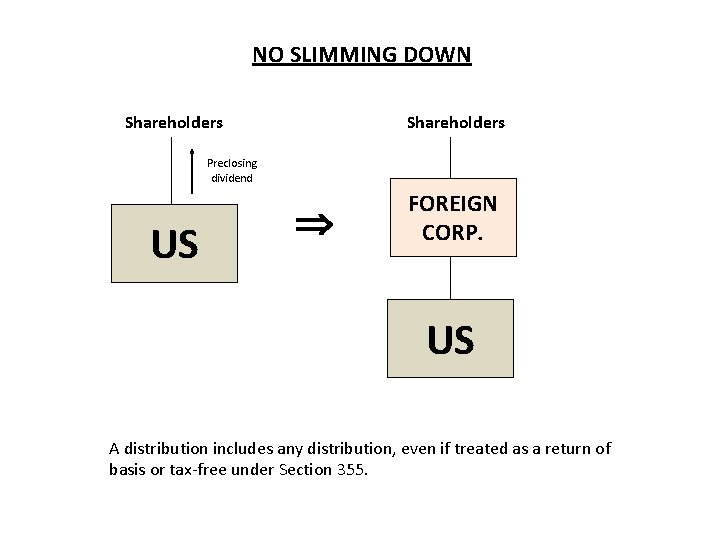
NO SLIMMING DOWN Shareholders Preclosing dividend US FOREIGN CORP. US A distribution includes any distribution, even if treated as a return of basis or tax-free under Section 355.
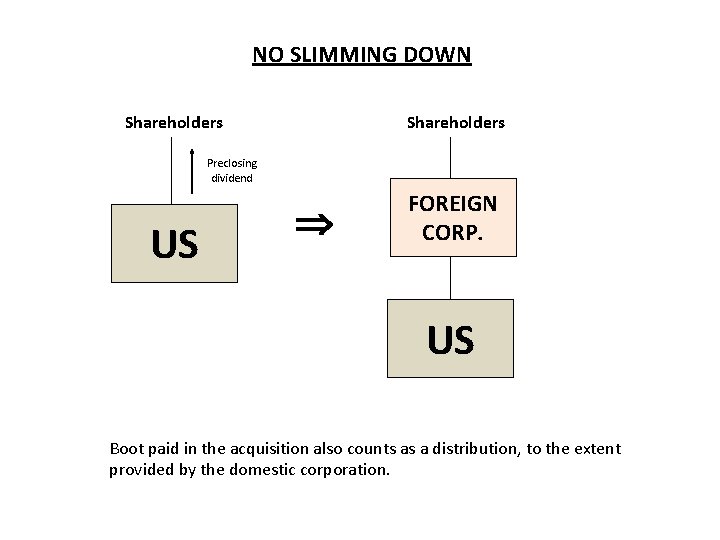
NO SLIMMING DOWN Shareholders Preclosing dividend US FOREIGN CORP. US Boot paid in the acquisition also counts as a distribution, to the extent provided by the domestic corporation.
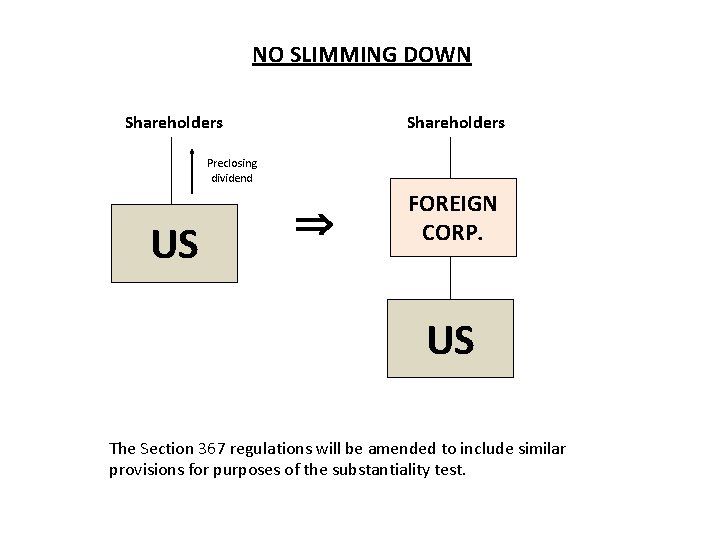
NO SLIMMING DOWN Shareholders Preclosing dividend US FOREIGN CORP. US The Section 367 regulations will be amended to include similar provisions for purposes of the substantiality test.
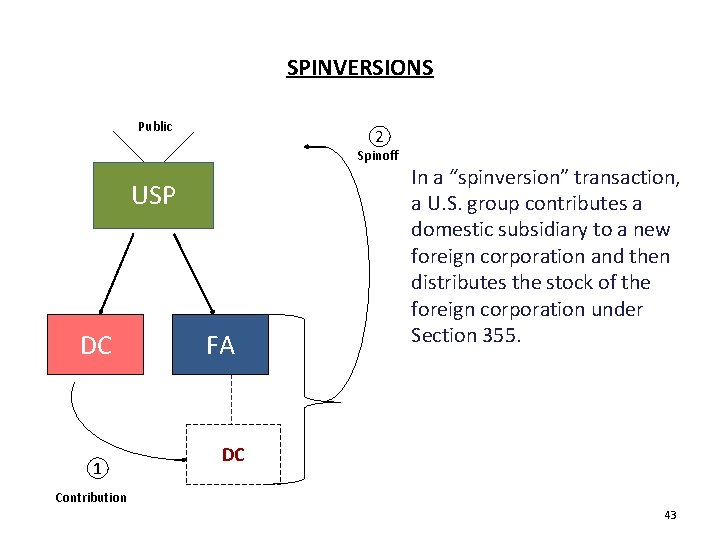
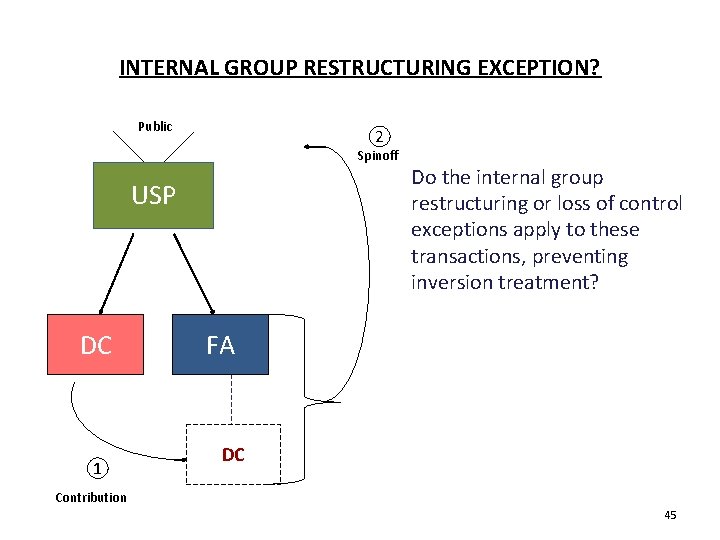
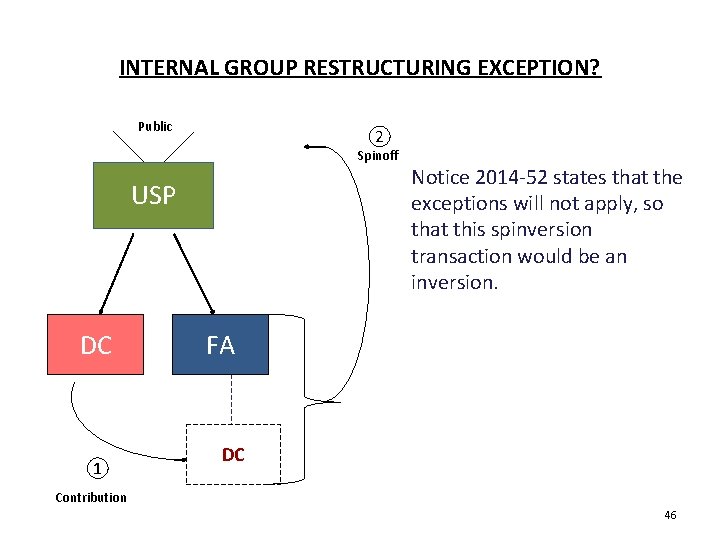
SPINVERSIONS Public 22 Spinoff USP DC 1 FA In a “spinversion” transaction, a U. S. group contributes a domestic subsidiary to a new foreign corporation and then distributes the stock of the foreign corporation under Section 355. DC Contribution 43
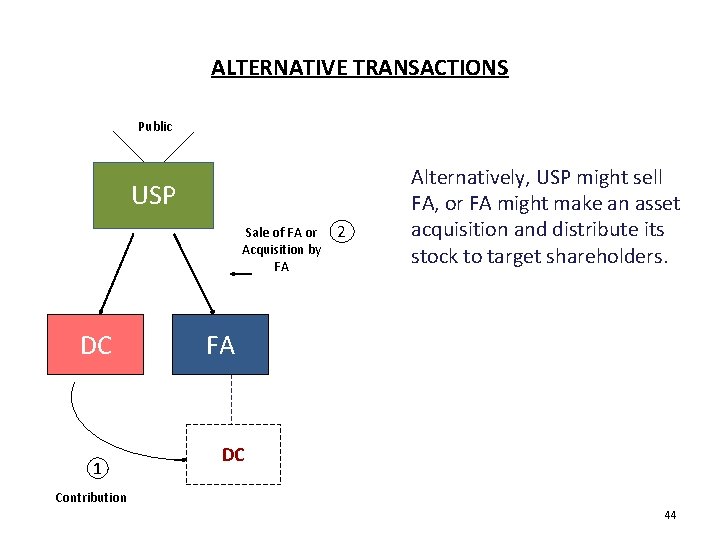
ALTERNATIVE TRANSACTIONS Public USP Sale of FA or Acquisition by FA DC 1 2 Alternatively, USP might sell FA, or FA might make an asset acquisition and distribute its stock to target shareholders. FA DC Contribution 44
INTERNAL GROUP RESTRUCTURING EXCEPTION? Public 22 Spinoff USP DC 1 Do the internal group restructuring or loss of control exceptions apply to these transactions, preventing inversion treatment? FA DC Contribution 45
INTERNAL GROUP RESTRUCTURING EXCEPTION? Public 22 Spinoff USP DC 1 Notice 2014 -52 states that the exceptions will not apply, so that this spinversion transaction would be an inversion. FA DC Contribution 46
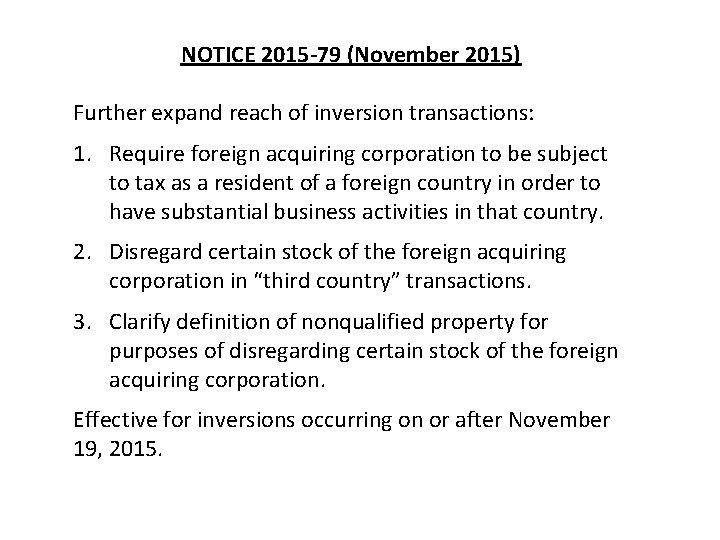
NOTICE 2015 -79 (November 2015) Further expand reach of inversion transactions: 1. Require foreign acquiring corporation to be subject to tax as a resident of a foreign country in order to have substantial business activities in that country. 2. Disregard certain stock of the foreign acquiring corporation in “third country” transactions. 3. Clarify definition of nonqualified property for purposes of disregarding certain stock of the foreign acquiring corporation. Effective for inversions occurring on or after November 19, 2015.
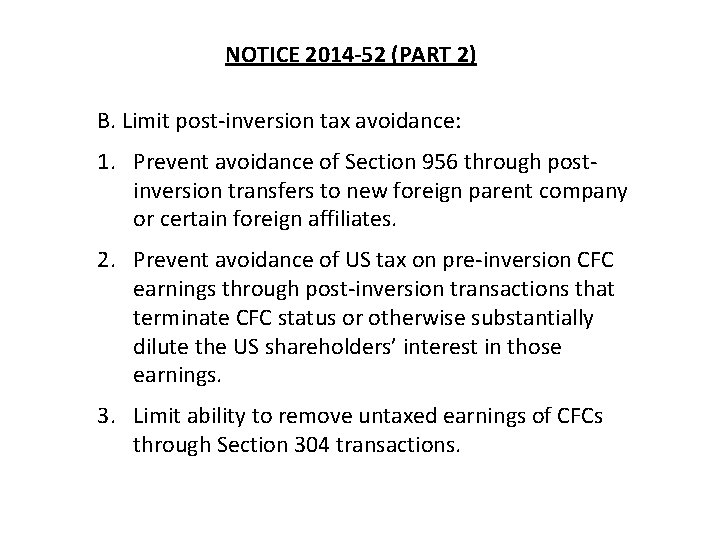
NOTICE 2014 -52 (PART 2) B. Limit post-inversion tax avoidance: 1. Prevent avoidance of Section 956 through postinversion transfers to new foreign parent company or certain foreign affiliates. 2. Prevent avoidance of US tax on pre-inversion CFC earnings through post-inversion transactions that terminate CFC status or otherwise substantially dilute the US shareholders’ interest in those earnings. 3. Limit ability to remove untaxed earnings of CFCs through Section 304 transactions.
EXPANSION OF SECTION 956 According to Notice 2014 -52, the IRS will issue regulations under Section 956(e) providing that any obligation or stock of a “foreign related person” within the meaning of Section 7874(d)(3) other than an “expatriated foreign subsidiary” will be treated as US property to the extent such obligation or stock is acquired by an expatriated foreign subsidiary during the 10 years following the inversion.
EXPANSION OF SECTION 956 Public New UK Holdco Loan? Pfizer (US) Astra. Zeneca (UK) Under Notice 2014 -52, loans from Pfizer’s historical CFCs to the new UK Holdco or to Astra. Zeneca and its foreign subsidiaries would have triggered Section 956. Foreign Subs $63 billion 50
NO CFC DECONTROL OR DILUTION According to Notice 2014 -52, the IRS will issue regulations under Section 7701(l) that will recharacterize transactions designed to terminate CFC status after an inversion.
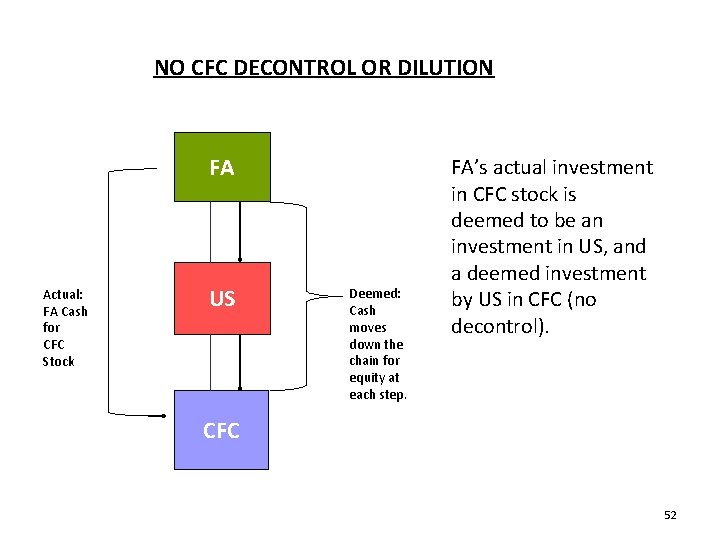
NO CFC DECONTROL OR DILUTION FA Actual: FA Cash for CFC Stock US Deemed: Cash moves down the chain for equity at each step. FA’s actual investment in CFC stock is deemed to be an investment in US, and a deemed investment by US in CFC (no decontrol). CFC 52
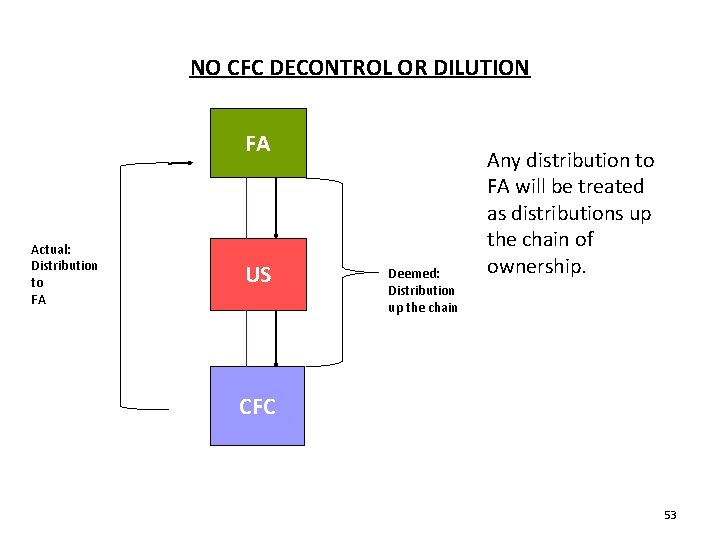
NO CFC DECONTROL OR DILUTION FA Actual: Distribution to FA US Deemed: Distribution up the chain Any distribution to FA will be treated as distributions up the chain of ownership. CFC 53
SECTION 304 TRANSACTIONS According to Notice 2014 -52, the IRS will issue regulations extending the reach of Section 304(b)(5)(B) to plug a possible loophole.
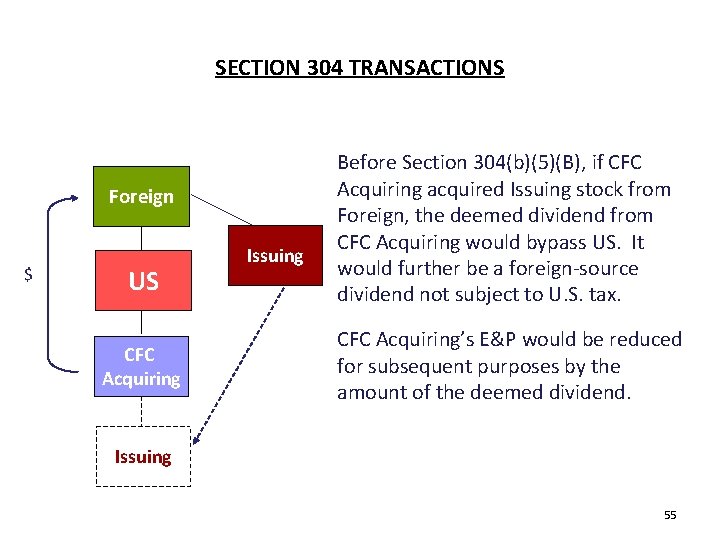
SECTION 304 TRANSACTIONS Foreign $ US CFC Acquiring Issuing Before Section 304(b)(5)(B), if CFC Acquiring acquired Issuing stock from Foreign, the deemed dividend from CFC Acquiring would bypass US. It would further be a foreign-source dividend not subject to U. S. tax. CFC Acquiring’s E&P would be reduced for subsequent purposes by the amount of the deemed dividend. Issuing 55
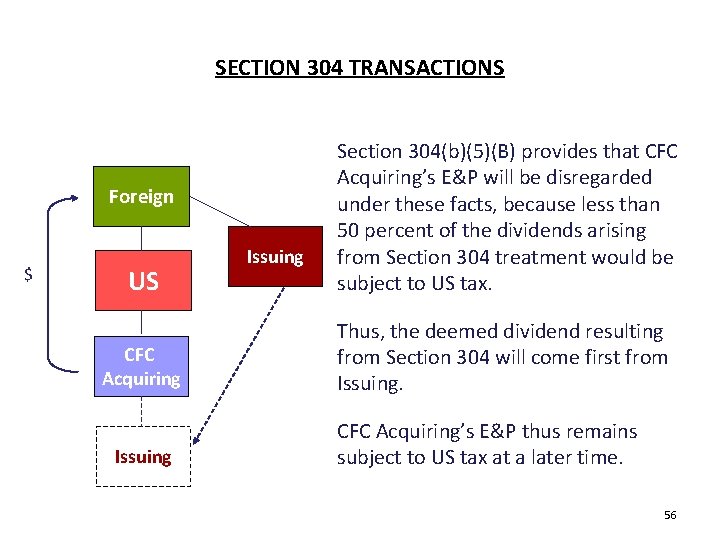
SECTION 304 TRANSACTIONS Foreign $ US CFC Acquiring Issuing Section 304(b)(5)(B) provides that CFC Acquiring’s E&P will be disregarded under these facts, because less than 50 percent of the dividends arising from Section 304 treatment would be subject to US tax. Thus, the deemed dividend resulting from Section 304 will come first from Issuing. CFC Acquiring’s E&P thus remains subject to US tax at a later time. 56
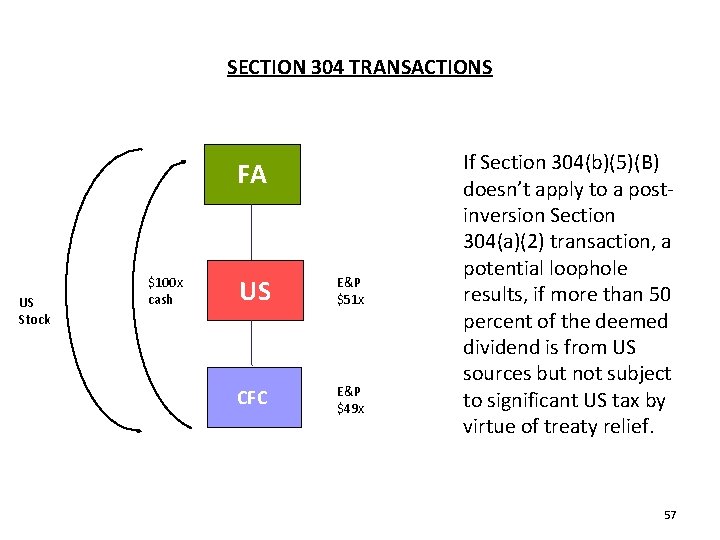
SECTION 304 TRANSACTIONS FA US Stock $100 x cash US E&P $51 x CFC E&P $49 x If Section 304(b)(5)(B) doesn’t apply to a postinversion Section 304(a)(2) transaction, a potential loophole results, if more than 50 percent of the deemed dividend is from US sources but not subject to significant US tax by virtue of treaty relief. 57
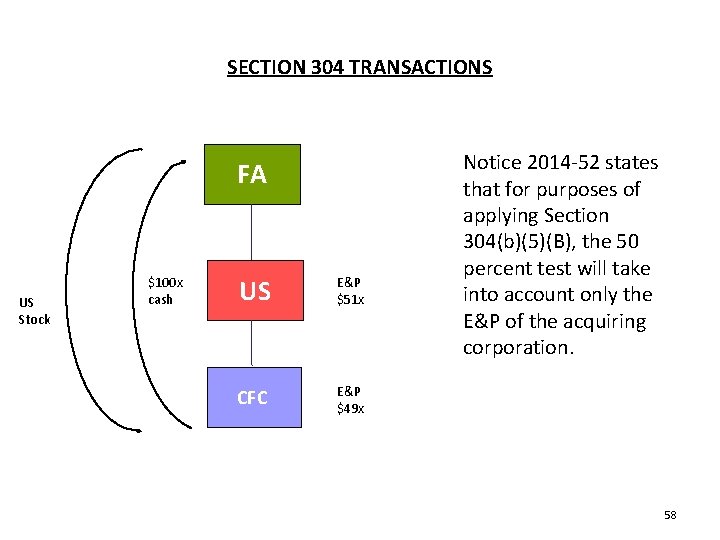
SECTION 304 TRANSACTIONS FA US Stock $100 x cash US E&P $51 x CFC E&P $49 x Notice 2014 -52 states that for purposes of applying Section 304(b)(5)(B), the 50 percent test will take into account only the E&P of the acquiring corporation. 58
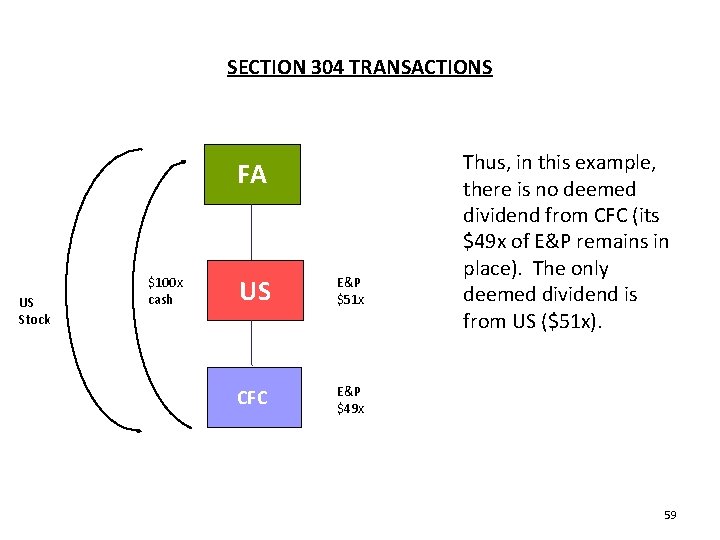
SECTION 304 TRANSACTIONS FA US Stock $100 x cash US E&P $51 x CFC E&P $49 x Thus, in this example, there is no deemed dividend from CFC (its $49 x of E&P remains in place). The only deemed dividend is from US ($51 x). 59
NOTICE 2015 -79 (November 2015) Further limit post-inversion tax avoidance: 1. Expand scope of inversion gain to include certain taxable deemed dividends recognized by an inverted company. 2. Require that all CFC built-in gain be recognized on a restructuring (not limited to Section 1248 amount). Effective for inversions completed on or after September 22, 2014.
CURRENT STATE OF PLAY 1. The IRS is busy writing regulations to flesh out Notices 2014 -52 and 2015 -79. 2. Inversions continue to occur. 3. Pfizer, for example, has announced an inversion transaction with Allergan, an Irish company that itself inverted some time ago. 4. In this transaction, Pfizer shareholders would reportedly receive only 56 percent of the combined company, so the transaction would presumably not be subject to the Section 7874 inversion rules. 5. This illustrates part of the illogic of the present rules: as more companies invert, it makes it easier for additional companies to do so. 6. Also, nothing in the inversion rules stops US persons from forming new businesses offshore in the first place. This eliminates the need for a subsequent inversion, as well as facilitating the inversions of others.
OTHER POSSIBLE REGULATORY RESPONSES – Expansion of anti-avoidance rules of Notice 2014 -52 to transactions not covered by Section 7874 (e. g. , Section 7874 is avoided if the foreign acquirer raises funds through debt or equity offerings and buys the US target for cash). – Special debt-equity rules for inverted corporations.
POSSIBLE LEGISLATIVE RESPONSES – The Obama Administration has already proposed the tightening of Section 7874 in response to the continuing appeal of inversions (2015 Green Book). – General idea is to reduce the 80 percent deemed US corporation threshold to 50 percent, so combining with somebody smaller won’t work. – Also, in terrorem proposal to turn foreign corporation into deemed US corporation (regardless of ownership) if the group has substantial business activities in the US and the foreign corporation is US managed following the transaction. – Possible tightening of Section 163(j) interest deduction rules, either for inverted corporations or foreign corporations generally.
POSSIBLE TREATY RESPONSES – Proposed changes to the US Model Treaty would eliminate treaty withholding tax relief for deductible payments by inverted entities. – Such payments would thus generally become subject to 30 - percent US withholding tax, eliminating most of the earnings stripping benefit. – It would take decades, however, for the US to negotiate new treaties to implement this change. – Alternatively, the US could move to override its treaties unilaterally through legislation, but this would raise political concerns.
CONCLUSION – Inversions are evidence that the existing US outbound rules are broken. – Need for fundamental US international tax reform.