
The Fair Labor Standards Act Adams and Reese
The Fair Labor Standards Act Adams and Reese LLP
Fair Labor Standards Act • Federal Minimum Wage: $7. 25/hour • Overtime: 1 ½ times the regular rate of pay for all hours over 40 hours in a work week
“White Collar” Exemptions • Section 13(a)(1) of the FLSA provides an exemption from both minimum wage and overtime pay for employees who are employed in a bona fide: – – Executive; Administrative; Professional; or Outside Sales capacity. • Certain computer employees may be exempt professionals under Section 13(a)(1) or exempt under Section 13(a)(17) of the FLSA.
Three Tests for Exemption • Salary Level • Salary Basis • Job Duties
Department of Labor Proposes to Update Salary Levels for Exemption • To ensure FLSA’s intended overtime protections are fully implemented • To simplify the identification of overtimeprotected (non-exempt) and exempt employees
Department of Labor Proposes to Change the Salary Requirement of the Highly Compensated Employee (HCE) • To ensure that the HCE exemption covers only employees who almost invariably meet all the other requirements for exemption
Department of Labor Proposes to Automatically Update the Salary Levels Annually • To ensure they maintain effectiveness going forward • To eliminate the need to go through the time consuming and cumbersome rulemaking process
Department of Labor Is Seeking Comments on the Duties Tests • To determine whether the tests are working as intended • To address concern that current tests may allow exemption of employees who perform a disproportionate amount of nonexempt work (e. g. grocery store managers)

Salary Level
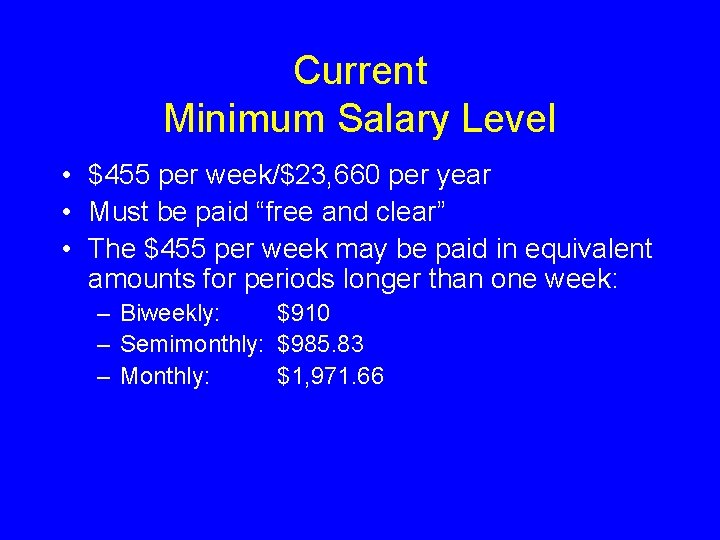
Current Minimum Salary Level • $455 per week/$23, 660 per year • Must be paid “free and clear” • The $455 per week may be paid in equivalent amounts for periods longer than one week: – Biweekly: $910 – Semimonthly: $985. 83 – Monthly: $1, 971. 66
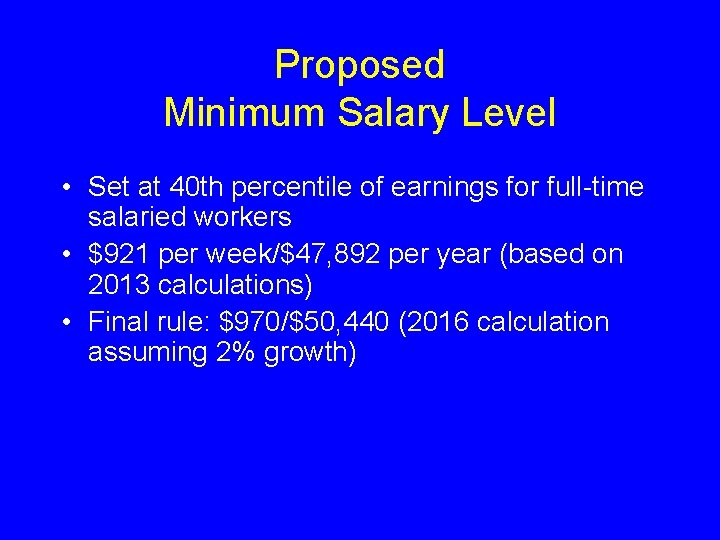
Proposed Minimum Salary Level • Set at 40 th percentile of earnings for full-time salaried workers • $921 per week/$47, 892 per year (based on 2013 calculations) • Final rule: $970/$50, 440 (2016 calculation assuming 2% growth)
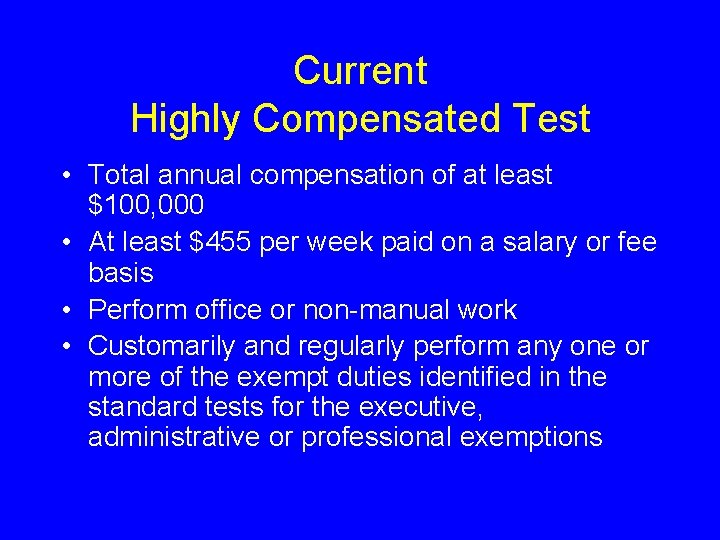
Current Highly Compensated Test • Total annual compensation of at least $100, 000 • At least $455 per week paid on a salary or fee basis • Perform office or non-manual work • Customarily and regularly perform any one or more of the exempt duties identified in the standard tests for the executive, administrative or professional exemptions
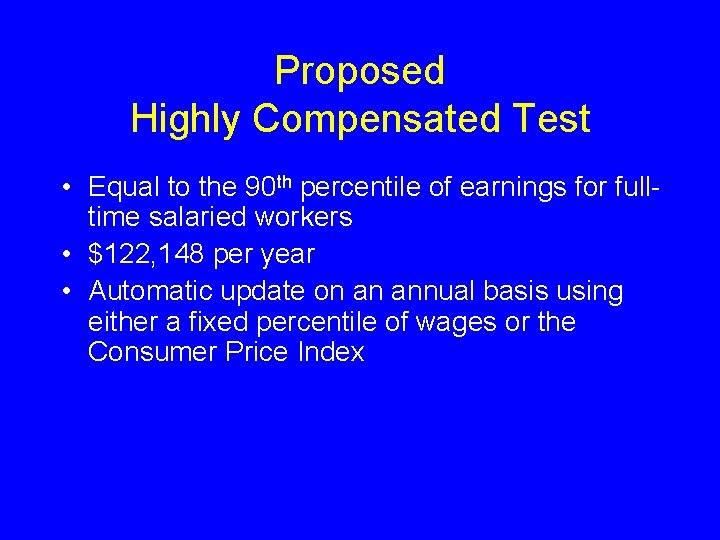
Proposed Highly Compensated Test • Equal to the 90 th percentile of earnings for fulltime salaried workers • $122, 148 per year • Automatic update on an annual basis using either a fixed percentile of wages or the Consumer Price Index
Salary Level Test Does Not Apply • • Doctors Lawyers Teachers Outside sales employees
Salary Basis
Salary Basis Test • Regularly receives a predetermined amount of compensation each pay period (on a weekly or less frequent basis) • The compensation cannot be reduced because of variations in the quality or quantity of the work performed • Must be paid the full salary for any week in which the employee performs any work • Need not be paid for any workweek when no work is performed
Deductions From Salary Generally • An employee is not paid on a salary basis if deductions from the predetermined salary are made for absences occasioned by the employer or by the operating requirements of the businesses • If the employee is ready, willing and able to work, deductions may not be made for time when work in not available
Deductions From Salary of Exempt Public Employees • Deductions of less than one day permitted for public employees whose accrued personal leave and sick leave have been exhausted • Based on concept that public employers cannot pay for services not rendered
Review of Duties Tests
Executive Exemption $921/$47, 892 • Primary duty is the management of the business or customarily recognized subdivision • Must regularly direct the work of two or more full-time employees or equivalent (four parttime employees will suffice) • Must have authority to hire or fire or give recommendations that have “particular weight” about hiring, firing, advancement, promotion or other change of status
Primary Duty • Spend more than 50% of time performing exempt work (rule of thumb) • If spend less than 50%, may still be exempt depending upon: – Relative importance of exempt duties versus other duties – Time spent on exempt work – Freedom from supervision – Relationship of employee’s salary to wages paid to employees performing same kind of nonexempt work – Ex. -food service manager – Ex. -transportation supervisor
“Particular Weight” • Whether it is part of the employee’s job duties to make such recommendations • The frequency with which recommendations are made or requested • The frequency with which upper management relies on the employee’s recommendations
Management • Interviewing, selecting, and training employees • Setting and adjusting pay and work hours • Maintaining production or sales records • Appraising employee productivity and efficiency • Handling employee complaints and grievances • Disciplining employees • Planning and apportioning work among employees
Management • Determining the techniques to be used; the type of materials, supplies, machinery, equipment or tools to be used; or the merchandise to be bought, stocked and sold • Providing for the safety and security of employees or property • Planning and controlling the budget • Monitoring or implementing legal compliance measures
Impact on School Districts • • Cafeteria manager Transportation supervisor Other non-educator supervisors All must make at least $47, 892 per year to be exempt
Administrative Exemption $921/$47, 892 • Primary duty is performance of office or non-manual work directly related to the management policies or general business operations of the employer; and • Includes the exercise of discretion and independent judgment with respect to matters of significance
Discretion and Independent Judgment • The comparison and evaluation of possible courses of conduct, and acting or making a decision after the various possibilities have been considered • Must be exercised with respect to “matters of significance, ” which refers to the level of importance or consequence of the work performed • Decisions and recommendations may be reviewed at a higher level and, upon occasion, revised or reversed
Questions to Ask • Does employee’s work affect policy or does the employee carry out policies determined by top management? • Is the employee’s work of substantial importance to the management or operation of the business? • Are the employee’s duties generally regarded as administrative or servicing rather than production tasks? • Does the employee have the authority to make independent choices, free from immediate direction and supervision with respect to matters of significance? • Does the employee’s work require the employee to make comparisons and evaluate possible courses of conduct and to act or make a decision after various possibilities have been considered?
Examples • Academic administrators (specific exemption for administrative employees whose primary duty is performing administrative functions directly related to academic instruction or training in an education establishment) • Business managers • Human resource and employee benefit managers • Public relations directors • Must make at least $921/$47, 892
Professional Exemption $921/$47, 892 • Primary duty involves performance of work requiring knowledge of an advanced type in a field of science or learning customarily acquired by a prolonged course of specialized intellectual instruction; or • Performance of work requiring invention, originality or talent in a recognized field of artistic or creative endeavor.
Professional Exemption (cont’d) • “Advanced knowledge” cannot be attained at the high school level • Is primarily intellectual in character and usually requires consistent exercise of discretion and judgment, as opposed to routine, mental, manual, mechanical, or physical work • Mechanical arts or skilled trades are not included within term “field of science or learning”
Professional Exemption (cont’d) • Must be a profession where specialized academic training is a standard prerequisite for entrance into the profession • Applies also to employees in those professions who have substantially the same level of knowledge and perform substantially the same work as degreed employees but who attained the advanced knowledge through a combination of work experience and intellectual instruction
Examples • Teachers-primary duty of teaching, tutoring, instructing or lecturing in the activity of imparting knowledge and who is employed and engaged in this activity as a teacher in an educational establishment (no salary requirement) • Nurses-RNs exempt; LPNs not exempt • Accountants-exempt – Accounting clerks, bookkeepers not exempt • Athletic trainers-exempt if completed four years of preprofessional study in accredited program and are certified by Board of Certification of the National Athletic Trainers Association
“Computer Professional” Exemption • Bona fide salary of at least $921/wk or on an hourly basis not less than $27. 63 an hour • Primary duty: – Application of systems analysis, techniques and procedures, which includes consultations with computer users to determine hardware, software or system functional specifications; or – Design, development, documentation, analysis, creation, testing, or modification of computer systems or programs based on and related to users specifications; or – Design, documentation, testing, creation or modification of computer programs related to machine operating systems; or – Any combination of the above duties
“Computer Professional” Exemption (cont’d) • Does not apply to computer operators or to employees engaged in computer manufacturing, repair or maintenance • Does not apply to employees whose work is highly dependent upon or facilitated by the use of computers and computer software programs but who do not perform the computer analysis or programming duties
The Fair Labor Standards Act Adams and Reese LLP
- Slides: 36