Florida Fish and Wildlife Conservation Commission Fire and
- Slides: 21
Florida Fish and Wildlife Conservation Commission Fire and Wildlife Habitat Restoration Johanna Freeman, Ph. D student Johanna Freeman (jfree 11@ufl. edu) UF School of Forest Resources and Conservation
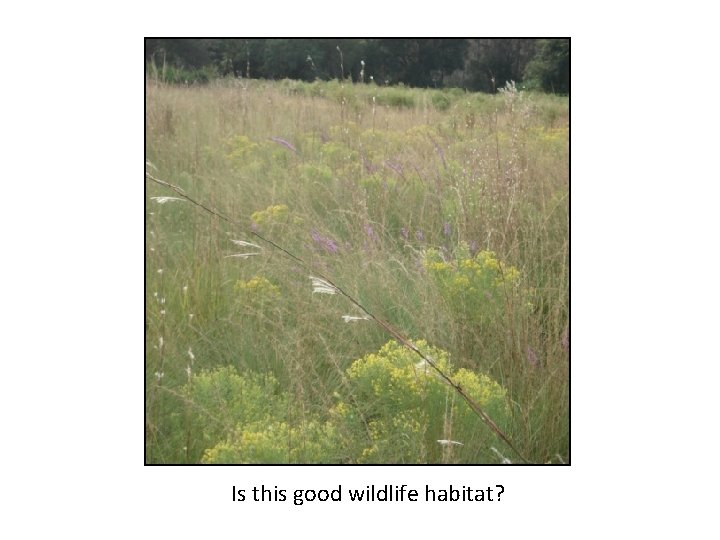
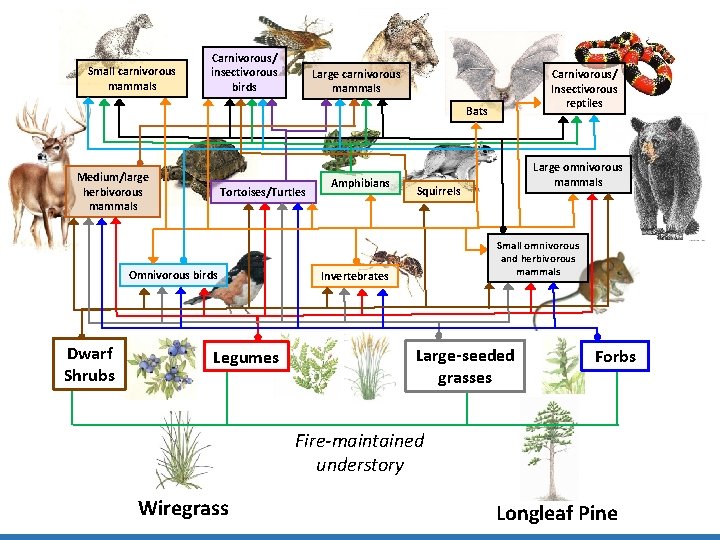
Is this good wildlife habitat?
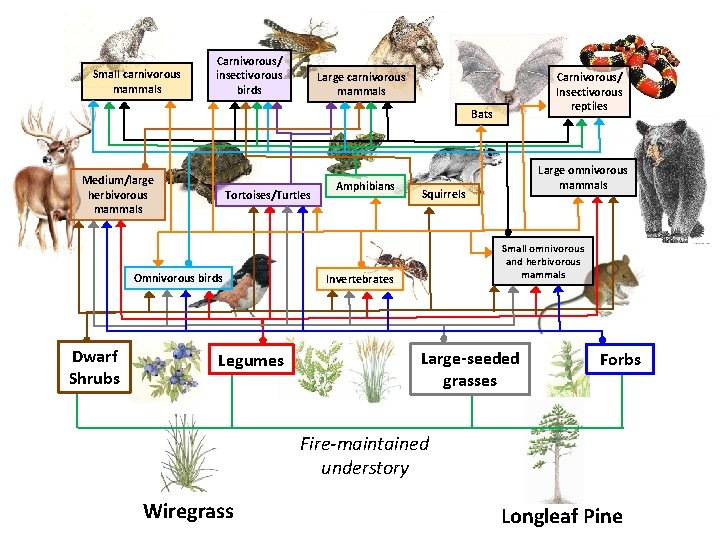
Small carnivorous mammals Carnivorous/ insectivorous birds Large carnivorous mammals Carnivorous/ Insectivorous reptiles Bats Medium/large herbivorous mammals Tortoises/Turtles Omnivorous birds Dwarf Shrubs Legumes Amphibians Large omnivorous mammals Squirrels Small omnivorous and herbivorous mammals Invertebrates Large-seeded grasses Forbs Fire-maintained understory Wiregrass Longleaf Pine
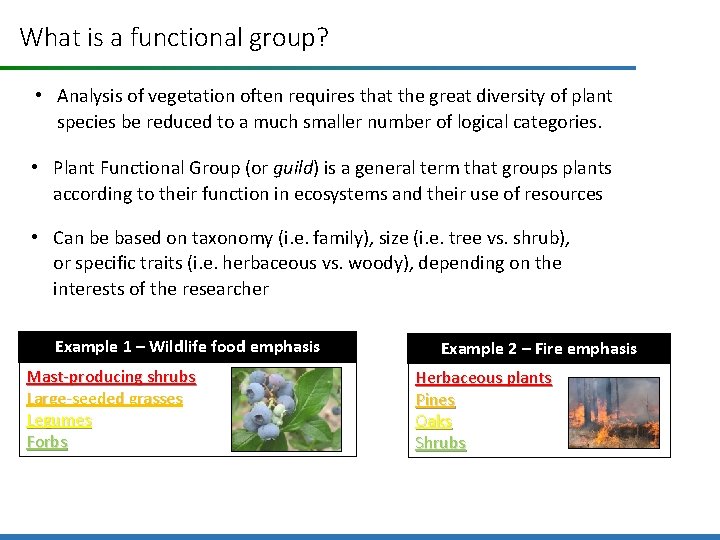
What is a functional group? • Analysis of vegetation often requires that the great diversity of plant species be reduced to a much smaller number of logical categories. • Plant Functional Group (or guild) is a general term that groups plants according to their function in ecosystems and their use of resources • Can be based on taxonomy (i. e. family), size (i. e. tree vs. shrub), or specific traits (i. e. herbaceous vs. woody), depending on the interests of the researcher Example 1 – Wildlife food emphasis Mast-producing shrubs Large-seeded grasses Legumes Forbs Example 2 – Fire emphasis Herbaceous plants Pines Oaks Shrubs
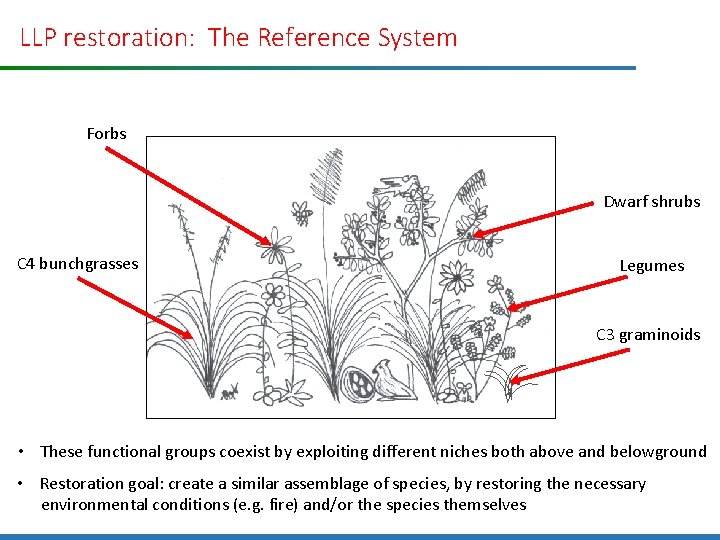
LLP restoration: The Reference System Forbs Dwarf shrubs C 4 bunchgrasses Legumes C 3 graminoids • These functional groups coexist by exploiting different niches both above and belowground • Restoration goal: create a similar assemblage of species, by restoring the necessary environmental conditions (e. g. fire) and/or the species themselves
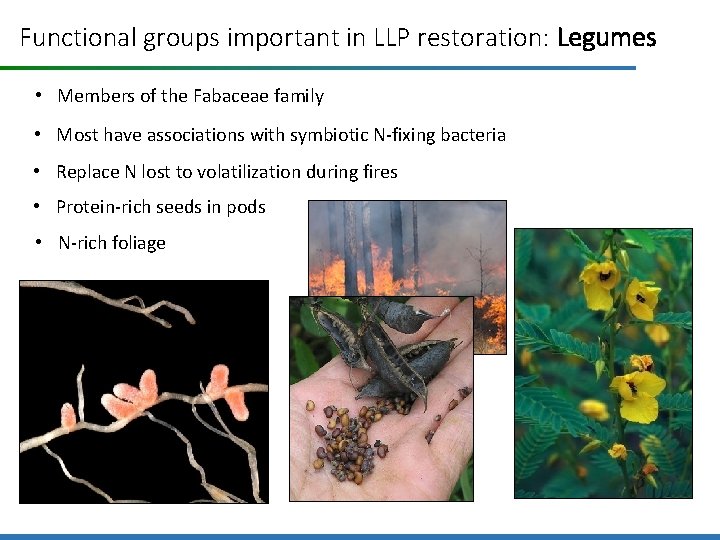
Functional groups important in LLP restoration: Legumes • Members of the Fabaceae family • Most have associations with symbiotic N-fixing bacteria • Replace N lost to volatilization during fires • Protein-rich seeds in pods • N-rich foliage
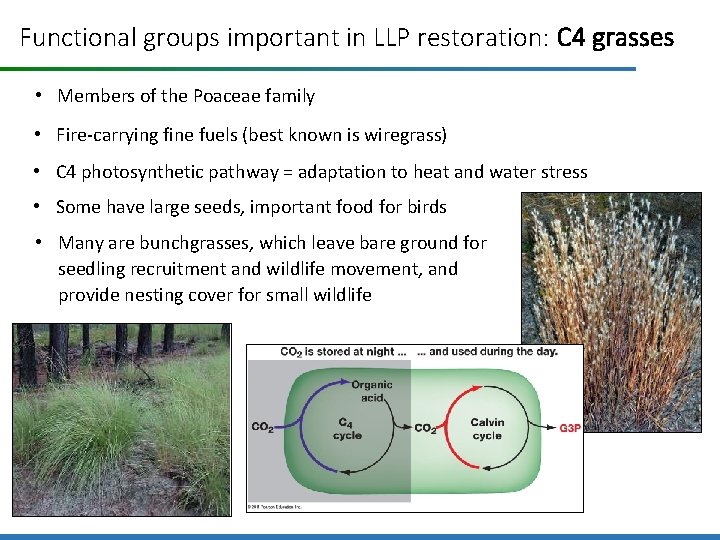
Functional groups important in LLP restoration: C 4 grasses • Members of the Poaceae family • Fire-carrying fine fuels (best known is wiregrass) • C 4 photosynthetic pathway = adaptation to heat and water stress • Some have large seeds, important food for birds • Many are bunchgrasses, which leave bare ground for seedling recruitment and wildlife movement, and provide nesting cover for small wildlife
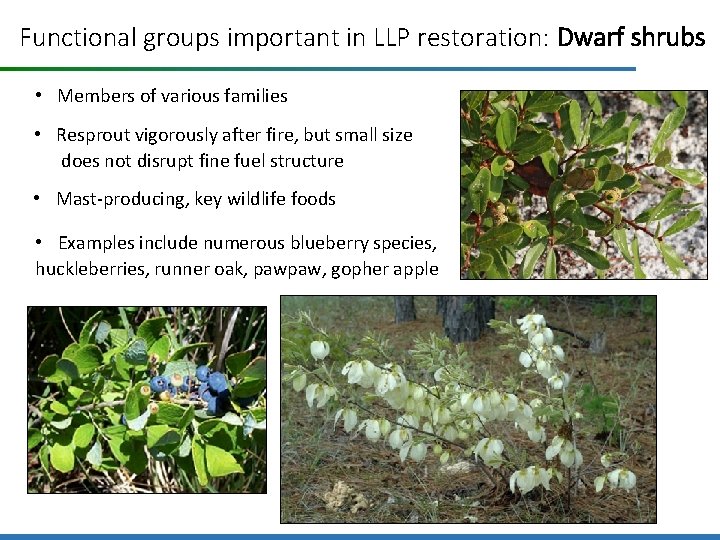
Functional groups important in LLP restoration: Dwarf shrubs • Members of various families • Resprout vigorously after fire, but small size does not disrupt fine fuel structure • Mast-producing, key wildlife foods • Examples include numerous blueberry species, huckleberries, runner oak, pawpaw, gopher apple
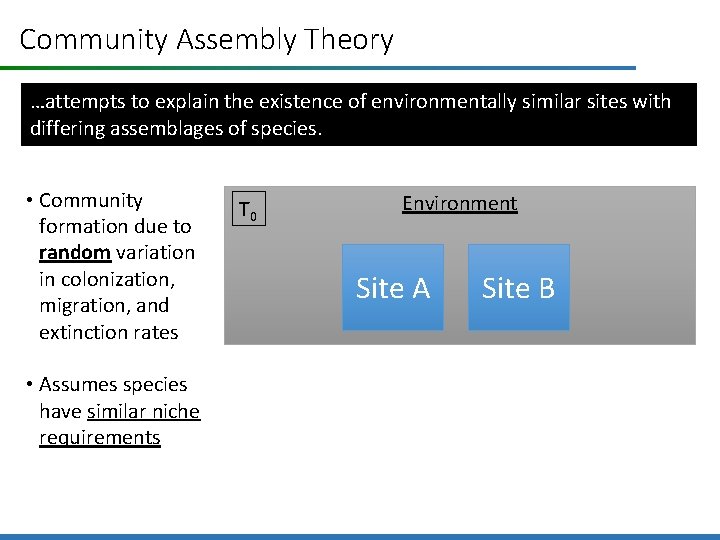
Community Assembly Theory …attempts to explain the existence of environmentally similar sites with differing assemblages of species. • Community formation due to random variation in colonization, migration, and extinction rates • Assumes species have similar niche requirements T 0 Environment Site A Site B
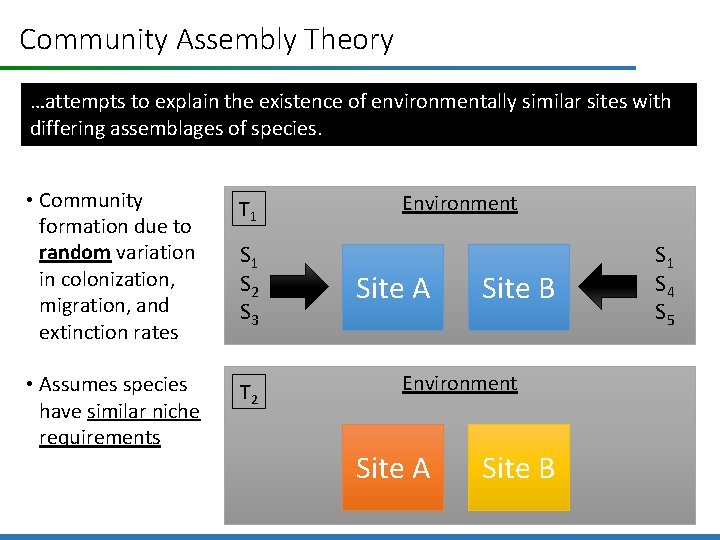
Community Assembly Theory …attempts to explain the existence of environmentally similar sites with differing assemblages of species. • Community formation due to random variation in colonization, migration, and extinction rates T 1 • Assumes species have similar niche requirements T 2 S 1 S 2 S 3 Environment Site A Site B S 1 S 4 S 5
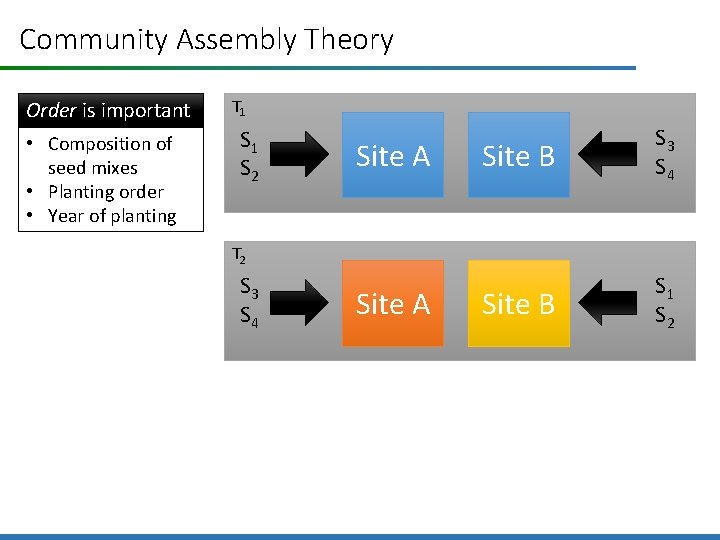
Community Assembly Theory Order is important • Composition of seed mixes • Planting order • Year of planting T 1 S 2 Site A Site B S 3 S 4 Site B S 1 S 2 T 2 S 3 S 4 Site A
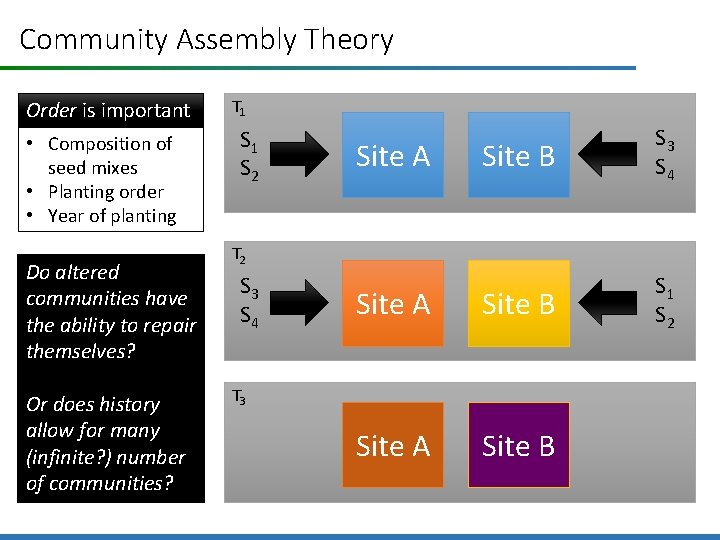
Community Assembly Theory Order is important • Composition of seed mixes • Planting order • Year of planting Do altered communities have the ability to repair themselves? Or does history allow for many (infinite? ) number of communities? T 1 S 2 Site B S 3 S 4 Site A Site B S 1 S 2 Site A Site B Site A T 2 S 3 S 4 T 3
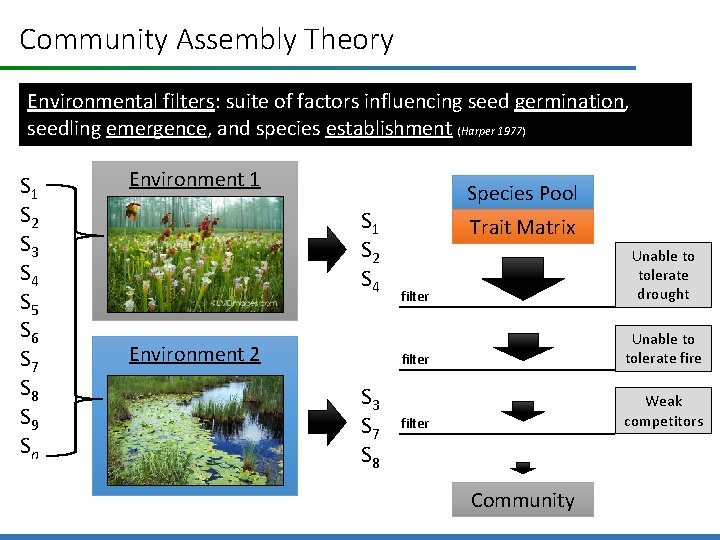
Community Assembly Theory Environmental filters: suite of factors influencing seed germination, seedling emergence, and species establishment (Harper 1977) S 1 S 2 S 3 S 4 S 5 S 6 S 7 S 8 S 9 Sn Environment 1 S 2 S 4 Environment 2 S 3 S 7 S 8 Species Pool Trait Matrix filter Unable to tolerate drought filter Unable to tolerate fire filter Weak competitors Community
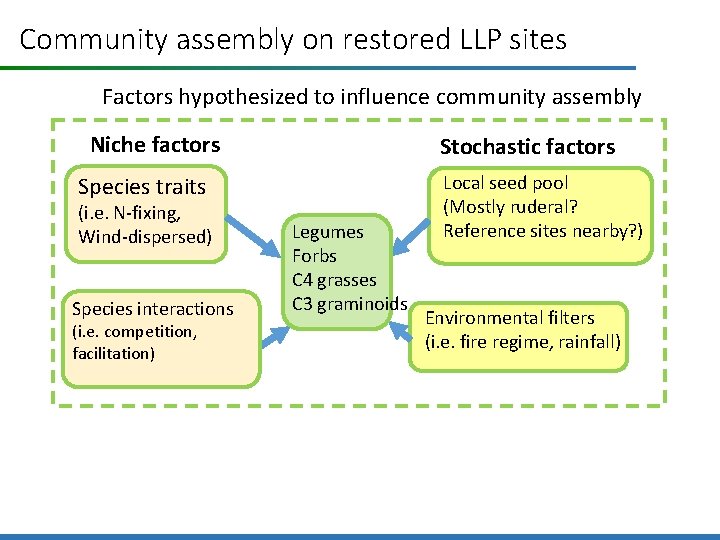
Community assembly on restored LLP sites Factors hypothesized to influence community assembly Niche factors Stochastic factors Species traits (i. e. N-fixing, Wind-dispersed) Species interactions (i. e. competition, facilitation) Legumes Forbs C 4 grasses C 3 graminoids Local seed pool (Mostly ruderal? Reference sites nearby? ) Environmental filters (i. e. fire regime, rainfall)
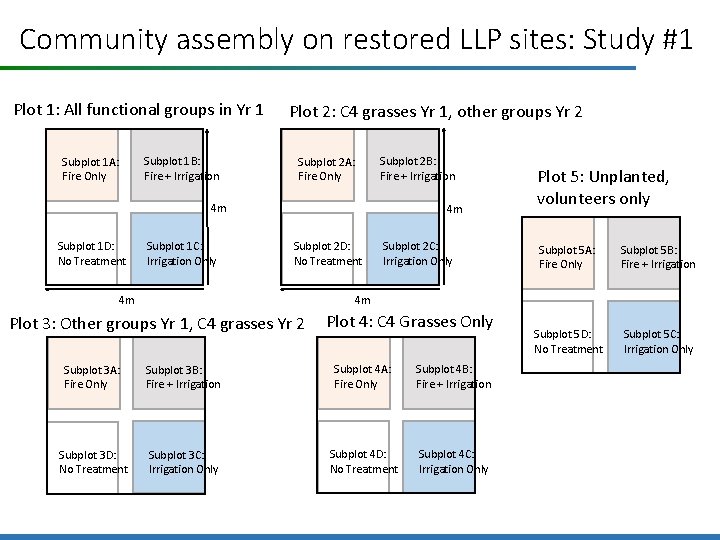
Community assembly on restored LLP sites: Study #1 Plot 1: All functional groups in Yr 1 Subplot 1 A: Fire Only Subplot 1 B: Fire + Irrigation Plot 2: C 4 grasses Yr 1, other groups Yr 2 Subplot 2 A: Fire Only Subplot 2 B: Fire + Irrigation 4 m Subplot 1 D: No Treatment Subplot 1 C: Irrigation Only 4 m Subplot 2 D: No Treatment 4 m Subplot 2 C: Irrigation Only Plot 5: Unplanted, volunteers only Subplot 5 A: Fire Only Subplot 5 B: Fire + Irrigation Subplot 5 D: No Treatment Subplot 5 C: Irrigation Only 4 m Plot 3: Other groups Yr 1, C 4 grasses Yr 2 Plot 4: C 4 Grasses Only Subplot 3 A: Fire Only Subplot 3 B: Fire + Irrigation Subplot 4 A: Fire Only Subplot 4 B: Fire + Irrigation Subplot 3 D: No Treatment Subplot 3 C: Irrigation Only Subplot 4 D: No Treatment Subplot 4 C: Irrigation Only
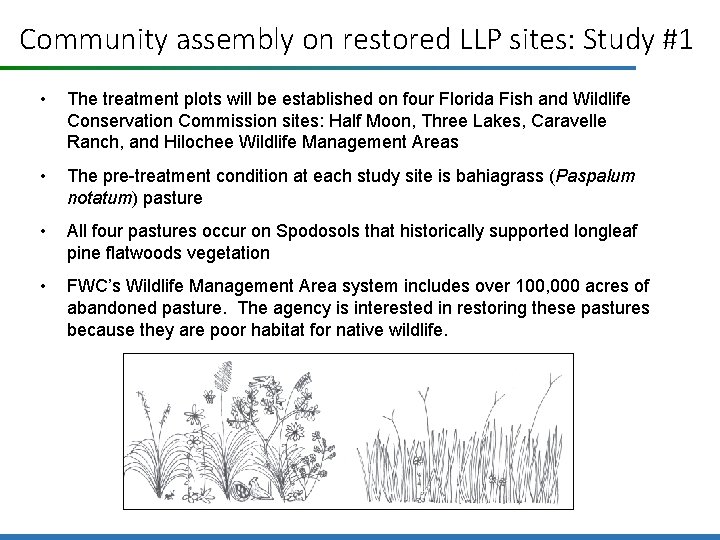
Community assembly on restored LLP sites: Study #1 • The treatment plots will be established on four Florida Fish and Wildlife Conservation Commission sites: Half Moon, Three Lakes, Caravelle Ranch, and Hilochee Wildlife Management Areas • The pre-treatment condition at each study site is bahiagrass (Paspalum notatum) pasture • All four pastures occur on Spodosols that historically supported longleaf pine flatwoods vegetation • FWC’s Wildlife Management Area system includes over 100, 000 acres of abandoned pasture. The agency is interested in restoring these pastures because they are poor habitat for native wildlife.
Community assembly on restored LLP sites: Study #2 “If you build it, they will come…? ”
Community assembly on restored LLP sites: Study #2 • Beneficial effects of fuel treatments on understory structural parameters (i. e. decreased woody cover/increased herbaceous cover) have been documented by several researchers in longleaf pine systems…. • But it appears that certain plant functional groups important to wildlife may be chronically underrepresented on restored sites (Provencher et al 2001, Kirkman et al. 2004, Kreye et al. 2013). • Few studies have isolated and examined the functional group composition of restored longleaf pine understories, and those that have addressed these parameters have been experimental studies at a single location • The proposed project will offer a new perspective by surveying plant communities on numerous restored sites across a wide geographic area
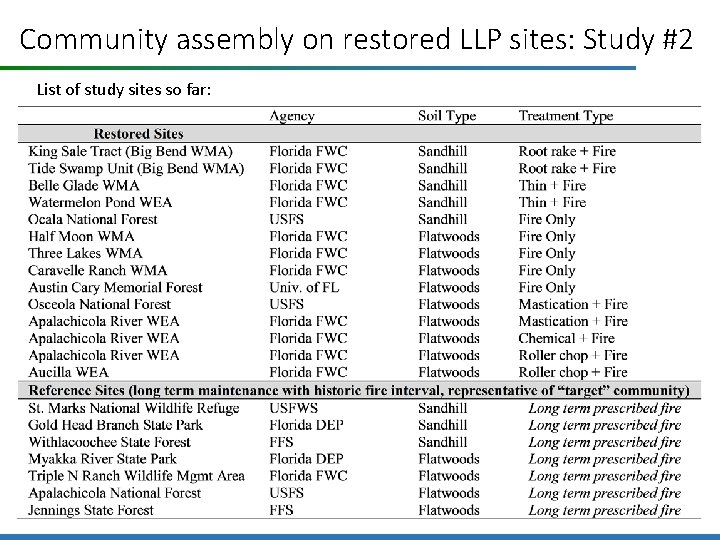
Community assembly on restored LLP sites: Study #2 List of study sites so far:
Community assembly on restored LLP sites: Study #2 All of the plant species found in this study will be classified according to - functional group (legume, shrub, grass, or forb), - seed dispersal type (wind, gravity, animal, or ant), - seed bank longevity (persistent vs. not persistent), - reproductive strategy (seed, vegetative, or both), - life span (annual vs. perennial) and - life history strategy Site variables will include: -pre-treatment fire-free interval; -type, frequency, and seasonality of treatment; -time since treatment; and -proximity to reference sites
Small carnivorous mammals Carnivorous/ insectivorous birds Large carnivorous mammals Carnivorous/ Insectivorous reptiles Bats Medium/large herbivorous mammals Tortoises/Turtles Omnivorous birds Dwarf Shrubs Legumes Amphibians Large omnivorous mammals Squirrels Small omnivorous and herbivorous mammals Invertebrates Large-seeded grasses Forbs Fire-maintained understory Wiregrass Longleaf Pine