
MSF Holland in Myanmar Reproductive tract infections 18












- Slides: 36
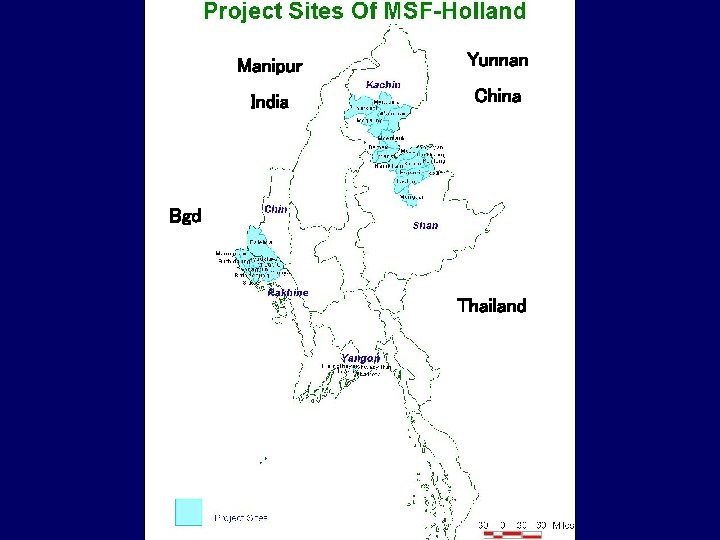
MSF Holland in Myanmar Reproductive tract infections 18 MSF clinics in Myanmar – Capital – North – East – West
Manipur Yunnan India China Bgd Thailand
STI management in resource poor setting ⇛ Symptoms. ⇛ Lab ⇛ The syndromic STI management was developed, which uses clinical algorithms based on STI syndromes, with or without lab. support
Syndromic approach for the diagnosis of cervicitis is inadequate • Cervicitis lacks specific signs and symptoms • A large group of women with sub-clinical and asymptomatic cervicitis (GC 50%, CT 75%) Syndromic approach does not address ⇛ There is not much of a syndrome. • And microscopy is not sensitive (40 -50%) for GC. • Simple CT test not (yet) available.
Considerations for STI management • People with high-risk behavior (SW, male clients SW, MSM) are the main reservoir of STI. • For a-symptomatic STI carriers, – regular (monthly) screening for STI – or regular mass treatment, – for high-risk women (and MSM).
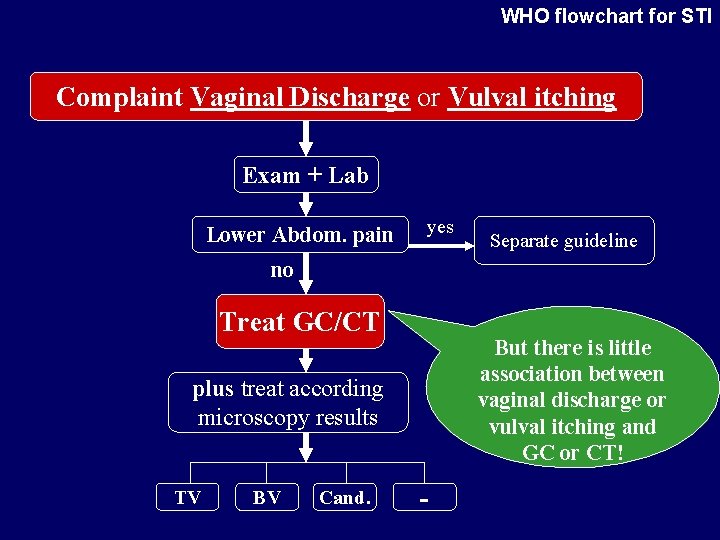
WHO flowchart for STI Complaint Vaginal Discharge or Vulval itching Exam + Lab Lower Abdom. pain yes Separate guideline no Treat GC/CT But there is little association between vaginal discharge or vulval itching and GC or CT! plus treat according microscopy results TV BV Cand. -
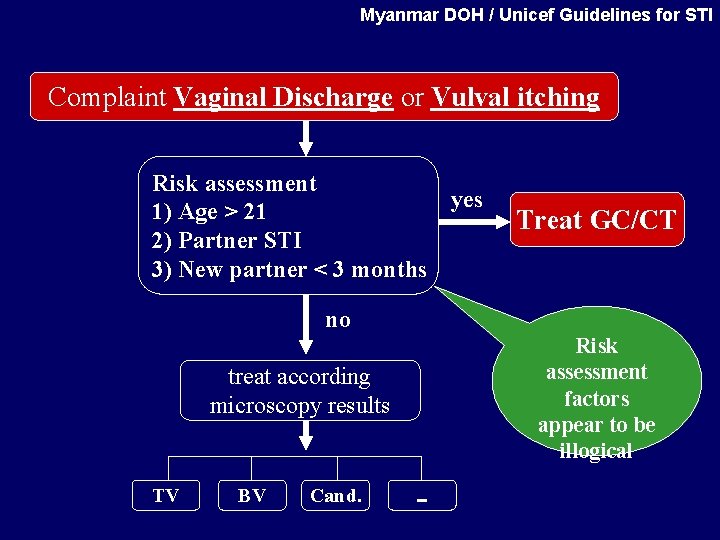
Myanmar DOH / Unicef Guidelines for STI Complaint Vaginal Discharge or Vulval itching Risk assessment yes 1) Age > 21 2) Partner STI 3) New partner < 3 months Treat GC/CT no Risk assessment factors appear to be illogical treat according microscopy results TV BV Cand. -
MSF started a modified flow chart • Flow chart based on a combination of • Risk factors • Symptoms / signs • Laboratory tests
MSF flowchart in Myanmar Women with or without symptoms - Previous STD “confirmed” = (2) - Previous STD-like complaints = (1) - Partner complains genital symptoms = (2) Risk assessment - Partners discharge/ ulcer observed = (3) - Single woman in high-risk area = (1) - New partner within 3 months = (2) - Husband assumed to visit SWs = (2) - SW = (3) <3 Low risk >= 3 High risk Treat GC/CT treat according to phys. exam + microscopy results
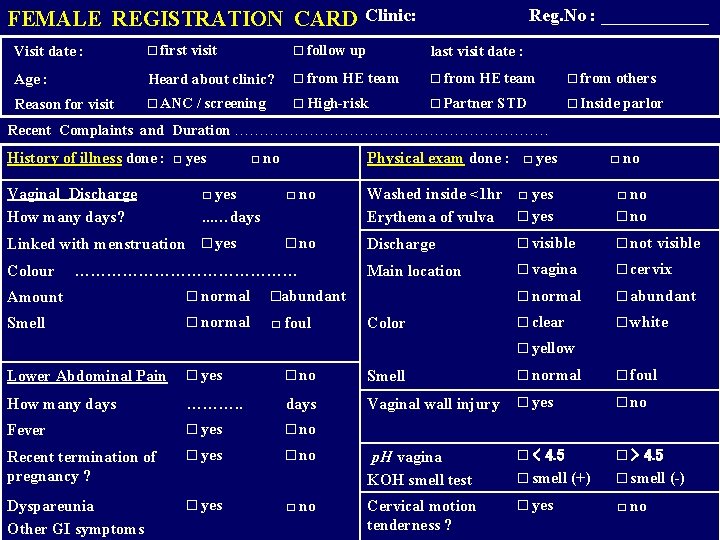
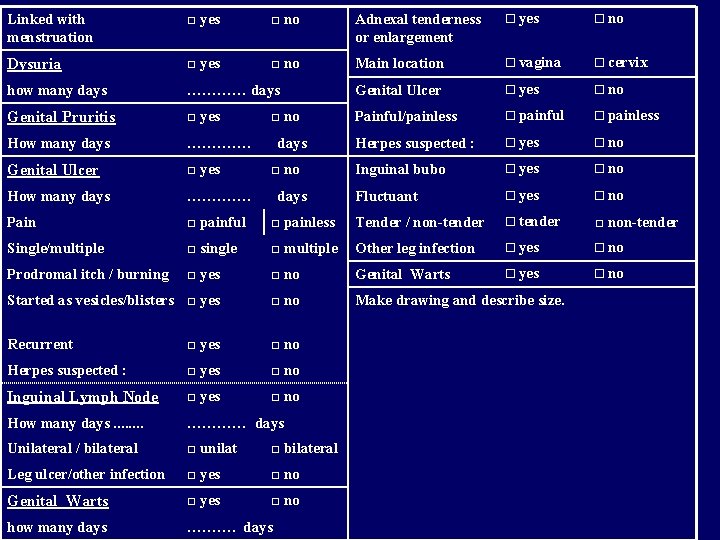
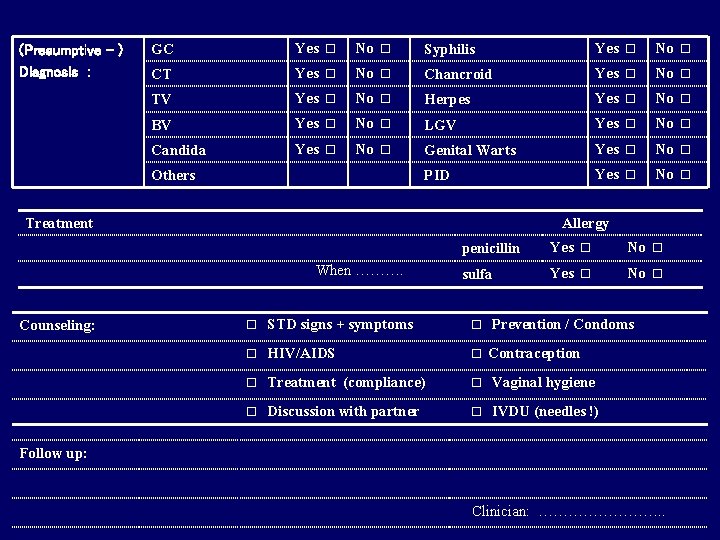
And a new patient STI registration form • Systematically record symptoms, signs and laboratory results. • Put the records in a data base.
FEMALE REGISTRATION CARD Clinic: Reg. No : ______ Visit date : □ first visit □ follow up last visit date : Age : Heard about clinic? □ from HE team □ from others Reason for visit □ ANC / screening □ High-risk □ Partner STD □ Inside parlor Recent Complaints and Duration …………………………… History of illness done : □ yes Vaginal Discharge How many days? □ yes. . . …days Linked with menstruation □ yes Colour Physical exam done : □ yes □ no Washed inside <1 hr □ yes Erythema of vulva □ yes □ no Discharge □ visible □ not visible Main location □ vagina □ cervix □ normal □ abundant □ clear □ white ………………… Amount □ normal □abundant Smell □ normal □ foul Color □ no □ yellow Lower Abdominal Pain □ yes □ no Smell □ normal □ foul How many days ………. . days Vaginal wall injury □ yes □ no Fever □ yes □ no Recent termination of pregnancy ? □ yes □ no p. H vagina KOH smell test □ < 4. 5 □ smell (+) □ > 4. 5 □ smell (-) Dyspareunia Other GI symptoms □ yes □ no Cervical motion tenderness ? □ yes □ no
Linked with menstruation □ yes □ no Adnexal tenderness or enlargement □ yes □ no Dysuria □ yes □ no Main location □ vagina □ cervix how many days ………… days Genital Ulcer □ yes □ no Genital Pruritis □ yes Painful/painless □ painful □ painless How many days …………. Herpes suspected : □ yes □ no Genital Ulcer □ yes Inguinal bubo □ yes □ no How many days …………. Fluctuant □ yes □ no Pain □ painful □ painless Tender / non-tender □ non-tender Single/multiple □ single □ multiple Other leg infection □ yes □ no Prodromal itch / burning □ yes □ no Genital Warts □ yes □ no Started as vesicles/blisters □ yes □ no Make drawing and describe size. Recurrent □ yes □ no Herpes suspected : □ yes □ no Inguinal Lymph Node □ yes □ no How many days. . . . ………… days Unilateral / bilateral □ unilat □ bilateral Leg ulcer/other infection □ yes □ no Genital Warts □ yes □ no how many days ………. days □ no days
For all women who visit the STD clinic : Single woman high-risk area (1) SW (3) Previous STD “confirmed” (2) Previous STD-like complaints (1) Score : _____ Define High or Low Risk group Yes/No New partner within 3 months (2) Husband assumed to visit SW (2) Partner complains genital sympt(2) Partners genit. sympt observed(3) Low Risk ( ≤ 2) □ Yes/No High-risk ( ≥ 3) □ For SWs at regular clinic visits only : Risk assessment for Cervical Infection o o Complains of ‘abnormal’ thick yellow discharge since her last visit ? Pain during sexual intercourse ? More than 5 clients a day (on average) ? Unprotected sex with new clients ? Yes Yes □ □ No□ No□ Score: If 2 questions “yes” Risk assessment (+) always treat for Cervicitis (GC + CT) Condom use □ regular □ rare □ never year started use. . Previous STD □ yes □ no What ………. When ………. Last menstruation □ Regular □ Irregular started : . . …… Pregnant Y/N Contraception □ yes □ no Other skin condition □ yes □ no □ urticaria □ crab lice □ scabies □ other
(Presumptive - ) Diagnosis : GC Yes □ No □ Syphilis Yes □ No □ CT Yes □ No □ Chancroid Yes □ No □ TV Yes □ No □ Herpes Yes □ No □ BV Yes □ No □ LGV Yes □ No □ Candida Yes □ No □ Genital Warts Yes □ No □ PID Yes □ No □ Others Treatment Allergy When ………. Counseling: penicillin Yes □ No □ sulfa Yes □ No □ □ STD signs + symptoms □ Prevention / Condoms □ HIV/AIDS □ Contraception □ Treatment (compliance) □ Vaginal hygiene □ Discussion with partner □ IVDU (needles !) Follow up: Clinician: …………. .
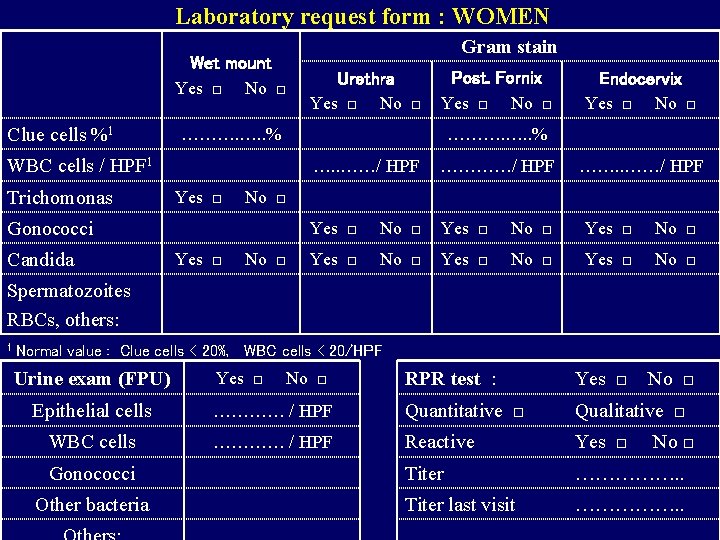
Laboratory request form : WOMEN Wet mount Yes □ No □ Clue cells %1 Post. Fornix Yes □ No □ Yes □ Endocervix Yes □ No □ ………. …. . % …. . ……/ HPF ……. . ……/ HPF Yes □ No □ Yes □ No □ Gonococci Candida Urethra Yes □ No □ ………. …. . % WBC cells / HPF 1 Trichomonas Gram stain No □ Spermatozoites RBCs, others: 1 Normal value : Clue cells < 20%, WBC cells < 20/HPF Urine exam (FPU) Yes □ No □ RPR test : Yes □ No □ Epithelial cells ………… / HPF Quantitative □ Qualitative □ WBC cells ………… / HPF Reactive Yes □ Titer ……………. . Titer last visit ……………. . Gonococci Other bacteria No □
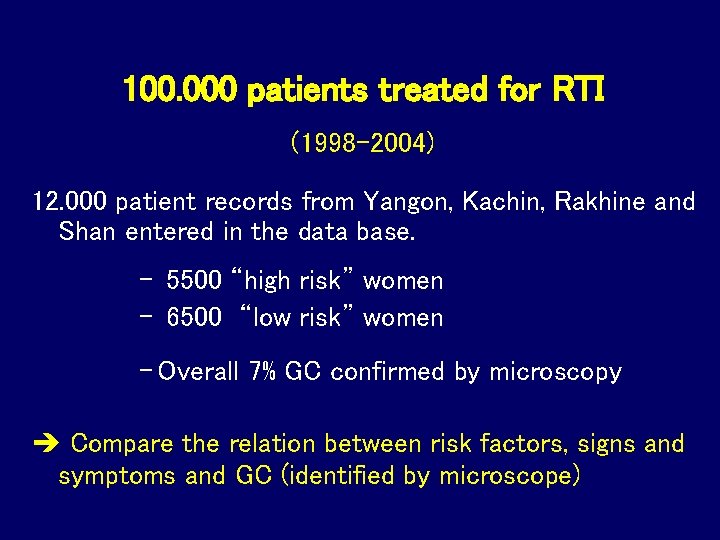
100. 000 patients treated for RTI (1998 -2004) 12. 000 patient records from Yangon, Kachin, Rakhine and Shan entered in the data base. – 5500 “high risk” women – 6500 “low risk” women – Overall 7% GC confirmed by microscopy Compare the relation between risk factors, signs and symptoms and GC (identified by microscope)
Correlation between risk factors and GC Risk factors GC (%) OR 73/270 (27%) 4. 9 449/3632 (12%) 2. 7 105/637 (17%) 2. 6 New partner within 3 months 202/1623 (12%) 2. 0 Previous STD confirmed 202/1777 (11%) 1. 8 Single women in high risk area 172/1742 (10%) 1. 5 Previous STD like complaint 274/2828 (10%) 1. 5 Husband assumed to visit SWs 152/1478 (10%) 1. 5 Partner discharge or ulcer observed Sex worker Partner complaint genital symptoms
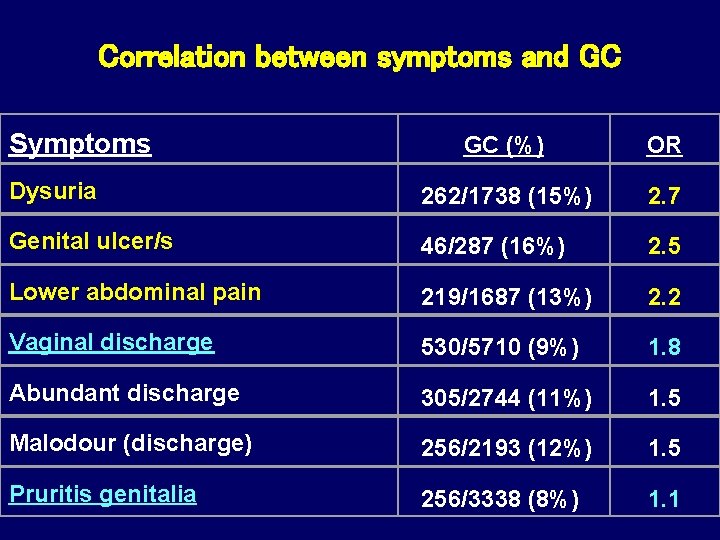
Correlation between symptoms and GC Symptoms GC (%) OR Dysuria 262/1738 (15%) 2. 7 Genital ulcer/s 46/287 (16%) 2. 5 Lower abdominal pain 219/1687 (13%) 2. 2 Vaginal discharge 530/5710 (9%) 1. 8 Abundant discharge 305/2744 (11%) 1. 5 Malodour (discharge) 256/2193 (12%) 1. 5 Pruritis genitalia 256/3338 (8%) 1. 1
Myanmar DOH / Unicef Guidelines for STI Complaint Vaginal Discharge or Vulval itching/burning Risk assessment 1) Age > 21 2) Partner STI 3) New partner within 3 months yes no treat according to microscopy results TV BV Cand. - Treat GC/CT Sensitivity 99% Specificity 4% 12000 patients, >10000 treated for GC
WHO Guidelines for STI Complaint Vaginal Discharge or Vulval itching Exam + Lab Lower abdom. pain yes Separate guideline no Treat GC/CT But the association between vaginal discharge or vulval itching and GC is not very strong! plus treat according microscopy results TV BV Cand. -
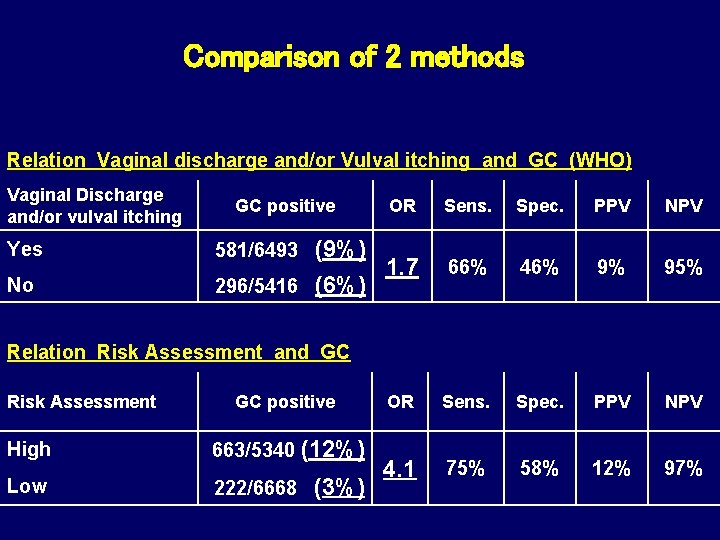
Comparison of 2 methods Relation Vaginal discharge and/or Vulval itching and GC (WHO) Vaginal Discharge and/or vulval itching Yes No GC positive OR Sens. Spec. PPV NPV (9%) 1. 7 296/5416 (6%) 66% 46% 9% 95% OR Sens. Spec. PPV NPV 4. 1 75% 58% 12% 97% 581/6493 Relation Risk Assessment and GC Risk Assessment GC positive High 663/5340 (12%) Low 222/6668 (3%)
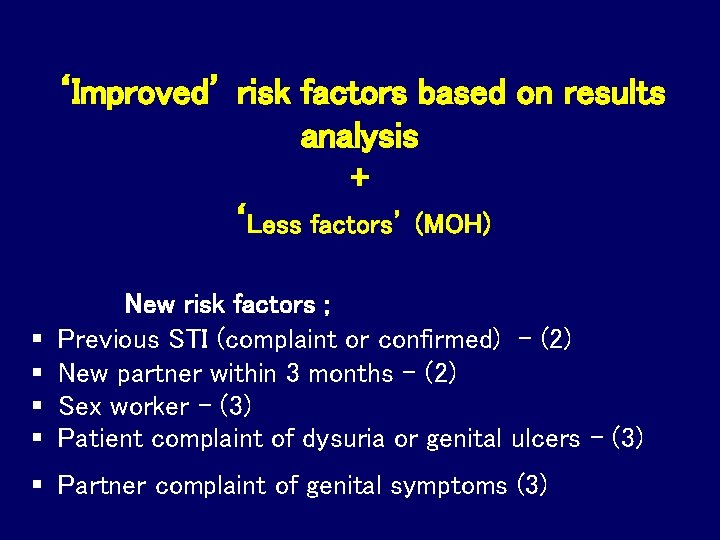
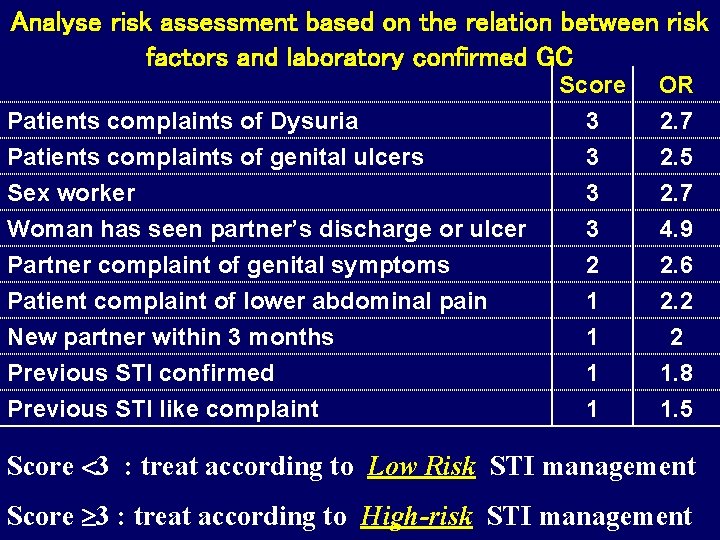
‘Improved’ risk factors based on results analysis + ‘Less factors’ (MOH) § § New risk factors ; Previous STI (complaint or confirmed) – (2) New partner within 3 months – (2) Sex worker – (3) Patient complaint of dysuria or genital ulcers – (3) § Partner complaint of genital symptoms (3)
Compare 3 methods VD or itching GC positive Yes 581/6493 (9%) No 296/5416 (6%) OR Sens. Spec. PPV NPV 1. 7 66% 46% 9% 95% 4. 1 75% 58% 12% 97% 4. 7 79% 56% 13% 97% OLD Risk Assessment High 663/5340 (12%) Low 222/6668 (3%) NEW Risk Assessment High 655/5234 (13%) Low 176/5948 (3%) But all have a very low PPV …. .
Conclusion Don’t limit the flowchart to “women with vag. discharge / itching but include all women. (miss >> 50% cervicitis) The risk assessment is more sensitive and specific than the vag. discharge. /itching flow chart. Risk assessment specific for each country / region…. Flow charts will have to be updated when prevalence rates change. (With a lower prevalence of STI, over-treatment gets worse if we use the same flow chart. ) End 1 …. .
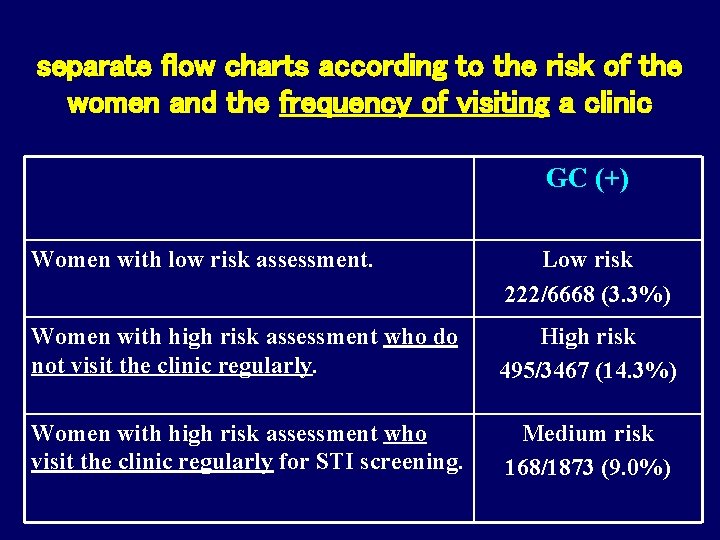
Prevalence of microscopy confirmed GC according to patient’s risk and follow up
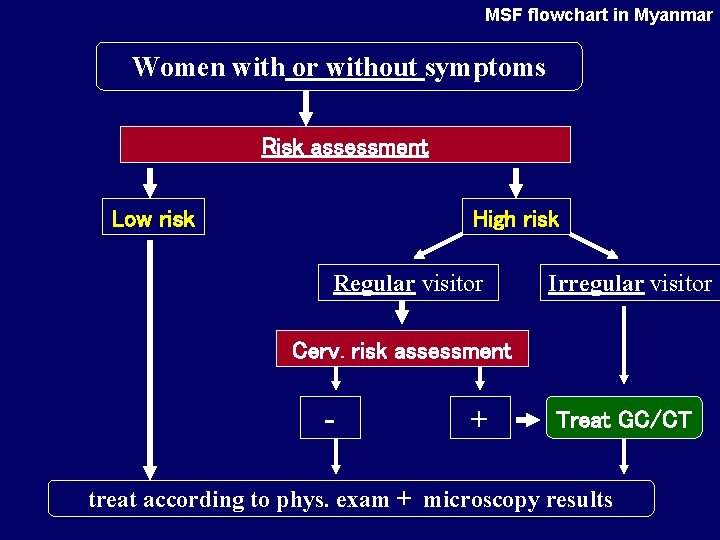
MSF flowchart in Myanmar Women with or without symptoms Risk assessment Low risk High risk Regular visitor Irregular visitor Cerv. risk assessment - + Treat GC/CT treat according to phys. exam + microscopy results
Prevalence of microscopy confirmed GC according to patient’s risk and follow up
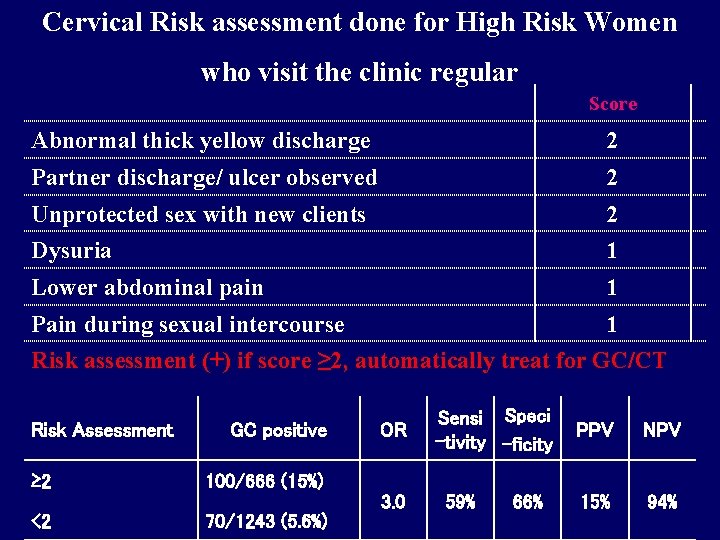
Cervical Risk assessment done for High Risk Women who visit the clinic regular Score Abnormal thick yellow discharge 2 Partner discharge/ ulcer observed 2 Unprotected sex with new clients 2 Dysuria 1 Lower abdominal pain 1 Pain during sexual intercourse 1 Risk assessment (+) if score ≥ 2, automatically treat for GC/CT Risk Assessment ≥ 2 <2 GC positive OR Sensi Speci -tivity -ficity PPV NPV 15% 94% 100/666 (15%) 70/1243 (5. 6%) 3. 0 59% 66%
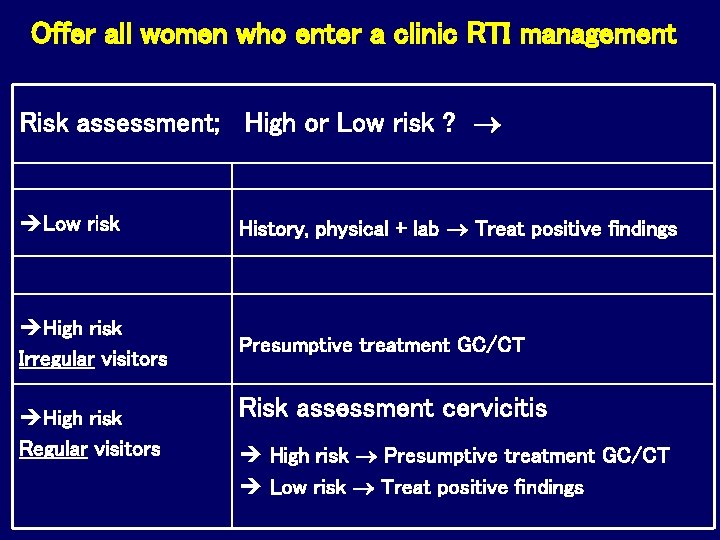
Offer all women who enter a clinic RTI management Risk assessment; High or Low risk ? Low risk History, physical + lab Treat positive findings High risk Irregular visitors Presumptive treatment GC/CT High risk Regular visitors Risk assessment cervicitis High risk Presumptive treatment GC/CT Low risk Treat positive findings
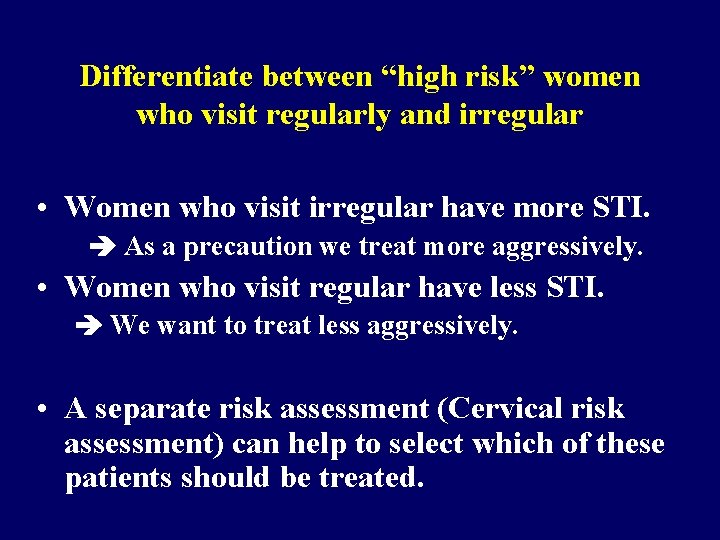
Differentiate between “high risk” women who visit regularly and irregular • Women who visit irregular have more STI. As a precaution we treat more aggressively. • Women who visit regular have less STI. We want to treat less aggressively. • A separate risk assessment (Cervical risk assessment) can help to select which of these patients should be treated.
STI management : Low Risk women (in clinic) Step 1 Main complaint : abnormal vaginal discharge or malodour Main complaint : vulvar pruritis Treat for TV/BV Treat for Candida Step 2 Clinic with speculum exam only Clinic with speculum + laboratory Cervical pus or Yellow vagina discharge or Cervical motion tenderness GC/ CT Discharge + KOH smell (+) + p. H>4. 5 TV/ BV Erythema ± discharge (white KOH smell (-) and p. H <4. 5) Candida Cervical pus or yellow vaginal discharge or Cervical motion tenderness or Cervical smear 20 PMNL or GC (+) any smear GC/ CT >20% clue cells + KOH smell (+) + p. H>4. 5 + homogenous discharge (≥ 3) or TV TV/ BV Erythema ± discharge ± candida (KOH smell () and p. H<4. 5) Candida
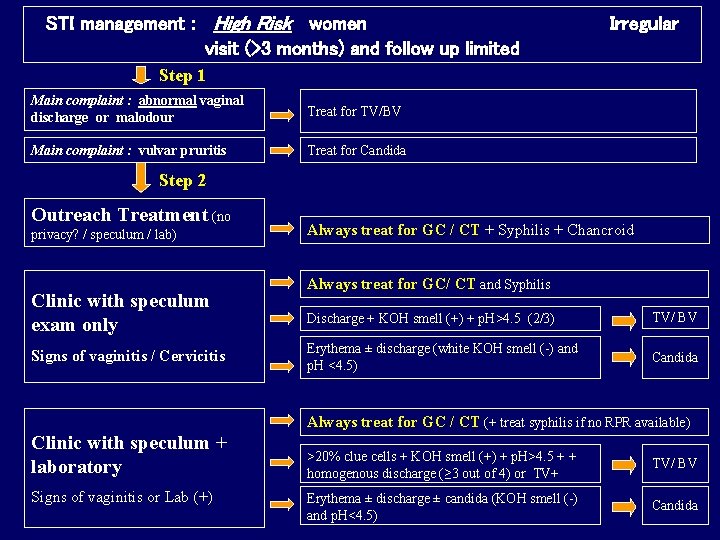
STI management : High Risk women visit (>3 months) and follow up limited Irregular Step 1 Main complaint : abnormal vaginal discharge or malodour Treat for TV/BV Main complaint : vulvar pruritis Treat for Candida Step 2 Outreach Treatment (no privacy? / speculum / lab) Clinic with speculum exam only Signs of vaginitis / Cervicitis Always treat for GC / CT + Syphilis + Chancroid Always treat for GC/ CT and Syphilis Discharge + KOH smell (+) + p. H>4. 5 (2/3) TV/ BV Erythema ± discharge (white KOH smell (-) and p. H <4. 5) Candida Always treat for GC / CT (+ treat syphilis if no RPR available) Clinic with speculum + laboratory Signs of vaginitis or Lab (+) >20% clue cells + KOH smell (+) + p. H>4. 5 + + homogenous discharge (≥ 3 out of 4) or TV+ TV/ BV Erythema ± discharge ± candida (KOH smell (-) and p. H<4. 5) Candida
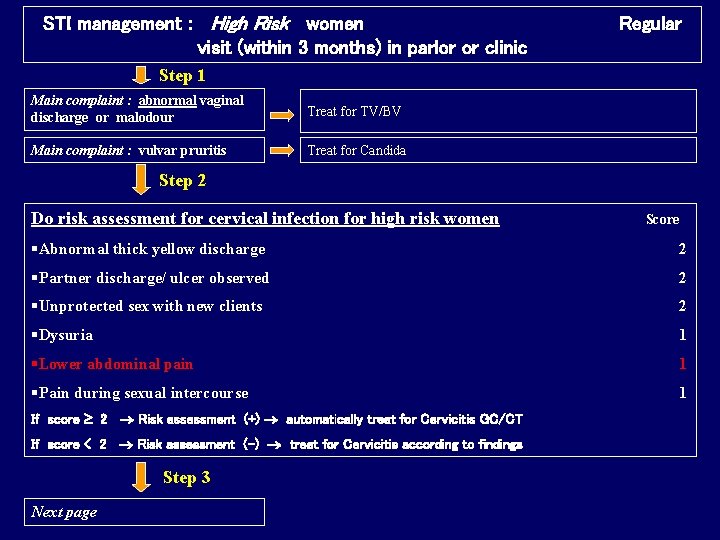
STI management : High Risk women visit (within 3 months) in parlor or clinic Regular Step 1 Main complaint : abnormal vaginal discharge or malodour Treat for TV/BV Main complaint : vulvar pruritis Treat for Candida Step 2 Do risk assessment for cervical infection for high risk women Score §Abnormal thick yellow discharge 2 §Partner discharge/ ulcer observed 2 §Unprotected sex with new clients 2 §Dysuria 1 §Lower abdominal pain 1 §Pain during sexual intercourse 1 If score 2 Risk assessment (+) automatically treat for Cervicitis GC/CT If score < 2 Risk assessment (-) treat for Cervicitis according to findings Step 3 Next page
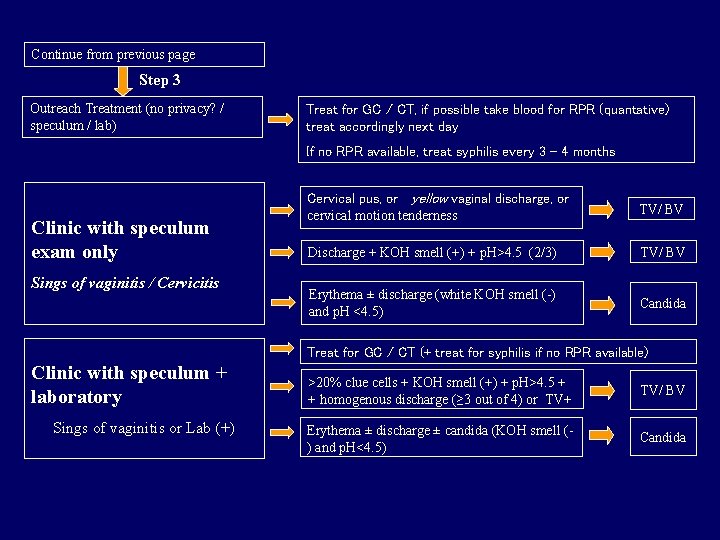
Continue from previous page Step 3 Outreach Treatment (no privacy? / speculum / lab) Treat for GC / CT, if possible take blood for RPR (quantative) treat accordingly next day If no RPR available, treat syphilis every 3 – 4 months Clinic with speculum exam only Sings of vaginitis / Cervicitis Cervical pus, or yellow vaginal discharge, or cervical motion tenderness TV/ BV Discharge + KOH smell (+) + p. H>4. 5 (2/3) TV/ BV Erythema ± discharge (white KOH smell (-) and p. H <4. 5) Candida Treat for GC / CT (+ treat for syphilis if no RPR available) Clinic with speculum + laboratory Sings of vaginitis or Lab (+) >20% clue cells + KOH smell (+) + p. H>4. 5 + + homogenous discharge (≥ 3 out of 4) or TV+ TV/ BV Erythema ± discharge ± candida (KOH smell () and p. H<4. 5) Candida
Analyse risk assessment based on the relation between risk factors and laboratory confirmed GC Patients complaints of Dysuria Patients complaints of genital ulcers Sex worker Woman has seen partner’s discharge or ulcer Partner complaint of genital symptoms Patient complaint of lower abdominal pain New partner within 3 months Previous STI confirmed Previous STI like complaint Score 3 3 3 OR 2. 7 2. 5 2. 7 3 2 1 1 4. 9 2. 6 2. 2 2 1. 8 1. 5 Score 3 : treat according to Low Risk STI management Score 3 : treat according to High-risk STI management
separate flow charts according to the risk of the women and the frequency of visiting a clinic GC (+) Women with low risk assessment. Low risk 222/6668 (3. 3%) Women with high risk assessment who do not visit the clinic regularly. High risk 495/3467 (14. 3%) Women with high risk assessment who visit the clinic regularly for STI screening. Medium risk 168/1873 (9. 0%)