INTRODUCTION TO ACUPUNCTURE PART ONE HUMA NAQVI MD


- Slides: 76
INTRODUCTION TO ACUPUNCTURE PART ONE HUMA NAQVI. MD MONTEFIORE MEDICAL CENTER ALBERT EINSTEIN COLLEGE OF MEDICINE
LEARNING OBJECTIVES Describe the basic theory, types and application of acupuncture Review current evidence on the efficacy of acupuncture Discuss the concept of Qi and De-Qi Discuss the concept of Yin and Yang Discuss the five element theory List possible acupuncture side effects Outline the application of acupuncture in the treatment of pain and musculoskeletal conditions
Course outline �Introduction to acupuncture �Evidence on efficiency �Concept of Qi and De-Qi �Concept of Yin and Yang �Acupuncture side affects �Five element theory �Acupuncture for pain �Tendinomuscular meridian treatment �Auricular acupuncture
INTRODUCTION Acupuncture is a treatment method that has been used in East Asia for thousands of years. In recent years it has been increasingly adopted worldwide. (Kaptchuk TJ-Ann Intern Med 2002). The technique that has been most often studied scientifically involves penetrating the skin with thin solid, metallic needles that are manipulated by hand or by electical stimulation.
HISTORY OF ACUPUNCTURE Acupuncture is one of the oldest, most commonly used systems of healing in the world. Originating in China some 3, 500 years ago, only in the last three decades has it become popular in the United State. Sharpened stones and bones has been reported for Acupuncture treatment date from 6000 BCE.
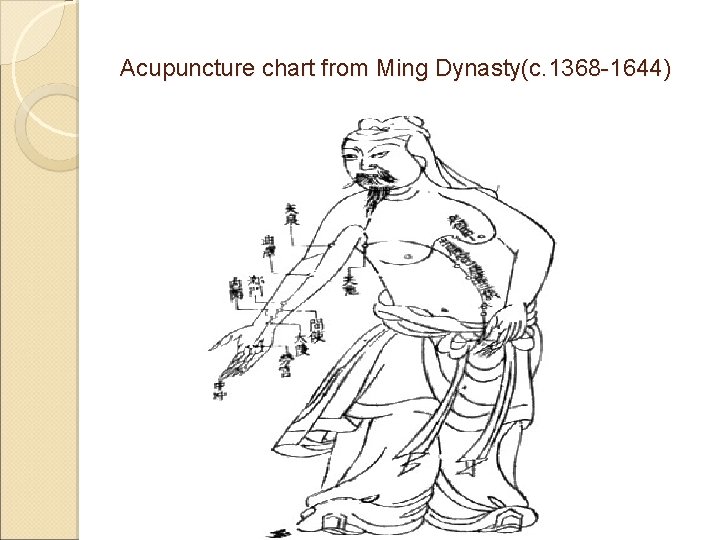
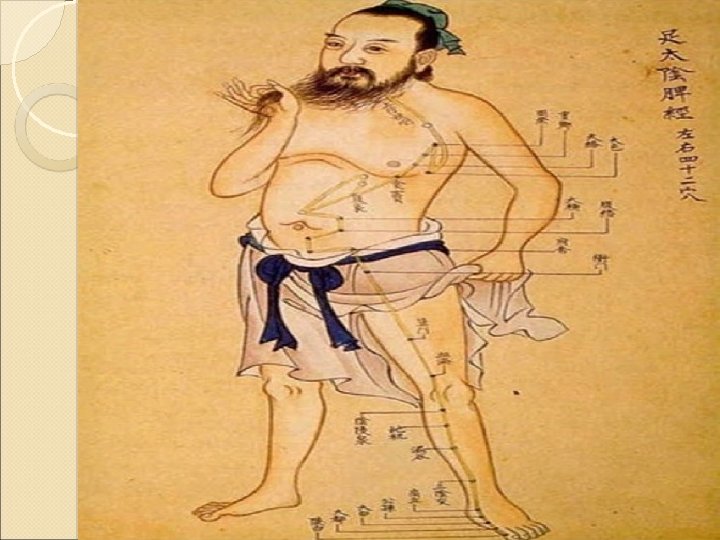
Acupuncture chart from Ming Dynasty(c. 1368 -1644)
BASIC CONCEPT The human body is comprised of an intricate network of energetic pathways, which are responsible for unifying the body’s organs to work together as a whole. These pathways known as meridians work much like an electric circuit in that they supply vital energy, or Qi, to the body’s systems in order to attain proper functioning. Acupuncture: derived from Latin acus (needle) and Punctura (to Puncture). Acupuncture is the stimulation of specific acupuncture points along the skin of the body using thin needles.
MEDICAL ACUPUNCTURE The mechanism of Acupuncture in traditional Chinese medicine may involve a form of energetic phenomenon such as the flow of energy call Qi through channels in our bodies known as MERIDIAN. Western medical Acupuncture Is a therapeutic modality involving the insertion of fine needles. It is an adaptation of Chinese acupuncture using current knowledge of Anatomy, physiology, pathology and principals of evidence based medicine.
EVIDENCE ON EFFECTIVENESS Evidence on effectiveness of acupuncture is variable and inconsistent even for single condition (colquhoun 2013 Anesthesia &Analgesia) The evidence suggests that short term treatment with Acupuncture does not produce long term benefits.
EVIDENCE BASED MEDICINE Acupuncture has proven to be effective for several diseases and symptoms including osteoarthritis and vomiting. (Manheimer E, 2010). (Lee A, 2009). Acupuncture is known to have physiologic effects relevant to analgesia. (Zhang WT, 2004).
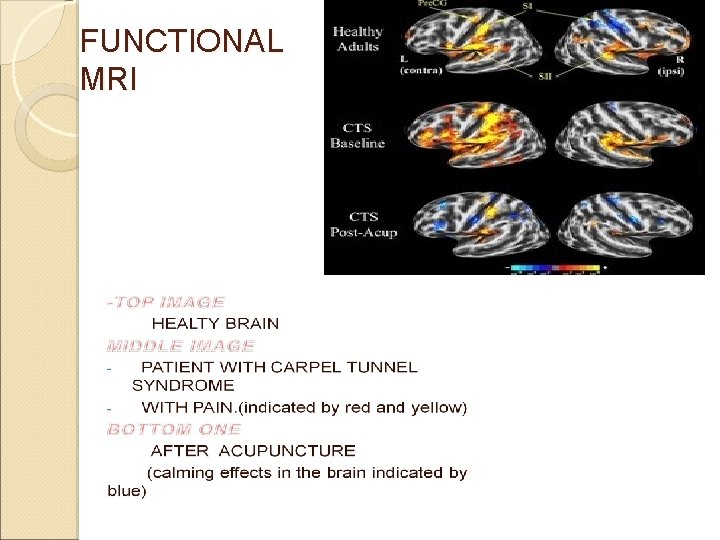
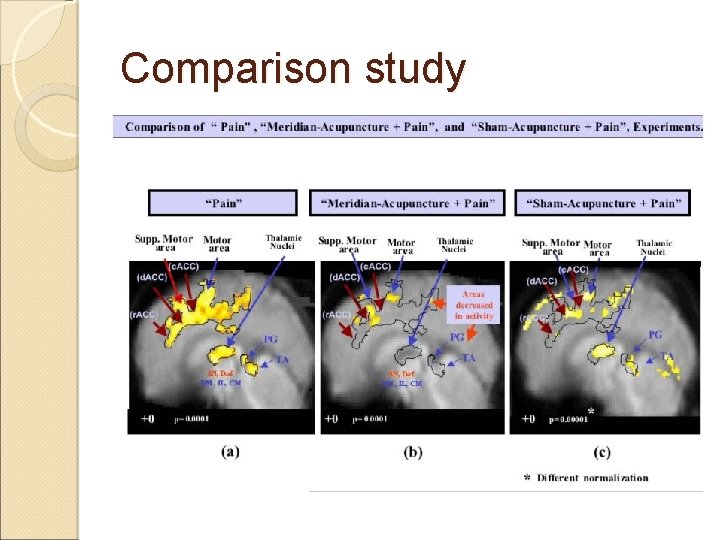
EVIDENCE BASED Multiple research approaches have shown that Acupuncture activates endogenous opioid mechanism. (Kaptchuk-Ann Internal Med 2002). Functional MRA suggests that Acupuncture has regionally specific quantifiable effects on relevant brain structures.
Qi (ENERGY). Qi is the vital energy or life force. • Generative force of life. • Qi flows from organ to organ through precise channels to maintain our vitality. • Qi is congenital, one we born with it. • Qi is acquired, we obtain from food and environment. In Traditional Chinese medicine stimulating specific acupuncture points corrects imbalances in the flow of Qi through channels called meridians. •
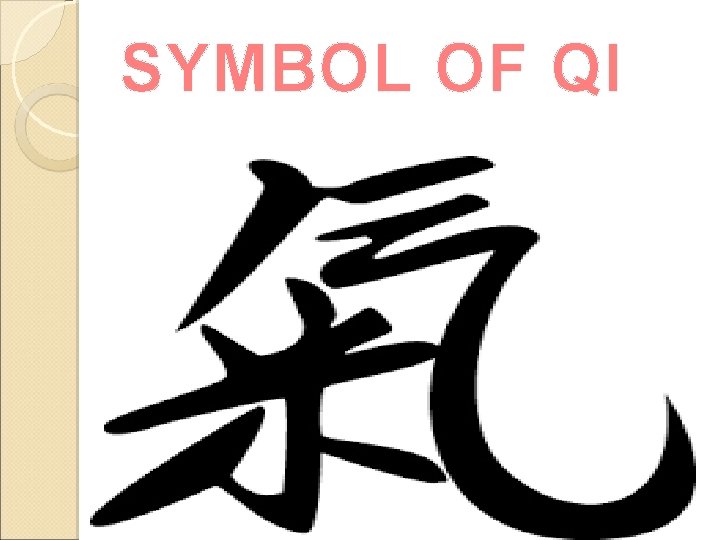
SYMBOL OF QI
DE-QI SENSATION ARRIVAL OF QI De-qi is a core concept of acupuncture and its necessary to produce therapeutic effects. (Yang Y 2013). De-qi is a sensation experienced by a patient or an acupuncturist during treatment. (JI-Eun Park 2013). De qi is considered to be an important variable in acupuncture achieving it is associated with positive outcome.
DE-QI Is a sensation of numbness , distension or electrical tingling at the needling site which might radiate along the corresponding meridian. If De qi is not achieve treatment success is low and following should be considered: -Acupoint is not accurate. -Depth of needle insertion not adequate. -inadequate manual manipulation.
DE-QI De-qi is associated with physiological changes De-qi intensity increases with an increase in sympathic discharge of the Autonomic nervous system. (Yu Dt Acupun Med).
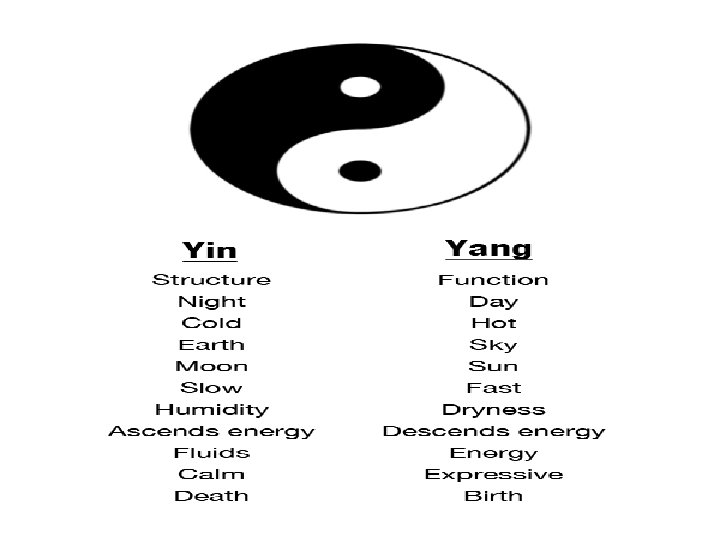
YIN AND YANG In Chinese philosophy these are two forces in the universe. Their interaction is thought to maintain the harmony of the universe and influence everything within it. YIN : IS NEGATIVE, DARK AND FEMININE. YANG: IS POSITIVE , BRIGHT AND MASCULINE
YIN AND YANG Examples: Day and night, they are interdependent i. e Yin is necessary for Yang to exist and vice versa. All phenomena and process can be described in terms of Yin and Yang. Yin organs are solid called Zang. Yang organs are hollow called Fu. Each organ has a nourishing Yin aspect and a dynamic yang aspect. There is nothing absolutely Yin or completely Yang.
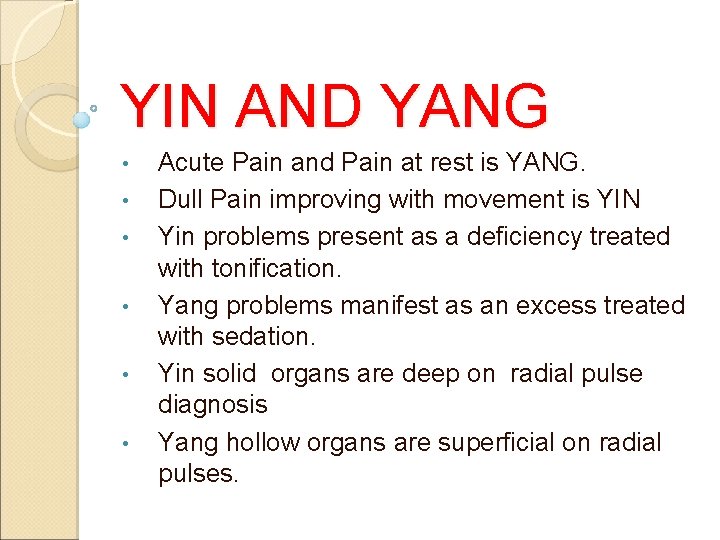
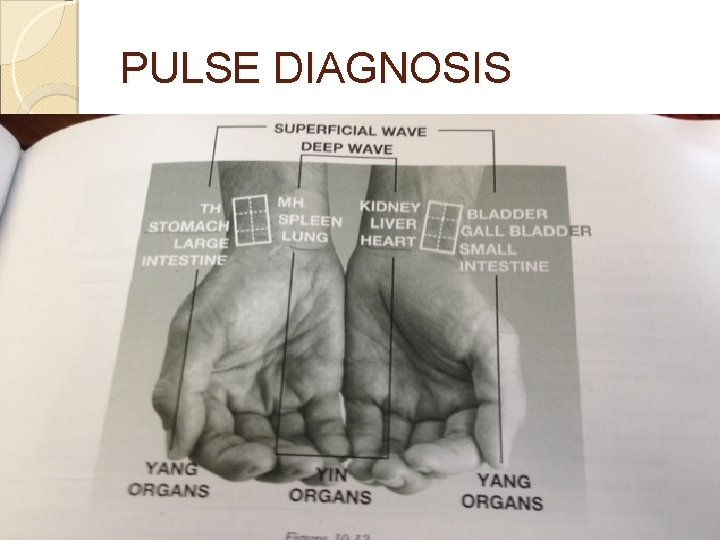
YIN AND YANG • • • Acute Pain and Pain at rest is YANG. Dull Pain improving with movement is YIN Yin problems present as a deficiency treated with tonification. Yang problems manifest as an excess treated with sedation. Yin solid organs are deep on radial pulse diagnosis Yang hollow organs are superficial on radial pulses.
YIN AND YANG Examples: Day and night they are interdependent i. e Yin is necessary for Yang to exist and vice versa. Hot and cold, Deficiency and excess, interiorexterior.
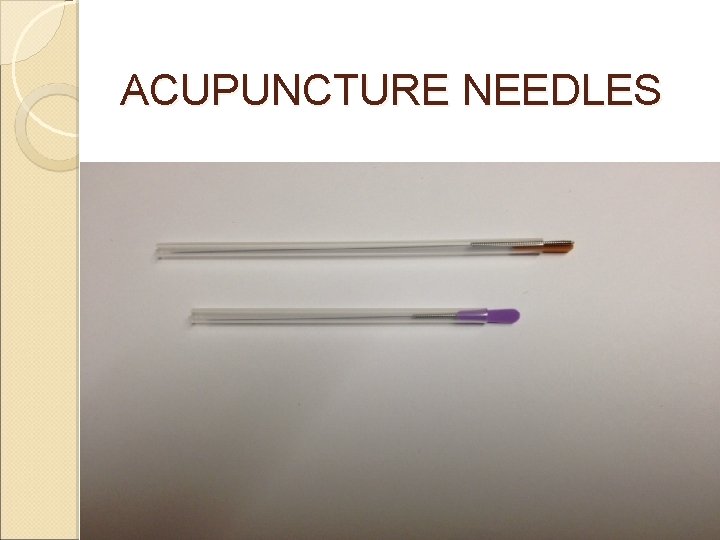
ACUPUNCTURE NEEDLES
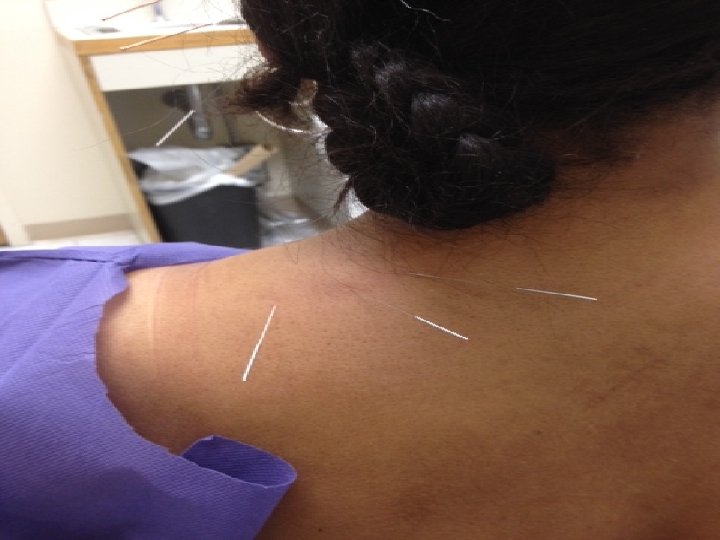
NEEDLE INSERTION TECHNIQUES
TONIFICATION OR BU - - Once De-Qi is achieved certain manipulation techniques are applied. Tonification means to concentrate or reinforce. Tonification is used in deficiency states related to Yin –the interior cold, hypoactive and hollow conditions. Its weak stimulation at the Acupuncture point is done to increase its energy.
SEDATION OR XIE Sedation is a reducing, dispersing or sedating method of treatment. Related to Yang, the exterior, hot and repletion conditions such as hyperfunctional, hyperactive, painful disorders. It is performed by comparatively strong stimulation at the acupuncture point to decrease its energy.
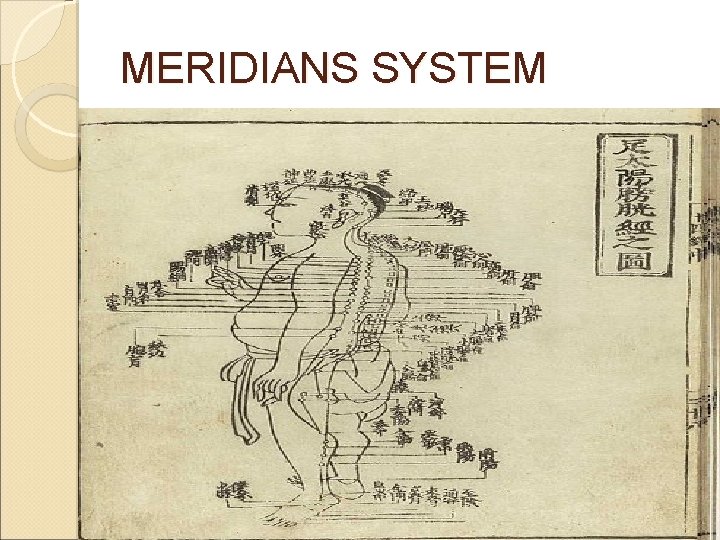
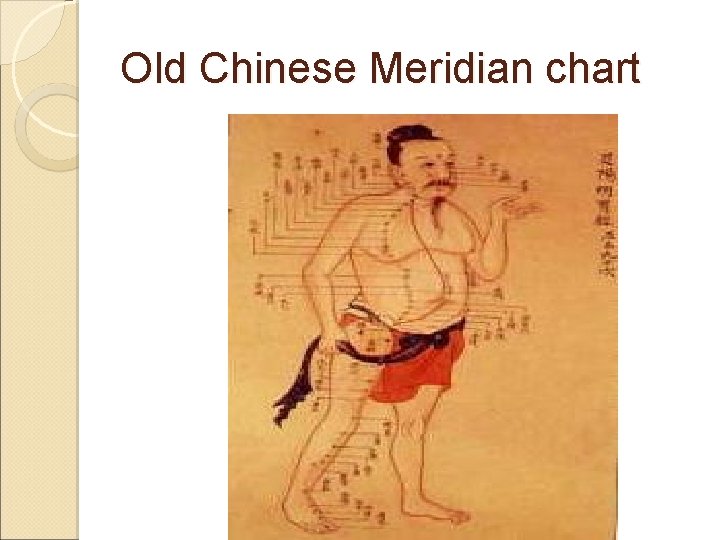
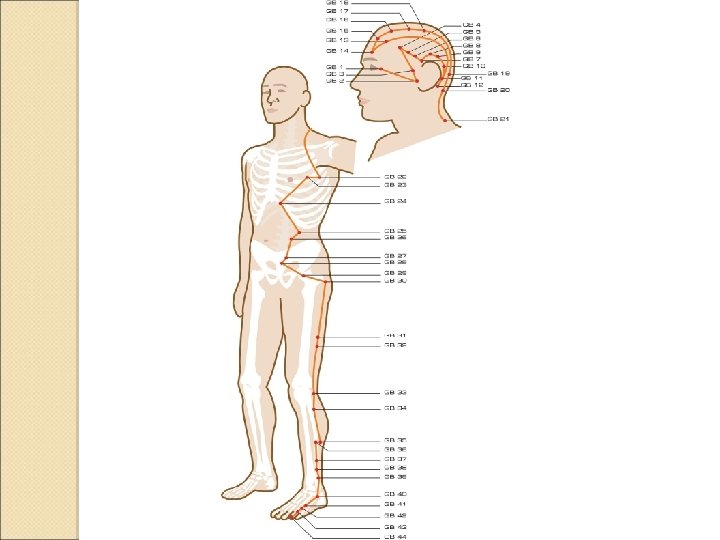
MERIDIAN Meridians are the energy moving pathways of the body. FUNCTION: -connecting affects -transporting affects COMPONENTS: -12 Regular meridians - 8 extraordinary meridian -15 collaterals Acupuncture is a technique for balancing the flow of energy (Qi) through pathways called Meridians.
MERIDIANS SYSTEM
Old Chinese Meridian chart
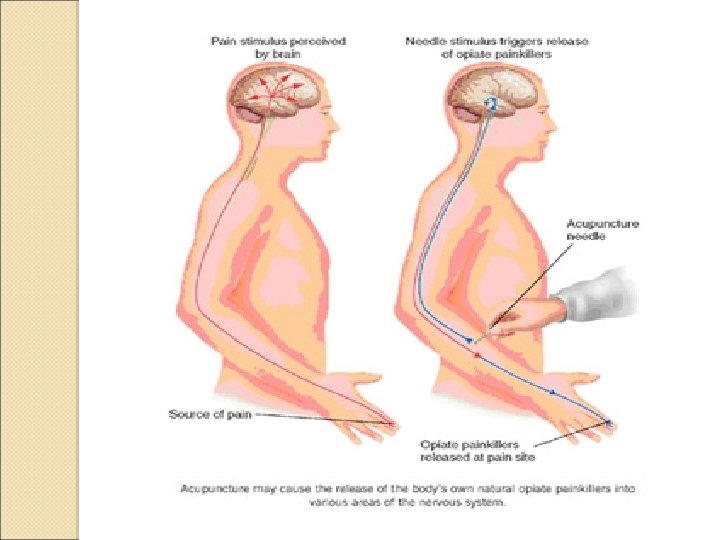
HOW ACUPUNCTURE WORKS . Evidence suggests that Acupuncture generates a sequence of events that include the release of endogenous opioid like substances that modulate pain within the central nervous system. Wang 2008 Anesthesia and Analgesia
HOW ACUPUNCTURE WORKS Acupuncture modulates brain activity in the: -Somatosensory cortex -Limbic system -Basal Ganglia -Brain stem -Cerebellum
HOW ACUPUNCTURE WORKS. When a nerve is blocked by local anesthesia Acupuncture is ineffective in the territory supplied by that nerve prove that the acupuncture effect is conducted along nerves.
HOW ACUPUNCTURE WORKS Evidence supports the endorphinmediated mechanism of acupuncture analgesia. High or low frequency stimulation induced by electrical acupuncture has been shown to release different types of endorphins.
FUNCTIONAL MRI
Comparison study
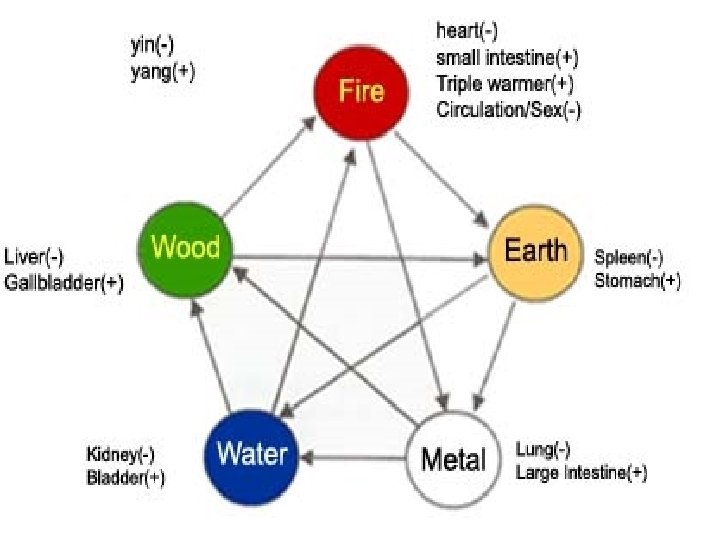
FIVE ELEMENTS THEORY As per Chinese theory man is made up of five elements: -Wood -Fire -Earth -Metal -Water
FIVE ELEMENTS On the basis of law of similarity the coupled internal organs were classified into five elements and these Elements were compared with various things like seasons , color , tastes emotion ect. Five Element theory correlates physiology with pathogenesis of disease and a guideline for treatment of diseases.
FIVE ELEMENTS
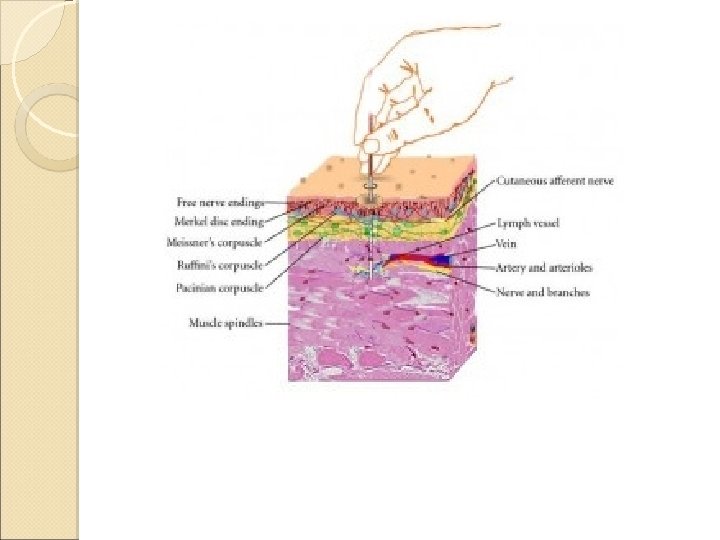
ACUPUNCTURE POINTS -Acupuncture is said to be effective only at certain points on the body surface known as ACUPUNCTURE POINTS. - Acupuncture points Correspond to the anatomic points at which small nerve bundles penetrate the fascia. (william et al 1989 anatomical atlas).
BIOELECTRICAL PROPERTIES OF ACUPUNCTURE POINTS AND CHANNELS. 1 -STUDIES SUGGEST THAT ELECTRICAL CONDUCTION AT ACUPUNCTURE POINTS IS DIFFERENT FROM THEIR IMMEDIATE ENVIRONMENT. 2 -EXCITATION OF ACUPUNCTURE POINTS PROVOKES PHYSIOLOGIC RESPONSE DIFFERENT FROM THE ENVIRONMENT. 3 - THESE POINTS ARE OF LOW ELECTRICAL RESISTANCE.
NEEDLE PROCEDURE
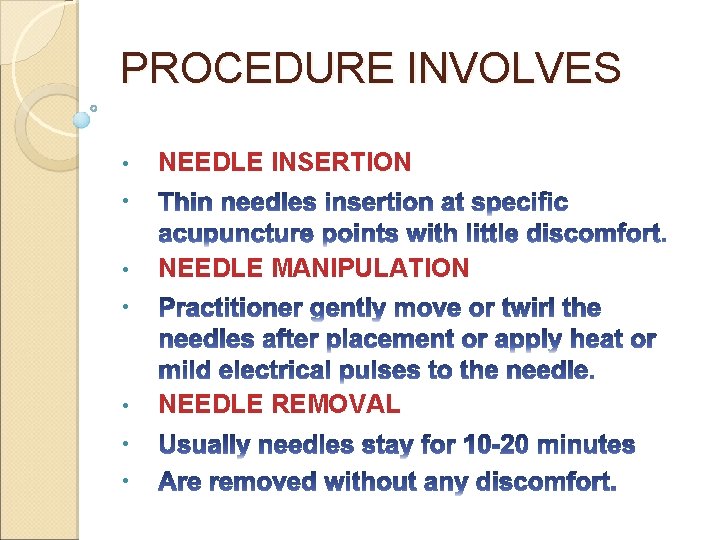
PROCEDURE INVOLVES • NEEDLE INSERTION • • NEEDLE MANIPULATION • • NEEDLE REMOVAL
AFTER ACUPUNCTURE TREATMENT. Results are variable and not consistent: relaxed energized tired lightheaded Not everyone respond to acupuncture treatments.
ACUPUNCTURE SAFETY Acupuncture is generally safe in the hands of appropriately trained practitioner using clean techniques and single use needle. (c-vincent-BMJ 2001). When properly delivered it has a low rate of (mostly) minor adverse affects. But Acupuncture is not entirely without risk.
ACUPUNCTRE SAFETY SIDE EFFECTS. -Soreness. -Minor bleeding. -Bruising -Light headed or sleepy -Pneumothorax(rare). -Needle shock.
CONTRAINDICATIONS 1. BLEEDING DISORDERS. 2. ANTICOAGULATION THERAPY (RELATIVE). 3. PACEMAKER (IF E-STIM IS USED). 4. PREGNANCY (thought to stimulate labor, can cause premature labor).
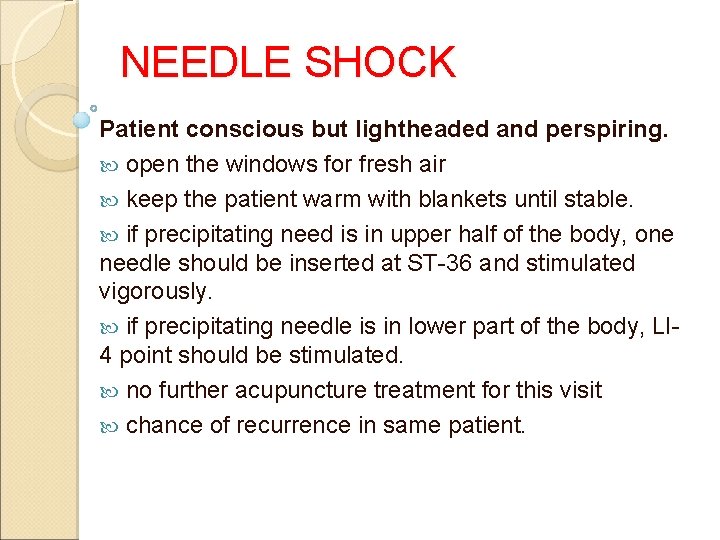
NEEDLE SHOCK Watch for signs of needle shock. Feeling unwell Lightheadedness. Fainting. Nausea Pallor. Perspiration. Loss of Consciousness.
NEEDLE SHOCK Uncommon but can occur during first or second treatment. Do not treat patient in a seated position. IF NEEDLE SHOCK OCCURS. Protect Patient from falling. Help patient to lie down Remove all needles quickly. Elevate patient’s legs. Maintain verbal contact with patient even if he/she is not replying. Assure the patient that this is a common phenomenon.
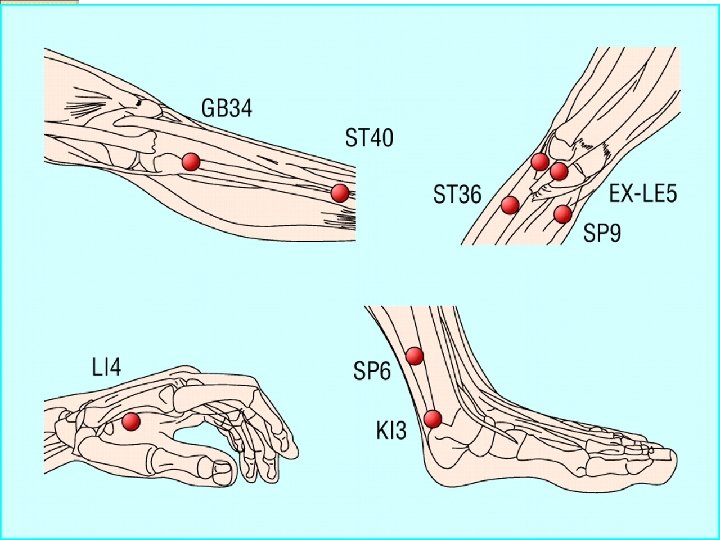
NEEDLE SHOCK TREATMENT If unconscious: Insert a needle at GV-26 deeply with vigorous manual stimulation. Patient may quickly regain consciousness but may remain disoriented. If response is not adequate, piqure KI-1 bilaterally and stimulate needles. If no response to these three needles after stimulation, start emergency medical interventions.
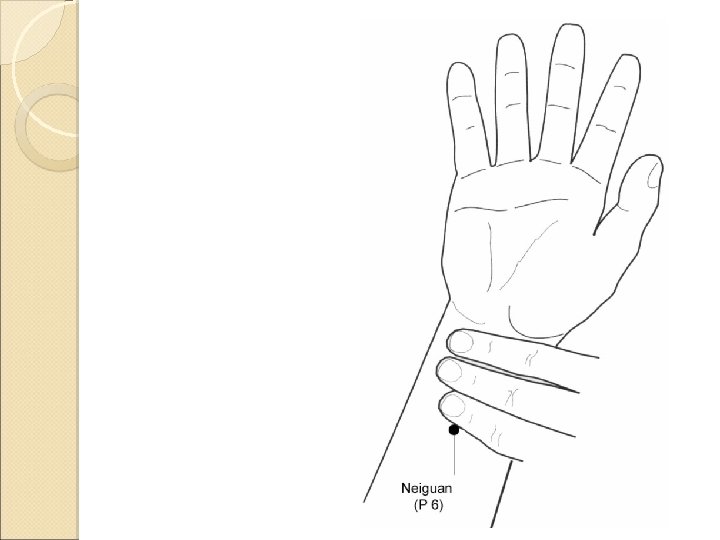
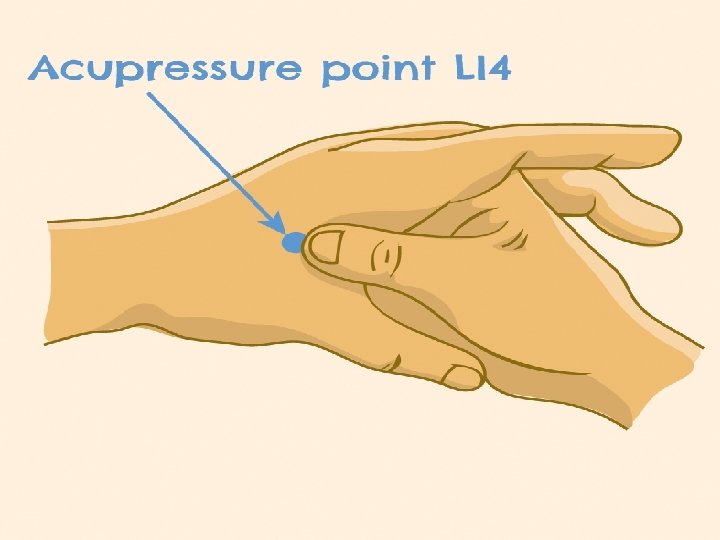
NEEDLE SHOCK Patient conscious but lightheaded and perspiring. open the windows for fresh air keep the patient warm with blankets until stable. if precipitating need is in upper half of the body, one needle should be inserted at ST-36 and stimulated vigorously. if precipitating needle is in lower part of the body, LI 4 point should be stimulated. no further acupuncture treatment for this visit chance of recurrence in same patient.
EVALUATION OF PATIENT INSPECTION OF TONGUE PULSE DIAGNOSIS STRUCTURAL BIOPSYCHOTYPES
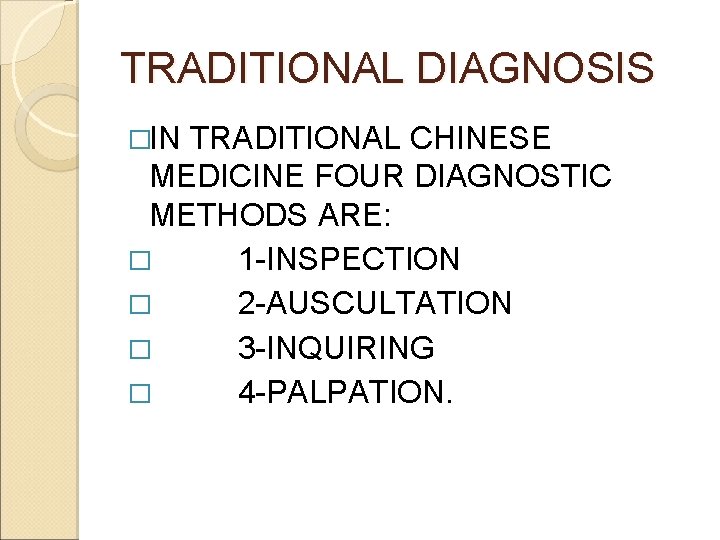
TRADITIONAL DIAGNOSIS �IN TRADITIONAL CHINESE MEDICINE FOUR DIAGNOSTIC METHODS ARE: � 1 -INSPECTION � 2 -AUSCULTATION � 3 -INQUIRING � 4 -PALPATION.
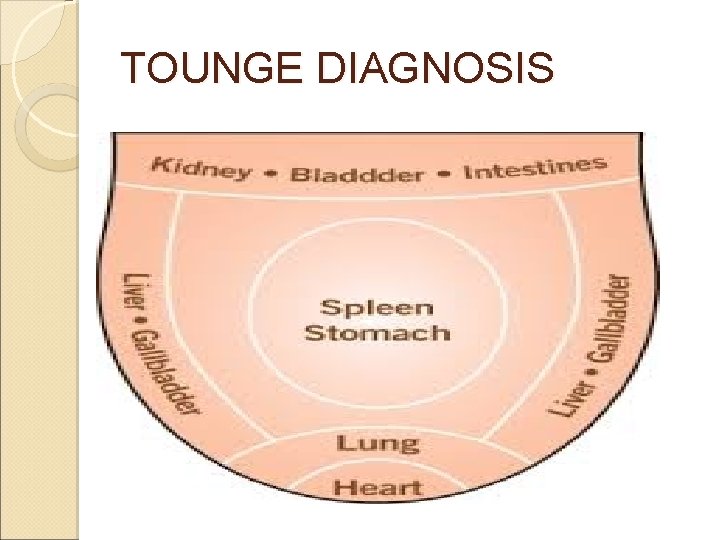
TONGUE DIAGNOSIS Examination of tongue and pulse are among the principal diagnostic methods in traditional Chinese medicine. The tongue reflects the basic condition and underlying problems of patient. Meridian branches from the kidney, liver, spleen, lung, and stomach go through the oropharynx to tongue. All internal organs will affect the condition of tongue and each organ has a zone where its activities are reflected.
TOUNGE DIAGNOSIS
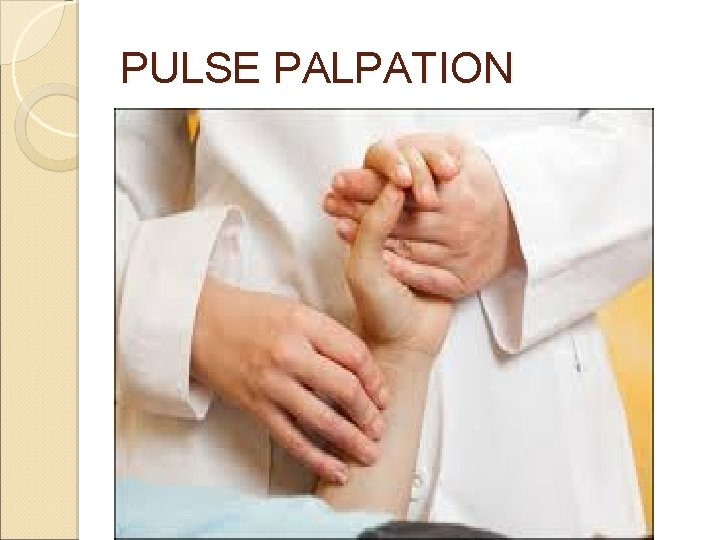
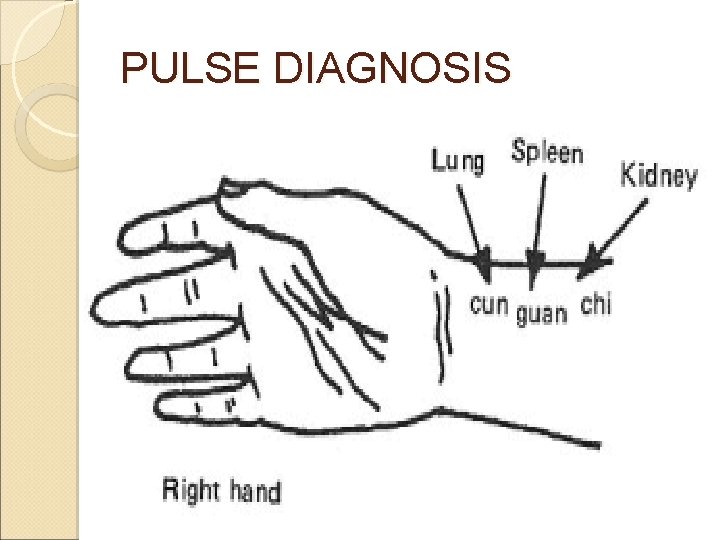
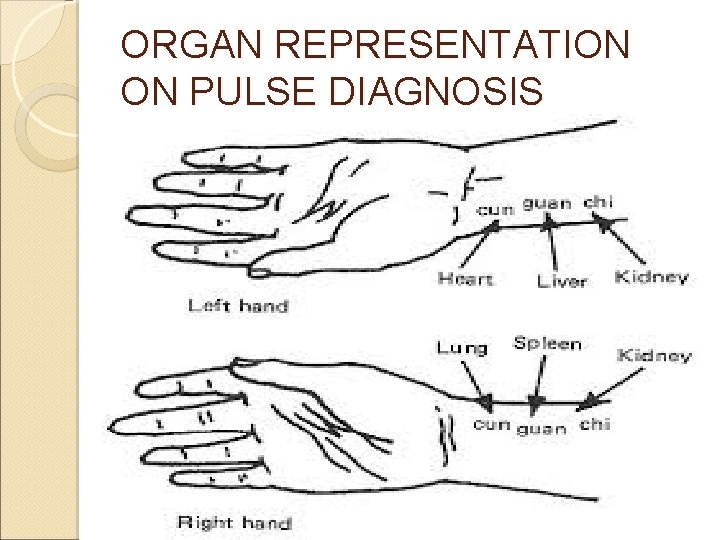
PULSE DIAGNOSIS PULSE PALPATION INVOLVES MEASURING THE PULSE OF THE RADIAL ARTERY AT A: ◦SUPERFICIAL LEVEL ◦DEEP LEVEL PALPATE WITH INDEX, MIDDLE AND RING FINGER OF EACH HAND FOR 12 PULSES. EACH PULSE ISTHOUGHT TO CORRESPOND WITH A SPECIFIC ORGAN SYSTEM.
PULSE PALPATION
PULSE DIAGNOSIS
PULSE DIAGNOSIS
ORGAN REPRESENTATION ON PULSE DIAGNOSIS
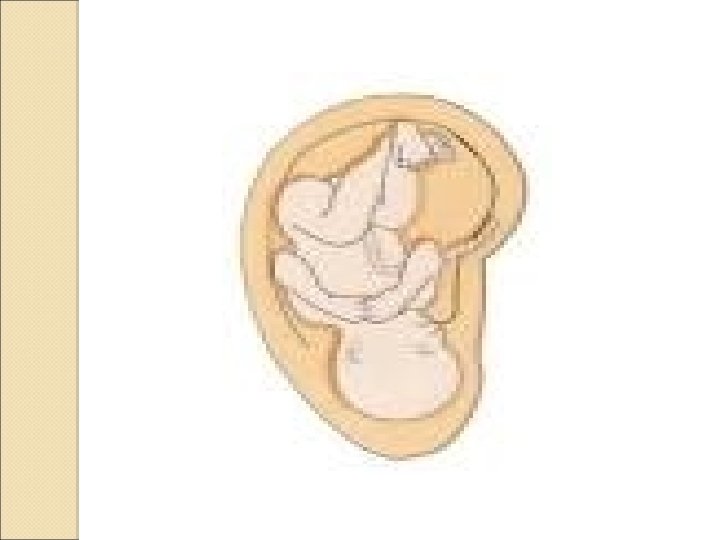
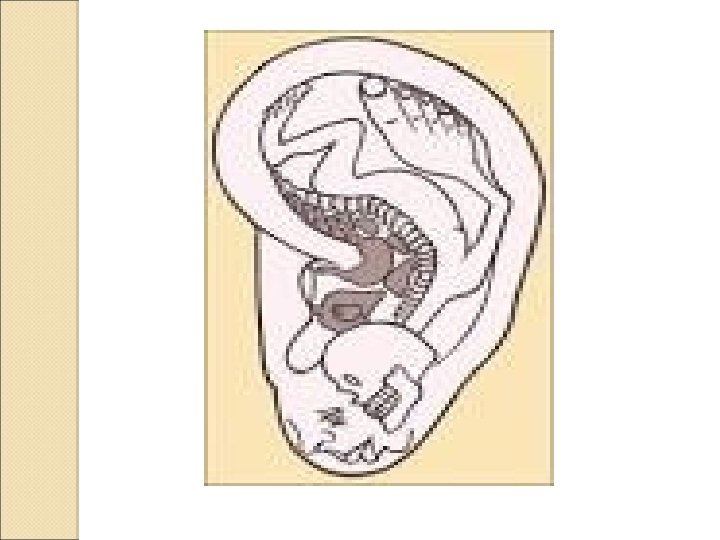
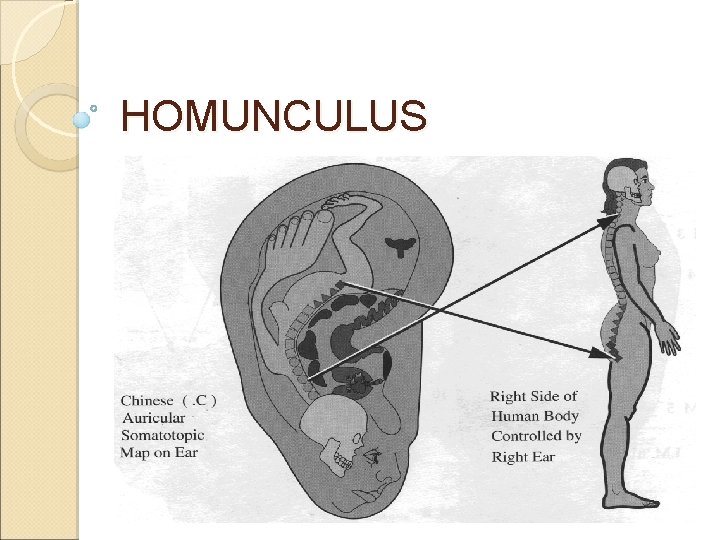
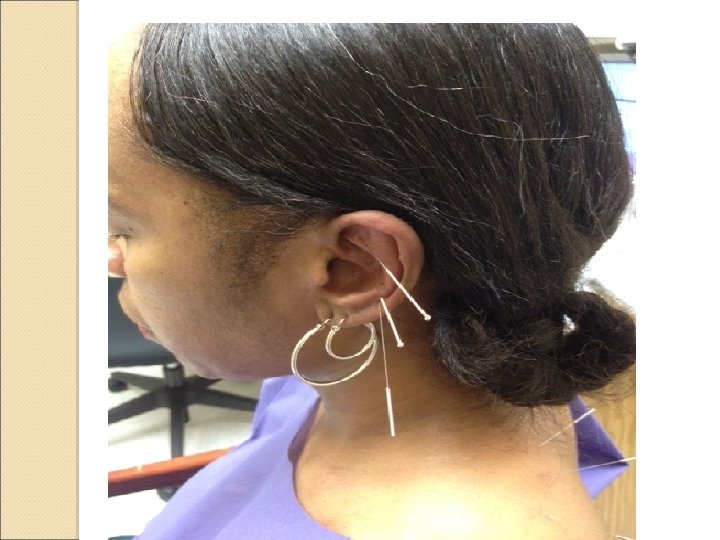
AURICULOTHERAPY u u u Ear Acupuncture Easy to learn and perform Effective Diagnostic and therapeutic Homunculus represents body parts. Involves multiple treatment protocols.
HOMUNCULUS
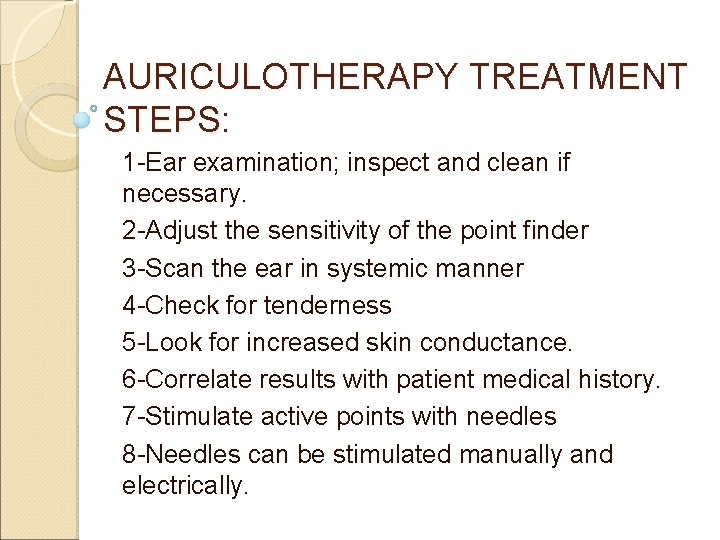
AURICULOTHERAPY TREATMENT STEPS: 1 -Ear examination; inspect and clean if necessary. 2 -Adjust the sensitivity of the point finder 3 -Scan the ear in systemic manner 4 -Check for tenderness 5 -Look for increased skin conductance. 6 -Correlate results with patient medical history. 7 -Stimulate active points with needles 8 -Needles can be stimulated manually and electrically.
COMPLICATIONS INFLAMMATION OF EAR INFECTION OF EAR CARTILAGE OR SKIN. LIGHTHEADNESS NAUSEA ADVISE PATIENT TO REMOVE NEEDLES IF THEY BECOME PAINFUL OR THE EAR GETS RED, PAINFUL, IRRITAED OR SWOLLEN.
RECOMMENDED RESEARCH ARTICLES Acupuncture Helps Chronic Headaches According to Largest Study Scientists One Step Closer to Understanding The Analgesic Effects of Acupuncture Eases Side Effects of Head, Neck Cancer Treatments Study Shows Acupuncture Significantly Lowers Blood Pressure Study Shows Acupuncture Works for Migraines