
Bidoped Fiber Lasers Opportunities and Challenges E M
Bi-doped Fiber Lasers: Opportunities and Challenges E. M. Dianov Fiber Optics Research Center of the Russian Academy of Sciences, 38 Vavilov str. , Moscow 119333, Russia. 1
Outline • Introduction • Spectroscopic properties of Bi-doped glasses and optical fibers • Bi-doped fiber lasers (1140 -1215 nm) • Bi-doped fiber lasers (1300 -1500 nm) • Nature of Bi-related luminescenters • Conclusion 2
Spectral regions of the existing fiber lasers 4
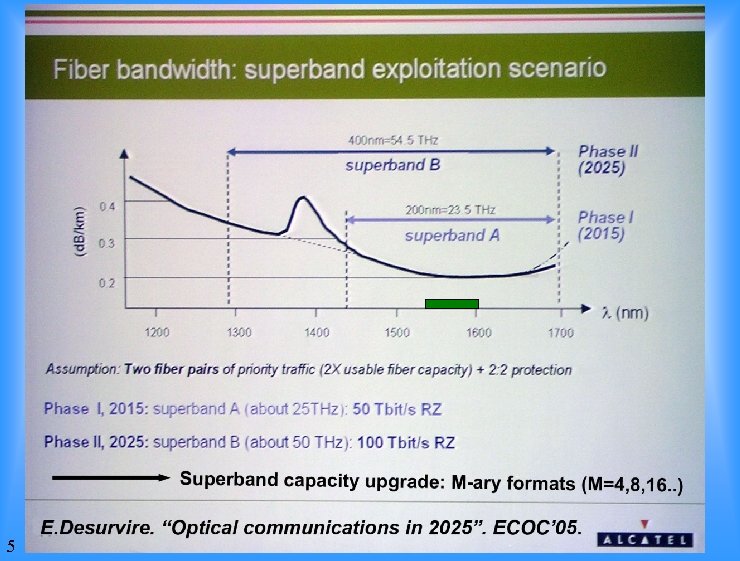
5
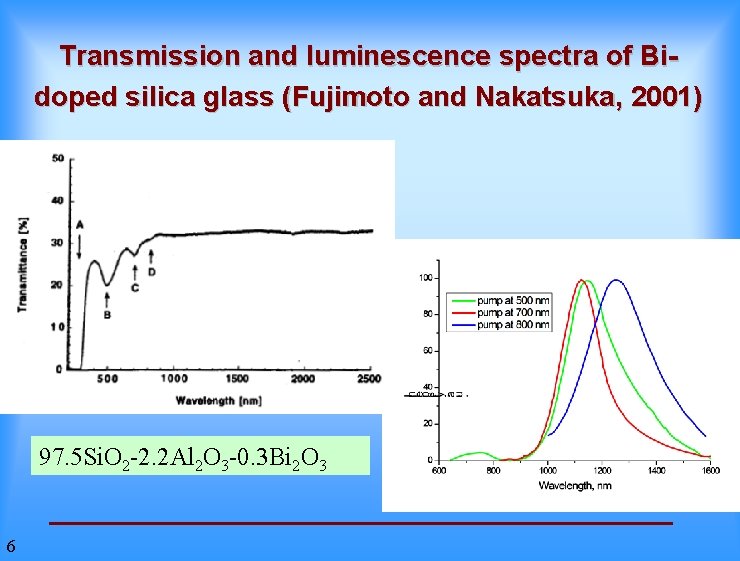
Transmission and luminescence spectra of Bidoped silica glass (Fujimoto and Nakatsuka, 2001) 97. 5 Si. O 2 -2. 2 Al 2 O 3 -0. 3 Bi 2 O 3 6
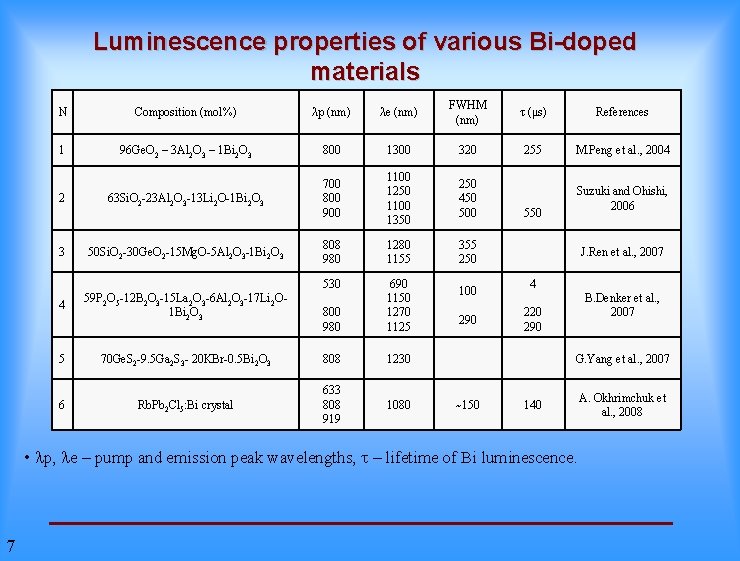
Luminescence properties of various Bi-doped materials N Composition (mol%) λp (nm) λe (nm) FWHM (nm) τ (μs) References 1 96 Ge. O 2 – 3 Al 2 O 3 – 1 Bi 2 O 3 800 1300 320 255 M. Peng et al. , 2004 63 Si. O 2 -23 Al 2 O 3 -13 Li 2 O-1 Bi 2 O 3 700 800 900 1100 1250 1100 1350 250 450 50 Si. O 2 -30 Ge. O 2 -15 Mg. O-5 Al 2 O 3 -1 Bi 2 O 3 808 980 1280 1155 355 250 530 800 980 690 1150 1270 1125 70 Ge. S 2 -9. 5 Ga 2 S 3 - 20 KBr-0. 5 Bi 2 O 3 808 1230 Rb. Pb 2 Cl 5: Bi crystal 633 808 919 1080 2 3 4 5 6 59 P 2 O 5 -12 B 2 O 3 -15 La 2 O 3 -6 Al 2 O 3 -17 Li 2 O 1 Bi 2 O 3 100 290 550 Suzuki and Ohishi, 2006 J. Ren et al. , 2007 4 B. Denker et al. , 2007 220 290 G. Yang et al. , 2007 ~150 140 • lp, le – pump and emission peak wavelengths, t – lifetime of Bi luminescence. 7 A. Okhrimchuk et al. , 2008
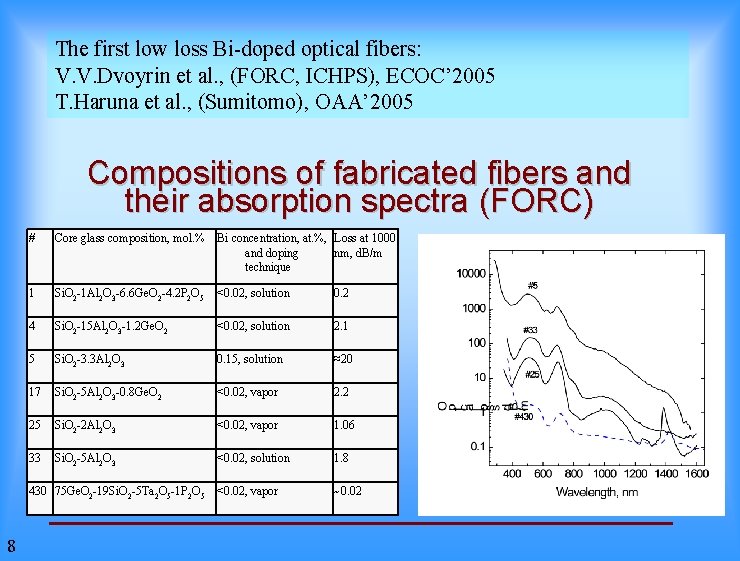
The first low loss Bi-doped optical fibers: V. V. Dvoyrin et al. , (FORC, ICHPS), ECOC’ 2005 T. Haruna et al. , (Sumitomo), OAA’ 2005 Compositions of fabricated fibers and their absorption spectra (FORC) # Core glass composition, mol. % Bi concentration, at. %, Loss at 1000 and doping nm, d. B/m technique 1 Si. O 2 -1 Al 2 O 3 -6. 6 Ge. O 2 -4. 2 P 2 O 5 <0. 02, solution 0. 2 4 Si. O 2 -15 Al 2 O 3 -1. 2 Ge. O 2 <0. 02, solution 2. 1 5 Si. O 2 -3. 3 Al 2 O 3 0. 15, solution ≈20 17 Si. O 2 -5 Al 2 O 3 -0. 8 Ge. O 2 <0. 02, vapor 2. 2 25 Si. O 2 -2 Al 2 O 3 <0. 02, vapor 1. 06 33 Si. O 2 -5 Al 2 O 3 <0. 02, solution 1. 8 <0. 02, vapor ~0. 02 430 75 Ge. O 2 -19 Si. O 2 -5 Ta 2 O 5 -1 P 2 O 5 8
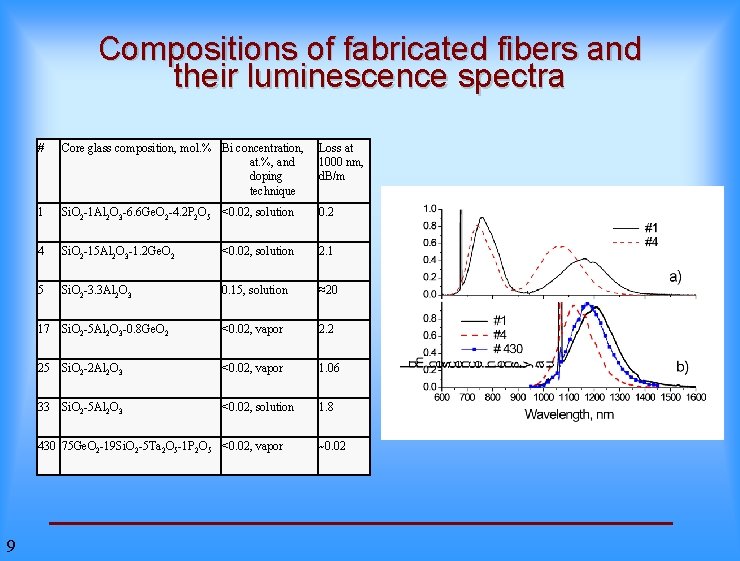
Compositions of fabricated fibers and their luminescence spectra # Core glass composition, mol. % Bi concentration, at. %, and doping technique Loss at 1000 nm, d. B/m 1 Si. O 2 -1 Al 2 O 3 -6. 6 Ge. O 2 -4. 2 P 2 O 5 <0. 02, solution 0. 2 4 Si. O 2 -15 Al 2 O 3 -1. 2 Ge. O 2 <0. 02, solution 2. 1 5 Si. O 2 -3. 3 Al 2 O 3 0. 15, solution ≈20 17 Si. O 2 -5 Al 2 O 3 -0. 8 Ge. O 2 <0. 02, vapor 2. 2 25 Si. O 2 -2 Al 2 O 3 <0. 02, vapor 1. 06 33 Si. O 2 -5 Al 2 O 3 <0. 02, solution 1. 8 430 75 Ge. O 2 -19 Si. O 2 -5 Ta 2 O 5 -1 P 2 O 5 <0. 02, vapor 9 ~0. 02
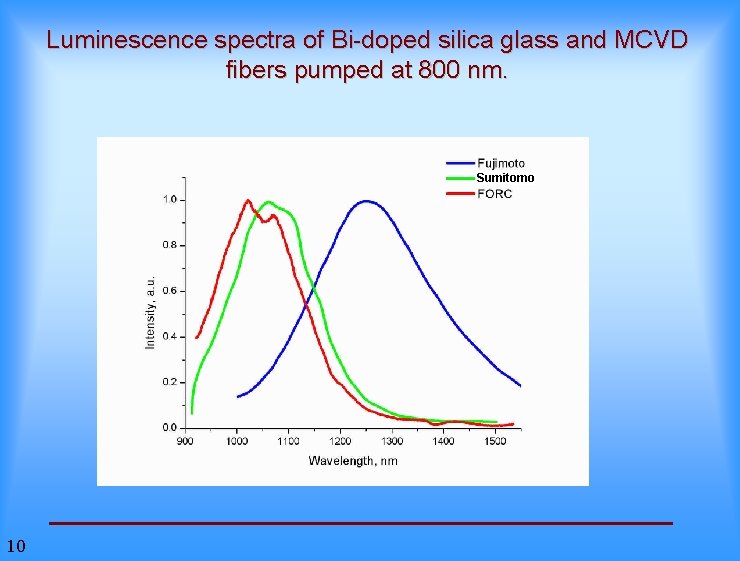
Luminescence spectra of Bi-doped silica glass and MCVD fibers pumped at 800 nm. Sumitomo 10
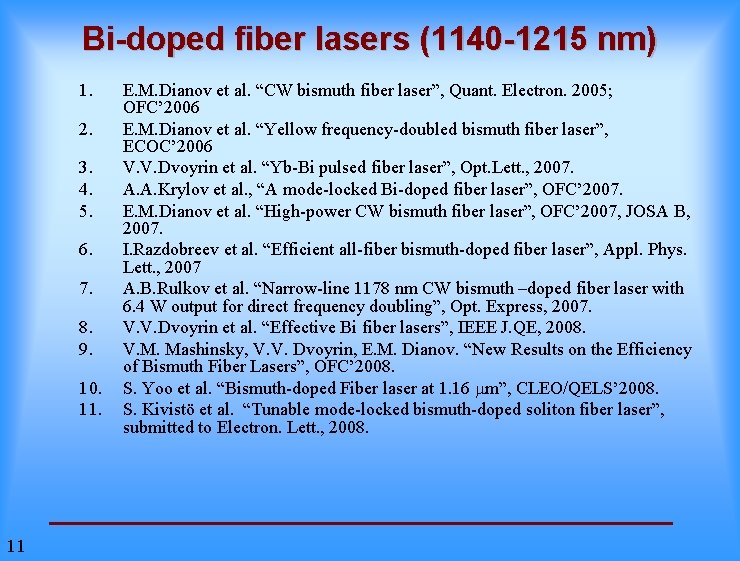
Bi-doped fiber lasers (1140 -1215 nm) 1. 2. 3. 4. 5. 6. 7. 8. 9. 10. 11. 11 E. M. Dianov et al. “CW bismuth fiber laser”, Quant. Electron. 2005; OFC’ 2006 E. M. Dianov et al. “Yellow frequency-doubled bismuth fiber laser”, ECOC’ 2006 V. V. Dvoyrin et al. “Yb-Bi pulsed fiber laser”, Opt. Lett. , 2007. A. A. Krylov et al. , “A mode-locked Bi-doped fiber laser”, OFC’ 2007. E. M. Dianov et al. “High-power CW bismuth fiber laser”, OFC’ 2007, JOSA B, 2007. I. Razdobreev et al. “Efficient all-fiber bismuth-doped fiber laser”, Appl. Phys. Lett. , 2007 A. B. Rulkov et al. “Narrow-line 1178 nm CW bismuth –doped fiber laser with 6. 4 W output for direct frequency doubling”, Opt. Express, 2007. V. V. Dvoyrin et al. “Effective Bi fiber lasers”, IEEE J. QE, 2008. V. M. Mashinsky, V. V. Dvoyrin, E. M. Dianov. “New Results on the Efficiency of Bismuth Fiber Lasers”, OFC’ 2008. S. Yoo et al. “Bismuth-doped Fiber laser at 1. 16 mm”, CLEO/QELS’ 2008. S. Kivistö et al. “Tunable mode-locked bismuth-doped soliton fiber laser”, submitted to Electron. Lett. , 2008.
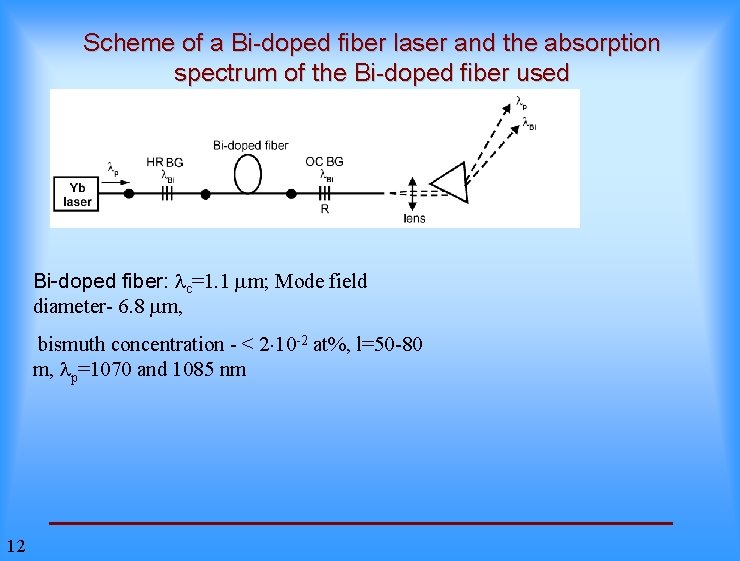
Scheme of a Bi-doped fiber laser and the absorption spectrum of the Bi-doped fiber used Bi-doped fiber: lc=1. 1 mm; Mode field diameter- 6. 8 mm, bismuth concentration - < 2 10 -2 at%, l=50 -80 m, lp=1070 and 1085 nm 12
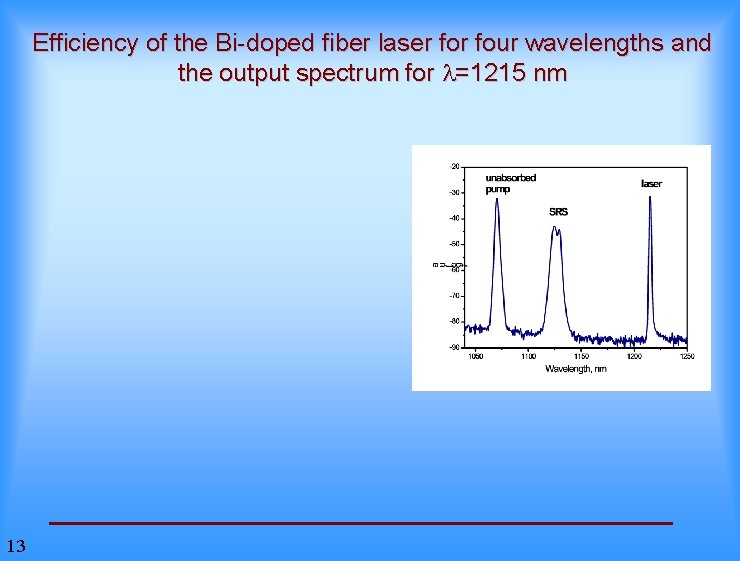
Efficiency of the Bi-doped fiber laser four wavelengths and the output spectrum for l=1215 nm 13
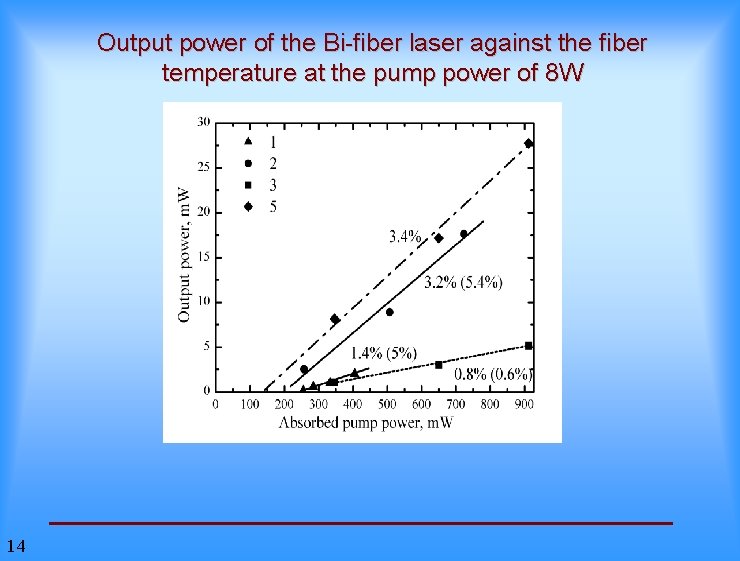
Output power of the Bi-fiber laser against the fiber temperature at the pump power of 8 W 14
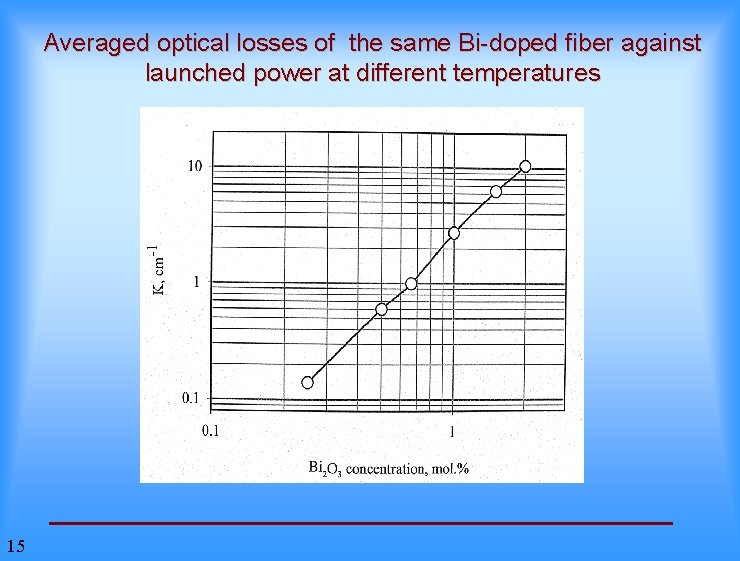
Averaged optical losses of the same Bi-doped fiber against launched power at different temperatures 15
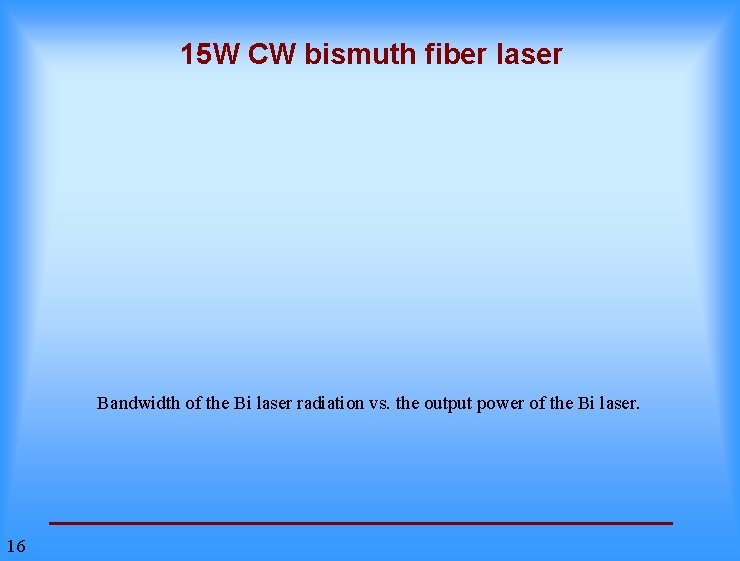
15 W CW bismuth fiber laser Bandwidth of the Bi laser radiation vs. the output power of the Bi laser. 16
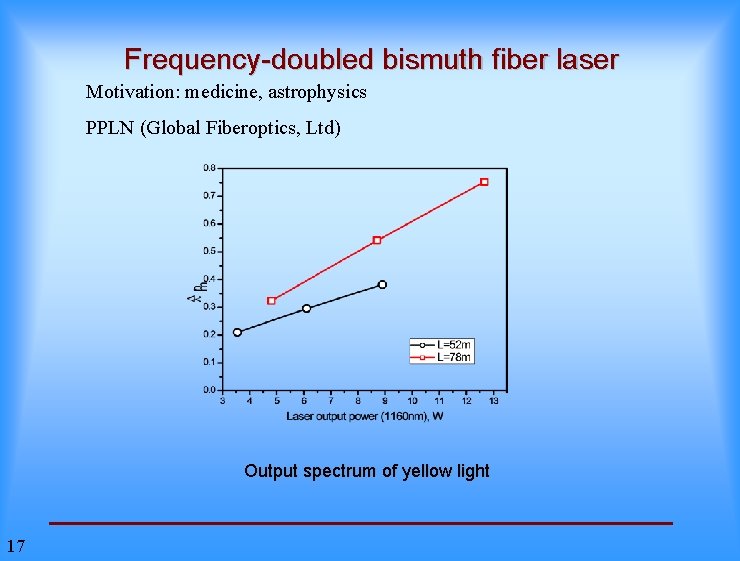
Frequency-doubled bismuth fiber laser Motivation: medicine, astrophysics PPLN (Global Fiberoptics, Ltd) Output spectrum of yellow light 17
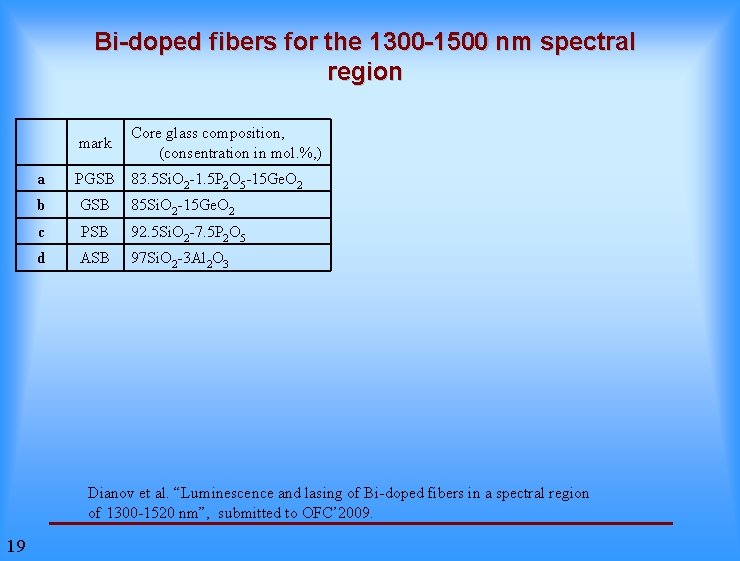
Bi-doped fibers for the 1300 -1500 nm spectral region mark Core glass composition, (consentration in mol. %, ) a PGSB 83. 5 Si. O 2 -1. 5 P 2 O 5 -15 Ge. O 2 b GSB 85 Si. O 2 -15 Ge. O 2 c PSB 92. 5 Si. O 2 -7. 5 P 2 O 5 d ASB 97 Si. O 2 -3 Al 2 O 3 Dianov et al. “Luminescence and lasing of Bi-doped fibers in a spectral region of 1300 -1520 nm”, submitted to OFC’ 2009. 19
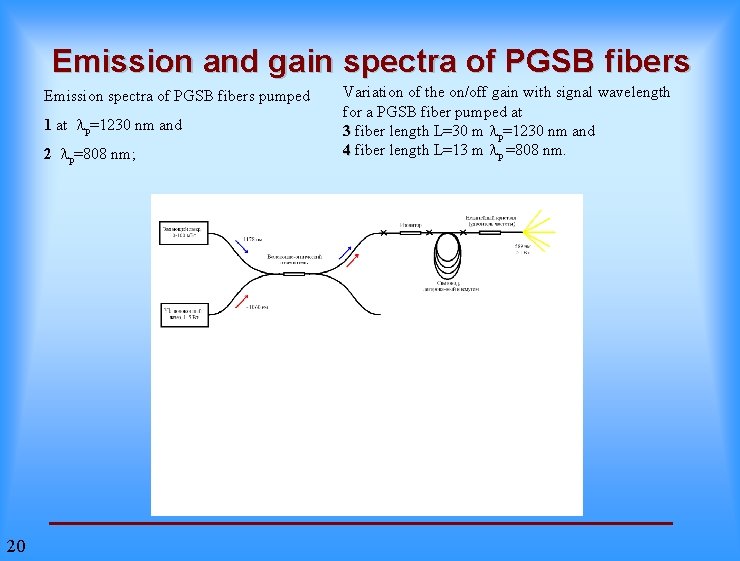
Emission and gain spectra of PGSB fibers Emission spectra of PGSB fibers pumped 1 at lp=1230 nm and 2 lp=808 nm; 20 Variation of the on/off gain with signal wavelength for a PGSB fiber pumped at 3 fiber length L=30 m lp=1230 nm and 4 fiber length L=13 m lp =808 nm.
Output emission spectra of Bi-doped fiber lasers I. A. Bufetov et al. “Bi-doped fiber lasers and amplifiers for a spectral region of 1300– 1470 nm”, Opt. Lett. , 33, 2227 -2229 (2008) 21
Output power of BFLs as a function of absorbed pump power at T=300 K The efficiency of the laser at T=77 K is shown in brackets. 22
What is a nature of Bi-related centers emitting in near IR? • Bi 5+ - Fujimoto and Nakatsuka, 2001 • Bi+ - X. Meng et al. , 2005 • Bi. O – J. Ren et al. , 2006 • Bi 2, Bi 2 -, Bi 22 - - Khonthon et al. , 2007; Sokolov et al. , 2008 23
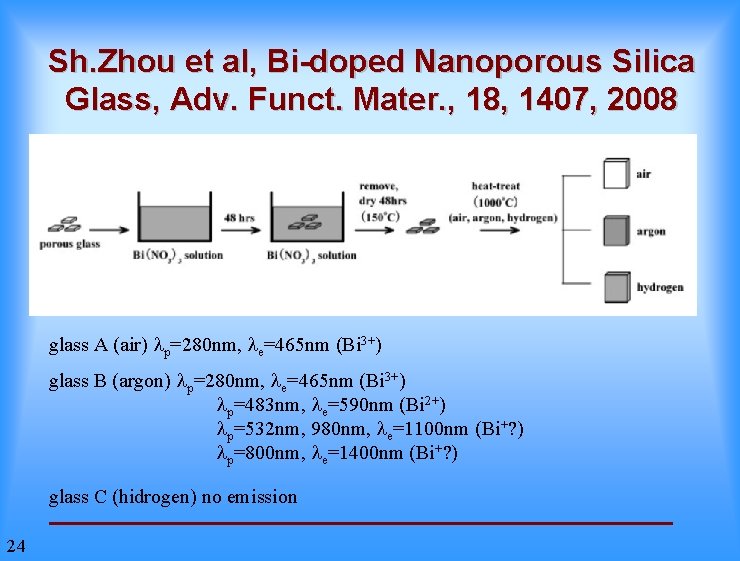
Sh. Zhou et al, Bi-doped Nanoporous Silica Glass, Adv. Funct. Mater. , 18, 1407, 2008 glass A (air) lp=280 nm, le=465 nm (Bi 3+) glass B (argon) lp=280 nm, le=465 nm (Bi 3+) lp=483 nm, le=590 nm (Bi 2+) lp=532 nm, 980 nm, le=1100 nm (Bi+? ) lp=800 nm, le=1400 nm (Bi+? ) glass C (hidrogen) no emission 24
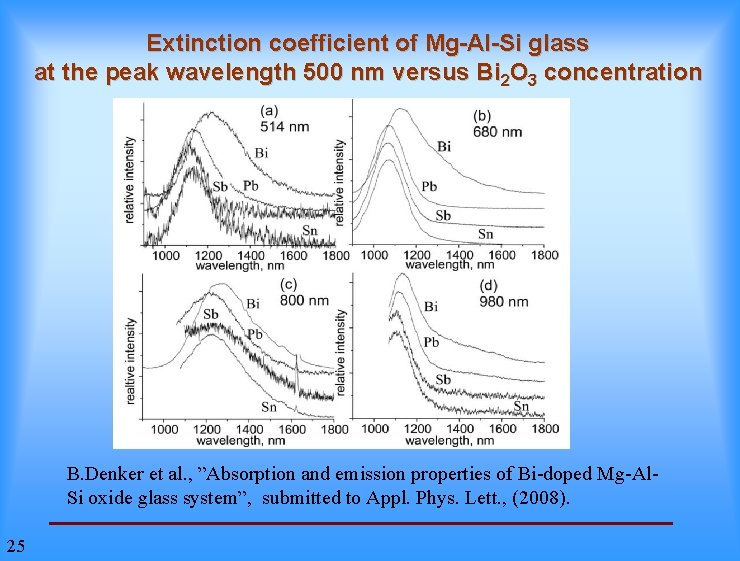
Extinction coefficient of Mg-Al-Si glass at the peak wavelength 500 nm versus Bi 2 O 3 concentration B. Denker et al. , ”Absorption and emission properties of Bi-doped Mg-Al. Si oxide glass system”, submitted to Appl. Phys. Lett. , (2008). 25
Fluorescence spectra are vertically shifted for clarity; fluorescence intensity is about zero at 1800 nm for all samples. M. Yu. Sharonov et al. „Spectroscopic study of optical centers formed in Bi-, Pb-, Sn-, Te-, and In-doped germinate glasses“, Opt. Lett. , vol. 33, pp. 2131 -2133, 2008 26
Conclusion • Demonstration of Bi-doped fiber laser generation in a spectral region of 1140 -1500 nm represents a significant milestone towards producing efficient fiber lasers and wideband optical amplifiers for this spectral region. • Unforeseen properties of Bi in glasses might hinder development of practical Bi-doped fiber lasers and amplifiers. • Further vast fundamental researches of properties of Bi in glasses are necessary. 27
- Slides: 27