Interpersonal Communication Communicating Assertively Presentation Facilitation Guide 2011

- Slides: 52
Interpersonal Communication: Communicating Assertively Presentation & Facilitation Guide © 2011 Skill. Soft Ireland Limited
Introduction and Ground Rules • Presenter: [enter name of presenter or facilitator]. • Target audience: Individuals who want to develop or refresh their interpersonal communication skills. • Goal: To demonstrate assertiveness in interpersonal communication. • Ground rules: • list ground rules here Interpersonal Communication: Communicating Assertively 2
Agenda • Course Overview. • Topic 1: Recognizing Assertive Behavior and Its Benefits. • Topic 2: Requirements for Assertive Communication. • Topic 3: Communicating Assertively. Interpersonal Communication: Communicating Assertively 3
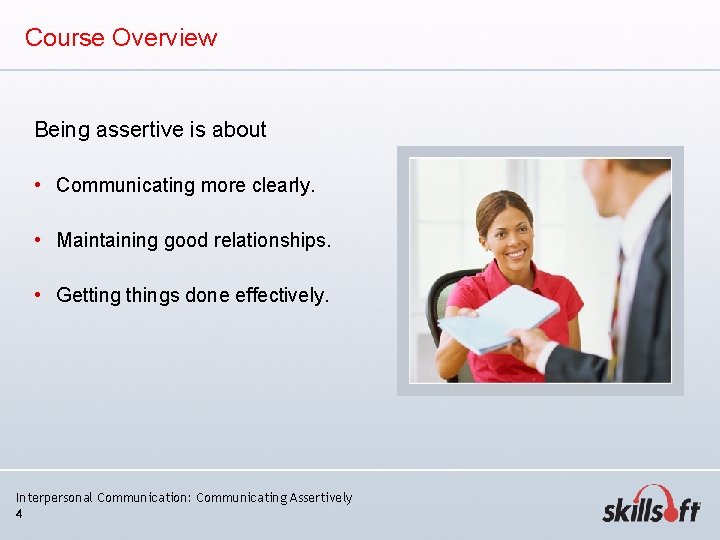
Course Overview Being assertive is about • Communicating more clearly. • Maintaining good relationships. • Getting things done effectively. Interpersonal Communication: Communicating Assertively 4
Topic 1: Recognizing Assertive Behavior and Its Benefits Classify the behavior styles exhibited in a given scenario. Interpersonal Communication: Communicating Assertively 5
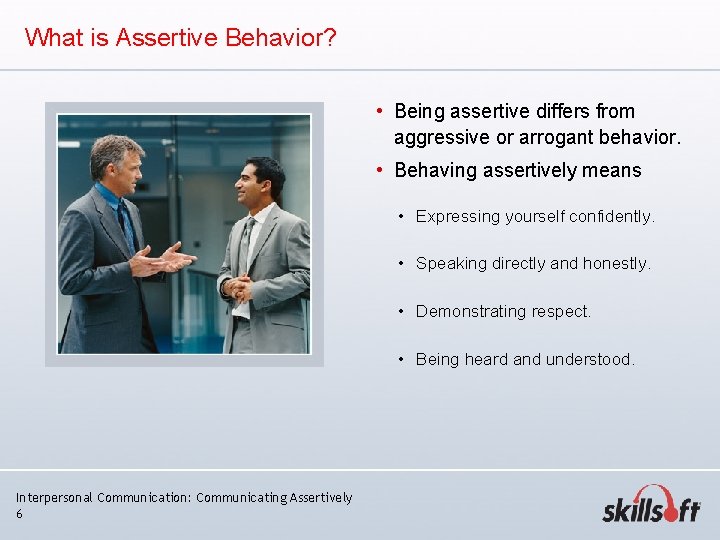
What is Assertive Behavior? • Being assertive differs from aggressive or arrogant behavior. • Behaving assertively means • Expressing yourself confidently. • Speaking directly and honestly. • Demonstrating respect. • Being heard and understood. Interpersonal Communication: Communicating Assertively 6
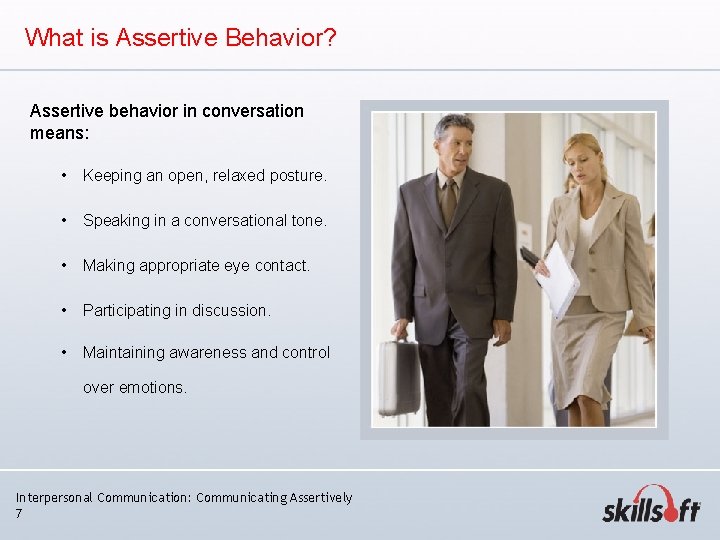
What is Assertive Behavior? Assertive behavior in conversation means: • Keeping an open, relaxed posture. • Speaking in a conversational tone. • Making appropriate eye contact. • Participating in discussion. • Maintaining awareness and control over emotions. Interpersonal Communication: Communicating Assertively 7
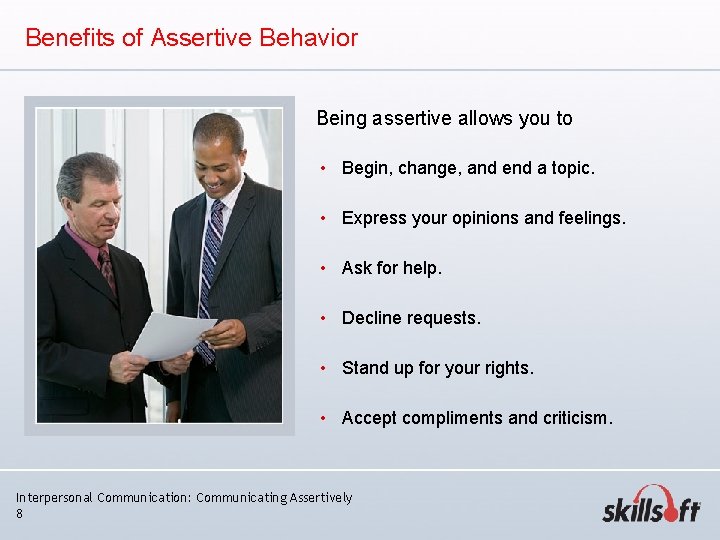
Benefits of Assertive Behavior Being assertive allows you to • Begin, change, and end a topic. • Express your opinions and feelings. • Ask for help. • Decline requests. • Stand up for your rights. • Accept compliments and criticism. Interpersonal Communication: Communicating Assertively 8
Discussion Do you think you are assertive, or do you know of colleagues who are assertive? Can you think of a time when you witnessed someone exhibiting the main characteristics of assertive behavior? Interpersonal Communication: Communicating Assertively 9
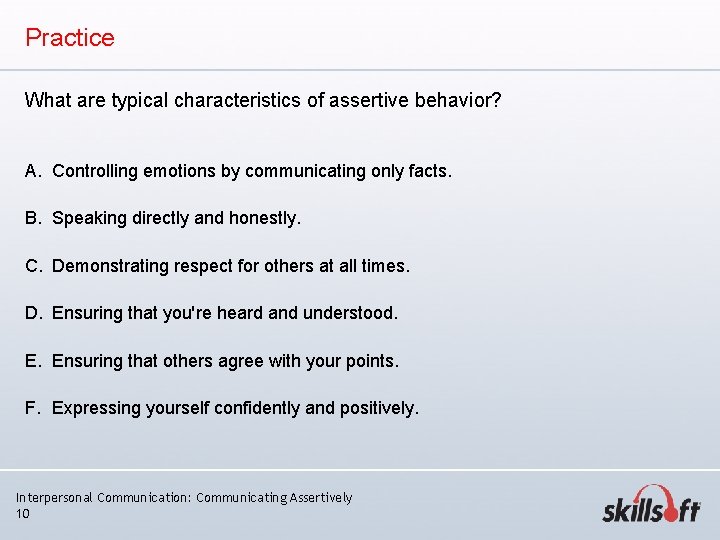
Practice What are typical characteristics of assertive behavior? A. Controlling emotions by communicating only facts. B. Speaking directly and honestly. C. Demonstrating respect for others at all times. D. Ensuring that you're heard and understood. E. Ensuring that others agree with your points. F. Expressing yourself confidently and positively. Interpersonal Communication: Communicating Assertively 10
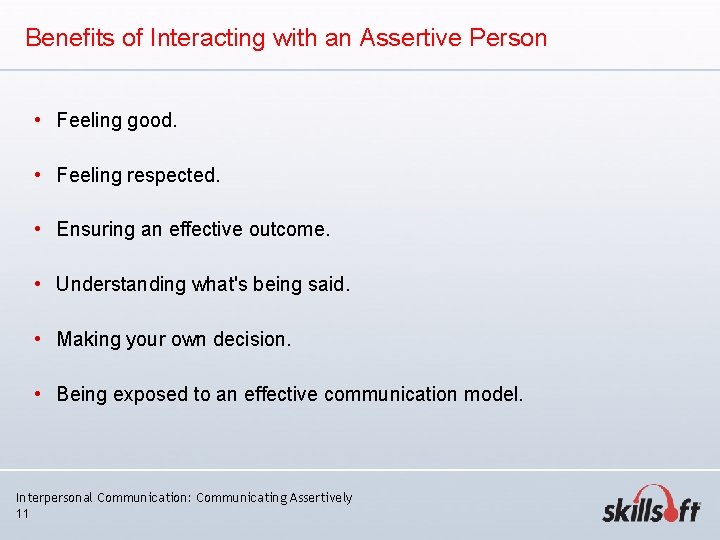
Benefits of Interacting with an Assertive Person • Feeling good. • Feeling respected. • Ensuring an effective outcome. • Understanding what's being said. • Making your own decision. • Being exposed to an effective communication model. Interpersonal Communication: Communicating Assertively 11
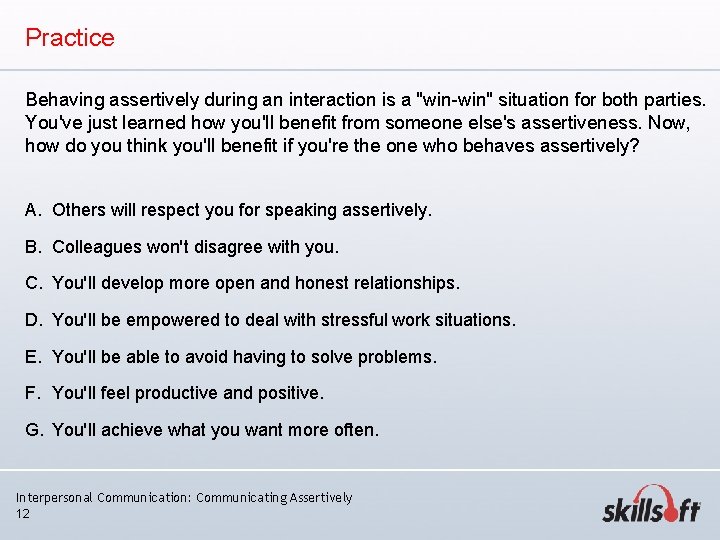
Practice Behaving assertively during an interaction is a "win-win" situation for both parties. You've just learned how you'll benefit from someone else's assertiveness. Now, how do you think you'll benefit if you're the one who behaves assertively? A. Others will respect you for speaking assertively. B. Colleagues won't disagree with you. C. You'll develop more open and honest relationships. D. You'll be empowered to deal with stressful work situations. E. You'll be able to avoid having to solve problems. F. You'll feel productive and positive. G. You'll achieve what you want more often. Interpersonal Communication: Communicating Assertively 12
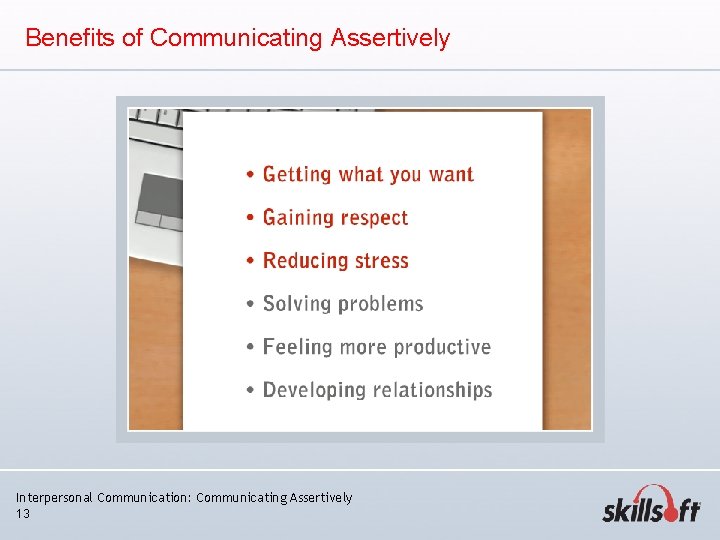
Benefits of Communicating Assertively Interpersonal Communication: Communicating Assertively 13
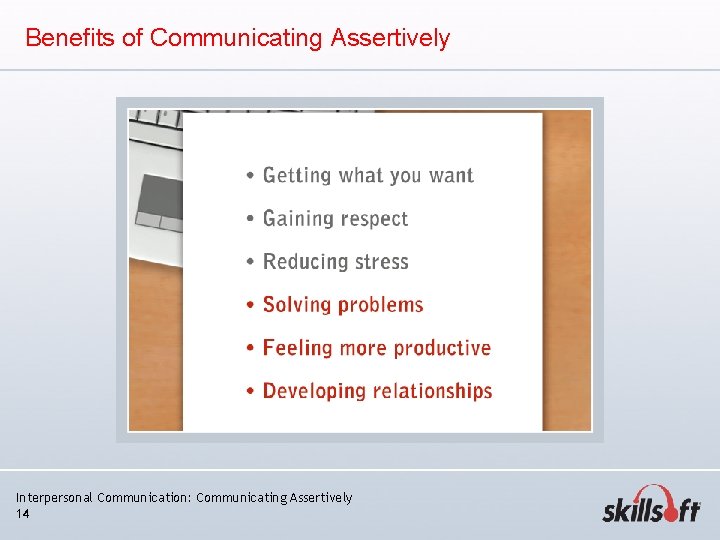
Benefits of Communicating Assertively Interpersonal Communication: Communicating Assertively 14
Classifying Communication Behavior • Passive. • Aggressive. • Directly aggressive. • Passive-aggressive. ― Hope others will "learn their lesson". ― Won't confront the problem directly. Interpersonal Communication: Communicating Assertively 15
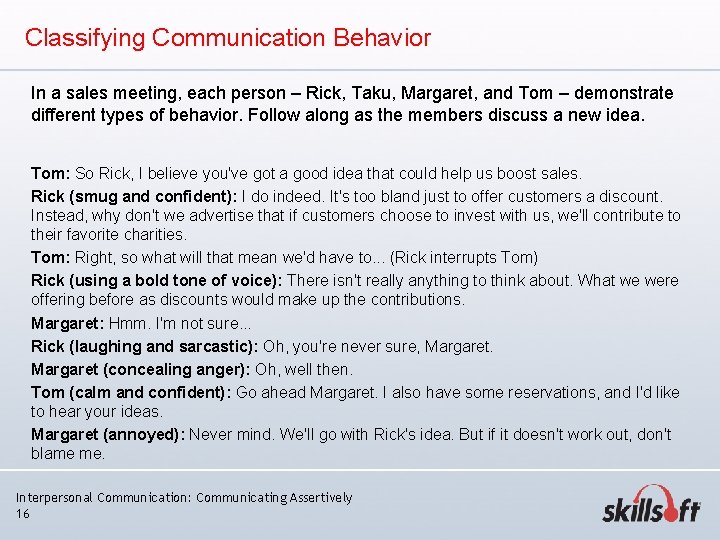
Classifying Communication Behavior In a sales meeting, each person – Rick, Taku, Margaret, and Tom – demonstrate different types of behavior. Follow along as the members discuss a new idea. Tom: So Rick, I believe you've got a good idea that could help us boost sales. Rick (smug and confident): I do indeed. It's too bland just to offer customers a discount. Instead, why don't we advertise that if customers choose to invest with us, we'll contribute to their favorite charities. Tom: Right, so what will that mean we'd have to. . . (Rick interrupts Tom) Rick (using a bold tone of voice): There isn't really anything to think about. What we were offering before as discounts would make up the contributions. Margaret: Hmm. I'm not sure. . . Rick (laughing and sarcastic): Oh, you're never sure, Margaret (concealing anger): Oh, well then. Tom (calm and confident): Go ahead Margaret. I also have some reservations, and I'd like to hear your ideas. Margaret (annoyed): Never mind. We'll go with Rick's idea. But if it doesn't work out, don't blame me. Interpersonal Communication: Communicating Assertively 16
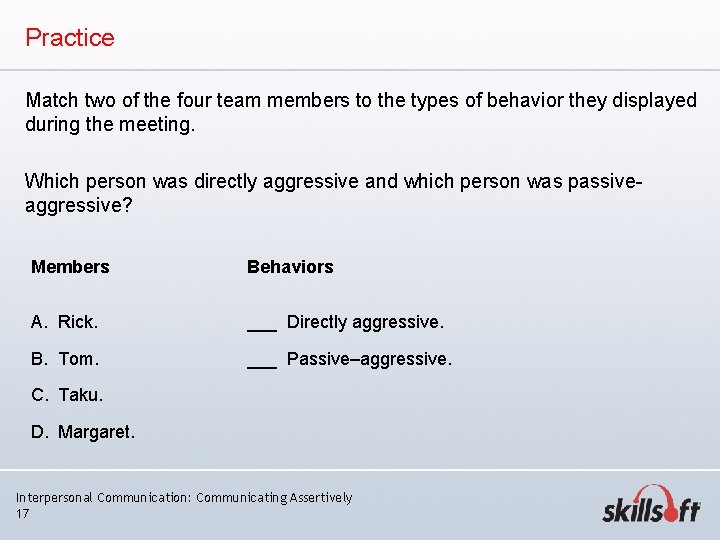
Practice Match two of the four team members to the types of behavior they displayed during the meeting. Which person was directly aggressive and which person was passiveaggressive? Members Behaviors A. Rick. ___ Directly aggressive. B. Tom. ___ Passive–aggressive. C. Taku. D. Margaret. Interpersonal Communication: Communicating Assertively 17
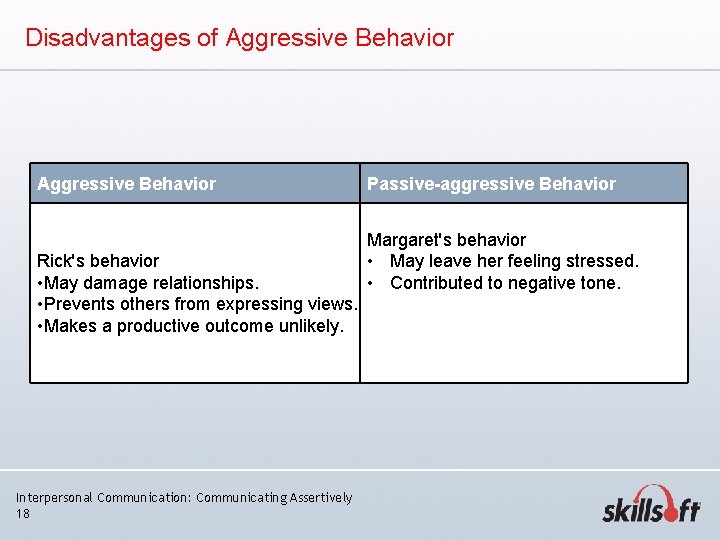
Disadvantages of Aggressive Behavior Rick's behavior • May damage relationships. • Prevents others from expressing views. • Makes a productive outcome unlikely. Interpersonal Communication: Communicating Assertively 18 Passive-aggressive Behavior Margaret's behavior • May leave her feeling stressed. • Contributed to negative tone.
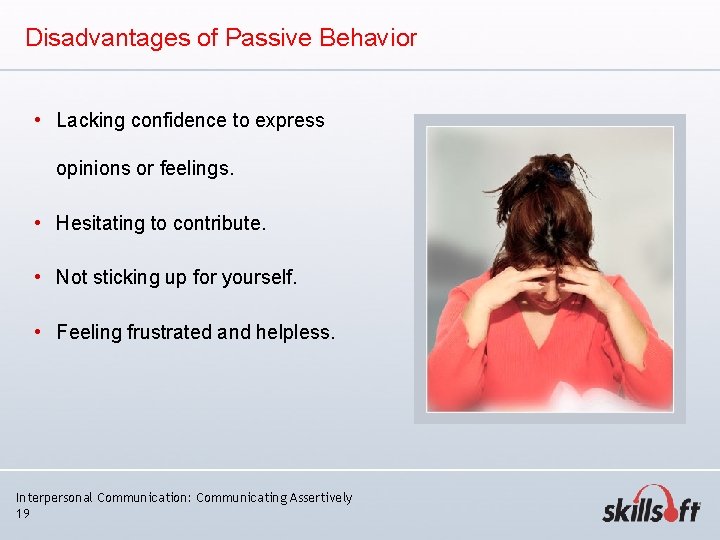
Disadvantages of Passive Behavior • Lacking confidence to express opinions or feelings. • Hesitating to contribute. • Not sticking up for yourself. • Feeling frustrated and helpless. Interpersonal Communication: Communicating Assertively 19
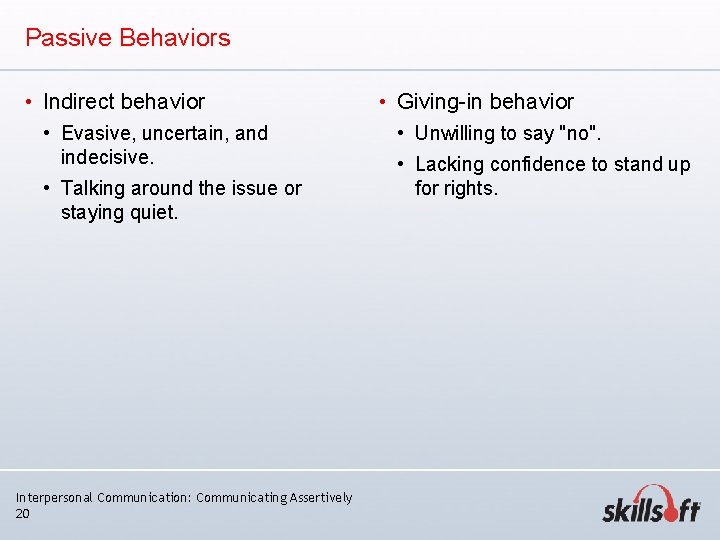
Passive Behaviors • Indirect behavior • Evasive, uncertain, and indecisive. • Talking around the issue or staying quiet. Interpersonal Communication: Communicating Assertively 20 • Giving-in behavior • Unwilling to say "no". • Lacking confidence to stand up for rights.
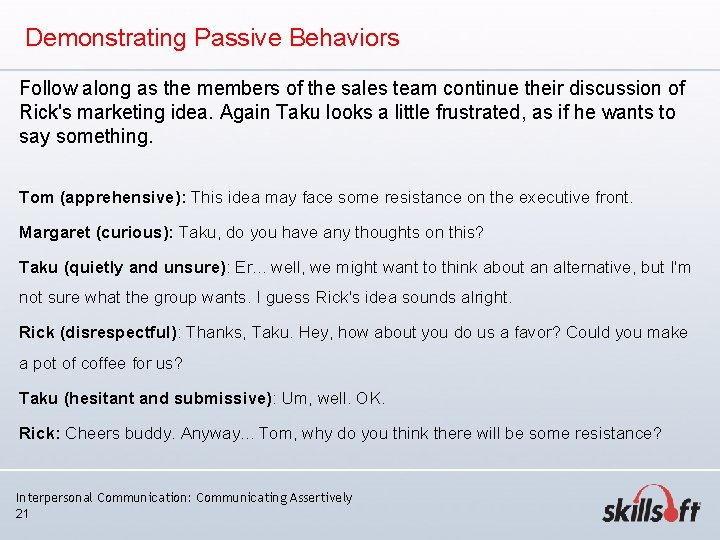
Demonstrating Passive Behaviors Follow along as the members of the sales team continue their discussion of Rick's marketing idea. Again Taku looks a little frustrated, as if he wants to say something. Tom (apprehensive): This idea may face some resistance on the executive front. Margaret (curious): Taku, do you have any thoughts on this? Taku (quietly and unsure): Er. . . well, we might want to think about an alternative, but I'm not sure what the group wants. I guess Rick's idea sounds alright. Rick (disrespectful): Thanks, Taku. Hey, how about you do us a favor? Could you make a pot of coffee for us? Taku (hesitant and submissive): Um, well. OK. Rick: Cheers buddy. Anyway. . . Tom, why do you think there will be some resistance? Interpersonal Communication: Communicating Assertively 21
Practice Simon, Beth, Carl, and Jackie are sitting around a table during a break. Refer to the Coffee Break learning aid for details about how they communicate and then match everyone to the type of behavior they display. People Behaviors A. Carl. ___ Assertive. B. Beth. ___ Passive-aggressive C. Jackie. ___ Passive. D. Simon. ___ Aggressive. Interpersonal Communication: Communicating Assertively 22
Discussion What type of behavior do you think you typically exhibit? Can you think of any examples of situations when you reacted this way? Interpersonal Communication: Communicating Assertively 23
Topic 2: Requirements for Assertive Communication Recognize statements and practices that demonstrate assertiveness, in a given scenario. Interpersonal Communication: Communicating Assertively 24
How to be an Assertive Communicator • Be honest and straightforward. • Be respectful of others. • Use assertive body language. Interpersonal Communication: Communicating Assertively 25
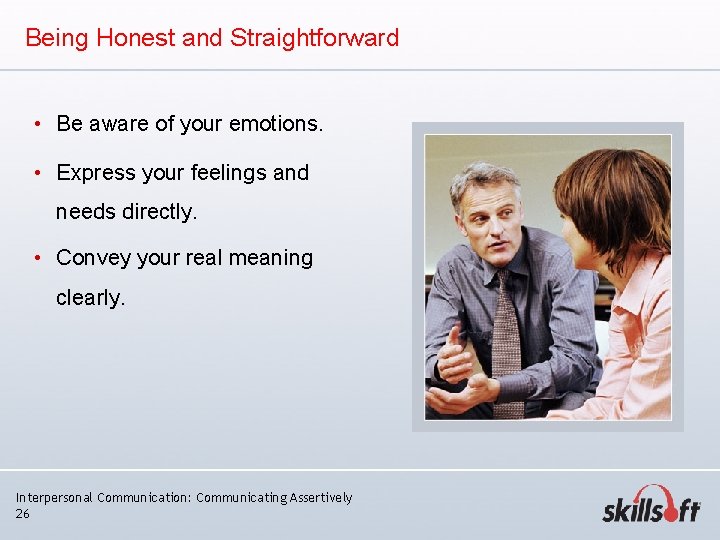
Being Honest and Straightforward • Be aware of your emotions. • Express your feelings and needs directly. • Convey your real meaning clearly. Interpersonal Communication: Communicating Assertively 26
Practice Take the example of asking for a raise. How do you think you should frame your statement or question to convey your meaning directly? A. "With the new responsibilities I've taken on, I'd like to ask for a raise. “ B. "I'm doing a lot more around here than I used to, don't you think? “ C. "Most employees who take on the responsibilities that I have are eligible for a raise. “ D. "I deserve a raise. " Interpersonal Communication: Communicating Assertively 27
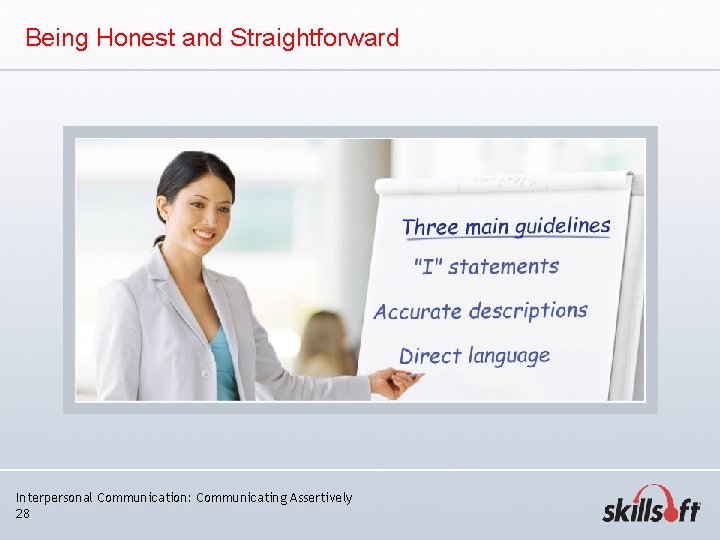
Being Honest and Straightforward Interpersonal Communication: Communicating Assertively 28
Using “I” Statements • Takes ownership of your ideas. • Avoids stating opinions as facts. • Shows respect for opinions of others "You've been ignoring my instructions. " I feel as though you’ve been ignoring my instructions. I get the impression you’ve been ignoring my instructions. I am concerned that you seem to have been ignoring my instructions. Interpersonal Communication: Communicating Assertively 29
Practice Do you think "I feel that you don't spend enough time checking the quality of your reports" is a good example of an assertive "I" statement? A. Yes. B. No. Interpersonal Communication: Communicating Assertively 30
Using “I” Statements • True "I" statements honestly express how you feel. Original statement Assertive "I" statement "You always interrupt me!" "I would like to be able to finish my points without being interrupted. " "You make me so mad. " "I get angry when you don't get your reports done on time. " "If you don't hurry up with the reports, this project is going to fail. " Interpersonal Communication: Communicating Assertively 31 "I'm concerned that if the reports aren't complete by next week, the whole project will be threatened. "
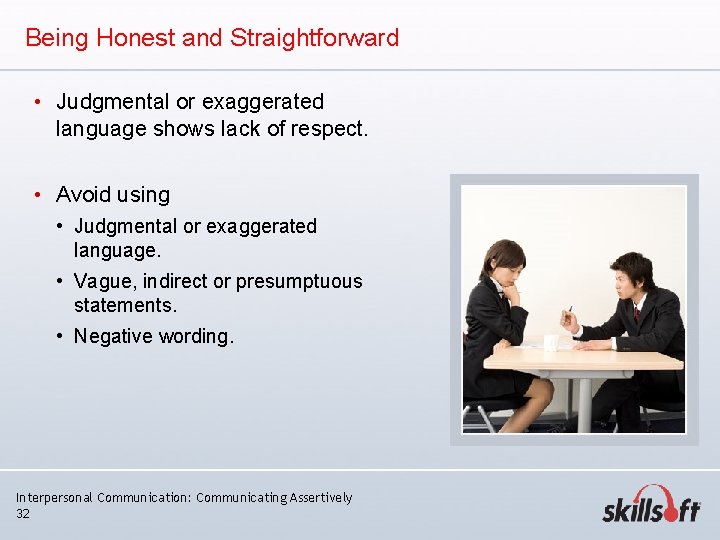
Being Honest and Straightforward • Judgmental or exaggerated language shows lack of respect. • Avoid using • Judgmental or exaggerated language. • Vague, indirect or presumptuous statements. • Negative wording. Interpersonal Communication: Communicating Assertively 32
Being Honest and Straightforward Follow along as Darren and Sara, two project leaders, discuss new information relating to a contract with William, their manager. Darren: I've just read the e-mail regarding the new schedule for the Tek Weekly job. The deadlines are tighter, and we still haven't advertised for new programmers! William: You always blow things out of proportion, Darren. Things will be fine! Sara: Why don't you offer the team another production bonus? William: I just need everything to run smoothly. Darren: A bonus isn't the issue, Sara. And things aren't likely to run smoothly, William, because there isn't enough time to complete the project with our current staff resources. Will you please advertise for new programmers as soon as possible? Interpersonal Communication: Communicating Assertively 33
Discussion Can you think of any difficult situations when you needed to make a request of your boss or colleagues? Were you honest and straightforward in your communication? Interpersonal Communication: Communicating Assertively 34
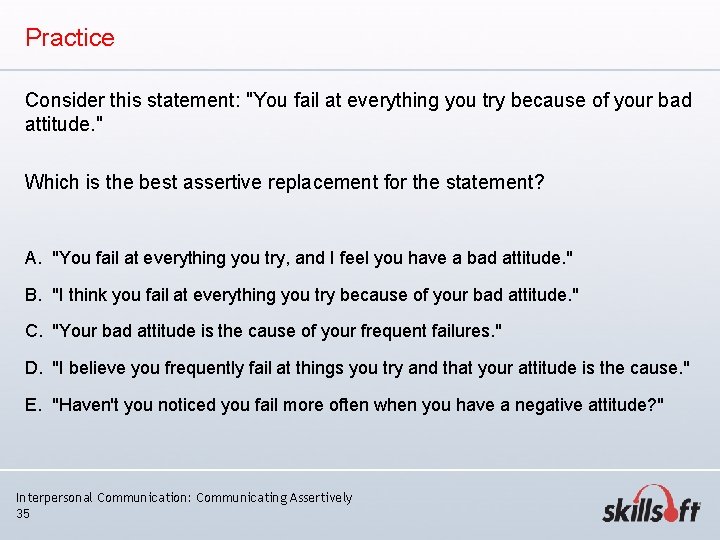
Practice Consider this statement: "You fail at everything you try because of your bad attitude. " Which is the best assertive replacement for the statement? A. "You fail at everything you try, and I feel you have a bad attitude. " B. "I think you fail at everything you try because of your bad attitude. " C. "Your bad attitude is the cause of your frequent failures. " D. "I believe you frequently fail at things you try and that your attitude is the cause. " E. "Haven't you noticed you fail more often when you have a negative attitude? " Interpersonal Communication: Communicating Assertively 35
Demonstrating Respect for Others • Start with a positive. • Show respect for the other person's position. • Present your opinion neutrally. Interpersonal Communication: Communicating Assertively 36
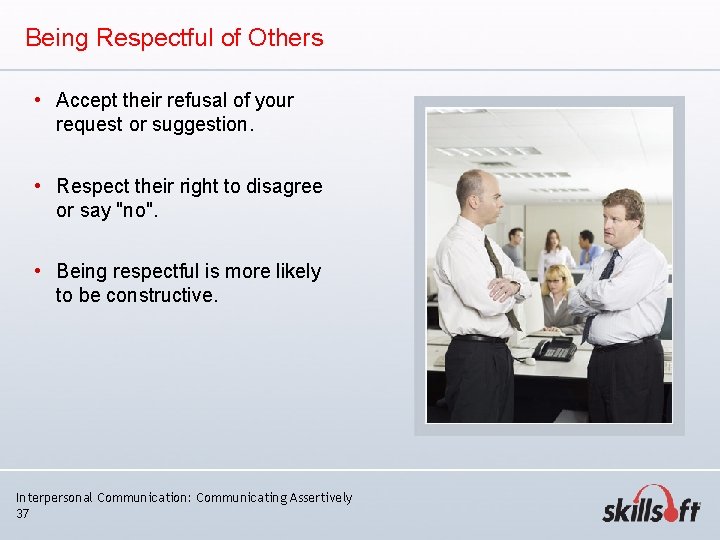
Being Respectful of Others • Accept their refusal of your request or suggestion. • Respect their right to disagree or say "no". • Being respectful is more likely to be constructive. Interpersonal Communication: Communicating Assertively 37
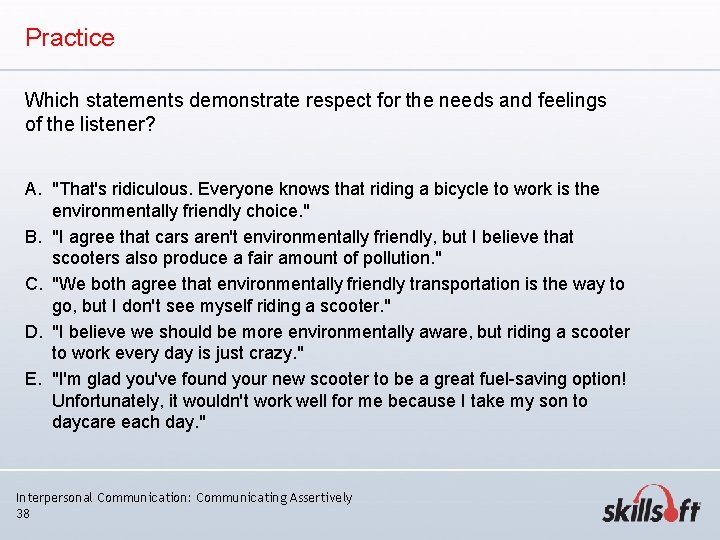
Practice Which statements demonstrate respect for the needs and feelings of the listener? A. "That's ridiculous. Everyone knows that riding a bicycle to work is the environmentally friendly choice. " B. "I agree that cars aren't environmentally friendly, but I believe that scooters also produce a fair amount of pollution. " C. "We both agree that environmentally friendly transportation is the way to go, but I don't see myself riding a scooter. " D. "I believe we should be more environmentally aware, but riding a scooter to work every day is just crazy. " E. "I'm glad you've found your new scooter to be a great fuel-saving option! Unfortunately, it wouldn't work well for me because I take my son to daycare each day. " Interpersonal Communication: Communicating Assertively 38
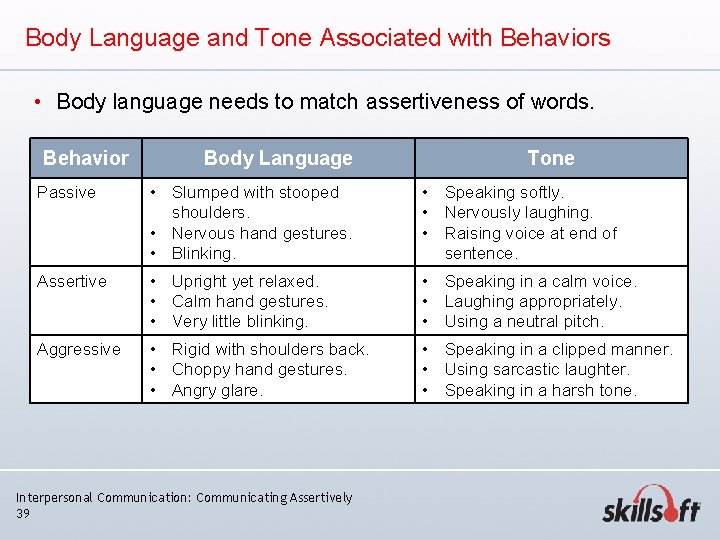
Body Language and Tone Associated with Behaviors • Body language needs to match assertiveness of words. Behavior Body Language Tone Passive • Slumped with stooped shoulders. • Nervous hand gestures. • Blinking. • Speaking softly. • Nervously laughing. • Raising voice at end of sentence. Assertive • Upright yet relaxed. • Calm hand gestures. • Very little blinking. • Speaking in a calm voice. • Laughing appropriately. • Using a neutral pitch. Aggressive • Rigid with shoulders back. • Choppy hand gestures. • Angry glare. • Speaking in a clipped manner. • Using sarcastic laughter. • Speaking in a harsh tone. Interpersonal Communication: Communicating Assertively 39
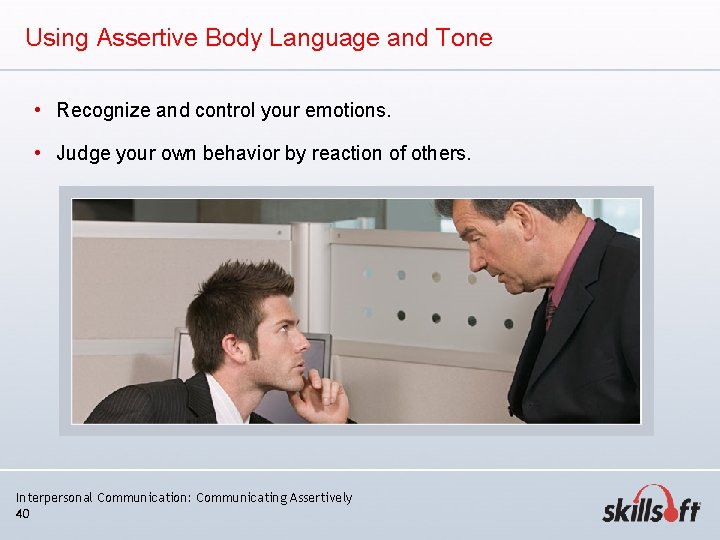
Using Assertive Body Language and Tone • Recognize and control your emotions. • Judge your own behavior by reaction of others. Interpersonal Communication: Communicating Assertively 40
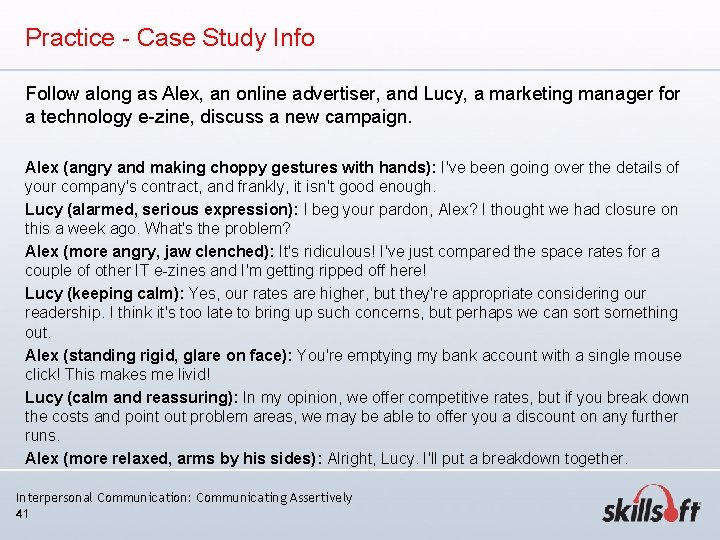
Practice - Case Study Info Follow along as Alex, an online advertiser, and Lucy, a marketing manager for a technology e-zine, discuss a new campaign. Alex (angry and making choppy gestures with hands): I've been going over the details of your company's contract, and frankly, it isn't good enough. Lucy (alarmed, serious expression): I beg your pardon, Alex? I thought we had closure on this a week ago. What's the problem? Alex (more angry, jaw clenched): It's ridiculous! I've just compared the space rates for a couple of other IT e-zines and I'm getting ripped off here! Lucy (keeping calm): Yes, our rates are higher, but they're appropriate considering our readership. I think it's too late to bring up such concerns, but perhaps we can sort something out. Alex (standing rigid, glare on face): You're emptying my bank account with a single mouse click! This makes me livid! Lucy (calm and reassuring): In my opinion, we offer competitive rates, but if you break down the costs and point out problem areas, we may be able to offer you a discount on any further runs. Alex (more relaxed, arms by his sides): Alright, Lucy. I'll put a breakdown together. Interpersonal Communication: Communicating Assertively 41
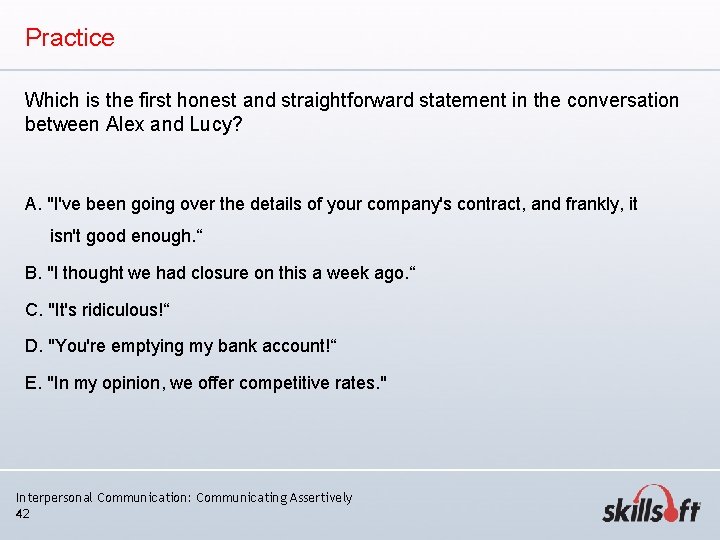
Practice Which is the first honest and straightforward statement in the conversation between Alex and Lucy? A. "I've been going over the details of your company's contract, and frankly, it isn't good enough. “ B. "I thought we had closure on this a week ago. “ C. "It's ridiculous!“ D. "You're emptying my bank account!“ E. "In my opinion, we offer competitive rates. " Interpersonal Communication: Communicating Assertively 42
Practice Which statements demonstrate respect for the other person's feelings and positions? A. "I've been going over the details of your company's contract, and frankly, it isn't good enough. " B. "Yes, our rates are higher, but they're appropriate considering our readership. " C. "You're emptying my bank account with a single mouse click!" D. "In my opinion, we offer competitive rates, but if you break down the costs and point out problem areas, we may be able to offer you a discount on any further runs. " Interpersonal Communication: Communicating Assertively 43
Practice Was Alex's body language assertive? A. Yes, it was assertive. B. No, it was aggressive. C. No, it was passive. Interpersonal Communication: Communicating Assertively 44
Topic 3: Communicating Assertively Communicate assertively in a given scenario. Interpersonal Communication: Communicating Assertively 45
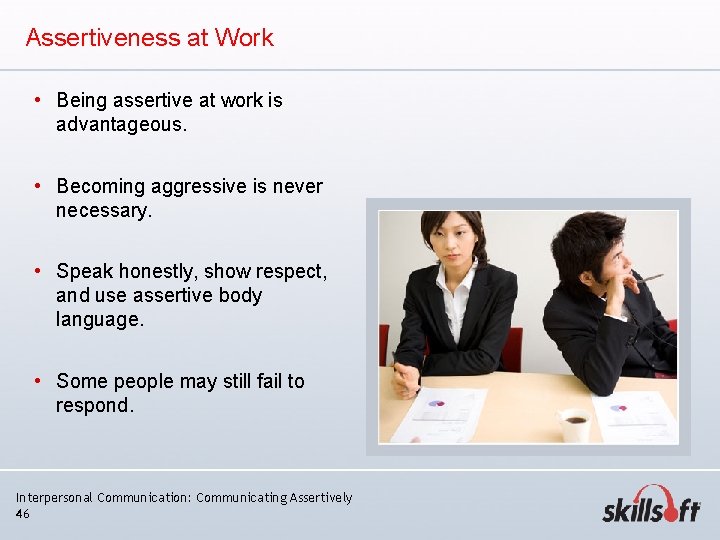
Assertiveness at Work • Being assertive at work is advantageous. • Becoming aggressive is never necessary. • Speak honestly, show respect, and use assertive body language. • Some people may still fail to respond. Interpersonal Communication: Communicating Assertively 46
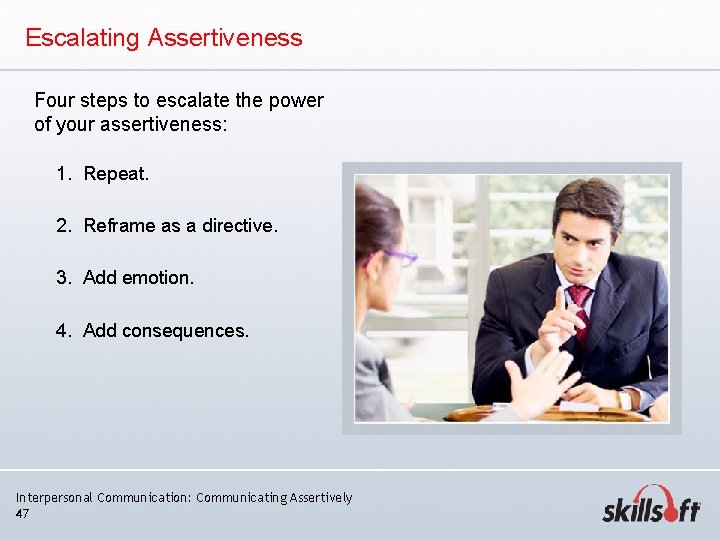
Escalating Assertiveness Four steps to escalate the power of your assertiveness: 1. Repeat. 2. Reframe as a directive. 3. Add emotion. 4. Add consequences. Interpersonal Communication: Communicating Assertively 47
Discussion Have you ever been in a situation when you failed to get your message across and had to escalate your assertiveness? Did you follow any, or all, of the four steps? How did the other person react to each step? Interpersonal Communication: Communicating Assertively 48
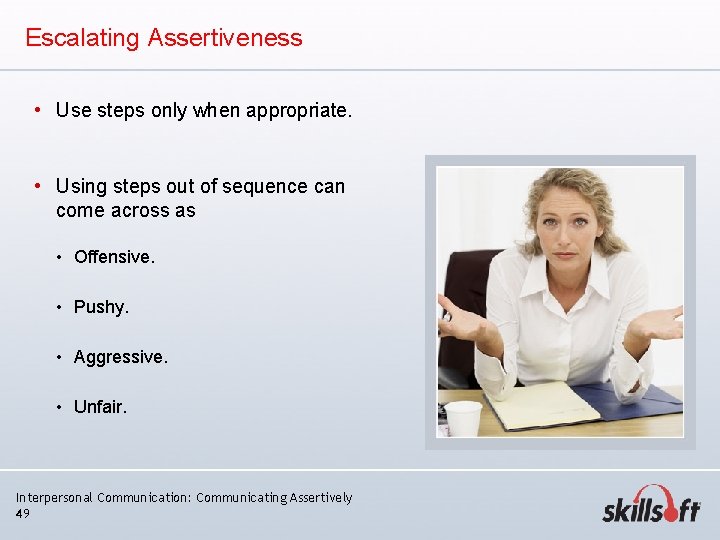
Escalating Assertiveness • Use steps only when appropriate. • Using steps out of sequence can come across as • Offensive. • Pushy. • Aggressive. • Unfair. Interpersonal Communication: Communicating Assertively 49
Practice You're in a meeting with a team member about how to make improvements to office communications. You have an idea to propose. You say "I was thinking – could we develop a notice board that is updated everyday? " Your colleague doesn't respond. Sequence the examples of statements in order of increasing power of assertiveness. ___ ___ "It's important that all ideas are acknowledged in a planning meeting. If you don't respond and tell me what you think of the idea of a notice board, we'll need to end this meeting. " "Could we develop a notice board that is updated everyday? “ "I'm getting irritated that you're not responding. Please tell me what you think of my idea about a notice board. " "Please tell me what you think of my idea about a notice board. " Interpersonal Communication: Communicating Assertively 50
Discussion You work for a national museum coordinating exhibits in the museum space. You have a lot of work to complete before opening night less than five days away and don't know how you'll get it all done in time. Vera, a colleague in charge of museum outreach, asks you to be her master of ceremonies for tomorrow's museum fundraiser lecture. You're certain there is no way you can agree to her request and still get your exhibits organized in time. So you politely but firmly decline: "I would like to help, Vera, but I'm not available for any extracurricular activities this week. Can you find someone else? " Your assertive response doesn't satisfy Vera, who keeps talking. How would you appropriately escalate the power of your message by escalating your assertiveness, so Vera understands that you mean it? Interpersonal Communication: Communicating Assertively 51
Wrap-up / Q&A • Topic 1: Recognizing Assertive Behavior and Its Benefits. • Classify the behavior styles exhibited in a given scenario. • Topic 2: Requirements for Assertive Communication. • Recognize statements and practices that demontrate assertiveness, in a given scenario. • Topic 3: Communicating Assertively. • Communicate assertively in a given scenario. Interpersonal Communication: Communicating Assertively 52