
Intercultural Competence in Interpersonal Relationships CHAPTER 10 Preview

- Slides: 10
Intercultural Competence in Interpersonal Relationships CHAPTER 10
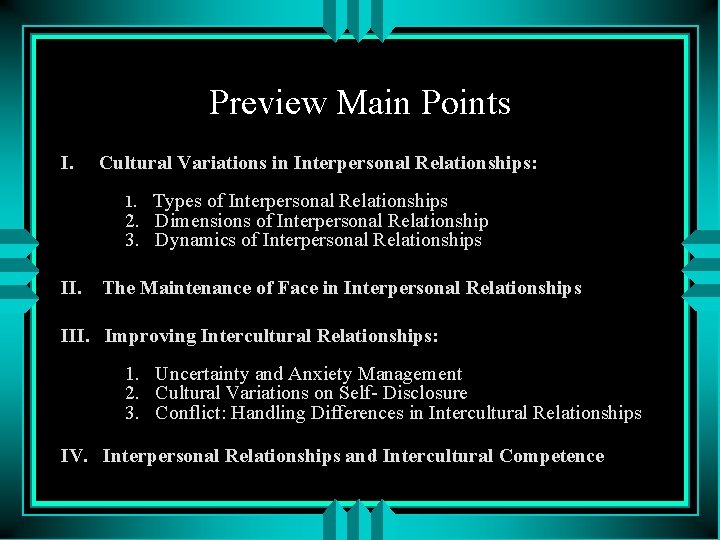
Preview Main Points I. Cultural Variations in Interpersonal Relationships: 1. Types of Interpersonal Relationships 2. Dimensions of Interpersonal Relationship 3. Dynamics of Interpersonal Relationships II. The Maintenance of Face in Interpersonal Relationships III. Improving Intercultural Relationships: 1. Uncertainty and Anxiety Management 2. Cultural Variations on Self- Disclosure 3. Conflict: Handling Differences in Intercultural Relationships IV. Interpersonal Relationships and Intercultural Competence
I. Cultural Variations in Interpersonal Relationships (1) I. 1. Types of Interpersonal Relationships: 1. Stranger 2. Acquaintance 3. Friend 4. Romantic partners 5. Family
I. Cultural Variations in Interpersonal Relationships (2) I. 2. Dimensions of Interpersonal Relationships: • Control involves status or social dominance • Affiliation used to interpret the degree of friendliness • Activation refers to the way people react to the world around them I. 3. Dynamics of Interpersonal Relationships • Autonomy-connection dialectic (Desire for separation…) • Novelty-predictability dialectic (Desire for change…) • Openness-closedness dialectic (Desire to share…)
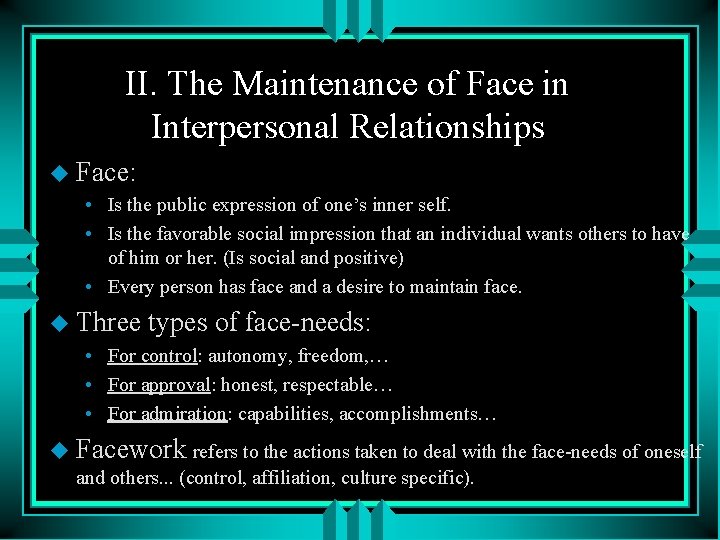
II. The Maintenance of Face in Interpersonal Relationships u Face: • Is the public expression of one’s inner self. • Is the favorable social impression that an individual wants others to have of him or her. (Is social and positive) • Every person has face and a desire to maintain face. u Three types of face-needs: • For control: autonomy, freedom, … • For approval: honest, respectable… • For admiration: capabilities, accomplishments… u Facework refers to the actions taken to deal with the face-needs of oneself and others. . . (control, affiliation, culture specific).
III. Improving Intercultural Relationships 1. Uncertainty and Anxiety Management u Definition: • Uncertainty refers to the extent to which a person lacks the knowledge… to understand • u Causes: • • • u Expectations about future interactions The incentive value The degree of deviance from what you have been expecting Positive and Negative Consequences: • u predict the intentions and behaviors of others. Anxiety refers to an individual’s degree of emotional tension and inability to cope with change. (Due to lack of knowledge…) Expectancy violations theory : Informational and Emotional Strategies to reduce Uncertainty and Anxiety: • • • Passive: observation… Active: asking… Interactive: conversing…
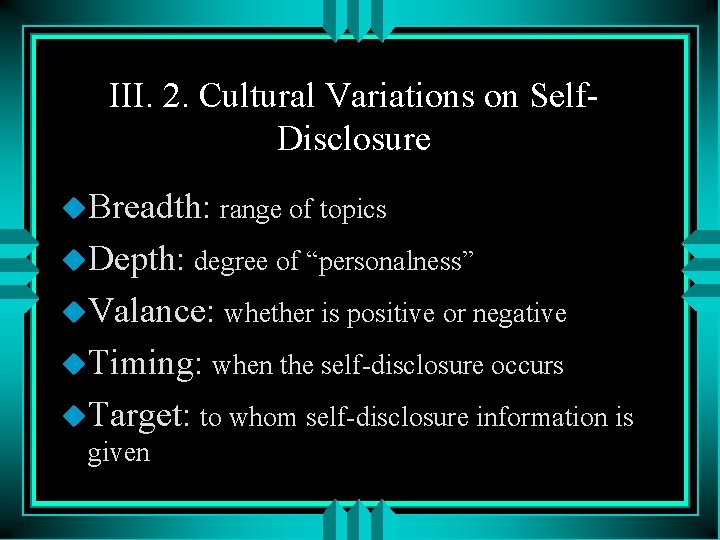
III. 2. Cultural Variations on Self. Disclosure u. Breadth: range of topics u. Depth: degree of “personalness” u. Valance: whether is positive or negative u. Timing: when the self-disclosure occurs u. Target: to whom self-disclosure information is given
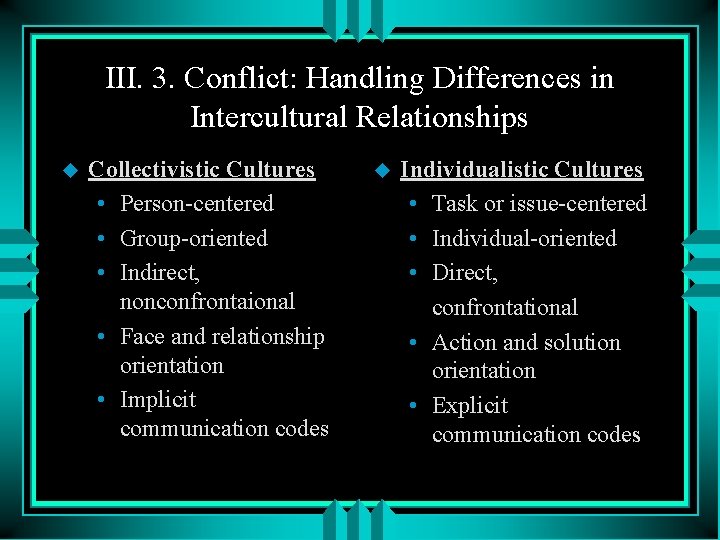
III. 3. Conflict: Handling Differences in Intercultural Relationships u Collectivistic Cultures • Person-centered • Group-oriented • Indirect, nonconfrontaional • Face and relationship orientation • Implicit communication codes u Individualistic Cultures • Task or issue-centered • Individual-oriented • Direct, confrontational • Action and solution orientation • Explicit communication codes
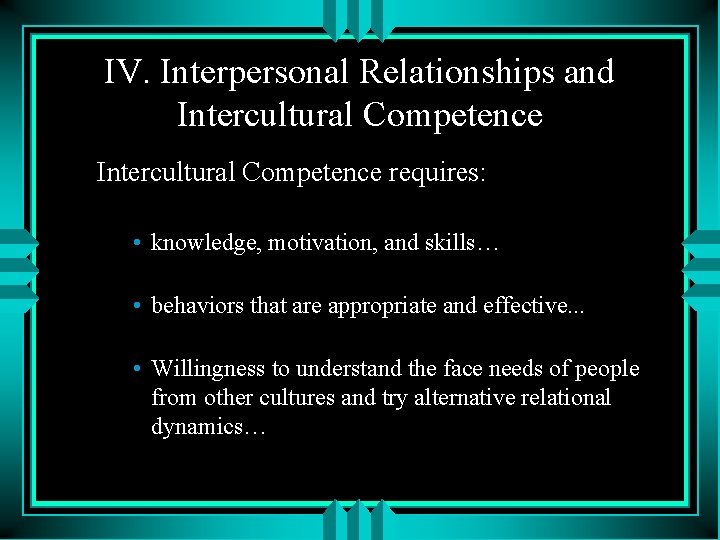
IV. Interpersonal Relationships and Intercultural Competence requires: • knowledge, motivation, and skills… • behaviors that are appropriate and effective. . . • Willingness to understand the face needs of people from other cultures and try alternative relational dynamics…
Preview Main Points I. Cultural Variations in Interpersonal Relationships: 1. Types of Interpersonal Relationships 2. Dimensions of Interpersonal Relationship 3. Dynamics of Interpersonal Relationships II. The Maintenance of Face in Interpersonal Relationships III. Improving Intercultural Relationships: 1. Uncertainty and Anxiety Management 2. Cultural Variations on Self- Disclosure 3. Conflict: Handling Differences in Intercultural Relationships IV. Interpersonal Relationships and Intercultural Competence