Information Security CS 526 Topic 3 Ciphers and
- Slides: 41
Information Security CS 526 Topic 3 Ciphers and Cipher Security: Stream Ciphers, Block Ciphers, Perfect Secrecy, and IND-CPA Security CS 526 Topic 3: Ciphers and Cipher Security 1
Announcements • HW 1 is out, due on Sept 10 – Start early, late policy is 3 total late days for HW and Project – Team project has separate late days CS 526 Topic 3: Ciphers and Cipher Security 2
Readings for This Lecture • Required reading from wikipedia • Stream cipher • Pseudorandom number generator • Block Cipher • Block cipher modes of operation • Information theoretic security • Ciphertext Indistinguishability CS 526 Topic 3: Ciphers and Cipher Security 3
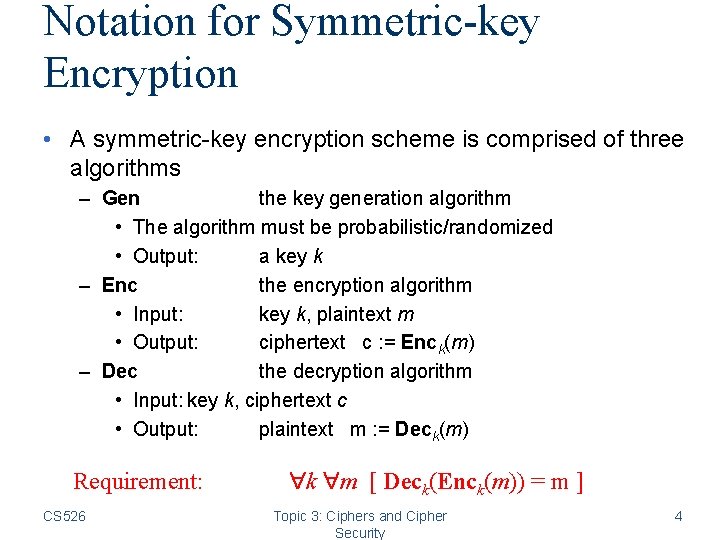
Notation for Symmetric-key Encryption • A symmetric-key encryption scheme is comprised of three algorithms – Gen the key generation algorithm • The algorithm must be probabilistic/randomized • Output: a key k – Enc the encryption algorithm • Input: key k, plaintext m • Output: ciphertext c : = Enck(m) – Dec the decryption algorithm • Input: key k, ciphertext c • Output: plaintext m : = Deck(m) Requirement: CS 526 k m [ Deck(Enck(m)) = m ] Topic 3: Ciphers and Cipher Security 4
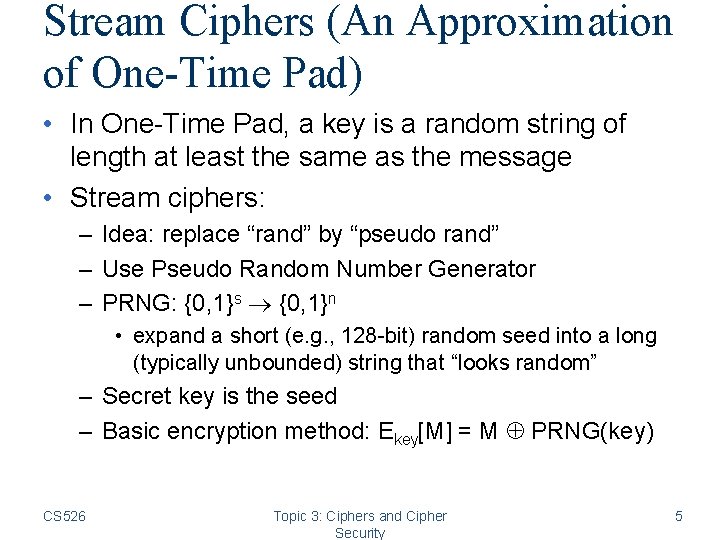
Stream Ciphers (An Approximation of One-Time Pad) • In One-Time Pad, a key is a random string of length at least the same as the message • Stream ciphers: – Idea: replace “rand” by “pseudo rand” – Use Pseudo Random Number Generator – PRNG: {0, 1}s {0, 1}n • expand a short (e. g. , 128 -bit) random seed into a long (typically unbounded) string that “looks random” – Secret key is the seed – Basic encryption method: Ekey[M] = M PRNG(key) CS 526 Topic 3: Ciphers and Cipher Security 5
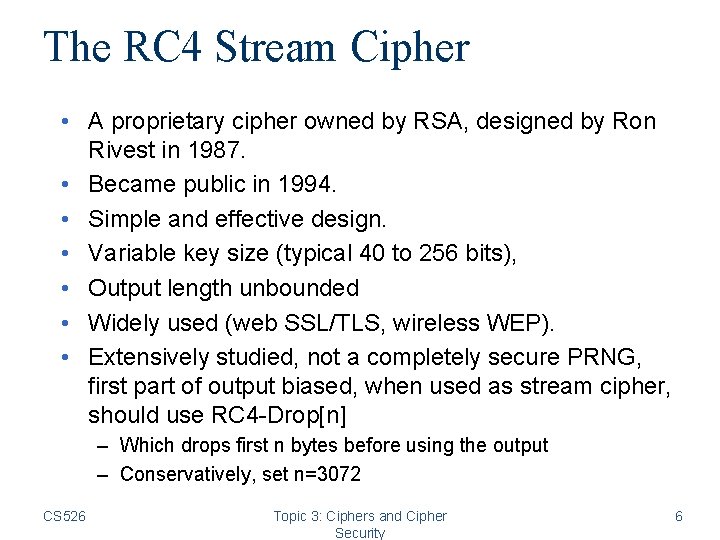
The RC 4 Stream Cipher • A proprietary cipher owned by RSA, designed by Ron Rivest in 1987. • Became public in 1994. • Simple and effective design. • Variable key size (typical 40 to 256 bits), • Output length unbounded • Widely used (web SSL/TLS, wireless WEP). • Extensively studied, not a completely secure PRNG, first part of output biased, when used as stream cipher, should use RC 4 -Drop[n] – Which drops first n bytes before using the output – Conservatively, set n=3072 CS 526 Topic 3: Ciphers and Cipher Security 6
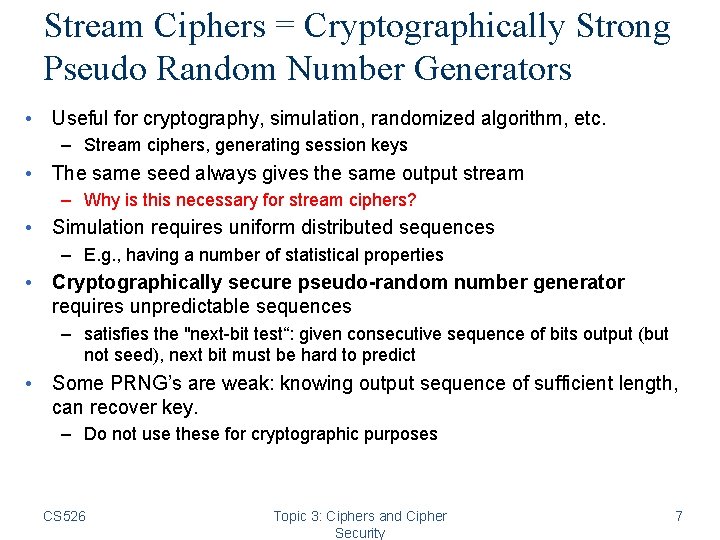
Stream Ciphers = Cryptographically Strong Pseudo Random Number Generators • Useful for cryptography, simulation, randomized algorithm, etc. – Stream ciphers, generating session keys • The same seed always gives the same output stream – Why is this necessary for stream ciphers? • Simulation requires uniform distributed sequences – E. g. , having a number of statistical properties • Cryptographically secure pseudo-random number generator requires unpredictable sequences – satisfies the "next-bit test“: given consecutive sequence of bits output (but not seed), next bit must be hard to predict • Some PRNG’s are weak: knowing output sequence of sufficient length, can recover key. – Do not use these for cryptographic purposes CS 526 Topic 3: Ciphers and Cipher Security 7
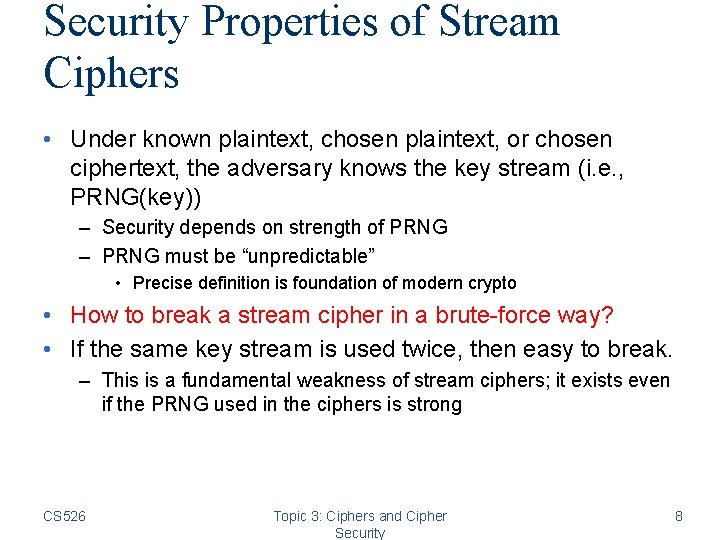
Security Properties of Stream Ciphers • Under known plaintext, chosen plaintext, or chosen ciphertext, the adversary knows the key stream (i. e. , PRNG(key)) – Security depends on strength of PRNG – PRNG must be “unpredictable” • Precise definition is foundation of modern crypto • How to break a stream cipher in a brute-force way? • If the same key stream is used twice, then easy to break. – This is a fundamental weakness of stream ciphers; it exists even if the PRNG used in the ciphers is strong CS 526 Topic 3: Ciphers and Cipher Security 8
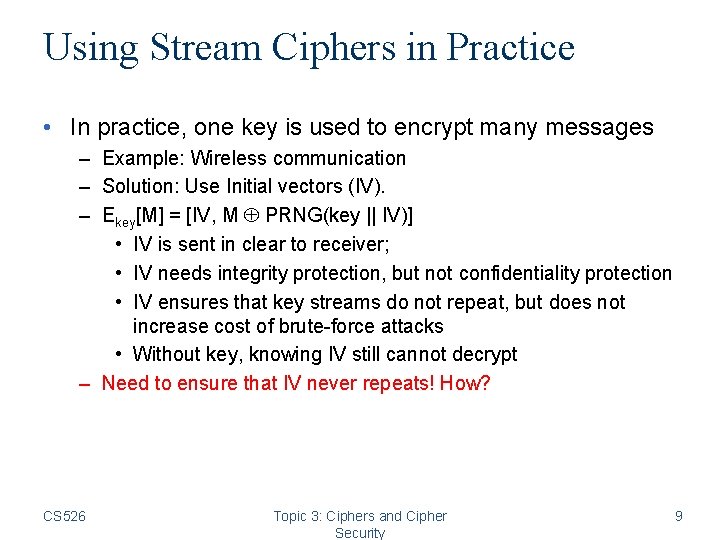
Using Stream Ciphers in Practice • In practice, one key is used to encrypt many messages – Example: Wireless communication – Solution: Use Initial vectors (IV). – Ekey[M] = [IV, M PRNG(key || IV)] • IV is sent in clear to receiver; • IV needs integrity protection, but not confidentiality protection • IV ensures that key streams do not repeat, but does not increase cost of brute-force attacks • Without key, knowing IV still cannot decrypt – Need to ensure that IV never repeats! How? CS 526 Topic 3: Ciphers and Cipher Security 9
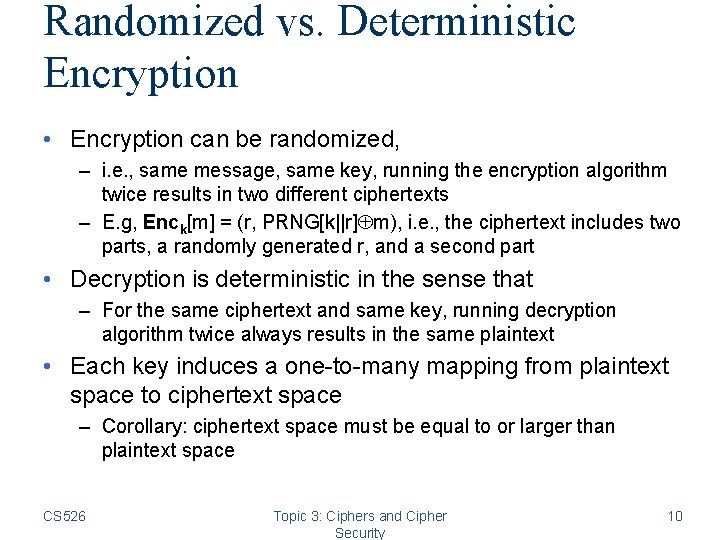
Randomized vs. Deterministic Encryption • Encryption can be randomized, – i. e. , same message, same key, running the encryption algorithm twice results in two different ciphertexts – E. g, Enck[m] = (r, PRNG[k||r] m), i. e. , the ciphertext includes two parts, a randomly generated r, and a second part • Decryption is deterministic in the sense that – For the same ciphertext and same key, running decryption algorithm twice always results in the same plaintext • Each key induces a one-to-many mapping from plaintext space to ciphertext space – Corollary: ciphertext space must be equal to or larger than plaintext space CS 526 Topic 3: Ciphers and Cipher Security 10
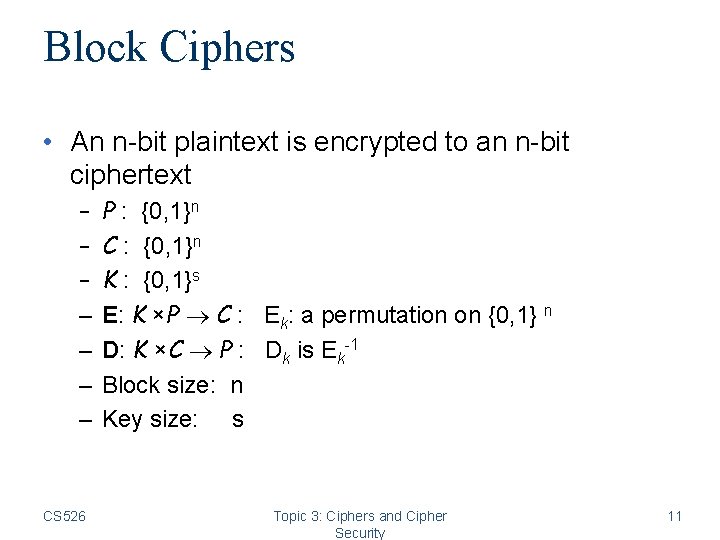
Block Ciphers • An n-bit plaintext is encrypted to an n-bit ciphertext – – – – CS 526 P : {0, 1}n C : {0, 1}n K : {0, 1}s E: K ×P C : Ek: a permutation on {0, 1} n D: K ×C P : Dk is Ek-1 Block size: n Key size: s Topic 3: Ciphers and Cipher Security 11
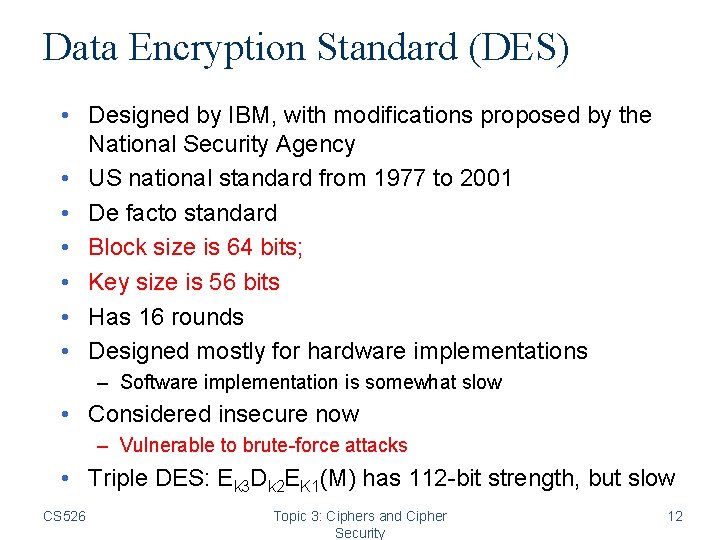
Data Encryption Standard (DES) • Designed by IBM, with modifications proposed by the National Security Agency • US national standard from 1977 to 2001 • De facto standard • Block size is 64 bits; • Key size is 56 bits • Has 16 rounds • Designed mostly for hardware implementations – Software implementation is somewhat slow • Considered insecure now – Vulnerable to brute-force attacks • Triple DES: Ek 3 Dk 2 EK 1(M) has 112 -bit strength, but slow CS 526 Topic 3: Ciphers and Cipher Security 12
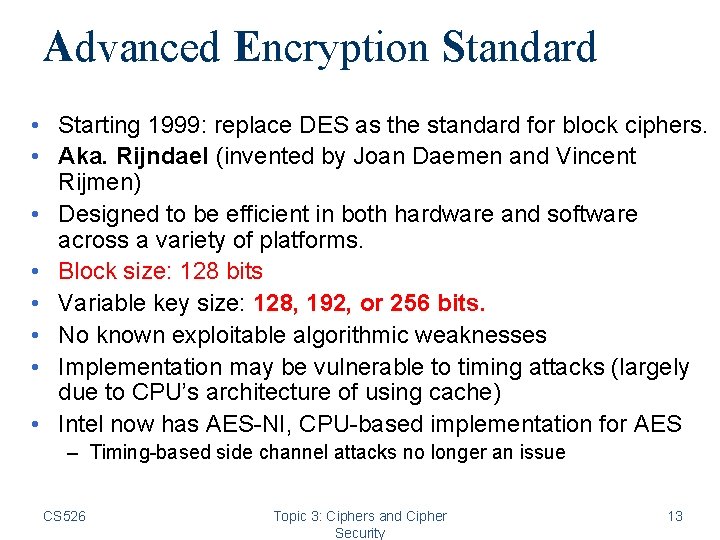
Advanced Encryption Standard • Starting 1999: replace DES as the standard for block ciphers. • Aka. Rijndael (invented by Joan Daemen and Vincent Rijmen) • Designed to be efficient in both hardware and software across a variety of platforms. • Block size: 128 bits • Variable key size: 128, 192, or 256 bits. • No known exploitable algorithmic weaknesses • Implementation may be vulnerable to timing attacks (largely due to CPU’s architecture of using cache) • Intel now has AES-NI, CPU-based implementation for AES – Timing-based side channel attacks no longer an issue CS 526 Topic 3: Ciphers and Cipher Security 13
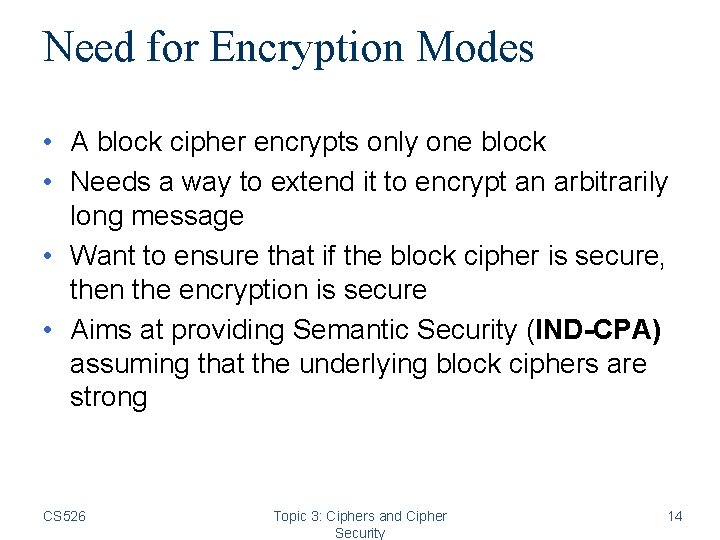
Need for Encryption Modes • A block cipher encrypts only one block • Needs a way to extend it to encrypt an arbitrarily long message • Want to ensure that if the block cipher is secure, then the encryption is secure • Aims at providing Semantic Security (IND-CPA) assuming that the underlying block ciphers are strong CS 526 Topic 3: Ciphers and Cipher Security 14
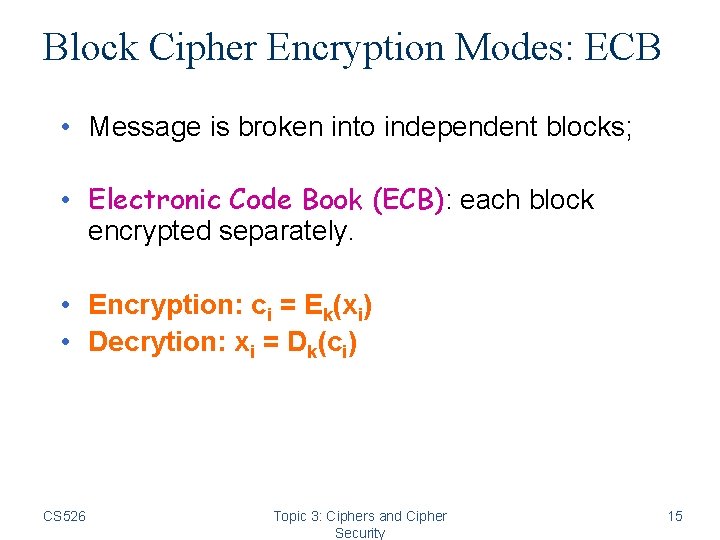
Block Cipher Encryption Modes: ECB • Message is broken into independent blocks; • Electronic Code Book (ECB): each block encrypted separately. • Encryption: ci = Ek(xi) • Decrytion: xi = Dk(ci) CS 526 Topic 3: Ciphers and Cipher Security 15
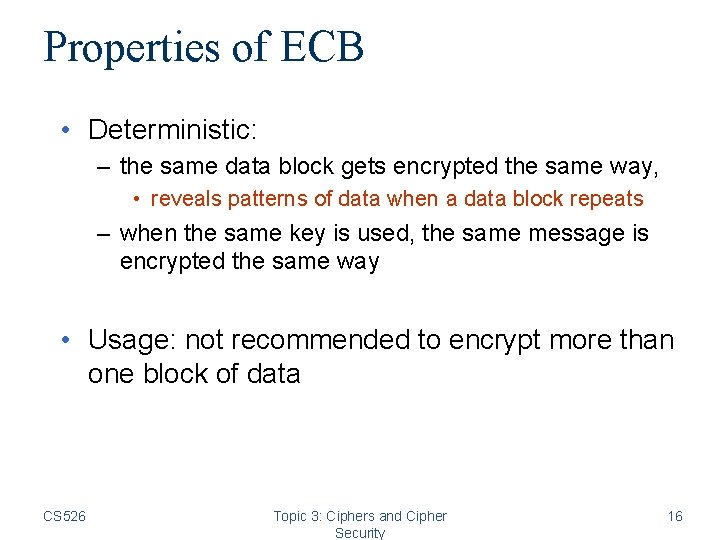
Properties of ECB • Deterministic: – the same data block gets encrypted the same way, • reveals patterns of data when a data block repeats – when the same key is used, the same message is encrypted the same way • Usage: not recommended to encrypt more than one block of data CS 526 Topic 3: Ciphers and Cipher Security 16
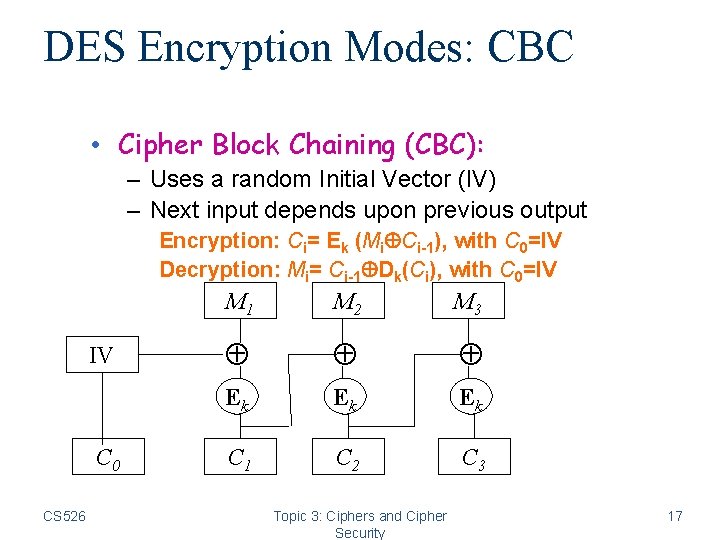
DES Encryption Modes: CBC • Cipher Block Chaining (CBC): – Uses a random Initial Vector (IV) – Next input depends upon previous output Encryption: Ci= Ek (Mi Ci-1), with C 0=IV Decryption: Mi= Ci-1 Dk(Ci), with C 0=IV IV C 0 CS 526 M 1 M 2 M 3 Ek Ek Ek C 1 C 2 C 3 Topic 3: Ciphers and Cipher Security 17
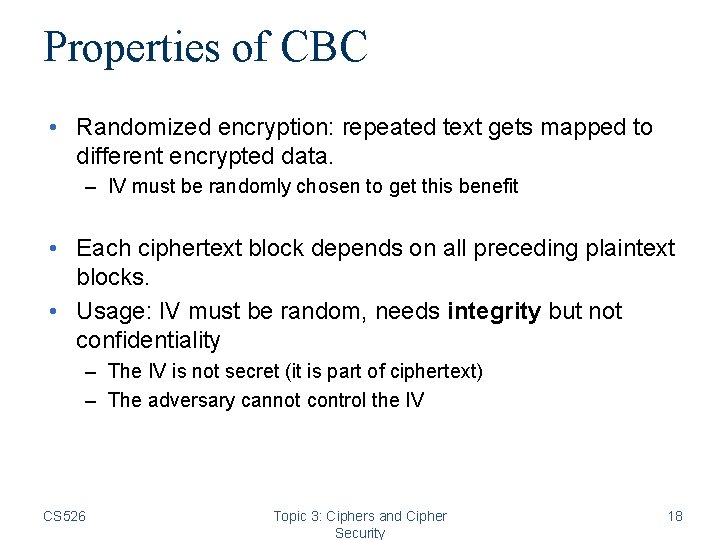
Properties of CBC • Randomized encryption: repeated text gets mapped to different encrypted data. – IV must be randomly chosen to get this benefit • Each ciphertext block depends on all preceding plaintext blocks. • Usage: IV must be random, needs integrity but not confidentiality – The IV is not secret (it is part of ciphertext) – The adversary cannot control the IV CS 526 Topic 3: Ciphers and Cipher Security 18
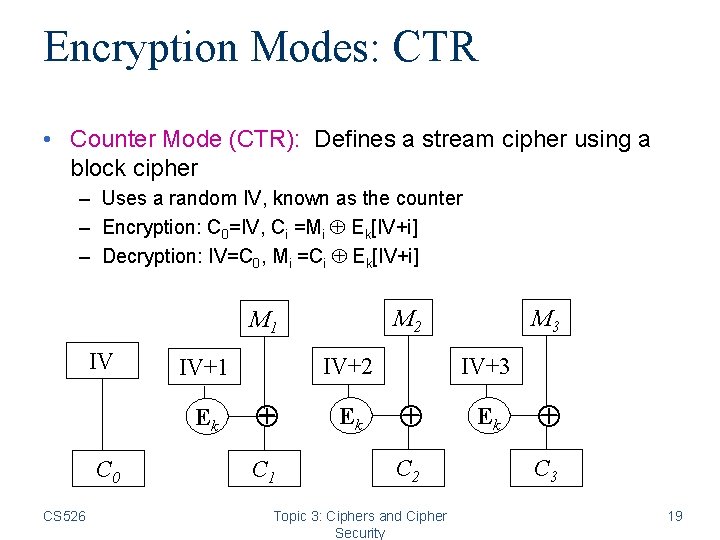
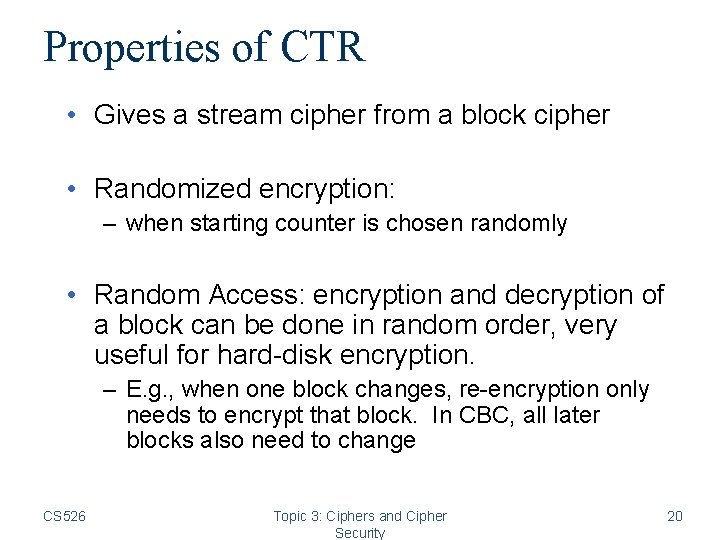
Encryption Modes: CTR • Counter Mode (CTR): Defines a stream cipher using a block cipher – Uses a random IV, known as the counter – Encryption: C 0=IV, Ci =Mi Ek[IV+i] – Decryption: IV=C 0, Mi =Ci Ek[IV+i] M 2 M 1 IV Ek C 0 CS 526 IV+2 IV+1 C 1 Ek M 3 IV+3 C 2 Topic 3: Ciphers and Cipher Security Ek C 3 19
Properties of CTR • Gives a stream cipher from a block cipher • Randomized encryption: – when starting counter is chosen randomly • Random Access: encryption and decryption of a block can be done in random order, very useful for hard-disk encryption. – E. g. , when one block changes, re-encryption only needs to encrypt that block. In CBC, all later blocks also need to change CS 526 Topic 3: Ciphers and Cipher Security 20
Encryption Schemes Commonly User • • RC 4 (with new IV for each message) AES+ECB (Only in very restricted scenarios) AES+CBC AES+CTR • Are they secure? • We need probability theory to study that. CS 526 Topic 3: Ciphers and Cipher Security 21
Begin Math CS 526 Topic 3: Ciphers and Cipher Security 22
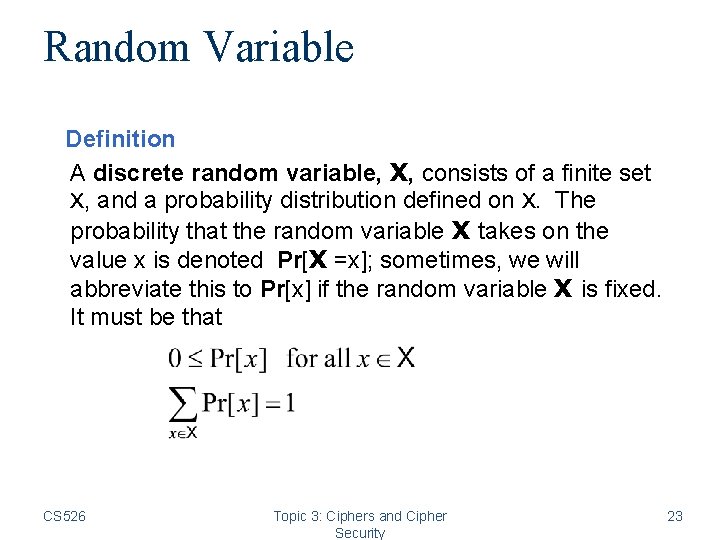
Random Variable Definition A discrete random variable, X, consists of a finite set X, and a probability distribution defined on X. The probability that the random variable X takes on the value x is denoted Pr[X =x]; sometimes, we will abbreviate this to Pr[x] if the random variable X is fixed. It must be that CS 526 Topic 3: Ciphers and Cipher Security 23
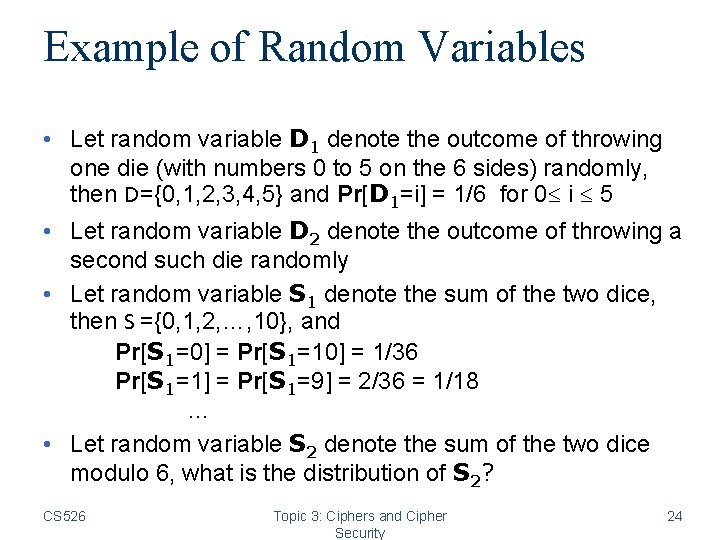
Example of Random Variables • Let random variable D 1 denote the outcome of throwing one die (with numbers 0 to 5 on the 6 sides) randomly, then D={0, 1, 2, 3, 4, 5} and Pr[D 1=i] = 1/6 for 0 i 5 • Let random variable D 2 denote the outcome of throwing a second such die randomly • Let random variable S 1 denote the sum of the two dice, then S ={0, 1, 2, …, 10}, and Pr[S 1=0] = Pr[S 1=10] = 1/36 Pr[S 1=1] = Pr[S 1=9] = 2/36 = 1/18 … • Let random variable S 2 denote the sum of the two dice modulo 6, what is the distribution of S 2? CS 526 Topic 3: Ciphers and Cipher Security 24
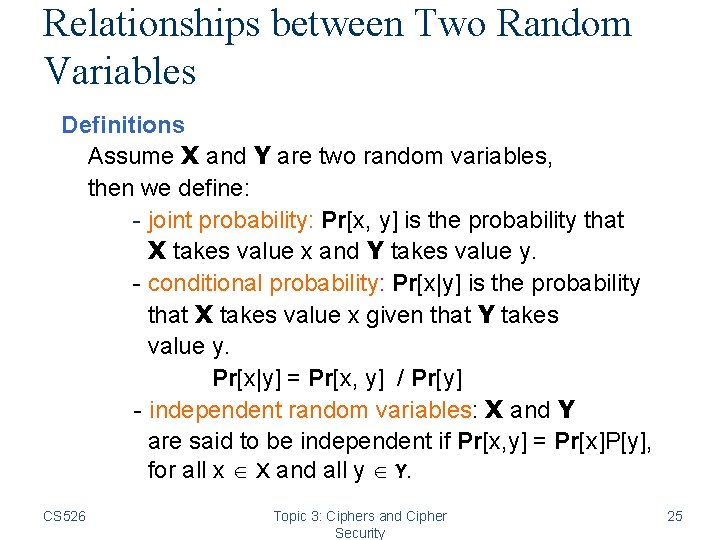
Relationships between Two Random Variables Definitions Assume X and Y are two random variables, then we define: - joint probability: Pr[x, y] is the probability that X takes value x and Y takes value y. - conditional probability: Pr[x|y] is the probability that X takes value x given that Y takes value y. Pr[x|y] = Pr[x, y] / Pr[y] - independent random variables: X and Y are said to be independent if Pr[x, y] = Pr[x]P[y], for all x X and all y Y. CS 526 Topic 3: Ciphers and Cipher Security 25
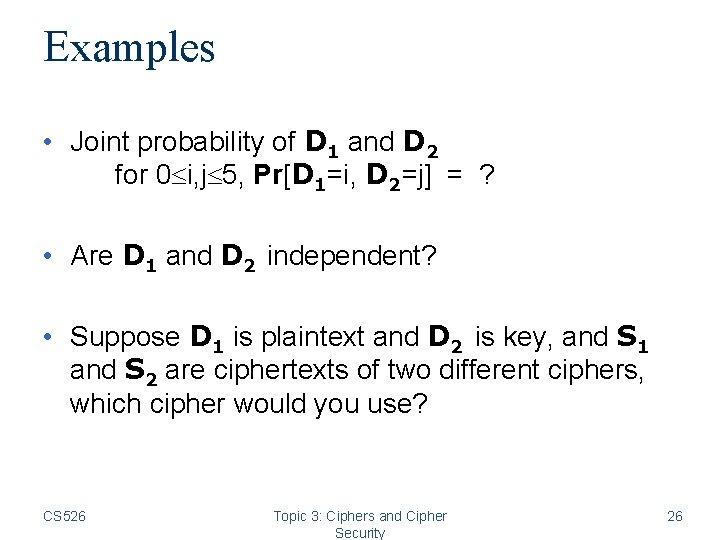
Examples • Joint probability of D 1 and D 2 for 0 i, j 5, Pr[D 1=i, D 2=j] = ? • Are D 1 and D 2 independent? • Suppose D 1 is plaintext and D 2 is key, and S 1 and S 2 are ciphertexts of two different ciphers, which cipher would you use? CS 526 Topic 3: Ciphers and Cipher Security 26
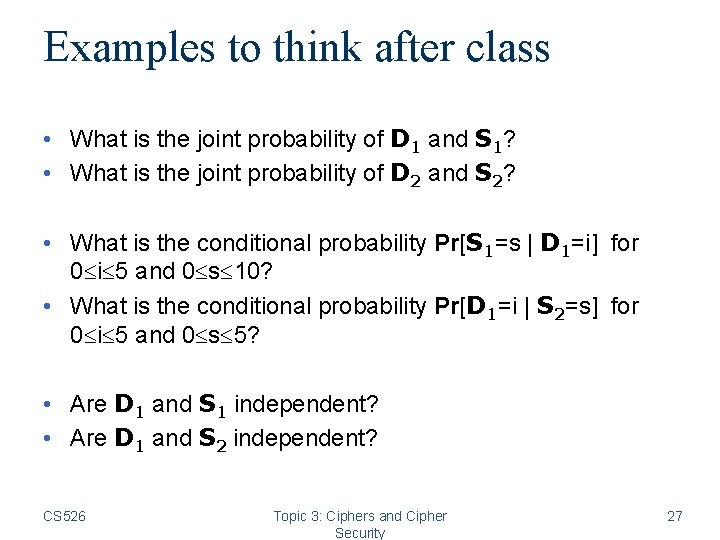
Examples to think after class • What is the joint probability of D 1 and S 1? • What is the joint probability of D 2 and S 2? • What is the conditional probability Pr[S 1=s | D 1=i] for 0 i 5 and 0 s 10? • What is the conditional probability Pr[D 1=i | S 2=s] for 0 i 5 and 0 s 5? • Are D 1 and S 1 independent? • Are D 1 and S 2 independent? CS 526 Topic 3: Ciphers and Cipher Security 27
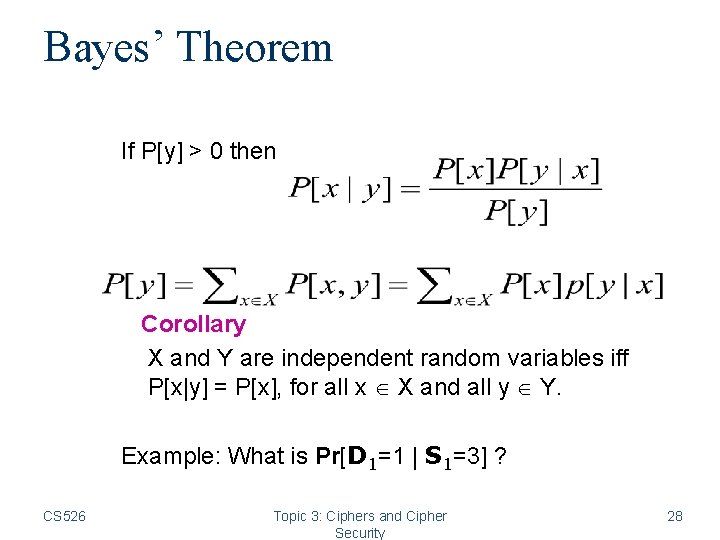
Bayes’ Theorem If P[y] > 0 then Corollary X and Y are independent random variables iff P[x|y] = P[x], for all x X and all y Y. Example: What is Pr[D 1=1 | S 1=3] ? CS 526 Topic 3: Ciphers and Cipher Security 28
End Math CS 526 Topic 3: Ciphers and Cipher Security 29
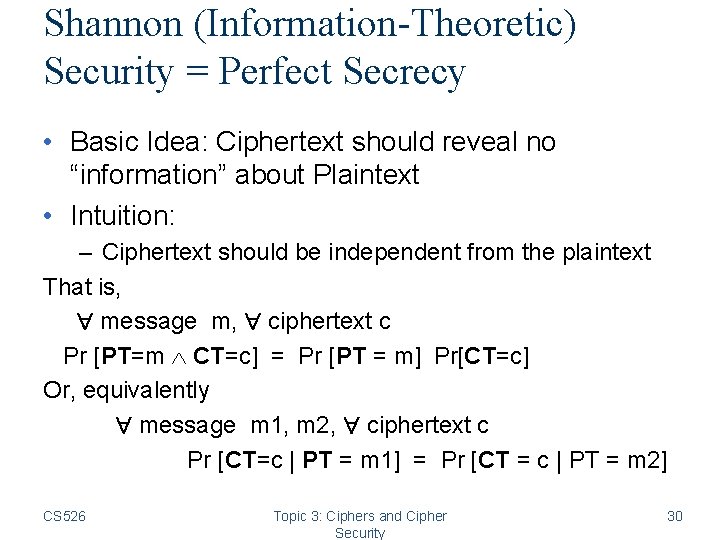
Shannon (Information-Theoretic) Security = Perfect Secrecy • Basic Idea: Ciphertext should reveal no “information” about Plaintext • Intuition: – Ciphertext should be independent from the plaintext That is, message m, ciphertext c Pr [PT=m CT=c] = Pr [PT = m] Pr[CT=c] Or, equivalently message m 1, m 2, ciphertext c Pr [CT=c | PT = m 1] = Pr [CT = c | PT = m 2] CS 526 Topic 3: Ciphers and Cipher Security 30
Example for Information Theoretical Security • Consider an example of encrypting the result of a 6 -side dice (1 to 6). – Method 1: randomly generate K=[1. . 6], ciphertext is result + K. • What is plaintext distribution? After seeing that the ciphertext is 3, what could be the plaintext. After seeing that the ciphertext is 12, what could be the plaintext? – Method 2: randomly generate K=[1. . 6], ciphertext is (result + K) mod 6. • Same questions. • Can one do a brute-force attack? CS 526 Topic 3: Ciphers and Cipher Security 31
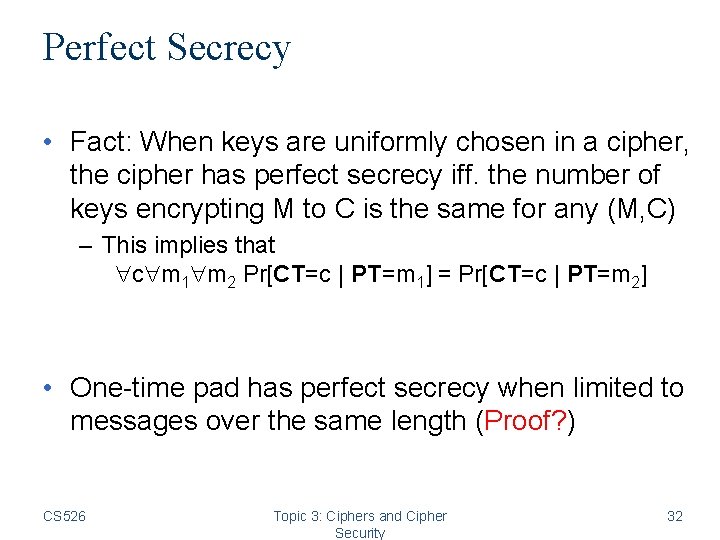
Perfect Secrecy • Fact: When keys are uniformly chosen in a cipher, the cipher has perfect secrecy iff. the number of keys encrypting M to C is the same for any (M, C) – This implies that c m 1 m 2 Pr[CT=c | PT=m 1] = Pr[CT=c | PT=m 2] • One-time pad has perfect secrecy when limited to messages over the same length (Proof? ) CS 526 Topic 3: Ciphers and Cipher Security 32
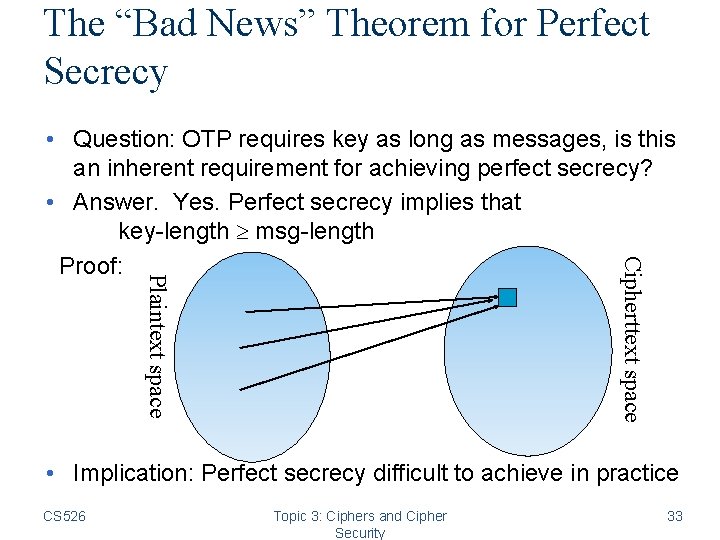
The “Bad News” Theorem for Perfect Secrecy Plaintext space Cipherttext space • Question: OTP requires key as long as messages, is this an inherent requirement for achieving perfect secrecy? • Answer. Yes. Perfect secrecy implies that key-length msg-length Proof: • Implication: Perfect secrecy difficult to achieve in practice CS 526 Topic 3: Ciphers and Cipher Security 33
Towards Computational Security • Perfect secrecy is too difficult to achieve. • Computational security uses two relaxations: – Security is preserved only against efficient (computationally bounded) adversaries • Adversary can only run in feasible amount of time – Adversaries can potentially succeed with some very small probability (that we can ignore the case it actually happens) CS 526 Topic 3: Ciphers and Cipher Security 34
Defining Security • Desire “semantic security”, i. e. , having access to the ciphertext does not help adversary to compute any function of the plaintext. – Difficult to use • Equivalent notion: Adversary cannot distinguish between the ciphertexts of two plaintexts CS 526 Topic 3: Ciphers and Cipher Security 35
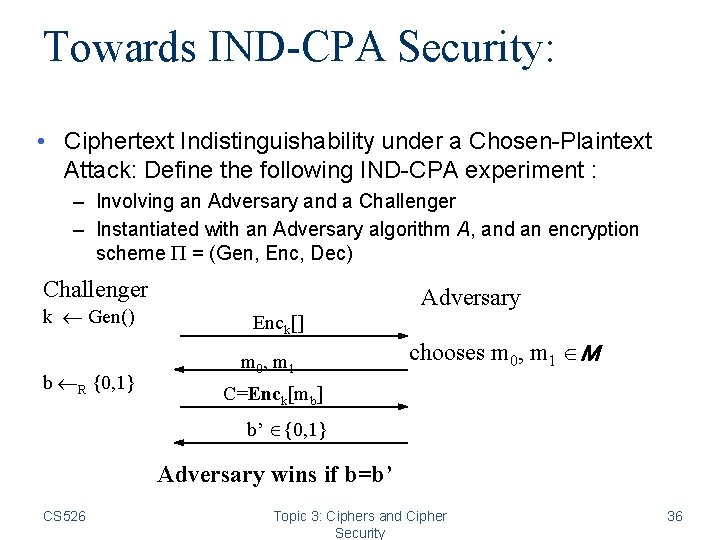
Towards IND-CPA Security: • Ciphertext Indistinguishability under a Chosen-Plaintext Attack: Define the following IND-CPA experiment : – Involving an Adversary and a Challenger – Instantiated with an Adversary algorithm A, and an encryption scheme = (Gen, Enc, Dec) Challenger k Gen() b R {0, 1} Adversary Enck[] m 0 , m 1 chooses m 0, m 1 M C=Enck[mb] b’ {0, 1} Adversary wins if b=b’ CS 526 Topic 3: Ciphers and Cipher Security 36
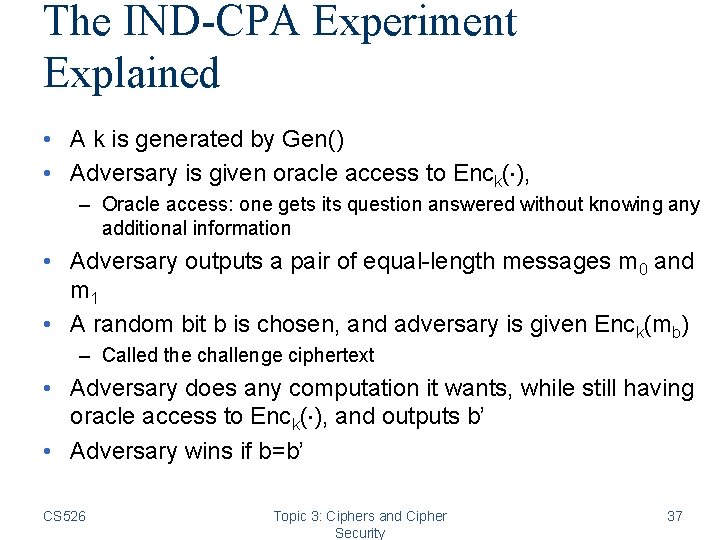
The IND-CPA Experiment Explained • A k is generated by Gen() • Adversary is given oracle access to Enck( ), – Oracle access: one gets its question answered without knowing any additional information • Adversary outputs a pair of equal-length messages m 0 and m 1 • A random bit b is chosen, and adversary is given Enck(mb) – Called the challenge ciphertext • Adversary does any computation it wants, while still having oracle access to Enck( ), and outputs b’ • Adversary wins if b=b’ CS 526 Topic 3: Ciphers and Cipher Security 37
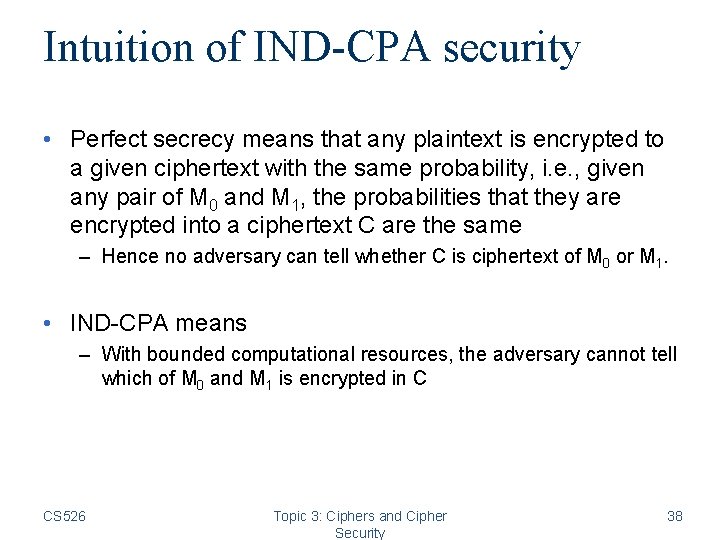
Intuition of IND-CPA security • Perfect secrecy means that any plaintext is encrypted to a given ciphertext with the same probability, i. e. , given any pair of M 0 and M 1, the probabilities that they are encrypted into a ciphertext C are the same – Hence no adversary can tell whether C is ciphertext of M 0 or M 1. • IND-CPA means – With bounded computational resources, the adversary cannot tell which of M 0 and M 1 is encrypted in C CS 526 Topic 3: Ciphers and Cipher Security 38
Computational Security vs. Information Theoretic Security • If a cipher has only computational security, then it can be broken by a brute force attack, e. g. , enumerating all possible keys – Weak algorithms can be broken with much less time • How to prove computational security? – Assume that some problems are hard (requires a lot of computational resources to solve), then show that breaking security means solving the problem • Computational security is foundation of modern cryptography. CS 526 Topic 3: Ciphers and Cipher Security 39
Security of Ciphers • Stream ciphers can be used to achieve IND-CPA security when the underlying PRNG is cryptographically strong • ECB does not have semantic security – How to break the semantic security (IND-CPA) of a block cipher with ECB? • CBC is proven to provide IND-CPA assuming that the block cipher is secure and that IV’s are randomly chosen • CTR is proven IND-CPA secure assuming that block cipher is secure and that IV’s are randomly chosen CS 526 Topic 3: Ciphers and Cipher Security 40
Coming Attractions … • Cryptography: Message Authentication Code and Cryptographic Hash Functions CS 526 Topic 3: Ciphers and Cipher Security 41