Highp T results from ALICE Marco van Leeuwen
- Slides: 29
High-p. T results from ALICE Marco van Leeuwen, Utrecht University, for the ALICE collaboration
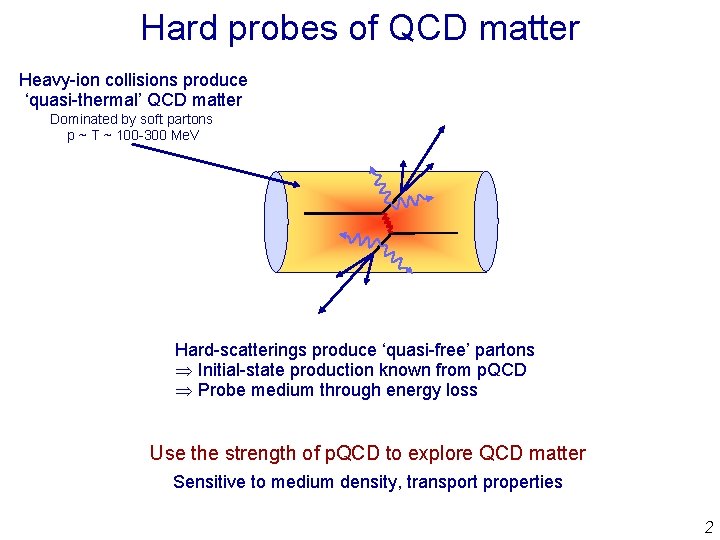
Hard probes of QCD matter Heavy-ion collisions produce ‘quasi-thermal’ QCD matter Dominated by soft partons p ~ T ~ 100 -300 Me. V Hard-scatterings produce ‘quasi-free’ partons Initial-state production known from p. QCD Probe medium through energy loss Use the strength of p. QCD to explore QCD matter Sensitive to medium density, transport properties 2
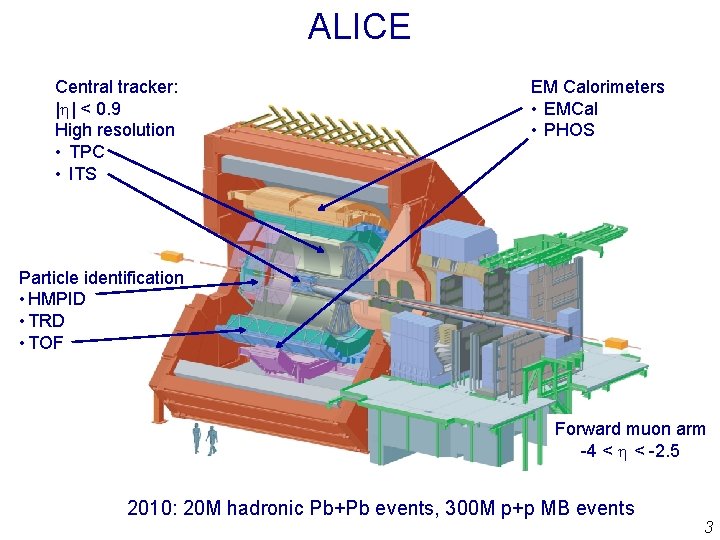
ALICE Central tracker: |h| < 0. 9 High resolution • TPC • ITS EM Calorimeters • EMCal • PHOS Particle identification • HMPID • TRD • TOF Forward muon arm -4 < h < -2. 5 2010: 20 M hadronic Pb+Pb events, 300 M p+p MB events 3
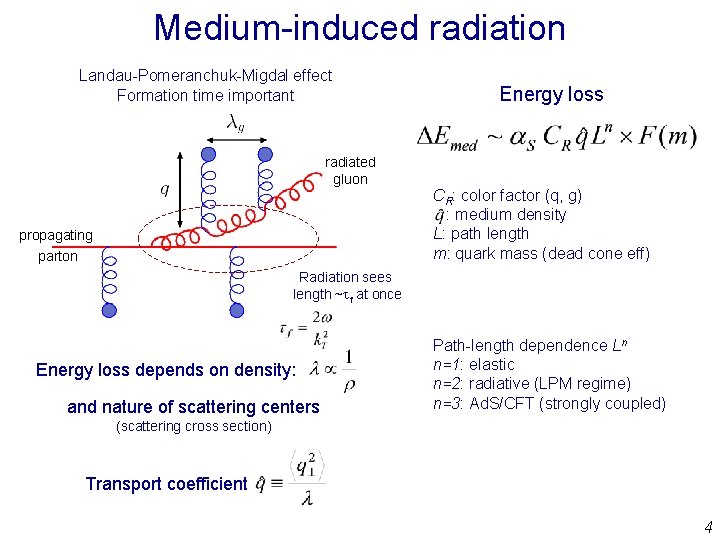
Medium-induced radiation Landau-Pomeranchuk-Migdal effect Formation time important radiated gluon propagating parton Energy loss CR: color factor (q, g) : medium density L: path length m: quark mass (dead cone eff) Radiation sees length ~tf at once Energy loss depends on density: and nature of scattering centers Path-length dependence Ln n=1: elastic n=2: radiative (LPM regime) n=3: Ad. S/CFT (strongly coupled) (scattering cross section) Transport coefficient 4
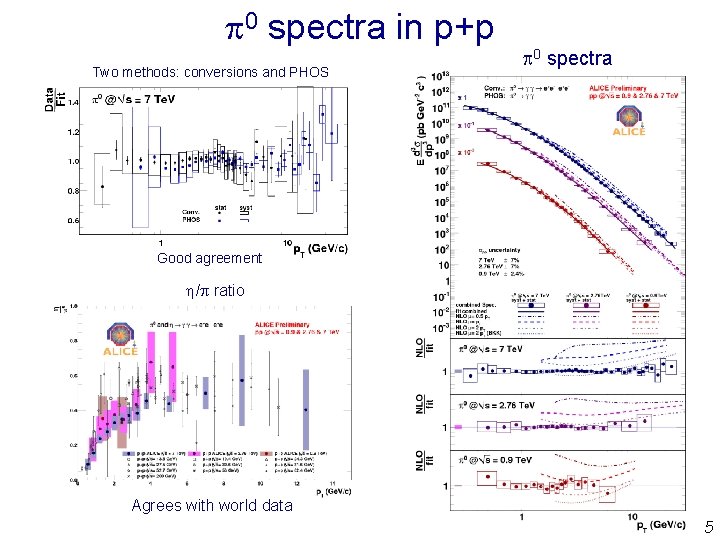
p 0 spectra in p+p Two methods: conversions and PHOS p 0 spectra Good agreement h/p ratio Agrees with world data 5
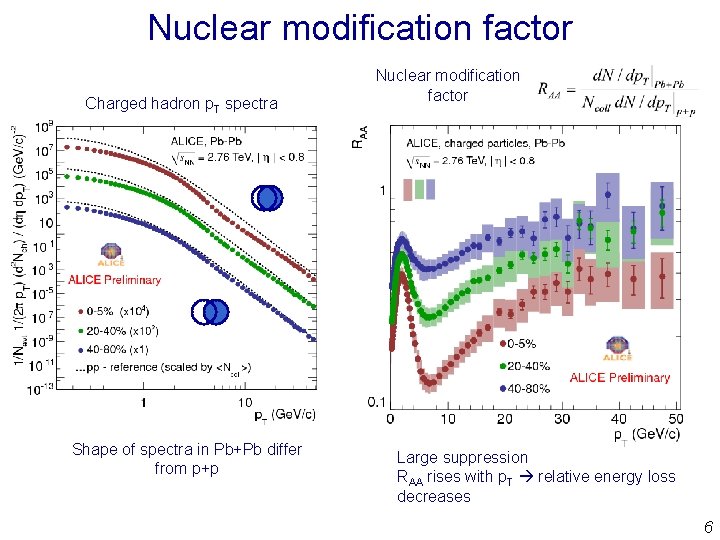
Nuclear modification factor Charged hadron p. T spectra Shape of spectra in Pb+Pb differ from p+p Nuclear modification factor Large suppression RAA rises with p. T relative energy loss decreases 6
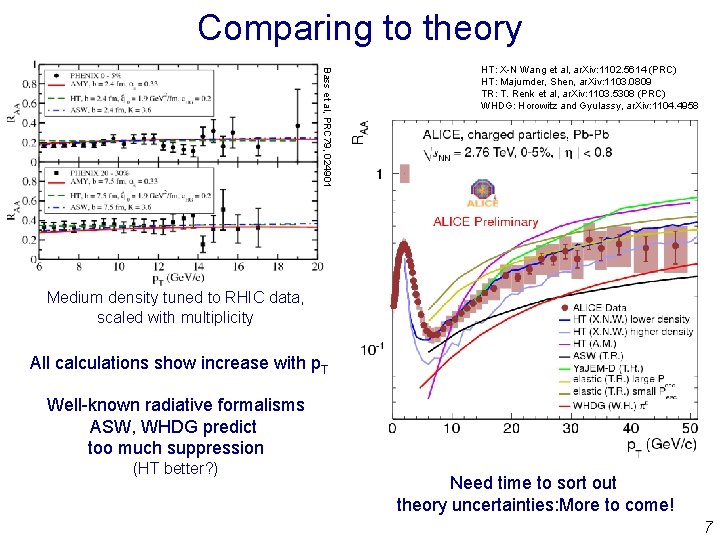
Comparing to theory Bass et al, PRC 79, 024901 HT: X-N Wang et al, ar. Xiv: 1102. 5614 (PRC) HT: Majumder, Shen, ar. Xiv: 1103. 0809 TR: T. Renk et al, ar. Xiv: 1103. 5308 (PRC) WHDG: Horowitz and Gyulassy, ar. Xiv: 1104. 4958 Medium density tuned to RHIC data, scaled with multiplicity Ingredients: show increase with p. T All calculations - p. QCD production - Medium density profile Well-known radiative formalisms tuned to RHIC data, scaled ASW, WHDG predict - Energy loss model too much suppression (HT better? ) Need time to sort out theory uncertainties: More to come! 7
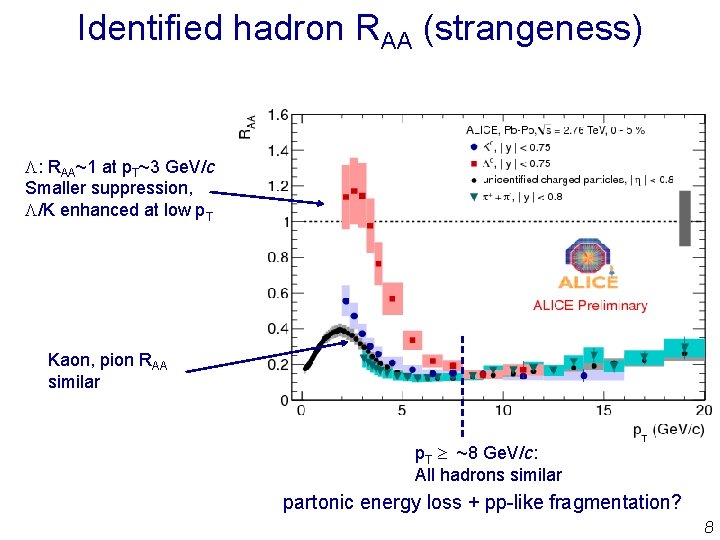
Identified hadron RAA (strangeness) L: RAA~1 at p. T~3 Ge. V/c Smaller suppression, L/K enhanced at low p. T Kaon, pion RAA similar p. T ~8 Ge. V/c: All hadrons similar partonic energy loss + pp-like fragmentation? 8
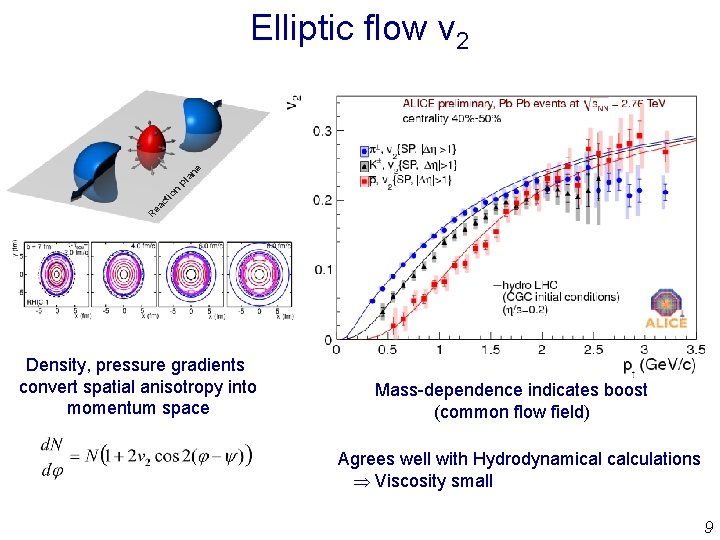
R ea ct io n pl an e Elliptic flow v 2 Density, pressure gradients convert spatial anisotropy into momentum space Mass-dependence indicates boost (common flow field) Agrees well with Hydrodynamical calculations Viscosity small 9
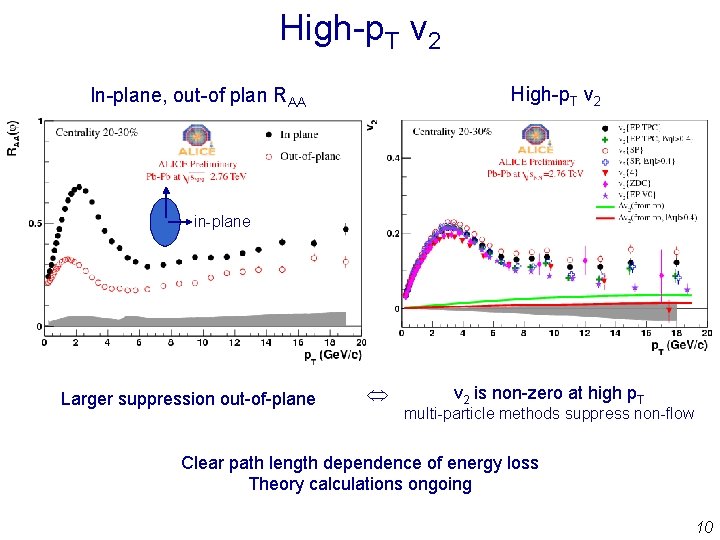
High-p. T v 2 In-plane, out-of plan RAA in-plane Larger suppression out-of-plane v 2 is non-zero at high p. T multi-particle methods suppress non-flow Clear path length dependence of energy loss Theory calculations ongoing 10
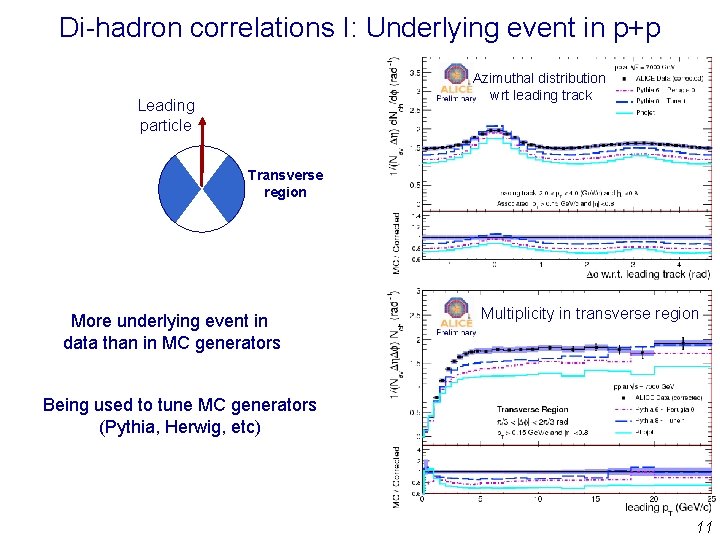
Di-hadron correlations I: Underlying event in p+p Azimuthal distribution wrt leading track Leading particle Transverse region More underlying event in data than in MC generators Multiplicity in transverse region Being used to tune MC generators (Pythia, Herwig, etc) 11
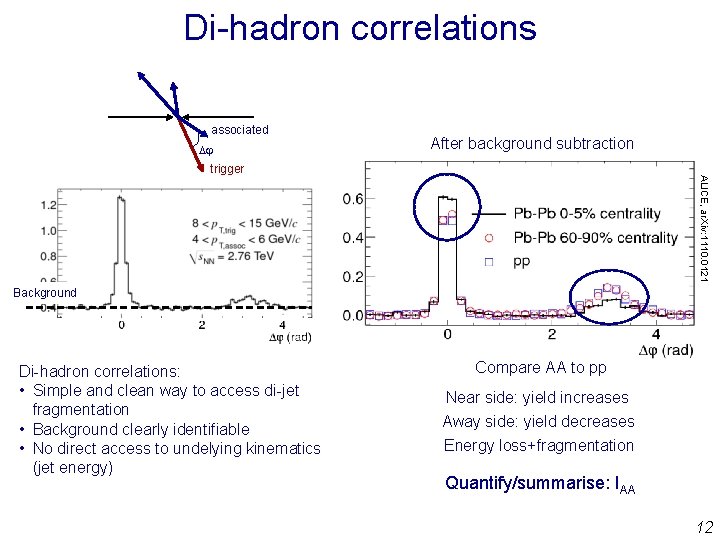
Di-hadron correlations associated After background subtraction ALICE, ar. Xiv: 1110. 0121 trigger Background Di-hadron correlations: • Simple and clean way to access di-jet fragmentation • Background clearly identifiable • No direct access to undelying kinematics (jet energy) Compare AA to pp Near side: yield increases Away side: yield decreases Energy loss+fragmentation Quantify/summarise: IAA 12
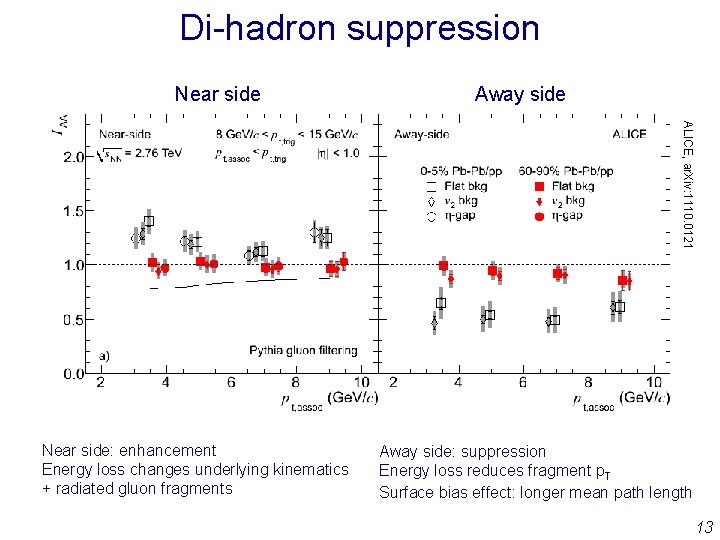
Di-hadron suppression Near side Away side ALICE, ar. Xiv: 1110. 0121 Near side: enhancement Energy loss changes underlying kinematics + radiated gluon fragments Away side: suppression Energy loss reduces fragment p. T Surface bias effect: longer mean path length 13
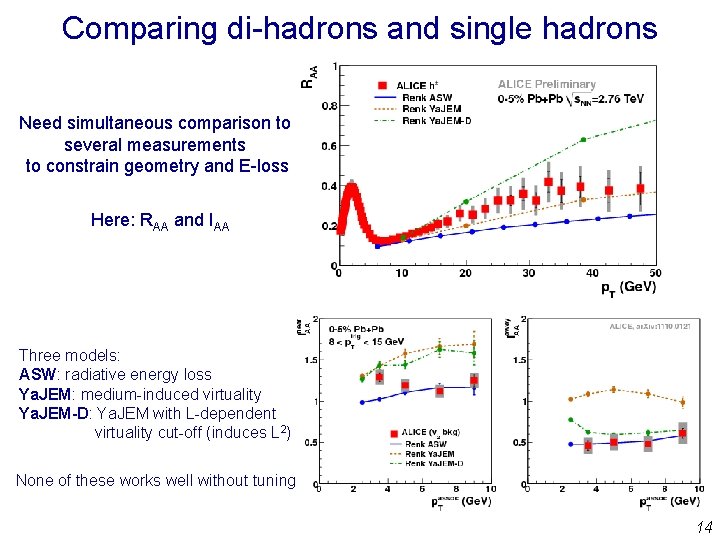
Comparing di-hadrons and single hadrons Need simultaneous comparison to several measurements to constrain geometry and E-loss Here: RAA and IAA Three models: ASW: radiative energy loss Ya. JEM: medium-induced virtuality Ya. JEM-D: Ya. JEM with L-dependent virtuality cut-off (induces L 2) None of these works well without tuning 14
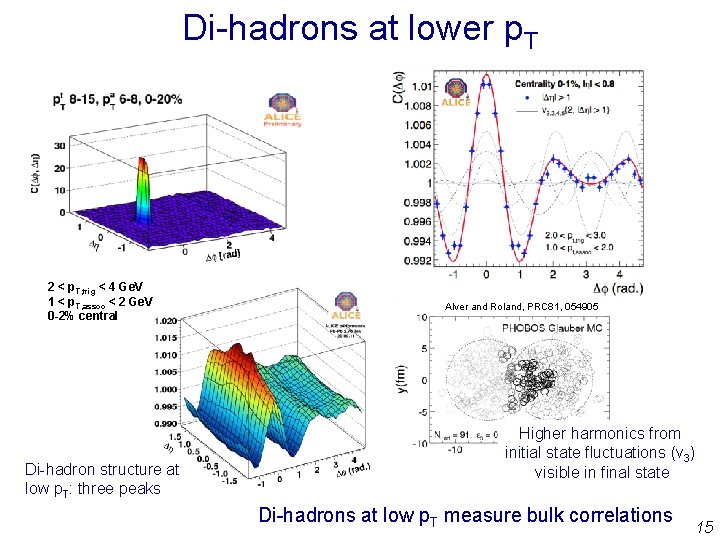
Di-hadrons at lower p. T 2 < p. T, trig < 4 Ge. V 1 < p. T, assoc < 2 Ge. V 0 -2% central Di-hadron structure at low p. T: three peaks Alver and Roland, PRC 81, 054905 Higher harmonics from initial state fluctuations (v 3) visible in final state Di-hadrons at low p. T measure bulk correlations 15
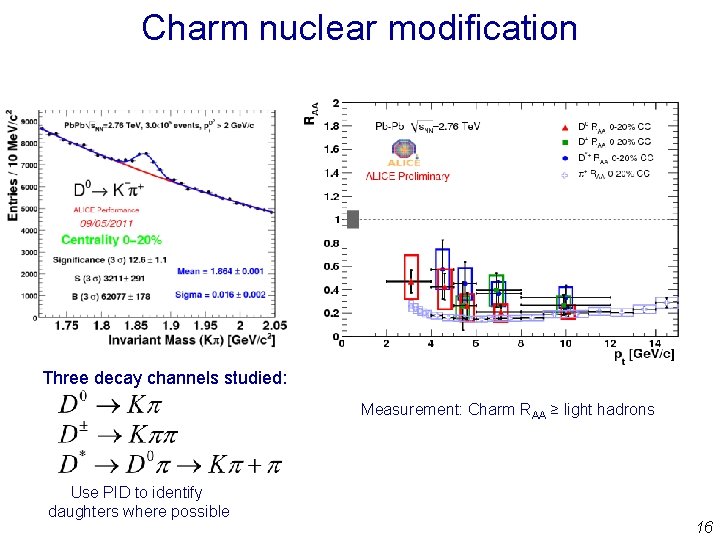
Charm nuclear modification Expected energy loss light Three decay channels studied: Expect: heavy quarks lose less energy effect Measurement: Charmdue RAAto ≥dead-cone light hadrons Most pronounced for bottom Use PID to identify daughters where possible 16
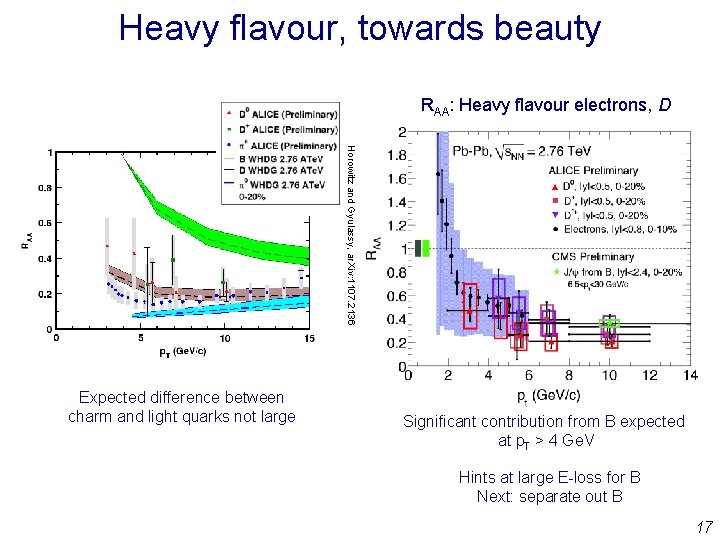
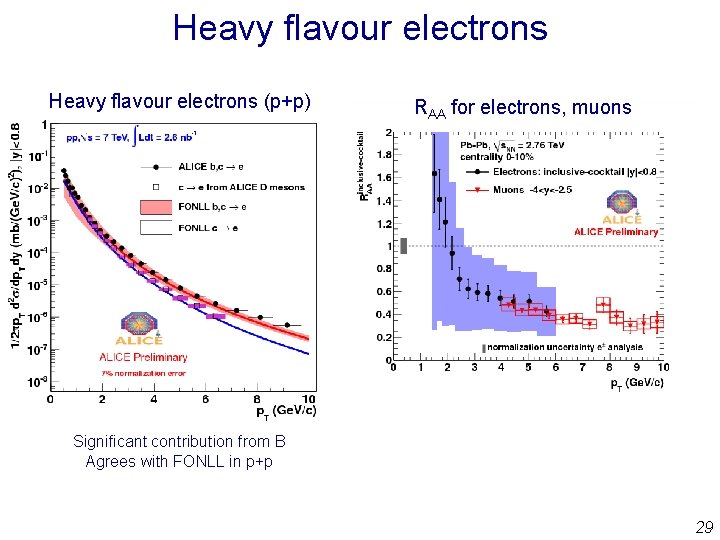
Heavy flavour, towards beauty RAA: Heavy flavour electrons, D Horowitz and Gyulassy, ar. Xiv: 1107. 2136 Expected difference between charm and light quarks not large Significant contribution from B expected at p. T > 4 Ge. V Hints at large E-loss for B Next: separate out B 17
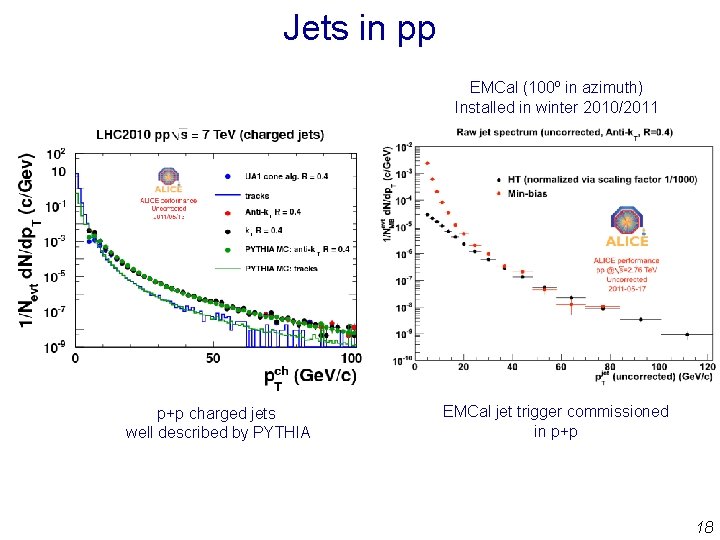
Jets in pp EMCal (100º in azimuth) Installed in winter 2010/2011 p+p charged jets well described by PYTHIA EMCal jet trigger commissioned in p+p 18
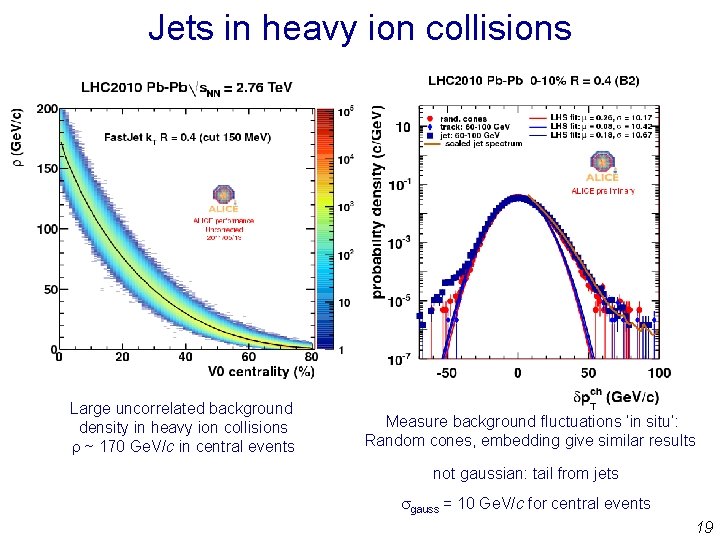
Jets in heavy ion collisions Large uncorrelated background density in heavy ion collisions r ~ 170 Ge. V/c in central events Measure background fluctuations ‘in situ’: Random cones, embedding give similar results not gaussian: tail from jets sgauss = 10 Ge. V/c for central events 19
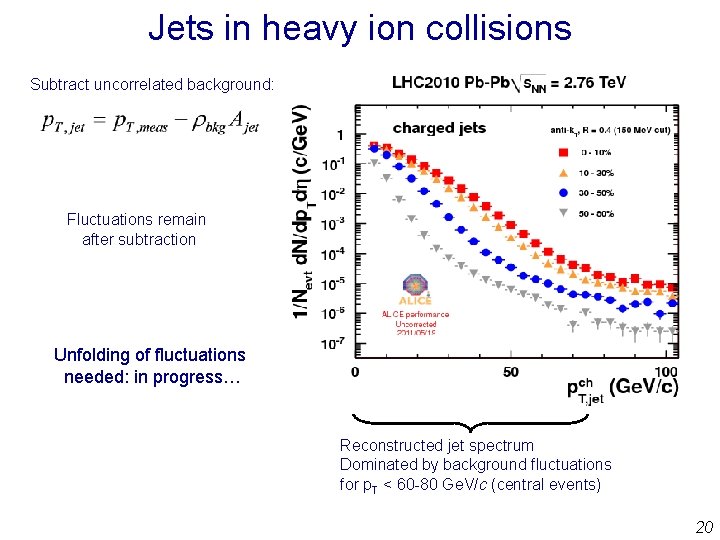
Jets in heavy ion collisions Subtract uncorrelated background: Fluctuations remain after subtraction Unfolding of fluctuations needed: in progress… Reconstructed jet spectrum Dominated by background fluctuations for p. T < 60 -80 Ge. V/c (central events) 20
2011 Pb+Pb run • Expect >1 k. Hz hadronic • Integrated lumi 10 -20 x 2010 – EMCal jet trigger – Forward muons (J/y, heavy flavour decays) • Online centrality trigger – Large increase of central events • RAA light, charm etc – Large sample of mid-central collisions • Flow at high p. T, charm flow 2012: p+Pb running – First tests promising 21
Conclusion • First round of parton energy loss results available: – – Single hadron, di-hadron suppression RAA similar for all measured hadrons at p. T > 8 Ge. V Dependence on reaction plane angle Heavy quarks (charm only for now) • Need careful comparisons with theory, RHIC to constrain theory • Jet reconstruction being worked on – Need stats, control background fluctuations • 2011 run will bring factor ~10 increase for main results 22
Extra slides 23
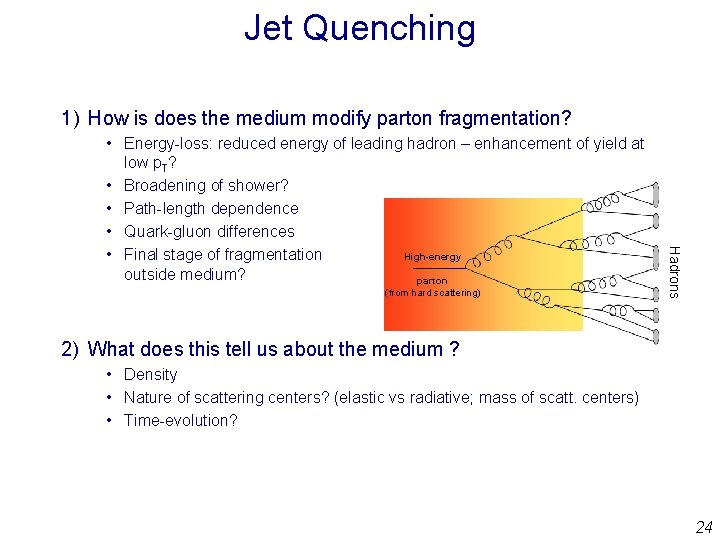
Jet Quenching 1) How is does the medium modify parton fragmentation? (from hard scattering) Hadrons • Energy-loss: reduced energy of leading hadron – enhancement of yield at low p. T? • Broadening of shower? • Path-length dependence • Quark-gluon differences High-energy • Final stage of fragmentation outside medium? parton 2) What does this tell us about the medium ? • Density • Nature of scattering centers? (elastic vs radiative; mass of scatt. centers) • Time-evolution? 24
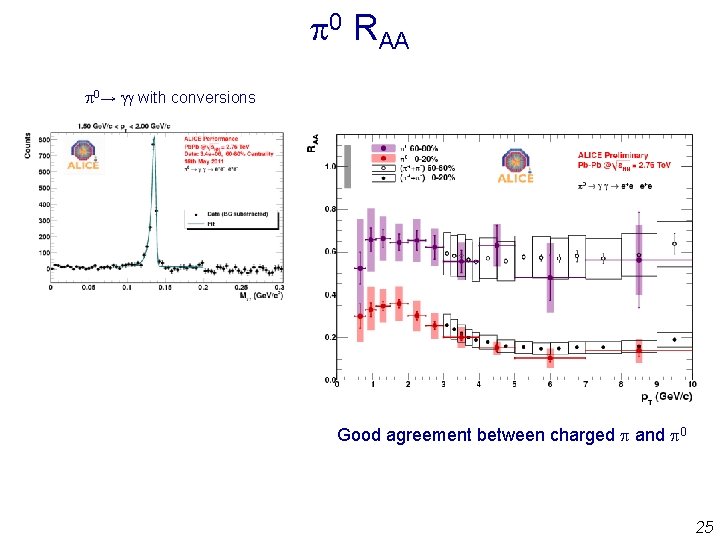
p 0 RAA p 0→ gg with conversions Good agreement between charged p and p 0 25
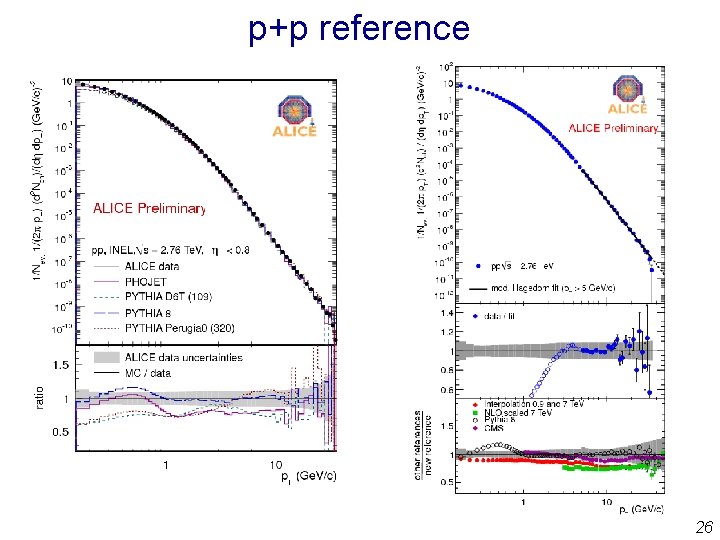
p+p reference 26
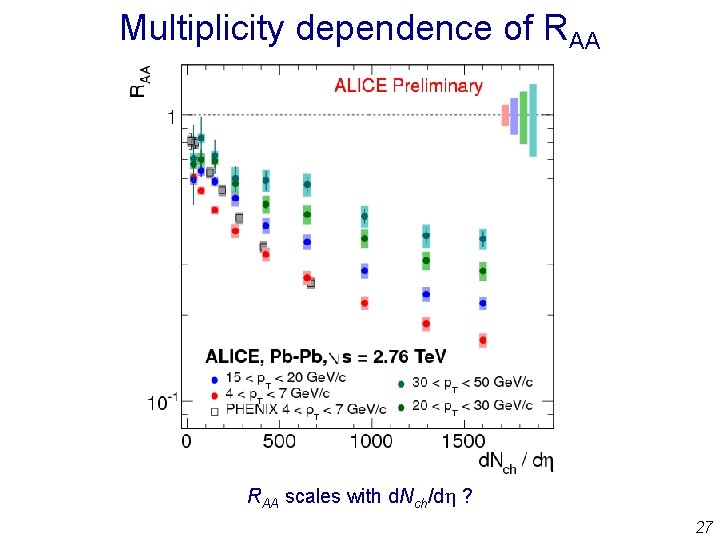
Multiplicity dependence of RAA scales with d. Nch/dh ? 27
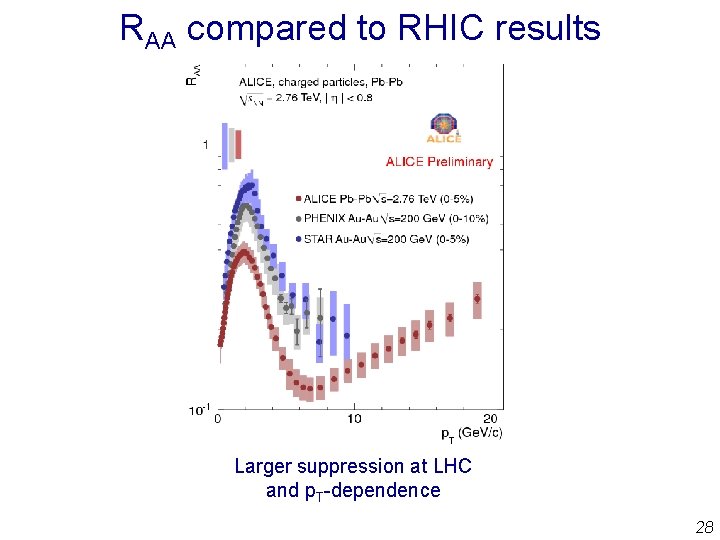
RAA compared to RHIC results Larger suppression at LHC and p. T-dependence 28
Heavy flavour electrons (p+p) RAA for electrons, muons Significant contribution from B Agrees with FONLL in p+p 29