High Spin Ground States d 2 d 3

- Slides: 37
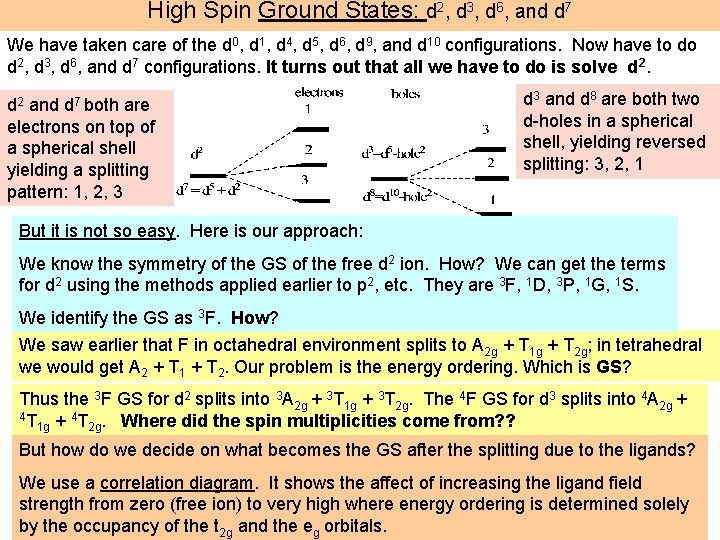
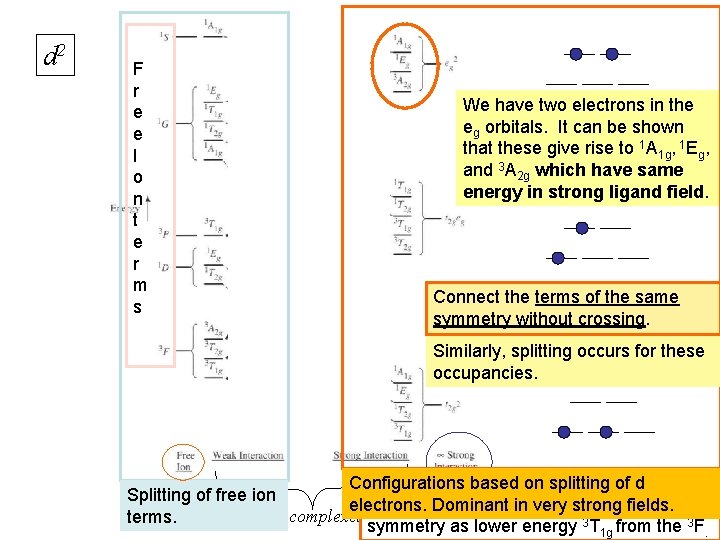
High Spin Ground States: d 2, d 3, d 6, and d 7 We have taken care of the d 0, d 1, d 4, d 5, d 6, d 9, and d 10 configurations. Now have to do d 2, d 3, d 6, and d 7 configurations. It turns out that all we have to do is solve d 2 and d 7 both are electrons on top of a spherical shell yielding a splitting pattern: 1, 2, 3 d 3 and d 8 are both two d-holes in a spherical shell, yielding reversed splitting: 3, 2, 1 But it is not so easy. Here is our approach: We know the symmetry of the GS of the free d 2 ion. How? We can get the terms for d 2 using the methods applied earlier to p 2, etc. They are 3 F, 1 D, 3 P, 1 G, 1 S. We identify the GS as 3 F. How? We saw earlier that F in octahedral environment splits to A 2 g + T 1 g + T 2 g; in tetrahedral we would get A 2 + T 1 + T 2. Our problem is the energy ordering. Which is GS? Thus the 3 F GS for d 2 splits into 3 A 2 g + 3 T 1 g + 3 T 2 g. The 4 F GS for d 3 splits into 4 A 2 g + 4 T 4 1 g + T 2 g. Where did the spin multiplicities come from? ? But how do we decide on what becomes the GS after the splitting due to the ligands? We use a correlation diagram. It shows the affect of increasing the ligand field strength from zero (free ion) to very high where energy ordering is determined solely by the occupancy of the t 2 g and the eg orbitals.
d 2 F r e e I o n t e r m s We have two electrons in the eg orbitals. It can be shown that these give rise to 1 A 1 g, 1 Eg, and 3 A 2 g which have same energy in strong ligand field. Connect the terms of the same symmetry without crossing. Similarly, splitting occurs for these occupancies. Configurations We have included basedthe on 3 splitting T 1 g originating of d from Splitting of free ion electrons. the 3 P. We Dominant will need in itvery immediately. strong fields. Same Real complexes terms. symmetry as lower energy 3 T 1 g from the 3 F.
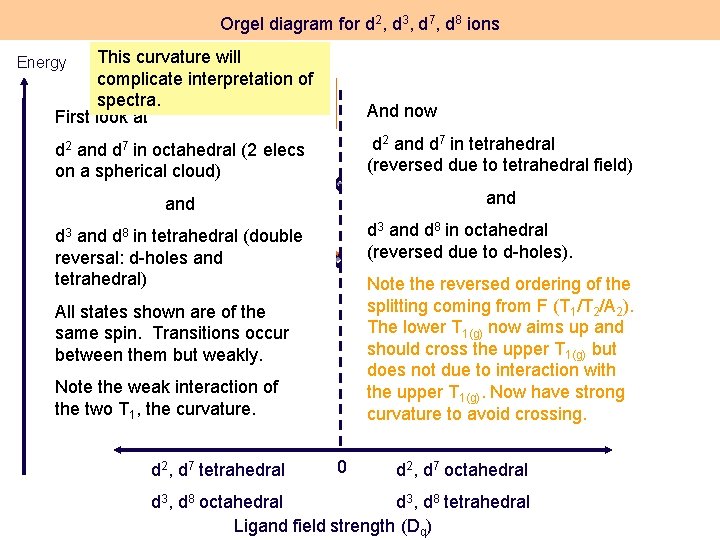
Orgel diagram for d 2, d 3, d 7, d 8 ions This curvature will complicate interpretation of spectra. Same symmetry; crossing forbidden First look at Energy And now d 2 and d 7 in tetrahedral (reversed due to tetrahedral field) T 1 or T 1 g and T 2 or T 2 g d 3 and d 8 in octahedral (reversed due to d-holes). 7 in octahedral (2 elecs and d 1 g Td 12 Tor T 1 g. T 1 or on a spherical cloud) P and T 1 or T 1 g T 13 or T 1 g 8 d and d in tetrahedral (double F reversal: d-holes and tetrahedral) T 2 or T 2 g All states shown are of the same spin. Transitions occur between them but weakly. Note the reversed ordering of the splitting coming from F (T 1/T 2/A 2). The lower T 1(g) now aims up and should cross the upper T 1(g) but. T or T 1 1 g does not due to interaction with the upper T 1(g). Now have strong curvature to avoid crossing. Note the weak interaction of the two T , the curvature. A 2 or A 2 g 1 d 2, d 7 tetrahedral A 2 or A 2 g 0 d 2, d 7 octahedral d 3, d 8 tetrahedral Ligand field strength (Dq)
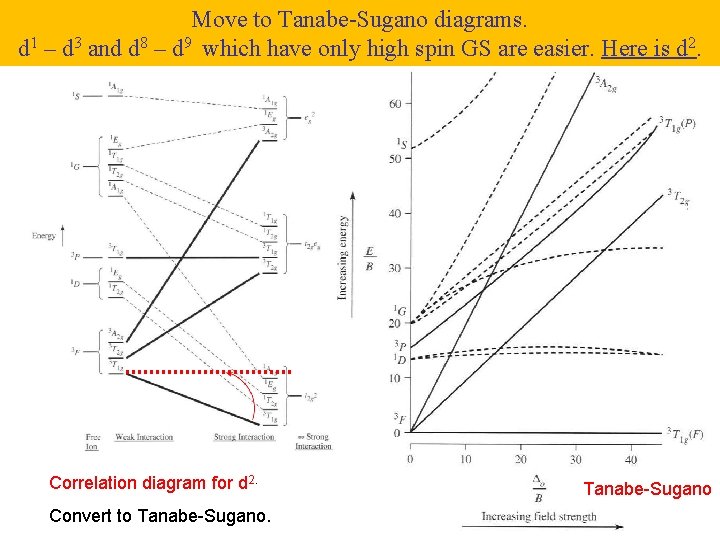
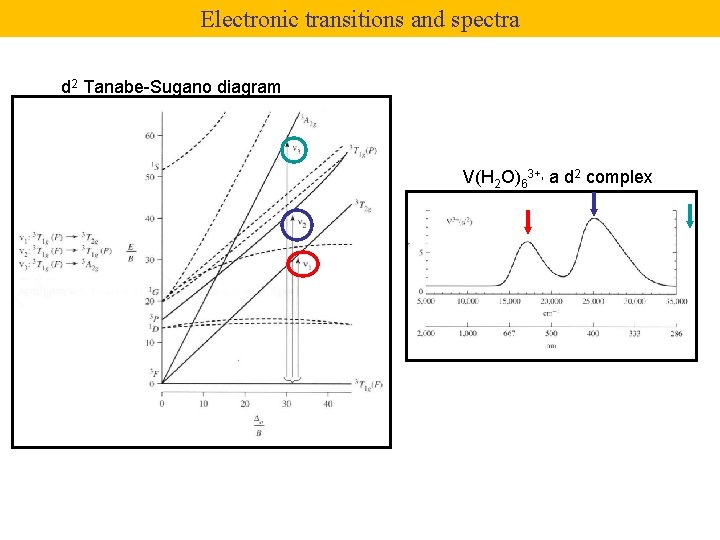
Move to Tanabe-Sugano diagrams. d 1 – d 3 and d 8 – d 9 which have only high spin GS are easier. Here is d 2. Correlation diagram for d 2. Convert to Tanabe-Sugano
Electronic transitions and spectra d 2 Tanabe-Sugano diagram V(H 2 O)63+, a d 2 complex
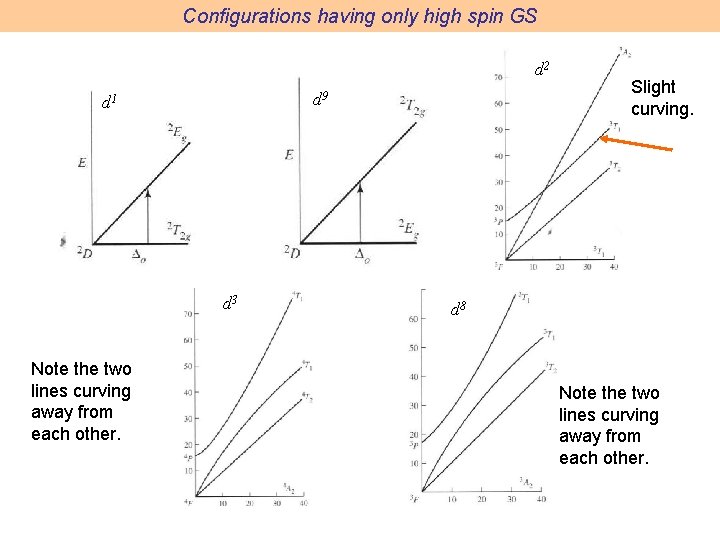
Configurations having only high spin GS d 2 d 9 d 1 d 3 Note the two lines curving away from each other. Slight curving. d 8 Note the two lines curving away from each other.
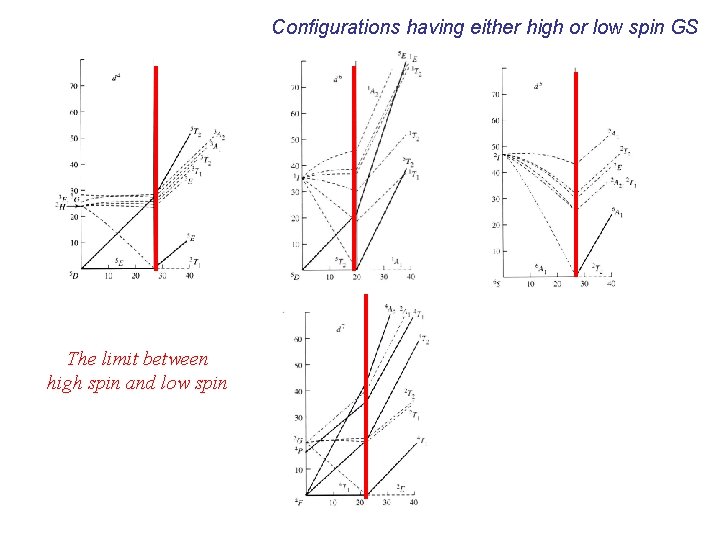
Configurations having either high or low spin GS The limit between high spin and low spin
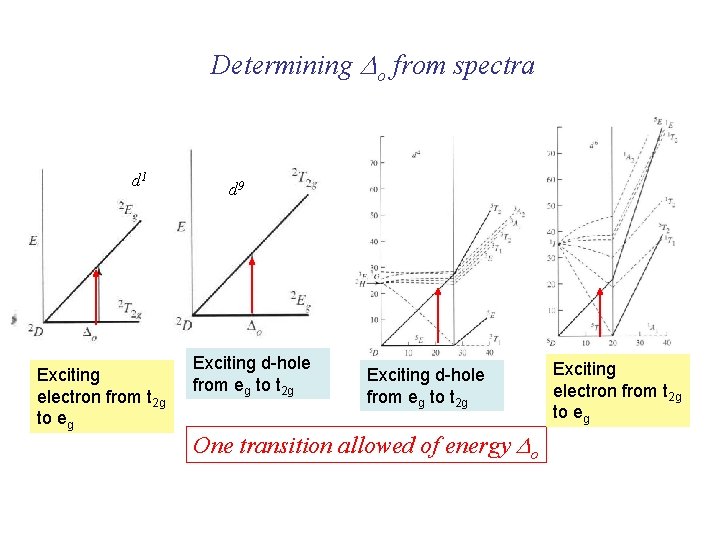
Determining Do from spectra d 1 Exciting electron from t 2 g to eg d 9 Exciting d-hole from eg to t 2 g One transition allowed of energy Do Exciting electron from t 2 g to eg
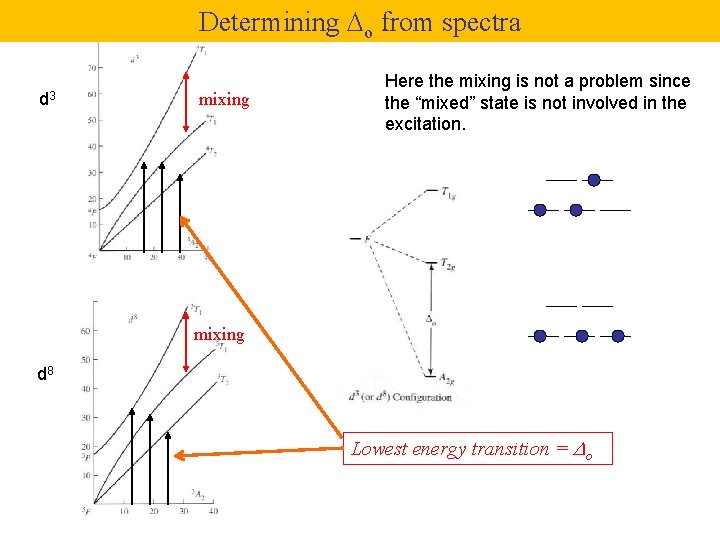
Determining Do from spectra d 3 mixing Here the mixing is not a problem since the “mixed” state is not involved in the excitation. mixing d 8 Lowest energy transition = Do
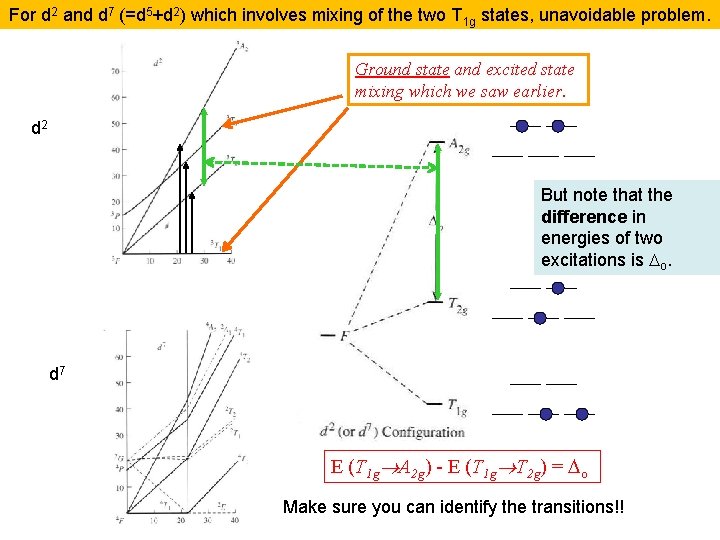
For d 2 and d 7 (=d 5+d 2) which involves mixing of the two T 1 g states, unavoidable problem. Ground state and excited state mixing which we saw earlier. d 2 But note that the difference in energies of two excitations is Do. d 7 E (T 1 g A 2 g) - E (T 1 g T 2 g) = Do Make sure you can identify the transitions!!
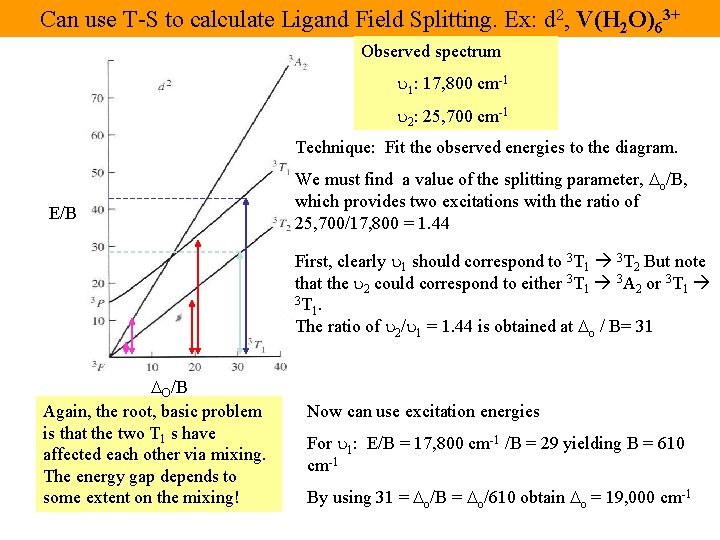
Can use T-S to calculate Ligand Field Splitting. Ex: d 2, V(H 2 O)63+ Observed spectrum u 1: 17, 800 cm-1 u 2: 25, 700 cm-1 Technique: Fit the observed energies to the diagram. E/B We must find a value of the splitting parameter, Do/B, which provides two excitations with the ratio of 25, 700/17, 800 = 1. 44 First, clearly u 1 should correspond to 3 T 1 3 T 2 But note that the u 2 could correspond to either 3 T 1 3 A 2 or 3 T 1 3 T. 1 The ratio of u 2/u 1 = 1. 44 is obtained at Do / B= 31 DO/B Again, the root, basic problem is that the two T 1 s have affected each other via mixing. The energy gap depends to some extent on the mixing! Now can use excitation energies For u 1: E/B = 17, 800 cm-1 /B = 29 yielding B = 610 cm-1 By using 31 = Do/B = Do/610 obtain Do = 19, 000 cm-1
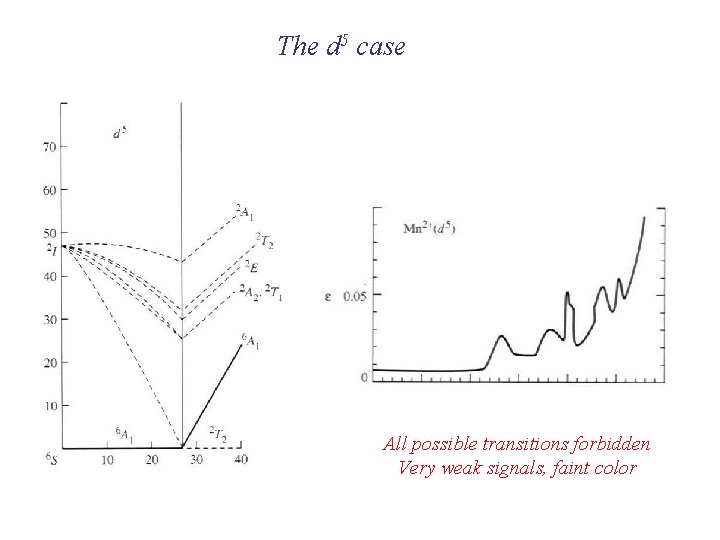
The d 5 case All possible transitions forbidden Very weak signals, faint color
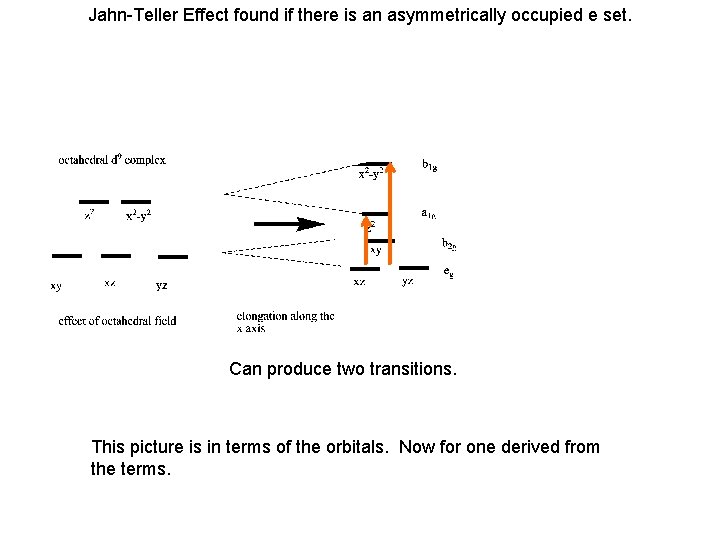
Jahn-Teller Effect found if there is an asymmetrically occupied e set. Can produce two transitions. This picture is in terms of the orbitals. Now for one derived from the terms.
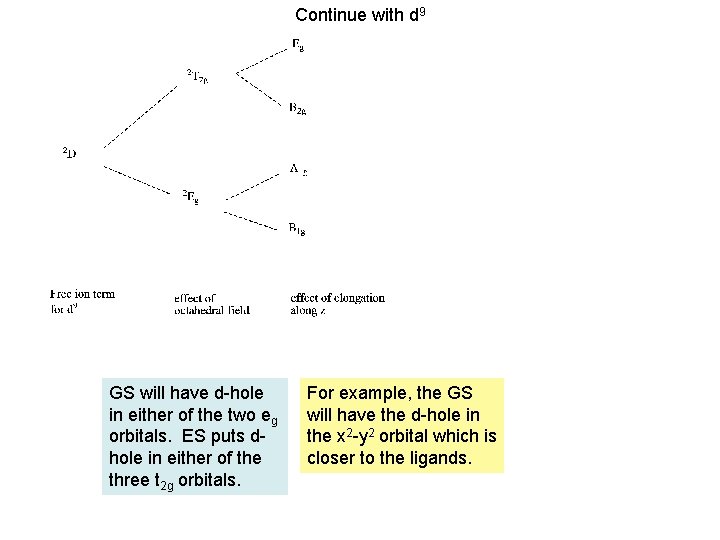
Continue with d 9 GS will have d-hole in either of the two eg orbitals. ES puts dhole in either of the three t 2 g orbitals. For example, the GS will have the d-hole in the x 2 -y 2 orbital which is closer to the ligands.
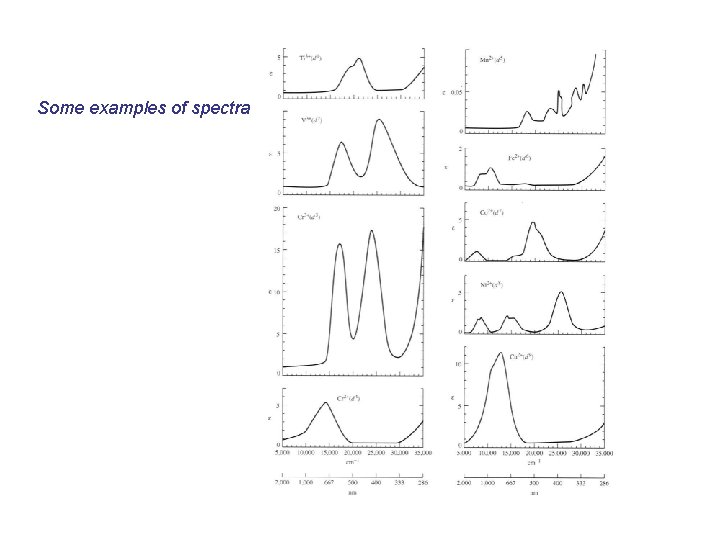
Some examples of spectra
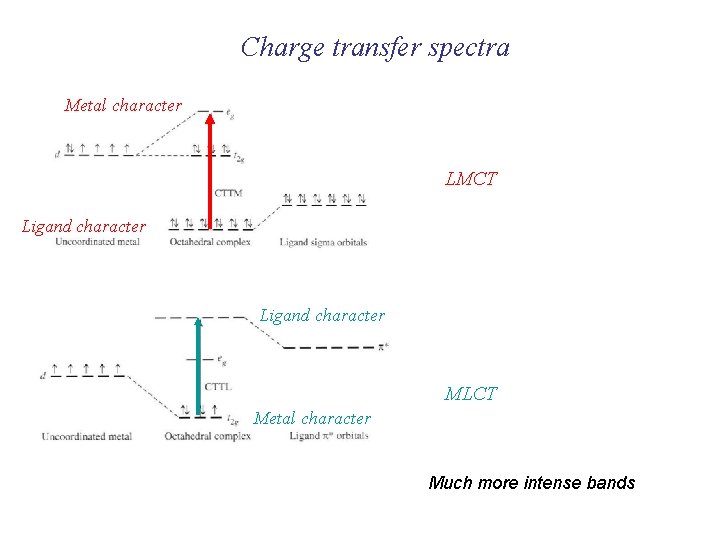
Charge transfer spectra Metal character LMCT Ligand character MLCT Metal character Much more intense bands
Coordination Chemistry Reactions of Metal Complexes
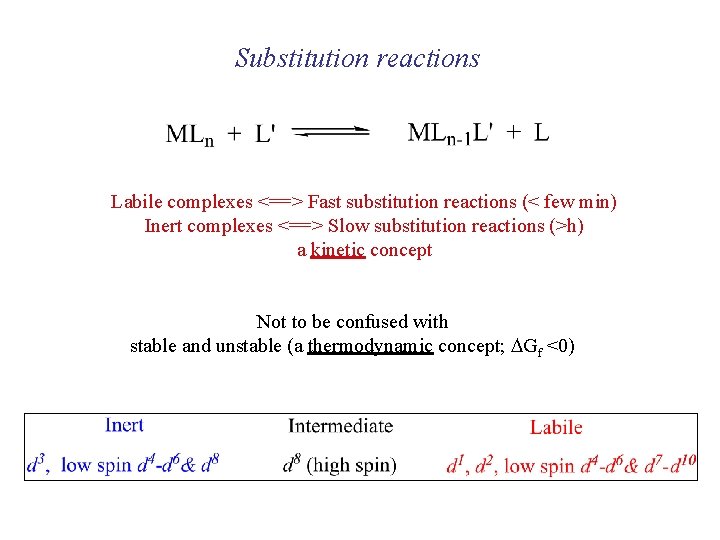
Substitution reactions Labile complexes <==> Fast substitution reactions (< few min) Inert complexes <==> Slow substitution reactions (>h) a kinetic concept Not to be confused with stable and unstable (a thermodynamic concept; DGf <0)
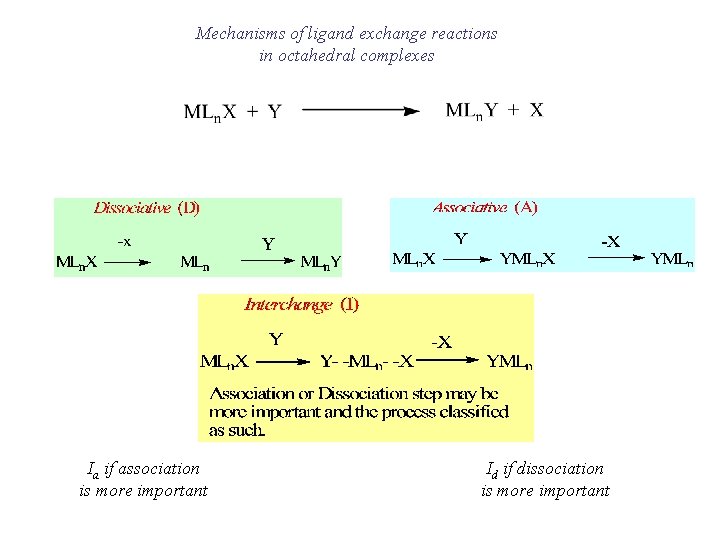
Mechanisms of ligand exchange reactions in octahedral complexes Ia if association is more important Id if dissociation is more important
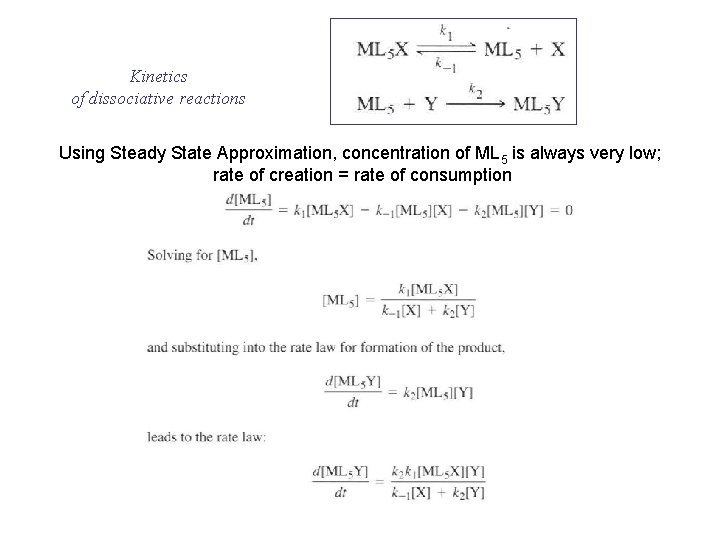
Kinetics of dissociative reactions Using Steady State Approximation, concentration of ML 5 is always very low; rate of creation = rate of consumption
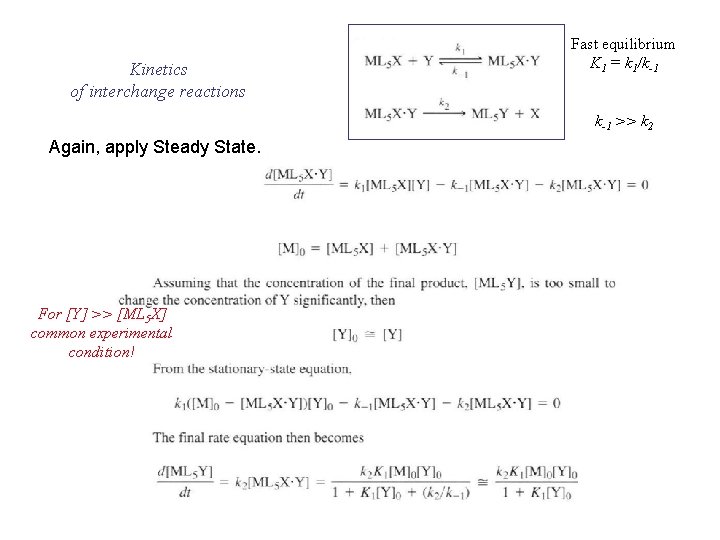
Kinetics of interchange reactions Fast equilibrium K 1 = k 1/k-1 >> k 2 Again, apply Steady State. For [Y] >> [ML 5 X] common experimental condition!
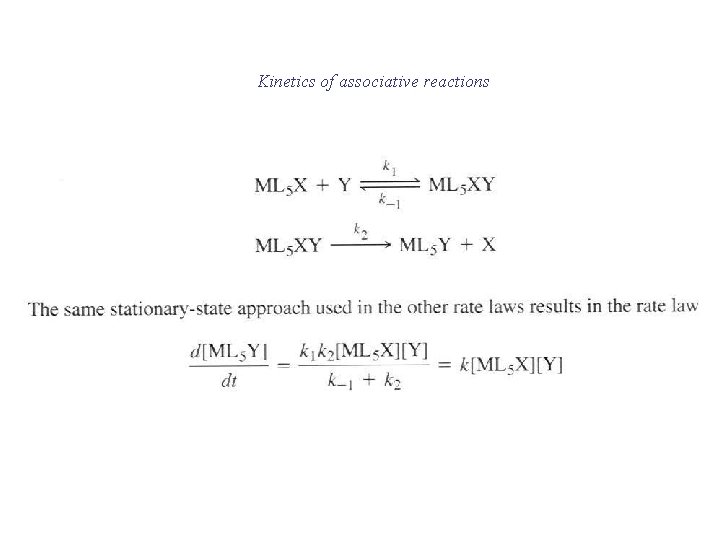
Kinetics of associative reactions
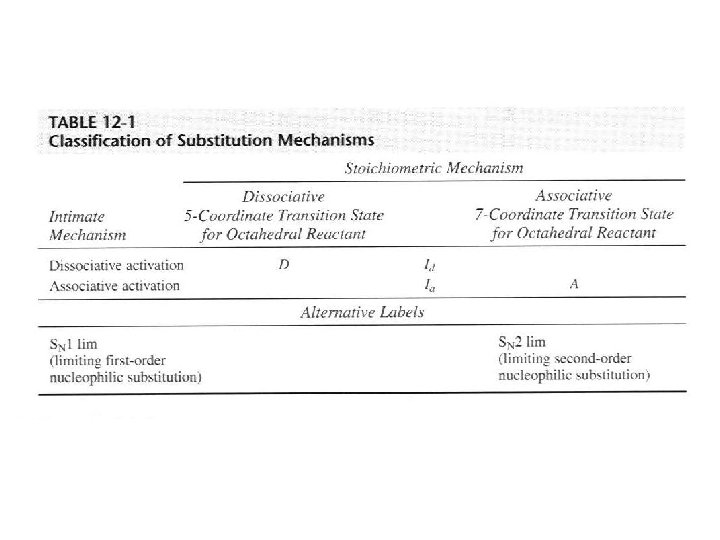
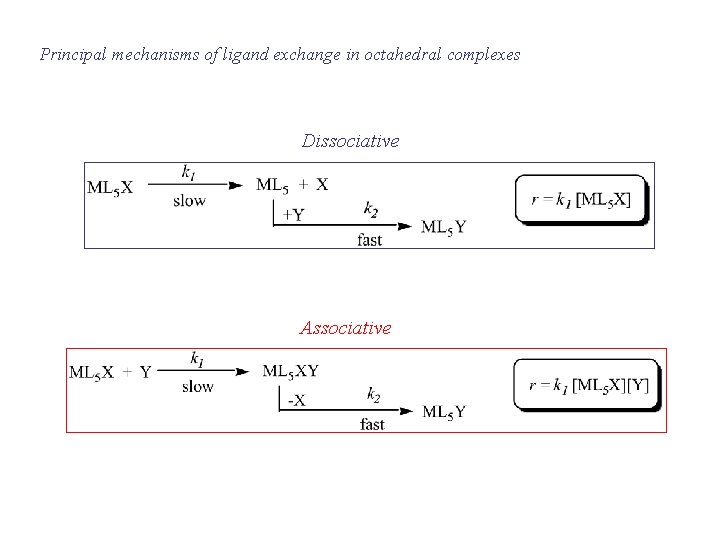
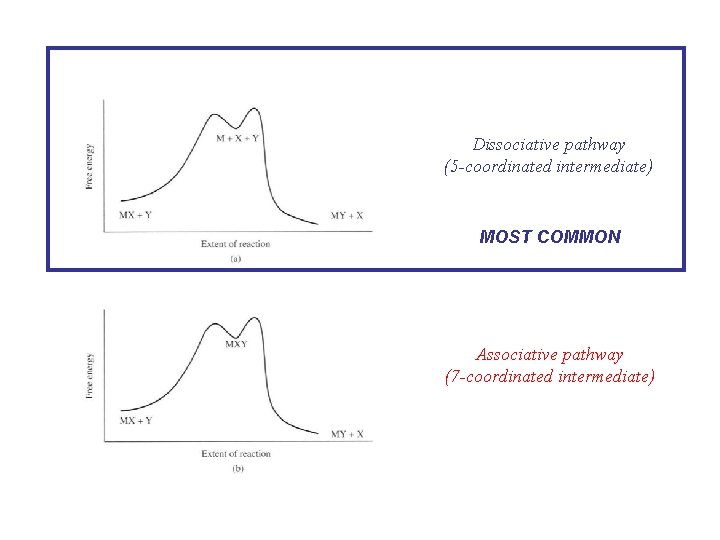
Principal mechanisms of ligand exchange in octahedral complexes Dissociative Associative
Dissociative pathway (5 -coordinated intermediate) MOST COMMON Associative pathway (7 -coordinated intermediate)
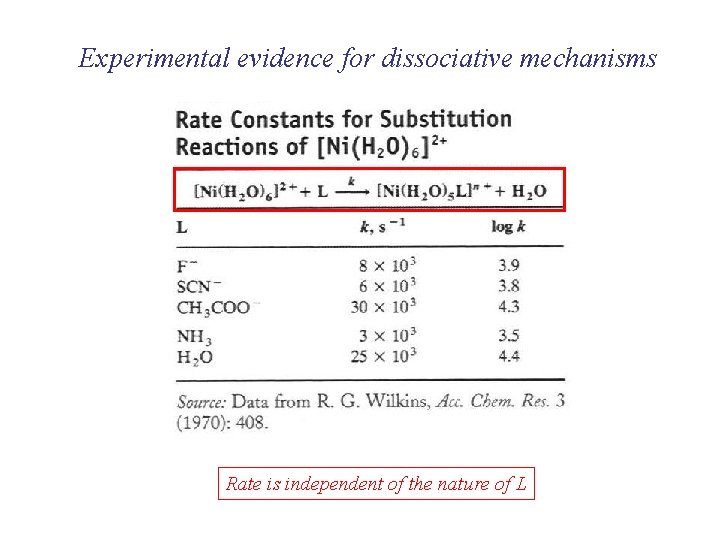
Experimental evidence for dissociative mechanisms Rate is independent of the nature of L
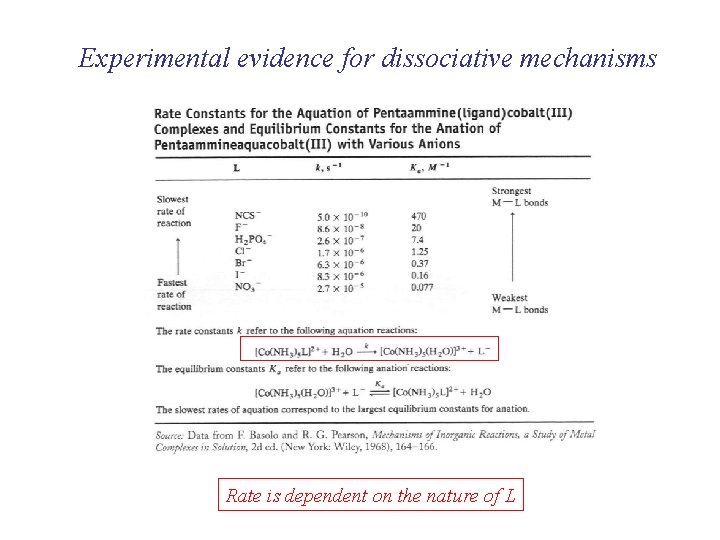
Experimental evidence for dissociative mechanisms Rate is dependent on the nature of L
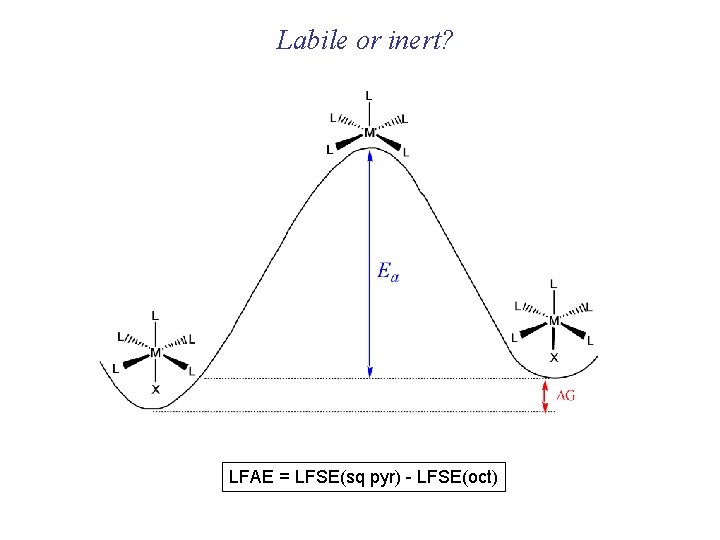
Inert and labile complexes Some common thermodynamic and kinetic profiles Exothermic (favored, large K) Large Ea, slow reaction Stable intermediate Endothermic (disfavored, small K) Small Ea, fast reaction
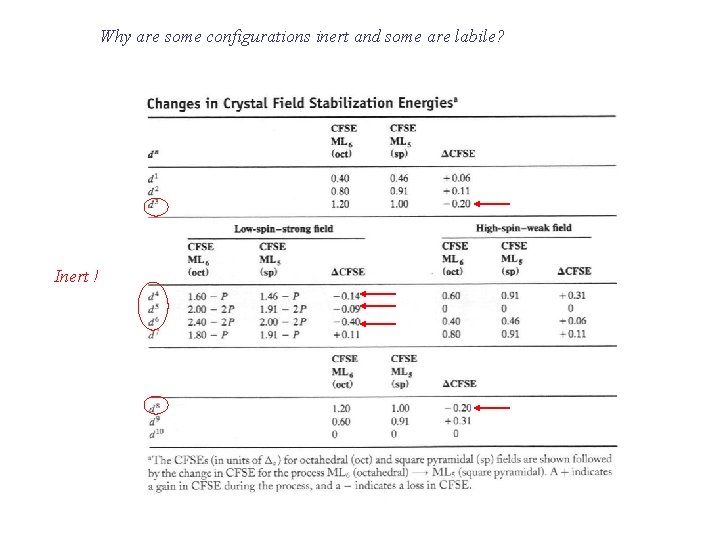
Labile or inert? LFAE = LFSE(sq pyr) - LFSE(oct)
Why are some configurations inert and some are labile? Inert !
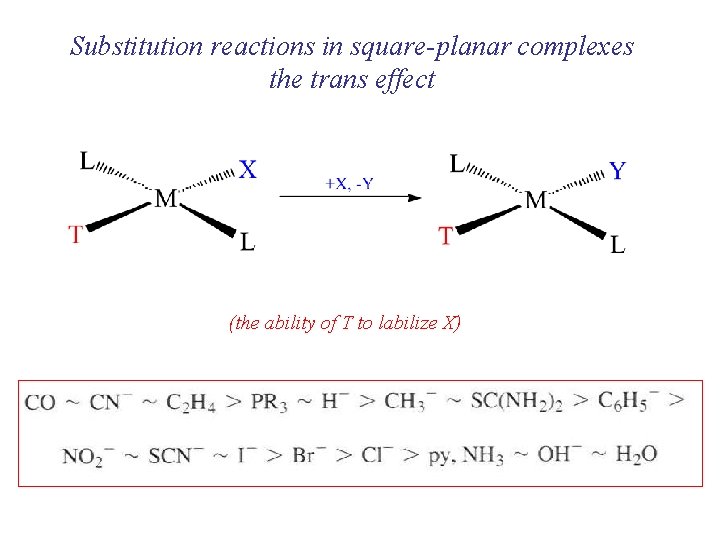
Substitution reactions in square-planar complexes the trans effect (the ability of T to labilize X)
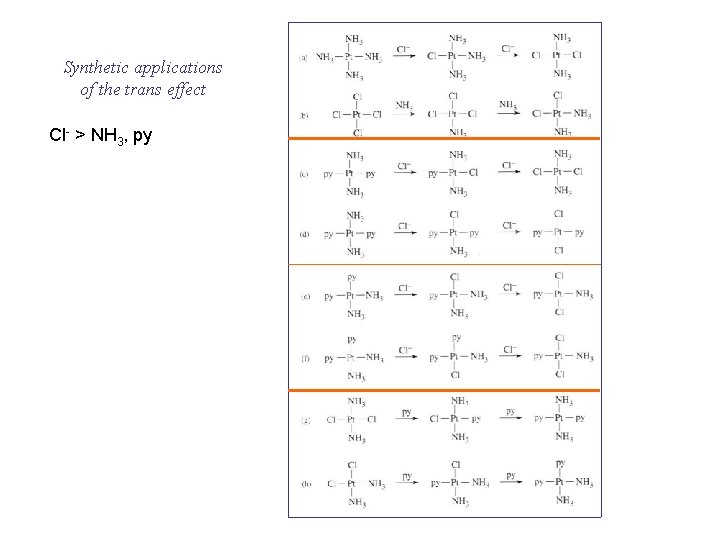
Synthetic applications of the trans effect Cl- > NH 3, py
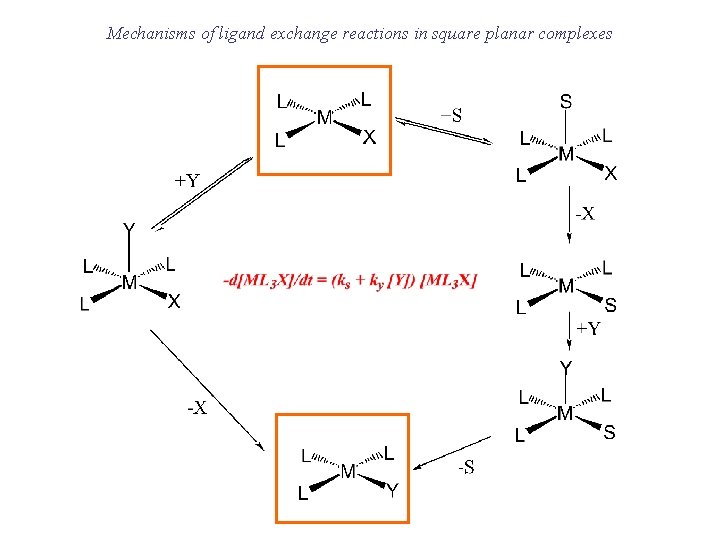
Mechanisms of ligand exchange reactions in square planar complexes
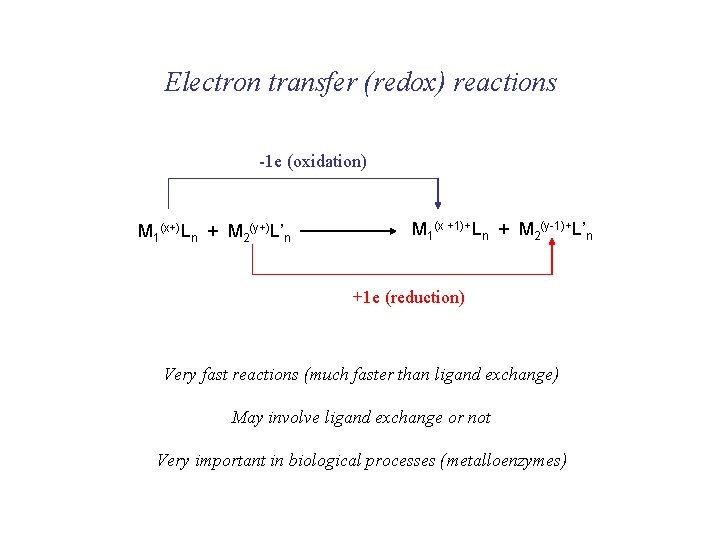
Electron transfer (redox) reactions -1 e (oxidation) M 1(x+)Ln + M 2(y+)L’n M 1(x +1)+Ln + M 2(y-1)+L’n +1 e (reduction) Very fast reactions (much faster than ligand exchange) May involve ligand exchange or not Very important in biological processes (metalloenzymes)
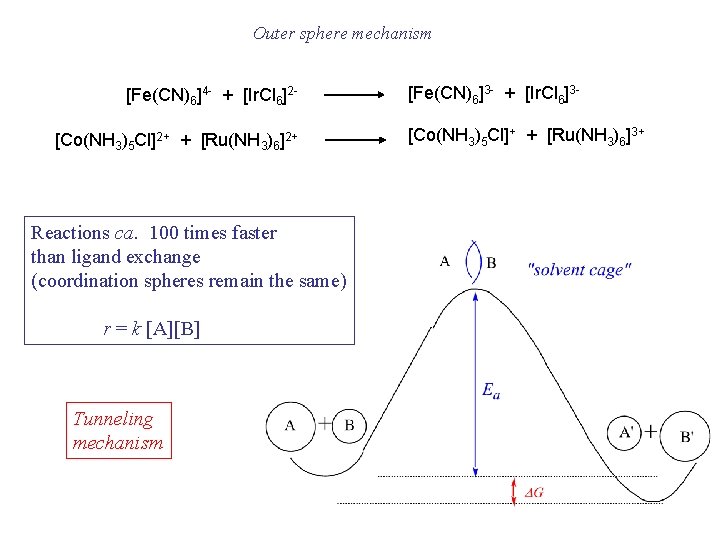
Outer sphere mechanism [Fe(CN)6]4 - + [Ir. Cl 6]2[Co(NH 3)5 Cl]2+ + [Ru(NH 3)6]2+ Reactions ca. 100 times faster than ligand exchange (coordination spheres remain the same) r = k [A][B] Tunneling mechanism [Fe(CN)6]3 - + [Ir. Cl 6]3[Co(NH 3)5 Cl]+ + [Ru(NH 3)6]3+
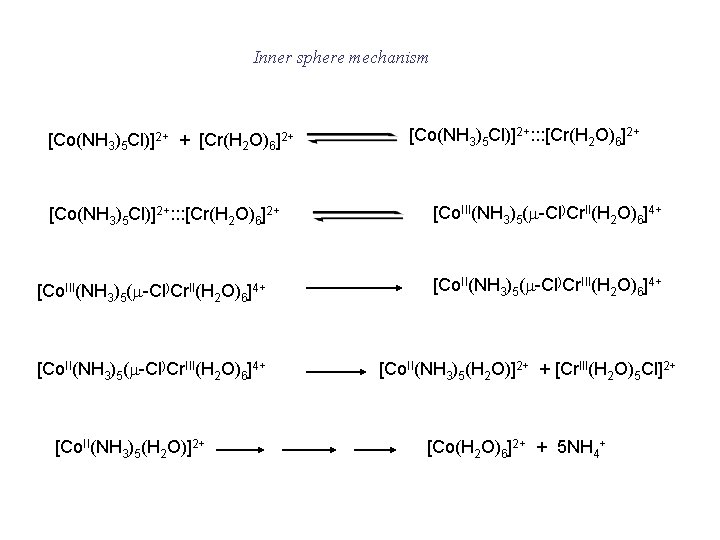
Inner sphere mechanism [Co(NH 3)5 Cl)]2+ + [Cr(H 2 O)6]2+ [Co(NH 3)5 Cl)]2+: : : [Cr(H 2 O)6]2+ [Co. III(NH 3)5(m-Cl)Cr. II(H 2 O)6]4+ [Co. II(NH 3)5(m-Cl)Cr. III(H 2 O)6]4+ [Co. II(NH 3)5(H 2 O)]2+ + [Cr. III(H 2 O)5 Cl]2+ [Co(H 2 O)6]2+ + 5 NH 4+
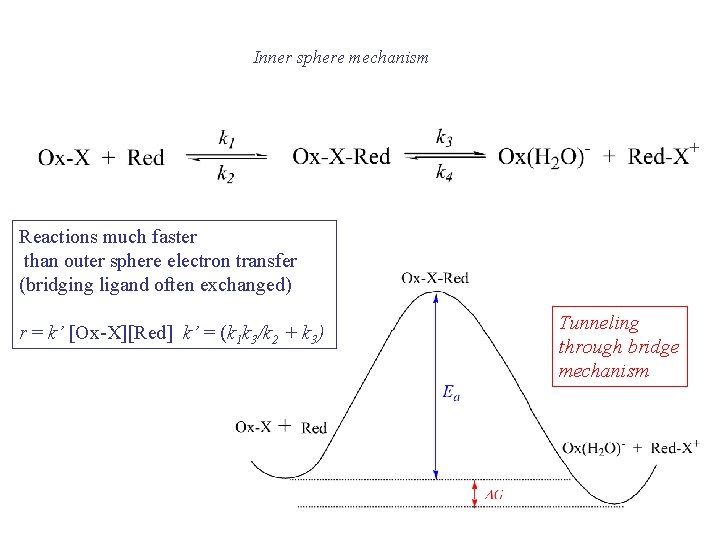
Inner sphere mechanism Reactions much faster than outer sphere electron transfer (bridging ligand often exchanged) r = k’ [Ox-X][Red] k’ = (k 1 k 3/k 2 + k 3) Tunneling through bridge mechanism