Health Interventions Evaluation of Cost Effectiveness Dr Sanjay


- Slides: 62
Health Interventions: Evaluation of Cost Effectiveness Dr Sanjay Dixit M. D. Ph. D Diploma in Health System Management(U. S. A. ) MGM Medical College Indore
Health care interventions. n n Health system with similar level of Health expenditure per capita show wide variations in population health outcomes Some system devote resources to expensive interventions with small effect on population health
Health Care Interventions n n Low cost interventions with potentially greater benefit are not fully implemented Information on both costs and effectiveness are essential for making evidence-based decisions about competing health care interventions
Health Care Interventions n 20 years ago Health Care intervention were centered exclusively on Clinical Effectiveness and not on Cost Effectiveness. n n Intervening years have seen an ever increasing strain on health resources. Therefore need of Economic Evaluation of health Interventions
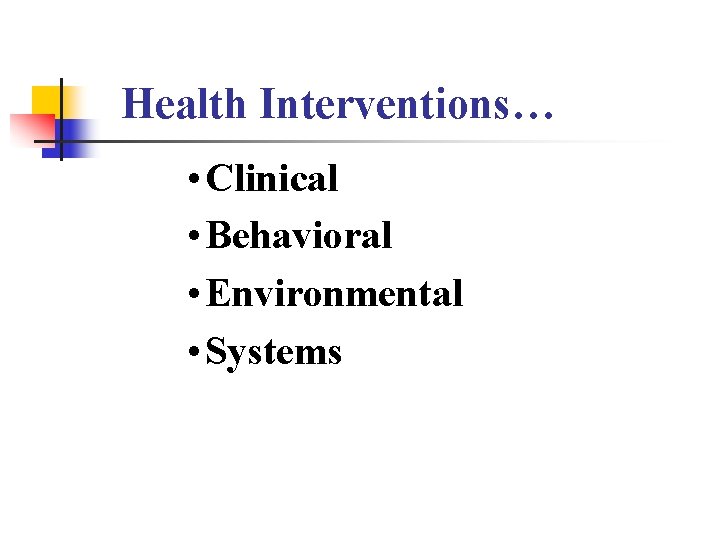
Health Interventions… • Clinical • Behavioral • Environmental • Systems
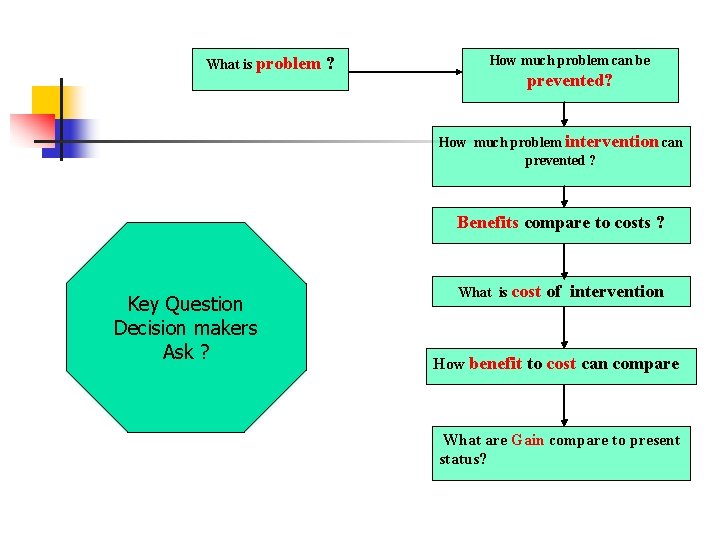
How much problem can be What is problem ? prevented? How much problem intervention can prevented ? Benefits compare to costs ? Key Question Decision makers Ask ? What is cost of intervention How benefit to cost can compare What are Gain compare to present status?
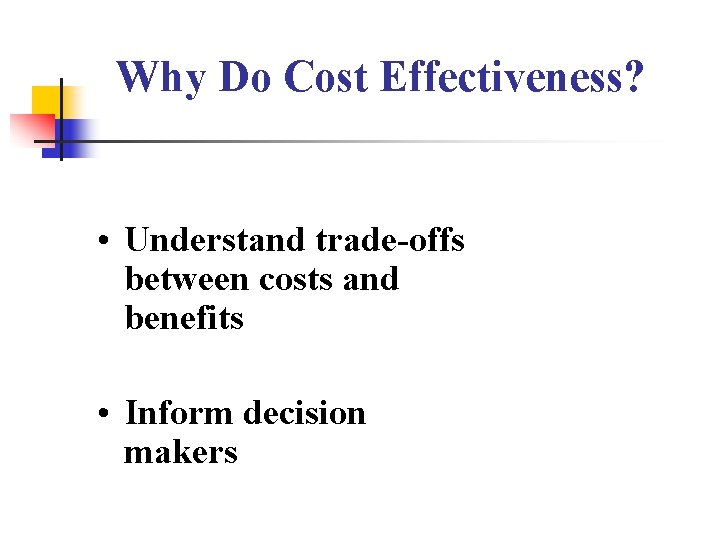
Why Do Cost Effectiveness? • Understand trade-offs between costs and benefits • Inform decision makers
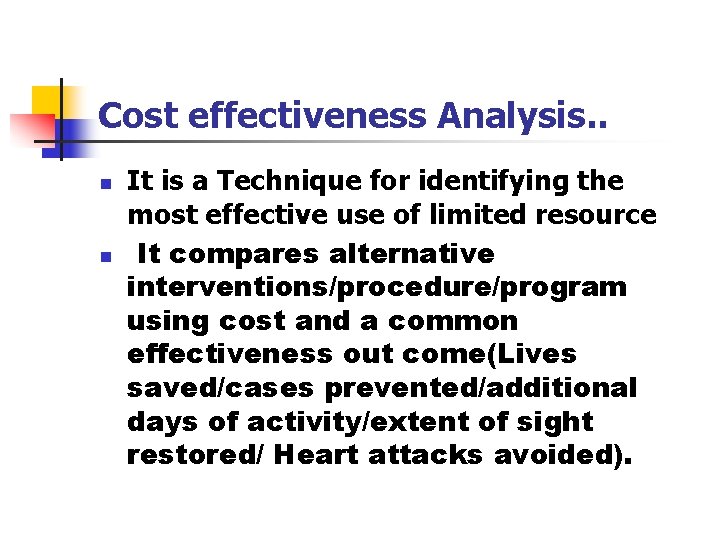
Cost effectiveness Analysis. . n n It is a Technique for identifying the most effective use of limited resource It compares alternative interventions/procedure/program using cost and a common effectiveness out come(Lives saved/cases prevented/additional days of activity/extent of sight restored/ Heart attacks avoided).
Cost effectiveness Analysis n n These are combined ( cost per heart attack avoided) such that the relative cost effectiveness can be assessed Used to assess the comparative impacts of expenditure on different health interventions.
Cost Effectiveness Analysis n A study evaluating whether hypertension screening, Nutrition Counseling, Medication, or by pass surgery would provide the most additional years of life for each Ruppes spent is a Cost effectiveness study
Cost Effectiveness Analysis n n Cost Effectiveness of interventions such as DOTS for tuberculosis is highly cost-effective Liver transplant for alcoholic cirrhosis is highly cost-ineffective
Cost Effectiveness Analysis… n It also helps to choose between medical and non medical approaches for protecting health such as better emergency medical services versus better highway design
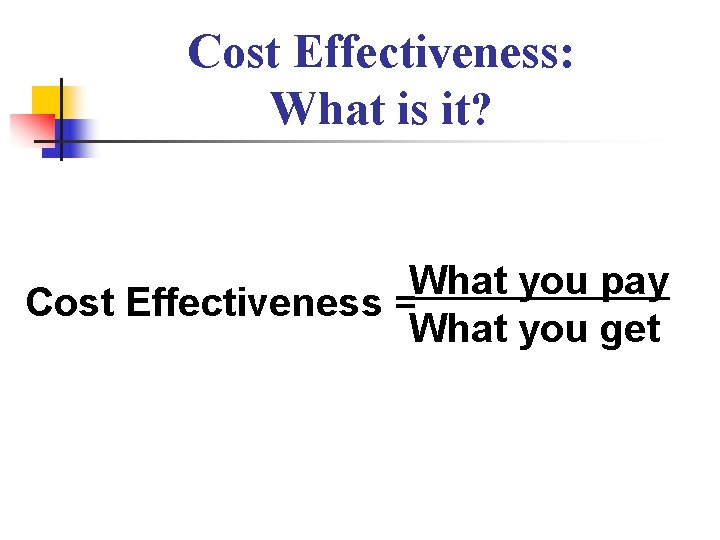
Cost Effectiveness: What is it? What you pay Cost Effectiveness = What you get
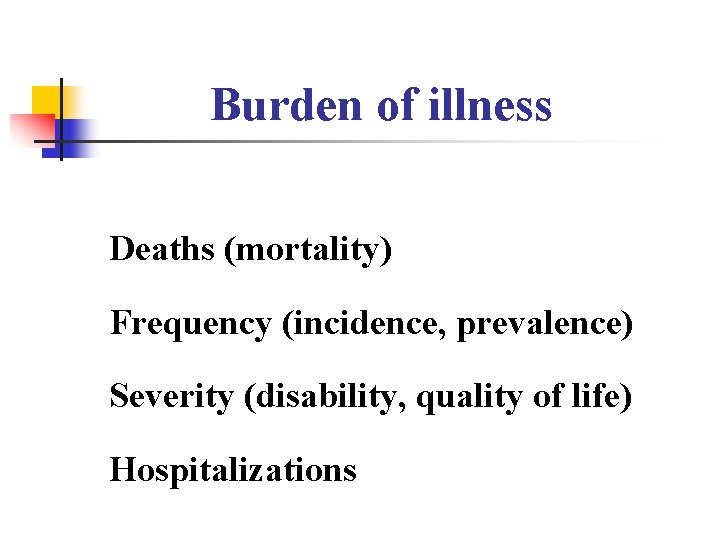
Burden of illness Deaths (mortality) Frequency (incidence, prevalence) Severity (disability, quality of life) Hospitalizations
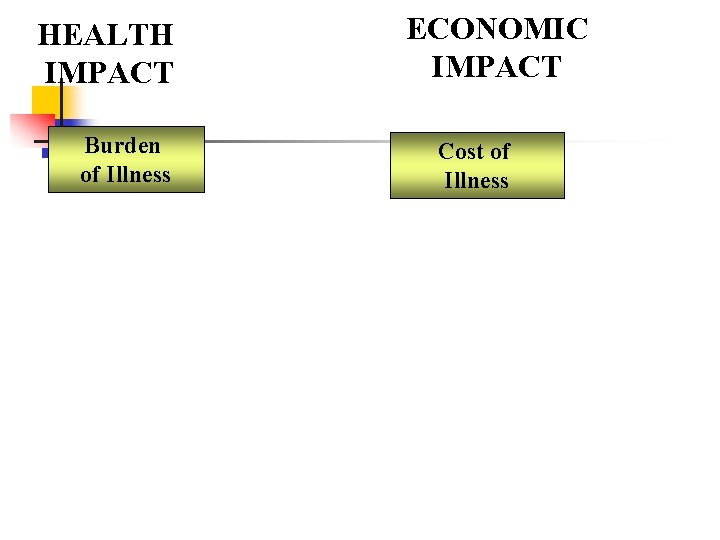
HEALTH IMPACT Burden of Illness ECONOMIC IMPACT
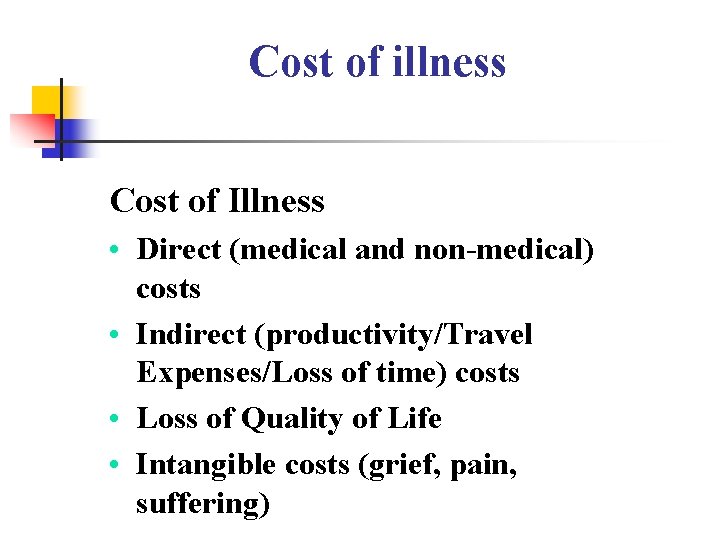
Cost of illness Cost of Illness • Direct (medical and non-medical) costs • Indirect (productivity/Travel Expenses/Loss of time) costs • Loss of Quality of Life • Intangible costs (grief, pain, suffering)
HEALTH IMPACT Burden of Illness ECONOMIC IMPACT Cost of Illness
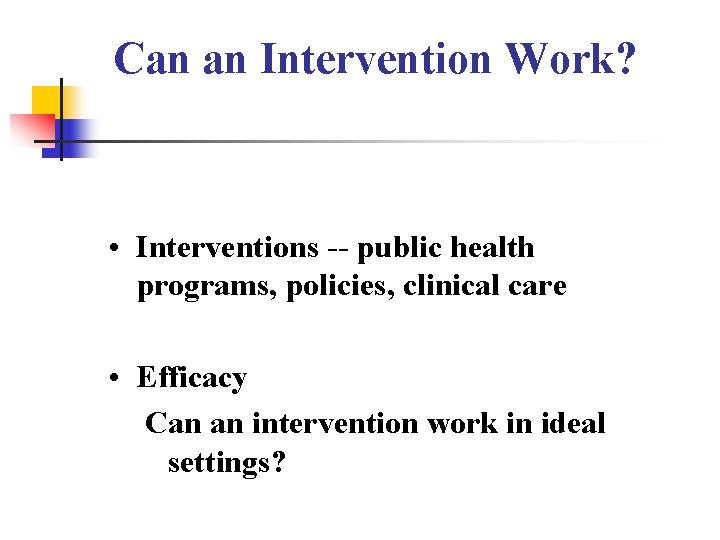
Can an Intervention Work? • Interventions -- public health programs, policies, clinical care • Efficacy Can an intervention work in ideal settings?
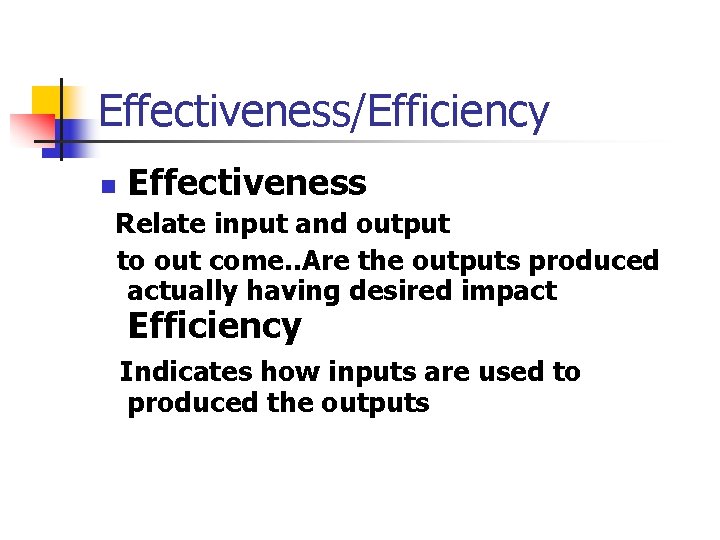
Effectiveness/Efficiency n Effectiveness Relate input and output to out come. . Are the outputs produced actually having desired impact Efficiency Indicates how inputs are used to produced the outputs
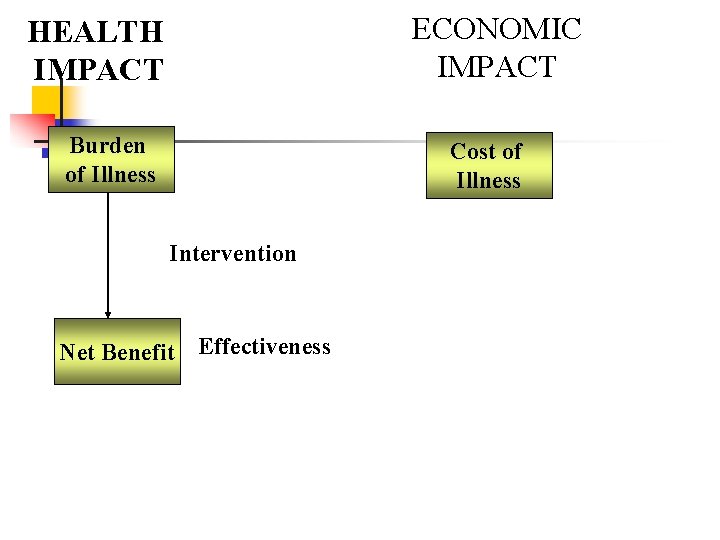
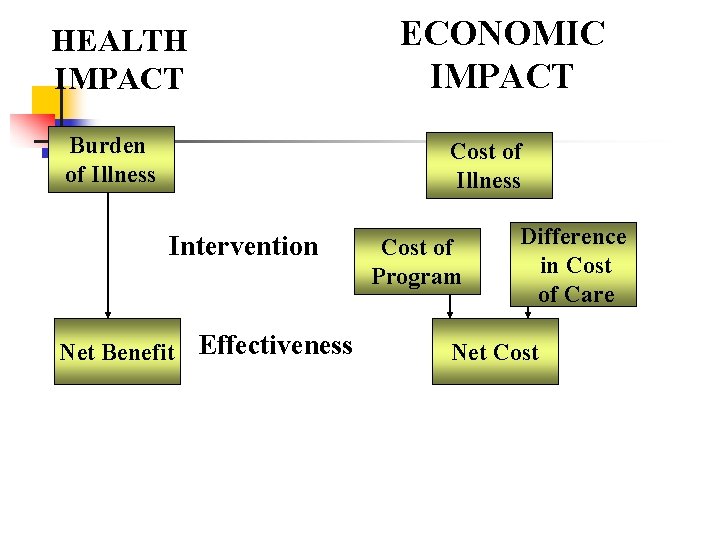
HEALTH IMPACT Burden of Illness ECONOMIC IMPACT Cost of Illness Intervention Net Benefit Effectiveness
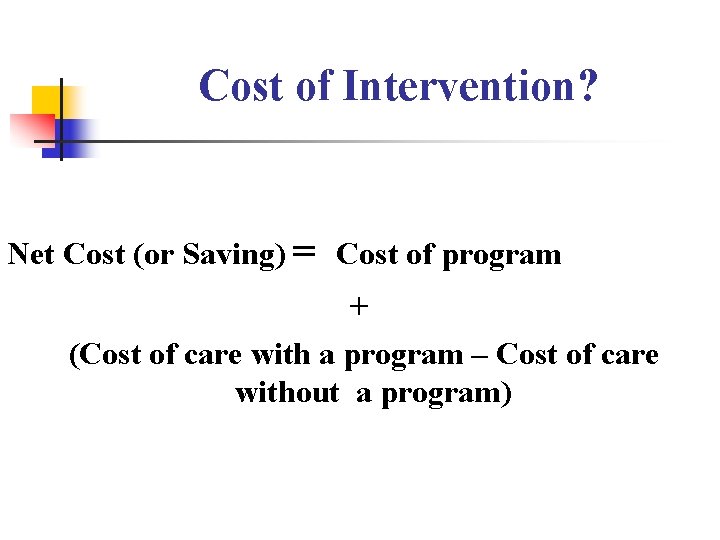
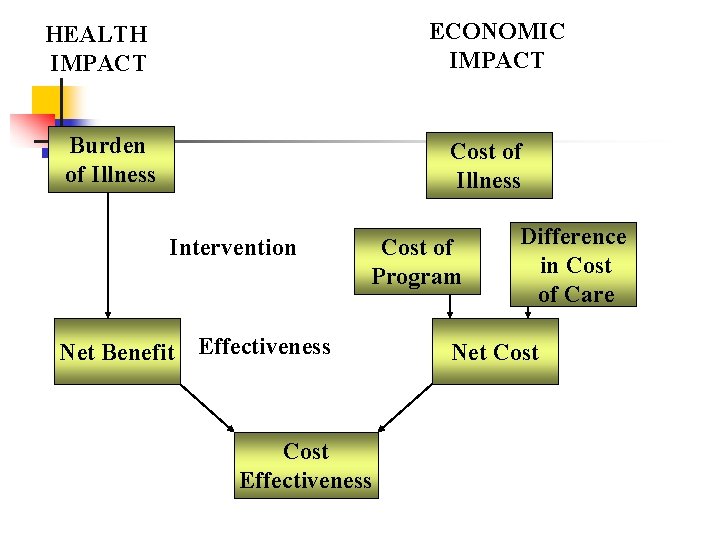
Cost of Intervention? Net Cost (or Saving) = Cost of program + (Cost of care with a program – Cost of care without a program)
HEALTH IMPACT Burden of Illness ECONOMIC IMPACT Cost of Illness Intervention Net Benefit Effectiveness Cost of Program Difference in Cost of Care Net Cost
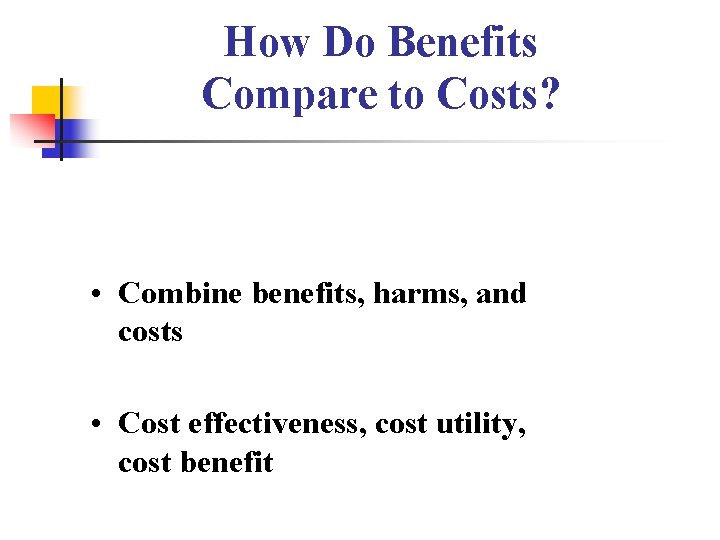
How Do Benefits Compare to Costs? • Combine benefits, harms, and costs • Cost effectiveness, cost utility, cost benefit
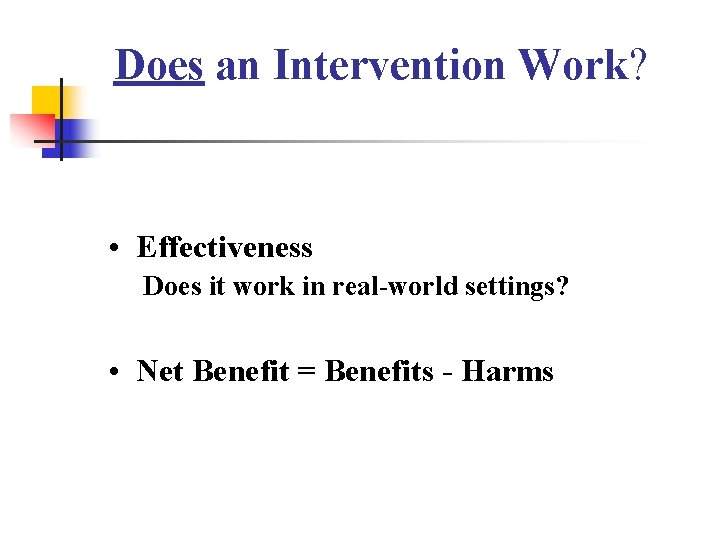
Does an Intervention Work? • Effectiveness Does it work in real-world settings? • Net Benefit = Benefits - Harms
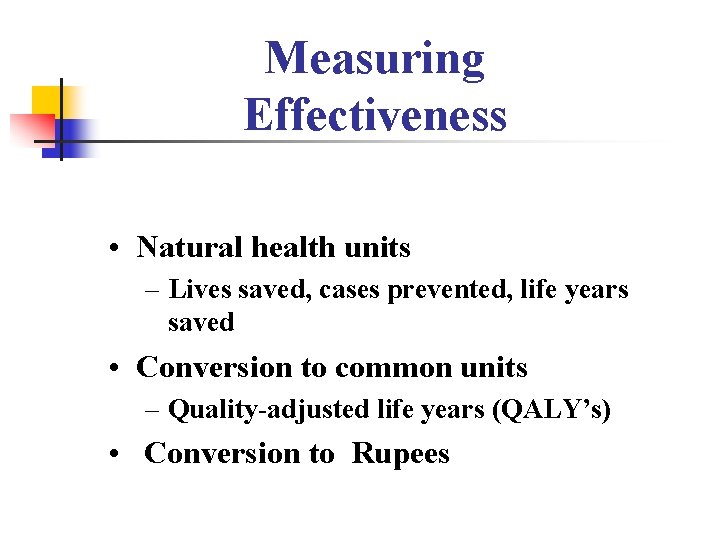
Measuring Effectiveness • Natural health units – Lives saved, cases prevented, life years saved • Conversion to common units – Quality-adjusted life years (QALY’s) • Conversion to Rupees
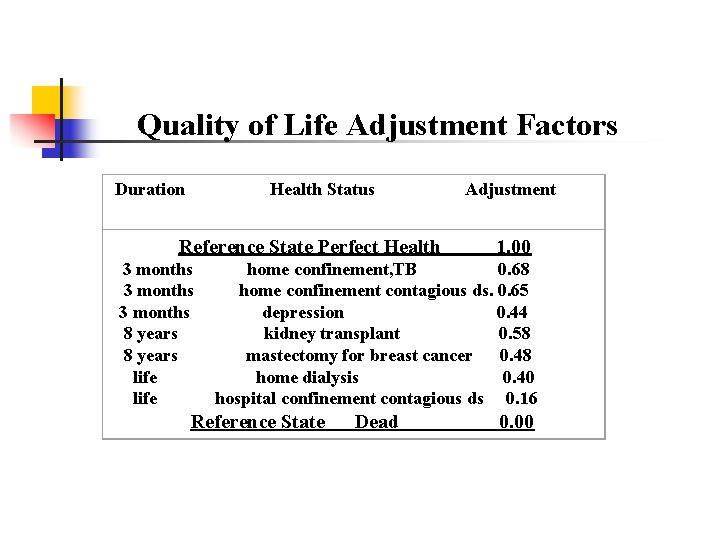
Quality of Life Adjustment Factors Duration Health Status Adjustment Reference State Perfect Health 1. 00 3 months home confinement, TB 0. 68 3 months home confinement contagious ds. 0. 65 3 months depression 0. 44 8 years kidney transplant 0. 58 8 years mastectomy for breast cancer 0. 48 life home dialysis 0. 40 life hospital confinement contagious ds 0. 16 Reference State Dead 0. 00
ECONOMIC IMPACT HEALTH IMPACT Burden of Illness Cost of Illness Intervention Cost of Program Net Benefit Effectiveness Cost Effectiveness Difference in Cost of Care Net Cost
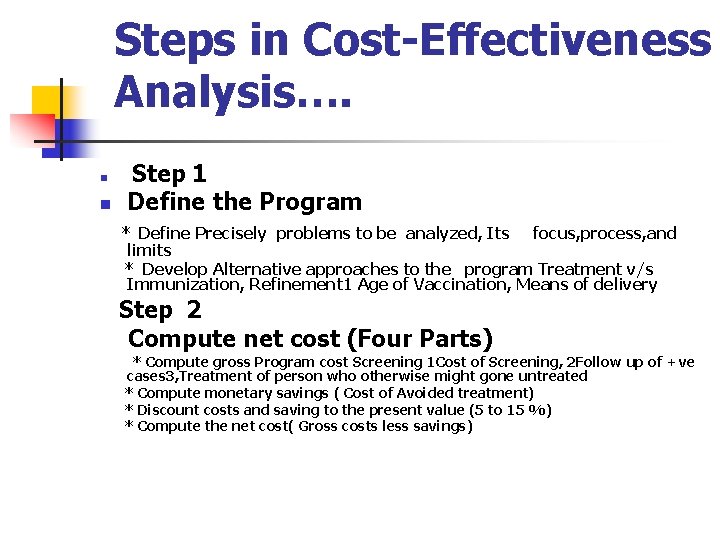
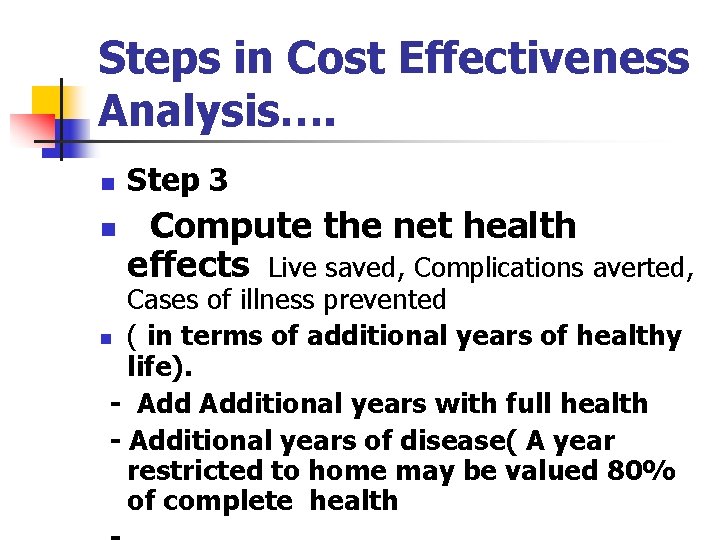
Steps in Cost-Effectiveness Analysis…. n n Step 1 Define the Program * Define Precisely problems to be analyzed, Its focus, process, and limits * Develop Alternative approaches to the program Treatment v/s Immunization, Refinement 1 Age of Vaccination, Means of delivery Step 2 Compute net cost (Four Parts) * Compute gross Program cost Screening 1 Cost of Screening, 2 Follow up of +ve cases 3, Treatment of person who otherwise might gone untreated * Compute monetary savings ( Cost of Avoided treatment) * Discount costs and saving to the present value (5 to 15 %) * Compute the net cost( Gross costs less savings)
Steps in Cost Effectiveness Analysis…. n n Step 3 Compute the net health effects Live saved, Complications averted, Cases of illness prevented n ( in terms of additional years of healthy life). - Additional years with full health - Additional years of disease( A year restricted to home may be valued 80% of complete health
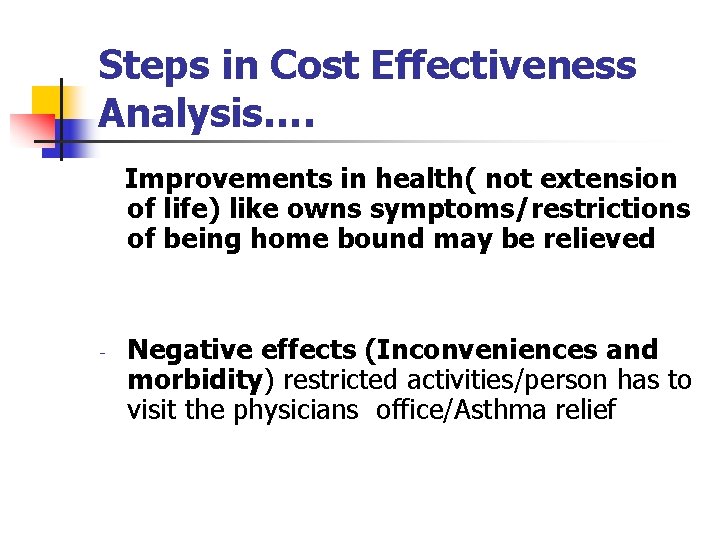
Steps in Cost Effectiveness Analysis…. Improvements in health( not extension of life) like owns symptoms/restrictions of being home bound may be relieved - Negative effects (Inconveniences and morbidity) restricted activities/person has to visit the physicians office/Asthma relief
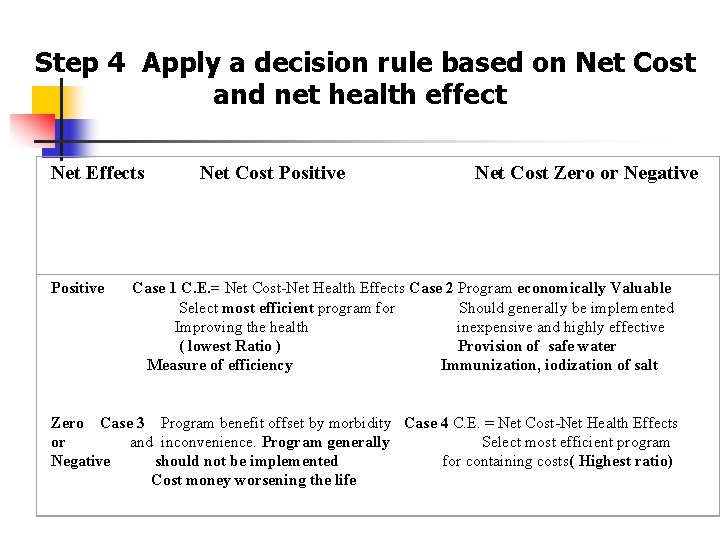
Step 4 Apply a decision rule based on Net Cost and net health effect Net Effects Net Cost Positive Net Cost Zero or Negative Positive Case 1 C. E. = Net Cost-Net Health Effects Case 2 Program economically Valuable Select most efficient program for Should generally be implemented Improving the health inexpensive and highly effective ( lowest Ratio ) Provision of safe water Measure of efficiency Immunization, iodization of salt Zero Case 3 Program benefit offset by morbidity Case 4 C. E. = Net Cost-Net Health Effects or and inconvenience. Program generally Select most efficient program Negative should not be implemented for containing costs( Highest ratio) Cost money worsening the life
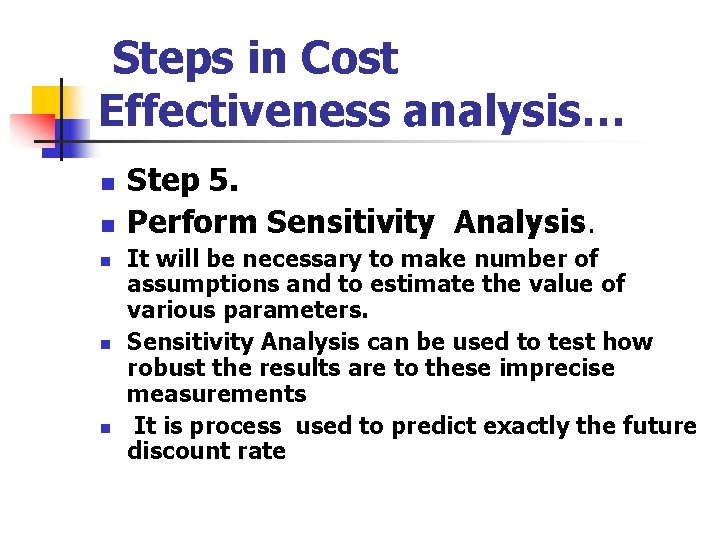
Steps in Cost Effectiveness analysis… n n n Step 5. Perform Sensitivity Analysis. It will be necessary to make number of assumptions and to estimate the value of various parameters. Sensitivity Analysis can be used to test how robust the results are to these imprecise measurements It is process used to predict exactly the future discount rate
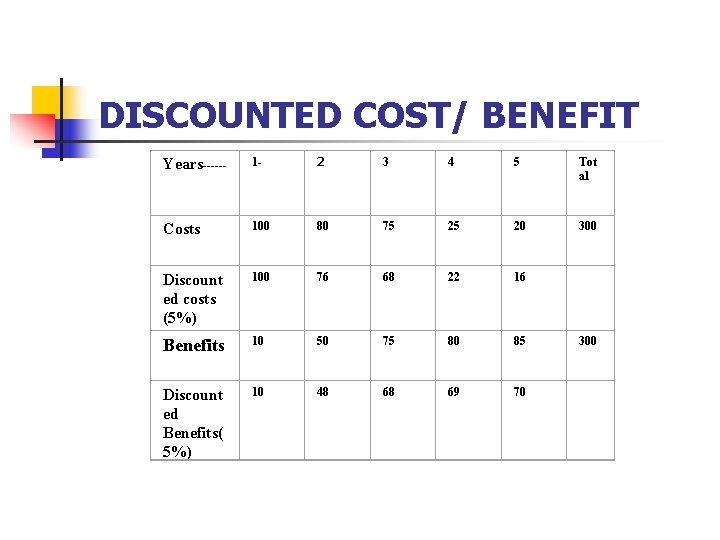
DISCOUNTED COST/ BENEFIT Years------ 1 - 2 3 4 5 Tot al Costs 100 80 75 25 20 300 Discount ed costs (5%) 100 76 68 22 16 Benefits 10 50 75 80 85 300 Discount ed Benefits( 5%) 10 48 68 69 70
Sensitivity Analysis…. n n Opinion differ about the value of year with impaired health relative to perfect health Medical experts are uncertain about the value of various preventive measure. Professional assessment are constantly updated with research Its difficult to predict future discount rate
Sensitivity Analysis…. n n In sensitivity analysis areas of uncertainty are varied and the effect on result is noted Uncertain factors are to be examined and their effect on decision rule are studied If final decision is not affected by making different assumptions about uncertain quantities-by choosing High and Low estimates, than intervention may be applied If the decision would drastically altered by different estimates, than we should be cautious for making the recommendations
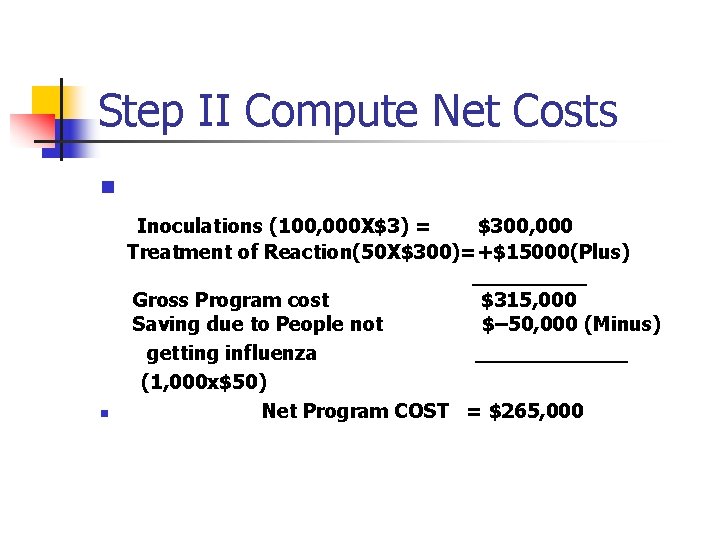
Step I Define the Program n n Hypothetical Influenza Inoculation Program Vaccinations would be administered to 100, 000 persons aged 65 years and older over next year in existing clinics and health centers
Step II Compute Net Costs n n Inoculations (100, 000 X$3) = $300, 000 Treatment of Reaction(50 X$300)=+$15000(Plus) _____ Gross Program cost $315, 000 Saving due to People not $– 50, 000 (Minus) getting influenza ______ (1, 000 x$50) Net Program COST = $265, 000
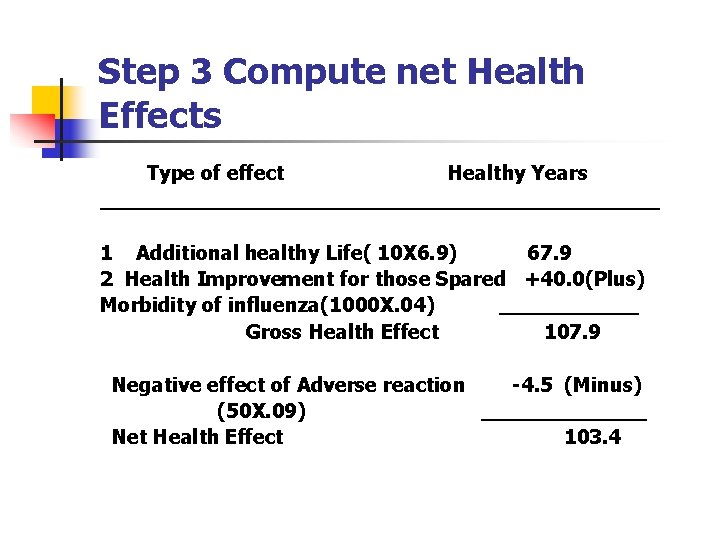
Step 3 Compute net Health Effects Type of effect Healthy Years ______________________ 1 Additional healthy Life( 10 X 6. 9) 67. 9 2 Health Improvement for those Spared +40. 0(Plus) Morbidity of influenza(1000 X. 04) ______ Gross Health Effect 107. 9 Negative effect of Adverse reaction -4. 5 (Minus) (50 X. 09) _______ Net Health Effect 103. 4
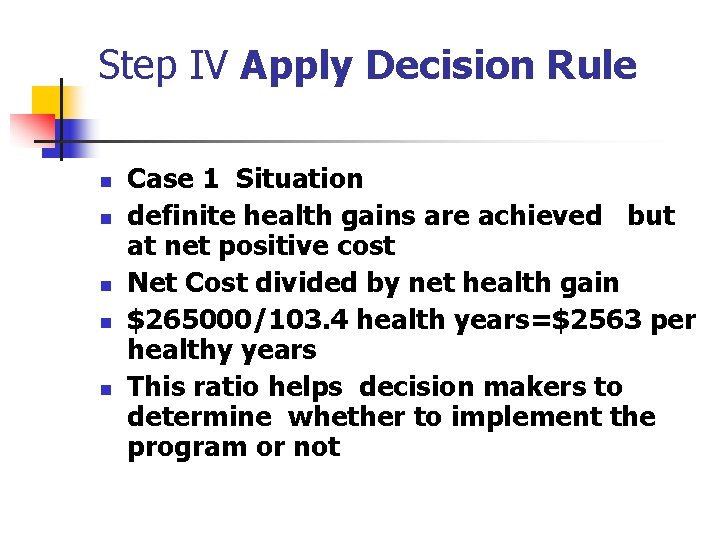
Step IV Apply Decision Rule n n n Case 1 Situation definite health gains are achieved but at net positive cost Net Cost divided by net health gain $265000/103. 4 health years=$2563 per healthy years This ratio helps decision makers to determine whether to implement the program or not
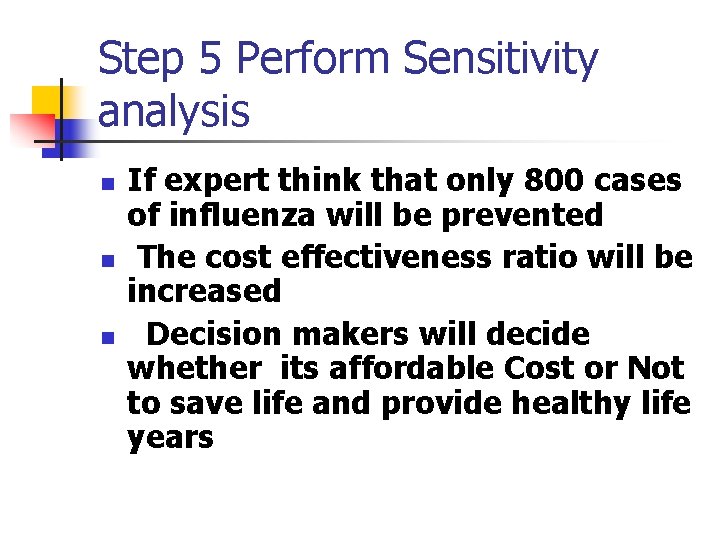
Step 5 Perform Sensitivity analysis n n n If expert think that only 800 cases of influenza will be prevented The cost effectiveness ratio will be increased Decision makers will decide whether its affordable Cost or Not to save life and provide healthy life years
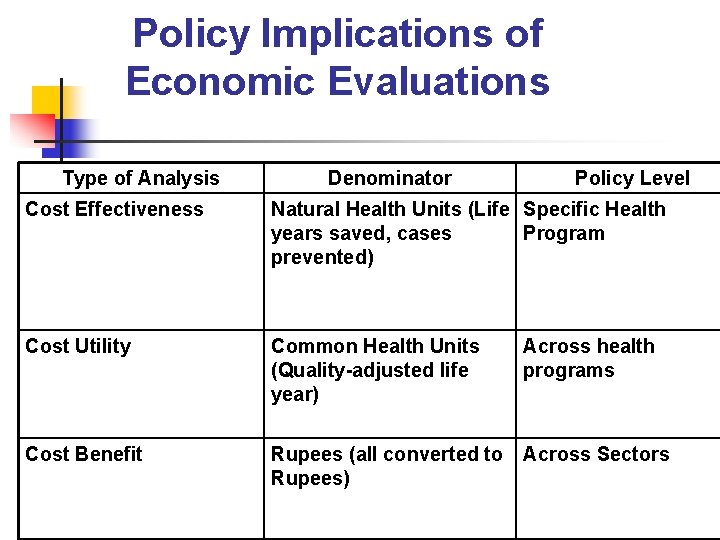
Policy Implications of Economic Evaluations Type of Analysis Denominator Policy Level Cost Effectiveness Natural Health Units (Life Specific Health years saved, cases Program prevented) Cost Utility Common Health Units (Quality-adjusted life year) Cost Benefit Rupees (all converted to Across Sectors Rupees) Across health programs
Preliminary List of Services Scoring 8 or Higher
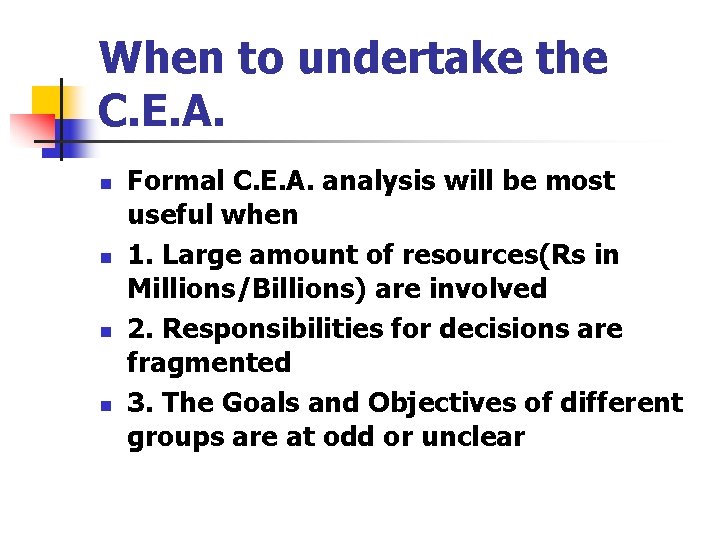
When to undertake the C. E. A. n n Formal C. E. A. analysis will be most useful when 1. Large amount of resources(Rs in Millions/Billions) are involved 2. Responsibilities for decisions are fragmented 3. The Goals and Objectives of different groups are at odd or unclear
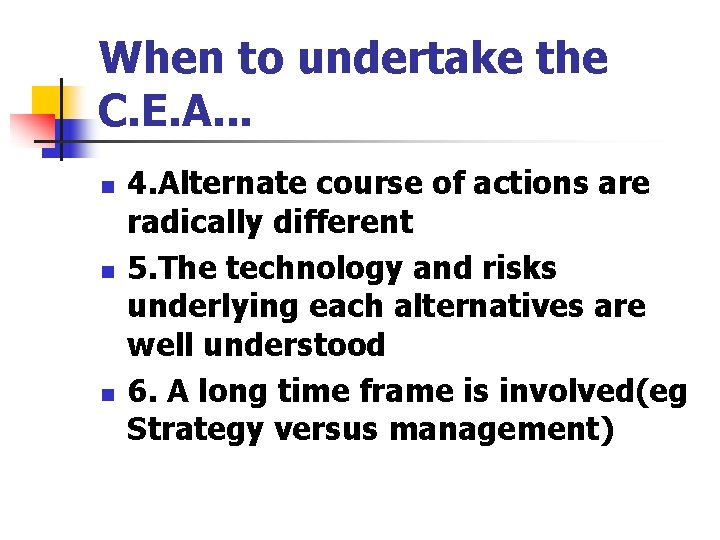
When to undertake the C. E. A. . . n n n 4. Alternate course of actions are radically different 5. The technology and risks underlying each alternatives are well understood 6. A long time frame is involved(eg Strategy versus management)
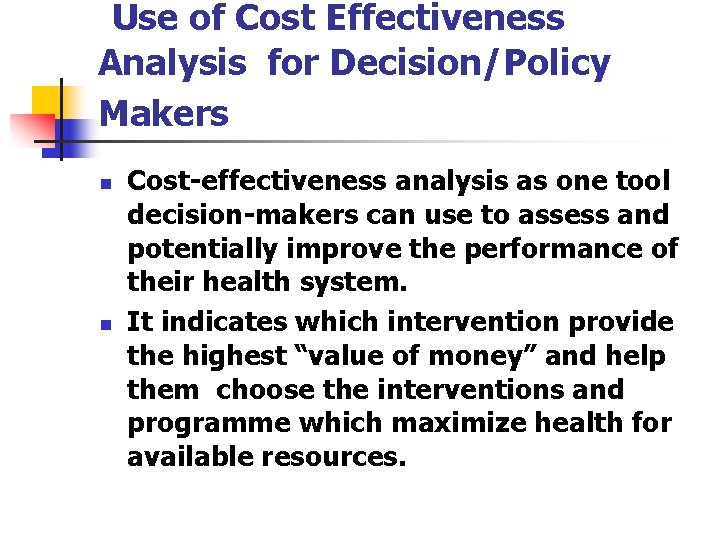
Use of Cost Effectiveness Analysis for Decision/Policy Makers n n Cost-effectiveness analysis as one tool decision-makers can use to assess and potentially improve the performance of their health system. It indicates which intervention provide the highest “value of money” and help them choose the interventions and programme which maximize health for available resources.
Challenges of CEA. n n Resource allocation decision affecting the entire health sector must take into account Priority of sick, reducing social inequalities in health or well being of future generation. Fails to identify existing misallocation of resources by focusing on evaluation of new technologies or strategies
Challenges of CEA. . n n n The result of many CEA studies are context- specific , they cannot be used in other population There are difficulties of generalizing context specific CEA studies Overall effectiveness of a given clinical intervention is often not known
References n n n Economics for Health Sector Analysis Concept and causes Mead Over The World Bank Washington D. C. Health Economics Fundamentals and Flow of funds Thomas E. Geten John Wiley & Sons (1997) Health Economics Theories, Insight Rexford E Sanrerre Revised Edition Dryden press Drden (2000) Development of WHO Guidelines on Generalized cost effectiveness analysis Christopher et. al Health Economics 9: 235 -251 (2000) Methods of Economic Evaluation of Health Care programme. Drummond. MF et. a Second Edition Oxford University Press(1997) Health interventions assessment WHO –CHOICE website
THANK YOU
Cost Utility Analysis n n n Life years saved are not homogenous Medical intervention is associated with significant number of life saved but a reduced quality of life. Another analysis “ Utility Analysis”has been frequently used in recent years.
Cost Utility Analysis n n Cost Utility analysis compares interventions(Procedure, test or method) using costs and health out come that is adjusted for quality of life as rated as assessed by the recipientthe patients ( For example Quality- Adjusted Life Years or QALYs. The ‘Common Currency’commonly used is QALYs,
Cost Utility…. . n A procedure with a 0. 5 Quality of life outcome(QOL) or Quality adjusted life year (QALY) costing Rs 4000 equals in C-U analysis as Rs 8000 with QOL result of 0. 25
Quality of Life adjustment Factors… It adjust number of life years gained by an index between 0. 00 (Death) and 1. 00 ( Good Health) n Respondents indicated that living for three months confined to hospital for tuberculosis treatment was worth only 1. 8 months ( 0. 60 x 3 months) n Some people consider some illness to be worse than death , such additional years lived in such misery may has negative value
Method to construct index for measuring utility n n First Method: Asks people who have same condition to assess the quality of their lives Second Method: Describes the condition to a group of people who do not have the condition and ask them to gauge the quality of life or utility
Cost Utility…. . n n Quality adjusted life years QALYs for each Health state and treatment was assessed by ‘Self Reported description’ Five dimensions are assessed Mobility, Self Care, Performance of usual activity, Pain/Discomfort, and Anxiety/Depression
Cost Utility… n n Each having three possible responses No problem/some difficulties/moderate problem/unable /Extreme problem Each combination has an associated utility value derived with a scale indexed between 0 ( dead) and 1 ( Full Health)
Cost utility analysis n The difficulty in using utility analysis lies in developing appropriate index for measuring the Utility
Economic Issues-Time Horizon n n Time frame should be long enough to capture all harms, benefits and costs regardless of when they occur, usually a lifetime Contrast with short term analyses which often capture many of the costs but fewer of the benefits
Economic Issues--Perspective Whose point of view -- patient, medical care system, employers, society
Examples of cost included in typical Cost effectiveness analysis based on perspective of analysis
Cost Benefit Analysis (CBA) measures both cost and benefits in monetary values. An intervention is commonly adopted if the monetary benefits exceed the cost, resulting in net benefit. n Important tool is the benefit -to-costs ratio Total Monetary cost of benefit or outcome divided by the total monetary cost of obtaining them n
Cost –minimization Analysis n n n The simplest from of economic evaluation where the procedure or programmer identified that cost the least. If there is no significant difference in the benefit of two interventions, the preferred intervention will be the one that is least costly If there is no significant difference in the cost of two interventions, the preferred intervention will be one that is most effective