
Special laws related to healthcare Dr Sanjay Gupte
- Slides: 89
Special laws related to healthcare Dr. Sanjay Gupte MD, DGO, FICOG, LLB, FRCOG President FOGSI 2010 Member Central Supervisory Board of PCPNDT Act Member Ethics Committee, Medical Council India Chairman Ethics Committee of Maharashtra Medical Council
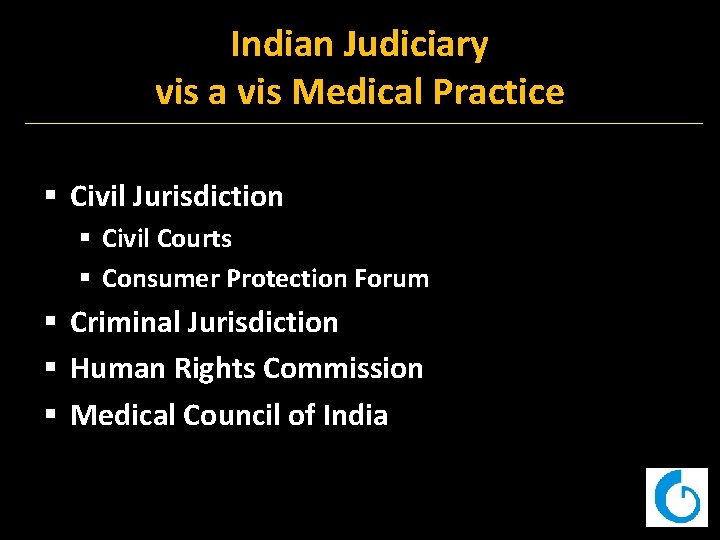
Indian Judiciary vis a vis Medical Practice § Civil Jurisdiction § Civil Courts § Consumer Protection Forum § Criminal Jurisdiction § Human Rights Commission § Medical Council of India
One More Jurisdiction The Mob Justice How to deal with it ?
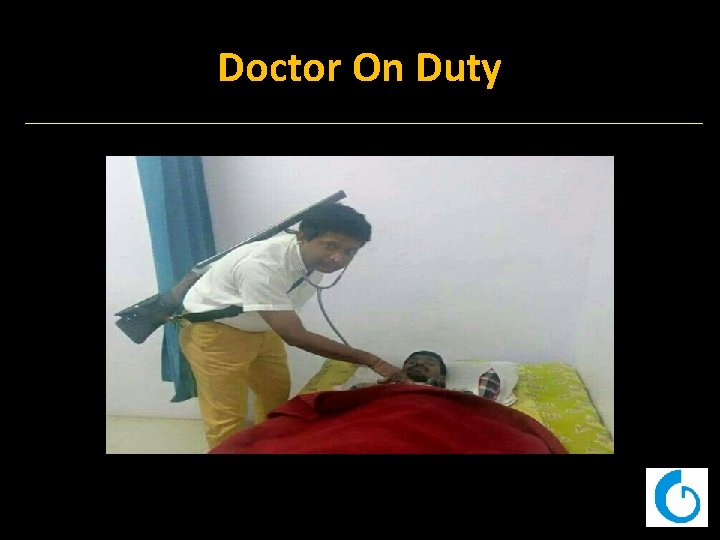
Doctor On Duty
Type of laws § Statutory laws § The laws enacted by the parliament. § Case laws § Decisions by the Supreme Court which become binding on all the lower courts.
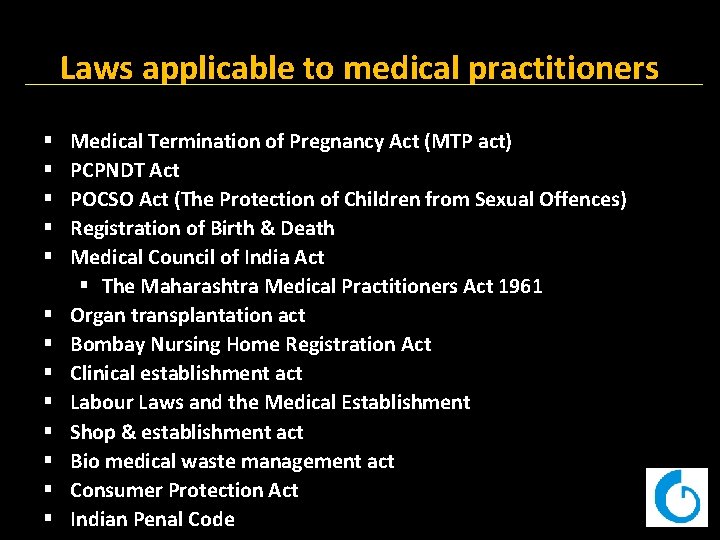
Laws applicable to medical practitioners § § § § Medical Termination of Pregnancy Act (MTP act) PCPNDT Act POCSO Act (The Protection of Children from Sexual Offences) Registration of Birth & Death Medical Council of India Act § The Maharashtra Medical Practitioners Act 1961 Organ transplantation act Bombay Nursing Home Registration Act Clinical establishment act Labour Laws and the Medical Establishment Shop & establishment act Bio medical waste management act Consumer Protection Act Indian Penal Code
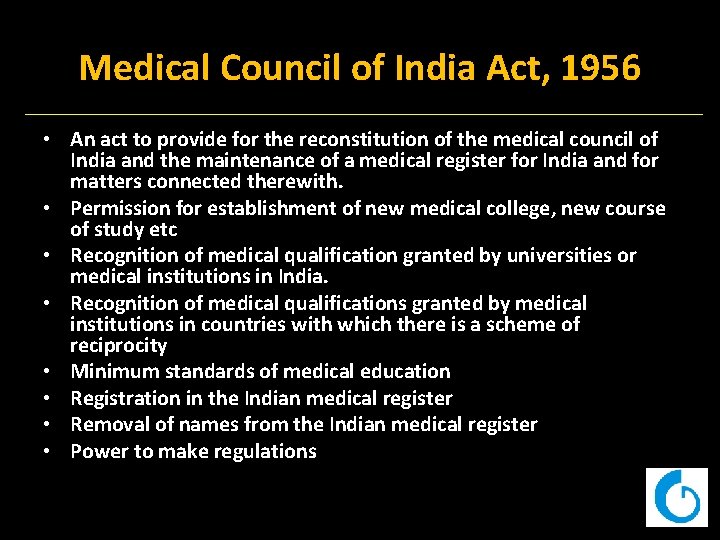
Medical Council of India Act, 1956 • An act to provide for the reconstitution of the medical council of India and the maintenance of a medical register for India and for matters connected therewith. • Permission for establishment of new medical college, new course of study etc • Recognition of medical qualification granted by universities or medical institutions in India. • Recognition of medical qualifications granted by medical institutions in countries with which there is a scheme of reciprocity • Minimum standards of medical education • Registration in the Indian medical register • Removal of names from the Indian medical register • Power to make regulations
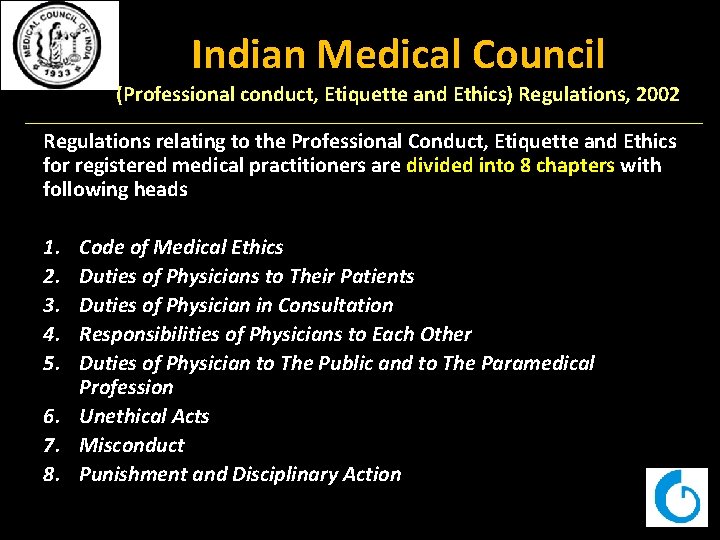
Indian Medical Council (Professional conduct, Etiquette and Ethics) Regulations, 2002 Regulations relating to the Professional Conduct, Etiquette and Ethics for registered medical practitioners are divided into 8 chapters with following heads 1. 2. 3. 4. 5. Code of Medical Ethics Duties of Physicians to Their Patients Duties of Physician in Consultation Responsibilities of Physicians to Each Other Duties of Physician to The Public and to The Paramedical Profession 6. Unethical Acts 7. Misconduct 8. Punishment and Disciplinary Action
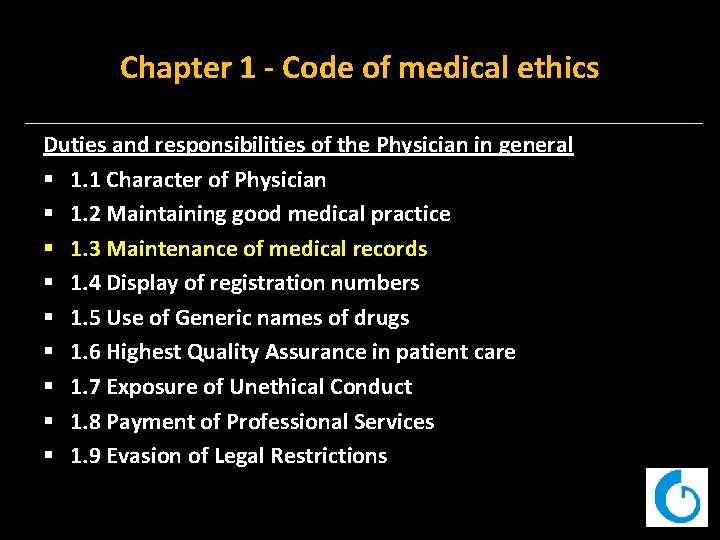
Chapter 1 Code of medical ethics Duties and responsibilities of the Physician in general § 1. 1 Character of Physician § 1. 2 Maintaining good medical practice § 1. 3 Maintenance of medical records § 1. 4 Display of registration numbers § 1. 5 Use of Generic names of drugs § 1. 6 Highest Quality Assurance in patient care § 1. 7 Exposure of Unethical Conduct § 1. 8 Payment of Professional Services § 1. 9 Evasion of Legal Restrictions
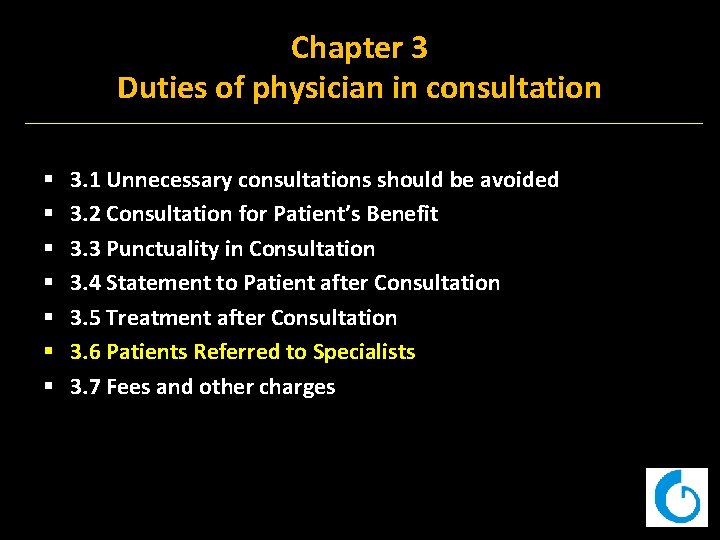
Chapter 3 Duties of physician in consultation § § § § 3. 1 Unnecessary consultations should be avoided 3. 2 Consultation for Patient’s Benefit 3. 3 Punctuality in Consultation 3. 4 Statement to Patient after Consultation 3. 5 Treatment after Consultation 3. 6 Patients Referred to Specialists 3. 7 Fees and other charges
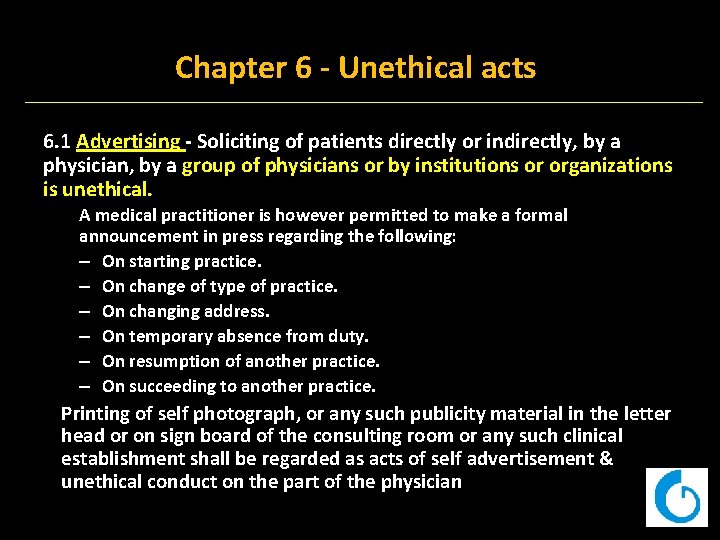
Chapter 6 Unethical acts 6. 1 Advertising Soliciting of patients directly or indirectly, by a physician, by a group of physicians or by institutions or organizations is unethical. A medical practitioner is however permitted to make a formal announcement in press regarding the following: – On starting practice. – On change of type of practice. – On changing address. – On temporary absence from duty. – On resumption of another practice. – On succeeding to another practice. Printing of self photograph, or any such publicity material in the letter head or on sign board of the consulting room or any such clinical establishment shall be regarded as acts of self advertisement & unethical conduct on the part of the physician
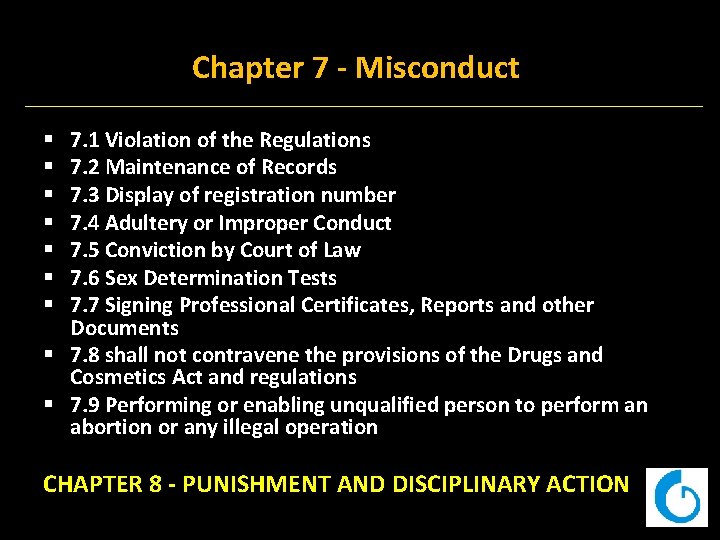
Chapter 7 Misconduct 7. 1 Violation of the Regulations 7. 2 Maintenance of Records 7. 3 Display of registration number 7. 4 Adultery or Improper Conduct 7. 5 Conviction by Court of Law 7. 6 Sex Determination Tests 7. 7 Signing Professional Certificates, Reports and other Documents § 7. 8 shall not contravene the provisions of the Drugs and Cosmetics Act and regulations § 7. 9 Performing or enabling unqualified person to perform an abortion or any illegal operation § § § § CHAPTER 8 PUNISHMENT AND DISCIPLINARY ACTION
Amendment notification 2009 Regulations 2015 § Gifts: A doctor shall not receive any gift from any pharmaceutical or allied health care industry and their sales people or representatives. § Travel facilities: A doctor shall not accept any travel facility inside the country or outside, from any pharmaceutical or allied healthcare industry or their representatives for self and family members for vacation or for attending conferences, etc as a delegate. § Hospitality: A doctor shall not accept individually any hospitality like hotel accommodation for self and family members under any pretext.
MTP ACT § To avoid the misuse of induced abortions, most countries have enacted laws whereby only qualified Gynecologists under conditions laid down and done in clinics/hospitals that have been approved can do abortions. § The Medical Termination of Pregnancy Act was enacted by the Indian Parliament in 1971 and came into force from 01 April, 1972. The MTP act was again revised in 1975 & in 2006
§ The reasons for which MTP is done, as interpreted from the Indian MTP Act, are: § Where a pregnant woman has a serious medical disease and continuation of pregnancy could endanger her life like: § Heart diseases, § Severe rise in blood pressure, etc. § Where the continuation of pregnancy could lead to substantial risk to the newborn leading to serious physical/mental handicaps eg. § Chromosomal abnormalities. § Rubella (German measles) viral infection to mother in first trimester
§ Pregnancy as a result of rape. § Failure of Contraceptive Device irrespective of the method used (natural methods/ barrier methods/ hormonal methods). This condition is a unique feature of the Indian Law. Most of the pregnancies can be terminated using this criterion. § Below 12 wks § 12 20 wks § Above 20 wks : 1 opinion : 2 gynecologists’ opinion : not allowed
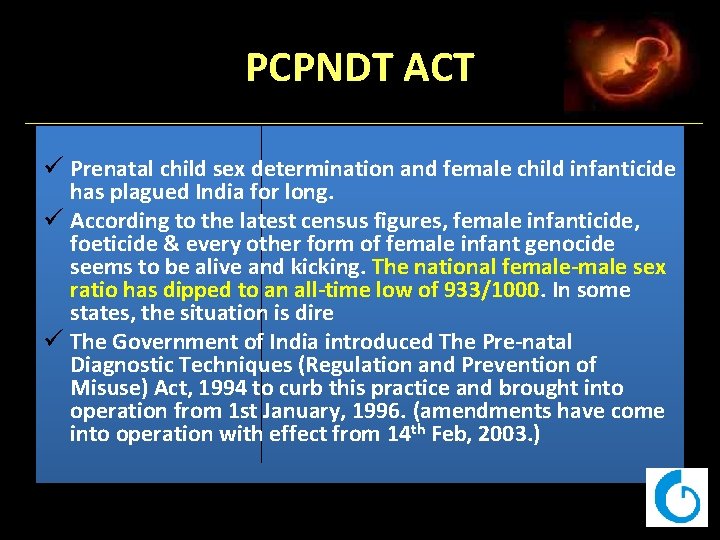
PCPNDT ACT ü Prenatal child sex determination and female child infanticide has plagued India for long. ü According to the latest census figures, female infanticide, foeticide & every other form of female infant genocide seems to be alive and kicking. The national female sex ratio has dipped to an all time low of 933/1000. In some states, the situation is dire ü The Government of India introduced The Pre natal Diagnostic Techniques (Regulation and Prevention of Misuse) Act, 1994 to curb this practice and brought into operation from 1 st January, 1996. (amendments have come into operation with effect from 14 th Feb, 2003. )
The Protection of Children from Sexual Offences (POCSO) Act, 2012 and The POCSO Rules, 2012
Purpose of the law Self contained comprehensive legislation to provide for: • Protection of children from offences of sexual assault, sexual harassment & pornography • Safeguarding the interests & well being of the child at each stage of the investigative & judicial process through Child friendly reporting procedures during – – Reporting – Investigation – Recording of evidence – Trial of offences • Establishing Special Courts for speedy trial of sexual offences against children
1. The Protection of Children from Sexual Offences Act, 2012…. . Notified in the Gazette of India on 20 th June, 2012. Salient Features: • Child defined as any person below the age of 18 years • Clear definition and description of Offences: ü Penetrative Sexual Assault ü Sexual Harassment ü Use of Child for Pornographic Purposes Cont…
Punishment for failure to report or record a case 21. (1) Any person, who fails to report the commission of an offence under sub section (1) of section 19 or section 20 or who fails to record such offence under sub section (2) of section 19 shall be punished with imprisonment of either description which may extend to six months or with fine or with both. • Below 18 yrs, even with consent; sexual relations are offense • Problem with MTP with < 18 yrs of age
The Transplantation of Human Organs Act § The transplantation of Human Organs Act came into force w. e. f. 4 2 1995 § Authority for removal of Human Organs in case of unclaimed bodies in Hospital or Prison
The Transplantation of Human Organs Act § Authority for removal of Human Organs from bodies sent for post mortem examination for medico legal or pathological purposes § Preservation of Human Organs § Restrictions on removal and transplantation of Human Organs § Punishment for removal of Human Organ without authority § The Gazette of India Extraordinary Part II Feb. 4 th 1995.
The Clinical Establishments (Registration and Regulation) Act 2010 and Rules 2012 (will replace Bombay Nursing Home Act) 1. An act to provide for the registration and regulation of clinical establishments in the country. 2. To prescribe minimum standards of facilities and services which may be provided by them. 3. Desired impact : improvement in public health.
Who is included ? A clinical establishment owned, controlled or managed by § The Government or a department of the Government; § A trust, whether public or private; § A corporation (including a society) registered under a Central, Provincial or State Act, whether or not owned by the Government; § A local authority; and § A single doctor
Prescribing the Conditions For registration and continuation, every clinical establishment shall fulfill the following conditions, namely : I. The minimum standards of facilities and services as may be prescribed; II. The minimum requirement of personnel as may be prescribed; III. Provisions for maintenance of records and reporting as may be prescribed; IV. Such other conditions as may be prescribed.
RULES § Copies of all records and statistics shall be kept with the clinical establishment concerned for at least 3 or 5 years. § shall comply with the Standard Treatment Guidelines and maintain electronic medical records of every patient as may be notified by the Central Government from time to time.
RULES § shall charge the rates for each type of procedure and service within the range of rates to be notified by the central government from time to time, for such procedures and services. § shall display the rates charged for each type of service provided and facilities available, for the benefit of the patients at a prominent place in the local dialect & as well as in English language.
Mandatory clause The clinical establishment shall undertake to provide within the staff and facilities available, such medical examination and treatment as may be required to stabilize the emergency medical condition of any individual who comes or is brought to such clinical establishment.
Labour laws & medical establishment The minimum wages act , 1948 The industrial employment act, 1946 The industrial dispute act, 1947 The workmen’s compensation act, 1923 The maternity benefit act, 1961 The payment gratuity act, 1972 The payment bonus act, 1965 The employees’ provident fund & miscellaneous provision act The employees’ state insurance act, 1948 The recognition of trade Unions & prevention of unfair labour practices act, 1971 § The Bombay labour welfare fund act, 1953 § § § § §
Shop & establishment act This act lays down & controls working conditions as well as relationship between employees & employers
Dr. Devendra M. Surti vs State of Gujarat • The appellant was a doctor having dispensary which is registered as a 'Commercial Establishment' under the provisions of the, Act. • The complainant Shri Pale visited the dispensary and found that though the dispensary was registered as 'Commercial Establishment‘ under the Act ; the register was not maintained as required. • Thereafter, a complaint was filed against the appellant after obtaining sanction for his prosecution. • After examining the provisions of the Shops and Establishments Act, 1948 it was concluded that “private dispensary of doctor is not commercial establishment”. • This was reconfirmed by Bombay high court in case Dr. (Smt. )Shubhada Motwani vs. The State of Maharashtra & Ors
THE MAHARASHTRA MEDICAL PRACTITIONERS ACT, 1961 • An Act to regulate the qualifications and to provide for the registration of practitioners of the Ayurvedic, Siddha and Unani Systems of Medicine, with it view to encourage the study and spread of such systems, and to make certain provisions relating to medical practitioners generally, in the State of Maharashtra; and for that purpose to consolidate and amend the law relating thereto. • The registered practitioners of the Indian Medicine and holding the qualifications mentioned in the PART A, A 1, B or D of the Schedule, shall have privilege to practice the modern scientific medicine known as allopathic medicine to the extent of the training they received in that system, along with the system of Indian Medicine for which they are registered
Biomedical waste management act § This is an act directing the disposal of bio medical waste in a proper manner § National pollution control board with various state boards to implement it
Indian Penal Code In certain situations criminal negligence may be alleged against the doctors & then Indian Penal Code may come into play Ø Sec 304 A: Whoever causes the death of any person by doing any rash or negligent act Ø Sec 312 to 316: Causing miscarriage, without woman’s consent Ø Sec 319 to 322: Voluntarily causing hurt or grievous hurt Ø Sec 340 to 342: Wrongful confinement
Ø Sec 419: Breach of contract to attend on & supply wants of helpless person Ø Sec 499: Defamation Ø Sec 202: Intentional omission to give information of offence by a person bound to inform Ø Sec 269: Negligent act likely to spread infection of disease dangerous to life
Consumer Protection Act § Revolutionary act § Applied to medical practitioners since 1991 § Made it comparatively easy for the patients to approach the courts against the doctors § Now more than 10, 000 cases are pending in front of various fora.
Land Mark Cases The Case Law
Dr. Laxman Balkrishna Joshi vs. Dr. Trimbak Bapu Godbole and another AIR 1969 SC 128 § A patient had suffered from fracture of the femur. § The accused doctor while putting the leg in plaster used manual traction § Used excessive force for this purpose, with the help of three men § This caused shock leading to the death of the boy. § On these facts the Supreme Court held that the doctor was liable to pay damages to the parents of the boy.
Legal principles laid down A person who holds himself out ready to give medical advice & treatment impliedly holds forth that he is possessed of skill & knowledge for the purpose. Such a person when consulted by a patient, owes certain duties, namely, a duty of care deciding whether to undertake the case, a duty of care in deciding what treatment to give, & a duty of care in the administration of the treatment. a breach of any these duties gives a right of action of negligence against him contd. .
The medical practitioner has discretion in choosing the treatment & such discretion is wider in case of emergency, but he must exercise a reasonable degree of care according to the circumstances of each case
Indian Medical Association vs. V. P. Shanta 1995(6) SCC 651 This landmark judgment decided that service rendered by medical professional comes under section 2(1)(0) of the act & hence the consumer protection act was applied to the medical practitioners It defined conditions such as – Who is a consumer ? – What is negligence ?
– What is deficiency in service ? – what are the main conditions under which medical practitioners can be held responsible, like Removal of the wrong limb; Performance of an operation on the wrong patient; Giving injection of a drug to which the patient is allergic without looking into the out patient card containing the warning; § Use of wrong gas during the course of an anesthetic, etc. Interestingly this decision also directed that complex medical situations should be sent to the civil courts ! § §
Poonam Verma vs. Ashwin Patel & Ors. (1996) 4 SCC 332 § The professional may be held liable for negligence on the ground that he was not possessed of the requisite skill which he professes to have. § Thus a doctor who has a qualification in Ayurvedic or Homeopathic medicine will be liable if he prescribes Allopathic treatment which causes any harm. Defined negligence “per se”
Sarwat Ali Khan vs. Prof. R. Gogi and others Original Petition No. 181 of 1997, decided on 18. 7. 2007 by the National Consumer Commission § 52 cataract operations performed between 26 th and 28 th September, 1995 in an eye hospital 14 persons lost their vision in the operated eye. § An enquiry revealed that in the Operation Theatre two autoclaves were not working properly. § This equipment is absolutely necessary to carry out sterilization of instruments, cotton, pads, linen, etc. , and the damage occurred because of its absence in working condition. The doctors were held liable.
Dr. Sr. Louie and Anr. vs. Smt. Kannolil Pathumma & Anr. § The National Consumer Commission held that Dr. Louie showed herself as an M. D. although she was only M. D. Freiburg, a German Degree which is equivalent to an M. B. B. S. degree in India. § She was guilty of negligence in treating a woman and her baby who died. § There was vacuum slip, and the baby was delivered in an asphyxiated condition (misrepresentation of skills) • Medical council has now made it compulsory to mention equivalence on the certificate
Pt. Parmanand Katara vs. Union of India & Others AIR 1989 SC 2039 § The petitioner referred to a report published in the newspaper “The Hindustan Times” in which it was mentioned that a scooterist was knocked down by a speeding car. § Seeing the profusely bleeding scooterist, a person who was on the road, picked up the injured and took him to the nearest hospital. § The doctors refused to attend and told the man that he should take the patient to another hospital located 20 kilometers away authorized to handle medico legal cases. § The injured was then taken to that hospital but by the time he could reach, the victim succumbed to his injuries. (Emergency medical care, a must ! )
Landmark judgment on good Samaritan procedures • March 30, 2016 SAVE LIFE FOUNDATION & ANR VS. ARUN MISHRA, J. in this judgment Supreme Court has given following landmark judgment • The guideline – A bystander or good Samaritan, including an eyewitness of a road accident, should be allowed to leave the hospital immediately after he/she takes an injured accident victim there – Except in case of an eyewitness, who has to furnish an address, no question shall be asked to such bystander or good Samaritan
• For police / emergency services – A person making a phone call to inform the police or emergency services about an injured victim lying on the road shall not be compelled to reveal name and personal details • For courts – In case a person, who has voluntarily stated that he/she is also an eyewitness to the accident and is required to be examined for the purpose of investigation or during trial, such person shall be examined on a single occasion.
• For hospitals – All registered public and private hospitals are not to detain bystander or good Samaritan or demand payment for registration and admission costs. – The injured has to be treated immediately as mandated by the Supreme Court in 1989 ruling – Lack of response by a doctor in an emergency situation pertaining to road accidents, shall constitute “professional misconduct”
Spring Medows Hospital & Another vs. Harjol Ahluwalia thr’ K. S. Ahluwalia & Another (1998) CPJ 1 § A minor child was admitted by his parents to a nursing home as he was suffering fever. § The doctor diagnosed typhoid and gave medicines for typhoid fever. § A nurse asked the father of the patient to get an injection of chloramphenicol in stead of chloromycetin which was administered by the nurse to the patient who immediately collapsed. § The doctor was examined and testified that the child suffered a cardiac arrest on account of the wronge medicine which led to brain damage.
§ The National Commission held the doctor negligent in performing his duty because instead of administering the injection himself he permitted the nurse to give the injection. § There was clear dereliction of duty on the part of the nurse who was not even a qualified nurse and was not registered with any nursing council of any State. § Both the doctor and nurse and the hospital were found liable and Rs. 12. 5 lakhs was awarded as compensation to the parents. (Liability of hospital & the employees)
Sethuraman Subramaniam Iyer vs. Triveni Nursing Home and Another (1998) CPJ 110 § The complainant’s wife suffered from Sinusitis and was advised surgery by the doctor. § She had suffered cardiac arrest while in the operation theatre. The State Commission found that necessary precautions and effective measures were taken to save the deceased and dismissed the complaint. § The State Commission relied on the affidavits of four doctors who opined that there was no negligence. The complainant had not given any expert evidence to support his allegation (Bad outcome doesn’t mean negligence !)
State of Punjab v/s Shiv Ram (2005) Dec CPJ Sterilization failure: Operating surgeon or employer not liable. Torts: Medical Negligence : Damages: Birth of child after sterilization operation: Merely because woman having undergone sterilization operation became pregnant and delivered child, operating surgeon or his employer cannot be held liable for compensation on account of unwanted pregnancy contd. .
Contd. . In spite of having undergone sterilization operation, if couple opts for bearing child, it ceases to be unwanted child Compensation for maintenance and for upbringing of such child cannot be claimed
CONSENT FOR SURGERY • Supreme Court of India has come out with very important judgment in case of Samira Kohli V/s Dr. Manchanda, Case No. CA 1949 of 1004 decided on 16 th January 2008. Appellant went to respondent’s clinic with her mother. On admission, the appellant’s signatures were taken on consent form for diagnostic and operative laparoscopy on 10. 5. 1995 – appellant was put under GA and subjected to a laparoscopic examination. When the appellant was still unconscious, assistant doctor came out of the Operation Theatre and took the consent of appellant’s mother, who was waiting outside, for performing hysterectomy. Thereafter, the Respondent performed a abdominal hysterectomy and bilateral salpingo oopherectomy.
• Hon. Supreme court has summarized the principles relating to consent as , – A doctor has to seek and secure the consent of the patient before commencing a treatment. The consent so obtained should be real and valid, which means that; the patient should have the capacity and competence to consent; his consent should be voluntary; and his consent should be on the basis of adequate information concerning the nature of the treatment procedure, so that he knows what is consenting to. – The adequate information to be furnished by the doctor (or a member of his team) who treats the patient, should enable the patient to make a balanced judgment as to whether he should submit himself to the particular treatment or not. This means that the doctor should disclose • Nature and procedure of the treatment and its purpose, benefits and effect • Alternatives if any available • An outline of the substantial risks; and • Adverse consequences of refusing treatment.
But there is no need to explain remote or theoretical risks involved, which may frighten or confuse a patient and result in refusal of consent for the necessary treatment. (“Real consent v/s informed consent”)
– Consent given only for a diagnostic procedure, can not be considered as consent for therapeutic treatment. Consent given for a specific treatment procedure will not be valid for conducting some other treatment procedure. The fact that the unauthorized additional surgery is beneficial to the patient, or that it would save considerable time and expense to the patient, or would relieve the patient from pain and suffering in future, are not grounds of defense The only exception to this rule is where the additional procedure though unauthorized, is necessary in order to save the life. – There can be common consent for diagnostic and operative procedures where they are contemplated. There can also be a common consent for a particular surgical procedure and an additional or further procedure that may become necessary during the course of surgery.
2005 AIR SCW 3685 (From: Punjab and. Haryana) R. C. Lahoti, C. J. I. , C. K. Mathur and P. K. Balasubramanyan, JJ Criminal Appeal Nos. 144 145 of 2004 D/5 8 2005. Appellant: Jacob Mathew Vs Respondents: State of Punjab and others Guidelines for prosecuting medical professionals: The cases of doctors (surgeons and Physicians) being subjected to criminal prosecution are on an increase.
Contd. . Sometimes, such prosecutions are filed by private complainants and sometimes by police on an FIR being lodged and cognizance taken. The investigating officer and the private complainant cannot always be supposed to have knowledge of medical science so as to determine whether the act of the accused medical professional amounts to rash or negligent act within the domain of criminal law under section 304 A of IPC.
Contd. . The investigating officer should, before proceeding against the doctor accused of rash or negligent act or omission, obtain an independent and competent medical opinion preferably from a doctor in government service qualified in that branch of medical practice who is expected to give an impartial and unbiased opinion. • A doctor accused of rashness or negligence, may not be arrested in a routine manner (simply because a charge has been leveled against him).
Mohammad Ishfaq v/s Martin D'Souza, Nanavati Hospital. Feb 17 , 2009 In this case Mr. Ishfaq suffered hearing loss due to Amikacin Inj. & National Forum in 2002 awarded compensation of 7 lacs by the doctor. The Supreme Court over ruled the judgment commenting that extra ordinary situations require extra ordinary remedies, & here doctor has to choose between devil & the deep sea.
In this case Justice MARKANDEY KATJU & Justice G. S. SINGHVI ruled that The courts and Consumer Fora are not experts in medical science, and must not substitute their own views over that of specialists.
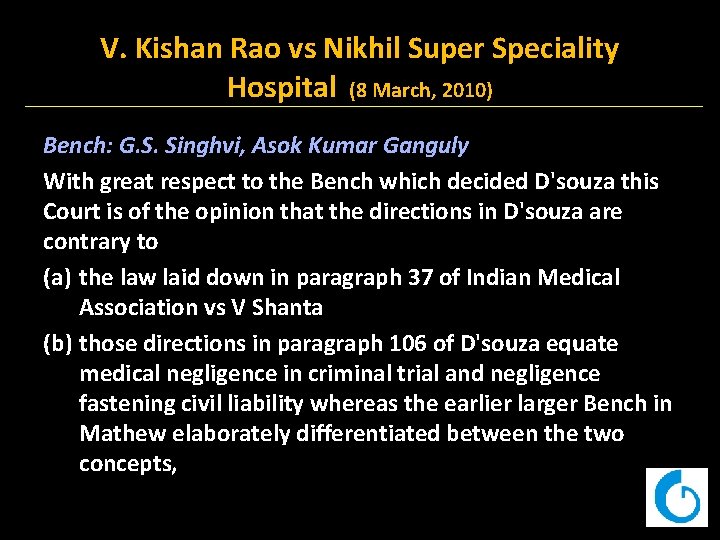
V. Kishan Rao vs Nikhil Super Speciality Hospital (8 March, 2010) Bench: G. S. Singhvi, Asok Kumar Ganguly With great respect to the Bench which decided D'souza this Court is of the opinion that the directions in D'souza are contrary to (a) the law laid down in paragraph 37 of Indian Medical Association vs V Shanta (b) those directions in paragraph 106 of D'souza equate medical negligence in criminal trial and negligence fastening civil liability whereas the earlier larger Bench in Mathew elaborately differentiated between the two concepts,
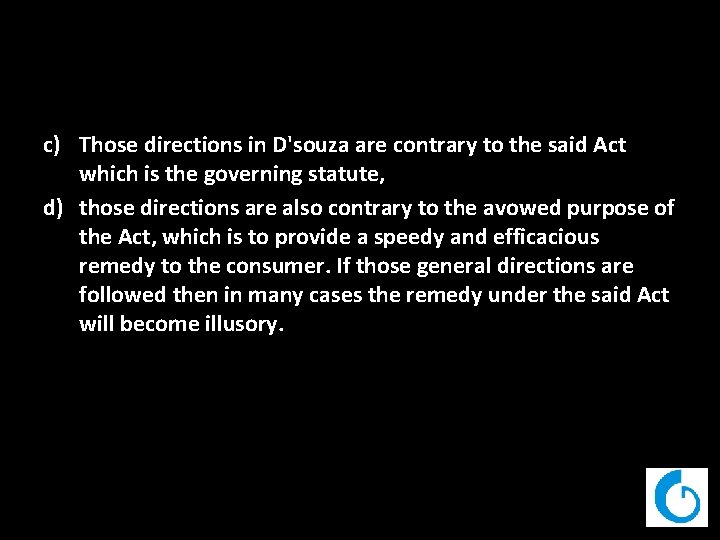
c) Those directions in D'souza are contrary to the said Act which is the governing statute, d) those directions are also contrary to the avowed purpose of the Act, which is to provide a speedy and efficacious remedy to the consumer. If those general directions are followed then in many cases the remedy under the said Act will become illusory.
A. Srimannarayana vs Dasari Santakumari & Anr 9 January, 2013 Bench: Surinder Singh Nijjar, Anil R. Dave
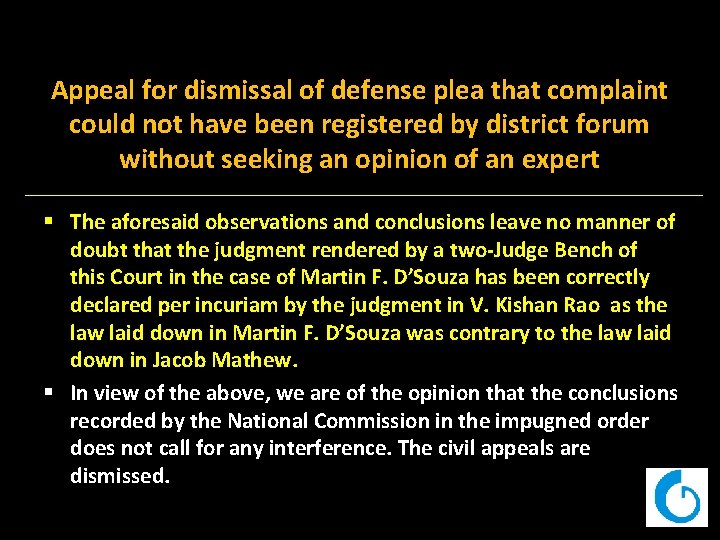
Appeal for dismissal of defense plea that complaint could not have been registered by district forum without seeking an opinion of an expert § The aforesaid observations and conclusions leave no manner of doubt that the judgment rendered by a two Judge Bench of this Court in the case of Martin F. D’Souza has been correctly declared per incuriam by the judgment in V. Kishan Rao as the law laid down in Martin F. D’Souza was contrary to the law laid down in Jacob Mathew. § In view of the above, we are of the opinion that the conclusions recorded by the National Commission in the impugned order does not call for any interference. The civil appeals are dismissed.
ANAESTHESIA COMPLAINT Karam Veer Singh v. Garg Nursing Home (2007) July CPJ Coma due to overdose of anaesthesia – Complainant’s child admitted by O. P. for operation – When child brought out, since then he is in coma – Complaint for compensation – Perusal of records shows that no tests done before operation
Surgeries cannot be performed in casual manner without any pre operative assessment – Total lack of care on part of O. P. – In case of no emergency, surgery should have been deferred to avoid risk – Instead of standard dose, test dose of anaesthesia should have been administered – Deficiency proved –Complaint allowed – Compensation awarded.
Rashmi Vora v. Arunaben D. Kothari (2005) Dec CPJ § Medical Negligence: Anesthetist negligent: Proper monitoring and recording of B. P. , ECG and heart beat, not done. B. P. high at Surgery time: Doctor performing surgery jointly liable. § Surgery done negligently – Anaesthesia administered at about 9 a. m. , patient died at 9. 40 a. m. due to cardiac arrest – Contradictory statements regarding cardiac arrest produced on record Contd. .
Contd. Proper monitoring and recording of B. P. , ECG and heart beat which was of great significance, not done – Anaesthetist completely negligent proved – Blood pressure of patient was high at time of surgery – This was not life saving or emergency surgery – It could have been delayed in order to ensure that B. P. is normal at time of surgery – Doctor performing surgery jointly liable – Quantum of compensation upheld in appeal.
Sushma Sharma v. Bombay Hospital (2007) June CPJ Consultants could give orders – Actual administration and supervision is responsibility of concerned parent unit of hospital – Consultant not be responsible for negligence.
DOCTOR’S PRESENCE Naseem Mohammed Bashir Ansari v. Dhange Hospital (2007) June CPJ • Doctor not present at delivery time Patient died Due care taken Died due to cardio respiratory failure No negligence proved – No relief entitled. • Allegation not proved – Patient did not stay in hospital despite medical advice Came all of a sudden with advanced labour pains – Concerned doctor is not supposed to be present all the time – Due care was taken – Patient died due to cardio – respiratory failure, due to haemorrhage and shock – Medical negligence not proved – No expert opinion produced in support – No relief entitled. • B. N. Chakravarty case
LOCUM ARRANGEMENT Nabhan Farhan Sah v. Latha Sharma (Dr. ) (2007) June CPJ Doctor went out of station in between 28/10 and 31. 10. 1999 Contention of O. P. , baby kept under care and supervision of other senior doctors in field – Merely going out of station is no ground to hold negligence or deficiency on part of O. P.
Shri Manishbhai Vs Sheth P T Surat Gen Hospital National Consumer Disputes Redressal Commission • Father of the complainant was admitted in Sheth P. T Surat General Hospital on 19. 11. 2012 He expired at about 2. 30 AM on 21. 11. 2012 while on ventilator. • The complainant submitted that doctor had left for outstation when the deceased was still admitted in the hospital and was under his treatment, without giving the instructions to the other doctor on duty. • It was decided that doctor could not have been expected to remain with the patient or in the hospital 24 hrs of the day. Like other normal human being he also needs to take rest and his meals and then get ready for the duty to be performed on the next day. Therefore, there was no negligence on the part of doctor in leaving the hospital and the patient being treated by other doctor in his absence
MISTAKEN DIAGNOSIS Bhagwati Devi v. S. M. G. Sonography Centre (2007) June CPJ Mistaken diagnosis – No damage causes – Nominal compensation awarded. Consumer Protection Act, 1986 – Section 15 – Medical Negligence – Giving wrong pathology report Mistaken diagnosis – Sonography test conducted by O. P. – Tumour / fibroid allegedly found in uterus of complainant – She got admitted in hospital, test again got conducted elsewhere Uterus found normal –
Contd… Incharge of O. P. centre not possessed of requisite skill and knowledge for purpose for which he was doing job – No damage been caused to complainant, because of alleged report – Further, mistaken diagnosis not necessarily negligent one – O. P. liable to pay nominal amount of compensation – Rs. 5, 000 awarded.
Rajesh Kumar Tiwari (Dr. ) v. Ramswaroop Rathore (2007) July CPJ Death due to administration of injection – Res ispa loquitur applicable – Treatment by O. P. , as Ayurvedic doctor – Not qualified for allopathic treatment – Negligence proved.
Achutrao Haribhau Khodwa vs State Of Maharashtra And Ors 20 February, 1996 • Negligence proved by finding of mop in the abdomen after tubectomy • 36 thousand compensation
M/S. Spring Meadows Hospital & Anr vs Harjol Ahluwalia Through, K. S. 25 March, 1998 • Negligence in giving Inj Lariago I/V by the nurse & a resident doctor. • Compensation of 12. 5 lakh + 5 lakh by national forum
Nizam'S Institute Of Medical. . . vs Prasanth S. Dhananka & Ors on 14 May, 2009 • Decision on cross specialty practice. • Cardiothoracic surgeon operating on neurological problem and not involving a neurosurgeon • In 1990, 20 yr old Prasant, a student of engineering, was operated upon at the Nizam Institute of Medical Sciences, Hyderabad. Due to medical negligence, Prasant was completely paralyzed. • The learned counsel for the respondent has, further, submitted that the proper method for determining compensation would be the multiplier method. We find absolutely no merit in this plea. The kind of damage that the complainant has suffered, the expenditure that he has incurred and is likely to incur in the future and the possibility that his rise in his chosen field would now be restricted, are matters which cannot be taken care of under the multiplier method.
Balram Prasad vs Kunal Saha & Ors 24 October, 2013 (Civil Case) • Dermatological problem – Medrol given in high dose – patient expired • Compensation asked for 77, 76, 73, 500/ (77 crores )with interest for the alleged deficiency in the service • The Civil Appeal No. 2866/2012 filed by the claimant Dr. Kunal Saha is also partly allowed. • Enhanced the compensation from Rs. 1, 34, 66, 000/ to Rs. 6, 08, 00, 550/ with 6% interest per annum from the date of the complaint to the date of the payment to the claimant.
V. Krishnakumar vs State of Tamil Nadu 1 July, 2015 • Delivery of premature baby (1996), wt 1250 gm at birth at Egmore, Chennai Govt hospital • Baby had blindness (ROP) due to 100% oxygen • Baby not screened between 2 4 weeks as was mandatory • At the outset, it may be noted that in such cases, this court has ruled out the computation of compensation according to the multiplier method. • The court rightly warned against the straightjacket approach of using the multiplier method for calculating damages in medical negligence cases. Quantification of Compensation
Restitutio in integrum • The principle of awarding compensation that can be safely relied on is restitutio in integrum. • The said principle provides that a person entitled to damages should, as nearly as possible, get that sum of money which would put him in the same position as he would have been if he had not sustained the wrong. (See Livingstone • Compensation of Rs. 1, 38, 000/
Dr. Mrs. Indu Verma v. Indraprastha Apollo Hospital 2009, Precious pregnancy for the doctor patient, Delay in performing LSCS by 27 hours and Excessive use of Syntocinon, the female baby developed CP.
• In this regard, the complainant sought opinion of doctors in USA and from her brother, who is a pediatric surgeon, in USA. The severally mentally retarded for as long as she lives. • The Disability Board of AIIMS, New Delhi certified opinion was that severe atrophy of baby’s brain cortex due to birth asphyxia and the child might remain the baby as ‘ 95% disability’. • Nishtha survived for 12 yrs with disabilities and with mental retardation. Unfortunately, baby Nistha died on 15. 1. 2012 • Total Compensation Rs. 1 Cr. , the hospital will pay 80 Lakh and the doctor 20 Lakh
The Supreme Court stand as off today No Strait-jacket formula No multiplier method Now the principle of restitutio in integrum
Conclusion • When we look at this fascinating spectrum of development of Indian Medical Law scenario one must say that in last 20 yrs it has now substantially matured. • The judiciary is trying its best to produce a balance between the patients & doctors interests. • However lately the high compensations allowed by the courts have become a major concern. • Now is the time when medical organizations should also come forward to engage the judiciary regarding this issue.