Goal Keeper Exploring Interaction Lockout Mechanisms for Regulating

- Slides: 34
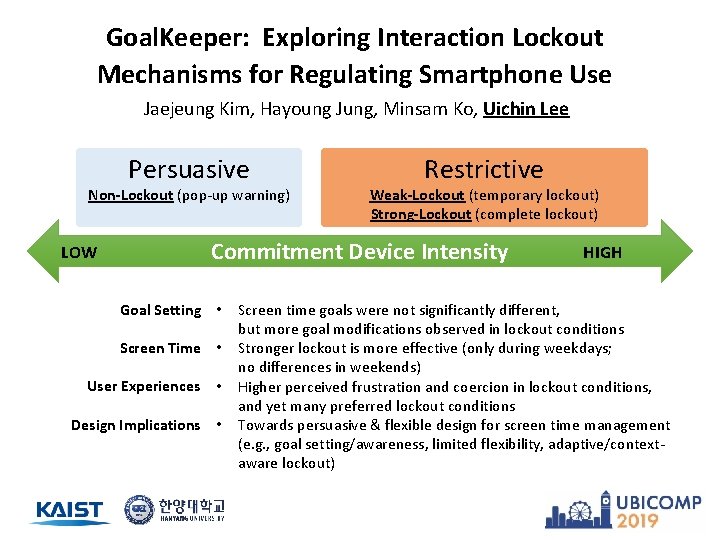
Goal. Keeper: Exploring Interaction Lockout Mechanisms for Regulating Smartphone Use Jaejeung Kim, Hayoung Jung, Minsam Ko, Uichin Lee
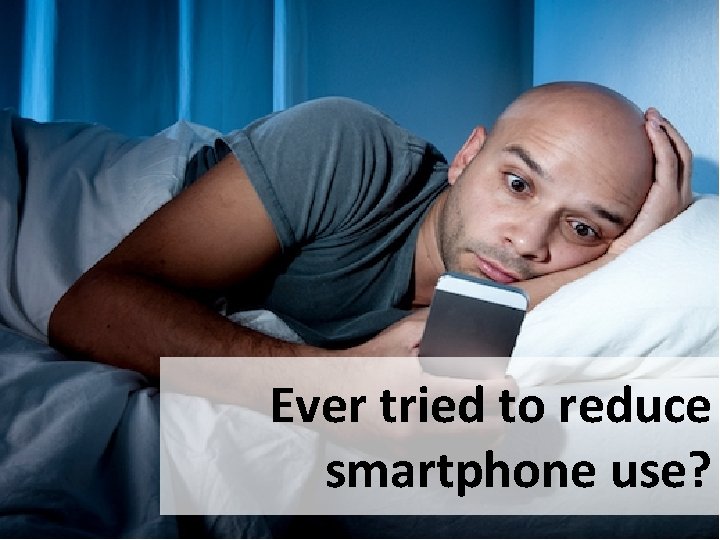
Ever tried to reduce smartphone use? 2
We often fail. 3
We often fail. But why? 4
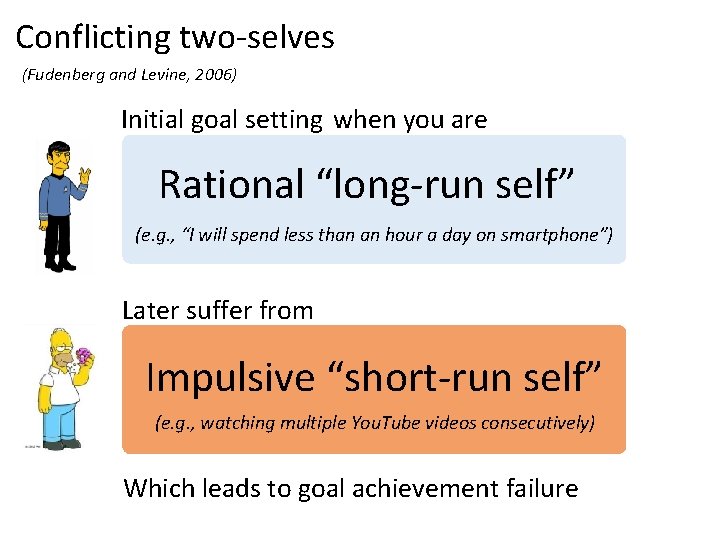
Conflicting two-selves (Fudenberg and Levine, 2006) Initial goal setting when you are Rational “long-run self” (e. g. , “I will spend less than an hour a day on smartphone”) Later suffer from Impulsive “short-run self” (e. g. , watching multiple You. Tube videos consecutively) Which leads to goal achievement failure
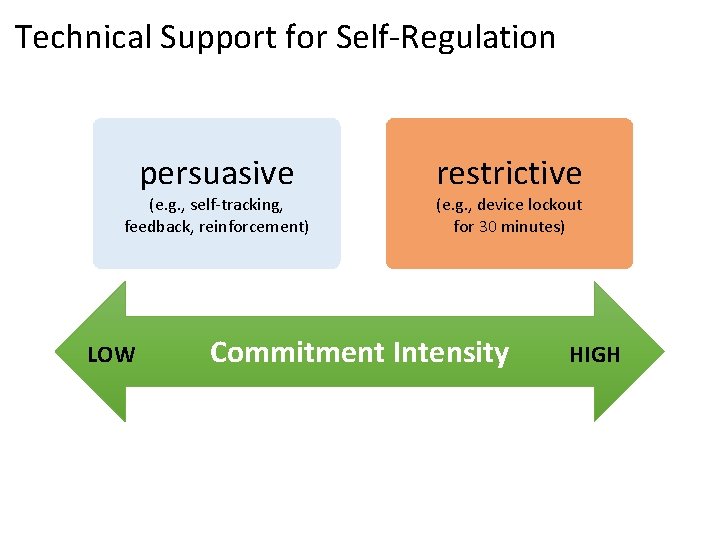
Technical Support for Self-Regulation persuasive (e. g. , self-tracking, feedback, reinforcement) LOW restrictive (e. g. , device lockout for 30 minutes) Commitment Intensity HIGH
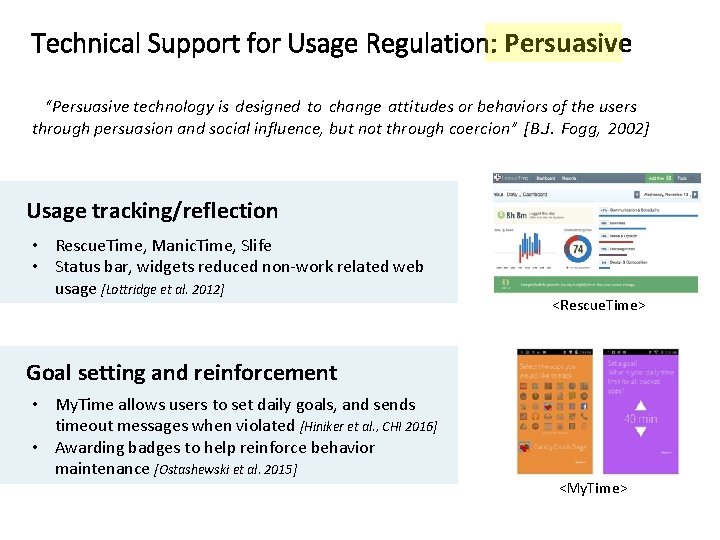
Technical Support for Usage Regulation: Persuasive “Persuasive technology is designed to change attitudes or behaviors of the users through persuasion and social influence, but not through coercion” [B. J. Fogg, 2002] Usage tracking/reflection • Rescue. Time, Manic. Time, Slife • Status bar, widgets reduced non-work related web usage [Lottridge et al. 2012] <Rescue. Time> Goal setting and reinforcement • My. Time allows users to set daily goals, and sends timeout messages when violated [Hiniker et al. , CHI 2016] • Awarding badges to help reinforce behavior maintenance [Ostashewski et al. 2015] <My. Time>
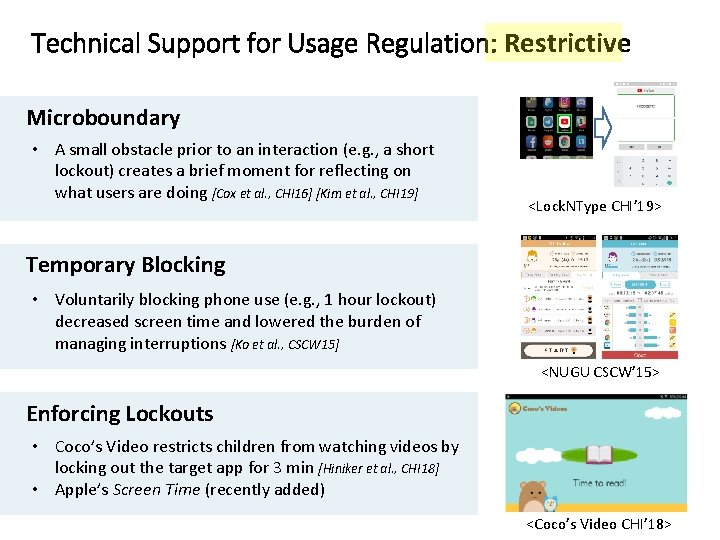
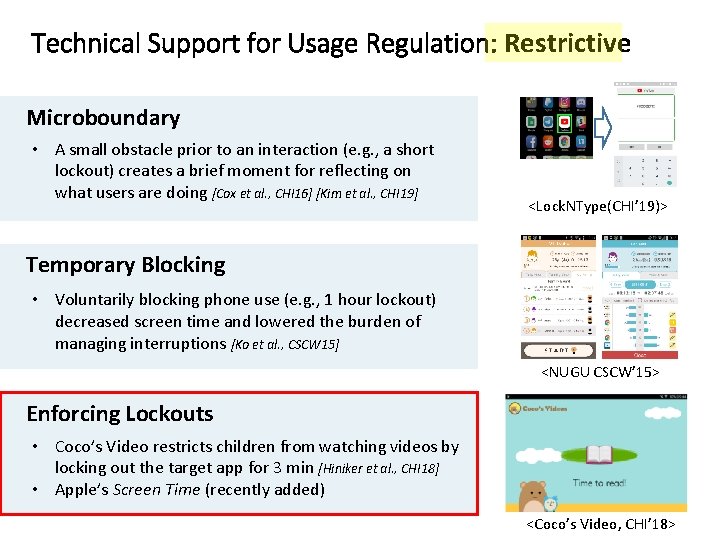
Technical Support for Usage Regulation: Restrictive Microboundary • A small obstacle prior to an interaction (e. g. , a short lockout) creates a brief moment for reflecting on what users are doing [Cox et al. , CHI 16] [Kim et al. , CHI 19] <Lock. NType CHI’ 19> Temporary Blocking • Voluntarily blocking phone use (e. g. , 1 hour lockout) decreased screen time and lowered the burden of managing interruptions [Ko et al. , CSCW 15] <NUGU CSCW’ 15> Enforcing Lockouts • Coco’s Video restricts children from watching videos by locking out the target app for 3 min [Hiniker et al. , CHI 18] • Apple’s Screen Time (recently added) <Coco’s Video CHI’ 18>
Technical Support for Usage Regulation: Restrictive Microboundary • A small obstacle prior to an interaction (e. g. , a short lockout) creates a brief moment for reflecting on what users are doing [Cox et al. , CHI 16] [Kim et al. , CHI 19] <Lock. NType(CHI’ 19)> Temporary Blocking • Voluntarily blocking phone use (e. g. , 1 hour lockout) decreased screen time and lowered the burden of managing interruptions [Ko et al. , CSCW 15] <NUGU CSCW’ 15> Enforcing Lockouts • Coco’s Video restricts children from watching videos by locking out the target app for 3 min [Hiniker et al. , CHI 18] • Apple’s Screen Time (recently added) <Coco’s Video, CHI’ 18>
Key Concept of Restrictive Approaches Commitment Device "voluntarily imposed restriction as an attempt to increase the likelihood of achieving goals” [Rogers et al. , 2014]
Key Concept of Restrictive Approaches Commitment Device "voluntarily imposed restrictions as an attempt to increase the likelihood of achieving goals” [Rogers et al. , 2014] Device lockout as a commitment device for better self-regulating smartphone use
Research Goal Comparatively understand how different commitment intensities of device lockout influence goal setting and screen time
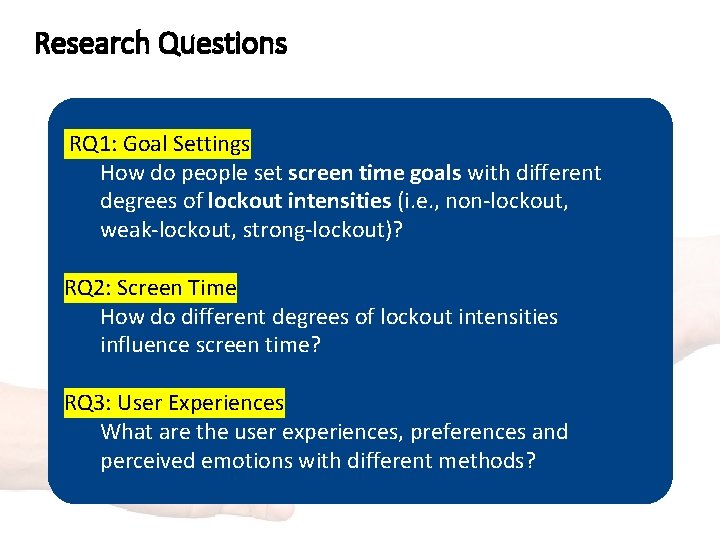
Research Questions RQ 1: Goal Settings How do people set screen time goals with different degrees of lockout intensities (i. e. , non-lockout, weak-lockout, strong-lockout)? RQ 2: Screen Time How do different degrees of lockout intensities influence screen time? RQ 3: User Experiences What are the user experiences, preferences and perceived emotions with different methods?
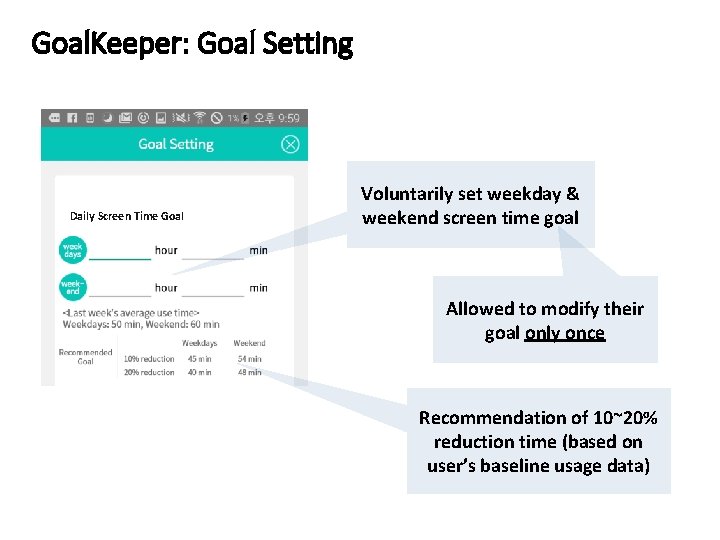
Goal. Keeper: Goal Setting Daily Screen Time Goal Voluntarily set weekday & weekend screen time goal Allowed to modify their goal only once Recommendation of 10~20% reduction time (based on user’s baseline usage data)
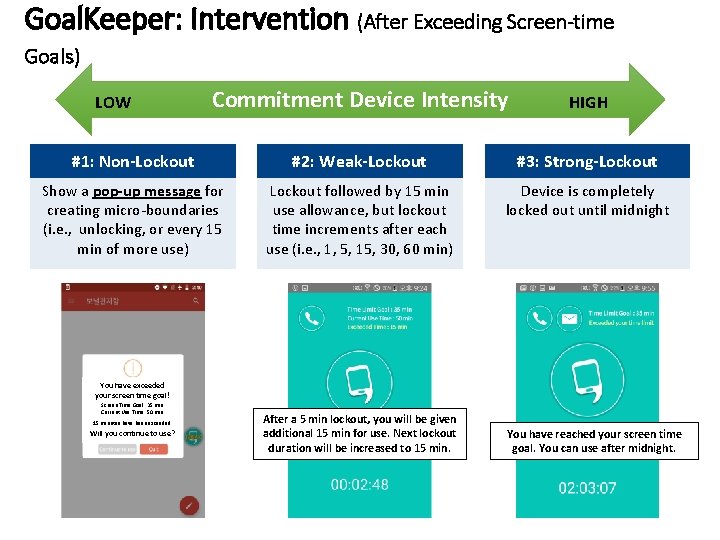
Goal. Keeper: Intervention (After Exceeding Screen-time Goals) Commitment Device Intensity HIGH #1: Non-Lockout #2: Weak-Lockout #3: Strong-Lockout Show a pop-up message for creating micro-boundaries (i. e. , unlocking, or every 15 min of more use) Lockout followed by 15 min use allowance, but lockout time increments after each use (i. e. , 1, 5, 15, 30, 60 min) Device is completely locked out until midnight LOW You have exceeded your screen time goal! Screen Time Goal: 35 min Current Use Time: 50 min 15 minutes have been exceeded Will you continue to use? After a 5 min lockout, you will be given additional 15 min for use. Next lockout duration will be increased to 15 min. You have reached your screen time goal. You can use after midnight.
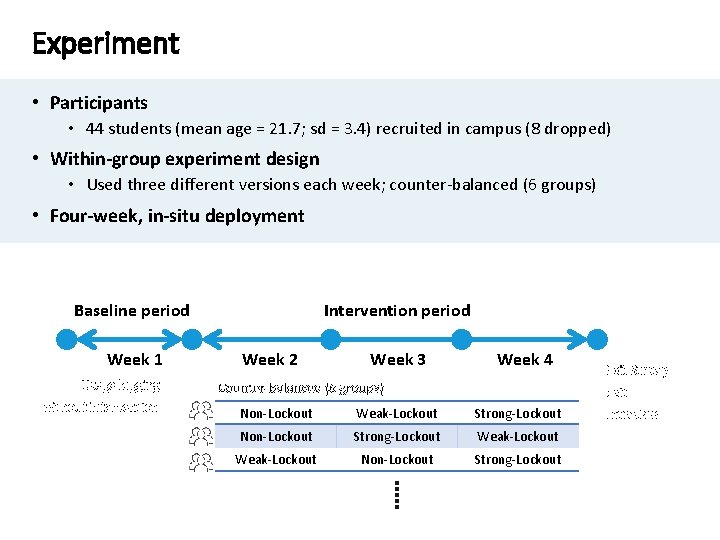
Experiment • Participants • 44 students (mean age = 21. 7; sd = 3. 4) recruited in campus (8 dropped) • Within-group experiment design • Used three different versions each week; counter-balanced (6 groups) • Four-week, in-situ deployment Baseline period Week 1 Usage logging without intervention Intervention period Week 2 Week 3 Week 4 Counter-balanced (6 groups) Exit Survey Exit Non-Lockout Weak-Lockout Strong-Lockout Non-Lockout Strong-Lockout Weak-Lockout Non-Lockout Strong-Lockout Interview
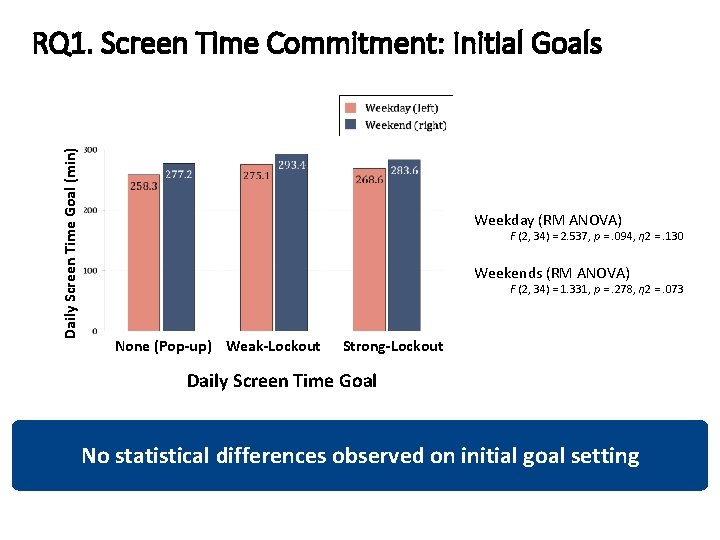
Daily Screen Time Goal (min) RQ 1. Screen Time Commitment: Initial Goals Weekday (RM ANOVA) F (2, 34) = 2. 537, p =. 094, η 2 =. 130 Weekends (RM ANOVA) F (2, 34) = 1. 331, p =. 278, η 2 =. 073 None (Pop-up) Weak-Lockout Strong-Lockout Daily Screen Time Goal No statistical differences observed on initial goal setting
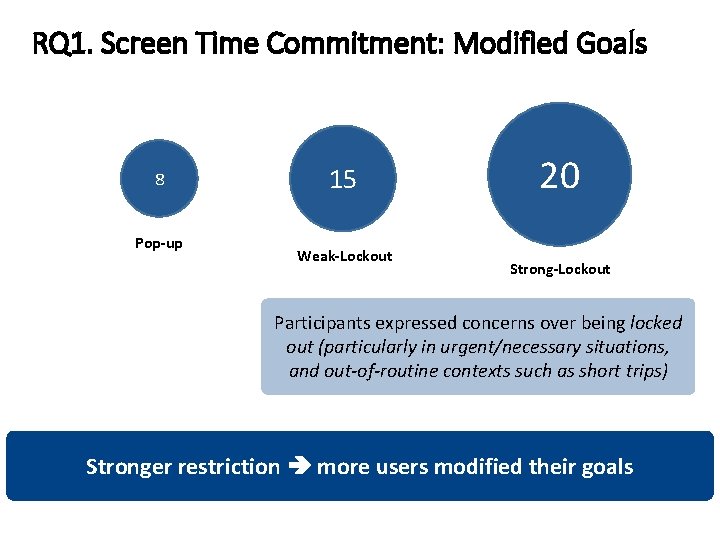
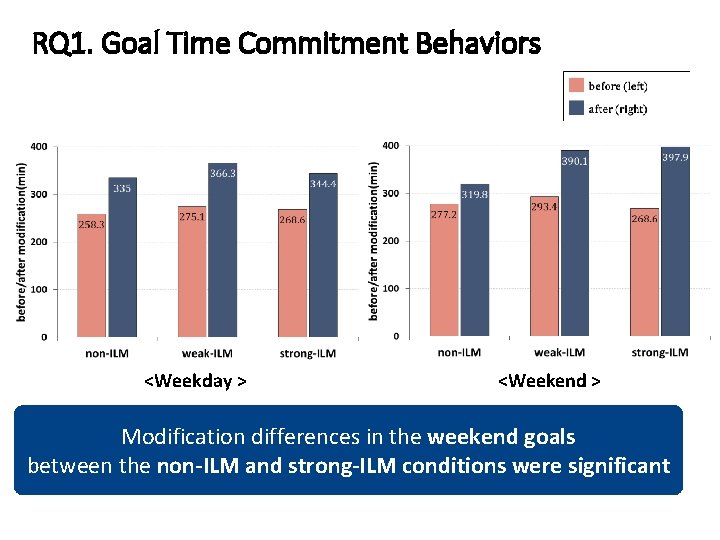
RQ 1. Screen Time Commitment: Modified Goals 8 Pop-up 15 Weak-Lockout 20 Strong-Lockout Participants expressed concerns over being locked out (particularly in urgent/necessary situations, and out-of-routine contexts such as short trips) Stronger restriction more users modified their goals
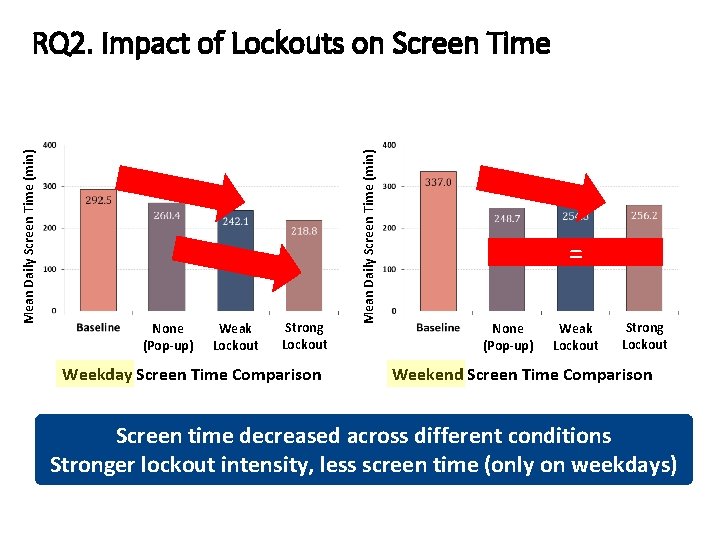
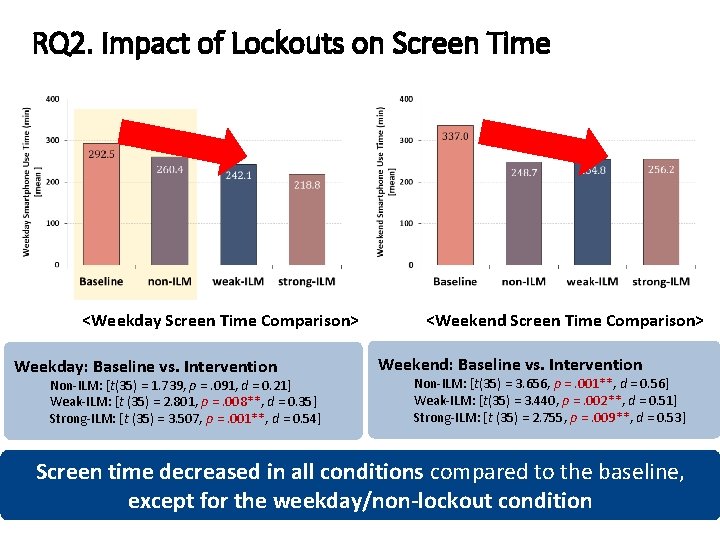
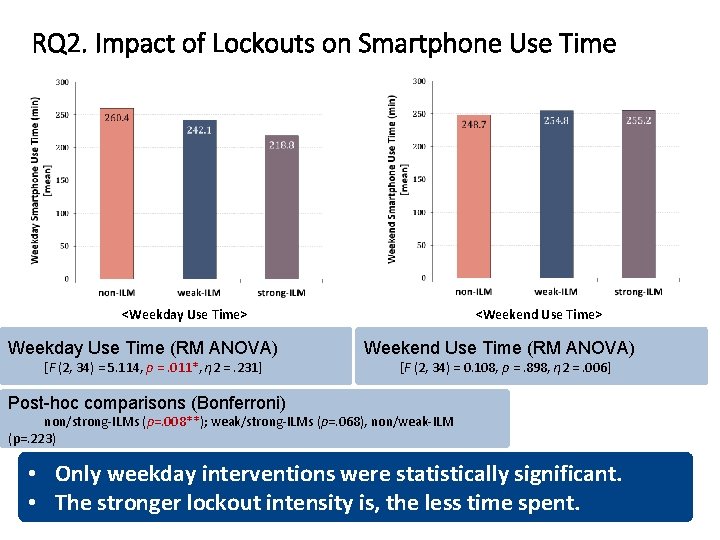
None (Pop-up) Weak Lockout Strong Lockout Weekday Screen Time Comparison Mean Daily Screen Time (min) RQ 2. Impact of Lockouts on Screen Time = None (Pop-up) Weak Lockout Strong Lockout Weekend Screen Time Comparison Screen time decreased across different conditions Stronger lockout intensity, less screen time (only on weekdays)
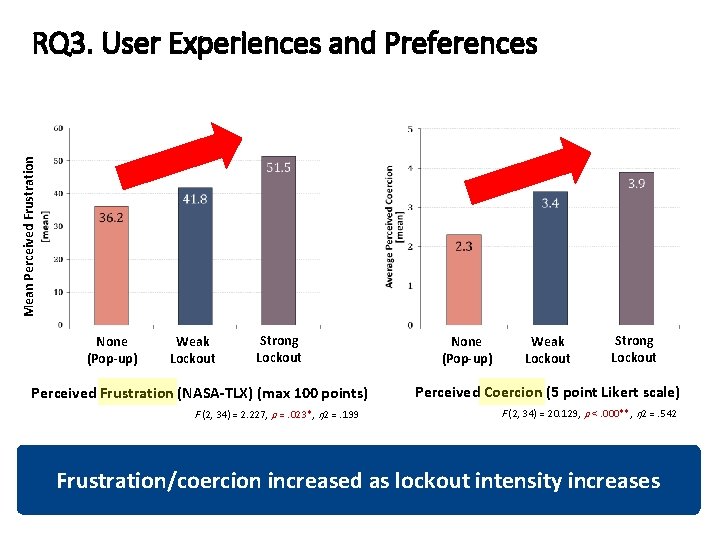
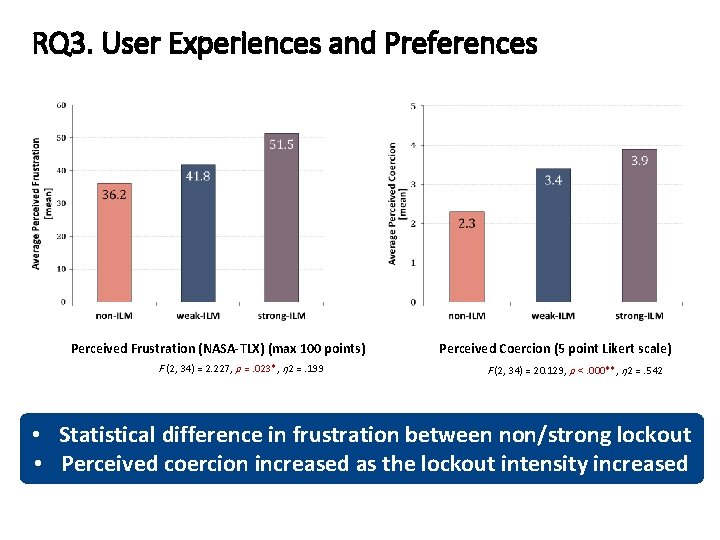
Mean Perceived Frustration RQ 3. User Experiences and Preferences None (Pop-up) Weak Lockout Strong Lockout Perceived Frustration (NASA-TLX) (max 100 points) F (2, 34) = 2. 227, p =. 023*, η 2 =. 199 None (Pop-up) Weak Lockout Strong Lockout Perceived Coercion (5 point Likert scale) F (2, 34) = 20. 129, p <. 000**, η 2 =. 542 Frustration/coercion increased as lockout intensity increases
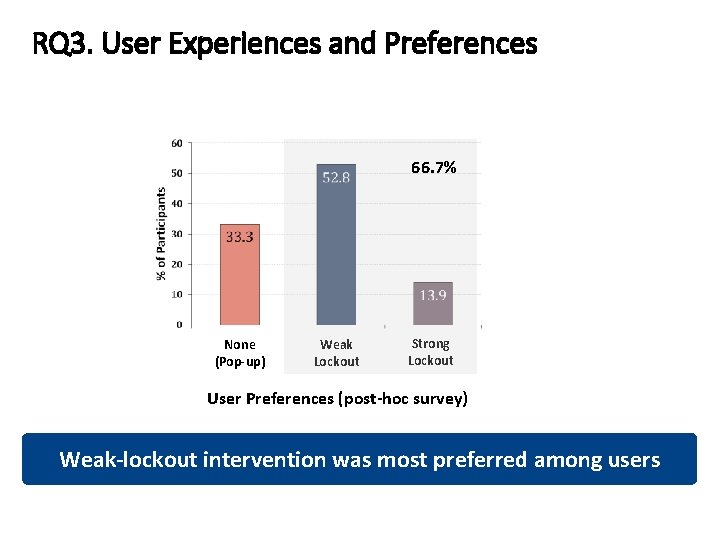
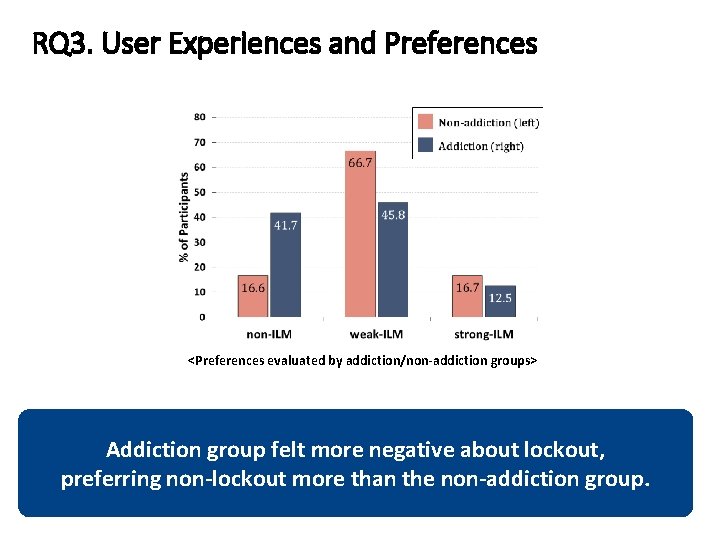
RQ 3. User Experiences and Preferences 66. 7% None (Pop-up) Weak Lockout Strong Lockout User Preferences (post-hoc survey) Weak-lockout intervention was most preferred among users
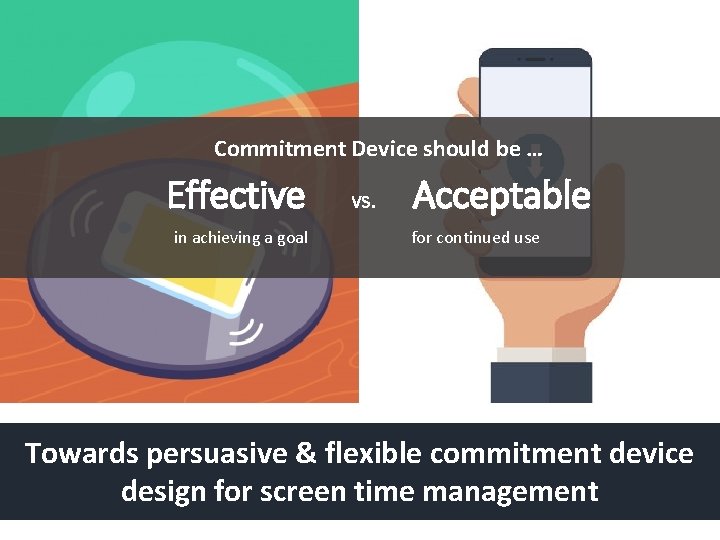
Commitment Device should be … Effective in achieving a goal vs. Acceptable for continued use Towards persuasive & flexible commitment device design for screen time management
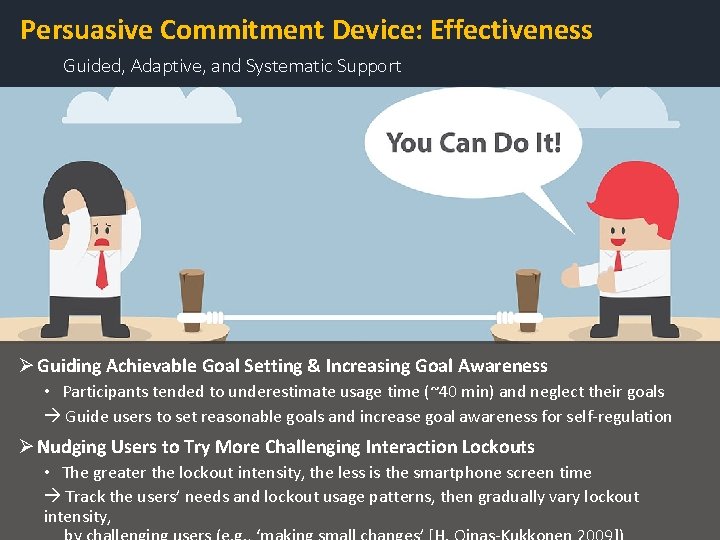
Persuasive Commitment Device: Effectiveness Guided, Adaptive, and Systematic Support Ø Guiding Achievable Goal Setting & Increasing Goal Awareness • Participants tended to underestimate usage time (~40 min) and neglect their goals Guide users to set reasonable goals and increase goal awareness for self-regulation Ø Nudging Users to Try More Challenging Interaction Lockouts • The greater the lockout intensity, the less is the smartphone screen time Track the users’ needs and lockout usage patterns, then gradually vary lockout intensity,
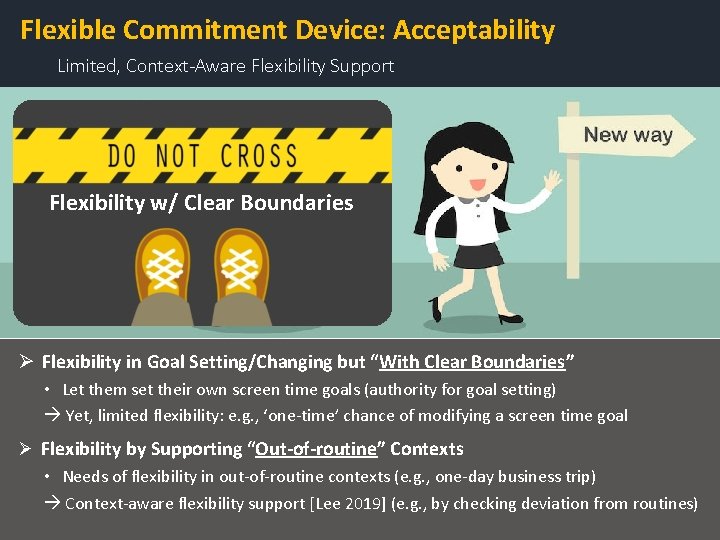
Flexible Commitment Device: Acceptability Limited, Context-Aware Flexibility Support Flexibility w/ Clear Boundaries V. S Ø Flexibility in Goal Setting/Changing but “With Clear Boundaries” • Let them set their own screen time goals (authority for goal setting) Yet, limited flexibility: e. g. , ‘one-time’ chance of modifying a screen time goal Ø Flexibility by Supporting “Out-of-routine” Contexts • Needs of flexibility in out-of-routine contexts (e. g. , one-day business trip) Context-aware flexibility support [Lee 2019] (e. g. , by checking deviation from routines)
Goal. Keeper: Exploring Interaction Lockout Mechanisms for Regulating Smartphone Use Jaejeung Kim, Hayoung Jung, Minsam Ko, Uichin Lee Persuasive Non-Lockout (pop-up warning) LOW Restrictive Weak-Lockout (temporary lockout) Strong-Lockout (complete lockout) Commitment Device Intensity Goal Setting • Screen Time • User Experiences • Design Implications • HIGH Screen time goals were not significantly different, but more goal modifications observed in lockout conditions Stronger lockout is more effective (only during weekdays; no differences in weekends) Higher perceived frustration and coercion in lockout conditions, and yet many preferred lockout conditions Towards persuasive & flexible design for screen time management (e. g. , goal setting/awareness, limited flexibility, adaptive/contextaware lockout)
Appendix 26
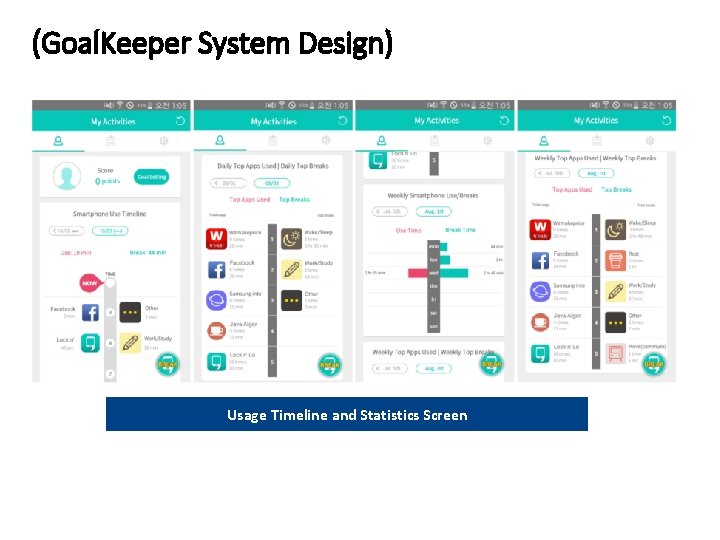
(Goal. Keeper System Design) Usage Timeline and Statistics Screen
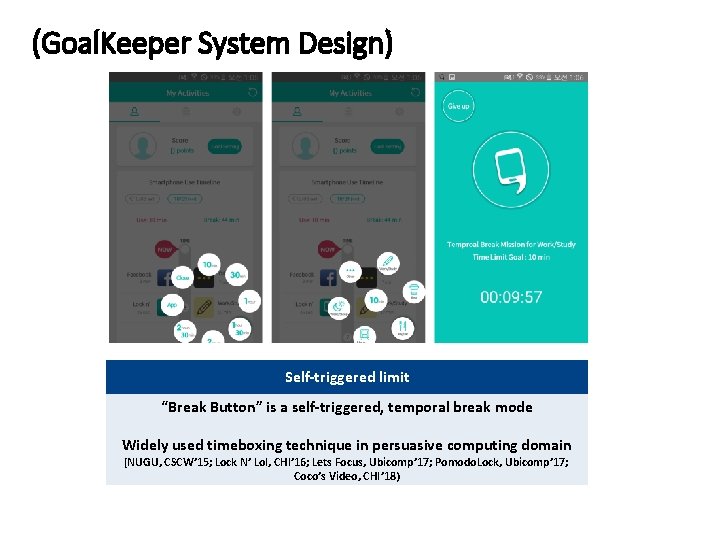
(Goal. Keeper System Design) Self-triggered limit “Break Button” is a self-triggered, temporal break mode Widely used timeboxing technique in persuasive computing domain [NUGU, CSCW’ 15; Lock N’ Lol, CHI’ 16; Lets Focus, Ubicomp’ 17; Pomodo. Lock, Ubicomp’ 17; Coco’s Video, CHI’ 18)
RQ 1. Goal Time Commitment Behaviors <Weekday > <Weekend > Modification differences in the weekend goals between the non-ILM and strong-ILM conditions were significant
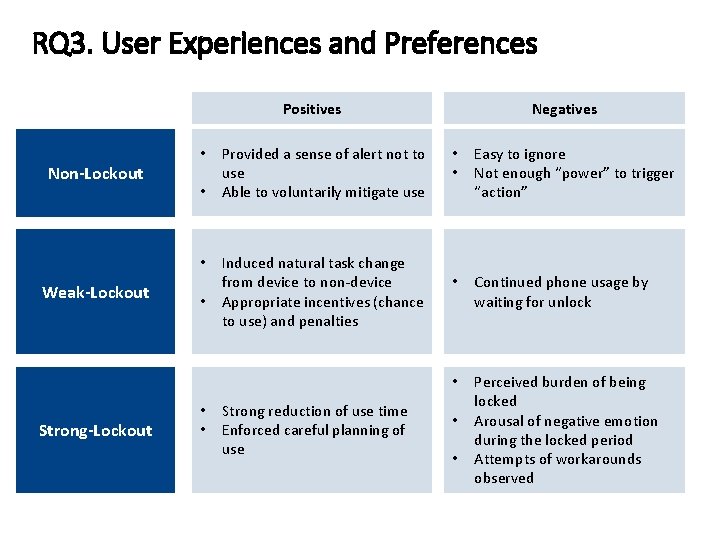
RQ 3. User Experiences and Preferences Positives Non-Lockout • • • Weak-Lockout Strong-Lockout • • • Provided a sense of alert not to use Able to voluntarily mitigate use Induced natural task change from device to non-device Appropriate incentives (chance to use) and penalties Strong reduction of use time Enforced careful planning of use Negatives • • Easy to ignore Not enough “power” to trigger “action” • Continued phone usage by waiting for unlock • Perceived burden of being locked Arousal of negative emotion during the locked period Attempts of workarounds observed • •
RQ 3. User Experiences and Preferences <Preferences evaluated by addiction/non-addiction groups> Addiction group felt more negative about lockout, preferring non-lockout more than the non-addiction group.
RQ 2. Impact of Lockouts on Screen Time <Weekday Screen Time Comparison> Weekday: Baseline vs. Intervention Non-ILM: [t(35) = 1. 739, p =. 091, d = 0. 21] Weak-ILM: [t (35) = 2. 801, p =. 008**, d = 0. 35] Strong-ILM: [t (35) = 3. 507, p =. 001**, d = 0. 54] <Weekend Screen Time Comparison> Weekend: Baseline vs. Intervention Non-ILM: [t(35) = 3. 656, p =. 001**, d = 0. 56] Weak-ILM: [t(35) = 3. 440, p =. 002**, d = 0. 51] Strong-ILM: [t (35) = 2. 755, p =. 009**, d = 0. 53] Screen time decreased in all conditions compared to the baseline, except for the weekday/non-lockout condition
RQ 2. Impact of Lockouts on Smartphone Use Time <Weekend Use Time> <Weekday Use Time> Weekday Use Time (RM ANOVA) [F (2, 34) = 5. 114, p =. 011*, η 2 =. 231] Weekend Use Time (RM ANOVA) [F (2, 34) = 0. 108, p =. 898, η 2 =. 006] Post-hoc comparisons (Bonferroni) non/strong-ILMs (p=. 008**); weak/strong-ILMs (p=. 068), non/weak-ILM (p=. 223) • Only weekday interventions were statistically significant. • The stronger lockout intensity is, the less time spent.
RQ 3. User Experiences and Preferences Perceived Frustration (NASA-TLX) (max 100 points) F (2, 34) = 2. 227, p =. 023*, η 2 =. 199 Perceived Coercion (5 point Likert scale) F (2, 34) = 20. 129, p <. 000**, η 2 =. 542 • Statistical difference in frustration between non/strong lockout • Perceived coercion increased as the lockout intensity increased