Game Theory Fall 2020 Mike Shor Topic 1
- Slides: 52
Game Theory Fall 2020 - Mike Shor Topic 1
“Only the paranoid survive. ” – Andy Grove Co-founder of Intel “ Game Theory © Mike Shor 2020 2
What is Game Theory? “No man island, entire on itself” — John Donne, 1624 ◉ Game theory is the study of rational behavior in interdependent situations. ◉ A game is any situation where the outcome of your actions depends on the actions of others Game Theory © Mike Shor 2020 3
Games We Play Game Theory © Mike Shor 2020 4
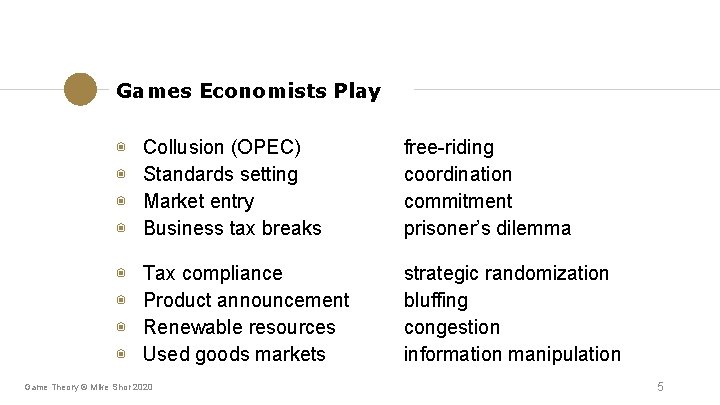
Games Economists Play ◉ ◉ Collusion (OPEC) Standards setting Market entry Business tax breaks free-riding coordination commitment prisoner’s dilemma ◉ ◉ Tax compliance Product announcement Renewable resources Used goods markets strategic randomization bluffing congestion information manipulation Game Theory © Mike Shor 2020 5
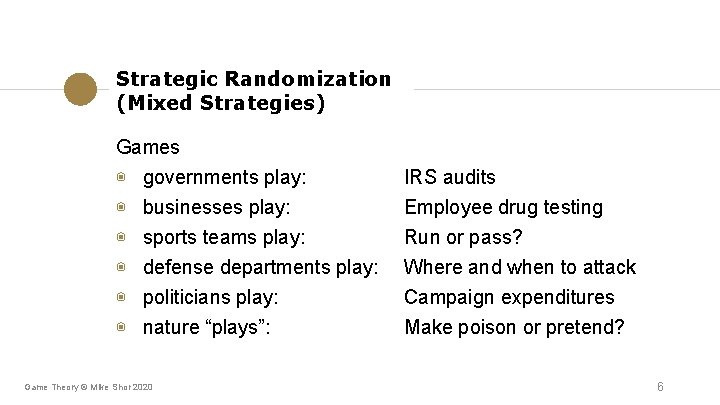
Strategic Randomization (Mixed Strategies) Games ◉ governments play: ◉ ◉ ◉ businesses play: sports teams play: defense departments play: politicians play: nature “plays”: Game Theory © Mike Shor 2020 IRS audits Employee drug testing Run or pass? Where and when to attack Campaign expenditures Make poison or pretend? 6
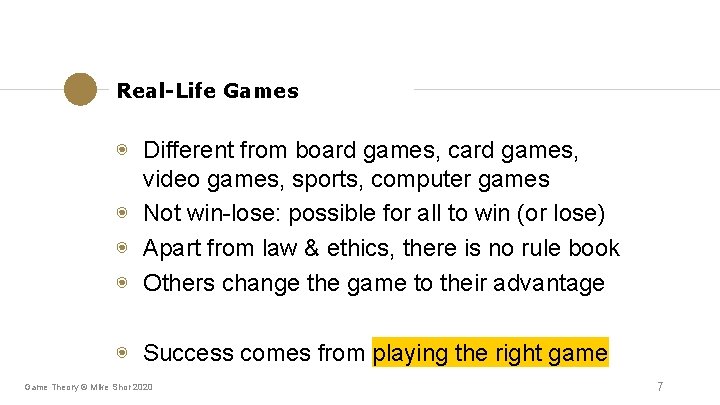
Real-Life Games ◉ Different from board games, card games, video games, sports, computer games ◉ Not win-lose: possible for all to win (or lose) ◉ Apart from law & ethics, there is no rule book ◉ Others change the game to their advantage ◉ Success comes from playing the right game Game Theory © Mike Shor 2020 7
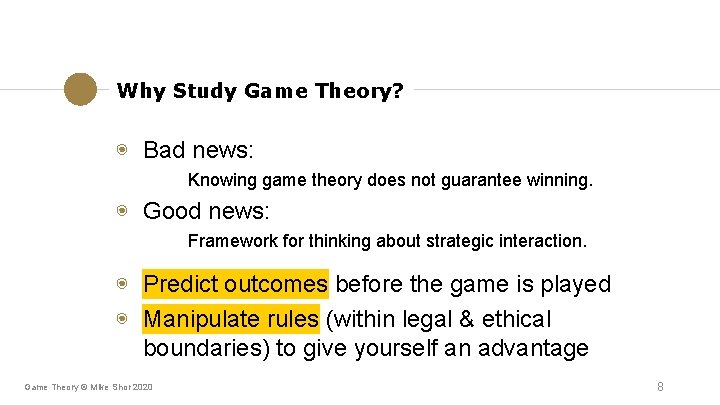
Why Study Game Theory? ◉ Bad news: Knowing game theory does not guarantee winning. ◉ Good news: Framework for thinking about strategic interaction. ◉ Predict outcomes before the game is played ◉ Manipulate rules (within legal & ethical boundaries) to give yourself an advantage Game Theory © Mike Shor 2020 8
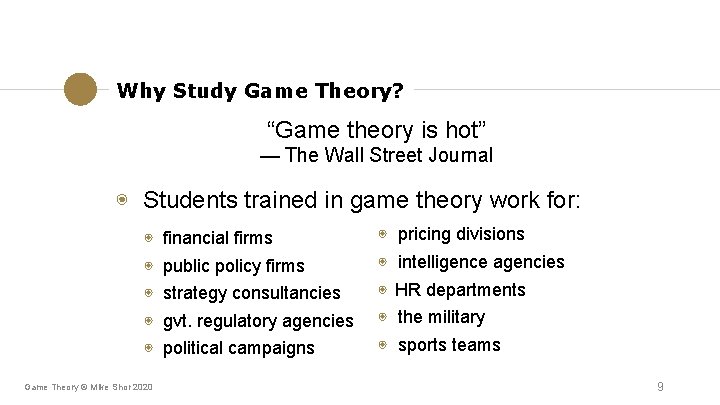
Why Study Game Theory? “Game theory is hot” — The Wall Street Journal ◉ Students trained in game theory work for: ◉ ◉ ◉ Game Theory © Mike Shor 2020 financial firms public policy firms strategy consultancies gvt. regulatory agencies political campaigns ◉ ◉ ◉ pricing divisions intelligence agencies HR departments the military sports teams 9
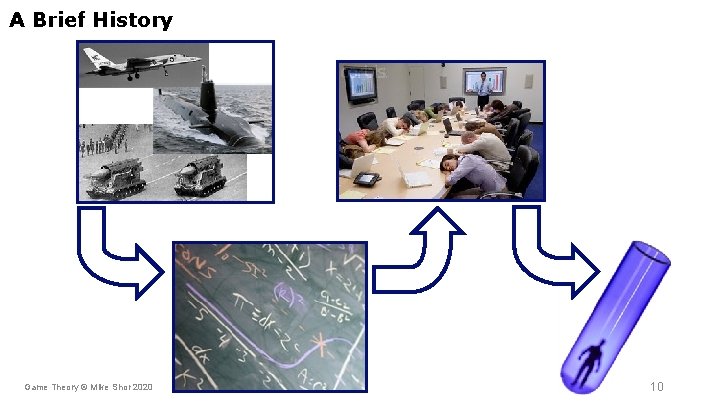
A Brief History Game Theory © Mike Shor 2020 10
Administratrivia Game Theory © Mike Shor 2020 11
Course Information ◉ Textbook None required ◉ Course web site Check after each lecture Game Theory © Mike Shor 2020 12
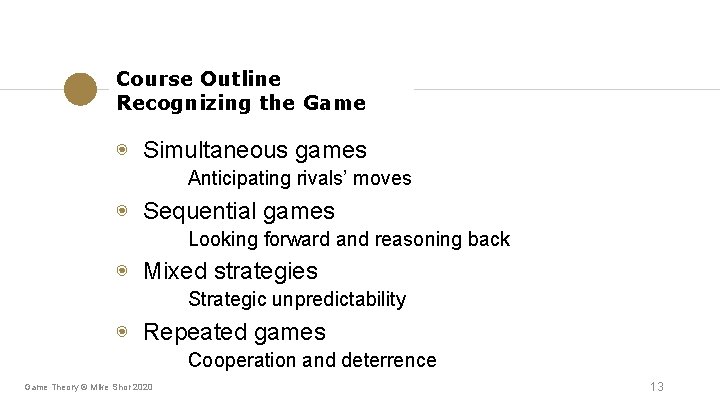
Course Outline Recognizing the Game ◉ Simultaneous games Anticipating rivals’ moves ◉ Sequential games Looking forward and reasoning back ◉ Mixed strategies Strategic unpredictability ◉ Repeated games Cooperation and deterrence Game Theory © Mike Shor 2020 13
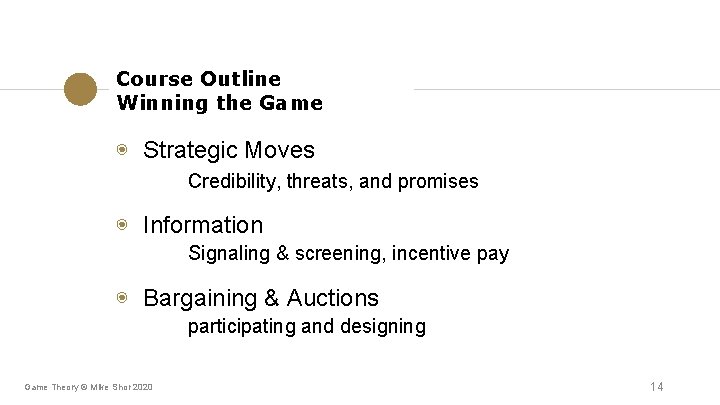
Course Outline Winning the Game ◉ Strategic Moves Credibility, threats, and promises ◉ Information Signaling & screening, incentive pay ◉ Bargaining & Auctions participating and designing Game Theory © Mike Shor 2020 14
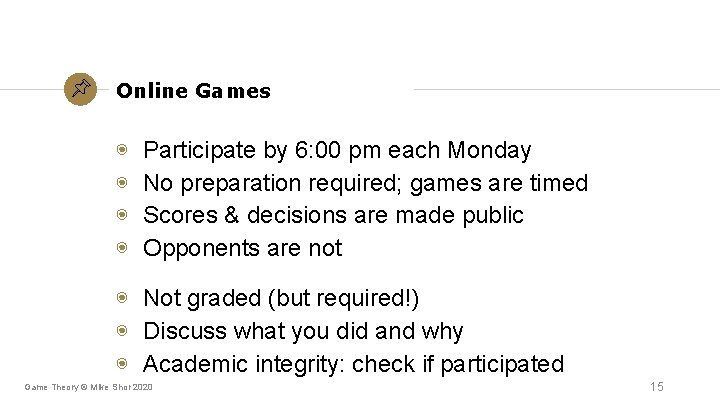
Online Games ◉ ◉ Participate by 6: 00 pm each Monday No preparation required; games are timed Scores & decisions are made public Opponents are not ◉ Not graded (but required!) ◉ Discuss what you did and why ◉ Academic integrity: check if participated Game Theory © Mike Shor 2020 15
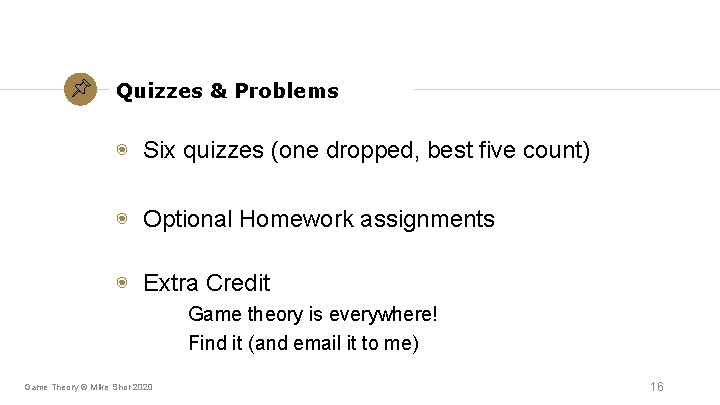
Quizzes & Problems ◉ Six quizzes (one dropped, best five count) ◉ Optional Homework assignments ◉ Extra Credit Game theory is everywhere! Find it (and email it to me) Game Theory © Mike Shor 2020 16
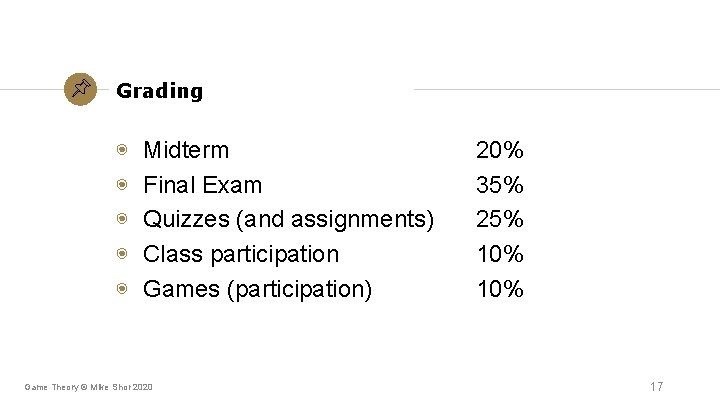
Grading ◉ ◉ ◉ Midterm Final Exam Quizzes (and assignments) Class participation Games (participation) Game Theory © Mike Shor 2020 20% 35% 25% 10% 17
Fall 2020 ◉ Straight-forward quizzes and exams ◉ Flexible due dates ◉ Optional assignments ◉ Let me know what is working and what isn’t Game Theory © Mike Shor 2020 18
Interactive Decision Theory: You are goal-driven when considering your options Game Theory: So is everyone else Game Theory © Mike Shor 2020 19
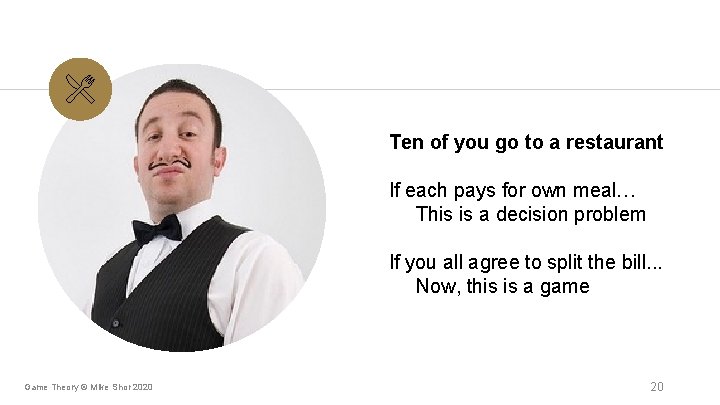
Ten of you go to a restaurant If each pays for own meal… This is a decision problem If you all agree to split the bill. . . Now, this is a game Game Theory © Mike Shor 2020 20
Interactive Decision Theory Never assume that people’s behaviors are fixed. Predict their reaction to your behavior. Game Theory © Mike Shor 2020 21
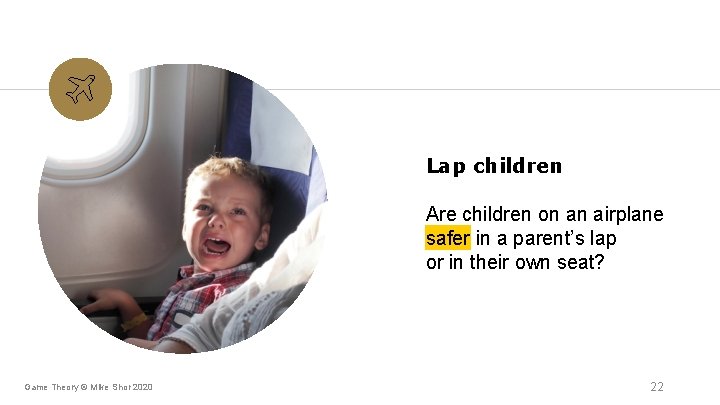
Lap children Are children on an airplane safer in a parent’s lap or in their own seat? Game Theory © Mike Shor 2020 22
Understanding Incentives ◉ Why extra customer capacity can be bad Can you be better off throwing some of your goods away prior to trading with someone? ◉ Why cannibalize your own sales? Can developing a product that only competes with other products you own ever be good? ◉ Where is it better to have a car break down? Are you more likely to get someone to stop and help on a busy street or a deserted one? Game Theory © Mike Shor 2020 23
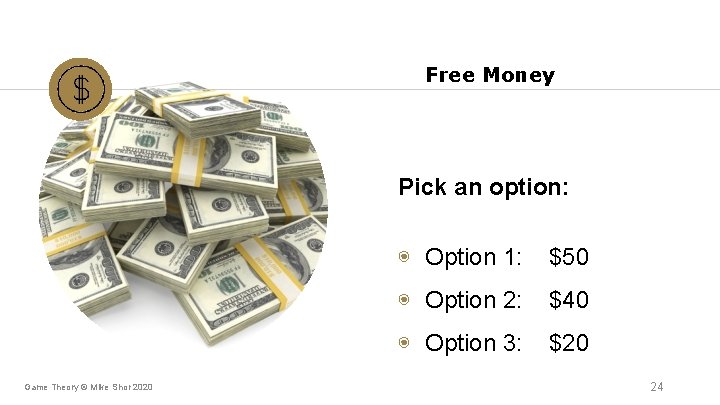
Free Money Pick an option: Game Theory © Mike Shor 2020 ◉ Option 1: $50 ◉ Option 2: $40 ◉ Option 3: $20 24
Incentives Spend as much time thinking about your opponents’ actions as you do your own! Up next: The rules of the game The assumptions of game theory Game Theory © Mike Shor 2020 25
Review ◉ Interactive decision theory ◉ Strategic interdependence of players ◉ You pursue your goals ◉ So does everyone else ◉ Your actions change incentives for others Game Theory © Mike Shor 2020 26
I don’t skate to where the puck is. I skate to where the puck is going to be. – Wayne Gretzky NHL record goal scorer “ Game Theory © Mike Shor 2020 27
Outline ◉ Defining the rules of the game ◉ Manipulating the rules if they are flexible ◉ Questioning game theory’s assumptions Game Theory © Mike Shor 2020 28
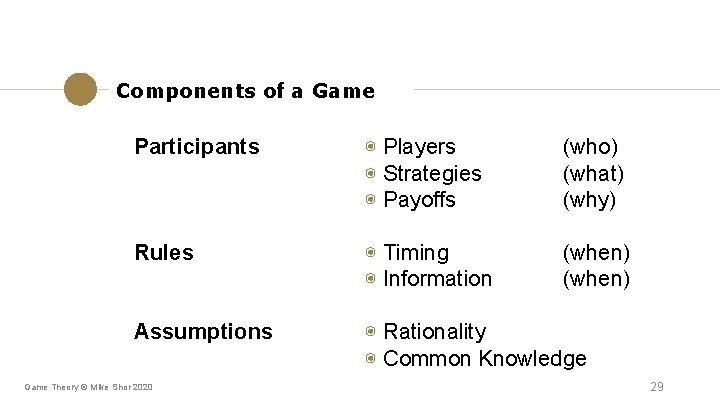
Components of a Game Participants ◉ Players ◉ Strategies ◉ Payoffs (who) (what) (why) Rules ◉ Timing ◉ Information (when) Assumptions ◉ Rationality ◉ Common Knowledge Game Theory © Mike Shor 2020 29
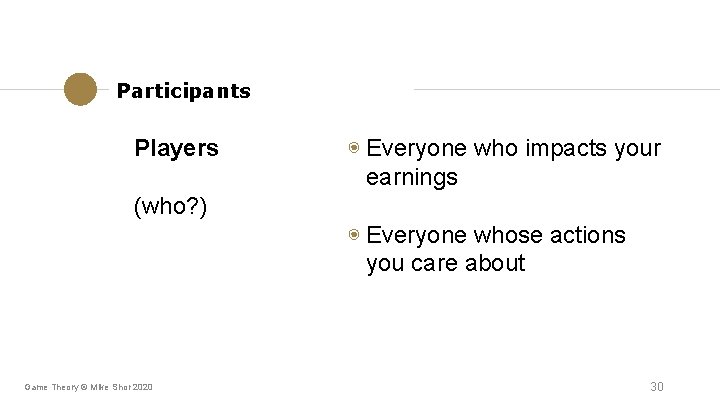
Participants Players ◉ Everyone who impacts your earnings (who? ) ◉ Everyone whose actions you care about Game Theory © Mike Shor 2020 30
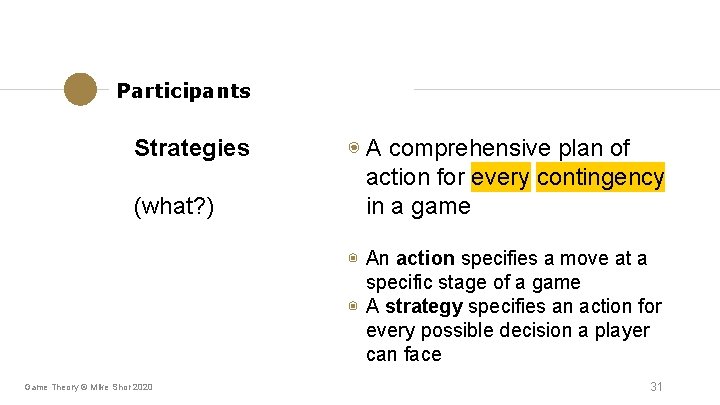
Participants Strategies (what? ) ◉ A comprehensive plan of action for every contingency in a game ◉ An action specifies a move at a specific stage of a game ◉ A strategy specifies an action for every possible decision a player can face Game Theory © Mike Shor 2020 31
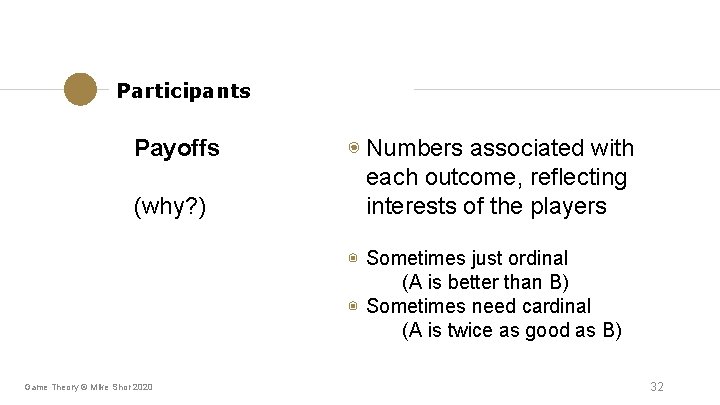
Participants Payoffs (why? ) ◉ Numbers associated with each outcome, reflecting interests of the players ◉ Sometimes just ordinal (A is better than B) ◉ Sometimes need cardinal (A is twice as good as B) Game Theory © Mike Shor 2020 32
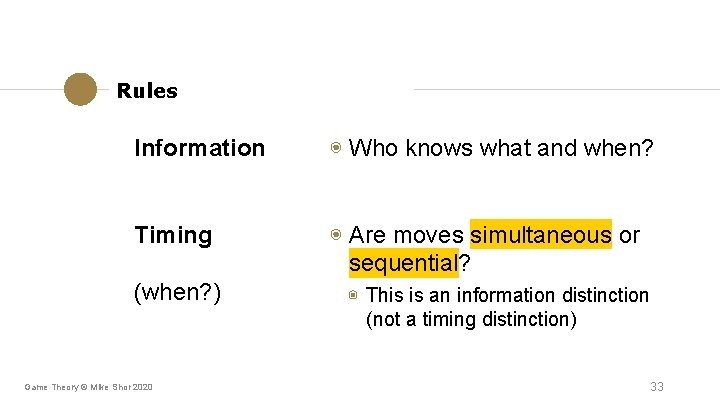
Rules Information ◉ Who knows what and when? Timing ◉ Are moves simultaneous or sequential? (when? ) Game Theory © Mike Shor 2020 ◉ This is an information distinction (not a timing distinction) 33
Changing the Rules Are the rules of the game fixed or flexible? Game Theory © Mike Shor 2020 34
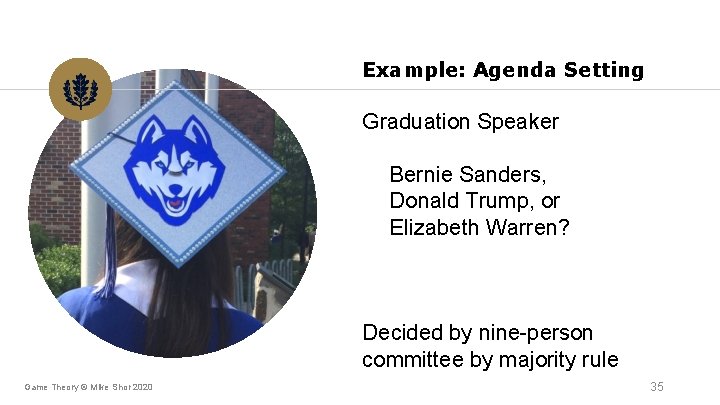
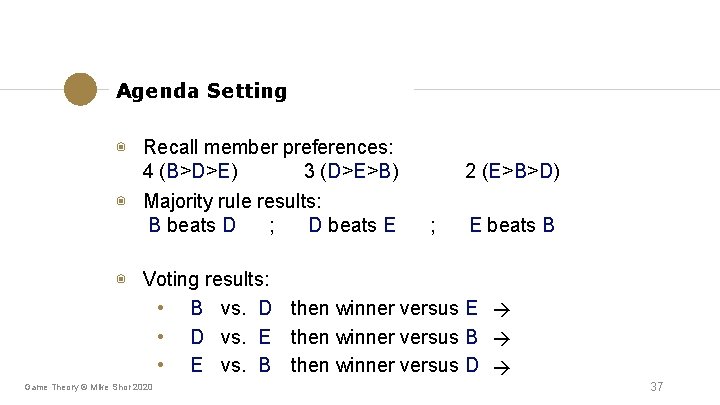
Example: Agenda Setting Graduation Speaker Bernie Sanders, Donald Trump, or Elizabeth Warren? Decided by nine-person committee by majority rule Game Theory © Mike Shor 2020 35
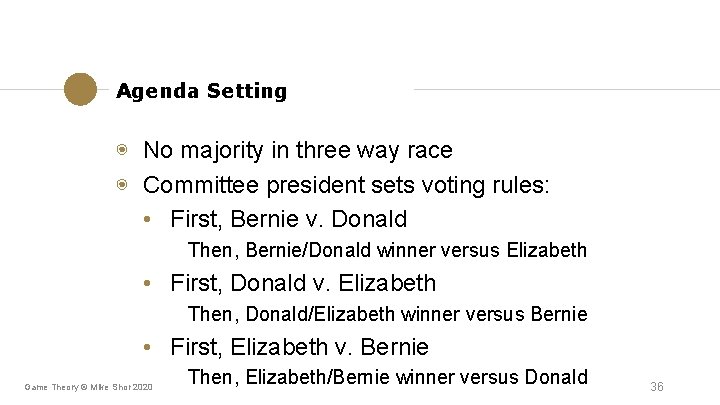
Agenda Setting ◉ No majority in three way race ◉ Committee president sets voting rules: • First, Bernie v. Donald Then, Bernie/Donald winner versus Elizabeth • First, Donald v. Elizabeth Then, Donald/Elizabeth winner versus Bernie • First, Elizabeth v. Bernie Game Theory © Mike Shor 2020 Then, Elizabeth/Bernie winner versus Donald 36
Agenda Setting ◉ Recall member preferences: 4 (B>D>E) 3 (D>E>B) ◉ Majority rule results: B beats D ; D beats E 2 (E>B>D) ; E beats B ◉ Voting results: • B vs. D then winner versus E • D vs. E then winner versus B • E vs. B then winner versus D Game Theory © Mike Shor 2020 37
Changing the Rules When the rules of the game are flexible, manipulate them to your advantage. Game Theory © Mike Shor 2020 38
The battle is won before it is ever fought. – Sun Tzu “ Game Theory © Mike Shor 2020 39
Assumptions ◉ Rationality ◉ Common Knowledge Game Theory © Mike Shor 2020 40
Assumptions Rationality ◉ Players aim to maximize their payoffs ◉ Players are perfect calculators ◉ Players know their own payoffs ◉ Players never make mistakes Game Theory © Mike Shor 2020 41
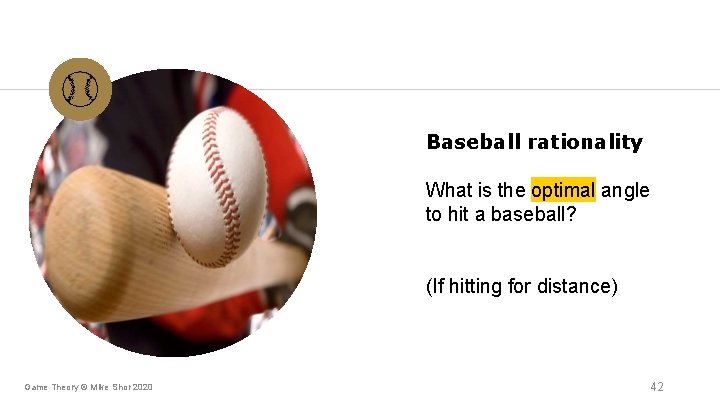
Baseball rationality What is the optimal angle to hit a baseball? (If hitting for distance) Game Theory © Mike Shor 2020 42
Assumptions Common Knowledge ◉ Each player knows the rules of the game ◉ Each player knows that each player knows that each player knows that each player knows ◉ Etc. Game Theory © Mike Shor 2020 43
Assumptions ◉ Knowledge: I know (some information) X ◉ Mutual knowledge: Each of us knows X ◉ Common knowledge: Each of us knows that each of us knows … that each of us knows X ◉ Players, strategies, payoffs, rules, and each player’s rationality are common knowledge Game Theory © Mike Shor 2020 44
Common Knowledge ◉ Do people really behave as theory predicts? ◉ If not, what good is theory? Game Theory © Mike Shor 2020 45
Common Knowledge ◉ Behavioral game theory: The rule of three ◉ Game theory: The rule of infinity ◉ Example: the stock market Game Theory © Mike Shor 2020 46
I can calculate the motions of heavenly bodies, but not the madness of people – Sir Isaac Newton upon losing £ 20, 000 in the South Sea Bubble in 1720 “ Game Theory © Mike Shor 2020 47
Common Knowledge If a crystal ball showed everyone the exact date of the next stock market crash, when would you sell? Game Theory © Mike Shor 2020 48
IPO Lock-up ◉ A company wishes to “go public” It offers to sell shares to the public Typically, only 20% of shares are offered The remainder are held by “insiders” ◉ Lock-up Precludes insiders from selling shares, typically for six months ◉ What happens when the lock-up expires? Game Theory © Mike Shor 2020 49
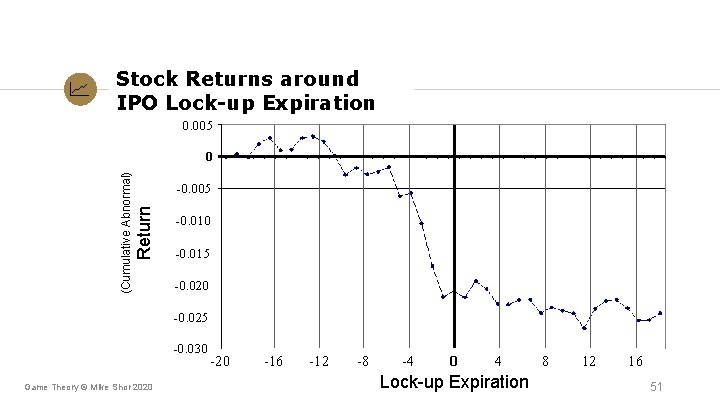
Increased supply after the lock-up expiration will drive price down. It is simply economics of supply and demand. – Wall Street Journal reporter “ Game Theory © Mike Shor 2020 50
Stock Returns around IPO Lock-up Expiration 0. 005 -0. 005 Return (Cumulative Abnormal) 0 -0. 015 -0. 020 -0. 025 -0. 030 Game Theory © Mike Shor 2020 -16 -12 -8 -4 0 4 Lock-up Expiration 8 12 16 51
Summary ◉ ◉ Every strategic interaction is a game The rules are likely to be flexible Think one step ahead The rule of three steps ◉ Next: Equilibrium: What are the outcome of games? Game Theory © Mike Shor 2020 52