
Game Theory is Evolving MIT 14 126 Fall
- Slides: 21
Game Theory is Evolving MIT 14. 126, Fall 2001
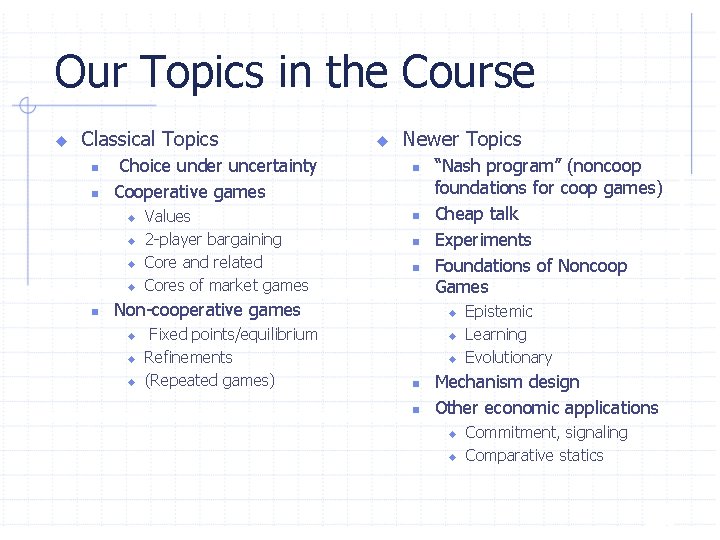
Our Topics in the Course u Classical Topics n n Choice under uncertainty Cooperative games u u n Values 2 -player bargaining Core and related Cores of market games u Newer Topics n n Non-cooperative games u u u Fixed points/equilibrium Refinements (Repeated games) “Nash program” (noncoop foundations for coop games) Cheap talk Experiments Foundations of Noncoop Games u u u n n Epistemic Learning Evolutionary Mechanism design Other economic applications u u Commitment, signaling Comparative statics
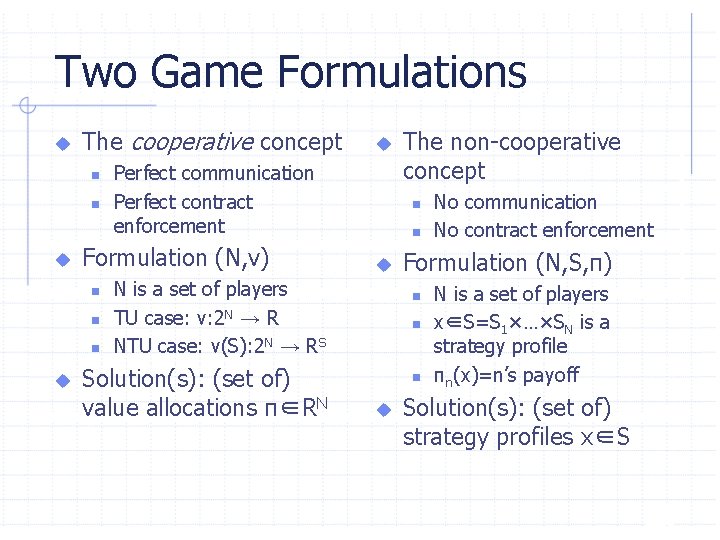
Two Game Formulations u The cooperative concept n n u Perfect communication Perfect contract enforcement Formulation (N, v) n u n n u N is a set of players TU case: v: 2 N → R NTU case: v(S): 2 N → RS Solution(s): (set of) value allocations π∈RN The non-cooperative concept Formulation (N, S, π) n n n u No communication No contract enforcement N is a set of players x∈S=S 1×…×SN is a strategy profile πn(x)=n’s payoff Solution(s): (set of) strategy profiles x∈S
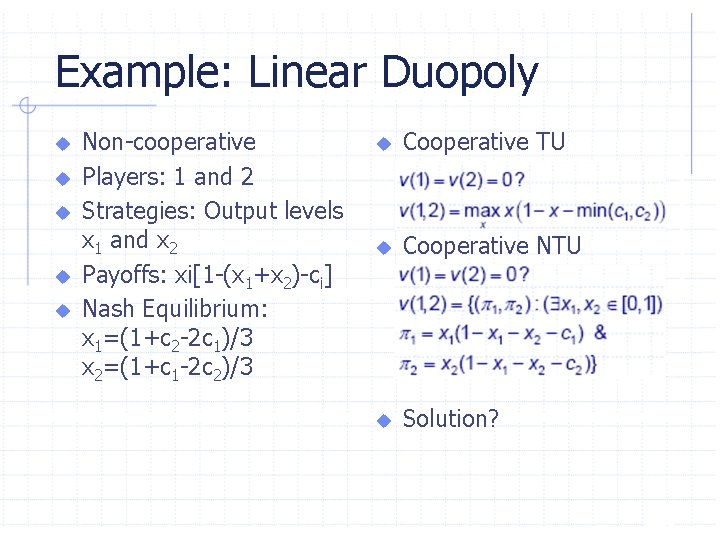
Example: Linear Duopoly u u u Non-cooperative Players: 1 and 2 Strategies: Output levels x 1 and x 2 Payoffs: xi[1 -(x 1+x 2)-ci] Nash Equilibrium: x 1=(1+c 2 -2 c 1)/3 x 2=(1+c 1 -2 c 2)/3 u Cooperative TU u Cooperative NTU u Solution?
Cooperative Solutions
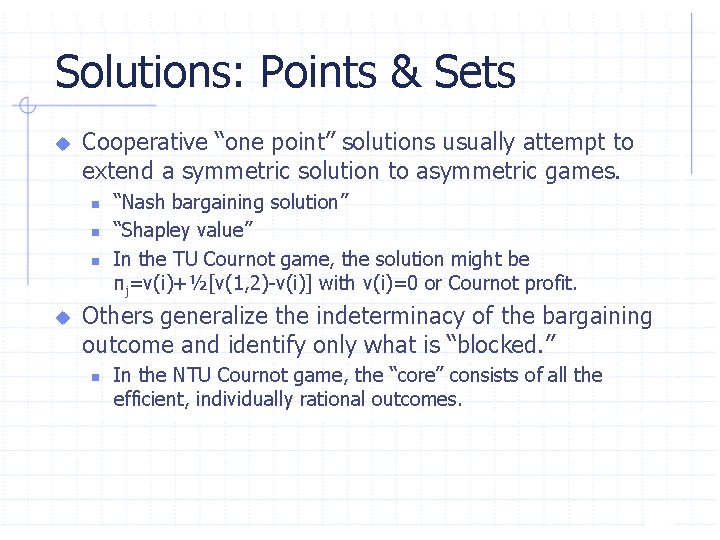
Solutions: Points & Sets u Cooperative “one point” solutions usually attempt to extend a symmetric solution to asymmetric games. n n n u “Nash bargaining solution” “Shapley value” In the TU Cournot game, the solution might be πj=v(i)+½[v(1, 2)-v(i)] with v(i)=0 or Cournot profit. Others generalize the indeterminacy of the bargaining outcome and identify only what is “blocked. ” n In the NTU Cournot game, the “core” consists of all the efficient, individually rational outcomes.
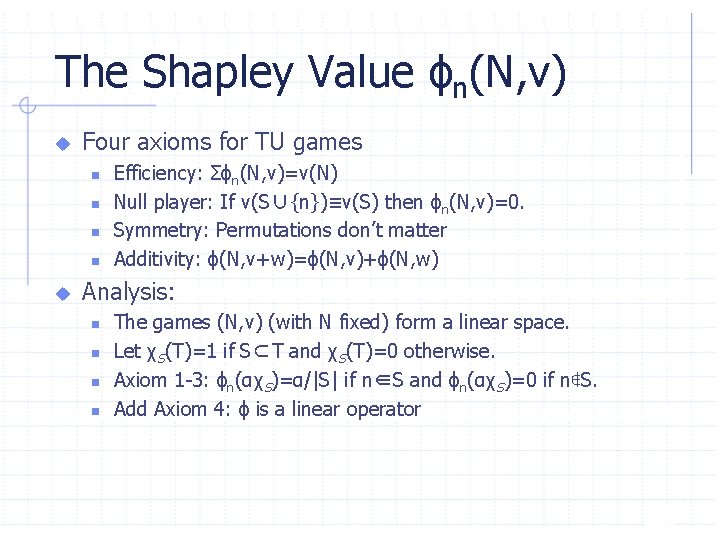
The Shapley Value ϕn(N, v) u Four axioms for TU games n n u Efficiency: Σϕn(N, v)=v(N) Null player: If v(S∪{n})≡v(S) then ϕn(N, v)=0. Symmetry: Permutations don’t matter Additivity: ϕ(N, v+w)=ϕ(N, v)+ϕ(N, w) Analysis: n n The games (N, v) (with N fixed) form a linear space. Let χS(T)=1 if S⊂T and χS(T)=0 otherwise. Axiom 1 -3: ϕn(αχS)=α/|S| if n∈S and ϕn(αχS)=0 if n∉S. Add Axiom 4: ϕ is a linear operator
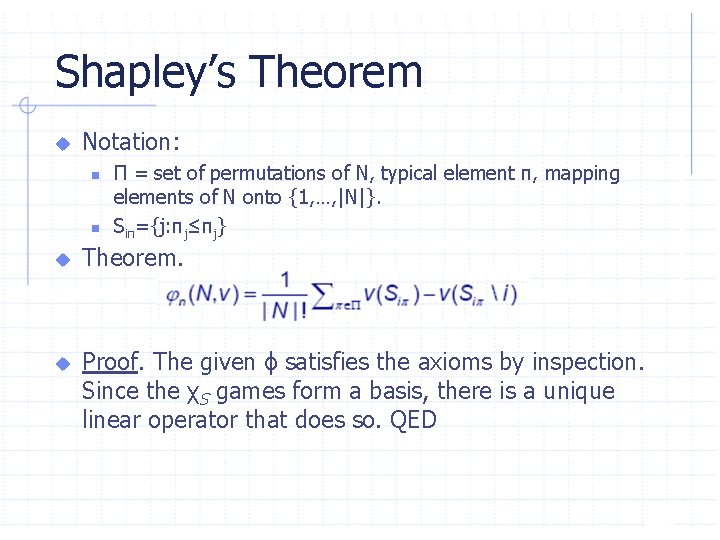
Shapley’s Theorem u Notation: n n Π = set of permutations of N, typical element π, mapping elements of N onto {1, …, |N|}. Siπ={j: πj≤πj} u Theorem. u Proof. The given ϕ satisfies the axioms by inspection. Since the χS games form a basis, there is a unique linear operator that does so. QED
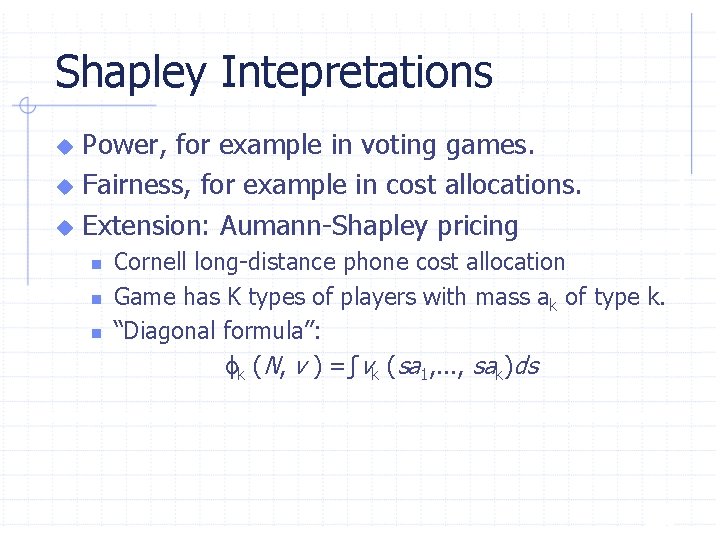
Shapley Intepretations Power, for example in voting games. u Fairness, for example in cost allocations. u Extension: Aumann-Shapley pricing u n n n Cornell long-distance phone cost allocation Game has K types of players with mass ak of type k. “Diagonal formula”: ϕk (N, v ) =∫vk (sa 1, . . . , sak)ds
Crossover Ideas Connecting Cooperative and Noncooperative game ideas
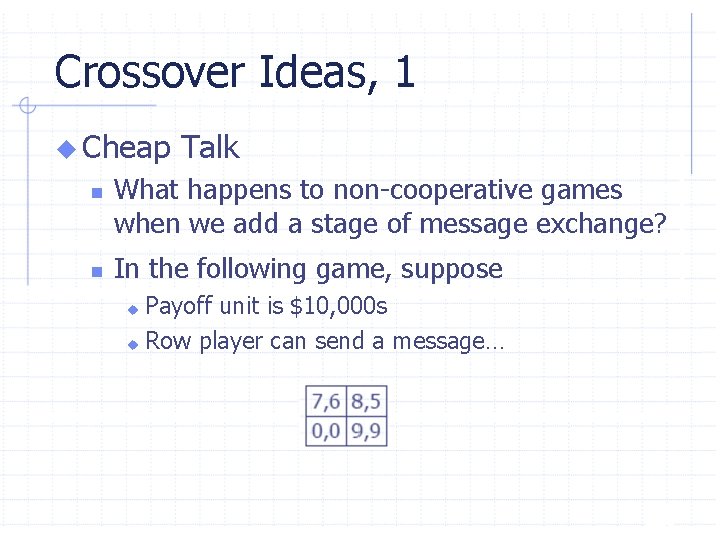
Crossover Ideas, 1 u Cheap n n Talk What happens to non-cooperative games when we add a stage of message exchange? In the following game, suppose Payoff unit is $10, 000 s u Row player can send a message… u
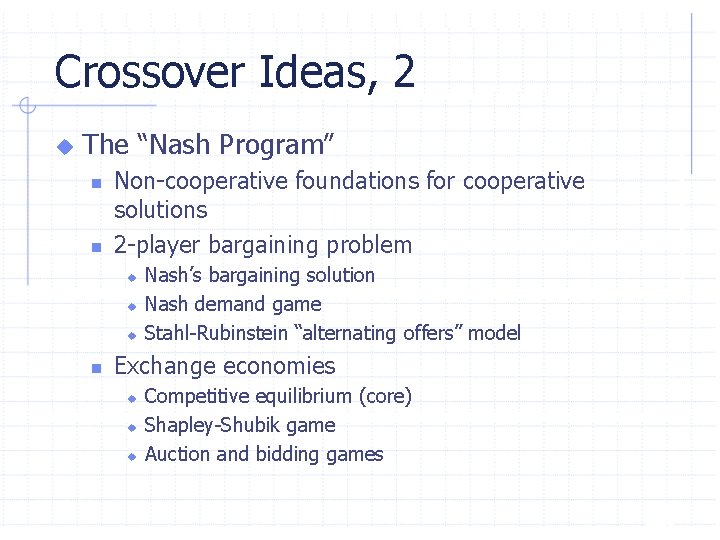
Crossover Ideas, 2 u The “Nash Program” n n Non-cooperative foundations for cooperative solutions 2 -player bargaining problem u u u n Nash’s bargaining solution Nash demand game Stahl-Rubinstein “alternating offers” model Exchange economies u u u Competitive equilibrium (core) Shapley-Shubik game Auction and bidding games
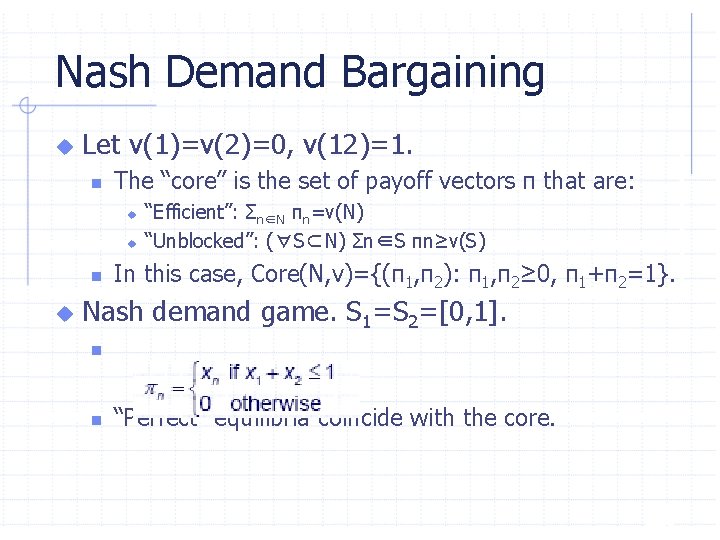
Nash Demand Bargaining u Let v(1)=v(2)=0, v(12)=1. n The “core” is the set of payoff vectors π that are: u u n u “Efficient”: Σn∈N πn=v(N) “Unblocked”: (∀S⊂N) Σn∈S πn≥v(S) In this case, Core(N, v)={(π1, π2): π1, π2≥ 0, π1+π2=1}. Nash demand game. S 1=S 2=[0, 1]. n n “Perfect” equilibria coincide with the core.
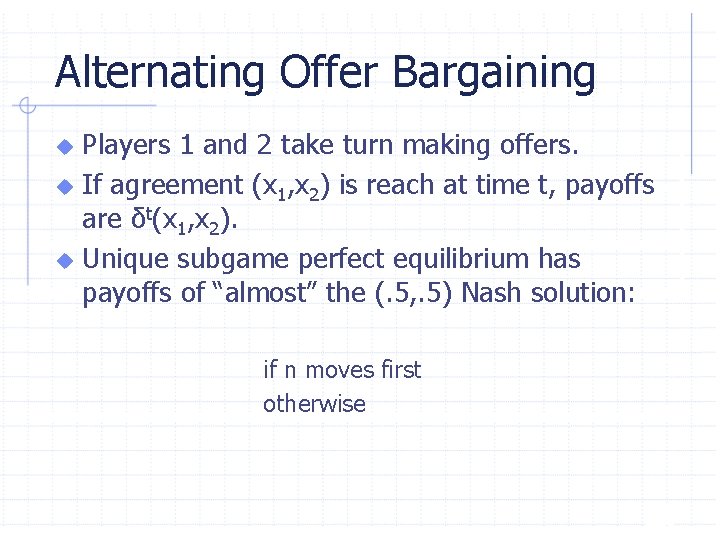
Alternating Offer Bargaining Players 1 and 2 take turn making offers. u If agreement (x 1, x 2) is reach at time t, payoffs are δt(x 1, x 2). u Unique subgame perfect equilibrium has payoffs of “almost” the (. 5, . 5) Nash solution: u if n moves first otherwise
Noncooperative Theory Rethinking equilibrium
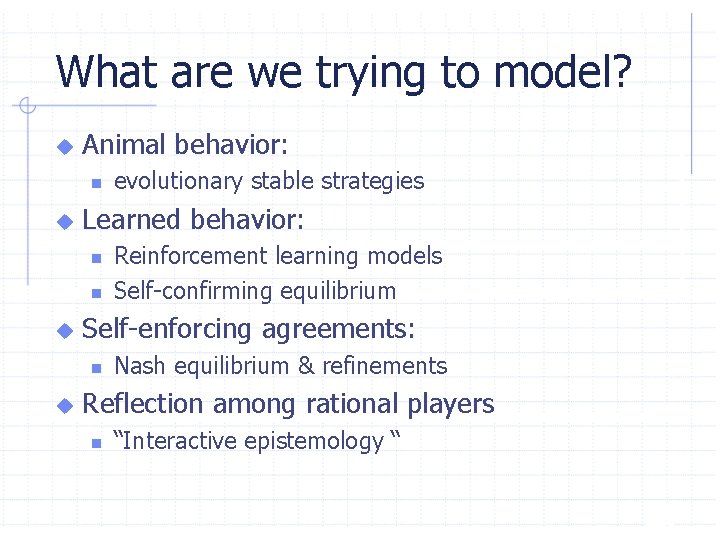
What are we trying to model? u Animal behavior: n u Learned behavior: n n u Reinforcement learning models Self-confirming equilibrium Self-enforcing agreements: n u evolutionary stable strategies Nash equilibrium & refinements Reflection among rational players n “Interactive epistemology “
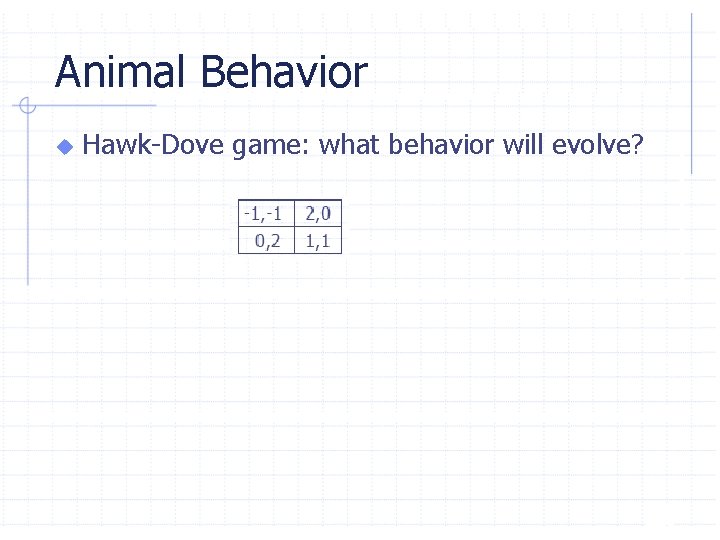
Animal Behavior u Hawk-Dove game: what behavior will evolve?
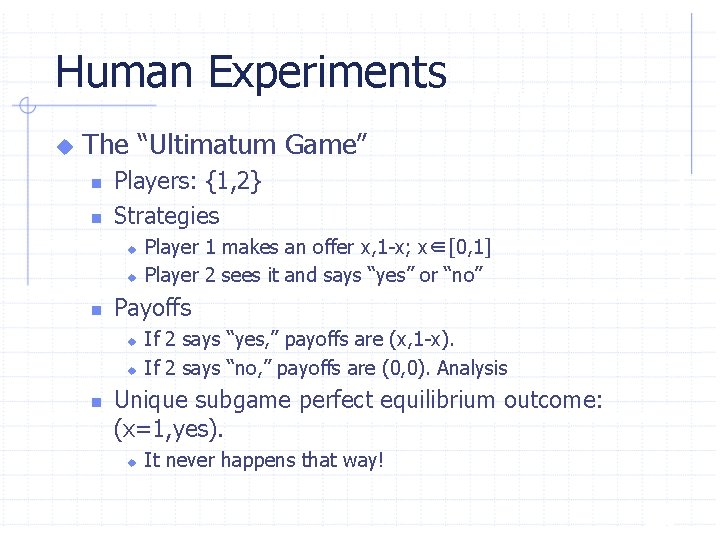
Human Experiments u The “Ultimatum Game” n n Players: {1, 2} Strategies u u n Payoffs u u n Player 1 makes an offer x, 1 -x; x∈[0, 1] Player 2 sees it and says “yes” or “no” If 2 says “yes, ” payoffs are (x, 1 -x). If 2 says “no, ” payoffs are (0, 0). Analysis Unique subgame perfect equilibrium outcome: (x=1, yes). u It never happens that way!
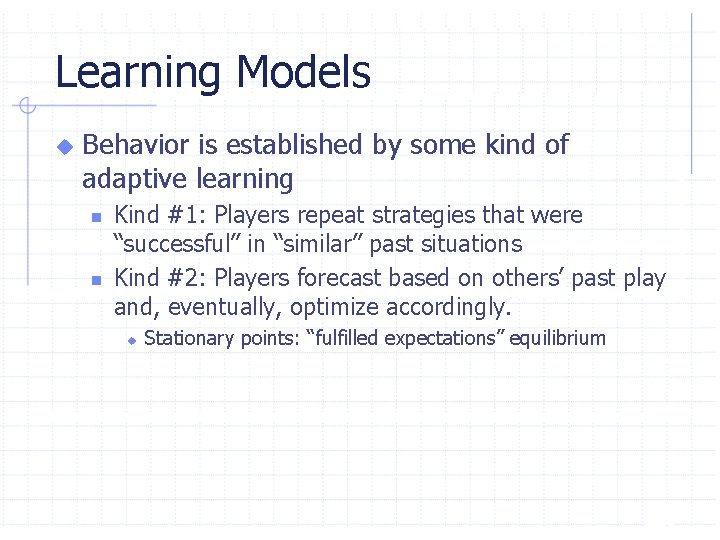
Learning Models u Behavior is established by some kind of adaptive learning n n Kind #1: Players repeat strategies that were “successful” in “similar” past situations Kind #2: Players forecast based on others’ past play and, eventually, optimize accordingly. u Stationary points: “fulfilled expectations” equilibrium
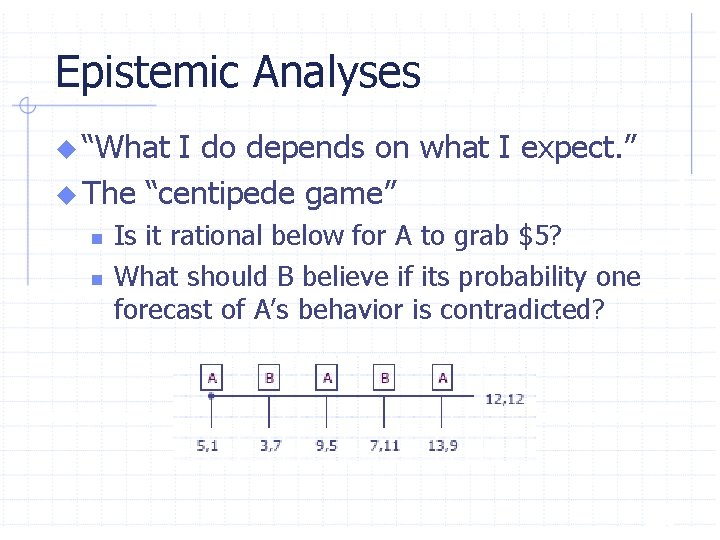
Epistemic Analyses u “What I do depends on what I expect. ” u The “centipede game” n n Is it rational below for A to grab $5? What should B believe if its probability one forecast of A’s behavior is contradicted?
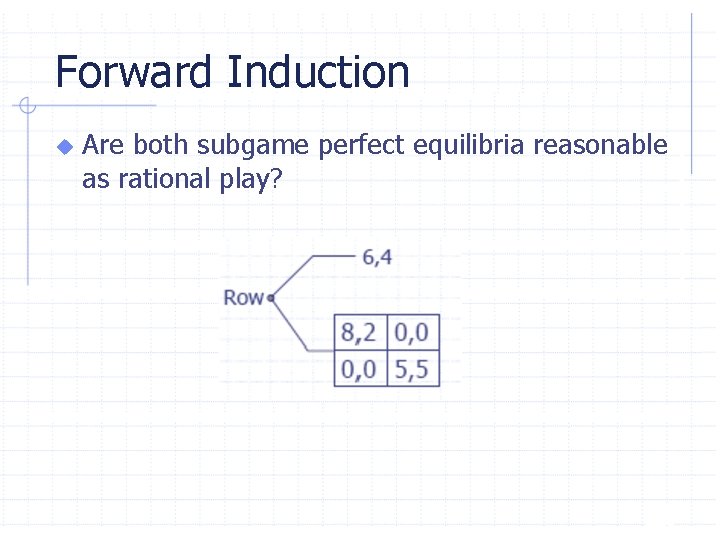
Forward Induction u Are both subgame perfect equilibria reasonable as rational play?