Ex prescription and FITT principles Interpretationshome exercises in





- Slides: 42
Ex prescription and FITT principles/ Interpretations/home exercises in Pulmonary Rehabilitation By Maria Buxton (With grateful acknowledgment to Sally Singh)
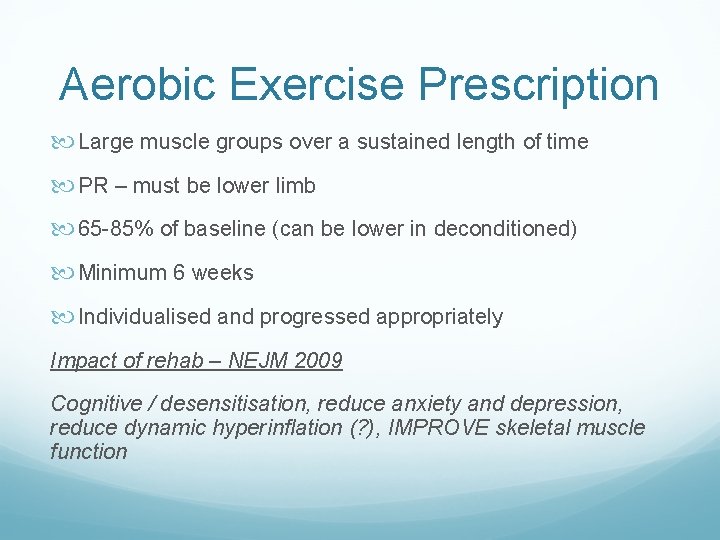
Aerobic Exercise Prescription Large muscle groups over a sustained length of time PR – must be lower limb 65 -85% of baseline (can be lower in deconditioned) Minimum 6 weeks Individualised and progressed appropriately Impact of rehab – NEJM 2009 Cognitive / desensitisation, reduce anxiety and depression, reduce dynamic hyperinflation (? ), IMPROVE skeletal muscle function
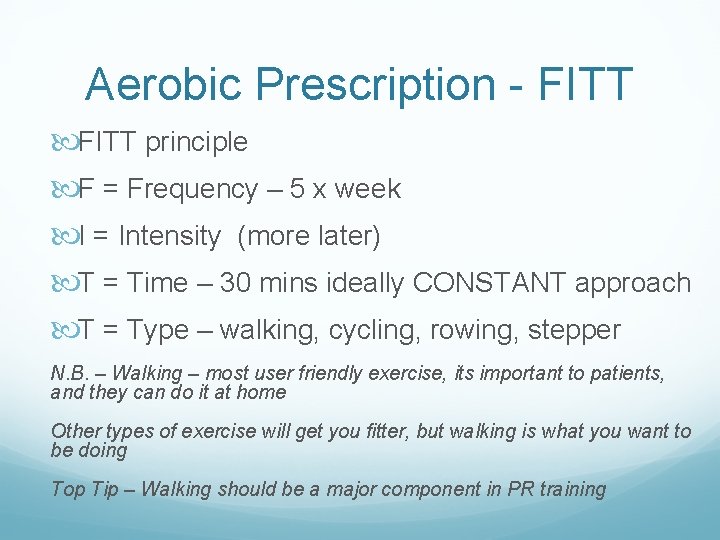
Aerobic Prescription - FITT principle F = Frequency – 5 x week I = Intensity (more later) T = Time – 30 mins ideally CONSTANT approach T = Type – walking, cycling, rowing, stepper N. B. – Walking – most user friendly exercise, its important to patients, and they can do it at home Other types of exercise will get you fitter, but walking is what you want to be doing Top Tip – Walking should be a major component in PR training
PR class and ‘homework’ F – Class = 2 x week ‘Homework’ = 3 x week extra – so exercise diaries required
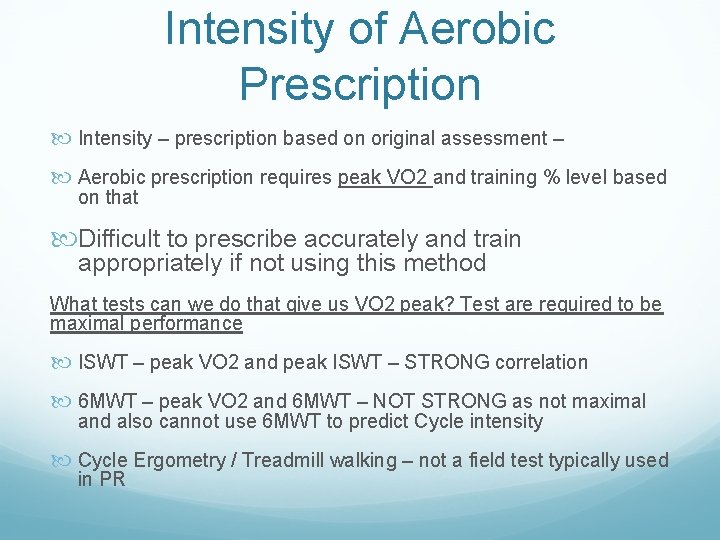
Intensity of Aerobic Prescription Intensity – prescription based on original assessment – Aerobic prescription requires peak VO 2 and training % level based on that Difficult to prescribe accurately and train appropriately if not using this method What tests can we do that give us VO 2 peak? Test are required to be maximal performance ISWT – peak VO 2 and peak ISWT – STRONG correlation 6 MWT – peak VO 2 and 6 MWT – NOT STRONG as not maximal and also cannot use 6 MWT to predict Cycle intensity Cycle Ergometry / Treadmill walking – not a field test typically used in PR
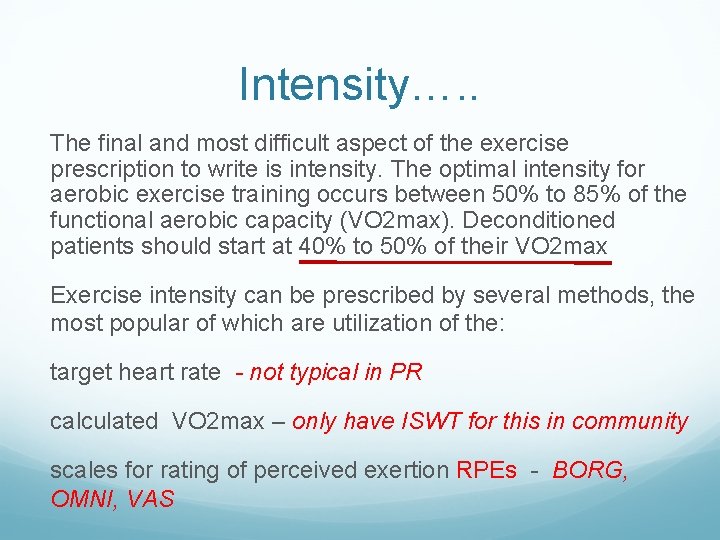
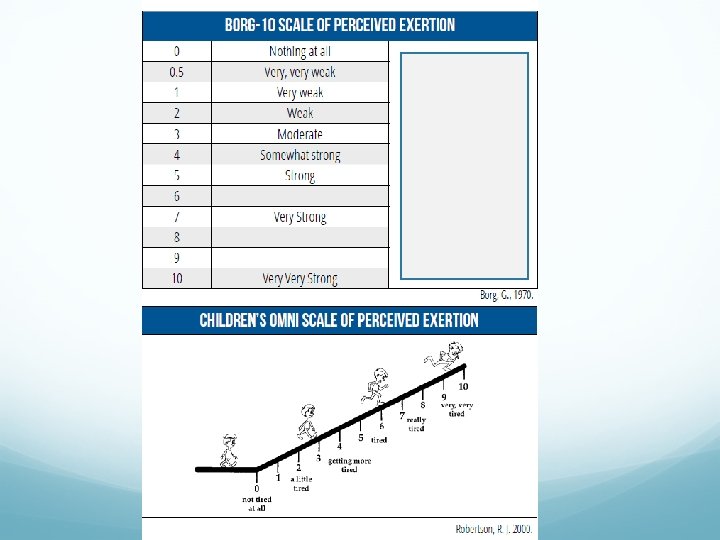
Intensity…. . The final and most difficult aspect of the exercise prescription to write is intensity. The optimal intensity for aerobic exercise training occurs between 50% to 85% of the functional aerobic capacity (VO 2 max). Deconditioned patients should start at 40% to 50% of their VO 2 max Exercise intensity can be prescribed by several methods, the most popular of which are utilization of the: target heart rate - not typical in PR calculated VO 2 max – only have ISWT for this in community scales for rating of perceived exertion RPEs - BORG, OMNI, VAS
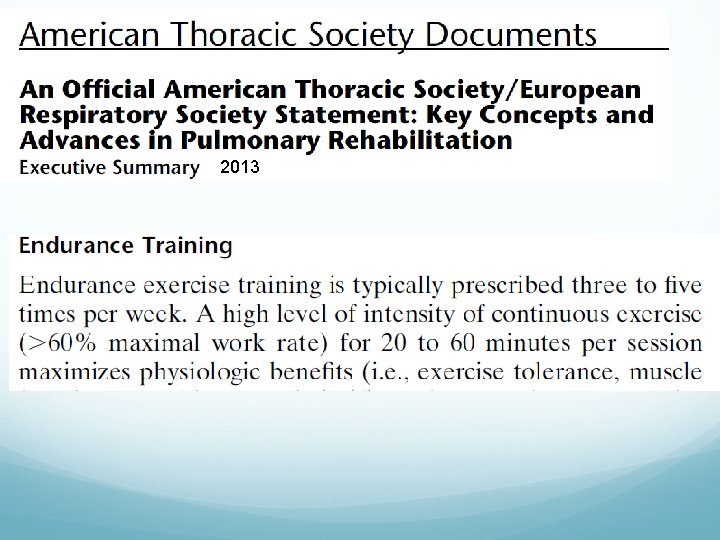
2013
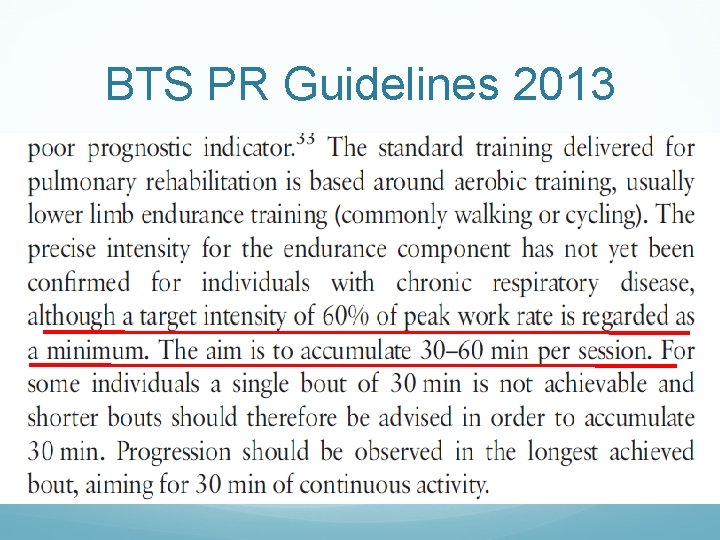
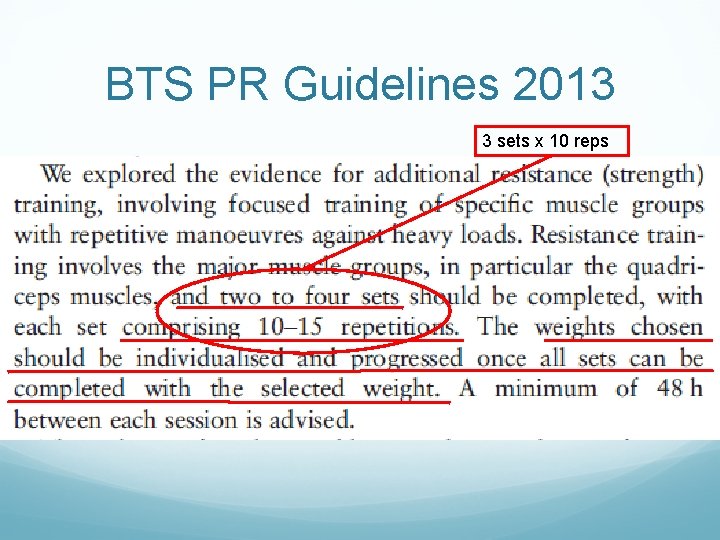
BTS PR Guidelines 2013
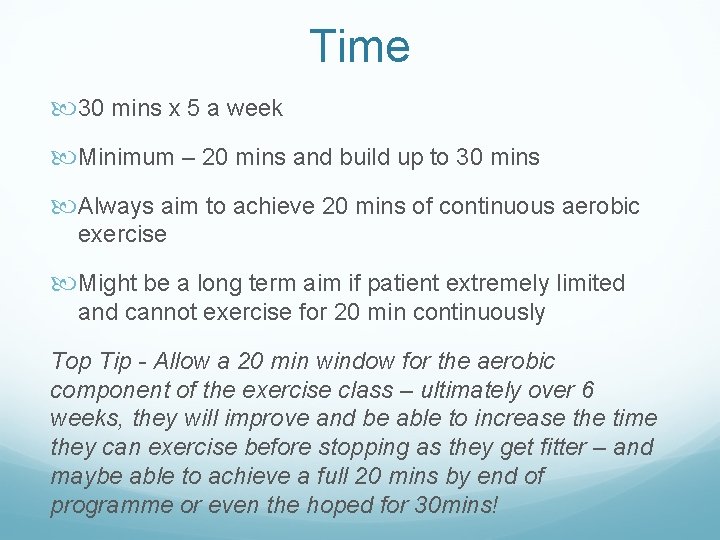
Time 30 mins x 5 a week Minimum – 20 mins and build up to 30 mins Always aim to achieve 20 mins of continuous aerobic exercise Might be a long term aim if patient extremely limited and cannot exercise for 20 min continuously Top Tip - Allow a 20 min window for the aerobic component of the exercise class – ultimately over 6 weeks, they will improve and be able to increase the time they can exercise before stopping as they get fitter – and maybe able to achieve a full 20 mins by end of programme or even the hoped for 30 mins!
Top Tip on the time spent doing aerobic exercise - 20 mins minimum, but 30 mins main goal CONSTANT exercise - Constant = Constant (this can include rest periods if too breathless, but time allocated to the exercise still is 20 mins - This is NOT a circuit when 2 mins on, 1 min off approach - Evidence of breaking up 20 mins into 2 x 10 min sessions, but try and aim at the end of 6 weeks to combine sessions to a continuous 20 mins and ultimately 30 min
Fitness levels PR = initial conditioning phase lasts approximately 4 to 6 weeks. During this phase, training effects should be appreciated. These are a decrease in resting heart rate, more rapid recovery of resting heart rate following physical activity, and the ability to increase duration and intensity without increasing fatigue. Post PR = improvement conditioning phase lasts approximately 4 to 6 months. Patients can be progressed to reach target heart rates or desired duration of physical activity. It is best to first increase the duration of activity to the desired length and then increase the intensity. The patient will continue to enhance cardiorespiratory fitness resulting in improved endurance and resistance to early fatigue. Long term - Most patients enter the maintenance conditioning phase after 6 months of regular exercise
Interval vs Continuous Training Continuous approach is what is recommended Interval Training = 100% peak work rate!!!!! Interval endurance training allows intense loads on peripheral muscles without reaching the ventilatory limit E. g. cycle at 100% = So Interval training regimen = 30 secs cycle at 100%, then 30 secs rest, - repeated x 45 mins ONLY possible in Cycle Ergometry and so NOT for typical PR Interesting point – reported dyspnoea is less in interval training that in continuous
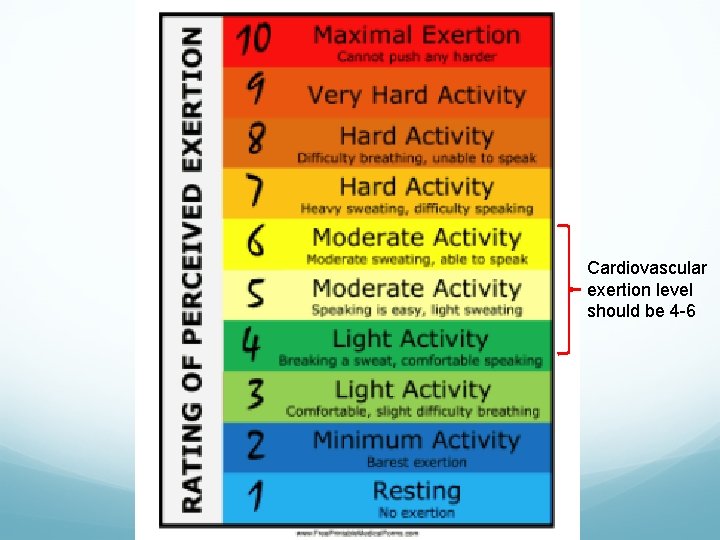
Circuit Training Variety of exercises – aerobic and strength Aerobic Part - practical field exercises (other than walking / cycle ) – e. g. Marching on the Spot, Star Jacks How to prescribe Intensity? Impossible to be perfect as no maximal VO 2 equivalent assessment performed Top Tip – 1. Try using ESWT speed – as this is 85% of ISWT peak speed which correlates to VO 2 peak – perceived exertion when walking at ESWT – BORG. Use this score to address how they should feel during the Marching, Star Jacks etc – it needs to be the same to address the Intensity This implies that have done ISWT and experience of ESWT 2. Or use BORG, OMNI or RPE – as long as this is reproducible and achieving desired outcome of intensity
Cardiovascular exertion level should be 4 -6
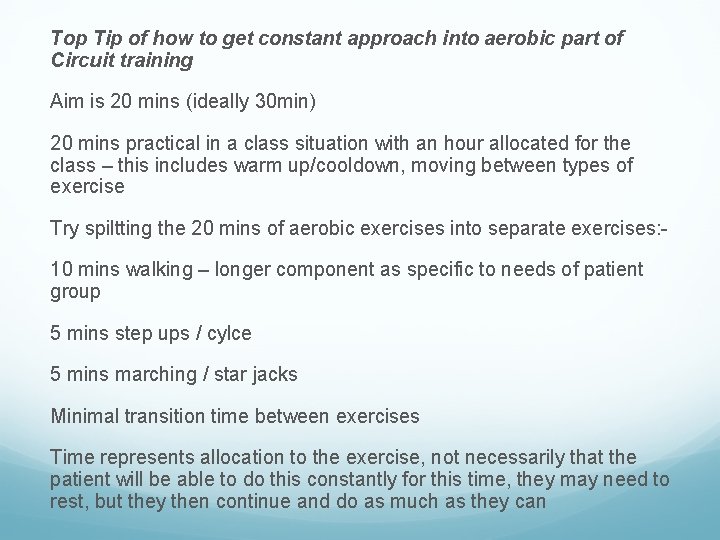
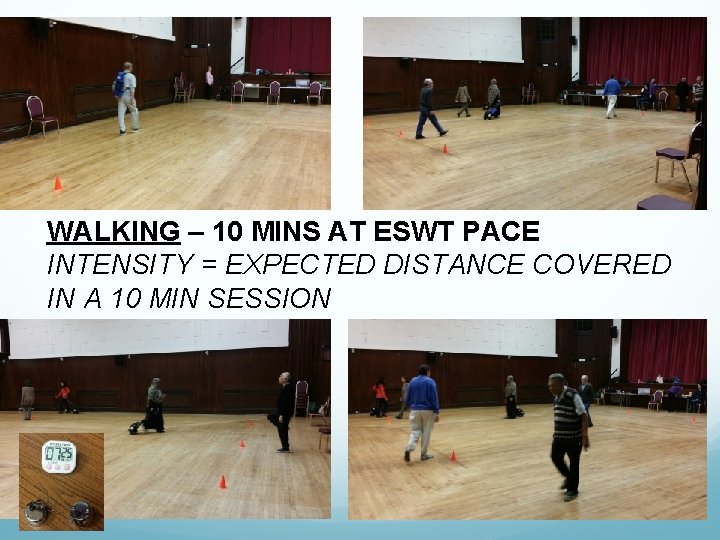
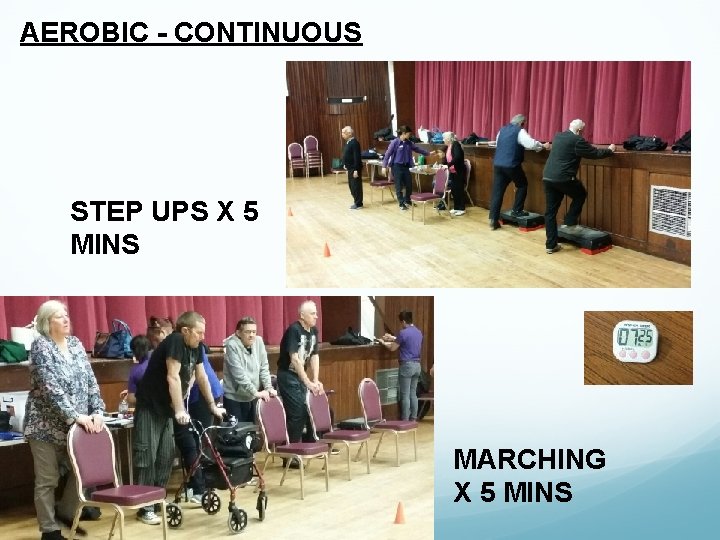
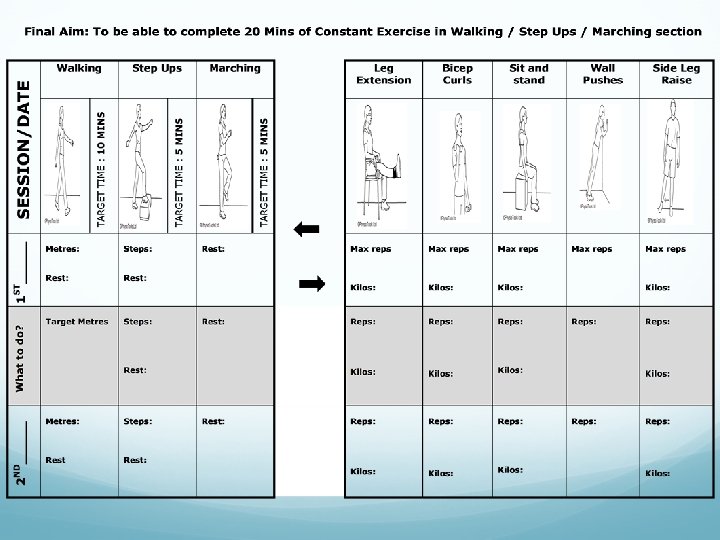
Top Tip of how to get constant approach into aerobic part of Circuit training Aim is 20 mins (ideally 30 min) 20 mins practical in a class situation with an hour allocated for the class – this includes warm up/cooldown, moving between types of exercise Try spiltting the 20 mins of aerobic exercises into separate exercises: 10 mins walking – longer component as specific to needs of patient group 5 mins step ups / cylce 5 mins marching / star jacks Minimal transition time between exercises Time represents allocation to the exercise, not necessarily that the patient will be able to do this constantly for this time, they may need to rest, but they then continue and do as much as they can
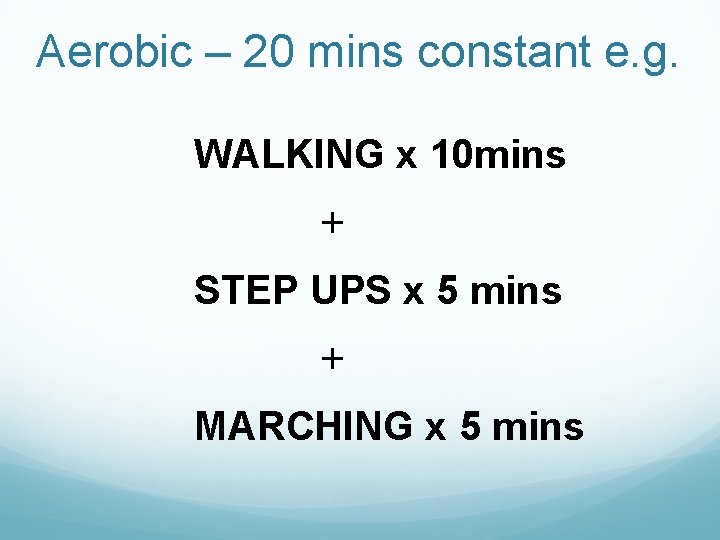
Aerobic – 20 mins constant e. g. WALKING x 10 mins + STEP UPS x 5 mins + MARCHING x 5 mins
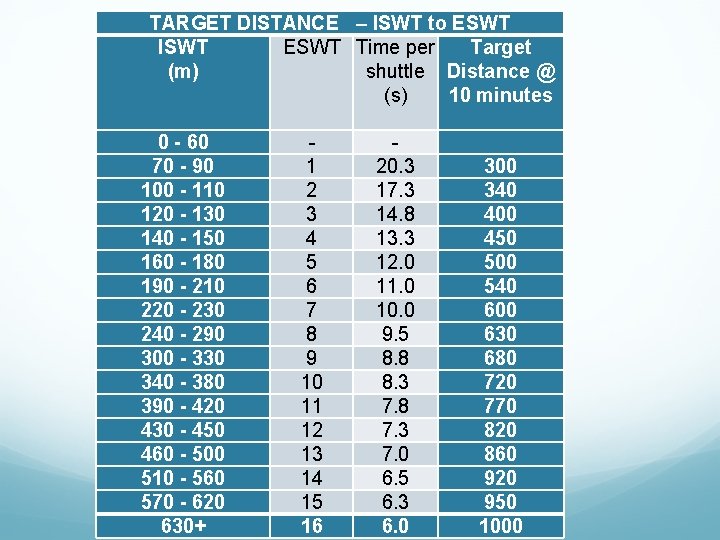
WALKING – 10 MINS AT ESWT PACE INTENSITY = EXPECTED DISTANCE COVERED IN A 10 MIN SESSION
TARGET DISTANCE – ISWT to ESWT ISWT ESWT Time per Target (m) shuttle Distance @ (s) 10 minutes 0 - 60 70 - 90 100 - 110 120 - 130 140 - 150 160 - 180 190 - 210 220 - 230 240 - 290 300 - 330 340 - 380 390 - 420 430 - 450 460 - 500 510 - 560 570 - 620 630+ 1 2 3 4 5 6 7 8 9 10 11 12 13 14 15 16 20. 3 17. 3 14. 8 13. 3 12. 0 11. 0 10. 0 9. 5 8. 8 8. 3 7. 8 7. 3 7. 0 6. 5 6. 3 6. 0 300 340 400 450 500 540 600 630 680 720 770 820 860 920 950 1000
AEROBIC - CONTINUOUS STEP UPS X 5 MINS MARCHING X 5 MINS
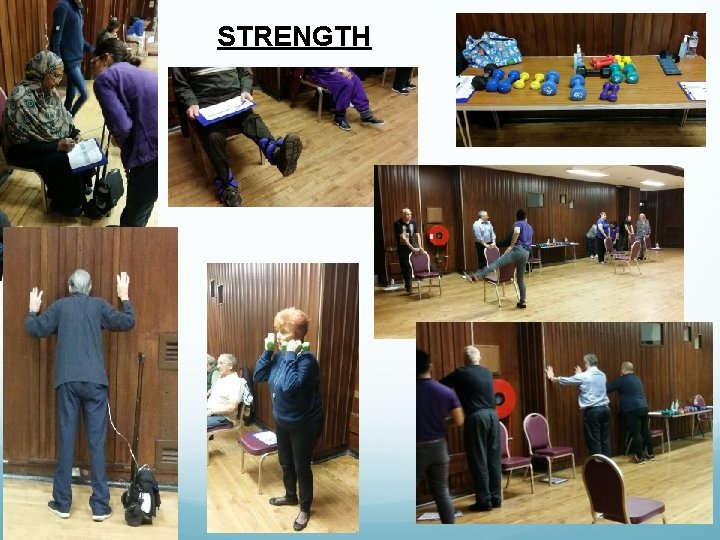
STRENGTH
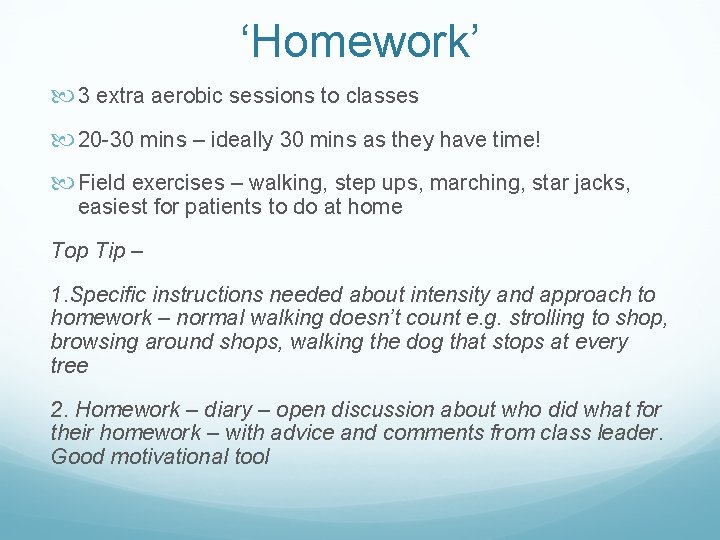
‘Homework’ 3 extra aerobic sessions to classes 20 -30 mins – ideally 30 mins as they have time! Field exercises – walking, step ups, marching, star jacks, easiest for patients to do at home Top Tip – 1. Specific instructions needed about intensity and approach to homework – normal walking doesn’t count e. g. strolling to shop, browsing around shops, walking the dog that stops at every tree 2. Homework – diary – open discussion about who did what for their homework – with advice and comments from class leader. Good motivational tool
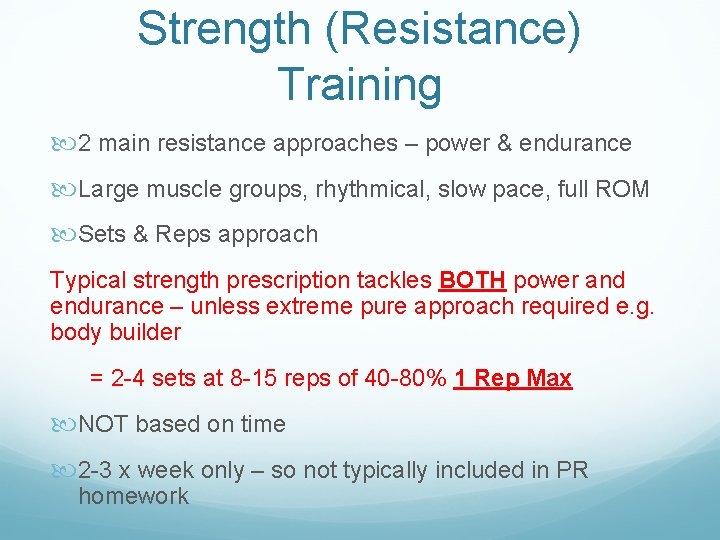
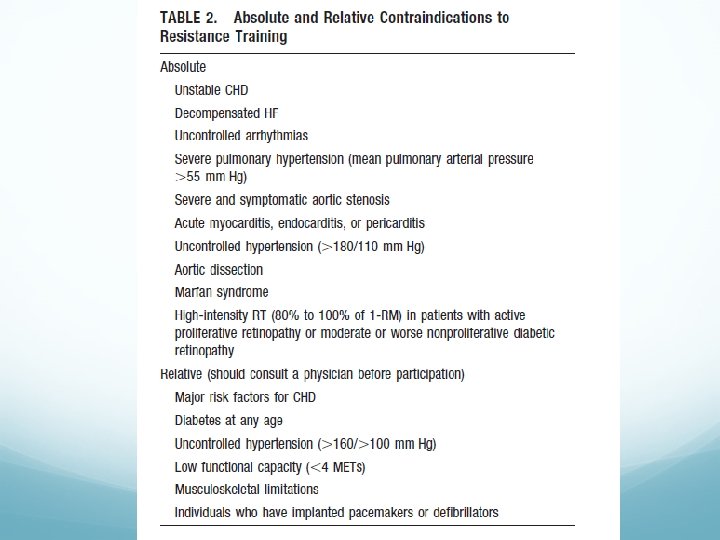
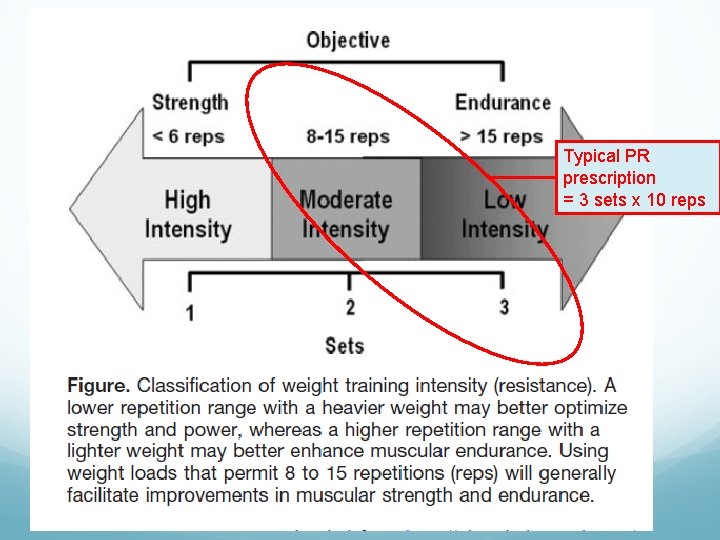
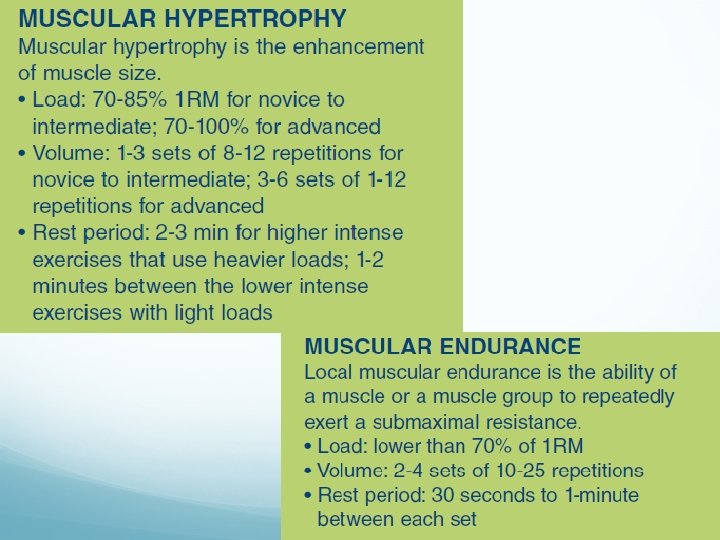
Strength (Resistance) Training 2 main resistance approaches – power & endurance Large muscle groups, rhythmical, slow pace, full ROM Sets & Reps approach Typical strength prescription tackles BOTH power and endurance – unless extreme pure approach required e. g. body builder = 2 -4 sets at 8 -15 reps of 40 -80% 1 Rep Max NOT based on time 2 -3 x week only – so not typically included in PR homework
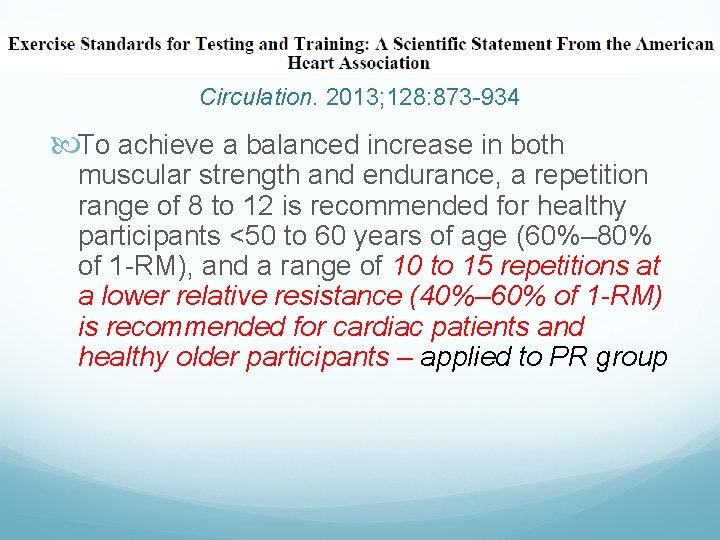
Circulation. 2013; 128: 873 -934 To achieve a balanced increase in both muscular strength and endurance, a repetition range of 8 to 12 is recommended for healthy participants <50 to 60 years of age (60%– 80% of 1 -RM), and a range of 10 to 15 repetitions at a lower relative resistance (40%– 60% of 1 -RM) is recommended for cardiac patients and healthy older participants – applied to PR group
Typical PR prescription = 3 sets x 10 reps
BTS PR Guidelines 2013 3 sets x 10 reps
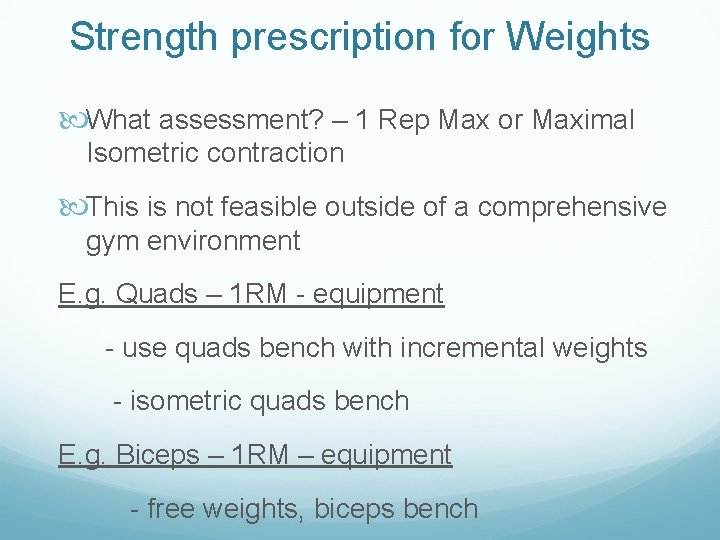
Strength prescription for Weights What assessment? – 1 Rep Max or Maximal Isometric contraction This is not feasible outside of a comprehensive gym environment E. g. Quads – 1 RM - equipment - use quads bench with incremental weights - isometric quads bench E. g. Biceps – 1 RM – equipment - free weights, biceps bench
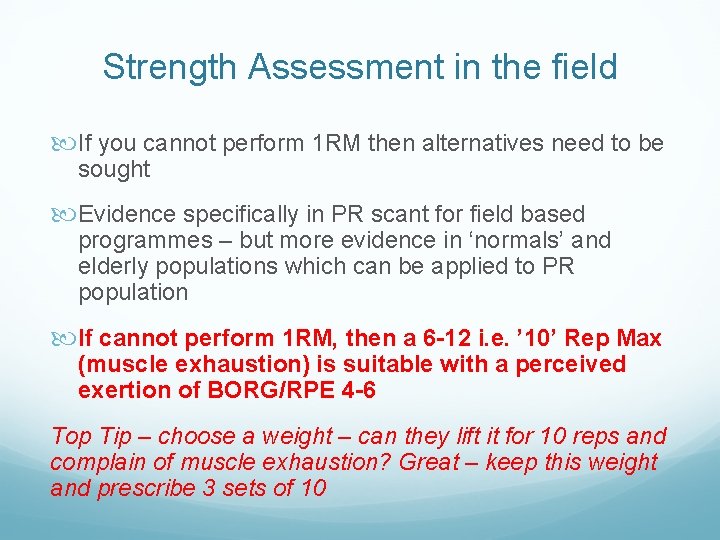
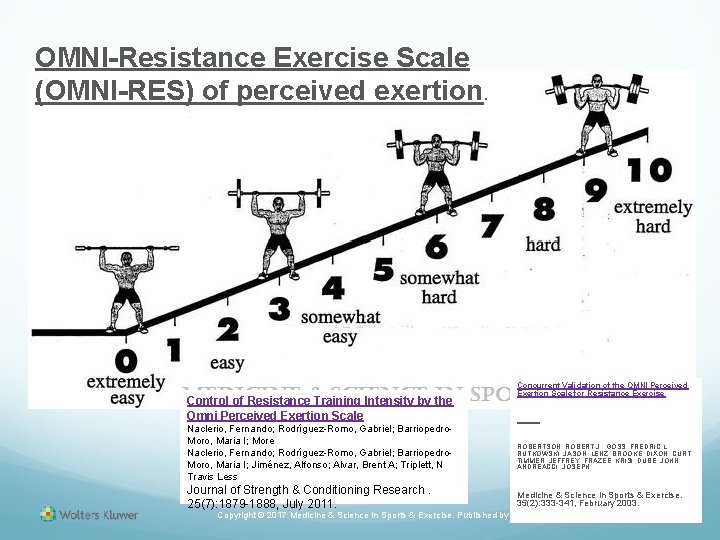
Strength Assessment in the field If you cannot perform 1 RM then alternatives need to be sought Evidence specifically in PR scant for field based programmes – but more evidence in ‘normals’ and elderly populations which can be applied to PR population If cannot perform 1 RM, then a 6 -12 i. e. ’ 10’ Rep Max (muscle exhaustion) is suitable with a perceived exertion of BORG/RPE 4 -6 Top Tip – choose a weight – can they lift it for 10 reps and complain of muscle exhaustion? Great – keep this weight and prescribe 3 sets of 10
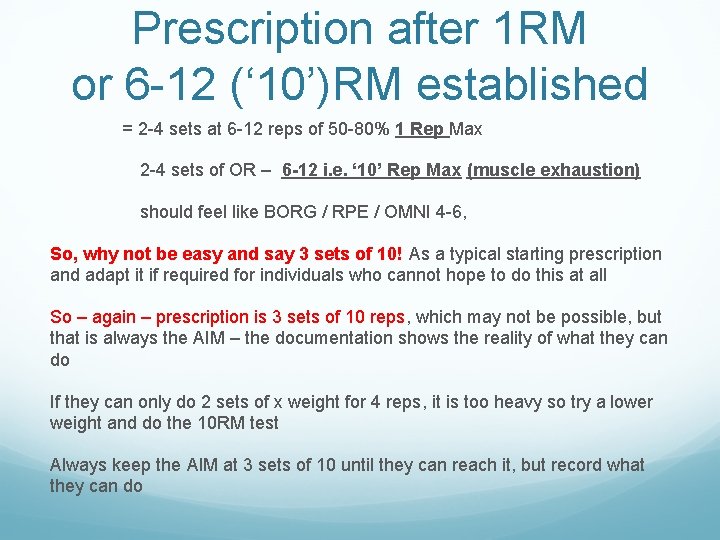
Prescription after 1 RM or 6 -12 (‘ 10’)RM established = 2 -4 sets at 6 -12 reps of 50 -80% 1 Rep Max 2 -4 sets of OR – 6 -12 i. e. ‘ 10’ Rep Max (muscle exhaustion) should feel like BORG / RPE / OMNI 4 -6, So, why not be easy and say 3 sets of 10! As a typical starting prescription and adapt it if required for individuals who cannot hope to do this at all So – again – prescription is 3 sets of 10 reps, which may not be possible, but that is always the AIM – the documentation shows the reality of what they can do If they can only do 2 sets of x weight for 4 reps, it is too heavy so try a lower weight and do the 10 RM test Always keep the AIM at 3 sets of 10 until they can reach it, but record what they can do
OMNI-Resistance Exercise Scale (OMNI-RES) of perceived exertion. Control of Resistance Training Intensity by the Omni Perceived Exertion Scale Naclerio, Fernando; Rodríguez-Romo, Gabriel; Barriopedro. Moro, Maria I; More Naclerio, Fernando; Rodríguez-Romo, Gabriel; Barriopedro. Moro, Maria I; Jiménez, Alfonso; Alvar, Brent A; Triplett, N Travis Less Journal of Strength & Conditioning Research. 25(7): 1879 -1888, July 2011. Concurrent Validation of the OMNI Perceived Exertion Scale for Resistance Exercise ROBERTSON, ROBERT J. ; GOSS, FREDRIC L. ; RUTKOWSKI, JASON; LENZ, BROOKE; DIXON, CURT; TIMMER, JEFFREY; FRAZEE, KRISI; DUBE, JOHN; ANDREACCI, JOSEPH Medicine & Science in Sports & Exercise. 35(2): 333 -341, February 2003. Copyright © 2017 Medicine & Science in Sports & Exercise. Published by Lippincott Williams & Wilkins. 36
Progression of Weight exercises If they can easily do 3 sets of x weight for 10 reps for 2 classes – INCREASE weight Re-prescribe as target is 3 sets of 10 reps, but in reality they can only do 3 sets of 4 reps - keep this prescription until they can do it RESTS between each set – Important due to metabolic, hormonal changes within muscle – rest is required – usually 1 -2 mins between sets get the best results
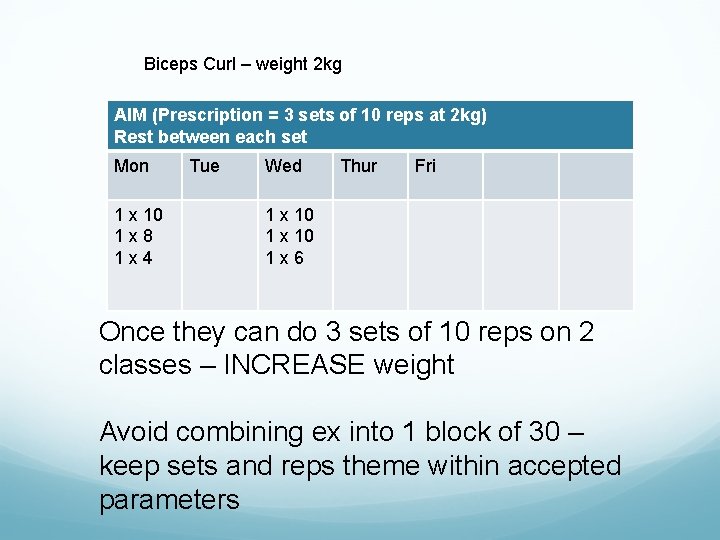
Biceps Curl – weight 2 kg AIM (Prescription = 3 sets of 10 reps at 2 kg) Rest between each set Mon 1 x 10 1 x 8 1 x 4 Tue Wed Thur Fri 1 x 10 1 x 6 Once they can do 3 sets of 10 reps on 2 classes – INCREASE weight Avoid combining ex into 1 block of 30 – keep sets and reps theme within accepted parameters
Non-weight resistance exercises E. g. sit to stand, wall push offs, squats, Possible methods : – e. Max test in 1 minute – Reps = 60 -75% x 3 sets Intensity to RPE / BORG 4 -6 – then apply intensity based on BORG/RPE at level 4 -6 to other exercises Top Tip – they should ‘feel’ that all exercises are as hard as each other even if the weights / reps are totally different
Quantity and Quality of Exercise for Developing and Maintaining Cardiorespiratory, Musculoskeletal, and Neuromotor Fitness in Apparently Healthy Adults: Guidance for Prescribing Exercise Medicine & Science in Sports & Exercise: July 2011 - Volume 43 - Issue 7 - pp 13341359