
Exercise Prescription for the Certified Cardiac Rehab Professional

Exercise Prescription for the Certified Cardiac Rehab Professional Erik Ostrowski, MS, ACSM-RCEP, CCRP Southern Illinois Healthcare Herrin Hospital
Today Exercise prescription (Ex Rx) as it relates to the CCRP exam Certified Cardiac Rehab Professional Specific Ex Rx recommendations for pulmonary patients have been omitted Most Ex Rx concepts for cardiac patients remain interchangeable with other chronic disease conditions
CCRP Exam Categories 10 Categories 1. Patient assessment 2. Nutritional management 3. Weight management 4. Blood lipid management 5. Blood pressure management 6. Diabetes management 7. Tobacco Cessation 8. Pyschosocial Management 9. Physical Activity Counseling 10. Exercise Training
CCRP Exam Blueprint Exercise Training Design and modify an aerobic exercise training program (10. 11, 10. 12, 10. 13) Understand consider various physiologic measures for use in an Ex Rx HR, HRR, VO 2 R and METs (10. 6) Design and modify a resistance training program (10. 15)
Components of the Ex Rx FITT Principle are four primary variables that need to be considered when designing a basic Ex Rx There F I – Frequency – Time T - Type (difficulty) %HRmax, %HRR, %VO 2 max, %VO 2 R, METs, RPE Time (duration) # of days per week Intensity – Intensity T Frequency minutes per session Type (mode) Continuous, rhythmic activities that involve large muscle groups
Components of the Ex Rx What are we missing? ? ? Progression Volume Principle becomes the FITT-VP Principle F I – Frequency – Intensity T – Time T – Type V – Volume P – Progression FITT
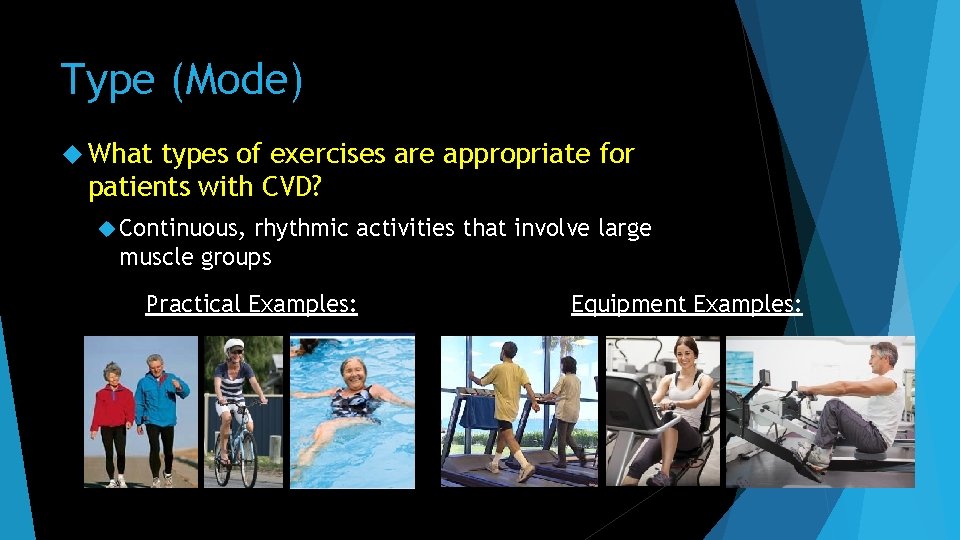
Type (Mode) What types of exercises are appropriate for patients with CVD? Continuous, rhythmic activities that involve large muscle groups Practical Examples: Equipment Examples:
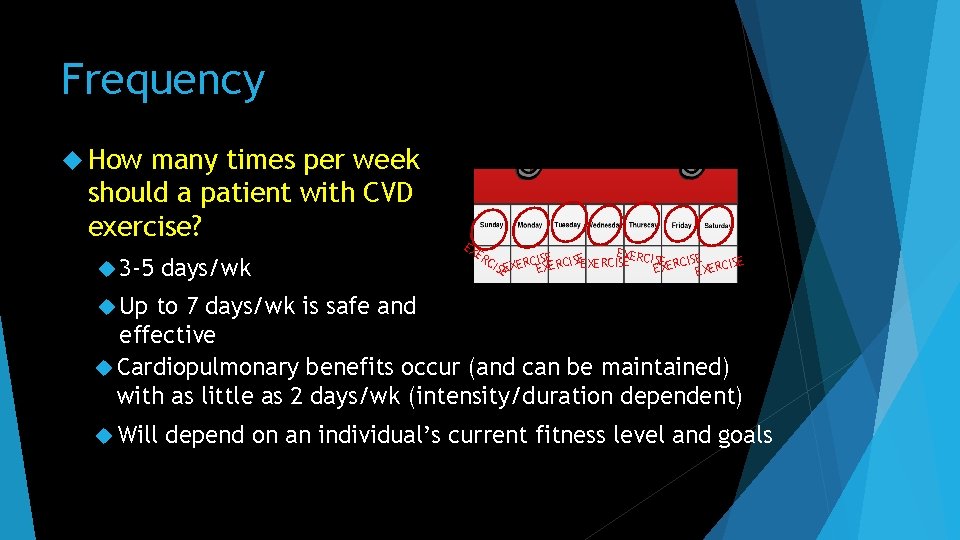
Frequency How many times per week should a patient with CVD exercise? 3 -5 days/wk EX E EXERCI E SE RCISE ISEEXERCIESXERCISEEXERCISE EXE EXER RC Up to 7 days/wk is safe and effective Cardiopulmonary benefits occur (and can be maintained) with as little as 2 days/wk (intensity/duration dependent) Will depend on an individual’s current fitness level and goals
Time (Duration) How many minutes should a patient with CVD exercise during a given session? 20 -60 May minutes be accumulated in shorter intervals of at least 10 minutes per interval In extremely deconditioned individuals, shorter intervals are acceptable with a goal to attain 10 minutes of continuous exercise before resting
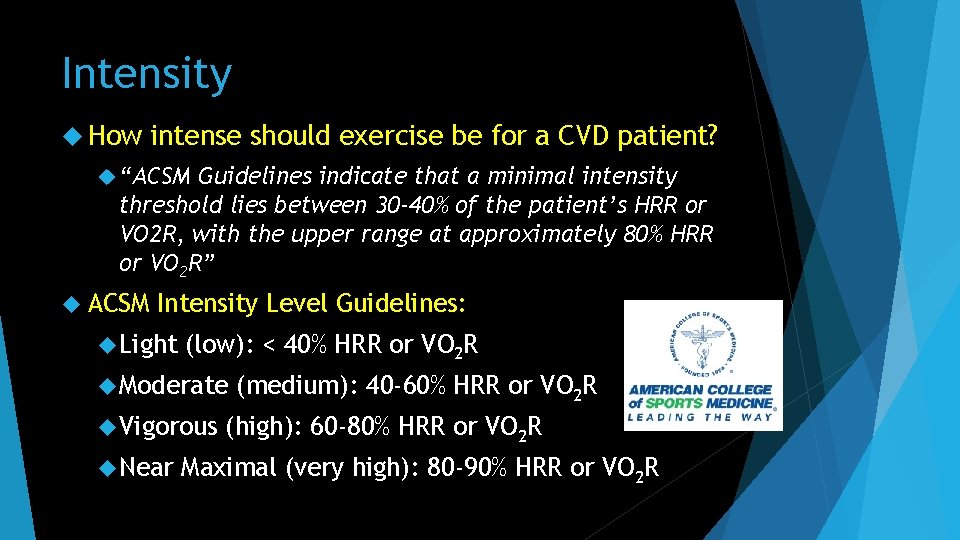
Intensity How intense should exercise be for a CVD patient? “ACSM Guidelines indicate that a minimal intensity threshold lies between 30 -40% of the patient’s HRR or VO 2 R, with the upper range at approximately 80% HRR or VO 2 R” ACSM Intensity Level Guidelines: Light (low): < 40% HRR or VO 2 R Moderate Vigorous Near (medium): 40 -60% HRR or VO 2 R (high): 60 -80% HRR or VO 2 R Maximal (very high): 80 -90% HRR or VO 2 R
Intensity What about an upper limit to exercise intensity levels for patients with CVD? Up to 80% HRR or VO 2 R is safe during continuous exercise Up to 90 -95% peak HR for short bouts during HIIT In other words, don’t be afraid to allow your patients to continue exercising past their age-predicted or estimated values if they are NOT asymptomatic!
Physiological Measures Heart Rate Maximum (HRmax) An individual’s maximum achievable heart rate Expressed Heart The Rate Reserve (HRR) difference between maximal and resting HR values Expressed Also in beats-per-min (bpm) called “Maximal Heart Rate Reserve (MHRR)”
Heart Rate Reserve (HRR) Method Karvonen Formula: ((HRmax – HRrest) x %) + HRrest 1. Also referred to as the Karvonen Method Find HRmax Directly measure using a maximal cardiopulmonary stress test Estimate 2. through equation (220 -age) Find HRrest Directly measure via palpation (or pulse oximeter) at rest 3. Pick the desired ACSM intensity level (%) 4. Input numbers into Karvonen Formula HRmax, HRrest, and the desired ACSM intensity level
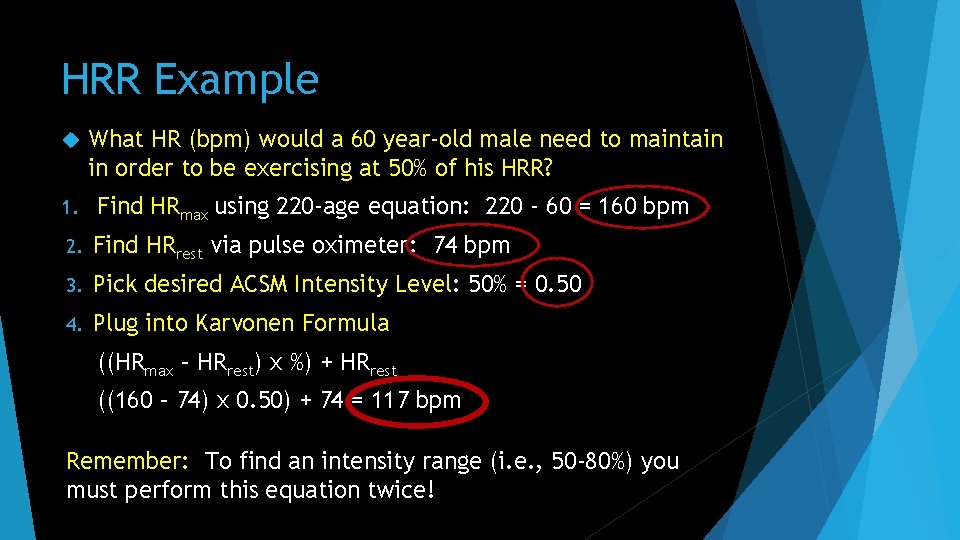
HRR Example What HR (bpm) would a 60 year-old male need to maintain in order to be exercising at 50% of his HRR? 1. Find HRmax using 220 -age equation: 220 - 60 = 160 bpm 2. Find HRrest via pulse oximeter: 74 bpm 3. Pick desired ACSM Intensity Level: 50% = 0. 50 4. Plug into Karvonen Formula ((HRmax – HRrest) x %) + HRrest ((160 – 74) x 0. 50) + 74 = 117 bpm Remember: To find an intensity range (i. e. , 50 -80%) you must perform this equation twice!

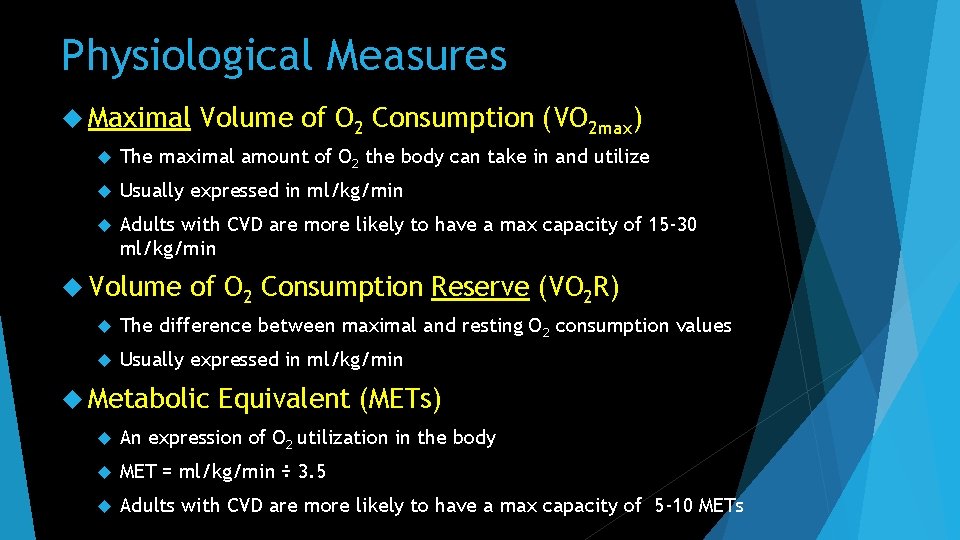
Physiological Measures Maximal Volume of O 2 Consumption (VO 2 max) The maximal amount of O 2 the body can take in and utilize Usually expressed in ml/kg/min Adults with CVD are more likely to have a max capacity of 15 -30 ml/kg/min Volume of O 2 Consumption Reserve (VO 2 R) The difference between maximal and resting O 2 consumption values Usually expressed in ml/kg/min Metabolic Equivalent (METs) An expression of O 2 utilization in the body MET = ml/kg/min ÷ 3. 5 Adults with CVD are more likely to have a max capacity of 5 -10 METs
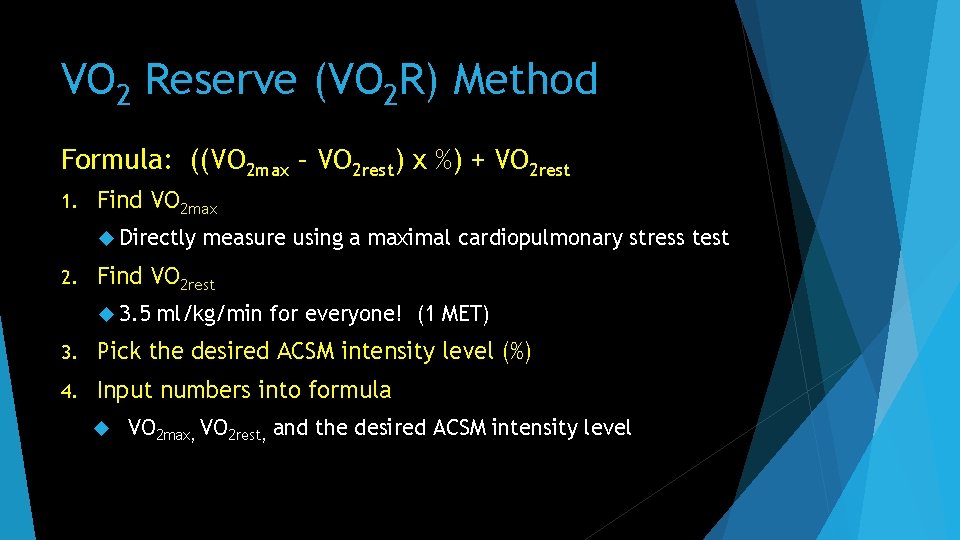
VO 2 Reserve (VO 2 R) Method Formula: ((VO 2 max – VO 2 rest) x %) + VO 2 rest 1. Find VO 2 max Directly 2. measure using a maximal cardiopulmonary stress test Find VO 2 rest 3. 5 ml/kg/min for everyone! (1 MET) 3. Pick the desired ACSM intensity level (%) 4. Input numbers into formula VO 2 max, VO 2 rest, and the desired ACSM intensity level
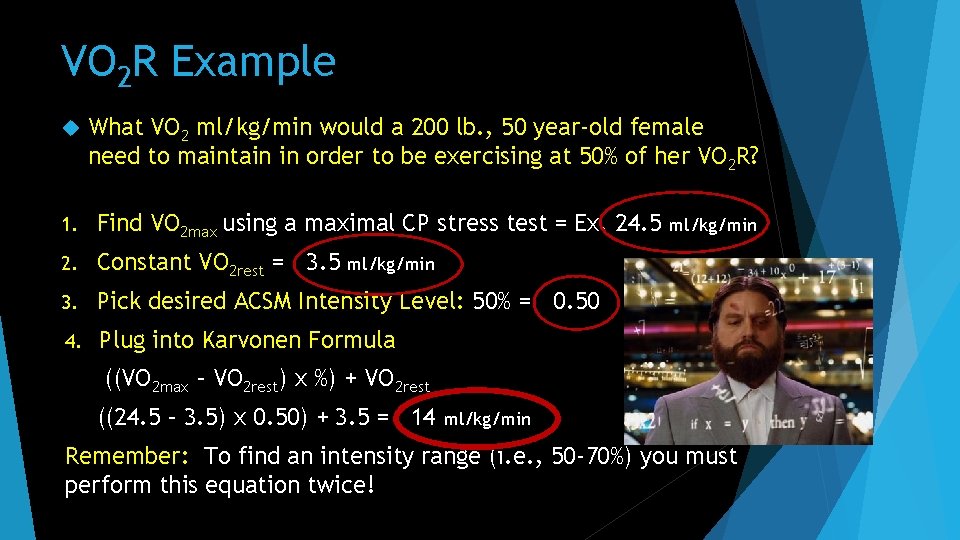
VO 2 R Example What VO 2 ml/kg/min would a 200 lb. , 50 year-old female need to maintain in order to be exercising at 50% of her VO 2 R? 1. Find VO 2 max using a maximal CP stress test = Ex. 24. 5 2. Constant VO 2 rest = 3. 5 3. Pick desired ACSM Intensity Level: 50% = 0. 50 4. Plug into Karvonen Formula ml/kg/min ((VO 2 max – VO 2 rest) x %) + VO 2 rest ((24. 5 – 3. 5) x 0. 50) + 3. 5 = 14 ml/kg/min Remember: To find an intensity range (i. e. , 50 -70%) you must perform this equation twice!
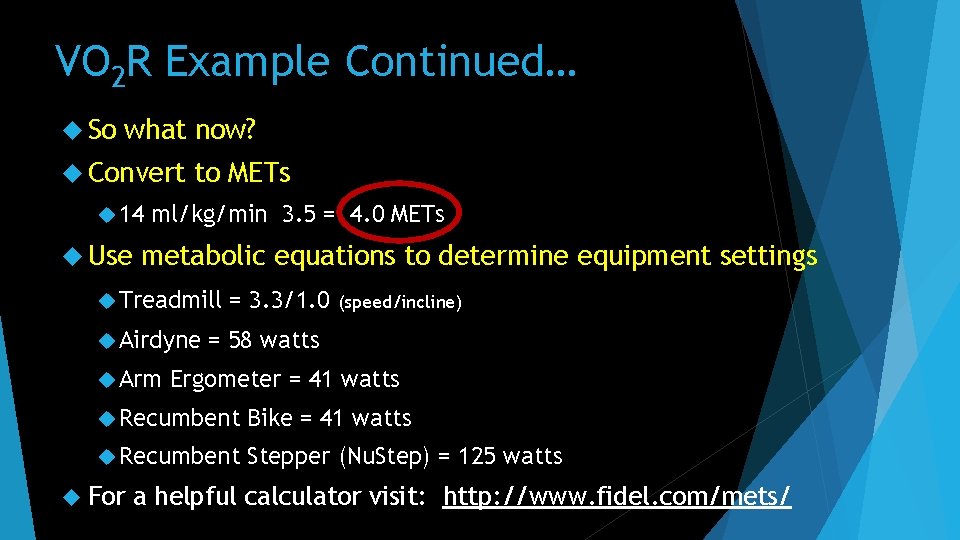
VO 2 R Example Continued… So what now? Convert 14 Use to METs ml/kg/min 3. 5 = 4. 0 METs metabolic equations to determine equipment settings Treadmill Airdyne Arm = 3. 3/1. 0 (speed/incline) = 58 watts Ergometer = 41 watts Recumbent Bike = 41 watts Recumbent Stepper (Nu. Step) = 125 watts For a helpful calculator visit: http: //www. fidel. com/mets/
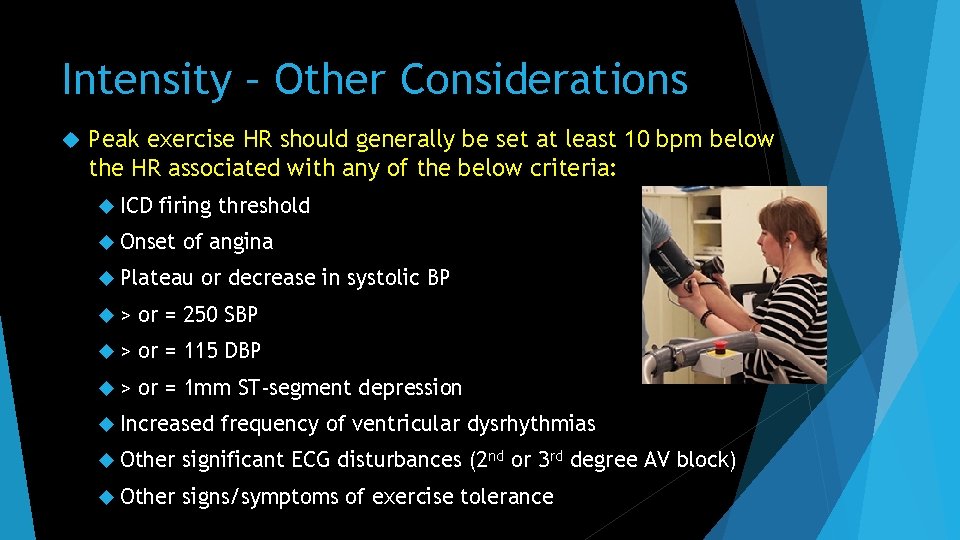
Intensity – Other Considerations Peak exercise HR should generally be set at least 10 bpm below the HR associated with any of the below criteria: ICD firing threshold Onset of angina Plateau or decrease in systolic BP > or = 250 SBP > or = 115 DBP > or = 1 mm ST-segment depression Increased frequency of ventricular dysrhythmias Other significant ECG disturbances (2 nd or 3 rd degree AV block) Other signs/symptoms of exercise tolerance
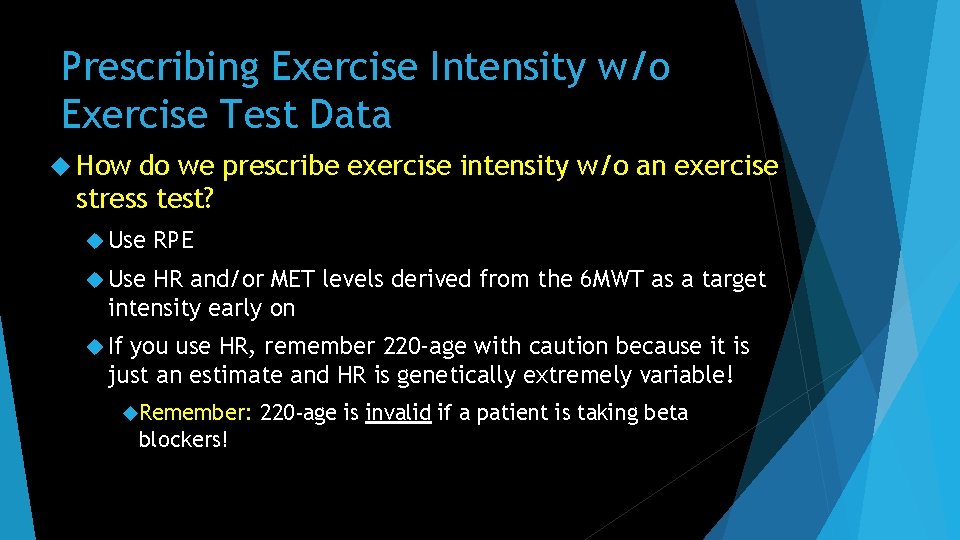
Prescribing Exercise Intensity w/o Exercise Test Data How do we prescribe exercise intensity w/o an exercise stress test? Use RPE Use HR and/or MET levels derived from the 6 MWT as a target intensity early on If you use HR, remember 220 -age with caution because it is just an estimate and HR is genetically extremely variable! Remember: blockers! 220 -age is invalid if a patient is taking beta
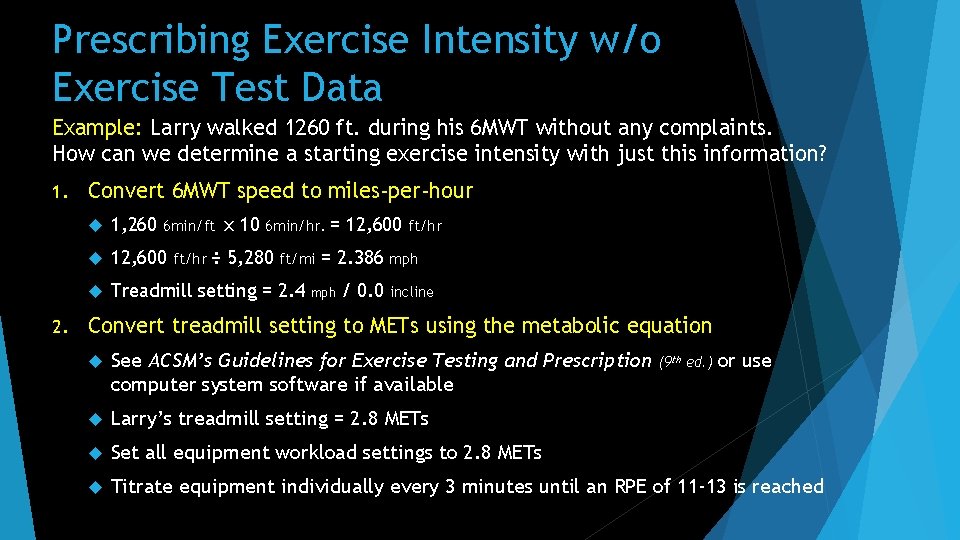
Prescribing Exercise Intensity w/o Exercise Test Data Example: Larry walked 1260 ft. during his 6 MWT without any complaints. How can we determine a starting exercise intensity with just this information? 1. 2. Convert 6 MWT speed to miles-per-hour 1, 260 12, 600 Treadmill setting = 2. 4 6 min/ft ft/hr x 10 6 min/hr. ÷ 5, 280 ft/mi = 12, 600 = 2. 386 mph / 0. 0 ft/hr mph incline Convert treadmill setting to METs using the metabolic equation See ACSM’s Guidelines for Exercise Testing and Prescription computer system software if available Larry’s treadmill setting = 2. 8 METs Set all equipment workload settings to 2. 8 METs Titrate equipment individually every 3 minutes until an RPE of 11 -13 is reached (9 th ed. ) or use
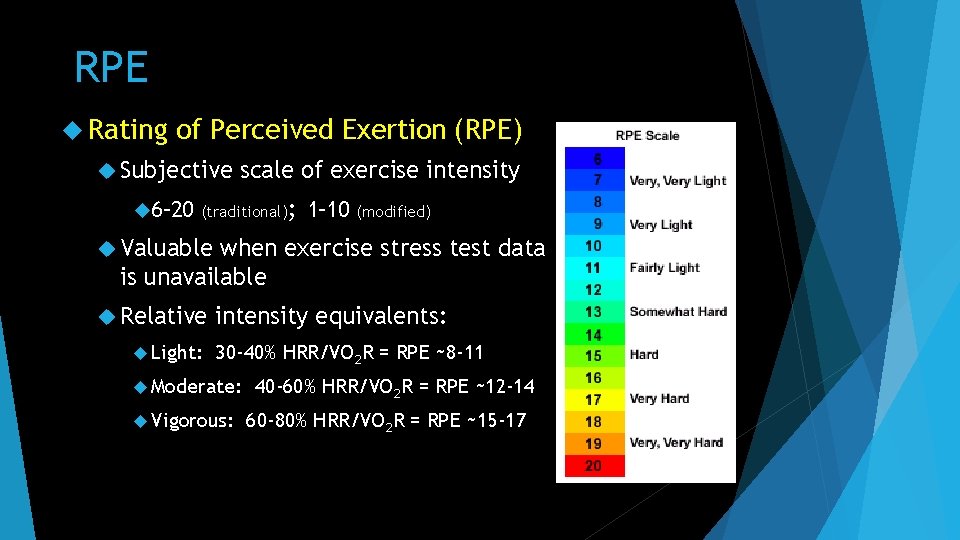
RPE Rating of Perceived Exertion (RPE) Subjective scale of exercise intensity 6– 20 (traditional); 1– 10 (modified) Valuable when exercise stress test data is unavailable Relative Light: intensity equivalents: 30 -40% HRR/VO 2 R = RPE ~8 -11 Moderate: Vigorous: 40 -60% HRR/VO 2 R = RPE ~12 -14 60 -80% HRR/VO 2 R = RPE ~15 -17
Progression Starting exercise goal: Attain 30 -40 minutes of continuous exercise at a lowmoderate intensity (RPE 11 -13) per session Progression goals: Gradually titrate upward the frequency, intensity and duration of exercise until the patient achieves: 5 -7 sessions per week 150 -300 (this includes home exercise!) mins per week 50 -60 mins per session 12 -16 RPE Gradually (somewhat hard - hard) increase exercise VOLUME
Volume What is exercise volume? Exercise Volume = Duration x Intensity x Frequency Expressed Why as MET-min-wk or kcal/wk is understanding exercise volume important? Standardized Excellent way to track exercise progression Recommend Strive Exercise <1000 5 -10% increase in exercise volume per week for 500 -1000 MET-min-wk volume impact on atherosclerotic lesion progression: kcal/wk = Likely progression 1000 -1500 >2200 measurement being used in research kcal/wk = Little/No progression kcal/wk = Possible regression
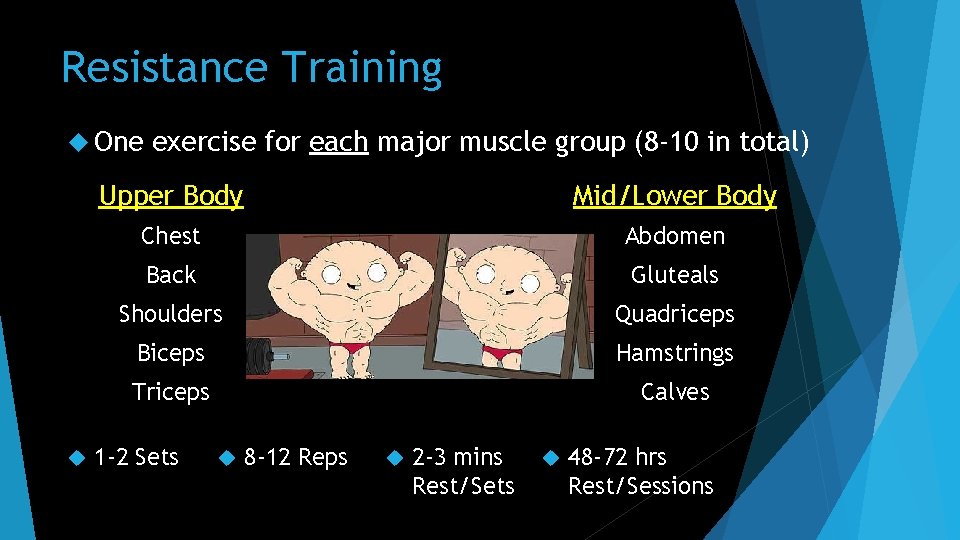
Resistance Training One exercise for each major muscle group (8 -10 in total) Upper Body Mid/Lower Body Chest Abdomen Back Gluteals Shoulders Quadriceps Biceps Hamstrings Triceps Calves 1 -2 Sets 8 -12 Reps 2 -3 mins Rest/Sets 48 -72 hrs Rest/Sessions
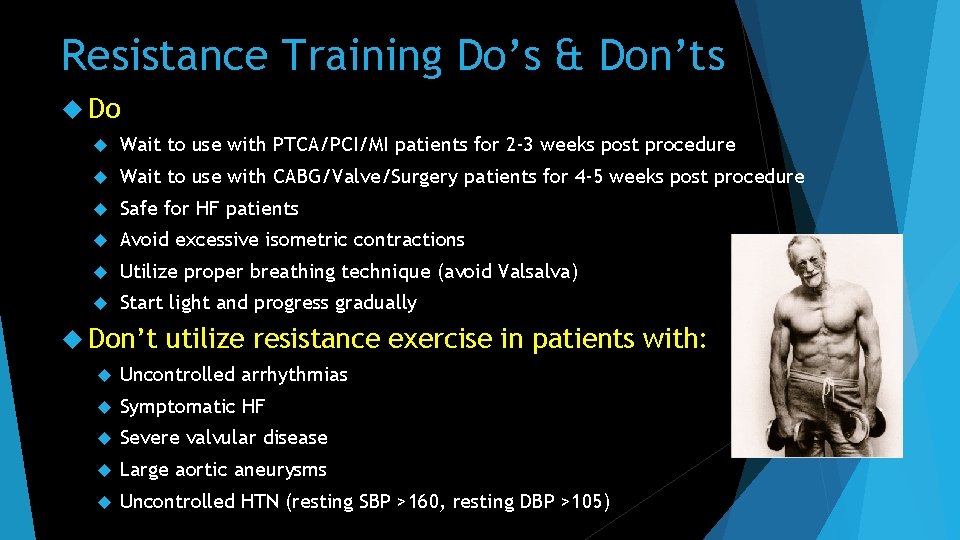
Resistance Training Do’s & Don’ts Do Wait to use with PTCA/PCI/MI patients for 2 -3 weeks post procedure Wait to use with CABG/Valve/Surgery patients for 4 -5 weeks post procedure Safe for HF patients Avoid excessive isometric contractions Utilize proper breathing technique (avoid Valsalva) Start light and progress gradually Don’t utilize resistance exercise in patients with: Uncontrolled arrhythmias Symptomatic HF Severe valvular disease Large aortic aneurysms Uncontrolled HTN (resting SBP >160, resting DBP >105)
Take Home Points If you use HR, remember 220 -age with caution because it is just an estimate and HR is genetically extremely variable It’s safe to allow patients to exceed the HR ranges you set for them so long as they are asymptomatic 220 -age is invalid if a patient is taking beta blockers Even if you do not plan to take the CCRP exam, this material is the foundation for how and why to prescribe exercise for patients with CVD It meets all AACVPR and ACSM guidelines Most patients enrolled in cardiac rehab (2 -3 x/wk) achieve < 1000 kcal/wk or 500 -1000 MET/min/wk of energy expenditure This is NOT enough exercise to reduce CVD risk All programs should emphasize the need to exercise at home
References AACVPR CCRP Study Guide ACSM’s Guidelines for Exercise Testing and Prescription (9 th ed. ) Clinical Exercise Physiology (3 rd ed. ) Brawner, C. (2010). Prescribing Exercise in Cardiac Rehabilitation without an Exercise Test. ACSM Certified News, 20, 7 -13. Brawner, C. , et al. (2004). Predicting maximum heart rate among patients with coronary heart disease receiving β-adrenergic blockade therapy. American Heart Journal, 148, 910 -914. Keteyian, S. et al. (2012). Predicting maximal HR in heart failure patients on β-blockade therapy. Medicine and Science in Sports and Exercise, 44, 371 -376. http: //www. fedel. com/mets/

Thank You! Erik Ostrowski, MS, ACSM-RCEP, CCRP Southern Illinois Healthcare Herrin Hospital
- Slides: 30