Evaluating Health Links in Ontario Walter Wodchis Ph


- Slides: 49
Evaluating Health Links in Ontario Walter Wodchis, Ph. D Health Quality Rounds Southlake Hospital, May 19 2016
Design by Walter Wodchis, Luke Mondor, Kevin Walker, Agnes Grudniewicz, Jenna Evans, Yu. Qing (Chris Bai), Seija Kromm, Gustavo Mery, Ross Baker
Objectives 1. Learn about the successes and challenges of Health Links in Ontario 2. Learn how the Health System Performance Research Network (HSPRN) is undertaking evaluation for Health Links in the Central LHIN 3. Learn about the provincial evaluation of health links 4. Learn what we know about success factors of integrated care from international experience. 3
HSPRN Involvement in Health Links 2013: What ‘value’ do Health Links add to the health system? 2015: Evaluating Health Links in the Central LHIN 2016: Palliative Indicators for Health Links 2016: Lead for Provincial Central Evaluation of Health Links 4
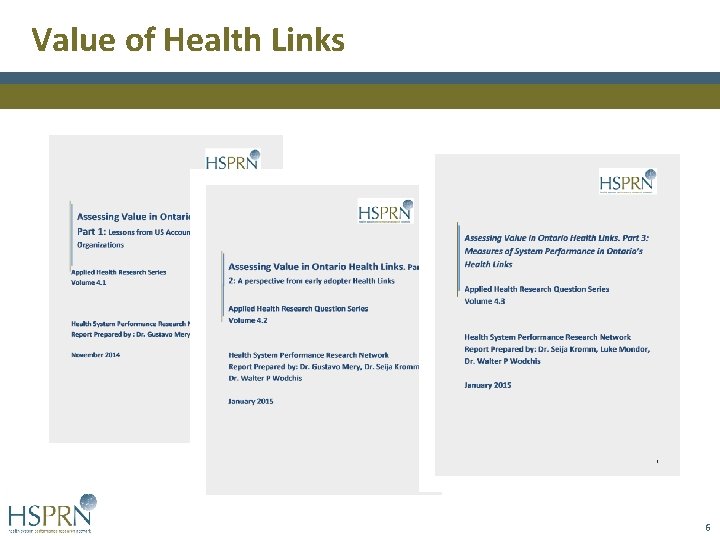
2013: Assessing Value in Health Links Our approach was undertaken in 3 parts: 1. To review documents and literature to assess how ‘value’ has been recognized and measured in U. S. Accountable Care Organizations (ACOs) and to select indicators that could be applicable to Health Links. 2. To interview HL leaders to identify promising HL strategies and how these strategies are creating value for patients and the Ontario health system. 3. To conduct empirical analysis to assess the performance of HLs on measurable indicators using health administrative data held at the Institute for Clinical Evaluative Sciences. 5
Value of Health Links 6
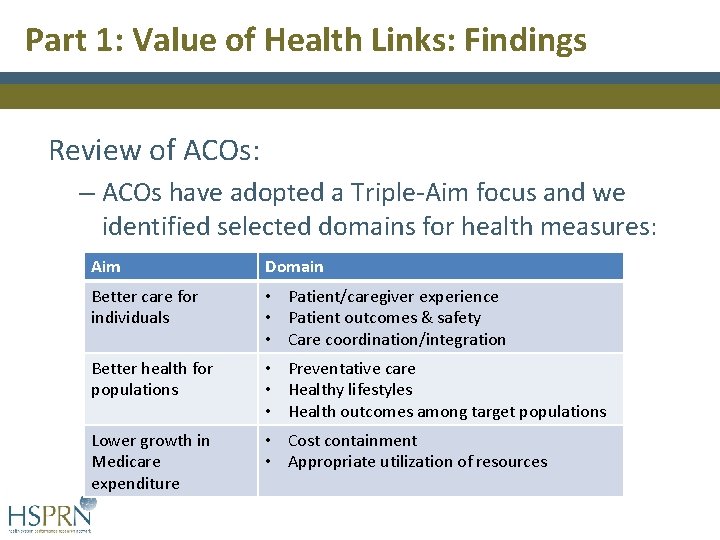
Part 1: Value of Health Links: Findings Review of ACOs: – ACOs have adopted a Triple-Aim focus and we identified selected domains for health measures: Aim Domain Better care for individuals • Patient/caregiver experience • Patient outcomes & safety • Care coordination/integration Better health for populations • Preventative care • Healthy lifestyles • Health outcomes among target populations Lower growth in Medicare expenditure • Cost containment • Appropriate utilization of resources 7
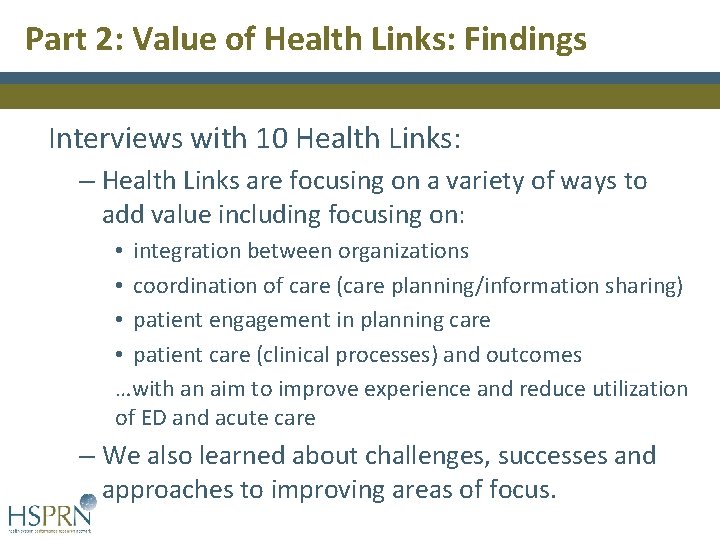
Part 2: Value of Health Links: Findings Interviews with 10 Health Links: – Health Links are focusing on a variety of ways to add value including focusing on: • integration between organizations • coordination of care (care planning/information sharing) • patient engagement in planning care • patient care (clinical processes) and outcomes …with an aim to improve experience and reduce utilization of ED and acute care – We also learned about challenges, successes and approaches to improving areas of focus. 8
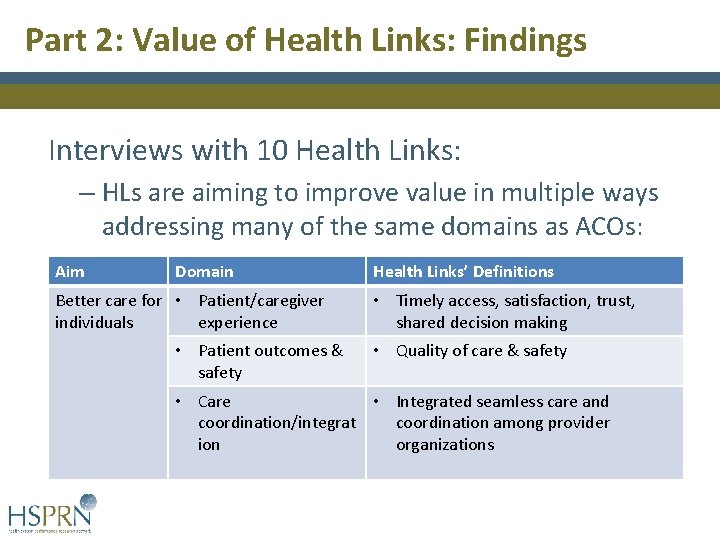
Part 2: Value of Health Links: Findings Interviews with 10 Health Links: – HLs are aiming to improve value in multiple ways addressing many of the same domains as ACOs: Aim Domain Better care for • Patient/caregiver individuals experience • Patient outcomes & safety Health Links’ Definitions • Timely access, satisfaction, trust, shared decision making • Quality of care & safety • Care • Integrated seamless care and coordination/integrat coordination among provider ion organizations 9
m ste l ve Le s OM PR alt h of th e. P System Costs Sy s EM He PR Patient perspective costs & er id ov s Pr tor e: ca ar Indi f. C eo nc rie op In ula di tio ca to n: S rs ys t pe em Ex Le ve l Value of Health Links: BEACCON Triple Aim
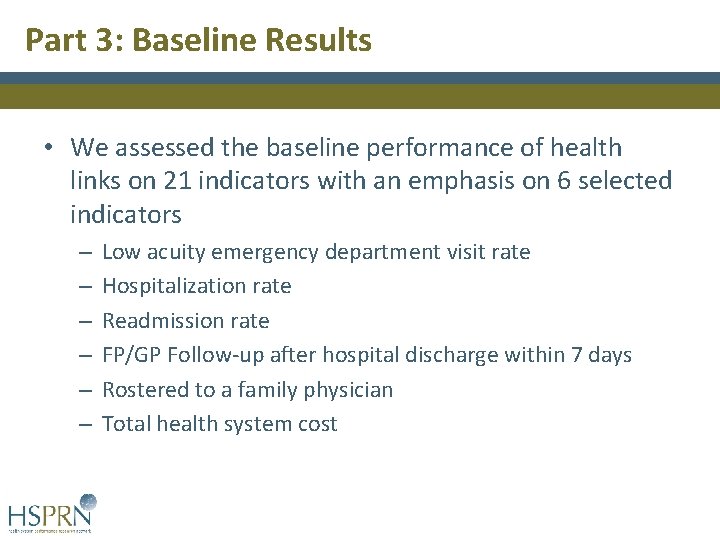
Part 3: Baseline Results • We assessed the baseline performance of health links on 21 indicators with an emphasis on 6 selected indicators – – – Low acuity emergency department visit rate Hospitalization rate Readmission rate FP/GP Follow-up after hospital discharge within 7 days Rostered to a family physician Total health system cost 11
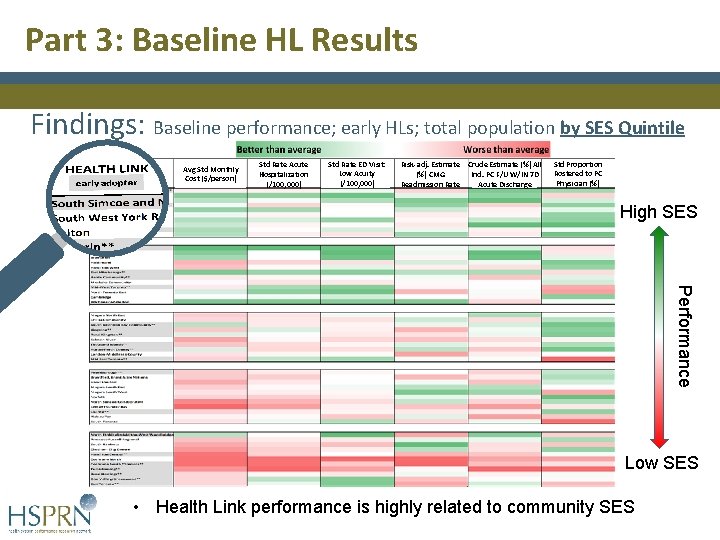
Part 3: Baseline HL Results Findings: Baseline performance; early HLs; total population by SES Quintile Avg Std Monthly Cost ($/person) Std Rate Acute Hospitalization (/100, 000) Std Rate ED Visit: Low Acuity (/100, 000) Risk-adj. Estimate Crude Estimate (%) All (%) CMG Ind. PC F/U W/IN 7 D Readmission Rate Acute Discharge Std Proportion Rostered to PC Physician (%) High SES Performance Low SES • Health Link performance is highly related to community SES
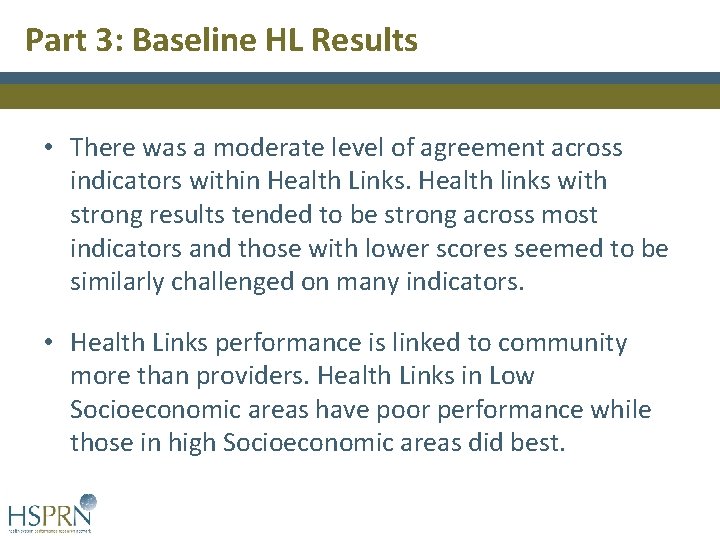
Part 3: Baseline HL Results • There was a moderate level of agreement across indicators within Health Links. Health links with strong results tended to be strong across most indicators and those with lower scores seemed to be similarly challenged on many indicators. • Health Links performance is linked to community more than providers. Health Links in Low Socioeconomic areas have poor performance while those in high Socioeconomic areas did best. 13
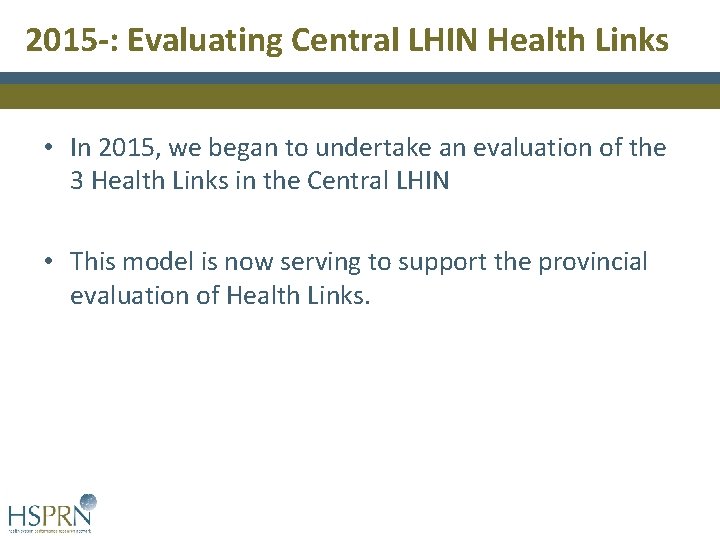
2015 -: Evaluating Central LHIN Health Links • In 2015, we began to undertake an evaluation of the 3 Health Links in the Central LHIN • This model is now serving to support the provincial evaluation of Health Links. 14
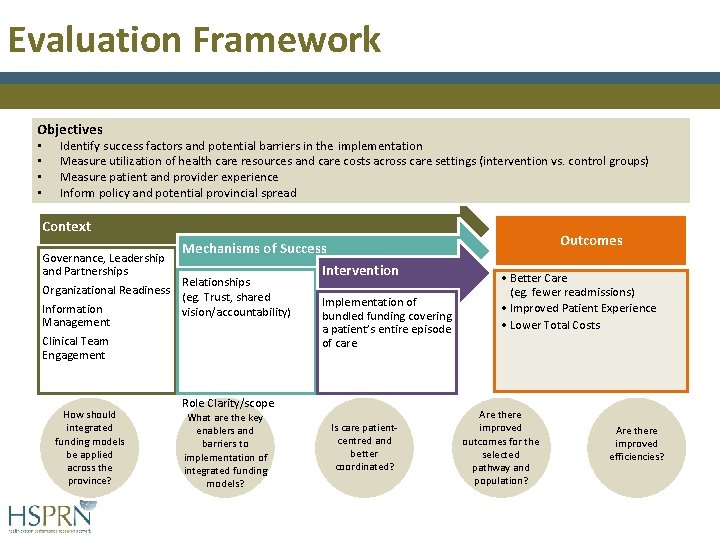
Evaluation Framework Objectives • • Identify success factors and potential barriers in the implementation Measure utilization of health care resources and care costs across care settings (intervention vs. control groups) Measure patient and provider experience Inform policy and potential provincial spread Context Mechanisms of Success Governance, Leadership Intervention and Partnerships Relationships Organizational Readiness (eg. Trust, shared Information vision/accountability) Management Clinical Team Engagement How should integrated funding models be applied across the province? Implementation of bundled funding covering a patient’s entire episode of care Role Clarity/scope What are the key enablers and barriers to implementation of integrated funding models? Is care patientcentred and better coordinated? Outcomes • Better Care (eg. fewer readmissions) • Improved Patient Experience • Lower Total Costs Are there improved outcomes for the selected pathway and population? Are there improved efficiencies?
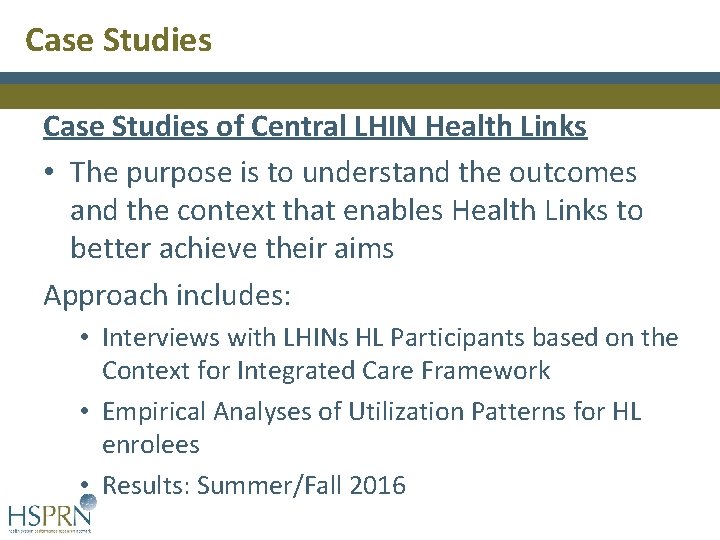
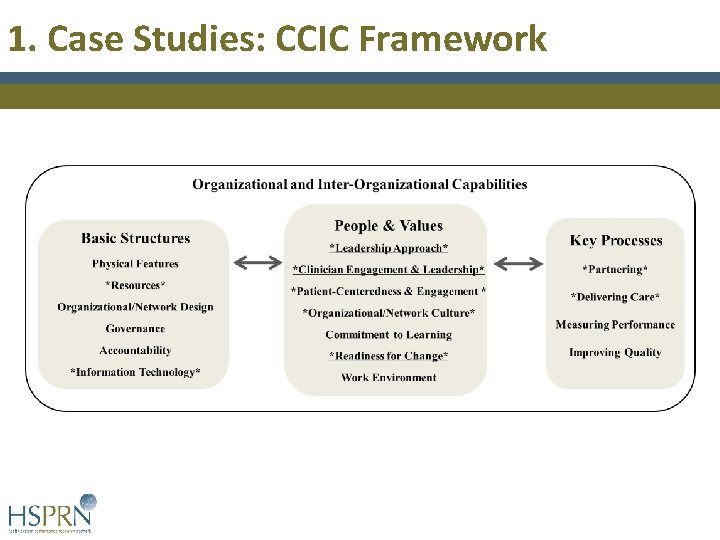
Case Studies of Central LHIN Health Links • The purpose is to understand the outcomes and the context that enables Health Links to better achieve their aims Approach includes: • Interviews with LHINs HL Participants based on the Context for Integrated Care Framework • Empirical Analyses of Utilization Patterns for HL enrolees • Results: Summer/Fall 2016 16
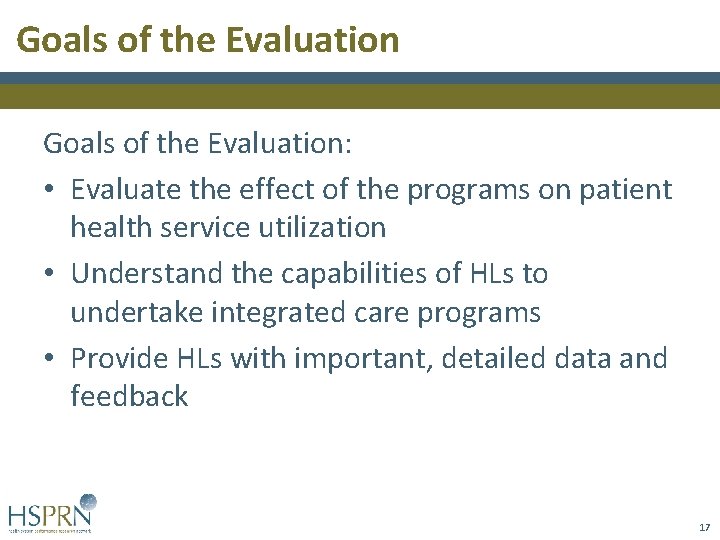
Goals of the Evaluation: • Evaluate the effect of the programs on patient health service utilization • Understand the capabilities of HLs to undertake integrated care programs • Provide HLs with important, detailed data and feedback 17
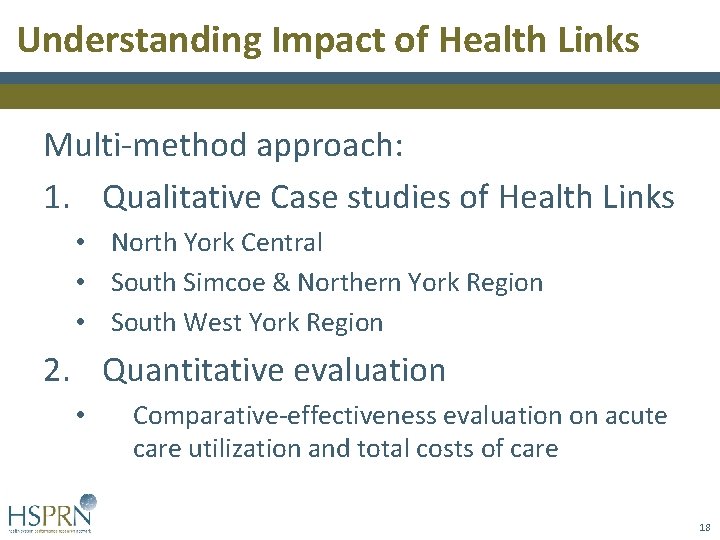
Understanding Impact of Health Links Multi-method approach: 1. Qualitative Case studies of Health Links • North York Central • South Simcoe & Northern York Region • South West York Region 2. Quantitative evaluation • Comparative-effectiveness evaluation on acute care utilization and total costs of care 18
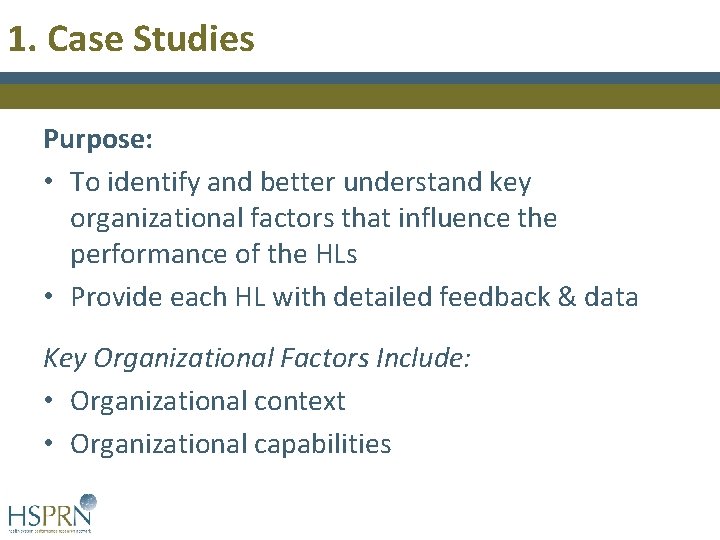
1. Case Studies Purpose: • To identify and better understand key organizational factors that influence the performance of the HLs • Provide each HL with detailed feedback & data Key Organizational Factors Include: • Organizational context • Organizational capabilities
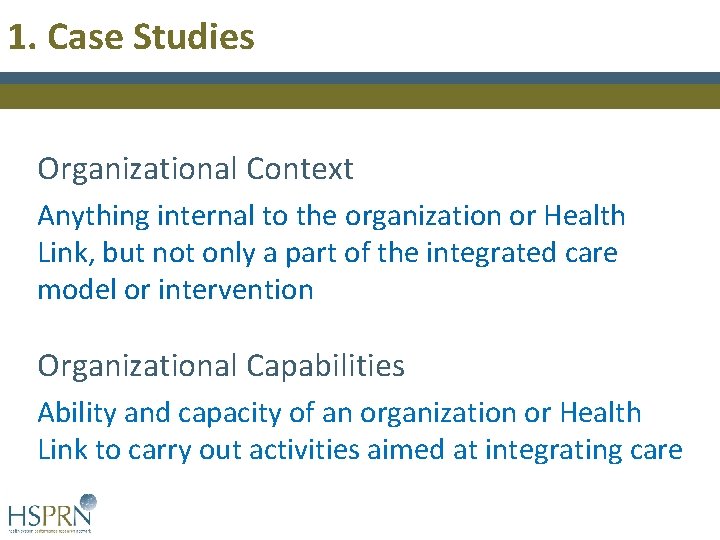
1. Case Studies Organizational Context Anything internal to the organization or Health Link, but not only a part of the integrated care model or intervention Organizational Capabilities Ability and capacity of an organization or Health Link to carry out activities aimed at integrating care 20
1. Case Studies: CCIC Framework
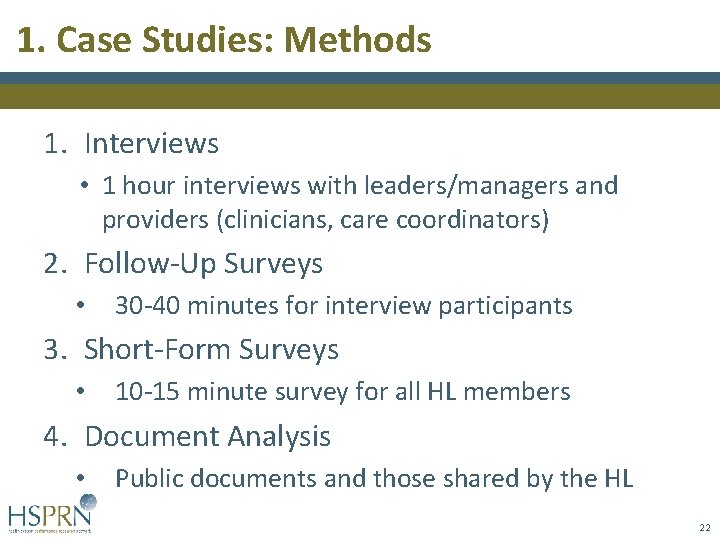
1. Case Studies: Methods 1. Interviews • 1 hour interviews with leaders/managers and providers (clinicians, care coordinators) 2. Follow-Up Surveys • 30 -40 minutes for interview participants 3. Short-Form Surveys • 10 -15 minute survey for all HL members 4. Document Analysis • Public documents and those shared by the HL 22
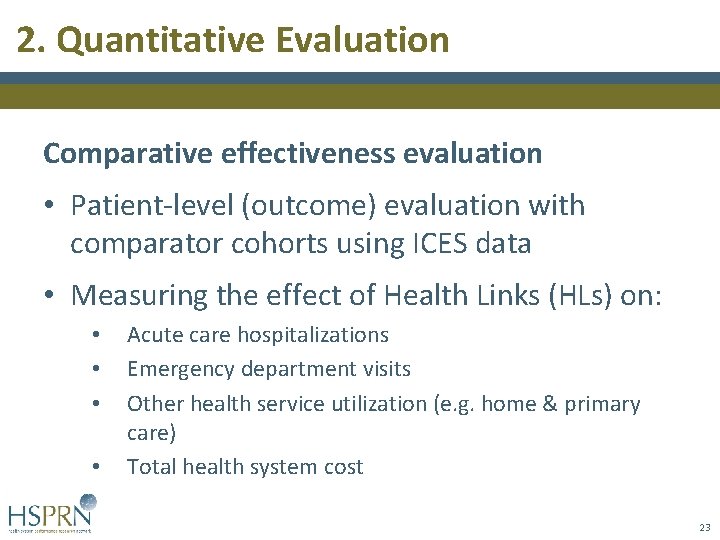
2. Quantitative Evaluation Comparative effectiveness evaluation • Patient-level (outcome) evaluation with comparator cohorts using ICES data • Measuring the effect of Health Links (HLs) on: • • Acute care hospitalizations Emergency department visits Other health service utilization (e. g. home & primary care) Total health system cost 23
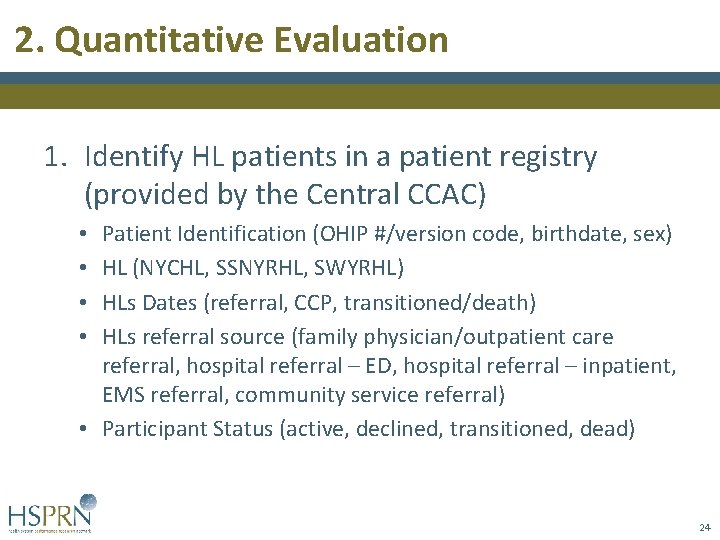
2. Quantitative Evaluation 1. Identify HL patients in a patient registry (provided by the Central CCAC) Patient Identification (OHIP #/version code, birthdate, sex) HL (NYCHL, SSNYRHL, SWYRHL) HLs Dates (referral, CCP, transitioned/death) HLs referral source (family physician/outpatient care referral, hospital referral – ED, hospital referral – inpatient, EMS referral, community service referral) • Participant Status (active, declined, transitioned, dead) • • 24
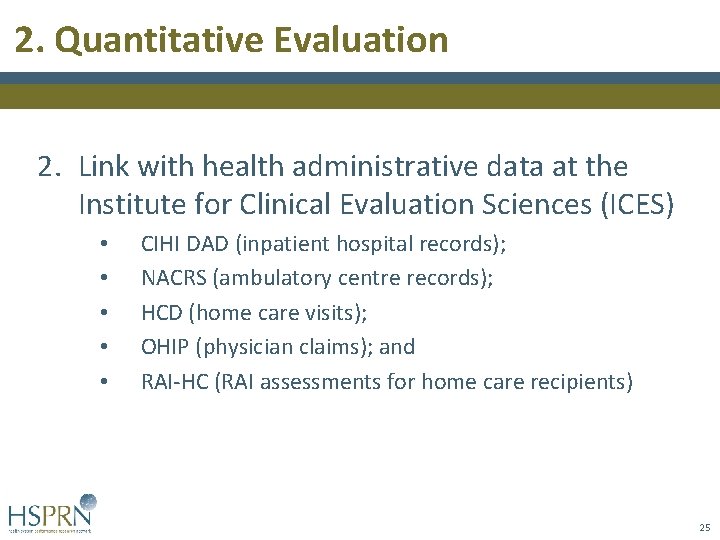
2. Quantitative Evaluation 2. Link with health administrative data at the Institute for Clinical Evaluation Sciences (ICES) • • • CIHI DAD (inpatient hospital records); NACRS (ambulatory centre records); HCD (home care visits); OHIP (physician claims); and RAI-HC (RAI assessments for home care recipients) 25
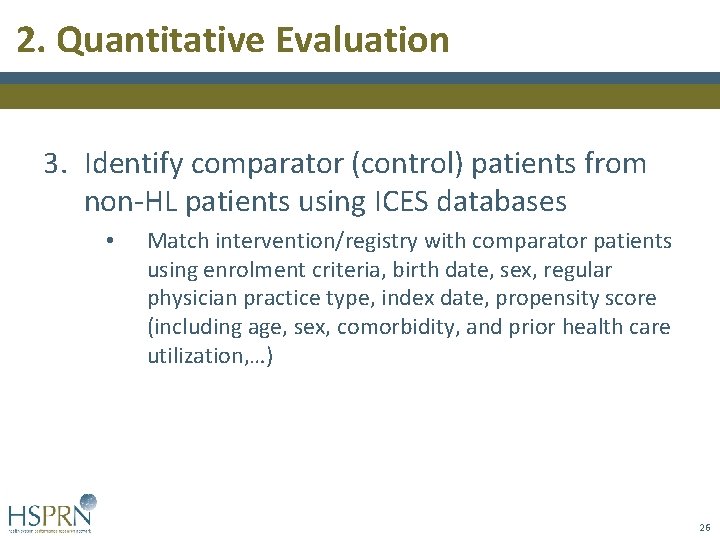
2. Quantitative Evaluation 3. Identify comparator (control) patients from non-HL patients using ICES databases • Match intervention/registry with comparator patients using enrolment criteria, birth date, sex, regular physician practice type, index date, propensity score (including age, sex, comorbidity, and prior health care utilization, …) 26
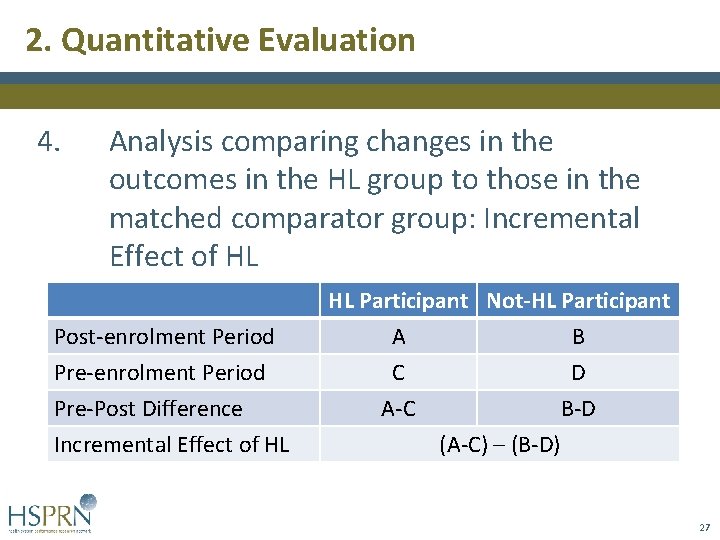
2. Quantitative Evaluation 4. Analysis comparing changes in the outcomes in the HL group to those in the matched comparator group: Incremental Effect of HL Post-enrolment Period Pre-Post Difference HL Participant Not-HL Participant A B C D A-C B-D Incremental Effect of HL (A-C) – (B-D) 27
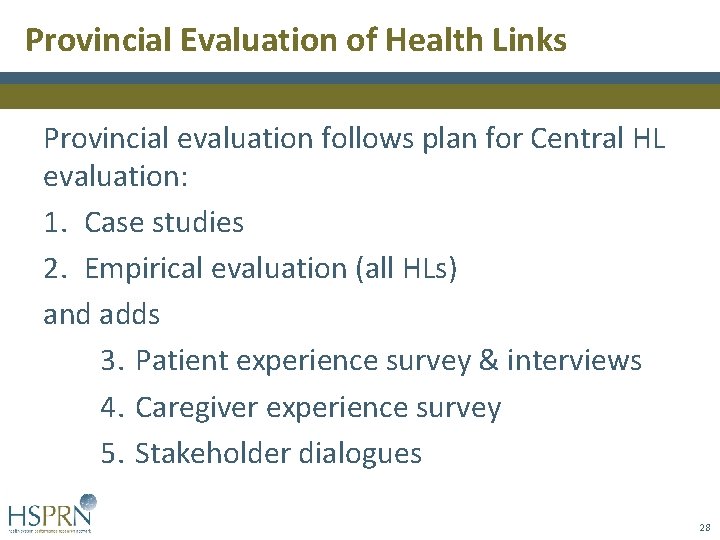
Provincial Evaluation of Health Links Provincial evaluation follows plan for Central HL evaluation: 1. Case studies 2. Empirical evaluation (all HLs) and adds 3. Patient experience survey & interviews 4. Caregiver experience survey 5. Stakeholder dialogues 28
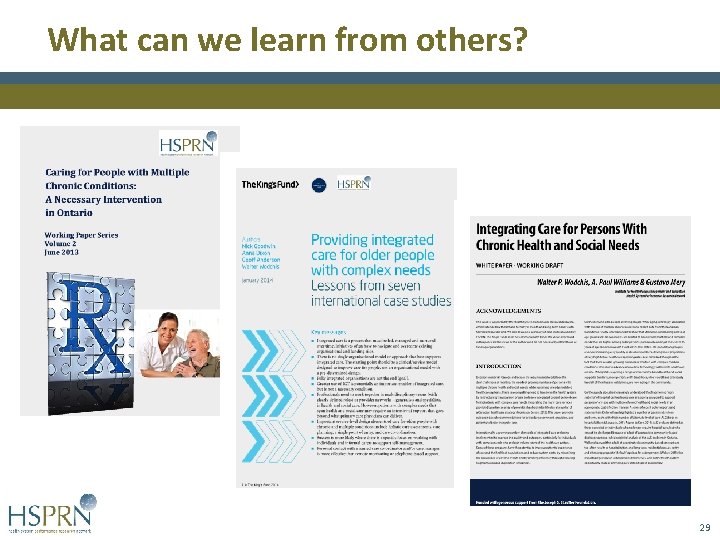
What can we learn from others? 29
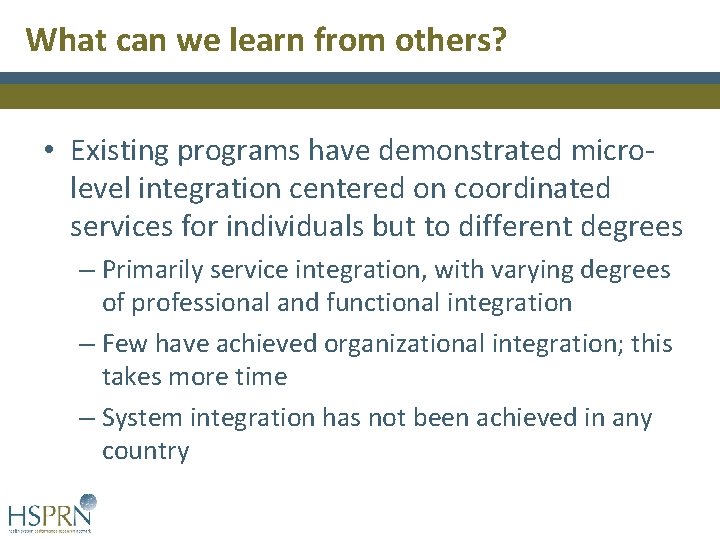
What can we learn from others? • Existing programs have demonstrated microlevel integration centered on coordinated services for individuals but to different degrees – Primarily service integration, with varying degrees of professional and functional integration – Few have achieved organizational integration; this takes more time – System integration has not been achieved in any country 30
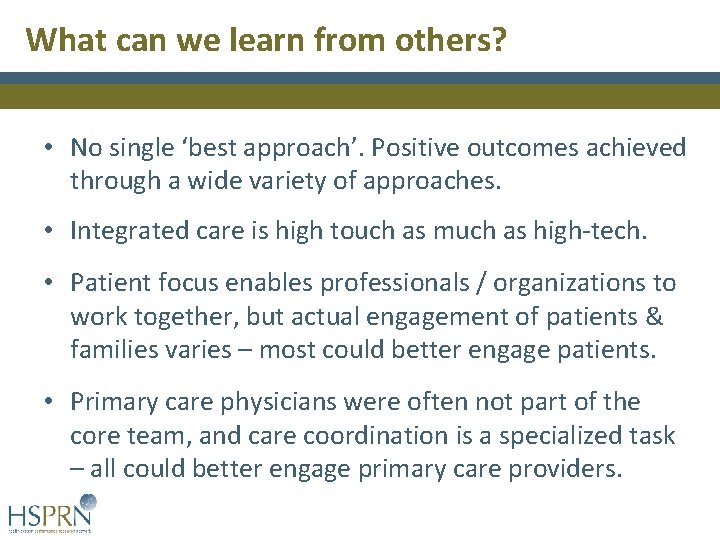
What can we learn from others? • No single ‘best approach’. Positive outcomes achieved through a wide variety of approaches. • Integrated care is high touch as much as high-tech. • Patient focus enables professionals / organizations to work together, but actual engagement of patients & families varies – most could better engage patients. • Primary care physicians were often not part of the core team, and care coordination is a specialized task – all could better engage primary care providers. 31
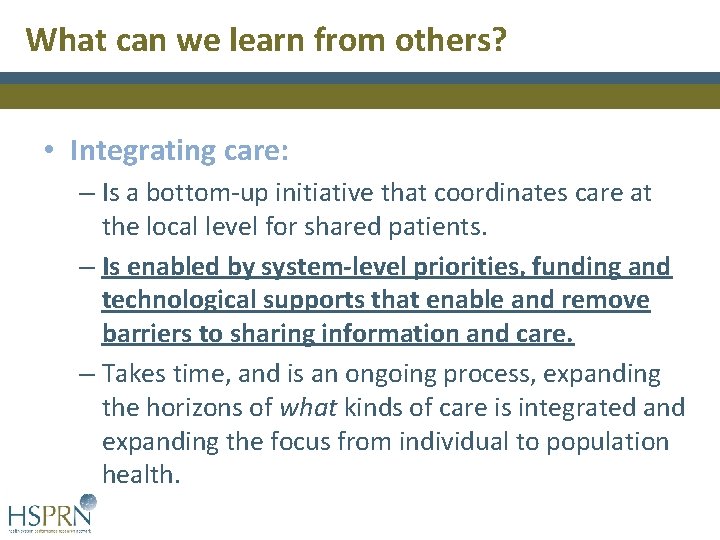
What can we learn from others? • Integrating care: – Is a bottom-up initiative that coordinates care at the local level for shared patients. – Is enabled by system-level priorities, funding and technological supports that enable and remove barriers to sharing information and care. – Takes time, and is an ongoing process, expanding the horizons of what kinds of care is integrated and expanding the focus from individual to population health. 32
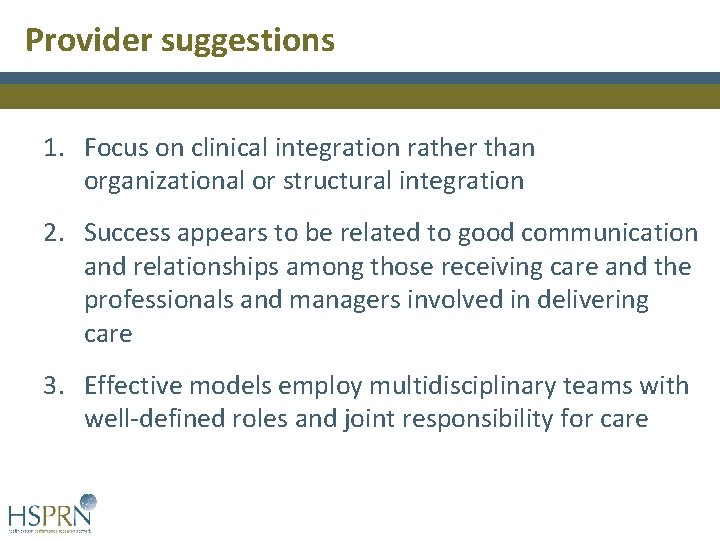
Provider suggestions 1. Focus on clinical integration rather than organizational or structural integration 2. Success appears to be related to good communication and relationships among those receiving care and the professionals and managers involved in delivering care 3. Effective models employ multidisciplinary teams with well-defined roles and joint responsibility for care 33
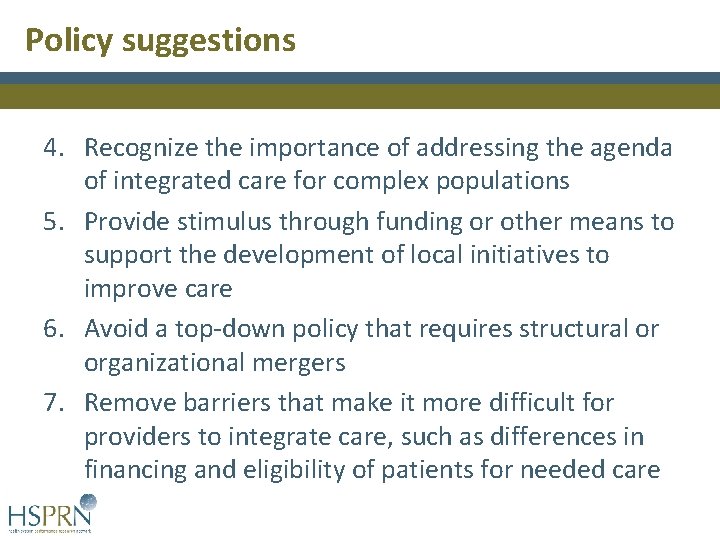
Policy suggestions 4. Recognize the importance of addressing the agenda of integrated care for complex populations 5. Provide stimulus through funding or other means to support the development of local initiatives to improve care 6. Avoid a top-down policy that requires structural or organizational mergers 7. Remove barriers that make it more difficult for providers to integrate care, such as differences in financing and eligibility of patients for needed care 34
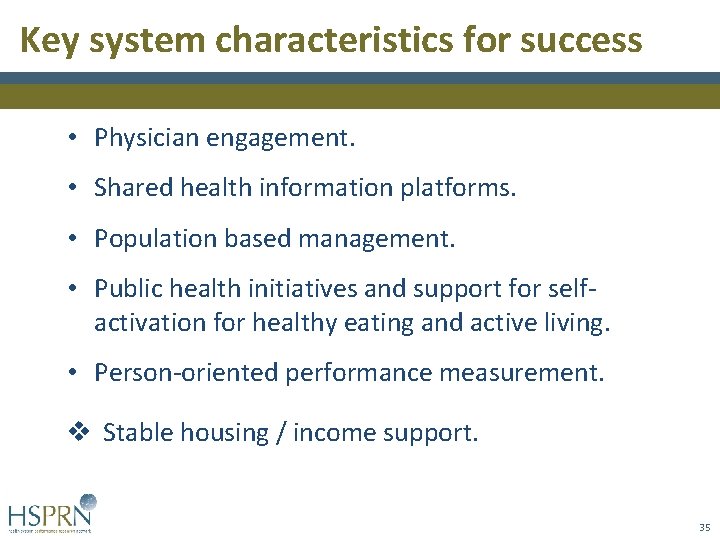
Key system characteristics for success • Physician engagement. • Shared health information platforms. • Population based management. • Public health initiatives and support for selfactivation for healthy eating and active living. • Person-oriented performance measurement. v Stable housing / income support. 35
…Stay tuned Follow Updates at: http: //hsprn. ca Our Work Evidence Briefs And of course: @infohsprn 36
Questions? Comments? 37
Additional slides 38
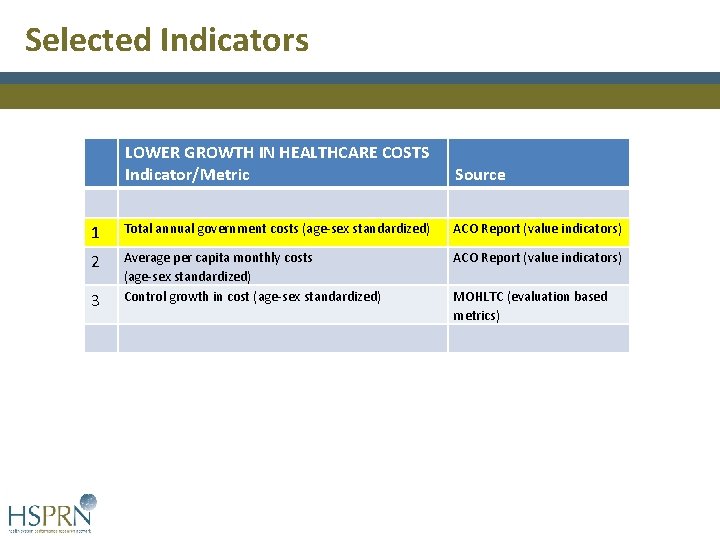
Selected Indicators LOWER GROWTH IN HEALTHCARE COSTS Indicator/Metric Source 1 Total annual government costs (age-sex standardized) ACO Report (value indicators) 2 Average per capita monthly costs (age-sex standardized) Control growth in cost (age-sex standardized) ACO Report (value indicators) 3 MOHLTC (evaluation based metrics) 39
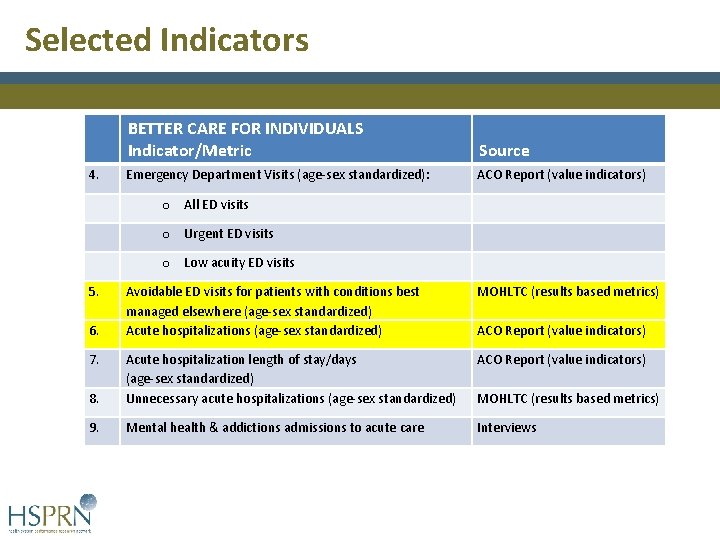
Selected Indicators 4. BETTER CARE FOR INDIVIDUALS Indicator/Metric Source Emergency Department Visits (age-sex standardized): ACO Report (value indicators) o All ED visits o Urgent ED visits o Low acuity ED visits 5. Avoidable ED visits for patients with conditions best managed elsewhere (age-sex standardized) Acute hospitalizations (age-sex standardized) MOHLTC (results based metrics) ACO Report (value indicators) 8. Acute hospitalization length of stay/days (age-sex standardized) Unnecessary acute hospitalizations (age-sex standardized) 9. Mental health & addictions admissions to acute care Interviews 6. 7. ACO Report (value indicators) MOHLTC (results based metrics) 40
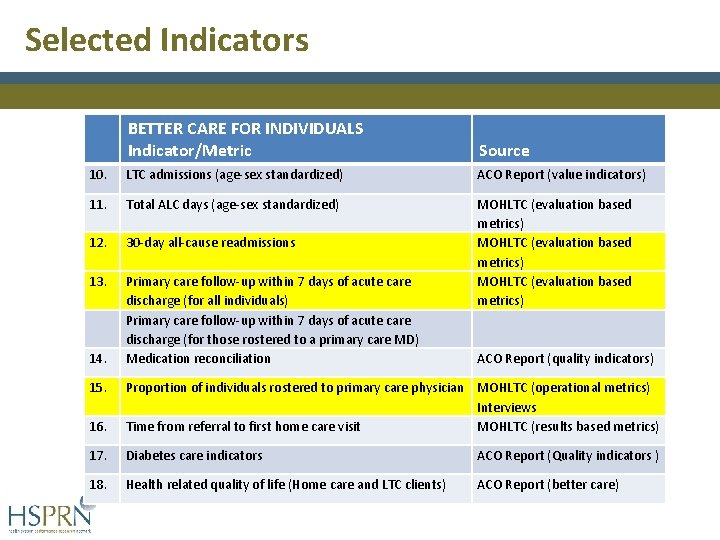
Selected Indicators BETTER CARE FOR INDIVIDUALS Indicator/Metric Source 10. LTC admissions (age-sex standardized) ACO Report (value indicators) 11. Total ALC days (age-sex standardized) 12. 30 -day all-cause readmissions 13. Primary care follow-up within 7 days of acute care discharge (for all individuals) Primary care follow-up within 7 days of acute care discharge (for those rostered to a primary care MD) Medication reconciliation MOHLTC (evaluation based metrics) 14. 15. ACO Report (quality indicators) 16. Proportion of individuals rostered to primary care physician MOHLTC (operational metrics) Interviews Time from referral to first home care visit MOHLTC (results based metrics) 17. Diabetes care indicators ACO Report (Quality indicators ) 18. Health related quality of life (Home care and LTC clients) ACO Report (better care) 41
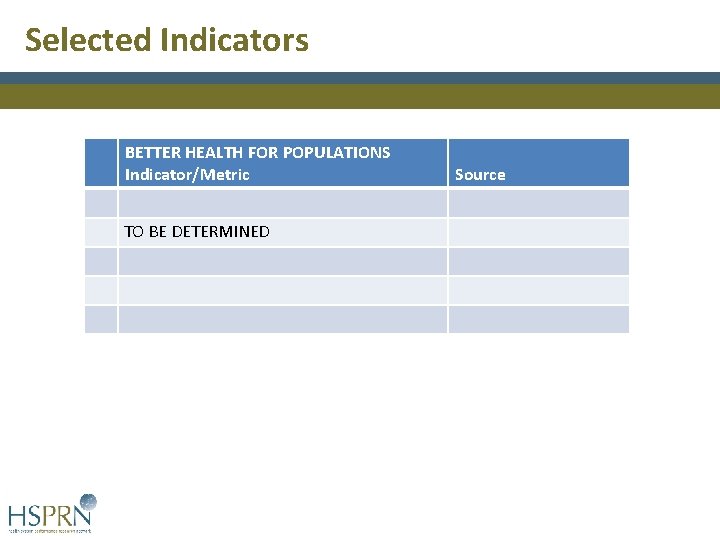
Selected Indicators BETTER HEALTH FOR POPULATIONS Indicator/Metric Source TO BE DETERMINED 42
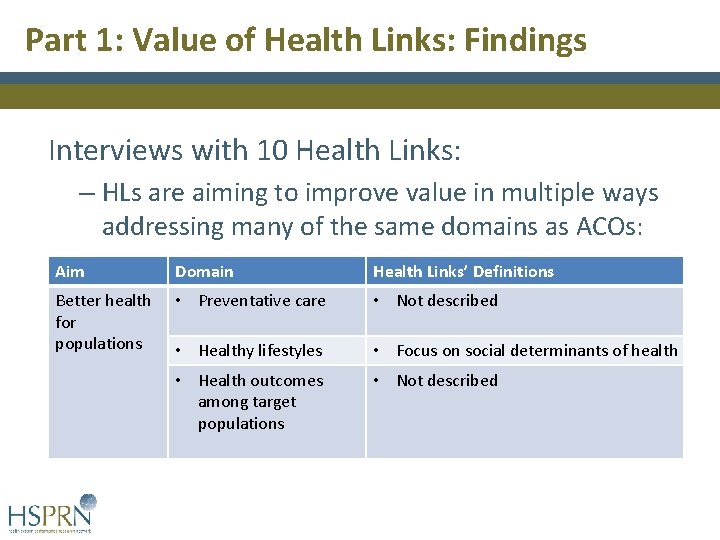
Part 1: Value of Health Links: Findings Interviews with 10 Health Links: – HLs are aiming to improve value in multiple ways addressing many of the same domains as ACOs: Aim Domain Health Links’ Definitions Better health for populations • Preventative care • Not described • Healthy lifestyles • Focus on social determinants of health • Health outcomes among target populations • Not described 43
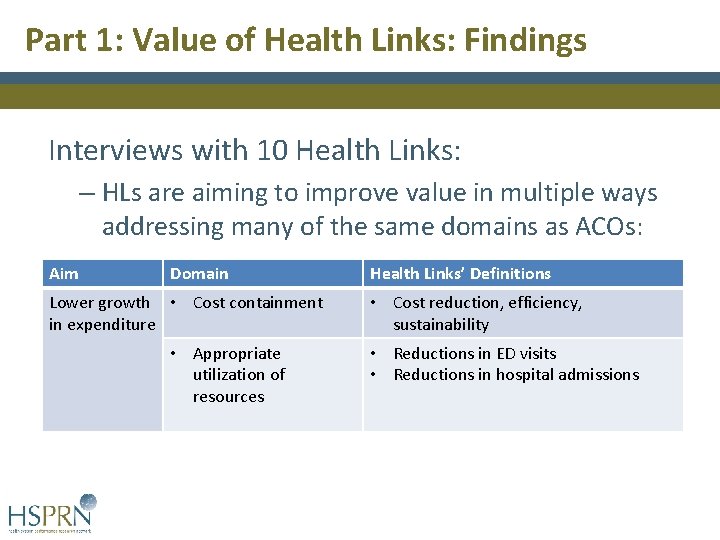
Part 1: Value of Health Links: Findings Interviews with 10 Health Links: – HLs are aiming to improve value in multiple ways addressing many of the same domains as ACOs: Aim Domain Lower growth • Cost containment in expenditure • Appropriate utilization of resources Health Links’ Definitions • Cost reduction, efficiency, sustainability • Reductions in ED visits • Reductions in hospital admissions 44
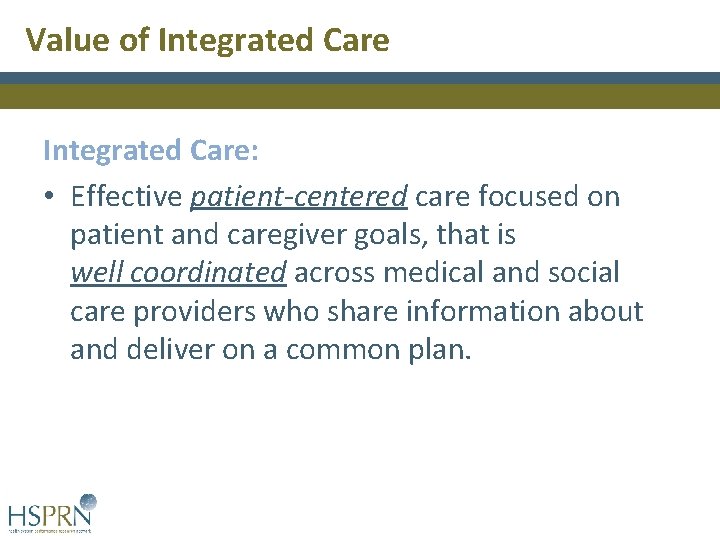
Value of Integrated Care: • Effective patient-centered care focused on patient and caregiver goals, that is well coordinated across medical and social care providers who share information about and deliver on a common plan. 45
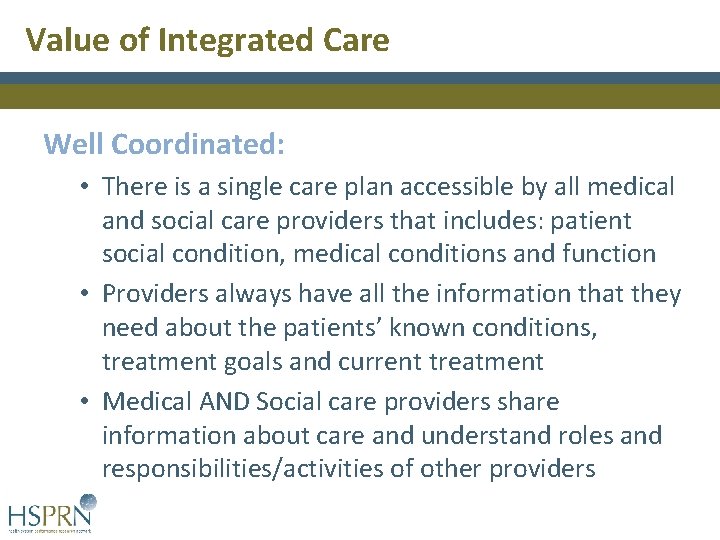
Value of Integrated Care Well Coordinated: • There is a single care plan accessible by all medical and social care providers that includes: patient social condition, medical conditions and function • Providers always have all the information that they need about the patients’ known conditions, treatment goals and current treatment • Medical AND Social care providers share information about care and understand roles and responsibilities/activities of other providers 46
Value of Integrated Care • Patients experience high value health care when they and their providers/carers share goals of care and work together progressing toward achieving those goals with a minimum of health and social care interventions (i. e. efficiently). 47
Value of Integrated Care • Providers experience high value health care when they are able to apply their insights and knowledge to address the needs of their patients leading to improved health of their patients. 48
Value of Integrated Care • The health care system experiences high value health care when available resources are optimally deployed to advance the health of individuals and of the population (patients in better health will use less care). 49