Ethics and Equity in Engineering Monique Frize P



- Slides: 38
Ethics and Equity in Engineering Monique Frize, P. Eng. , O. C. NSERC/Nortel Joint Chair for Women in Science and Engineering in ONTARIO Carleton University / University of Ottawa, CANADA
Content z. Four Ethical Theories z. Code of Ethics for Engineers z. Ethical Decision-Making Process z. Privacy and Confidentiality, Plagiarism z. Equity (participation of women, strategies for K-12, universities, workplaces, profession)
Definition of a Profession z. Work that requires highly developed skills, judgment, discretion, not routine; z. Extensive formal education to become a member (not just training); z. Sets standards for conduct and self -governance; z. Significant public good, safety. z C. B. Fledderman “Engineering Ethics”, Prentice Hall, 1999
Professional Engineers Act Misconduct or Incompetence Code of Ethics (Professional Engineers Ontario) Other codes (IEEE, etc. . )
Examples: Moral Dilemmas z. Choosing between risking health of workers or stopping work; z. Is a gift innocent kindness or an attempt at bribery ? z. An engineer undermines another; z. Company secrets after leave?
Definition of Ethics z. The study of right or wrong; z. Good and evil; z. Obligations and rights; z. Justice; z. Social and political ideals. z Andrews and Kemper, textbook referenced in course outline
Ethical Decision-Making z. Define the problem; z. Assess possible solutions; z. Resolve moral problem and develop moral criteria to guide human behaviour and decision
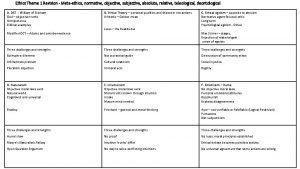
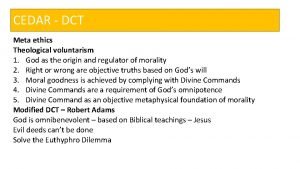
Four Ethical Theories z. Utilitarianism : John Stuart Mill and others z. Formalism or Duty Ethics : Kant z. Rights Ethics : Locke z. Virtue Ethics : Aristotle
Utilitarianism z. That which produces the maximum benefit for the greatest number of people (ex. Democracy) z. Calculate : Intensity and Duration of a benefit or pleasure and number of people affected
Formalism or Duty Ethics (Kant) z. Each person has fundamental duty to act ethically; zconscience imposed on absolute, categorical imperative (i. e. unconditional demand); zfollows universal principles.
Examples z. Be honest z. Be fair z. Do not hurt others z. Keep your promises z. Obey the law z. This leads to ‘RESPECT for HUMANITY’
Rights Ethics (Locke) z. Everyone has rights that arise from existing (i. e. Right to LIFE, maximum individual LIBERTY, and human DIGNITY are FUNDAMENTAL RIGHTS). z. Other rights arise as a consequence; z. DUTY is a consequence of personal rights.
Examples z. Charter of Human Rights and Freedoms (Canadian Law, 1980 s); z. Only the fundamental rights set by Parliament are included (ex. Right to a harassment-free, discrimination-free environment).
Virtue Ethics (Aristotle) z. Compromise between extremes and select the GOLDEN MEAN Between EXCESS and DEFICIENCY z. Virtues : Truly human qualities such as power of thought, reason, deduction, logic; happiness or goodness result if humans qualities function fully.
Examples: Golden Mean z. Modesty : between vanity and humility zcourage: foolhardiness and cowardice zgenerosity: wastefulness and stinginess
Code of Ethics z. Duty to Society and to the Public z. Duty to Employers z. Duty to Clients z. Duty to Colleagues z. Duty to Employees and Subordinates z. Duty to the Profession z. Duty to Oneself
Solving Ethical Problems z. Define problem or need z. Gather information, define goal z. Generate alternative solutions or methods : synthesis z. Evaluate benefits and cost of each solution: analysis z. Decide and optimize z. Implement the best solution
Privacy and Confidentiality z* Privacy: freedom from intrusion or public attention; removed from public view or knowledge. z#Confidentiality: Entrusted with secrets. z# Secrecy: The keeping of secrets; information is withheld. *J. W. Decew, “In Pursuit of Privacy: Law, Ethics, and the Rise of Technology” Cornell University Press, 1997. / # Dictionaries
Plagiarism z. To adopt or reproduce as one’s own work someone else’s work; z. To incorporate into one’s own work WITHOUT AKNOWLEDGEMENT zhttp: //www. zoology. ubc. ca/bpg/ plagiarism. htm
Equity in Science and Engineering z. The early days: 1960’s: One female student in a faculty or in a discipline z. Very lonely, feel different, that you shouldn’t be there, but also a mascot z. Culture: Lady Godiva was alive and well z. Macho, masculine culture
The 70’s z. A few more women, but not many (intriguing) z. A curiosity still, lonely but there a few other women around, no female role models z. In the workplace: one woman on a site, in a mine, in a plant, on an oil field
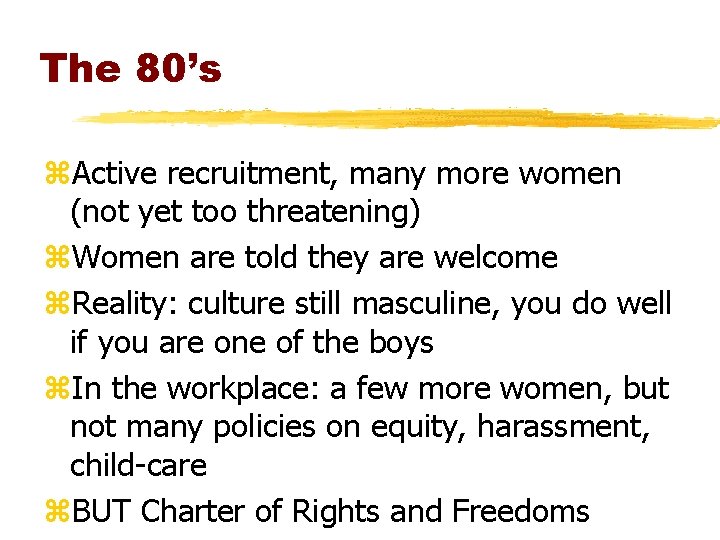
The 80’s z. Active recruitment, many more women (not yet too threatening) z. Women are told they are welcome z. Reality: culture still masculine, you do well if you are one of the boys z. In the workplace: a few more women, but not many policies on equity, harassment, child-care z. BUT Charter of Rights and Freedoms
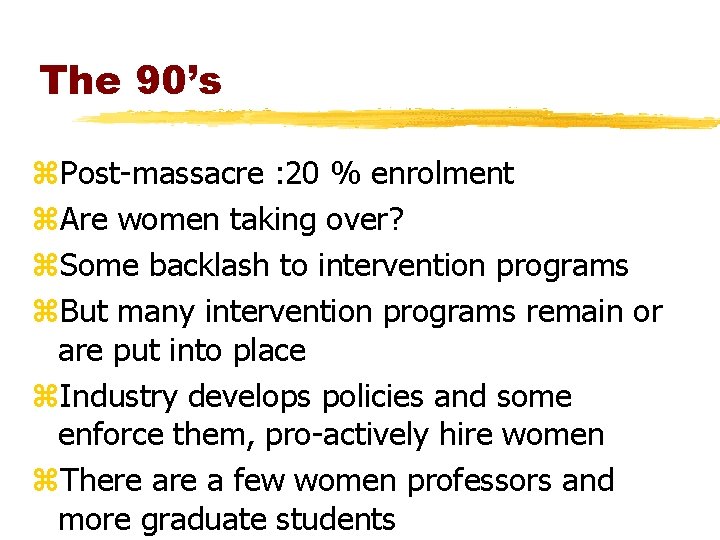
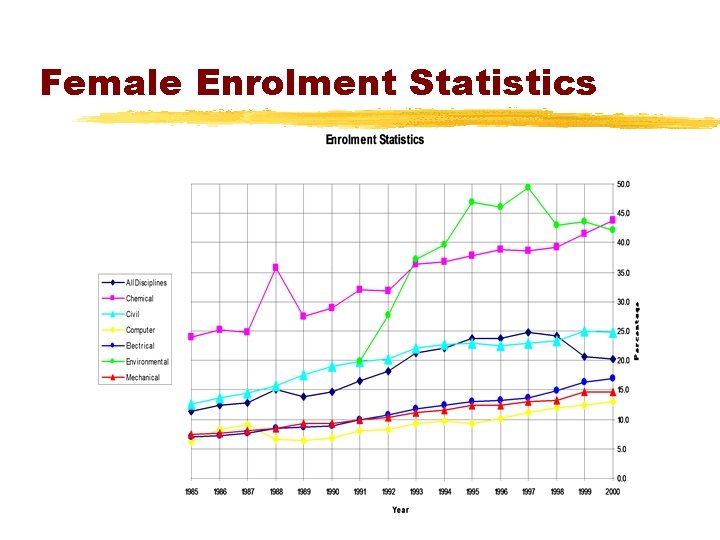
The 90’s z. Post-massacre : 20 % enrolment z. Are women taking over? z. Some backlash to intervention programs z. But many intervention programs remain or are put into place z. Industry develops policies and some enforce them, pro-actively hire women z. There a few women professors and more graduate students
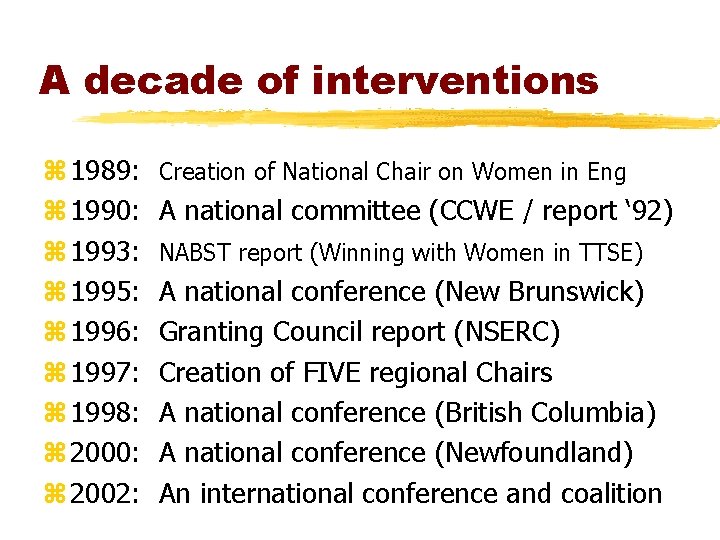
A decade of interventions z 1989: z 1990: z 1993: z 1995: z 1996: z 1997: z 1998: z 2000: z 2002: Creation of National Chair on Women in Eng A national committee (CCWE / report ‘ 92) NABST report (Winning with Women in TTSE) A national conference (New Brunswick) Granting Council report (NSERC) Creation of FIVE regional Chairs A national conference (British Columbia) A national conference (Newfoundland) An international conference and coalition
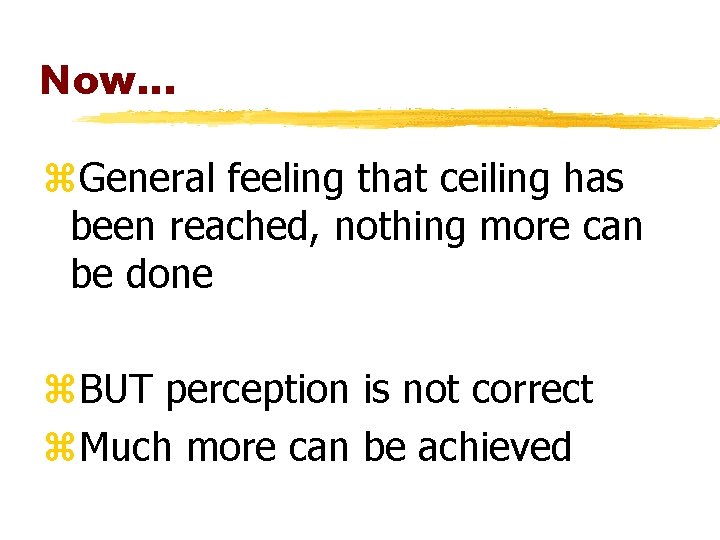
Now. . . z. General feeling that ceiling has been reached, nothing more can be done z. BUT perception is not correct z. Much more can be achieved
Female Enrolment Statistics
K-12 Strategies z. Increase the profile of women z. Increase contact with students z. Demystify various disciplines, show human connection z. Explain the opportunities, mentoring, networking and support z. Continue major efforts not to lose ground
Successful programs z. Pathmakers (role models, fun, exciting, confidence) z. Pinocchio nose (talk, game, project, visit labs) z. Sessions for parents/teachers z. Sessions with co-op employers (double standards, confidence level, benefits of diversity)
Culture Hacker and others describe the culture of engineering as an environment stressing: z. The importance of technology over personal relationships z. Formal abstract knowledge over inexact humanistic knowledge z. Male attributes over female ones
Strategies for universities z. Change the culture; humanise (teaching style, curriculum, what is valued) z. Monitor climate, find ways to improve z. Support women students with special needs z. Identify how feminine values improve the discipline and expect respect for these
Universities (cont. ) z. Policy on sexual harassment (in 1990 s) z. Policy on hiring: y. For equal candidates, pick a man in female dominated fields and a woman in male dominated fields y. Review tenure and promotion criteria z. MIT report: This survey is needed in every Canadian University z. Re-define excellence in more general way.
Examples curriculum and teaching styles z Multidisciplinary programs (ex. problem-solving and life sciences) z Environmental, Industrial, Chemical and Biomedical Engineering are popular z Computer Science applications in arts, music z Add societal context and relevance to other disciplines (mech, elec, civil) z Cooperative teaching (learning) style
Education and training z. Ethical Decision-making z. Social responsibility z. Impact of technology on people, society z. Principles of sustainability, protection of the environment z. Gender, racial issues and homophobia
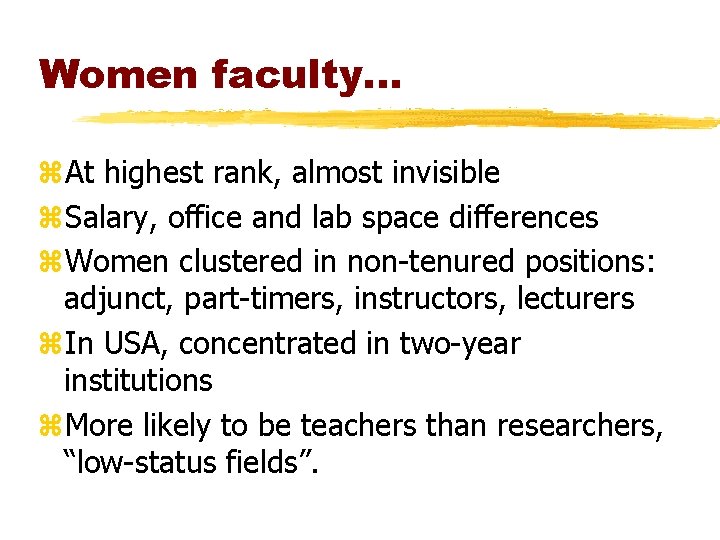
Women faculty. . . z. At highest rank, almost invisible z. Salary, office and lab space differences z. Women clustered in non-tenured positions: adjunct, part-timers, instructors, lecturers z. In USA, concentrated in two-year institutions z. More likely to be teachers than researchers, “low-status fields”.
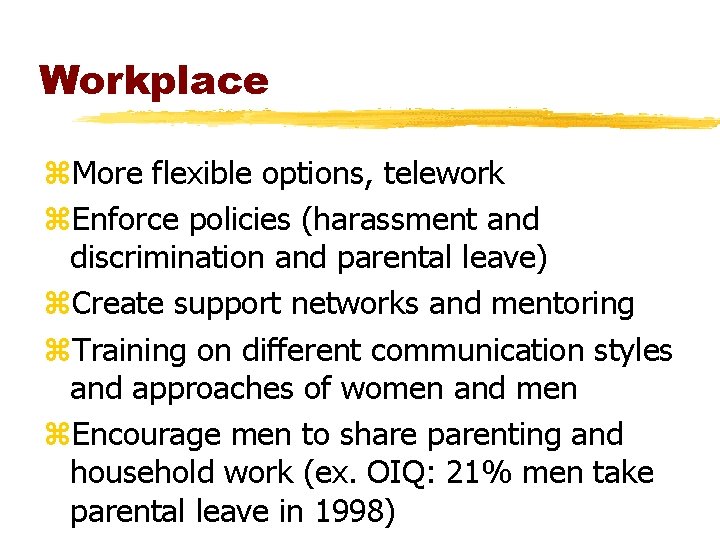
Workplace z. More flexible options, telework z. Enforce policies (harassment and discrimination and parental leave) z. Create support networks and mentoring z. Training on different communication styles and approaches of women and men z. Encourage men to share parenting and household work (ex. OIQ: 21% men take parental leave in 1998)
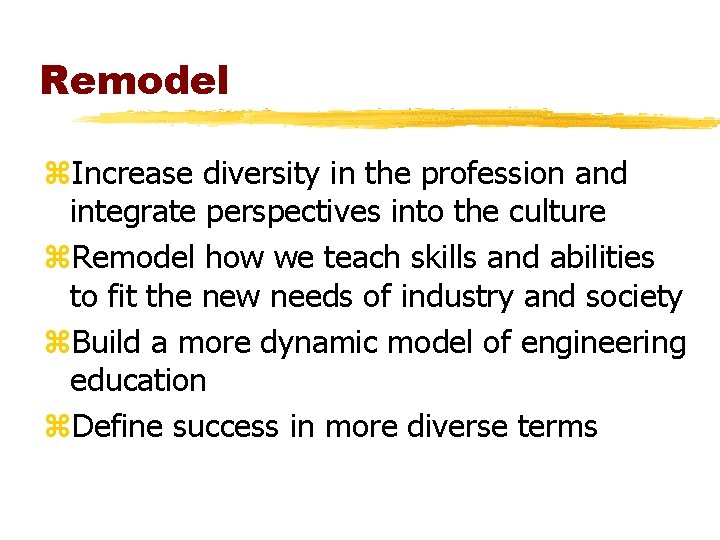
Remodel z. Increase diversity in the profession and integrate perspectives into the culture z. Remodel how we teach skills and abilities to fit the new needs of industry and society z. Build a more dynamic model of engineering education z. Define success in more diverse terms
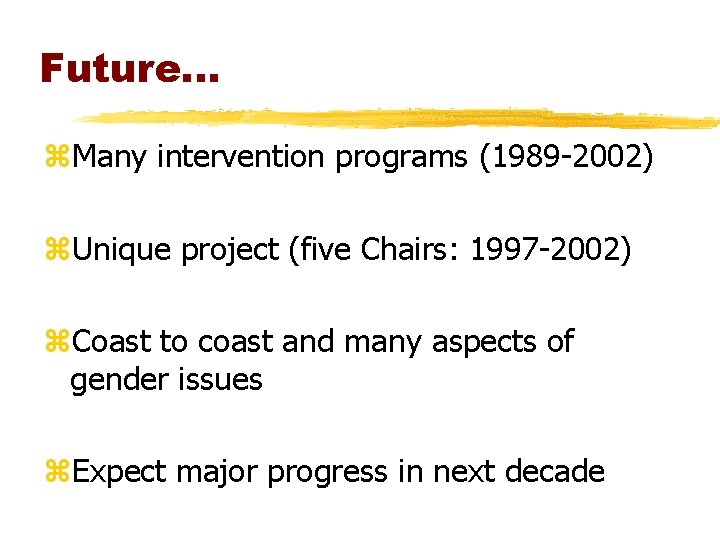
Future. . . z. Many intervention programs (1989 -2002) z. Unique project (five Chairs: 1997 -2002) z. Coast to coast and many aspects of gender issues z. Expect major progress in next decade
Ontario Chair’s web site http: //www. genie. uottawa. ca/cwse-on http: //www. icwes 12. org