ETH Swiss federal Institute of Technology Zurich TCAD

- Slides: 31
ETH Swiss federal Institute of Technology Zurich TCAD for compact modeling Luca Sponton, Paul Pfaeffli and Lars Bomholt September 22 nd, 2006 MOS-AK Workshop Montreux
Outline § § § Introduction Bringing process information to design PCM example Process-aware SPICE compact models Challenges for TCAD-generated models Summary ETH Swiss federal Institute of Technology Zurich Luca Sponton 2
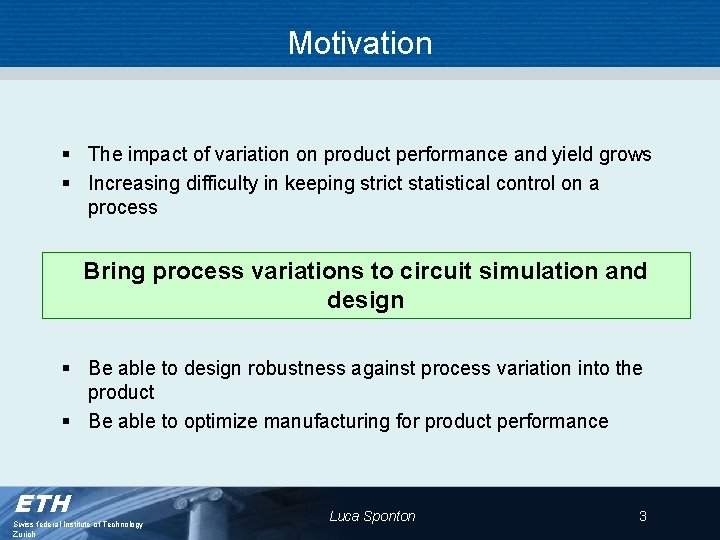
Motivation § The impact of variation on product performance and yield grows § Increasing difficulty in keeping strict statistical control on a process Bring process variations to circuit simulation and design § Be able to design robustness against process variation into the product § Be able to optimize manufacturing for product performance ETH Swiss federal Institute of Technology Zurich Luca Sponton 3
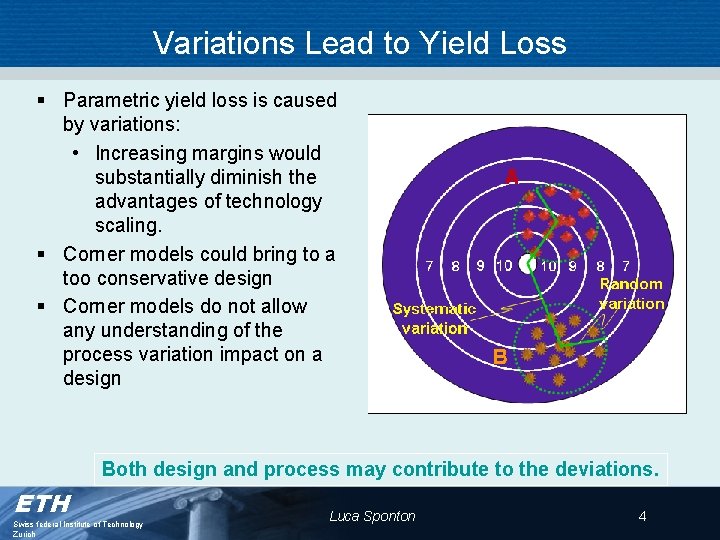
Variations Lead to Yield Loss § Parametric yield loss is caused by variations: • Increasing margins would substantially diminish the advantages of technology scaling. § Corner models could bring to a too conservative design § Corner models do not allow any understanding of the process variation impact on a design Both design and process may contribute to the deviations. ETH Swiss federal Institute of Technology Zurich Luca Sponton 4
Outline § § § Introduction Bringing process information to design PCM example Process-aware SPICE compact models Challenges for TCAD-generated models Summary ETH Swiss federal Institute of Technology Zurich Luca Sponton 5
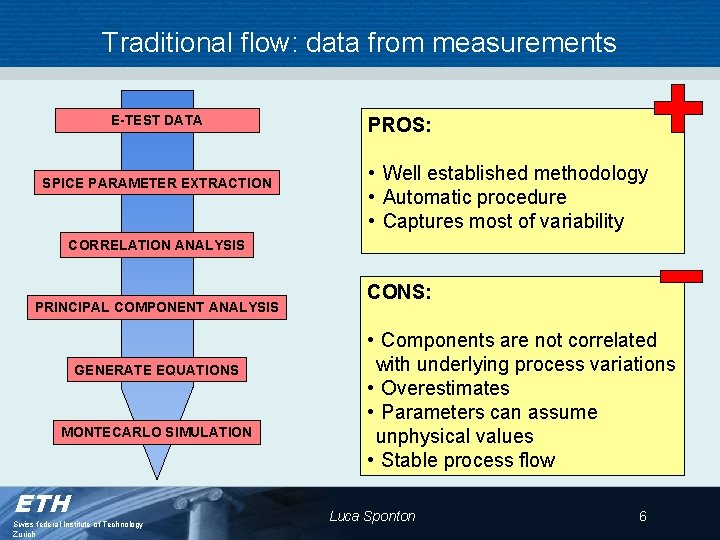
Traditional flow: data from measurements E-TEST DATA SPICE PARAMETER EXTRACTION PROS: • Well established methodology • Automatic procedure • Captures most of variability CORRELATION ANALYSIS PRINCIPAL COMPONENT ANALYSIS GENERATE EQUATIONS MONTECARLO SIMULATION ETH Swiss federal Institute of Technology Zurich CONS: • Components are not correlated with underlying process variations • Overestimates • Parameters can assume unphysical values • Stable process flow Luca Sponton 6
Advantages of TCAD extracted models § TCAD is the ideal tool to characterize process variations § TCAD simulations are accurate, do not drift during time and are available in an early stage of technology development § It is possible to access process parameters and device characteristics that are not controlled or measured accurately in manufacturing § It is cheaper than running large design of experiments on silicon How do we bring process information into design? ETH Swiss federal Institute of Technology Zurich Luca Sponton 7
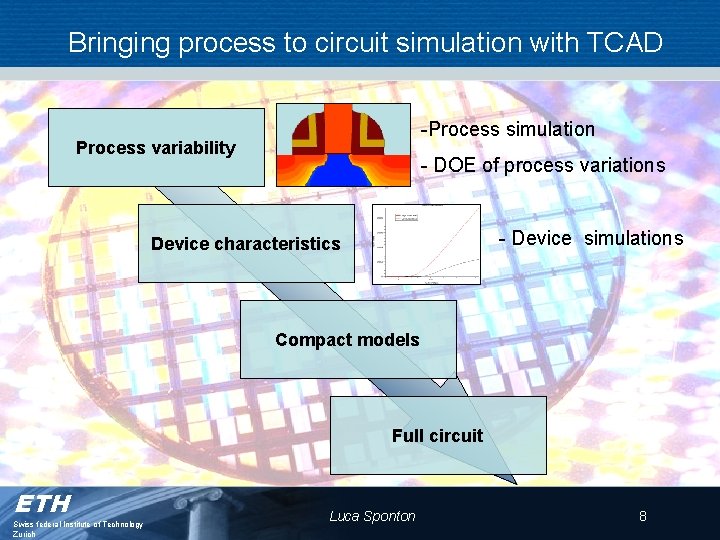
Bringing process to circuit simulation with TCAD -Process simulation Process variability - DOE of process variations - Device simulations Device characteristics Compact models Full circuit ETH Swiss federal Institute of Technology Zurich Luca Sponton 8
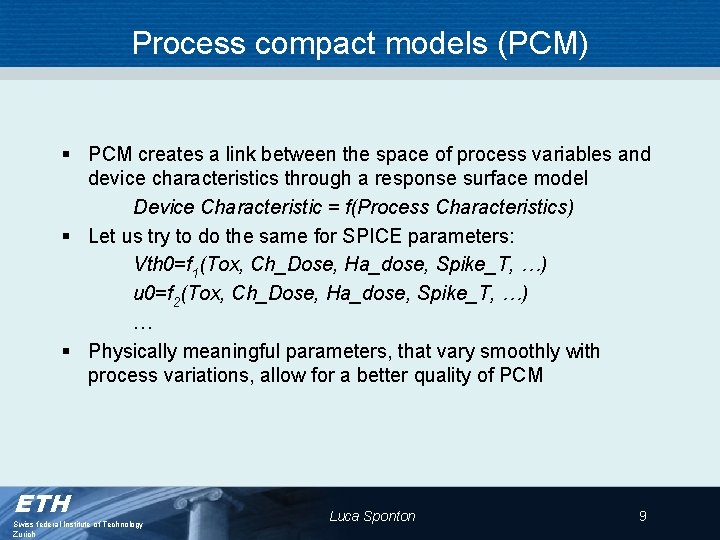
Process compact models (PCM) § PCM creates a link between the space of process variables and device characteristics through a response surface model Device Characteristic = f(Process Characteristics) § Let us try to do the same for SPICE parameters: Vth 0=f 1(Tox, Ch_Dose, Ha_dose, Spike_T, …) u 0=f 2(Tox, Ch_Dose, Ha_dose, Spike_T, …) … § Physically meaningful parameters, that vary smoothly with process variations, allow for a better quality of PCM ETH Swiss federal Institute of Technology Zurich Luca Sponton 9
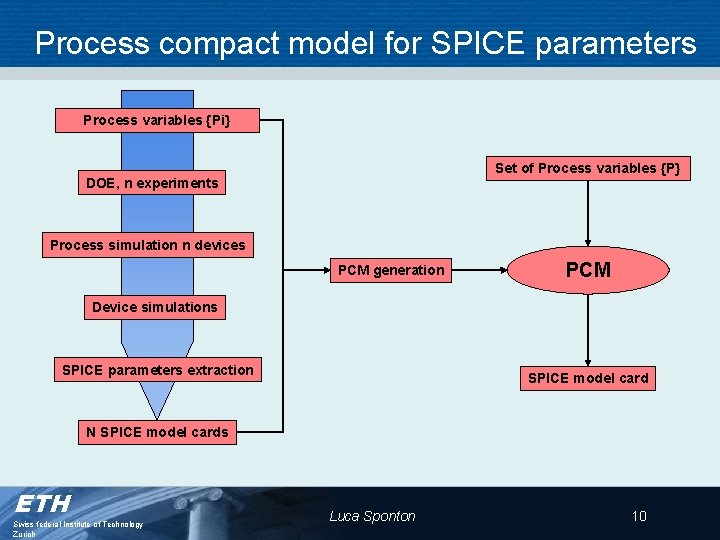
Process compact model for SPICE parameters Process variables {Pi} Set of Process variables {P} DOE, n experiments Process simulation n devices PCM generation PCM Device simulations SPICE parameters extraction SPICE model card N SPICE model cards ETH Swiss federal Institute of Technology Zurich Luca Sponton 10
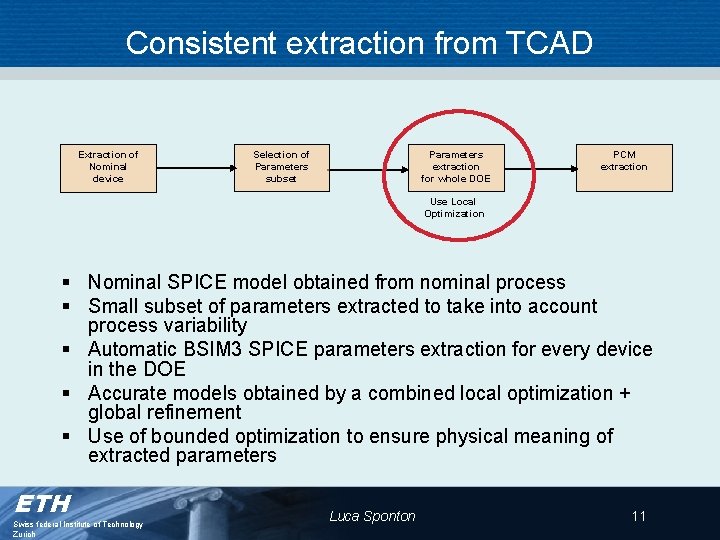
Consistent extraction from TCAD Extraction of Nominal device Selection of Parameters subset Parameters extraction for whole DOE PCM extraction Use Local Optimization § Nominal SPICE model obtained from nominal process § Small subset of parameters extracted to take into account process variability § Automatic BSIM 3 SPICE parameters extraction for every device in the DOE § Accurate models obtained by a combined local optimization + global refinement § Use of bounded optimization to ensure physical meaning of extracted parameters ETH Swiss federal Institute of Technology Zurich Luca Sponton 11
Outline § § § Introduction Bringing process information to design PCM example Process-aware SPICE compact models Challenges for TCAD-generated models Summary ETH Swiss federal Institute of Technology Zurich Luca Sponton 12
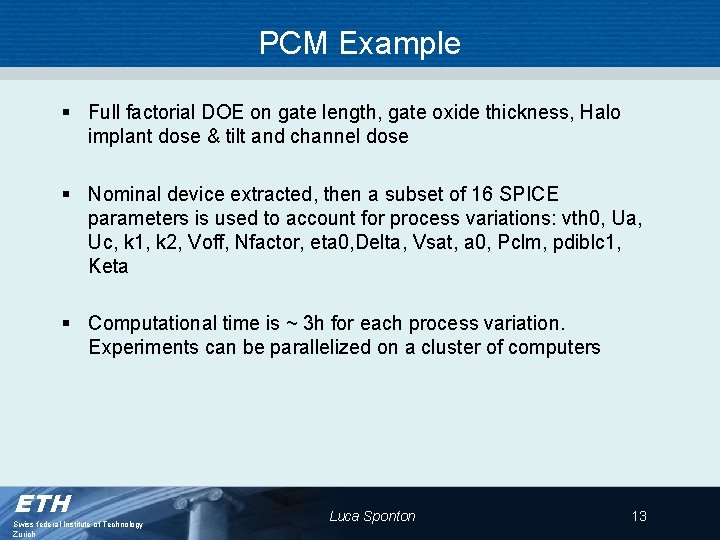
PCM Example § Full factorial DOE on gate length, gate oxide thickness, Halo implant dose & tilt and channel dose § Nominal device extracted, then a subset of 16 SPICE parameters is used to account for process variations: vth 0, Ua, Uc, k 1, k 2, Voff, Nfactor, eta 0, Delta, Vsat, a 0, Pclm, pdiblc 1, Keta § Computational time is ~ 3 h for each process variation. Experiments can be parallelized on a cluster of computers ETH Swiss federal Institute of Technology Zurich Luca Sponton 13
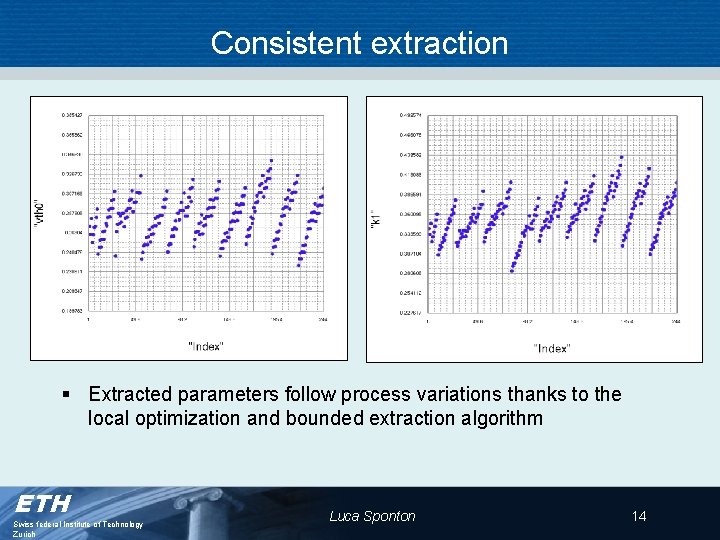
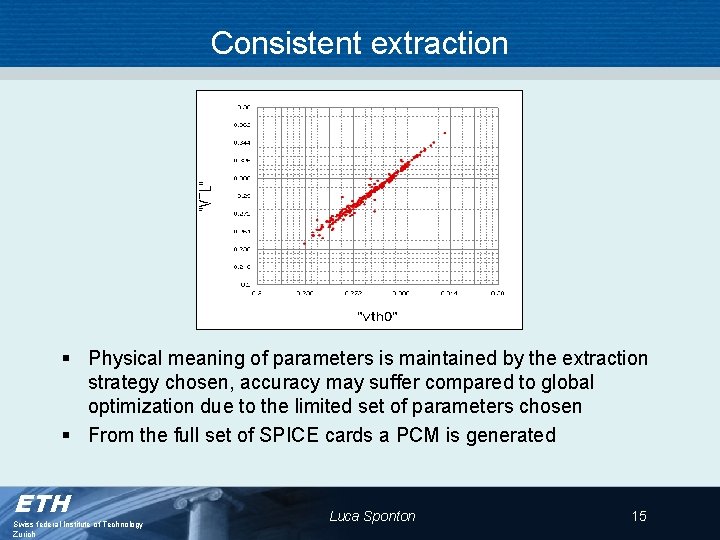
Consistent extraction § Extracted parameters follow process variations thanks to the local optimization and bounded extraction algorithm ETH Swiss federal Institute of Technology Zurich Luca Sponton 14
Consistent extraction § Physical meaning of parameters is maintained by the extraction strategy chosen, accuracy may suffer compared to global optimization due to the limited set of parameters chosen § From the full set of SPICE cards a PCM is generated ETH Swiss federal Institute of Technology Zurich Luca Sponton 15
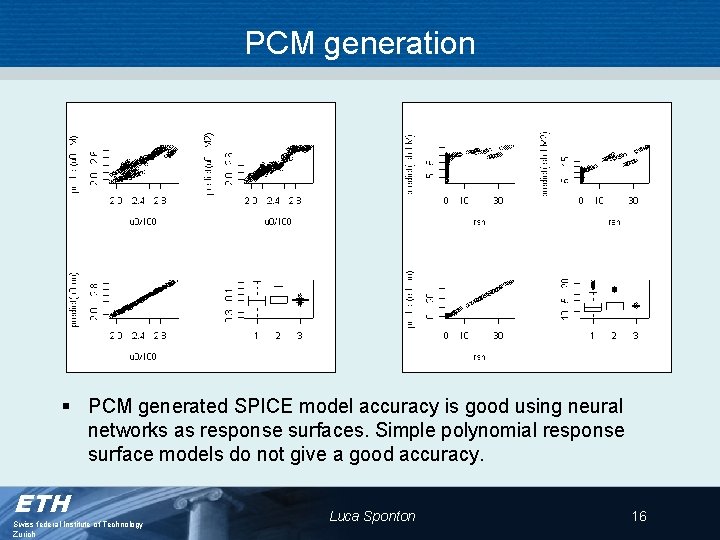
PCM generation § PCM generated SPICE model accuracy is good using neural networks as response surfaces. Simple polynomial response surface models do not give a good accuracy. ETH Swiss federal Institute of Technology Zurich Luca Sponton 16
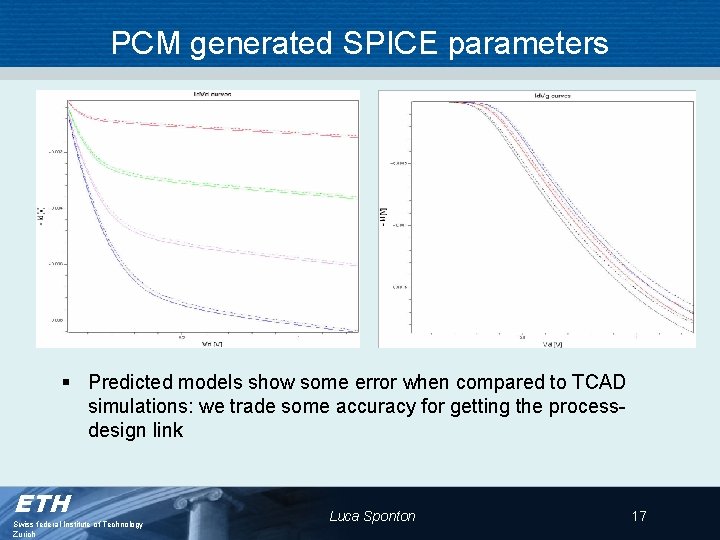
PCM generated SPICE parameters § Predicted models show some error when compared to TCAD simulations: we trade some accuracy for getting the processdesign link ETH Swiss federal Institute of Technology Zurich Luca Sponton 17
Consistent extraction from TCAD PROS: • Early availability of models • Physically meaningful SPICE parameters • Consistent extraction and PCM allow linking directly SPICE parameters to process variations CONS: • • Nominal device extraction time consuming Automated extraction flow has to be optimized on the process Accuracy worse than with global ‘unbounded’ optimization Model prediction introduces additional error ETH Swiss federal Institute of Technology Zurich Luca Sponton 18
Outline § § § Introduction Process variations to circuit variations PCM example Process-aware SPICE compact models Challenges for TCAD-generated models Summary ETH Swiss federal Institute of Technology Zurich Luca Sponton 19
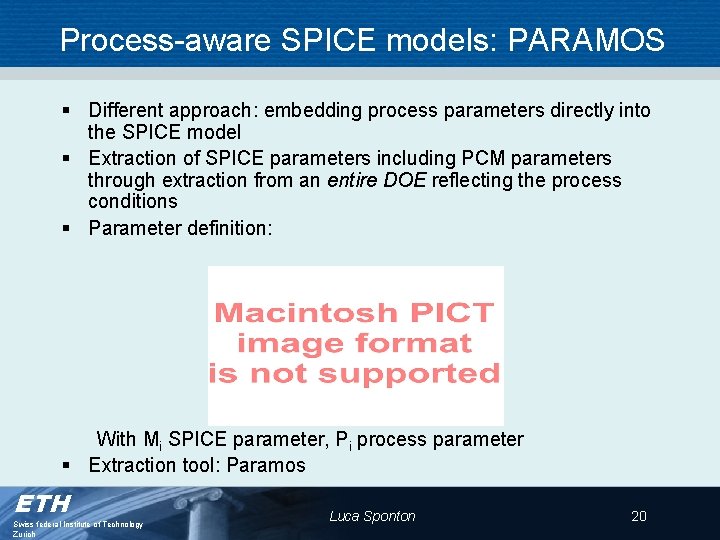
Process-aware SPICE models: PARAMOS § Different approach: embedding process parameters directly into the SPICE model § Extraction of SPICE parameters including PCM parameters through extraction from an entire DOE reflecting the process conditions § Parameter definition: With Mi SPICE parameter, Pi process parameter § Extraction tool: Paramos ETH Swiss federal Institute of Technology Zurich Luca Sponton 20
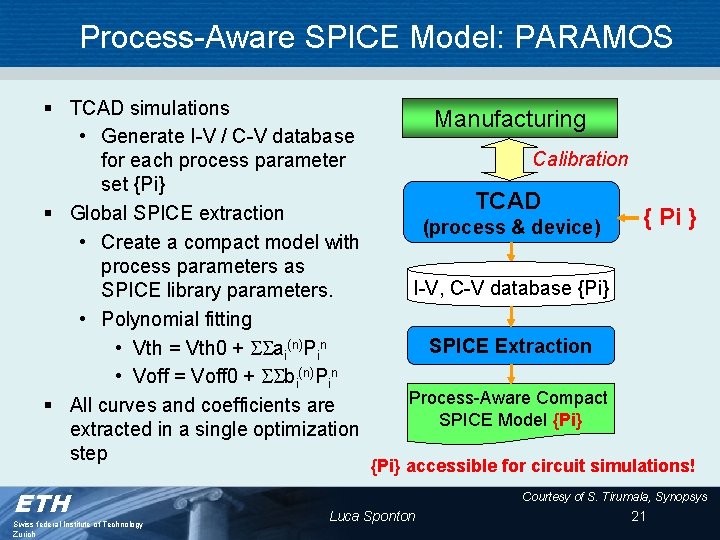
Process-Aware SPICE Model: PARAMOS § TCAD simulations • Generate I-V / C-V database for each process parameter set {Pi} § Global SPICE extraction • Create a compact model with process parameters as SPICE library parameters. • Polynomial fitting • Vth = Vth 0 + SSai(n)Pin • Voff = Voff 0 + SSbi(n)Pin § All curves and coefficients are extracted in a single optimization step ETH Swiss federal Institute of Technology Zurich Manufacturing Calibration TCAD (process & device) { Pi } I-V, C-V database {Pi} SPICE Extraction Process-Aware Compact SPICE Model {Pi} accessible for circuit simulations! Courtesy of S. Tirumala, Synopsys Luca Sponton 21
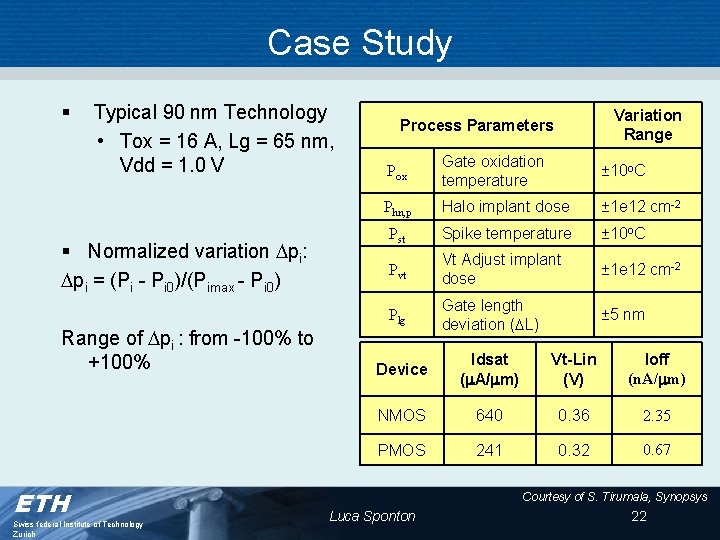
Case Study § Typical 90 nm Technology • Tox = 16 A, Lg = 65 nm, Vdd = 1. 0 V § Normalized variation Dpi: Dpi = (Pi - Pi 0)/(Pimax - Pi 0) Range of Dpi : from -100% to +100% ETH Swiss federal Institute of Technology Zurich Variation Range Process Parameters Pox Gate oxidation temperature ± 10 o. C Phn, p Halo implant dose ± 1 e 12 cm-2 Pst Spike temperature ± 10 o. C Pvt Vt Adjust implant dose ± 1 e 12 cm-2 Plg Gate length deviation (DL) ± 5 nm Device Idsat (m. A/mm) Vt-Lin (V) Ioff (n. A/mm) NMOS 640 0. 36 2. 35 PMOS 241 0. 32 0. 67 Courtesy of S. Tirumala, Synopsys Luca Sponton 22
Quality of Compact Model Extraction Model TCAD C-V Model TCAD sim § Excellent fit for I-V curves (rms error < 5%) § Excellent fit for Vt-Lin and Idsat ( <4%) § Acceptable fit for Ioff (<40%) ETH Swiss federal Institute of Technology Zurich Courtesy of S. Tirumala, Synopsys Luca Sponton 23
Delay Variation and Sensitivity Input rise § § § Delay is most sensitive to Tox variation. • Varies from -10% to +24% as Dpox changes -100% to +100% The response to gate length variation (DL) is relatively weak • - 5% to +5% across the full range of DL variation. Variation around nominal process is non-symmetrical • -10 % vs 24% for min and max variation. ETH Swiss federal Institute of Technology Zurich Courtesy of S. Tirumala, Synopsys Luca Sponton 24
Outline § § § Introduction Process variations to circuit variations Extraction techniques for variability Process-aware SPICE compact models Challenges for TCAD-generated models Summary ETH Swiss federal Institute of Technology Zurich Luca Sponton 25
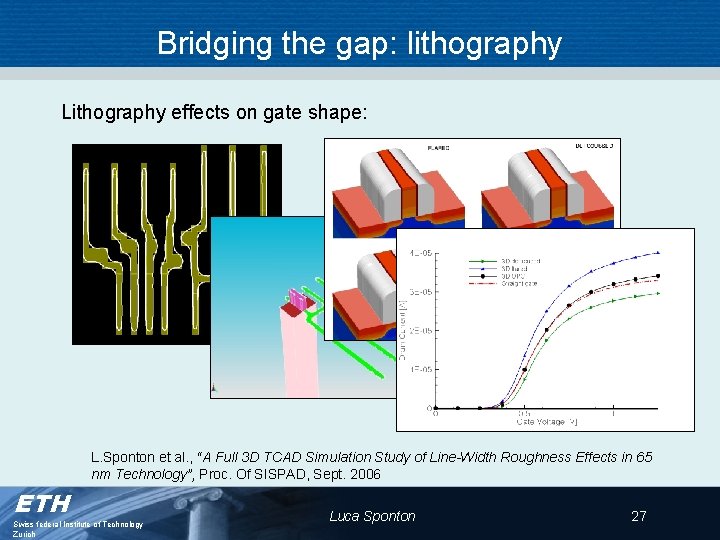
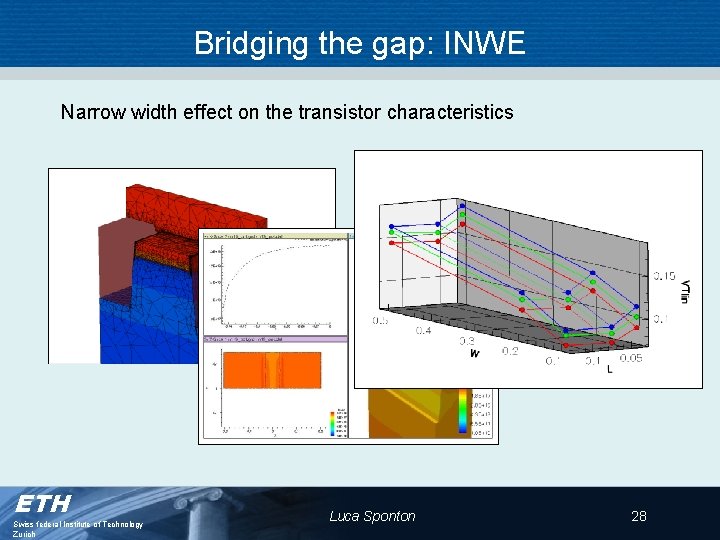
Challenges for TCAD-generated models § There are historically some missing links between TCAD and compact model extraction [1]: • • Lithography effects on gate shape Isolation formation (STI or LOCOS) Outdiffusion of implanted dopant … § All these effects are 3 D effects not easily accountable for with 2 D simulations [1] C. C. Mc. Andrews, “Predictive technology characterization, missing links between TCAD and compact modeling”, Proc. of SISPAD, 2000 ETH Swiss federal Institute of Technology Zurich Luca Sponton 26
Bridging the gap: lithography Lithography effects on gate shape: L. Sponton et al. , “A Full 3 D TCAD Simulation Study of Line-Width Roughness Effects in 65 nm Technology”, Proc. Of SISPAD, Sept. 2006 ETH Swiss federal Institute of Technology Zurich Luca Sponton 27
Bridging the gap: INWE Narrow width effect on the transistor characteristics ETH Swiss federal Institute of Technology Zurich Luca Sponton 28
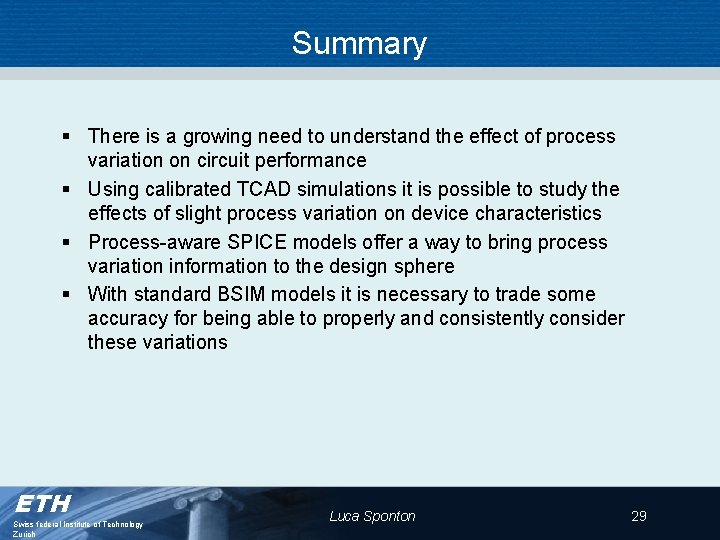
Summary § There is a growing need to understand the effect of process variation on circuit performance § Using calibrated TCAD simulations it is possible to study the effects of slight process variation on device characteristics § Process-aware SPICE models offer a way to bring process variation information to the design sphere § With standard BSIM models it is necessary to trade some accuracy for being able to properly and consistently consider these variations ETH Swiss federal Institute of Technology Zurich Luca Sponton 29
Acknowledgements § The authors would like to thank people at Synopsys and ETH Zurich for their contribution to the work, in particular Dipankar Pramanik, Shridhar Tirumala, Sathya Krishnamurthy, Yuri Mahotin § Part of this work was financed through the KTI Project “Parametric Design and Analysis for Semiconductor Technology Computer Aided Design (PARA-TCAD)” ETH Swiss federal Institute of Technology Zurich Luca Sponton 30
ETH Swiss federal Institute of Technology Zurich Thanks for your attention Luca Sponton Swiss Federal Institute of Technology (ETH) Integrated Systems Laboratory Phone: +41 44 632 7786 (ETH) Phone: +41 44 567 1555 (SYNOPSYS) Email: luca@iis. ee. ethz. ch September 22 nd, 2006 MOS-AK Workshop Montreux