
Silvaco TCAD Introduction David Green david greensilvaco com



- Slides: 30
Silvaco TCAD Introduction David Green david. green@silvaco. com
Topics § § § Introduction Why use TCAD (Technology Computer Aided Design) Silvaco TCAD overview Interactive tools Additional Resources Conclusions 2 / 34 SIMDET 2018
Introduction • Founded in 1984. • Market leader in TCAD, Spice simulation & IC CAD. • Large customer base of Foundry, IDM, ASIC and Fabless semiconductor Companies. • Privately held. • Fifteen locations worldwide. • Silvaco Europe is a major R&D centre for TCAD and EDA modelling. 3 / 34 SIMDET 2018
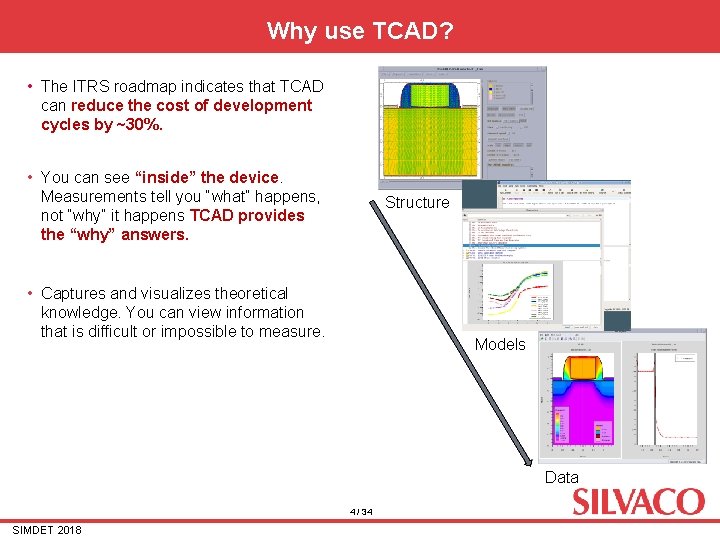
Why use TCAD? • The ITRS roadmap indicates that TCAD can reduce the cost of development cycles by ~30%. • You can see “inside” the device. Measurements tell you “what” happens, not “why” it happens TCAD provides the “why” answers. Structure • Captures and visualizes theoretical knowledge. You can view information that is difficult or impossible to measure. Models Data 4 / 34 SIMDET 2018
Silvaco – Software flow Process Simulation Device Simulation SPICE Modeling Layout 3 D Parasitic RC Extraction SPICE DRC/LVS Reliability Analysis 5 / 34 SIMDET 2018 Variation Analysis
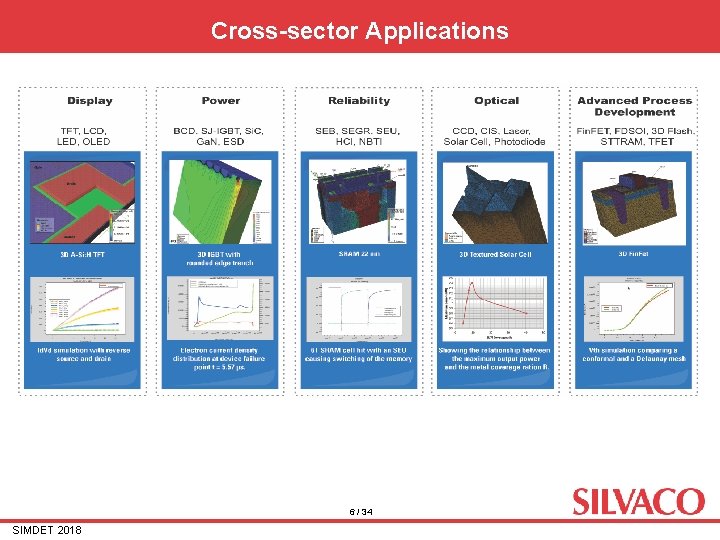
Cross-sector Applications 6 / 34 SIMDET 2018
2 D/3 D Electro/Optical/ Thermal/Atomistic Device Simulation 3 D RC Extraction Clever 7 / 34 SIMDET 2018 Tonyplot – Visualization 2 D/3 D Process Simulation + Emulation Victory Device Virtual Wafer Fab (VWF) - DOE Victory Process Deckbuild – Deck Editor + Execution Silvaco TCAD Overview
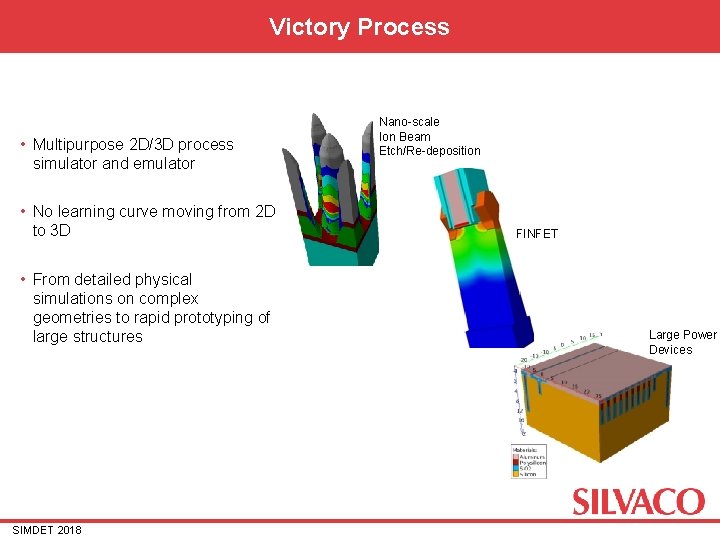
Victory Process • Multipurpose 2 D/3 D process simulator and emulator Nano-scale Ion Beam Etch/Re-deposition • No learning curve moving from 2 D to 3 D FINFET • From detailed physical simulations on complex geometries to rapid prototyping of large structures SIMDET 2018 Large Power Devices
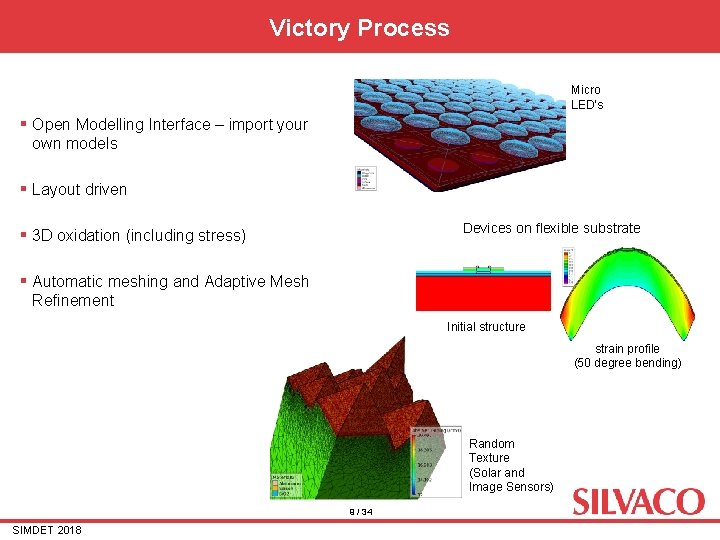
Victory Process Micro LED’s § Open Modelling Interface – import your own models § Layout driven Devices on flexible substrate § 3 D oxidation (including stress) § Automatic meshing and Adaptive Mesh Refinement Initial structure strain profile (50 degree bending) Random Texture (Solar and Image Sensors) 9 / 34 SIMDET 2018
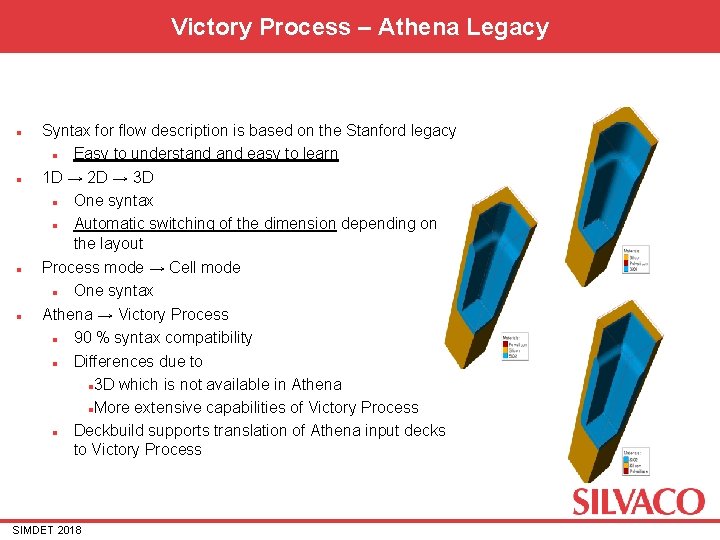
Victory Process – Athena Legacy Syntax for flow description is based on the Stanford legacy Easy to understand easy to learn 1 D → 2 D → 3 D One syntax Automatic switching of the dimension depending on the layout Process mode → Cell mode One syntax Athena → Victory Process 90 % syntax compatibility Differences due to 3 D which is not available in Athena More extensive capabilities of Victory Process Deckbuild supports translation of Athena input decks to Victory Process SIMDET 2018
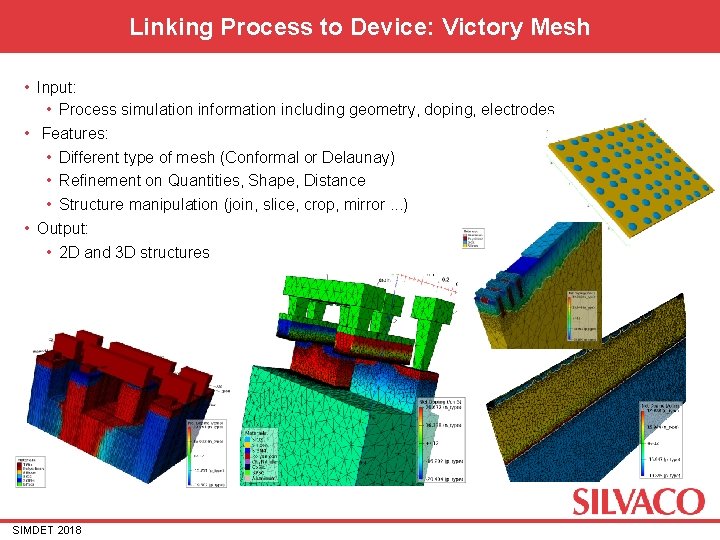
Linking Process to Device: Victory Mesh • Input: • Process simulation information including geometry, doping, electrodes • Features: • Different type of mesh (Conformal or Delaunay) • Refinement on Quantities, Shape, Distance • Structure manipulation (join, slice, crop, mirror. . . ) • Output: • 2 D and 3 D structures SIMDET 2018
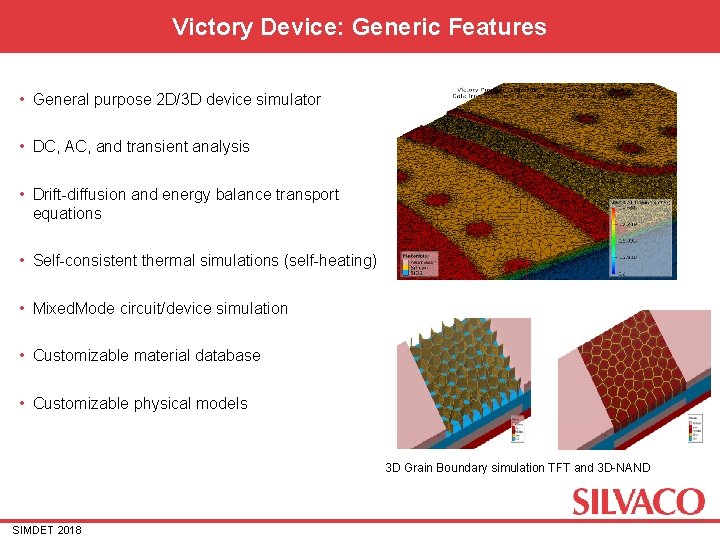
Victory Device: Generic Features • General purpose 2 D/3 D device simulator • DC, AC, and transient analysis • Drift-diffusion and energy balance transport equations • Self-consistent thermal simulations (self-heating) • Mixed. Mode circuit/device simulation • Customizable material database • Customizable physical models 3 D Grain Boundary simulation TFT and 3 D-NAND SIMDET 2018
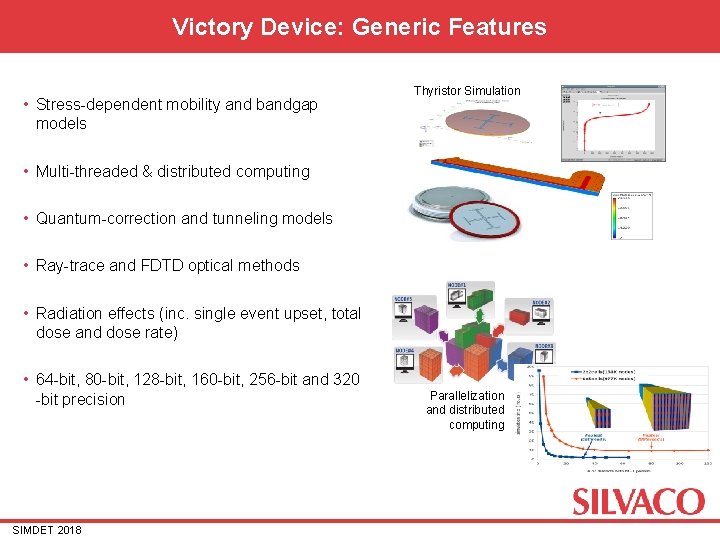
Victory Device: Generic Features • Stress-dependent mobility and bandgap Thyristor Simulation models • Multi-threaded & distributed computing • Quantum-correction and tunneling models • Ray-trace and FDTD optical methods • Radiation effects (inc. single event upset, total dose and dose rate) • 64 -bit, 80 -bit, 128 -bit, 160 -bit, 256 -bit and 320 -bit precision SIMDET 2018 Parallelization and distributed computing
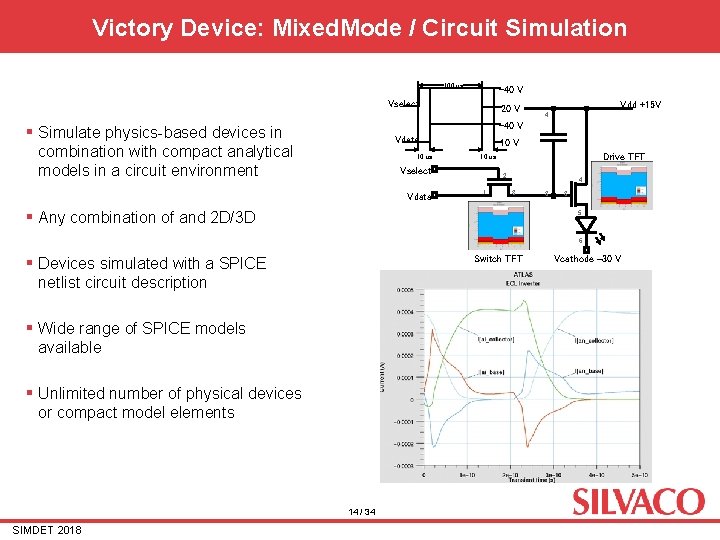
Victory Device: Mixed. Mode / Circuit Simulation 100 us -40 V Vselect 20 V Vdd +15 V 4 -40 V § Simulate physics-based devices in Vdata combination with compact analytical models in a circuit environment 10 us 10 V Vselect Vdata Drive TFT 10 us 2 1 4 3 § Any combination of and 2 D/3 D 3 3 5 6 § Devices simulated with a SPICE Switch TFT netlist circuit description § Wide range of SPICE models available § Unlimited number of physical devices or compact model elements 14 / 34 SIMDET 2018 Vcathode – 30 V
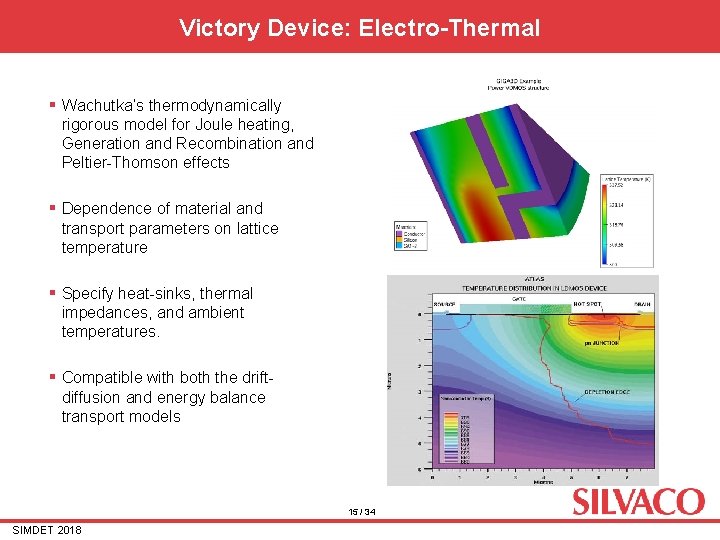
Victory Device: Electro-Thermal § Wachutka’s thermodynamically rigorous model for Joule heating, Generation and Recombination and Peltier-Thomson effects § Dependence of material and transport parameters on lattice temperature § Specify heat-sinks, thermal impedances, and ambient temperatures. § Compatible with both the driftdiffusion and energy balance transport models 15 / 34 SIMDET 2018
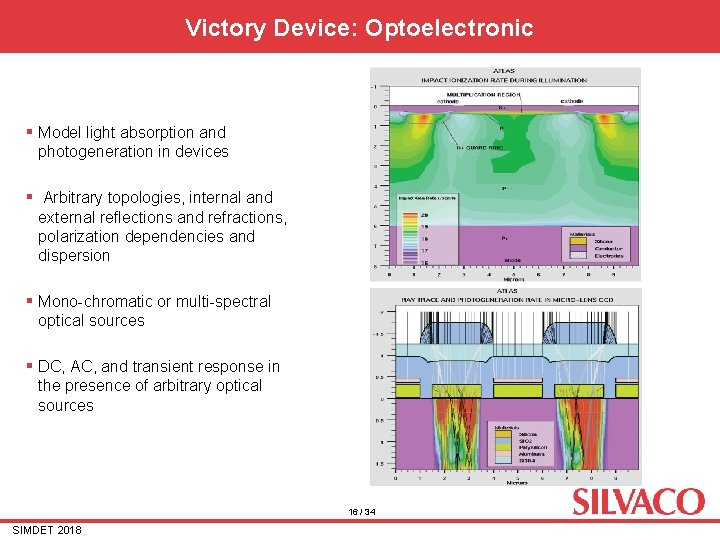
Victory Device: Optoelectronic § Model light absorption and photogeneration in devices § Arbitrary topologies, internal and external reflections and refractions, polarization dependencies and dispersion § Mono-chromatic or multi-spectral optical sources § DC, AC, and transient response in the presence of arbitrary optical sources 16 / 34 SIMDET 2018
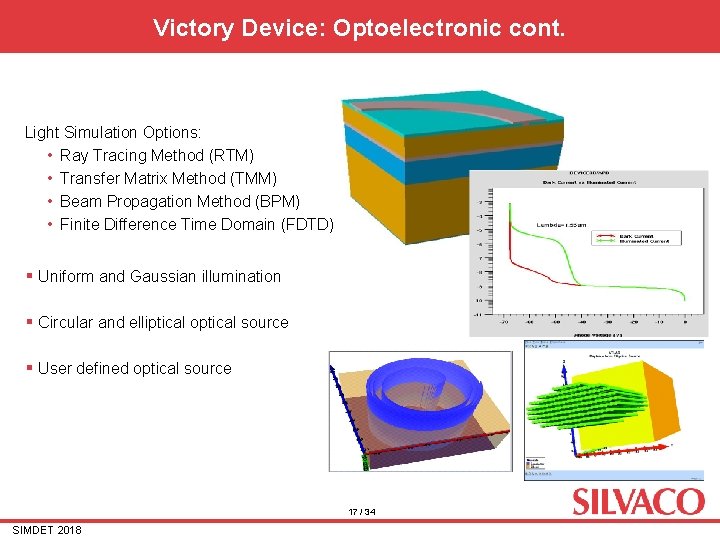
Victory Device: Optoelectronic cont. Light Simulation Options: • Ray Tracing Method (RTM) • Transfer Matrix Method (TMM) • Beam Propagation Method (BPM) • Finite Difference Time Domain (FDTD) § Uniform and Gaussian illumination § Circular and elliptical optical source § User defined optical source 17 / 34 SIMDET 2018
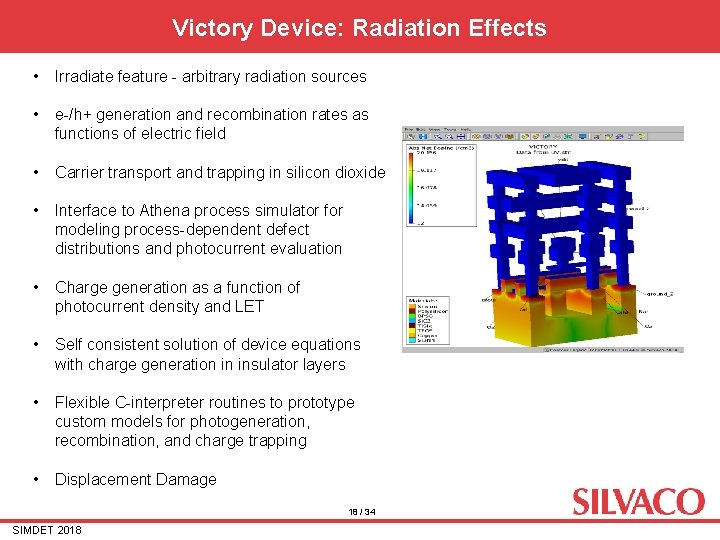
Victory Device: Radiation Effects • Irradiate feature - arbitrary radiation sources • e-/h+ generation and recombination rates as functions of electric field • Carrier transport and trapping in silicon dioxide • Interface to Athena process simulator for modeling process-dependent defect distributions and photocurrent evaluation • Charge generation as a function of photocurrent density and LET • Self consistent solution of device equations with charge generation in insulator layers • Flexible C-interpreter routines to prototype custom models for photogeneration, recombination, and charge trapping • Displacement Damage 18 / 34 SIMDET 2018
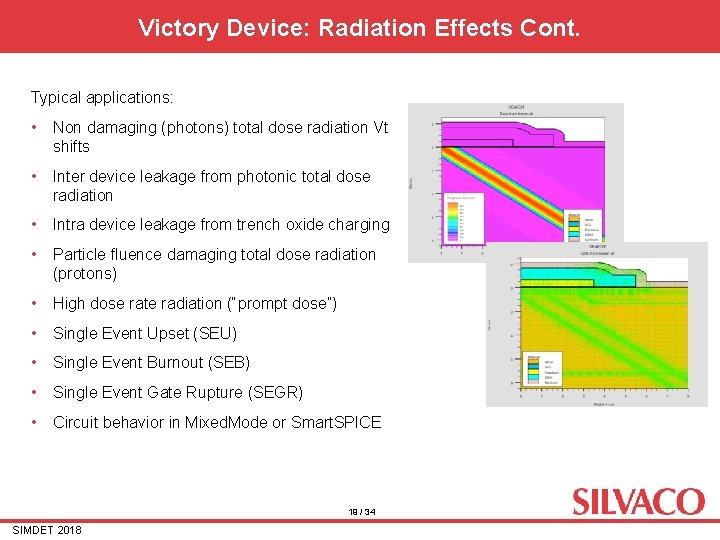
Victory Device: Radiation Effects Cont. Typical applications: • Non damaging (photons) total dose radiation Vt shifts • Inter device leakage from photonic total dose radiation • Intra device leakage from trench oxide charging • Particle fluence damaging total dose radiation (protons) • High dose rate radiation (“prompt dose”) • Single Event Upset (SEU) • Single Event Burnout (SEB) • Single Event Gate Rupture (SEGR) • Circuit behavior in Mixed. Mode or Smart. SPICE 19 / 34 SIMDET 2018
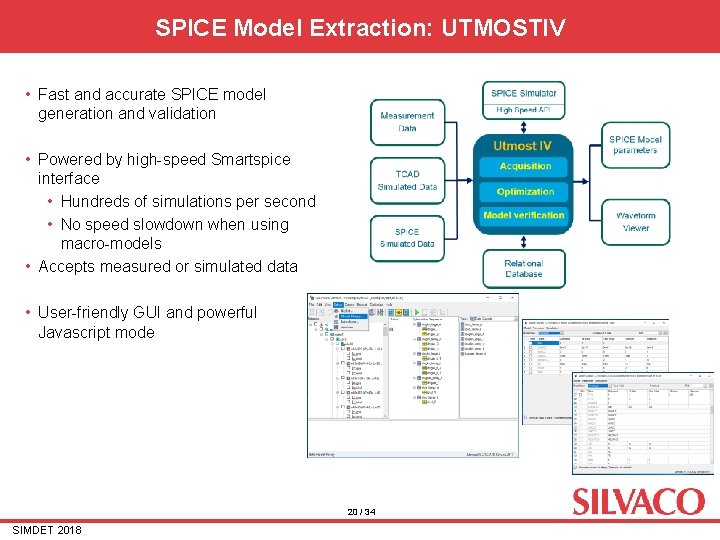
SPICE Model Extraction: UTMOSTIV • Fast and accurate SPICE model generation and validation • Powered by high-speed Smartspice interface • Hundreds of simulations per second • No speed slowdown when using macro-models • Accepts measured or simulated data • User-friendly GUI and powerful Javascript mode 20 / 34 SIMDET 2018
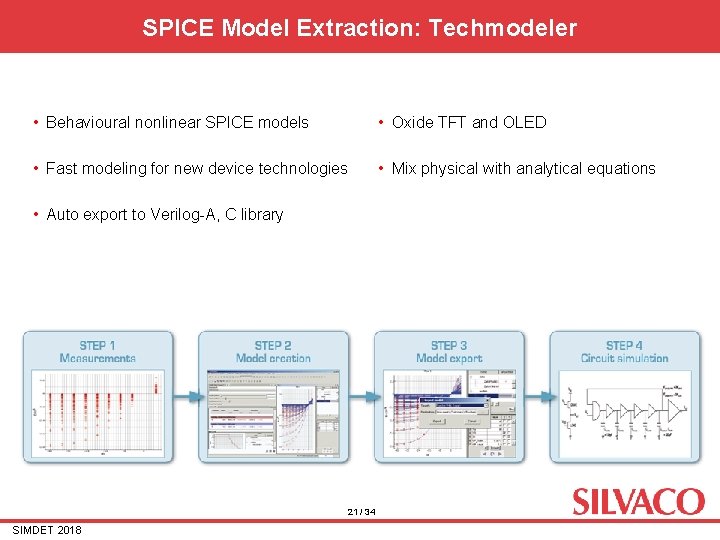
SPICE Model Extraction: Techmodeler • Behavioural nonlinear SPICE models • Oxide TFT and OLED • Fast modeling for new device technologies • Mix physical with analytical equations • Auto export to Verilog-A, C library 21 / 34 SIMDET 2018
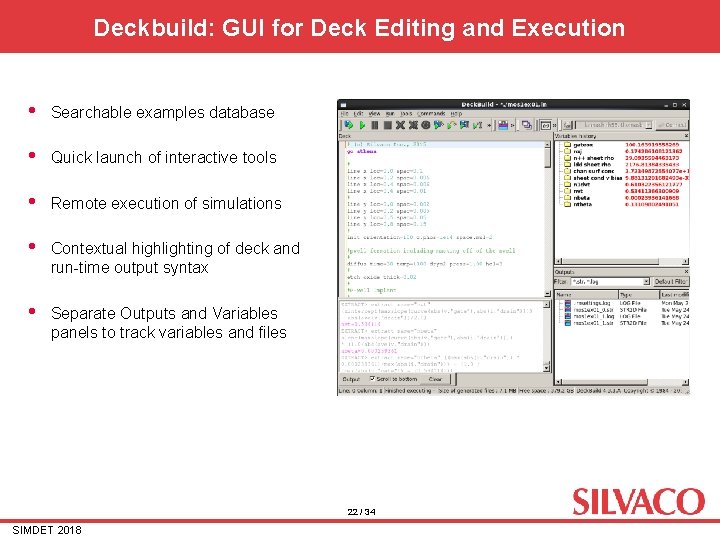
Deckbuild: GUI for Deck Editing and Execution • Searchable examples database • Quick launch of interactive tools • Remote execution of simulations • Contextual highlighting of deck and run-time output syntax • Separate Outputs and Variables panels to track variables and files 22 / 34 SIMDET 2018
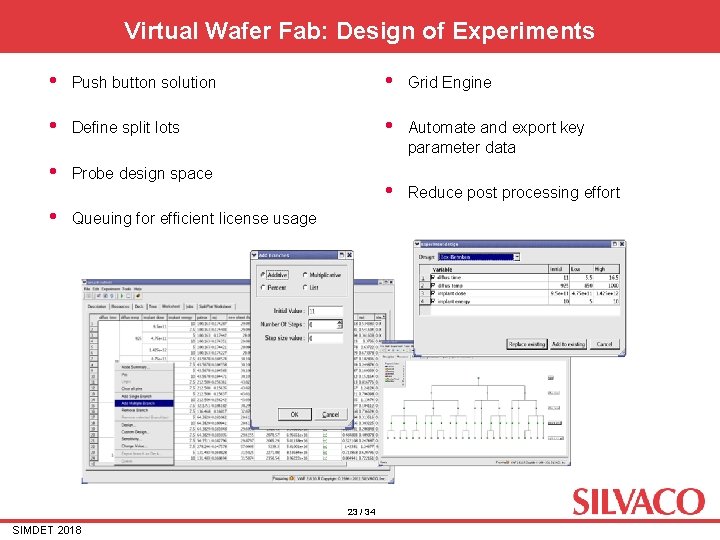
Virtual Wafer Fab: Design of Experiments • Push button solution • Grid Engine • Define split lots • Automate and export key parameter data • Probe design space Reduce post processing effort • • Queuing for efficient license usage 23 / 34 SIMDET 2018
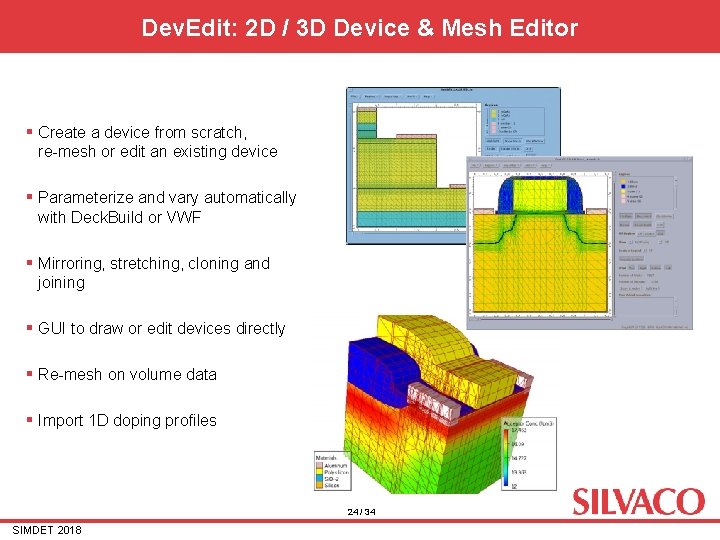
Dev. Edit: 2 D / 3 D Device & Mesh Editor § Create a device from scratch, re-mesh or edit an existing device § Parameterize and vary automatically with Deck. Build or VWF § Mirroring, stretching, cloning and joining § GUI to draw or edit devices directly § Re-mesh on volume data § Import 1 D doping profiles 24 / 34 SIMDET 2018
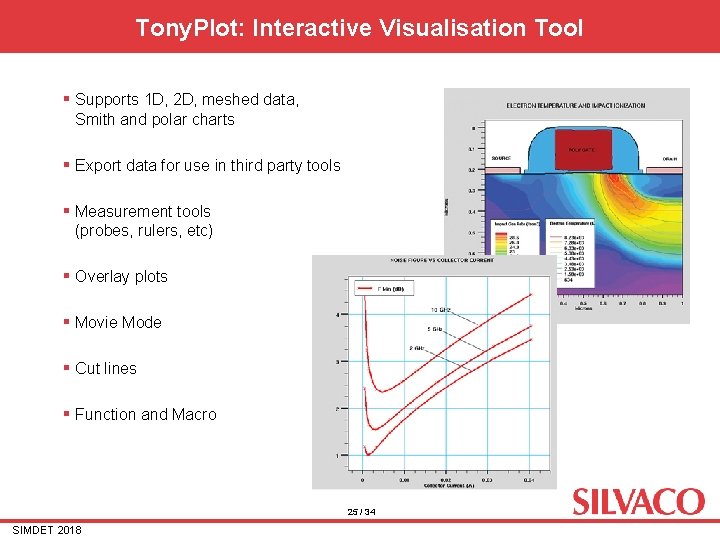
Tony. Plot: Interactive Visualisation Tool § Supports 1 D, 2 D, meshed data, Smith and polar charts § Export data for use in third party tools § Measurement tools (probes, rulers, etc) § Overlay plots § Movie Mode § Cut lines § Function and Macro 25 / 34 SIMDET 2018
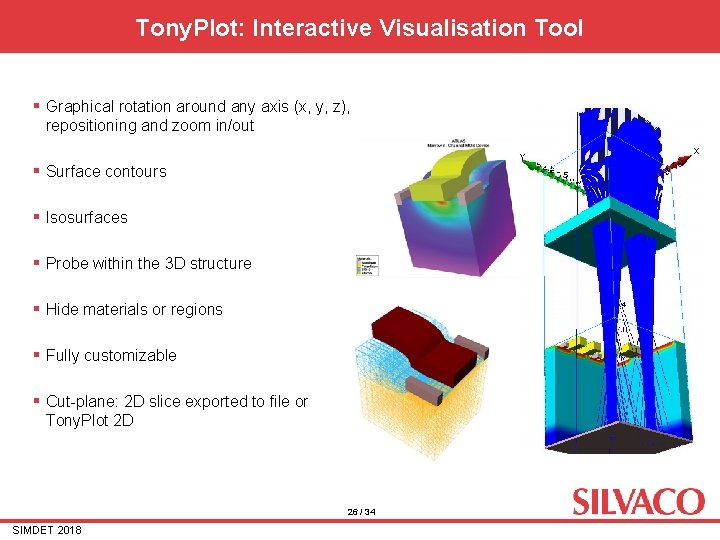
Tony. Plot: Interactive Visualisation Tool § Graphical rotation around any axis (x, y, z), repositioning and zoom in/out § Surface contours § Isosurfaces § Probe within the 3 D structure § Hide materials or regions § Fully customizable § Cut-plane: 2 D slice exported to file or Tony. Plot 2 D 26 / 34 SIMDET 2018
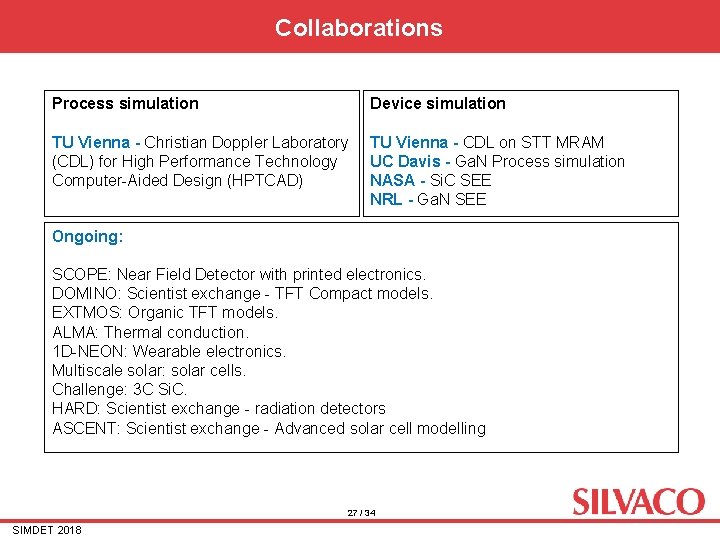
Collaborations Process simulation Device simulation TU Vienna - Christian Doppler Laboratory (CDL) for High Performance Technology Computer-Aided Design (HPTCAD) TU Vienna - CDL on STT MRAM UC Davis - Ga. N Process simulation NASA - Si. C SEE NRL - Ga. N SEE Ongoing: SCOPE: Near Field Detector with printed electronics. DOMINO: Scientist exchange - TFT Compact models. EXTMOS: Organic TFT models. ALMA: Thermal conduction. 1 D-NEON: Wearable electronics. Multiscale solar: solar cells. Challenge: 3 C Si. C. HARD: Scientist exchange - radiation detectors ASCENT: Scientist exchange - Advanced solar cell modelling 27 / 34 SIMDET 2018
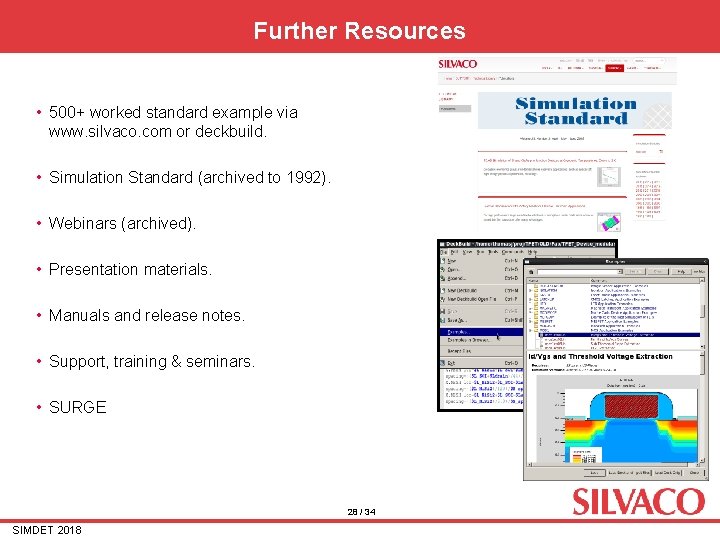
Further Resources • 500+ worked standard example via www. silvaco. com or deckbuild. • Simulation Standard (archived to 1992). • Webinars (archived). • Presentation materials. • Manuals and release notes. • Support, training & seminars. • SURGE 28 / 34 SIMDET 2018
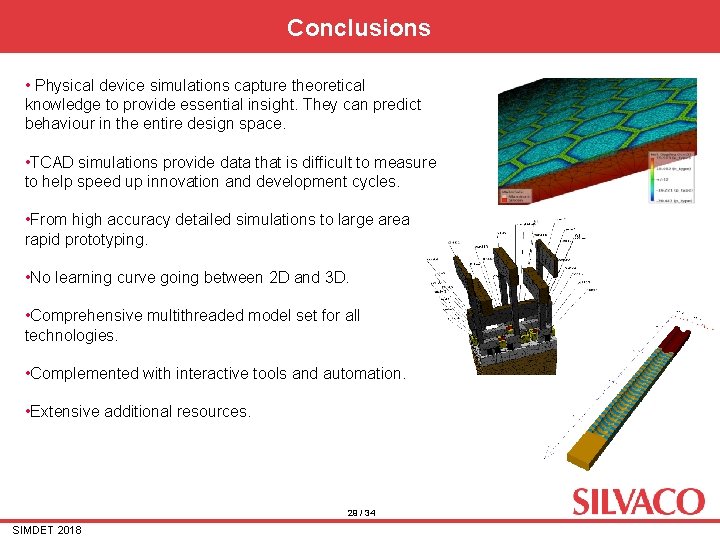
Conclusions • Physical device simulations capture theoretical knowledge to provide essential insight. They can predict behaviour in the entire design space. • TCAD simulations provide data that is difficult to measure to help speed up innovation and development cycles. • From high accuracy detailed simulations to large area rapid prototyping. • No learning curve going between 2 D and 3 D. • Comprehensive multithreaded model set for all technologies. • Complemented with interactive tools and automation. • Extensive additional resources. 29 / 34 SIMDET 2018