Modelling radiation damage in TCAD 1 2 F

- Slides: 38
Modelling radiation damage in TCAD (1, 2), F. Moscatelli(2), A. Morozzi(1, 2) D. Passeri(1, 2) (1) Dipartimento di Ingegneria - Università di Perugia, Italy (2) Istituto Nazionale Fisica Nucleare - Sezione di Perugia, Italy D. Passeri – Modelling radiation damage in TCAD
Outline √ Motivations and background. √ TCAD radiation damage modelling: discussion. √ Simulation results and comparison with experimental data: - DC (steady-state) -> Diodes / Gate Controlled Diodes. - AC (small-signals) -> MOS Capacitors. - Time (transient) -> Multi-strip structures. √ Conclusions. D. Passeri – Modelling radiation damage in TCAD 2
Outline √ Motivations and background. √ TCAD radiation damage modelling: discussion. √ Simulation results and comparison with experimental data: - DC (steady-state) -> Diodes / Gate Controlled Diodes. - AC (small-signals) -> MOS Capacitors. - Time (transient) -> Multi-strip structures. √ Conclusions. D. Passeri – Modelling radiation damage in TCAD 3
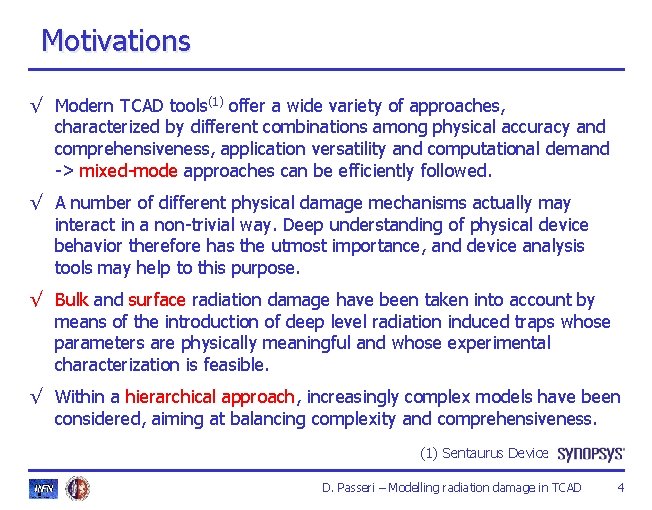
Motivations √ Modern TCAD tools(1) offer a wide variety of approaches, characterized by different combinations among physical accuracy and comprehensiveness, application versatility and computational demand -> mixed-mode approaches can be efficiently followed. √ A number of different physical damage mechanisms actually may interact in a non-trivial way. Deep understanding of physical device behavior therefore has the utmost importance, and device analysis tools may help to this purpose. √ Bulk and surface radiation damage have been taken into account by means of the introduction of deep level radiation induced traps whose parameters are physically meaningful and whose experimental characterization is feasible. √ Within a hierarchical approach, increasingly complex models have been considered, aiming at balancing complexity and comprehensiveness. (1) Sentaurus Device D. Passeri – Modelling radiation damage in TCAD 4
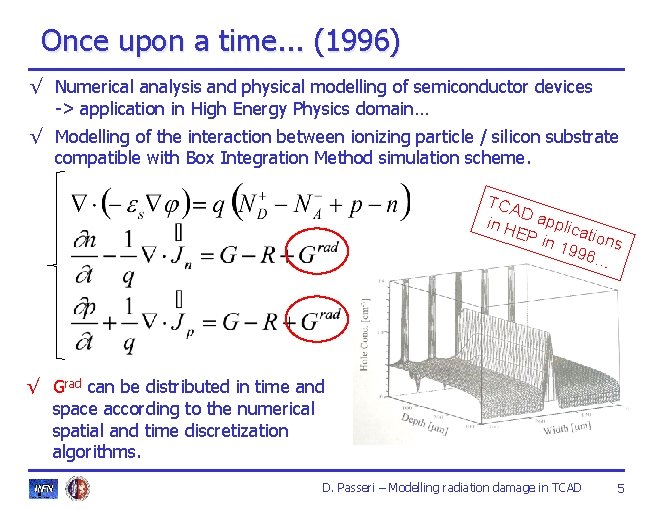
Once upon a time. . . (1996) √ Numerical analysis and physical modelling of semiconductor devices -> application in High Energy Physics domain… √ Modelling of the interaction between ionizing particle / silicon substrate compatible with Box Integration Method simulation scheme. TCA D in H applic a EP in 1 tions 996 … √ Grad can be distributed in time and space according to the numerical spatial and time discretization algorithms. D. Passeri – Modelling radiation damage in TCAD 5
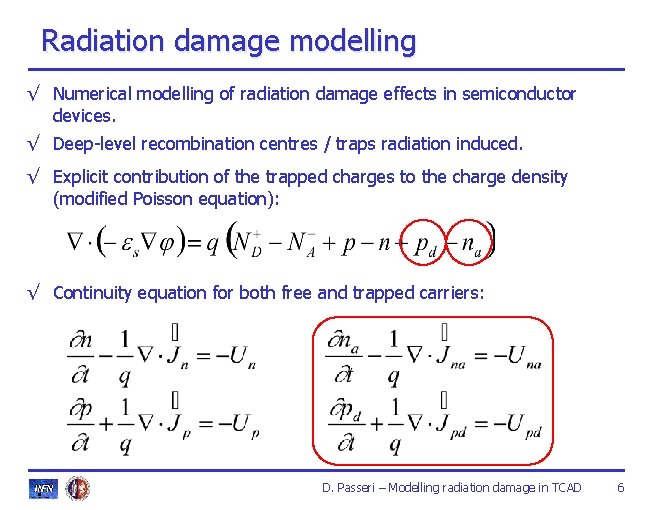
Radiation damage modelling √ Numerical modelling of radiation damage effects in semiconductor devices. √ Deep-level recombination centres / traps radiation induced. √ Explicit contribution of the trapped charges to the charge density (modified Poisson equation): √ Continuity equation for both free and trapped carriers: D. Passeri – Modelling radiation damage in TCAD 6
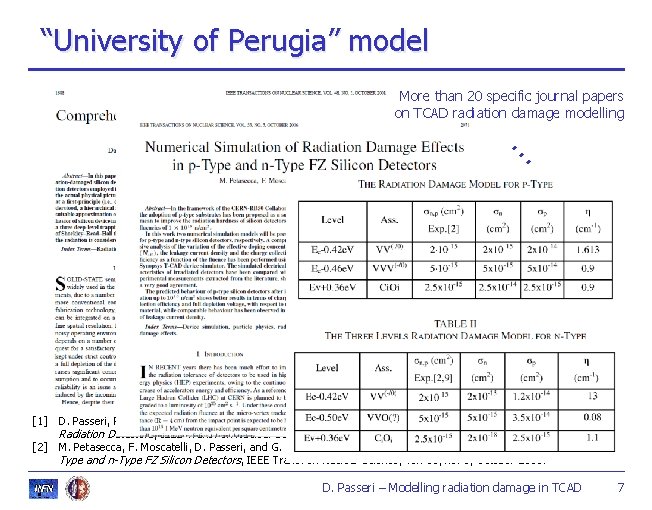
“University of Perugia” model More than 20 specific journal papers on TCAD radiation damage modelling … [1] [2] D. Passeri, P. Ciampolini, G. M. Bilei, and F. Moscatelli, Comprehensive Modeling of Bulk-Damage Effects in Silicon Radiation Detectors, IEEE Trans. on Nuclear Science, vol. 48, no. 5, October 2001. M. Petasecca, F. Moscatelli, D. Passeri, and G. U. Pignatel, Numerical Simulation of Radiation Damage Effects in p. Type and n-Type FZ Silicon Detectors, IEEE Trans. on Nuclear Science, vol. 53, no. 5, October 2006. D. Passeri – Modelling radiation damage in TCAD 7
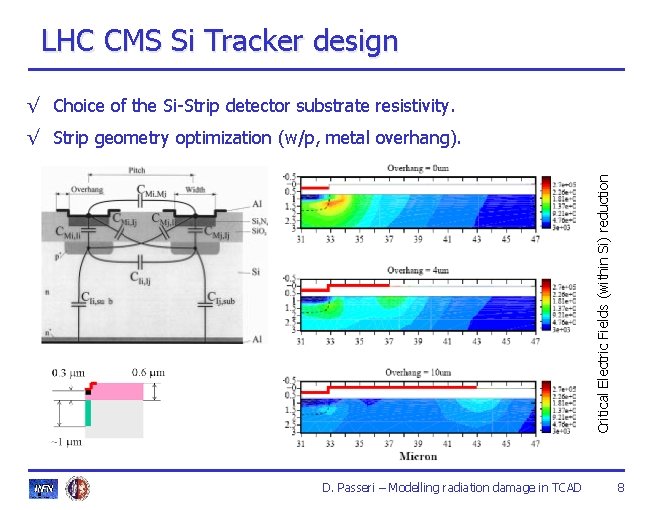
LHC CMS Si Tracker design √ Choice of the Si-Strip detector substrate resistivity. Electron concentration at the surface D. Passeri – Modelling radiation damage in TCAD Critical Electric Fields (within Si) reduction √ Strip geometry optimization (w/p, metal overhang). 8
Outline √ Motivations and background. √ TCAD radiation damage modelling: discussion. √ Simulation results and comparison with experimental data: - DC (steady-state) -> Diodes / Gate Controlled Diodes. - AC (small-signals) -> MOS Capacitors. - Time (transient) -> Multi-strip structures. √ Conclusions. D. Passeri – Modelling radiation damage in TCAD 9
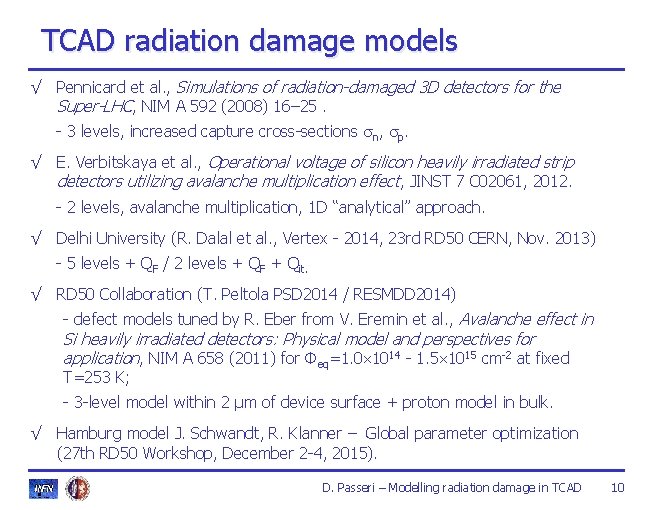
TCAD radiation damage models √ Pennicard et al. , Simulations of radiation-damaged 3 D detectors for the Super-LHC, NIM A 592 (2008) 16– 25. - 3 levels, increased capture cross-sections n, p. √ E. Verbitskaya et al. , Operational voltage of silicon heavily irradiated strip detectors utilizing avalanche multiplication effect, JINST 7 C 02061, 2012. - 2 levels, avalanche multiplication, 1 D “analytical” approach. √ Delhi University (R. Dalal et al. , Vertex - 2014, 23 rd RD 50 CERN, Nov. 2013) - 5 levels + QF / 2 levels + QF + Qit. √ RD 50 Collaboration (T. Peltola PSD 2014 / RESMDD 2014) - defect models tuned by R. Eber from V. Eremin et al. , Avalanche effect in Si heavily irradiated detectors: Physical model and perspectives for application, NIM A 658 (2011) for Φeq=1. 0 1014 - 1. 5 1015 cm-2 at fixed T=253 K; - 3 -level model within 2 μm of device surface + proton model in bulk. √ Hamburg model J. Schwandt, R. Klanner – Global parameter optimization (27 th RD 50 Workshop, December 2 -4, 2015). D. Passeri – Modelling radiation damage in TCAD 10
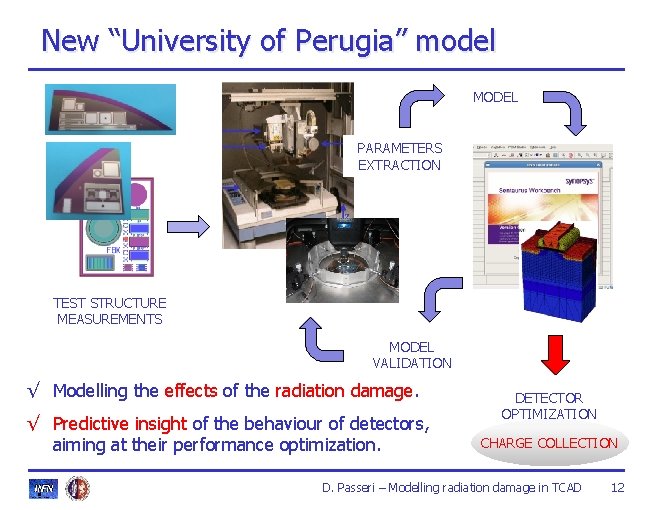
New “University of Perugia” model √ Extend the predictive capabilities to HL-LHC radiation damage levels (e. g. fluences > 2. 0× 1016 cm-2 1 Me. V neutrons). √ Keep low the number of traps (e. g. fitting parameters). √ New effects (e. g. charge multiplication <- avalanche effects). √ Physically grounded approach. √ No over-specific modelling (one model fits all…). √ Predictive capabilities @ , @T, @Vbias, … D. Passeri – Modelling radiation damage in TCAD 11
New “University of Perugia” model MODEL PARAMETERS EXTRACTION TEST STRUCTURE MEASUREMENTS MODEL VALIDATION √ Modelling the effects of the radiation damage. √ Predictive insight of the behaviour of detectors, aiming at their performance optimization. DETECTOR OPTIMIZATION CHARGE COLLECTION D. Passeri – Modelling radiation damage in TCAD 12
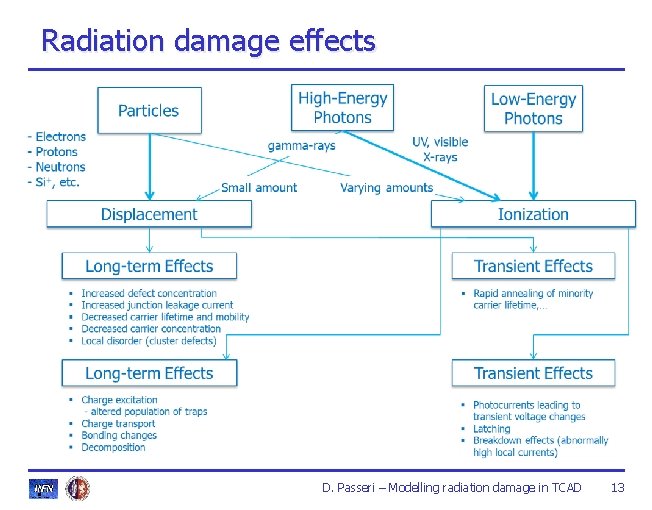
Radiation damage effects D. Passeri – Modelling radiation damage in TCAD 13
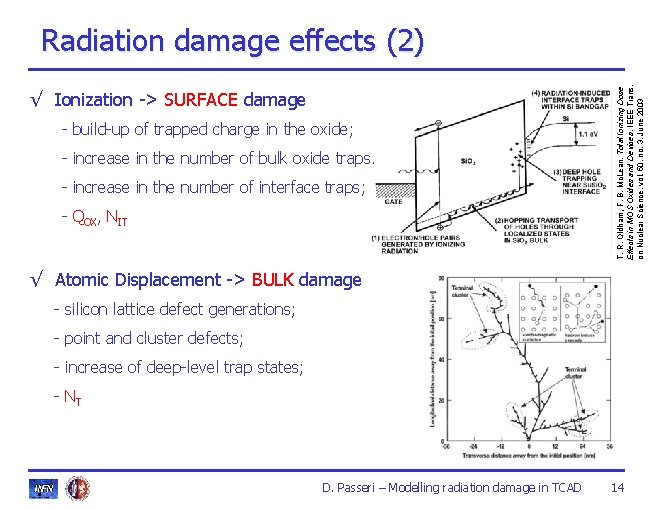
√ Ionization -> SURFACE damage - build-up of trapped charge in the oxide; - increase in the number of bulk oxide traps. - increase in the number of interface traps; - QOX, NIT T. R. Oldham, F. B. Mc. Lean, Total Ionizing Dose Effects in MOS Oxides and Devices, IEEE Trans. on Nuclear Science, vol. 50, no. 3, June 2003 Radiation damage effects (2) √ Atomic Displacement -> BULK damage - silicon lattice defect generations; - point and cluster defects; - increase of deep-level trap states; - NT D. Passeri – Modelling radiation damage in TCAD 14
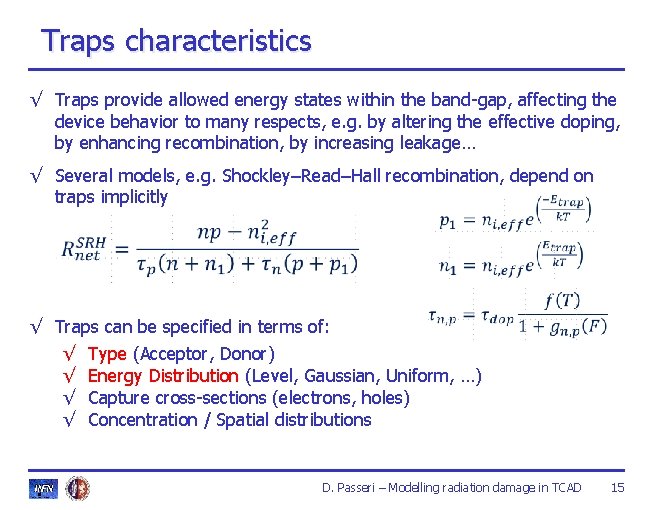
Traps characteristics √ Traps provide allowed energy states within the band-gap, affecting the device behavior to many respects, e. g. by altering the effective doping, by enhancing recombination, by increasing leakage… √ Several models, e. g. Shockley–Read–Hall recombination, depend on traps implicitly √ Traps can be specified in terms of: √ Type (Acceptor, Donor) √ Energy Distribution (Level, Gaussian, Uniform, …) √ Capture cross-sections (electrons, holes) √ Concentration / Spatial distributions D. Passeri – Modelling radiation damage in TCAD 15
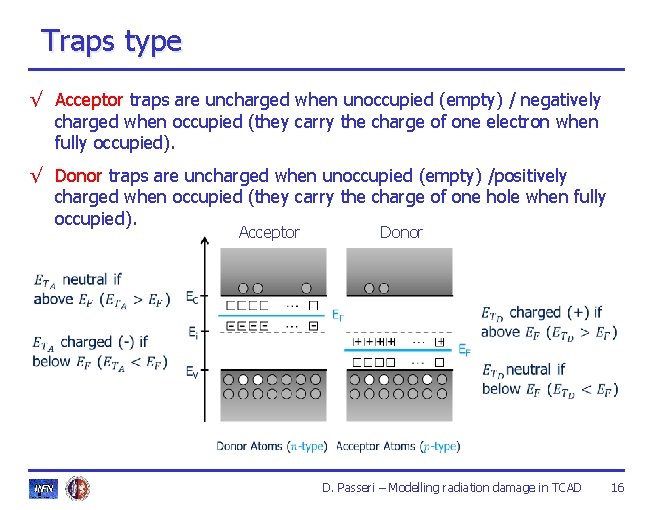
Traps type √ Acceptor traps are uncharged when unoccupied (empty) / negatively charged when occupied (they carry the charge of one electron when fully occupied). √ Donor traps are uncharged when unoccupied (empty) /positively charged when occupied (they carry the charge of one hole when fully occupied). Acceptor Donor D. Passeri – Modelling radiation damage in TCAD 16
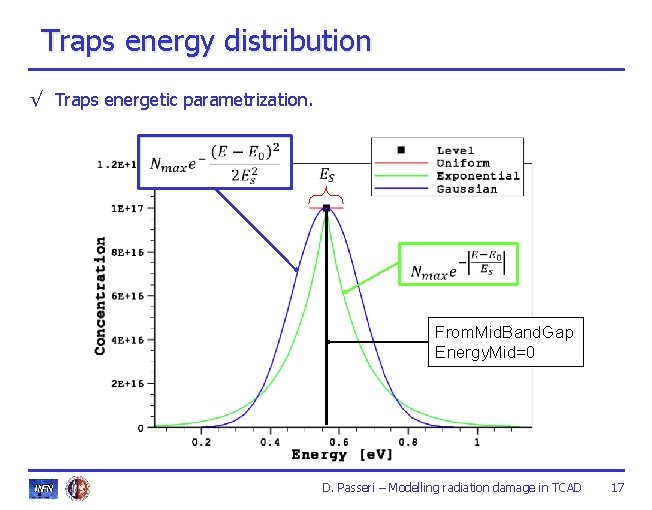
Traps energy distribution √ Traps energetic parametrization. From. Mid. Band. Gap Energy. Mid=0 D. Passeri – Modelling radiation damage in TCAD 17
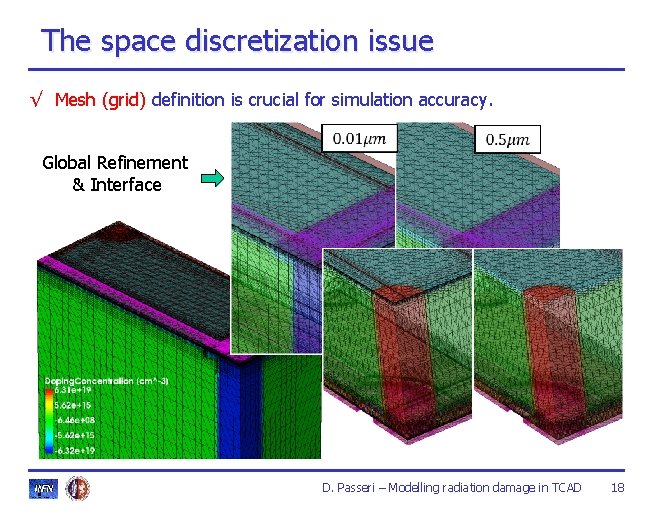
The space discretization issue √ Mesh (grid) definition is crucial for simulation accuracy. Global Refinement & Interface D. Passeri – Modelling radiation damage in TCAD 18
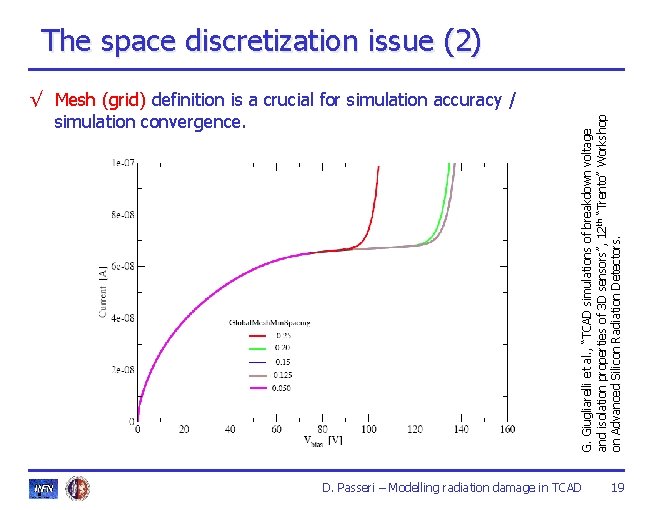
√ Mesh (grid) definition is a crucial for simulation accuracy / simulation convergence. G. Giugliarelli et al. , “TCAD simulations of breakdown voltage and isolation properties of 3 D sensors”, 12 th “Trento” Workshop on Advanced Silicon Radiation Detectors. The space discretization issue (2) D. Passeri – Modelling radiation damage in TCAD 19
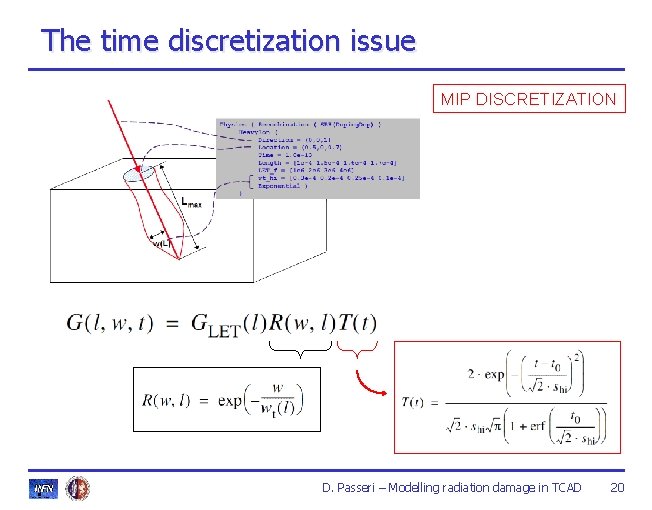
The time discretization issue MIP DISCRETIZATION D. Passeri – Modelling radiation damage in TCAD 20
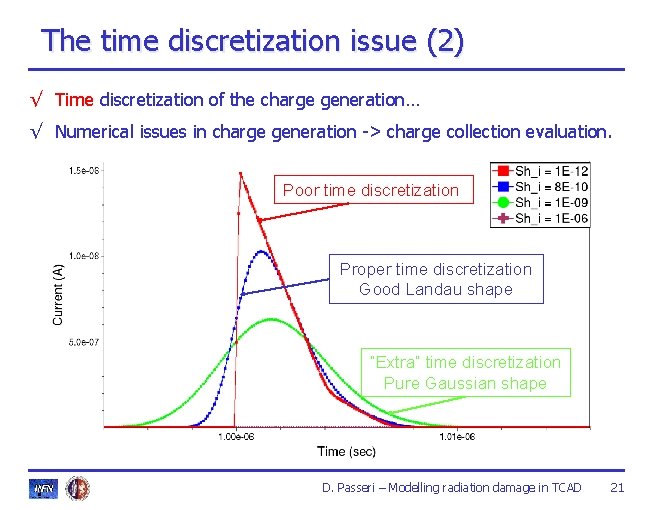
The time discretization issue (2) √ Time discretization of the charge generation… √ Numerical issues in charge generation -> charge collection evaluation. Poor time discretization Proper time discretization Good Landau shape “Extra” time discretization Pure Gaussian shape D. Passeri – Modelling radiation damage in TCAD 21
Outline √ Motivations and background. √ TCAD radiation damage modelling: discussion. √ Simulation results and comparison with experimental data: - DC (steady-state) -> Diodes / Gate Controlled Diodes. - AC (small-signals) -> MOS Capacitors. - Time (transient) -> Multi-strip structures. √ Conclusions. D. Passeri – Modelling radiation damage in TCAD 22
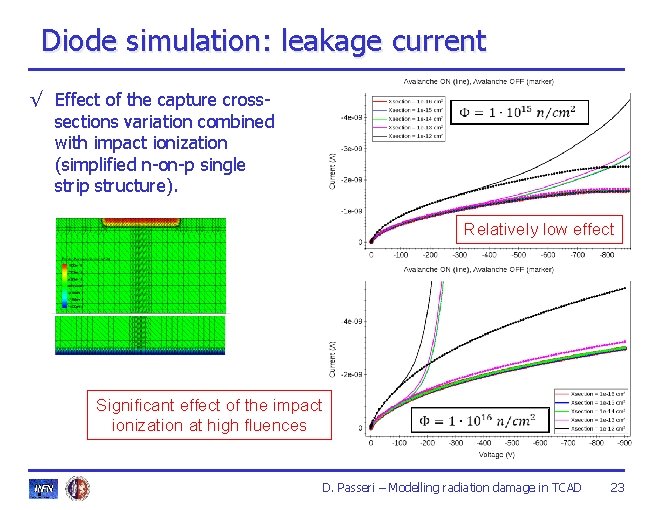
Diode simulation: leakage current √ Effect of the capture crosssections variation combined with impact ionization (simplified n-on-p single strip structure). Relatively low effect Significant effect of the impact ionization at high fluences D. Passeri – Modelling radiation damage in TCAD 23
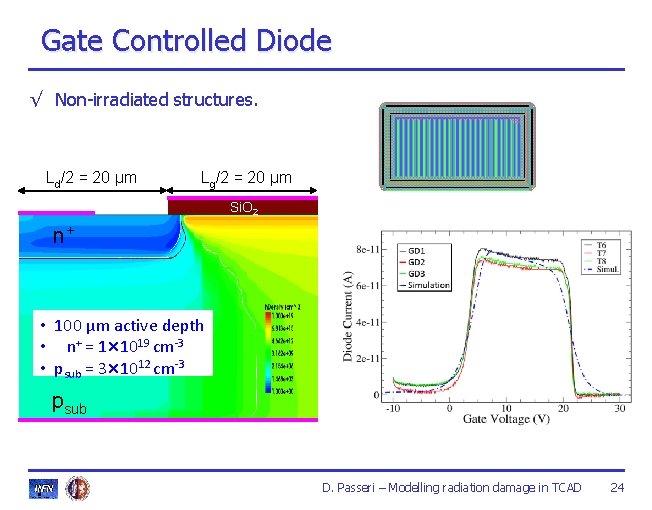
Gate Controlled Diode √ Non-irradiated structures. Ld/2 = 20 µm Lg/2 = 20 µm Si. O 2 n+ • 100 µm active depth • n+ = 1× 1019 cm-3 • psub = 3× 1012 cm-3 psub D. Passeri – Modelling radiation damage in TCAD 24
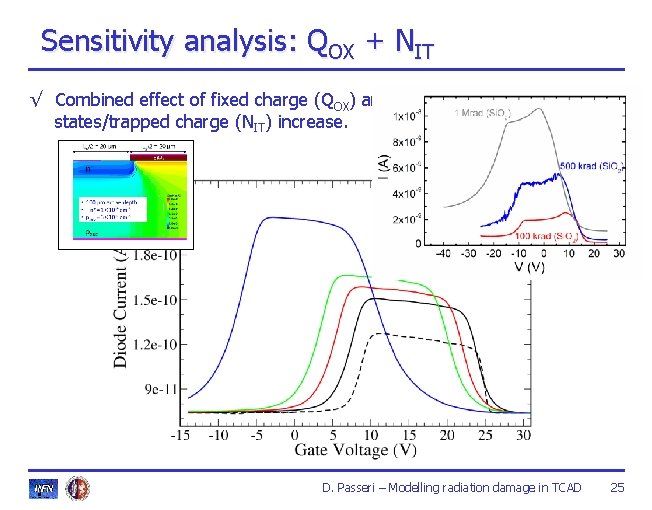
Sensitivity analysis: QOX + NIT √ Combined effect of fixed charge (QOX) and interface trap states/trapped charge (NIT) increase. D. Passeri – Modelling radiation damage in TCAD 25
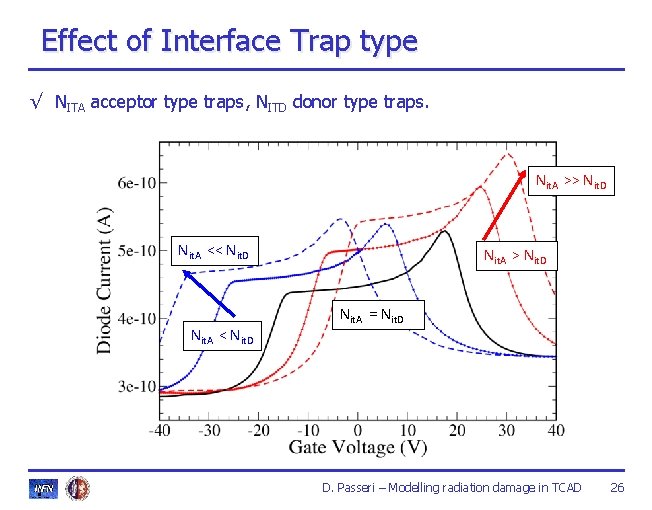
Effect of Interface Trap type √ NITA acceptor type traps, NITD donor type traps. Nit. A >> Nit. D Nit. A << Nit. D Nit. A > Nit. D Nit. A = Nit. D D. Passeri – Modelling radiation damage in TCAD 26
Outline √ Motivations and background. √ TCAD radiation damage modelling: discussion. √ Simulation results and comparison with experimental data: - DC (steady-state) -> Diodes / Gate Controlled Diodes. - AC (small-signals) -> MOS Capacitors. - Time (transient) -> Multi-strip structures. √ Conclusions. D. Passeri – Modelling radiation damage in TCAD 27
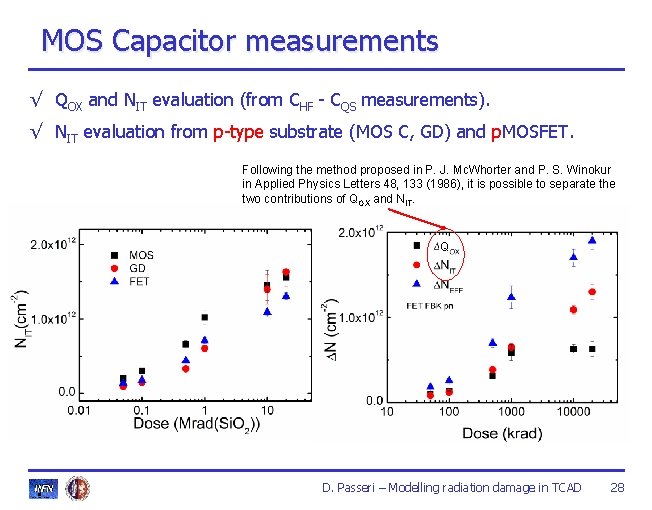
MOS Capacitor measurements √ QOX and NIT evaluation (from CHF - CQS measurements). √ NIT evaluation from p-type substrate (MOS C, GD) and p. MOSFET. Following the method proposed in P. J. Mc. Whorter and P. S. Winokur in Applied Physics Letters 48, 133 (1986), it is possible to separate the two contributions of QOX and NIT. Q D. Passeri – Modelling radiation damage in TCAD 28
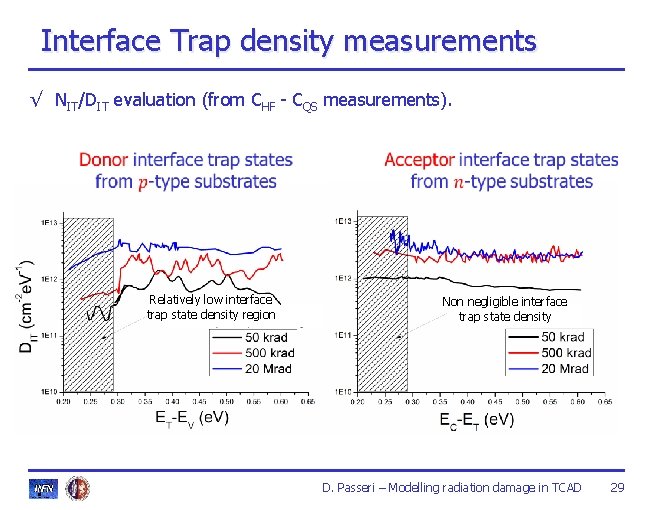
Interface Trap density measurements √ NIT/DIT evaluation (from CHF - CQS measurements). Relatively low interface trap state density region Non negligible interface trap state density D. Passeri – Modelling radiation damage in TCAD 29
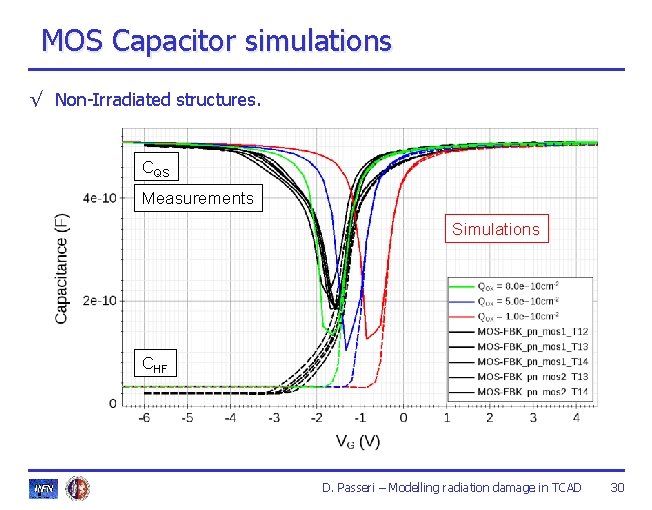
MOS Capacitor simulations √ Non-Irradiated structures. CQS Measurements Simulations CHF D. Passeri – Modelling radiation damage in TCAD 30
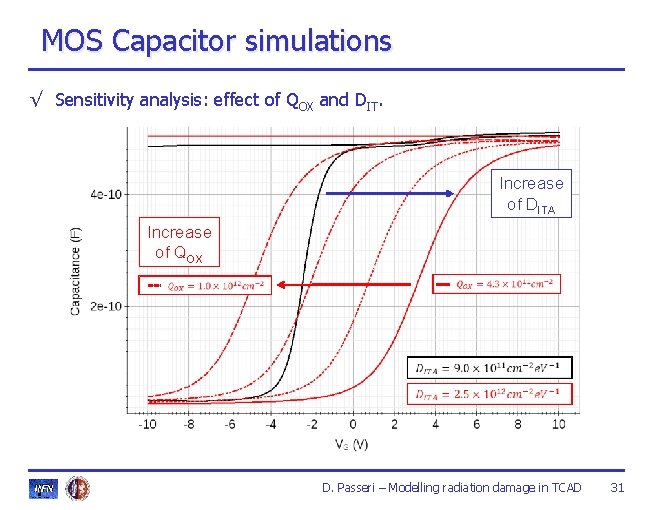
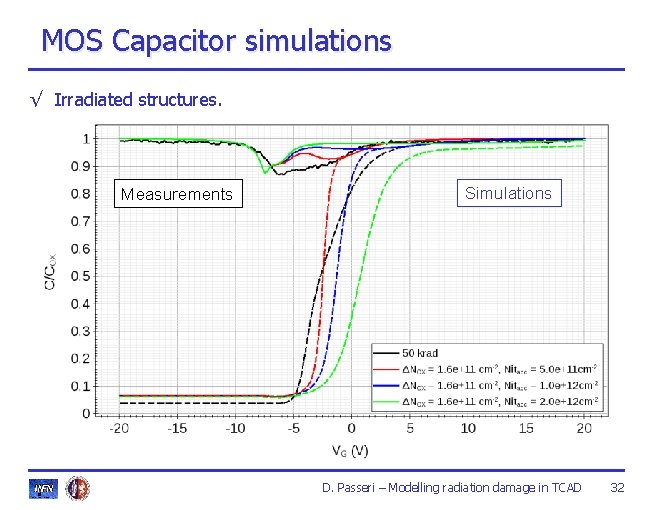
MOS Capacitor simulations √ Sensitivity analysis: effect of QOX and DIT. Increase of DITA Increase of QOX D. Passeri – Modelling radiation damage in TCAD 31
MOS Capacitor simulations √ Irradiated structures. Measurements Simulations D. Passeri – Modelling radiation damage in TCAD 32
Outline √ Motivations and background. √ TCAD radiation damage modelling: discussion. √ Simulation results and comparison with experimental data: - DC (steady-state) -> Diodes / Gate Controlled Diodes. - AC (small-signals) -> MOS Capacitors. - Time (transient) -> Multi-strip structures. √ Conclusions. D. Passeri – Modelling radiation damage in TCAD 33
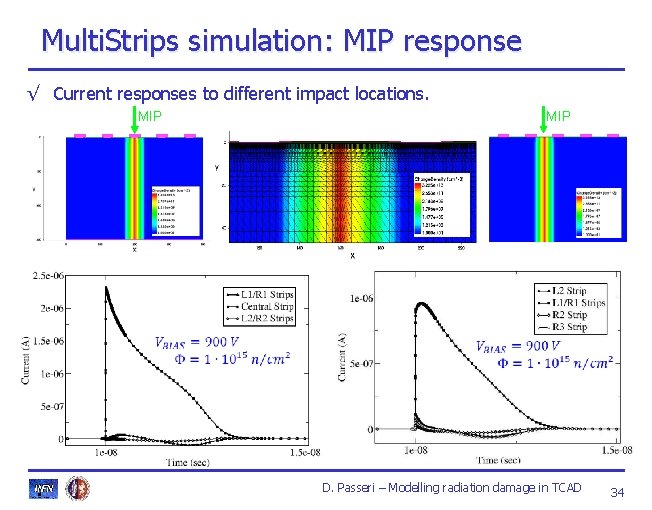
Multi. Strips simulation: MIP response √ Current responses to different impact locations. MIP D. Passeri – Modelling radiation damage in TCAD 34
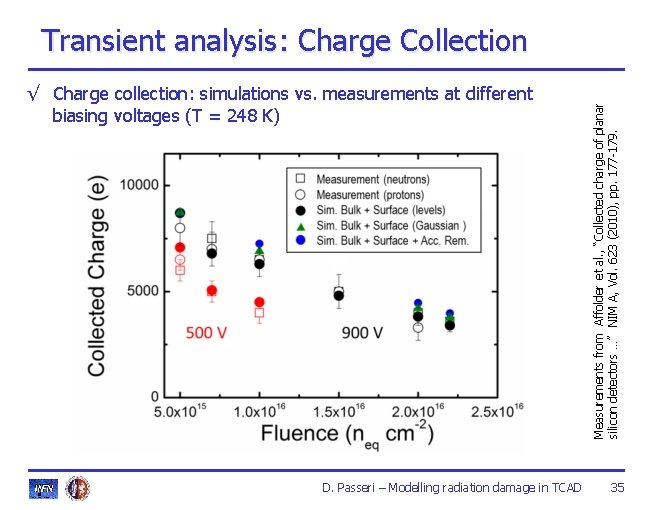
√ Charge collection: simulations vs. measurements at different biasing voltages (T = 248 K) D. Passeri – Modelling radiation damage in TCAD Measurements from Affolder et al. , “Collected charge of planar silicon detectors …” NIM A, Vol. 623 (2010), pp. 177 -179. Transient analysis: Charge Collection 35
Outline √ Motivations and background. √ TCAD radiation damage modelling: discussion. √ Simulation results and comparison with experimental data: - DC (steady-state) -> Diodes / Gate Controlled Diodes. - AC (small-signals) -> MOS Capacitors. - Time (transient) -> Multi-strip structures. √ Conclusions. D. Passeri – Modelling radiation damage in TCAD 36
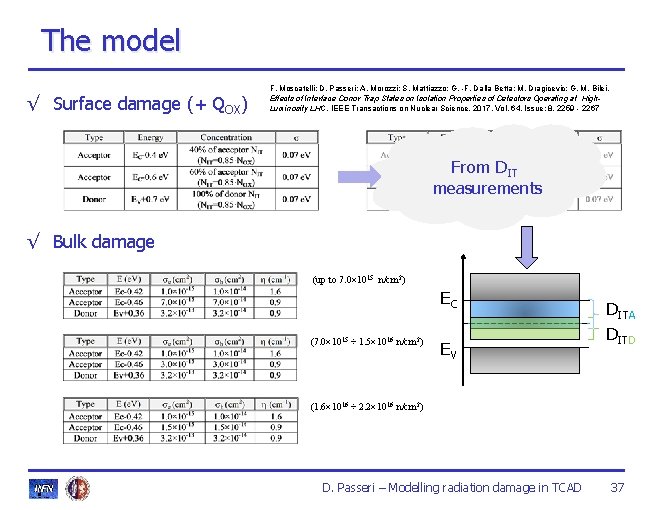
The model √ Surface damage (+ QOX) F. Moscatelli; D. Passeri; A. Morozzi; S. Mattiazzo; G. -F. Dalla Betta; M. Dragicevic; G. M. Bilei, Effects of Interface Donor Trap States on Isolation Properties of Detectors Operating at High. Luminosity LHC, IEEE Transactions on Nuclear Science, 2017, Vol. 64, Issue: 8, 2259 - 2267 From DIT measurements √ Bulk damage (up to 7. 0 1015 n/cm 2) EC (7. 0 1015 ÷ 1. 5 1016 n/cm 2) EV DITA DITD (1. 6 1016 ÷ 2. 2 1016 n/cm 2) D. Passeri – Modelling radiation damage in TCAD 37
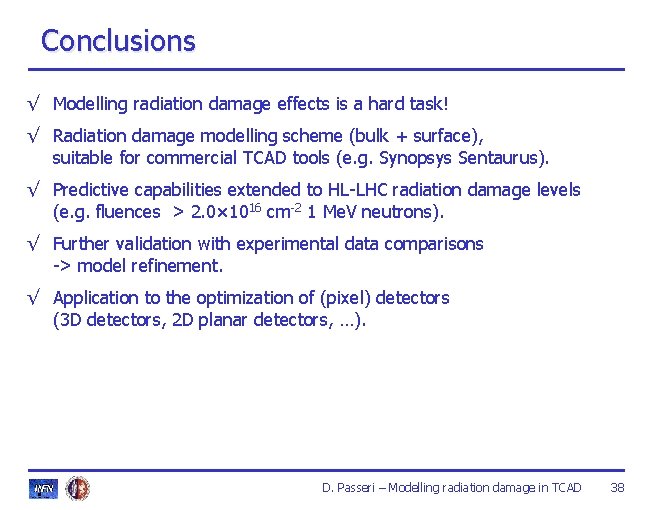
Conclusions √ Modelling radiation damage effects is a hard task! √ Radiation damage modelling scheme (bulk + surface), suitable for commercial TCAD tools (e. g. Synopsys Sentaurus). √ Predictive capabilities extended to HL-LHC radiation damage levels (e. g. fluences > 2. 0× 1016 cm-2 1 Me. V neutrons). √ Further validation with experimental data comparisons -> model refinement. √ Application to the optimization of (pixel) detectors (3 D detectors, 2 D planar detectors, …). D. Passeri – Modelling radiation damage in TCAD 38