Emergency Management Institute EMI Higher Education Program National

- Slides: 51
Emergency Management Institute (EMI) Higher Education Program & National Training Liaison Presents Webinar: The Next Generation Core Competencies: Handbook of Behavioral Anchors & Key Actions for Measurement May 1, 2018 2: 00 -4: 00 EDT 1 -800 -320 -4330 PIN 376368 May 1, 2018 1
Administrative § Submitting questions § File/Resource Sharing § The session will be recorded and captioned § Access to Adobe site post webinar § How to follow up with presenters § How to get more information about the Higher Education Program May 1, 2018 2
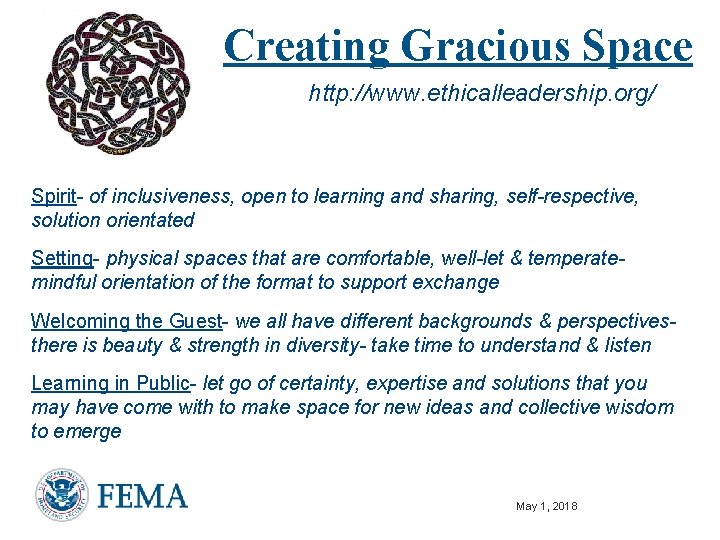
Creating Gracious Space http: //www. ethicalleadership. org/ Spirit- of inclusiveness, open to learning and sharing, self-respective, solution orientated Setting- physical spaces that are comfortable, well-let & temperatemindful orientation of the format to support exchange Welcoming the Guest- we all have different backgrounds & perspectivesthere is beauty & strength in diversity- take time to understand & listen Learning in Public- let go of certainty, expertise and solutions that you may have come with to make space for new ideas and collective wisdom to emerge May 1, 2018
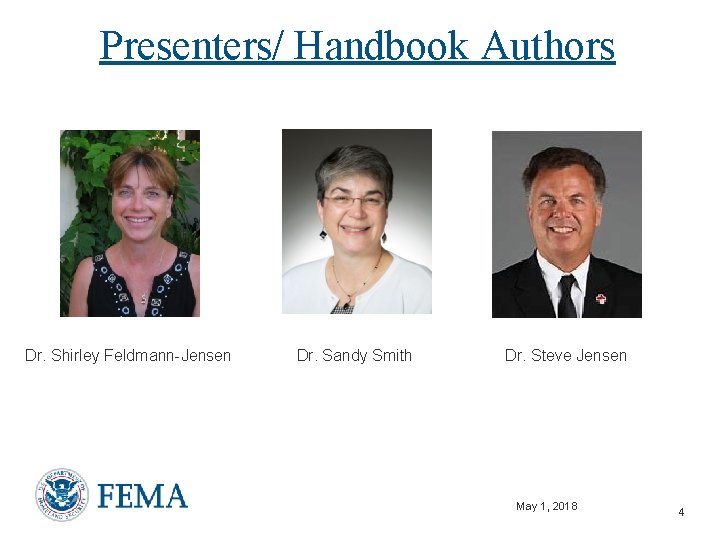
Presenters/ Handbook Authors Dr. Shirley Feldmann-Jensen Dr. Sandy Smith Dr. Steve Jensen May 1, 2018 4
The Next Generation Core Competencies: Handbook of Behavioral Anchors for Measurement What It Is and How you Can Use It May 1, 2018
Purpose Establish a set of core competencies to match the drivers of tomorrow’s risk. ØSupport the education processes in preparing the future emergency management workforce. ØProvide tools for shaping the workforce in an increasingly dynamic environment. ØIdentify the behaviors/actions that demonstrate a specific core competency. May 1, 2018 6
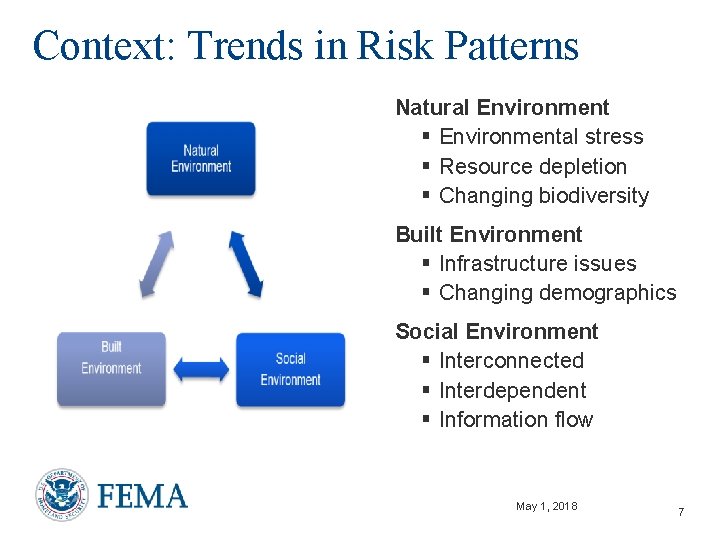
Context: Trends in Risk Patterns Natural Environment § Environmental stress § Resource depletion § Changing biodiversity Built Environment § Infrastructure issues § Changing demographics Social Environment § Interconnected § Interdependent § Information flow May 1, 2018 7
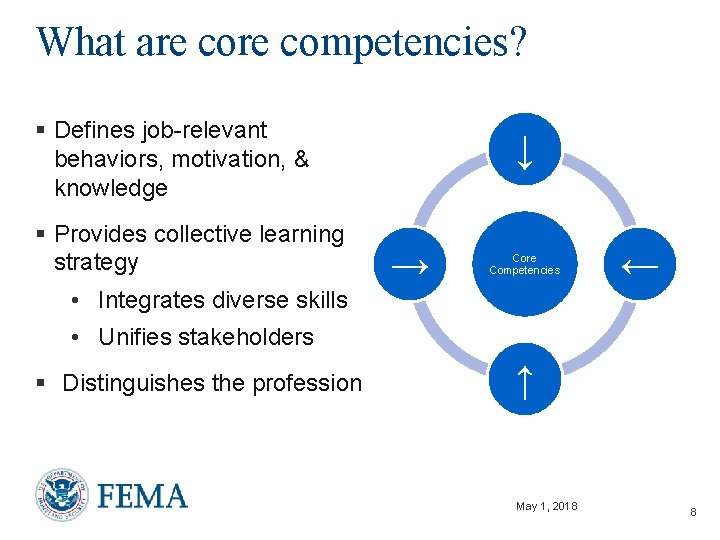
What are competencies? § Defines job-relevant behaviors, motivation, & knowledge § Provides collective learning strategy • Integrates diverse skills ↓ → Core Competencies ← • Unifies stakeholders § Distinguishes the profession ↑ May 1, 2018 8
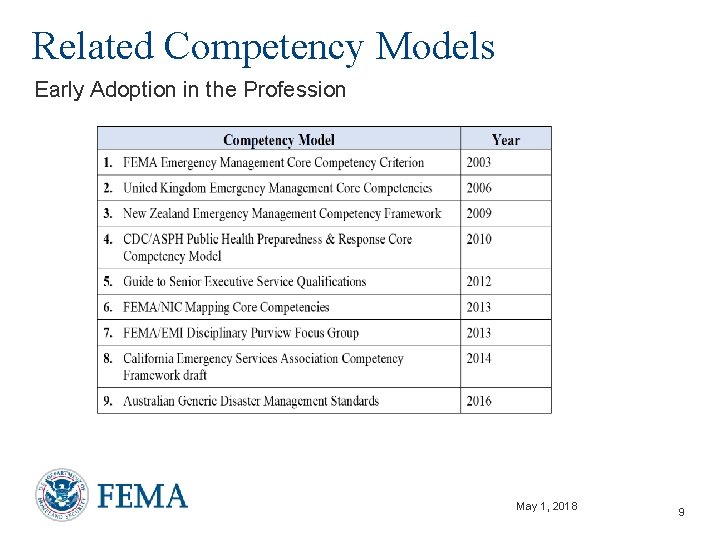
Related Competency Models Early Adoption in the Profession May 1, 2018 9
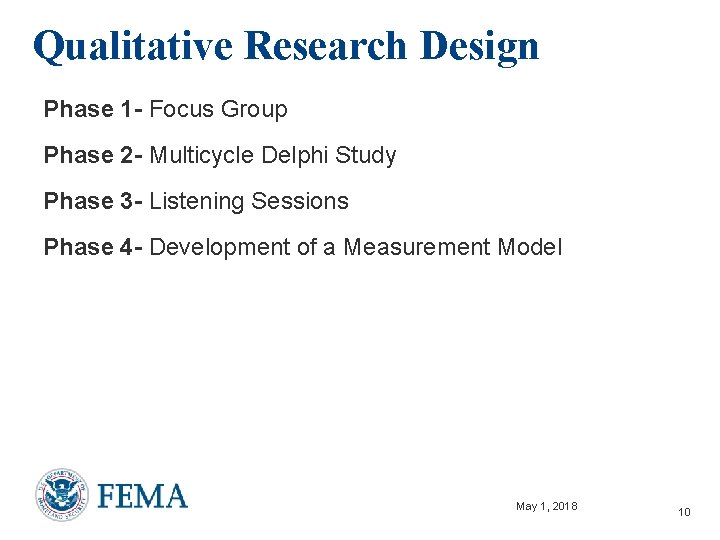
Qualitative Research Design Phase 1 - Focus Group Phase 2 - Multicycle Delphi Study Phase 3 - Listening Sessions Phase 4 - Development of a Measurement Model May 1, 2018 10
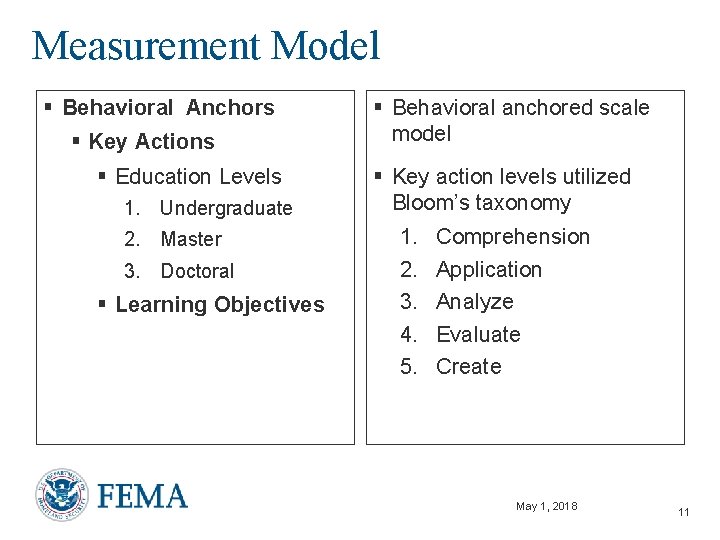
Measurement Model § Behavioral Anchors § Key Actions § Education Levels 1. Undergraduate 2. Master 3. Doctoral § Learning Objectives § Behavioral anchored scale model § Key action levels utilized Bloom’s taxonomy 1. 2. 3. 4. 5. Comprehension Application Analyze Evaluate Create May 1, 2018 11
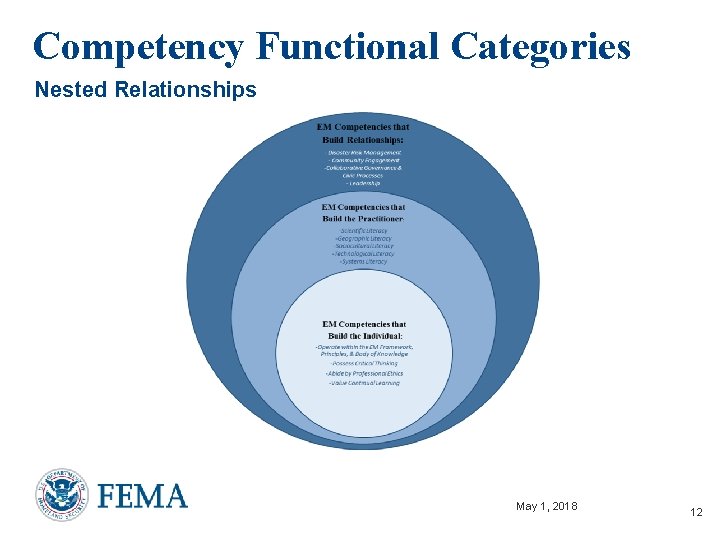
Competency Functional Categories Nested Relationships May 1, 2018 12
Competencies that Build the Individual
Operate within the EM Framework, Principles, & Body of Knowledge Definition: The emergency management professional utilizes a proactive, anticipatory, and innovative approach for guiding public policy and in the application of the emergency management framework and principles. Emergency management seeks to promote safer, more resilient, and thriving communities. All necessary actions are employed to mitigate against, prepare for, respond to, and recover from threatened or actual hazards. Emergency Management activities must be comprehensive, progressive, risk -driven, integrated, collaborative, coordinated, flexible, and professional (Blanchard, et al. , 2007). May 1, 2018 14
Behavioral Anchors 1. 2. 3. 4. 5. 6. 7. 8. 9. Comprehensive Progressive Risk-driven Integrated Collaborative Coordinated Flexible Professional Uses EM Body of Knowledge May 1, 2018 15
Possess Critical Thinking Definition: The emergency management professional employs critical thinking to identify and reduce disaster risk in the communities they serve. Critical thinking is a disciplined and multifaceted intellectual process, which involves problem-solving, strategic, adaptive, and innovative thinking. The practice of recognizing relevant evidence, understanding relationships in multi-layered data, and making clear the connections between potential causes and effects is fundamental to decision-making, adaptive actions, and thriving in uncertain environments. May 1, 2018 16
Behavioral Anchors 1. Problem identification & solving 2. Strategic thinking processes 3. Flexible, innovative, adaptive thinking processes May 1, 2018 17
Abide by Professional Ethics Definition: The emergency management professional both abides by and champions professional ethics. Professional ethics delineate expected and appropriate conduct, principles, and moral and ethical values that guide practice in the midst of both known and uncertain environments. Ethics must be approached as a totality of principles, not as individual guidelines; together, the sum of principles provides an important foundation for action. May 1, 2018 18
Behavioral Anchors 1. Respect 2. Veracity 3. Justice 4. Integrity 5. Service 6. Duty to protect 7. Integrates ethical principles within stakeholder discourse May 1, 2018 19
Continual Learning Definition The emergency management professional engages in continual learning as a central means of increasing their efficacy when operating in a dynamic risk environment. Continual learning is about building adaptive capacity through an iterative exchange of new information in relationship to prior understanding. The continual learning process allows ongoing improvement, which is critical to achieving system stability, resilience, and thriving opportunities in the midst of an uncertain and complex future. Continual learners develop and nurture a frame of mind that values and utilizes curiosity, reflection, experience, and the development of new understanding. May 1, 2018 20
Behavioral Anchors 1. Reflects & questions 2. Understands confidence levels 3. Contributes to a body of knowledge that spans disciplines 4. Engages others in inquiry 5. Seeks practical application for public value May 1, 2018 21
Competencies that Build the Practitioner
Scientific Literacy Definition: The emergency management professional possesses an understanding and working knowledge of scientific processes, as well as a familiarity with the natural, social, and applied sciences. Diverse scientific knowledge is essential to inform the management and understanding of disaster risk and vulnerability on local, regional, national, and global levels. Scientific literacy is the capacity to objectively and systematically work through complex problems, using the scientific process to identify questions, interpret evidence based findings to inform decision making, and effectively communicate the results to policy makers and the public. Through the use of the scientific process and principles in relationship to hazards, risks, and vulnerabilities, practitioners can deliver enhanced value to enable the communities they serve to thrive. May 1, 2018 23
Behavioral Anchors 1. Knowledge & understanding 2. Find & evaluate credible literature sources 3. Inquiry & problem solving processes May 1, 2018 24
Geographic Literacy Definition The emergency management professional possesses a foundational and comprehensive understanding of the geographic configurations of hazards, vulnerability, and risk. Geographic literacy comprises knowledge of the earth’s physical and human systems, utilizing a spatial foundation where hazards, vulnerability, and risk can be conceptualized. The interconnections, interactions, and implications across complex physical, built, and social environments can be analyzed to track changing disaster risk profiles and inform decision making. May 1, 2018 25
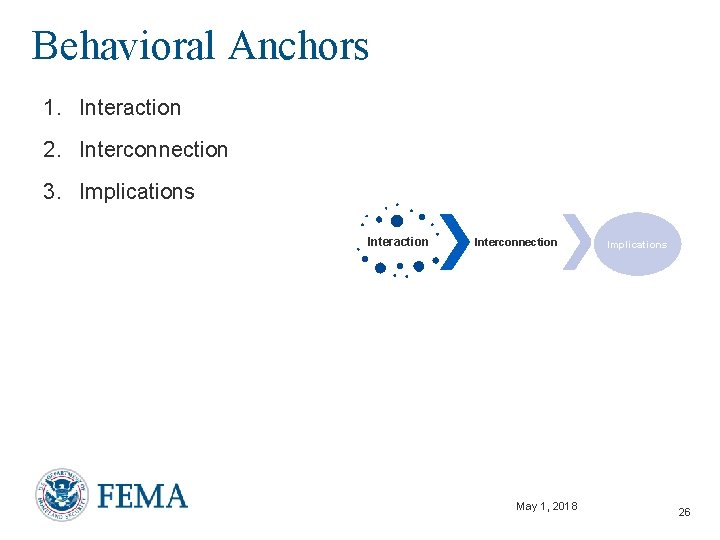
Behavioral Anchors 1. Interaction 2. Interconnection 3. Implications Interaction Interconnection May 1, 2018 Implications 26
Sociocultural Literacy Definition: The emergency management professional recognizes the social determinants of risk, as both the risks for and the effects of disasters are socially produced. A sociocultural foundation provides the lens to examine and understand human behavior, and the individual and collective ways in which humans may affect their relationship to risk, adaptive capacity, and ability to thrive. May 1, 2018 27
Behavioral Anchors 1. Social determinants of disaster risk 2. Politics, political, & legal processes 3. Building adaptive capacity May 1, 2018 28
Technological Literacy Definition: The emergency management professional possesses a fundamental understanding of evolving technologies, their relevant application to practice, and timely adoption of these technologies. Technology refers to the mechanisms or devices developed from the application of scientific knowledge. Integrating emerging or evolving technology into emergency management practice requires an awareness of current innovations, the ability to evaluate their potential utility, the expertise to utilize technologies, and a grasp of the security measures necessary to protect the technology. May 1, 2018 29
Behavioral Anchors 1. Guides information flow 2. Guides action between the parts and the whole 3. Guides understanding of the wider environment 4. Guides innovation processes May 1, 2018 30
Systems Literacy Definition: The emergency management professional sees the whole picture, particularly inter-relationships and patterns of change. Systems literacy helps the emergency management professional synchronize their understanding and practice with the ongoing shift away from a linear and hierarchical human order to one that is characteristically dynamic, complex, and exponential. The focus of systems literacy is on interdependent relationships that produce reactions, changes, and adaptations over time. This scientific foundation provides the emergency management professional a deeper understanding of the present for developing future focused strategies that enable adaptation and the ability to thrive. May 1, 2018 31
Behavioral Anchors 1. Utilizes technology 2. Evaluation of technology 3. Advances the use of technologies 4. Assesses the legal, ethical, & social implications of technology May 1, 2018 32
Competencies that Build Relationships
Disaster Risk Management Definition: The emergency management professional communicates and facilitates disaster risk awareness, assessment, measurement, and reduction across a broad spectrum of stakeholders. Disaster risk management is the application of strategies and policies to prevent new disaster risk, reduce existing disaster risk, and manage the residual disaster risk, ultimately contributing to loss reduction, resilience building, and thriving communities. An understanding of how systems interact to create risk, along with recognition that risk is interdependent with social systems is fundamental to the function. May 1, 2018 34
Behavioral Anchors 1. Communicates & interprets hazards & risks 2. Applies disaster risk management 3. Monitors, reviews, & evaluates risk management processes & outcomes May 1, 2018 35
Community Engagement Definition: The emergency management professional is able to facilitate community ownership of risk. Community engagement involves an open dialogue and relationship development that fosters working constructively to reduce the shared disaster risk. The practices of clearly communicating information, giving voice to unheard community members, integrating divergent perspectives, promoting and supporting individuals, families, businesses, and organizations are vital for building the foundation of respect and support for a thriving community. May 1, 2018 36
Behavioral Anchors 1. Involves key stakeholders 2. Cultivates partnerships & mutual respect 3. Creates public value 4. Establishes a process for expanded engagement & continual learning May 1, 2018 37
Governance & Civics Definition: The emergency management professional understands how to participate with civic and legal processes, from politics to policy. The way society manages collective processes is referred to as governance, which seeks to identify, evaluate, and operate within the context of relational dynamics including those within power structures. Collaborative processes further expand the achievement of public value by bringing people together across the boundaries of public agencies, levels of government, NGOs, business, and civil society. May 1, 2018 38
Behavioral Anchors 1. Considers policy options in relationship to the stakeholders 2. Political & legal 3. Brings people together across sectors 4. Builds social capital through collective processes 5. Implementation 6. Evaluation & continual improvement May 1, 2018 39
Leadership Definition: The emergency management professional is comfortable leading within and across organizations. Effective emergency management leadership emphasizes team building, collaboration, collective leadership, and communication connectivity to a wide range of stakeholders, so that the complex risks can be addressed. Leadership is characterized by: informed decision-making, constructive administration and management techniques, fostering a shared vision, empowering others, establishing communication capabilities across varied networks, and creating an outcome oriented environment for continual improvement. May 1, 2018 40
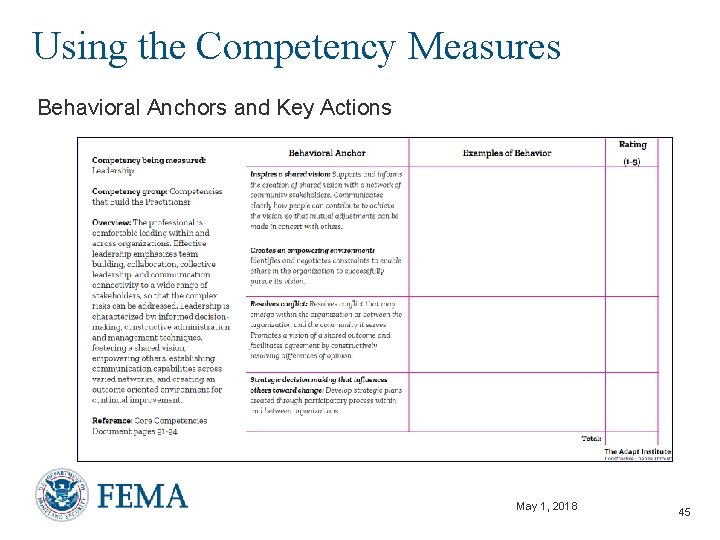
Behavioral Anchors 1. Inspires a shared vision 2. Creates an empowering environment 3. Resolves conflict 4. Strategic decision making that influences others toward change May 1, 2018 41
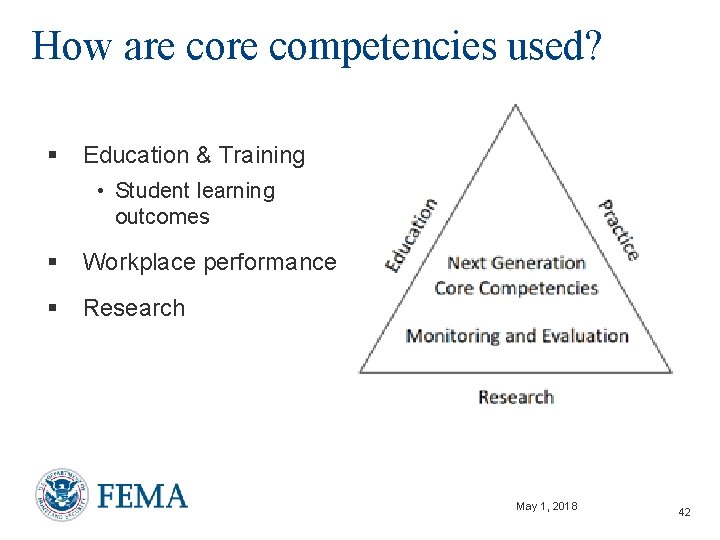
How are competencies used? § Education & Training • Student learning outcomes § Workplace performance § Research May 1, 2018 42
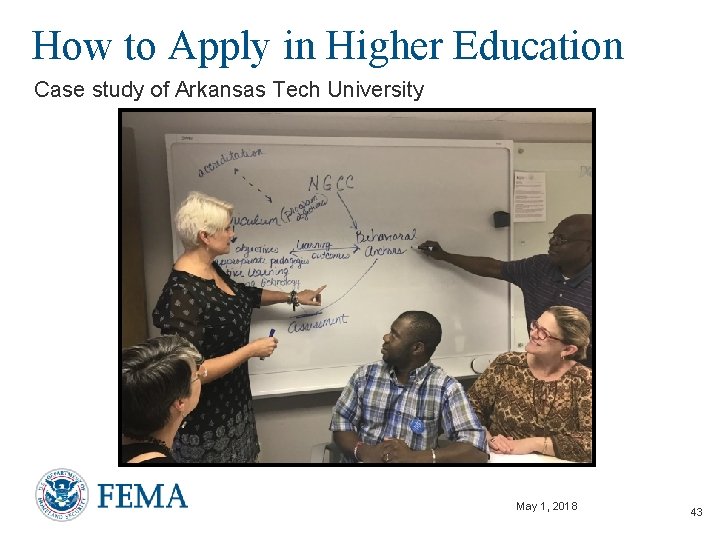
How to Apply in Higher Education Case study of Arkansas Tech University May 1, 2018 43
How to Apply in the Workplace Shape the workforce: § Focus our work § Build the right teams § Continual improvement Examples: § DHS Core Competencies (eg. Management Directive 3181) § OPM Senior Executive Service Qualifications May 1, 2018 44
Using the Competency Measures Behavioral Anchors and Key Actions May 1, 2018 45
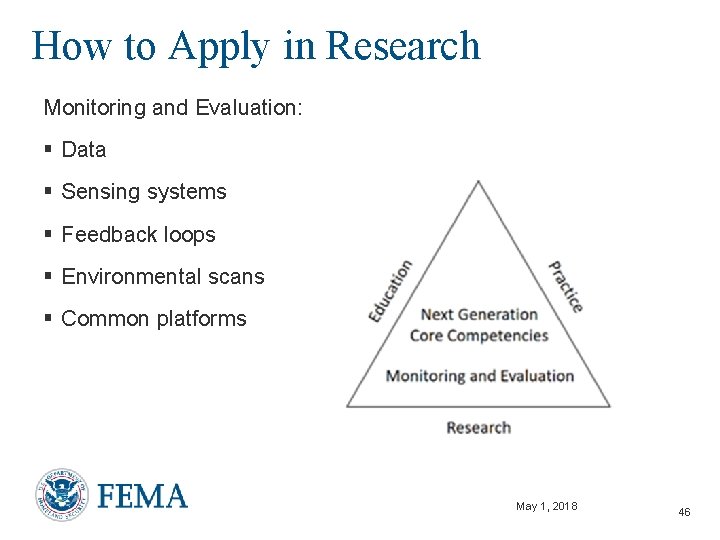
How to Apply in Research Monitoring and Evaluation: § Data § Sensing systems § Feedback loops § Environmental scans § Common platforms May 1, 2018 46
Future Needs 1. Develop learning materials to leverage our efforts in higher education and the workplace 2. Align core competency models in other Human Security fields: Homeland Security, Law, Fire, Public Health EM, and Humanitarian Assistance 3. Develop performance measures for practice 4. Revisit the Department of Labor O-Net Summary Report 5. Develop a platform for advancing the Core Competencies May 1, 2018 47
Handbook Access The Next Generation Core Competencies for Emergency Management Professionals: Handbook of Behavioral Anchors and Key Actions for Measurement Accessible at the FEMA Higher Education program website: https: //training. fema. gov/hiedu/emcompetencies. aspx May 1, 2018 48
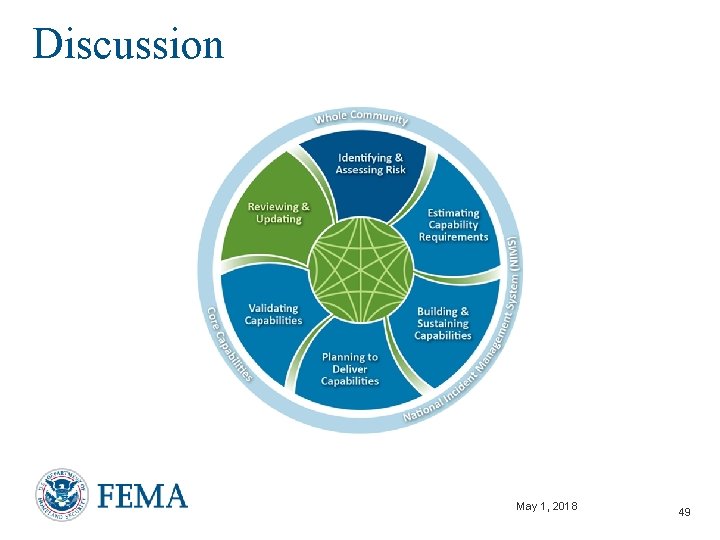
Discussion May 1, 2018 49
Contact Information Presenter contact information: § Shirley Feldmann-Jensen, DPPD, California State University at Long Beach, Shirley. Jensen@csulb. edu § Steven Jensen, DPPD, California State University at Long Beach, steven. jensen@csulb. edu § Sandy Maxwell Smith, Ph. D. – Arkansas Technical University, ssmith 107@atu. edu EMI Higher Education Program Information: § Wendy Walsh wendy. walsh@fema. dhs. gov 301 -447 -1262 § Barbara Johnson Barbara. Johnson 3@fema. dhs. gov 301 -447 -1452 § Danielle Green Danielle. green@associates. fema. dhs. gov 301. 447 -7251 http: //training. fema. gov/hiedu/ 20 th Annual Emergency Management Higher Education Symposium 50