
Emergency Management Institute Higher Education Project B Wayne
Emergency Management Institute Higher Education Project B. Wayne Blanchard, Ph. D. , CEM Readiness Section, EMI/NPD/FEMA/DHS (301) 447 -1262, wayne. blanchard@dhs. gov http: //training. fema. gov/EMIWeb/edu July 1, 2008
EM Hi-Ed Project Presentation Table of Contents n EM & Hi-Ed Project Background ----- pp. 3 -46 • History • Goals, The EM Profession, Audiences, • Philosophical Context n EM Hi-Ed Project Activities/Courses-- pp. 47 -62 n Collegiate EM Program Information -- pp. 63 -82 n Future EM Hi. Ed & Profession Issues –pp. 83 -121 2
First Things First: What Is Emergency Management? n Umbrella Term – Captures wide range-people & organizations n Addresses Question: What do we do about hazards and disasters? n Comprehensive Emergency Management: • All Hazards – Natural, Technological, Intentional • All Phases – Mitigation, Preparedness, Response, Recovery • All Actors – Inter and Intra-Governmental, Private Sector, Voluntary Organizations 3
Where Does One Find Emergency Management? n All levels of government in the U. S. • Federal (FEMA, other Federal Agencies) • State – Every State Has An Organization • Local – Virtually Every County and City n Private Sector: • Business Contingency and Continuity Planning – wide range of other terms n Many others sectors involved, e. g. : • Emergency Services • Public Health 4
Background Context for EM Hi. Ed Project – Late 1994 -Early 1995 n Reaction to Criticisms and Weaknesses: • Hugo, Andrew, Loma Prieta • Inadequate Level of Professionalism Within Emergency Management n New Hazards: Y 2 K, Terrorism, Technologies, Illnesses, Climate? n Increasing Intensity/Frequency for Some Hazards (e. g. , Flooding) n Growing Vulnerability and Losses – Double to Triple Per Decade n Baby Boomer EM Generation Nearing Retirement n New EMI Superintendent and New Associate FEMA Director: • EMI to Focus on Functional Training • Seek to Leverage Institutions of Hi. Ed – Focus on Education 5
National Science and Technology Council, 1996 on Natural Hazards n “Future prospects are sobering. • Continued U. S. population growth, • Increased urbanization and concentration in hazard-prone coastal areas, • Increased capital and physical plant, • Accelerated deterioration of the urban infrastructure, and • Emerging but unknown new vulnerabilities posed by technological advance • Virtually guarantee that economic losses from natural hazards will continue to rise throughout the early part of the coming century. • Losses of $100 billion from individual events, and perhaps unprecedented loss of life, loom in our future. ” 6
Technological & Intentional Hazards n 123 plants in 24 States where a chemical release of dangerous materials could threaten more than one million people. (U. S. Environmental Protection Agency, 2004) n 15, 000 high-risk chemical facilities proximate to tens of millions of citizens 7
Underlying Problems in 1994/1995 And Now n We Build in Floodplains n We Destroy Wetlands n We Build Along Earthquake Faults n We Build On The Coast n We Build On Alluvial Fans (spilling from mountains) n We Build In and Near Forests Susceptible to Wildfires n We Try To Control Nature n We Don’t Zone, Code, Build, Maintain (Aging Infrastructure), Inspect and Enforce Appropriately Enough n Thus – Disasters Are A Growth Business 8
Global Background Context n “There has been a rapid escalation in the incidence of severe disaster events in recent decades. n Total reported global costs have risen 15 -fold over the past five decades, n While numbers of people affected tripled between the 1970 s and 1990 s. ” (Pro. Vention Consortium, “Measuring Mitigation, ” 2004) n No Light At The End of The Tunnel – Here or Abroad 9
US & Global Disasters n “Disasters are increasingly common. n Worldwide, a major disaster occurs almost daily. n In the United States, a disaster has occurred, on average, every week for the past 10 years, according to the Federal Emergency Management Agency” (Pricewaterhouse. Coopers, Closing the Seams, 2007, p. 6) 10
Steady Rise in Disaster Losses n “Losses from natural disasters…[have] been doubling or tripling each decade since 1960…” (Harvey Ryland, Institute for Business and Home Safety, Lessons from PPP 2000, 2001) n "One catastrophe modeling company predicts that catastrophe losses will double every decade or so due to growing residential and commercial density and more expensive buildings. “ (Insurance Information Institute, Catastrophes: Insurance Issues, Jan 2008. )/ 11
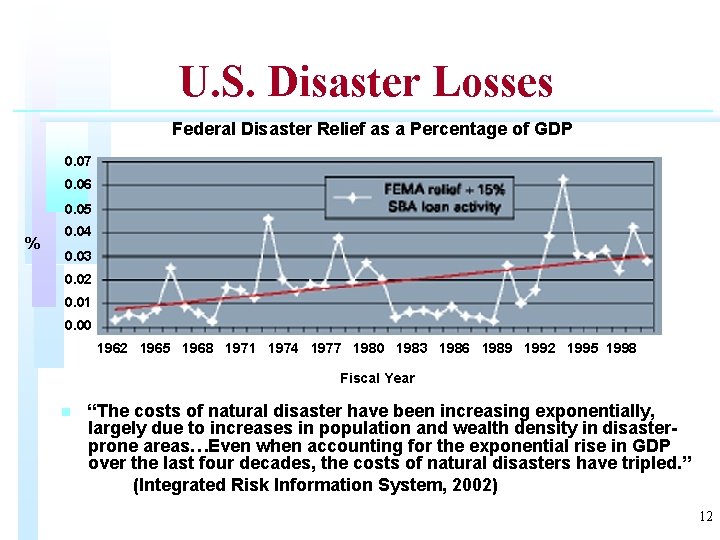
U. S. Disaster Losses Federal Disaster Relief as a Percentage of GDP 0. 07 0. 06 0. 05 % 0. 04 0. 03 0. 02 0. 01 0. 00 1962 1965 1968 1971 1974 1977 1980 1983 1986 1989 1992 1995 1998 Fiscal Year n “The costs of natural disaster have been increasing exponentially, largely due to increases in population and wealth density in disasterprone areas…Even when accounting for the exponential rise in GDP over the last four decades, the costs of natural disasters have tripled. ” (Integrated Risk Information System, 2002) 12
Have We Learned Nothing? n In Large Measure Knew/Know What To Do n Past and Current Practices Not Effective Enough n Need Professional EM Cadre Better Positioned for 21 st Century Environment 13
Things Needed (Need) To Change n “Human history becomes more and more a race between education and catastrophe. ” (H. G. Wells) n “The time has come for a new national approach to natural hazards. ” (Congressional Natural Hazards Caucus, January, 2001) n Saw Need For More Professional EM Cadre n With Professionalism will come More Respect and Value in the EM Position, and then more appropriate Salaries and adequate Budgets 14
Goals EMI Higher Education Project n Increase Collegiate Study of Hazards, Disasters, & Emer. Mgmt. n Enhance Emergency Management Professionalism n Support Development of Academic Discipline of Emer. Mgmt. n Long-Term: Make Contribution to Enhanced Hazards Footing n Long-Term: Greater Collegiate Role in EM and Disaster Reduction 15
What About Colleges and Universities? n Only Four Formal “Emergency Management” College Programs • Two did not provide academic credit • Academic Credit: 1 BA, 1 Certificate n Believed that academic community could engage more in hazards, disasters and what to do about them. 16
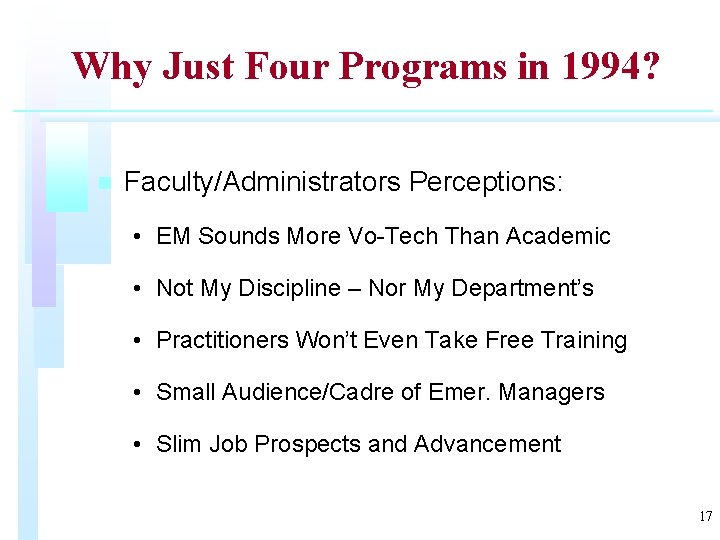
Why Just Four Programs in 1994? n Faculty/Administrators Perceptions: • EM Sounds More Vo-Tech Than Academic • Not My Discipline – Nor My Department’s • Practitioners Won’t Even Take Free Training • Small Audience/Cadre of Emer. Managers • Slim Job Prospects and Advancement 17
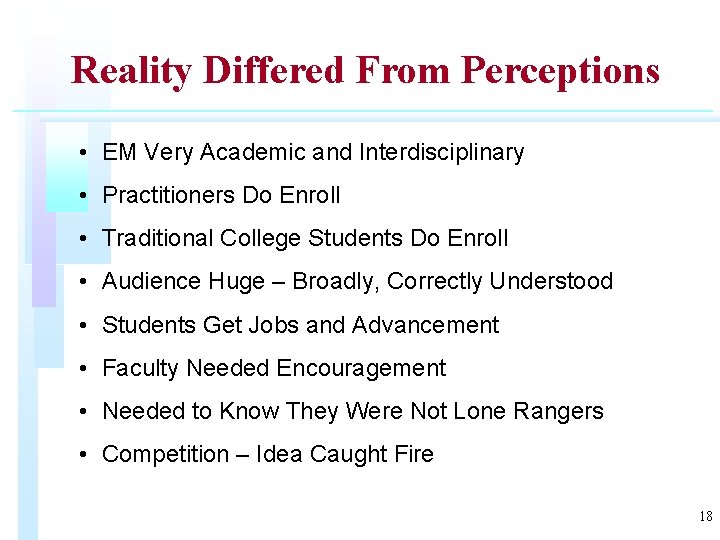
Reality Differed From Perceptions • EM Very Academic and Interdisciplinary • Practitioners Do Enroll • Traditional College Students Do Enroll • Audience Huge – Broadly, Correctly Understood • Students Get Jobs and Advancement • Faculty Needed Encouragement • Needed to Know They Were Not Lone Rangers • Competition – Idea Caught Fire 18
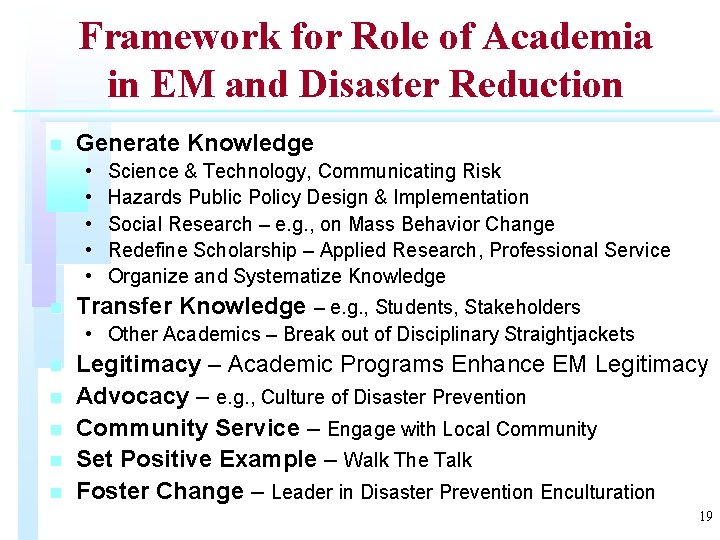
Framework for Role of Academia in EM and Disaster Reduction n Generate Knowledge • • • n Science & Technology, Communicating Risk Hazards Public Policy Design & Implementation Social Research – e. g. , on Mass Behavior Change Redefine Scholarship – Applied Research, Professional Service Organize and Systematize Knowledge Transfer Knowledge – e. g. , Students, Stakeholders • Other Academics – Break out of Disciplinary Straightjackets n n n Legitimacy – Academic Programs Enhance EM Legitimacy Advocacy – e. g. , Culture of Disaster Prevention Community Service – Engage with Local Community Set Positive Example – Walk The Talk Foster Change – Leader in Disaster Prevention Enculturation 19
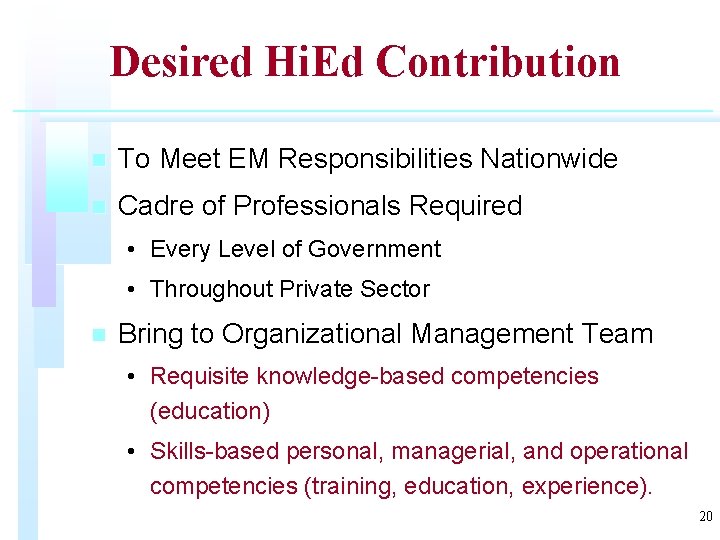
Desired Hi. Ed Contribution n To Meet EM Responsibilities Nationwide n Cadre of Professionals Required • Every Level of Government • Throughout Private Sector n Bring to Organizational Management Team • Requisite knowledge-based competencies (education) • Skills-based personal, managerial, and operational competencies (training, education, experience). 20
Why Study EM Academically? n “…some emergency management systems are exclusively ‘ambulances at the bottom of cliffs’, whereas others are also ‘fences at the top’. (Dr. Neil Britton, “Higher Education in Emergency Management: What is Happening Elsewhere, ” Paper for the 2004 EM Hi. Ed Conference, June 2004, p. 2. ) n This is why, for those who tout the “Be-All” of “Experience, ” that “Experience” needs to be grounded in EDUCATION. 21
Why Study EM Academically? “Emergency management leaders need an academic, not just experiential, knowledge base of…natural and manmade hazards…[to develop] the deep understanding necessary…to effectively develop and implement strategic efforts to mitigate threats or to properly prepare for the response and recovery from their consequences. ” (Glen L. Woodbury, Journal of Emergency Management, March/April 2005, p. 27) 22
Why Study EM Academically? “We will continue to place more and more citizens at risk. This may result because they became homeowners in hazard prone areas…. Some will be future victims of terrorists attacks. Whatever the agent, one thing is clear. There will be more victims of disaster in the next decade than there has been in the last. Maybe its time for more university faculty to bring this topic into their classrooms. ” (Dr. Thomas Drabek, Western Social Science Association Paper, 2005) 23
Why Study EM Academically? Question Governmental Gospel n Look at Different Points of View n Look at Different Approaches to EM n Provide Background Knowledge/Context n Build Emergency Management Theory n Develop Research and Analysis Skills n If We Had It Right, Why Does Disaster Loss Curve Look Like Rocket Trajectory? n 24
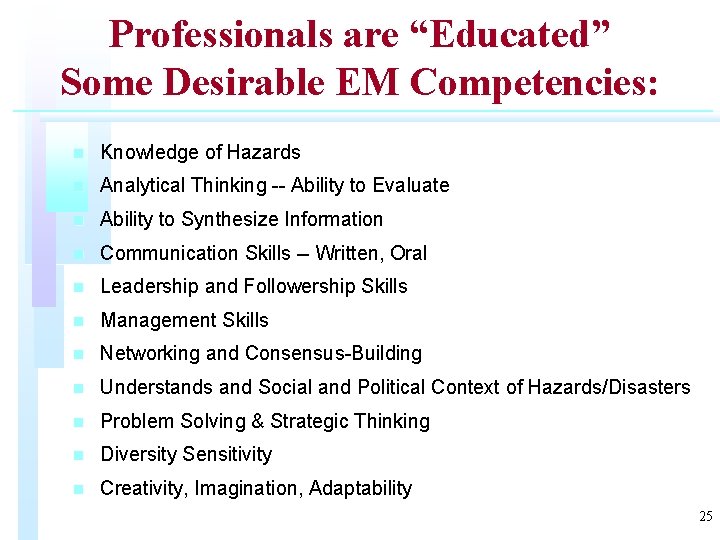
Professionals are “Educated” Some Desirable EM Competencies: n Knowledge of Hazards n Analytical Thinking -- Ability to Evaluate n Ability to Synthesize Information n Communication Skills -- Written, Oral n Leadership and Followership Skills n Management Skills n Networking and Consensus-Building n Understands and Social and Political Context of Hazards/Disasters n Problem Solving & Strategic Thinking n Diversity Sensitivity n Creativity, Imagination, Adaptability 25
Definition of “Profession” & Importance of Education n “A Vocation or occupation requiring advanced education and training, and involving intellectual skills, as medicine, law, theology, engineering, teaching, etc. …” (Webster’s New World Dictionary, Third College Edition) 26
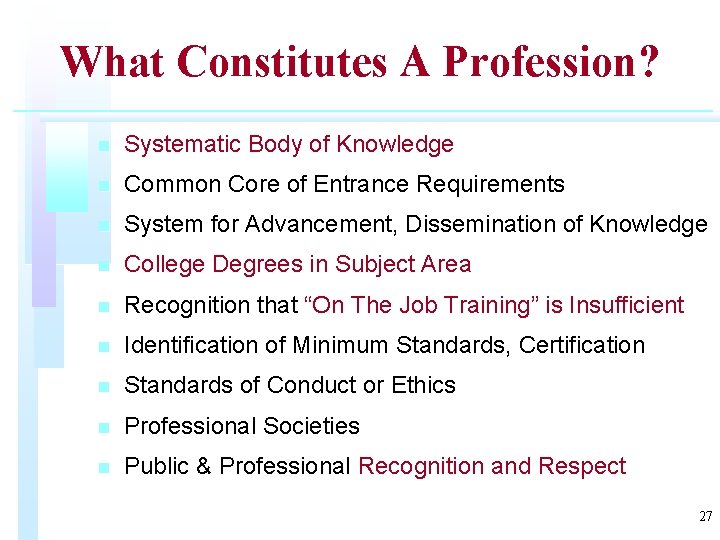
What Constitutes A Profession? n Systematic Body of Knowledge n Common Core of Entrance Requirements n System for Advancement, Dissemination of Knowledge n College Degrees in Subject Area n Recognition that “On The Job Training” is Insufficient n Identification of Minimum Standards, Certification n Standards of Conduct or Ethics n Professional Societies n Public & Professional Recognition and Respect 27
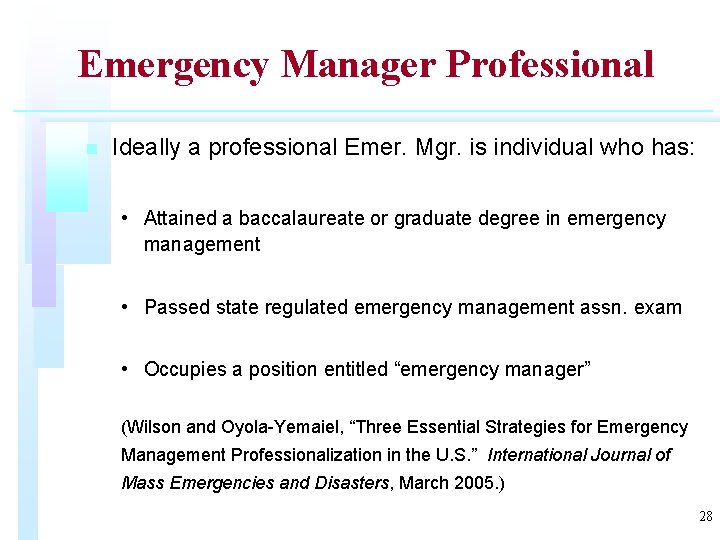
Emergency Manager Professional n Ideally a professional Emer. Mgr. is individual who has: • Attained a baccalaureate or graduate degree in emergency management • Passed state regulated emergency management assn. exam • Occupies a position entitled “emergency manager” (Wilson and Oyola-Yemaiel, “Three Essential Strategies for Emergency Management Professionalization in the U. S. ” International Journal of Mass Emergencies and Disasters, March 2005. ) 28
Warning! About to Discuss Emergency Management “Stereotype” n Stereotype – Image Held, Right or Wrong n Discussing It Steps On Some Toes n Does Not Apply to All In Previous Generations n Even When Some “Stereotypical” Images are Applicable, It’s Still Possible to Have Good and Effective Emergency Management n Nonetheless, All Has Not Been Well in the EM Past, and This Deserves Some Reflection 29
Emergency Manager “Stereotype” The Way of the Past n Not College Educated (4 -year Degree) • 2004 survey of NC Emergency Mgrs – 15% had BA/S n Middle to Late Middle-Aged Caucasian Male n Knowledge Base: • Experiential (Learns on the Job) • Consensus (Others who Learned on Job, i. e. Past Practice) • Values “Street Smarts, ” not “Book Learning” n Job Obtained Other Than With EM Competencies & Fundamentals n Doesn’t Read Hazard, Disaster, Emer. Mgmt. Research Literature n Emergency Management is 2 nd or 3 rd Career 30
Emergency Manager “Stereotype” The Way of the Past (Continued) n Spends E. M. Career In One Jurisdiction n Frequently Not Full-Time Professional, Nor Valued As Such • Wears Other Hats (or is “The Other Hat” – e. g. Fire Dept. 1 st) • Many Part-Time & Volunteer Positions n Plans FOR Jurisdiction - Primarily Disaster Response Oriented – Reactive, Command Control Style n Works Primarily With Emergency Services • Minimal Access to Top Decision-Makers n Has Not Done a Hazard, Risk, Vulnerability Assessment n Employs a Hazard-Based Emergency Mgmt. Approach n Has Not Joined EM Professional Association n Not Well Paid or Funded 31
New Generation Emergency Managers Goal: Enhance EM Profession n College Educated--Many With EM Degrees n Younger, More Diverse and Culturally Sensitive n Knowledge Base: Science, Research, Case Studies of Lessons Learned n Has Studied & Developed EM Fundamentals & Competencies, e. g. , • Deeper Understanding of Hazards, Disasters, What To Do About Them • Analytical, Communication Skills • Technologically More Capable/Adept, e. g. , GIS Applications • Programmatically Rooted in Comprehensive & Integrated EM – i. e. , all-hazards, phases, actors – via partnering, networking, coordinating n Life-Long Learner--Reads Hazard, Disaster, EM Research Literature 32
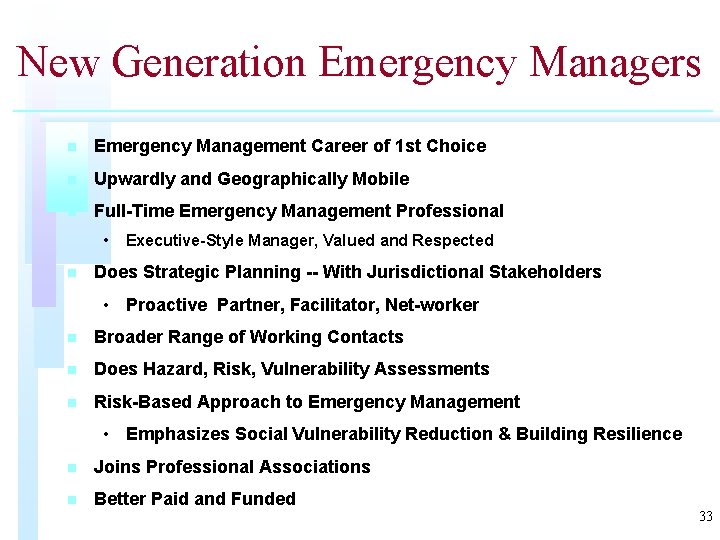
New Generation Emergency Managers n Emergency Management Career of 1 st Choice n Upwardly and Geographically Mobile n Full-Time Emergency Management Professional • n Executive-Style Manager, Valued and Respected Does Strategic Planning -- With Jurisdictional Stakeholders • Proactive Partner, Facilitator, Net-worker n Broader Range of Working Contacts n Does Hazard, Risk, Vulnerability Assessments n Risk-Based Approach to Emergency Management • Emphasizes Social Vulnerability Reduction & Building Resilience n Joins Professional Associations n Better Paid and Funded 33
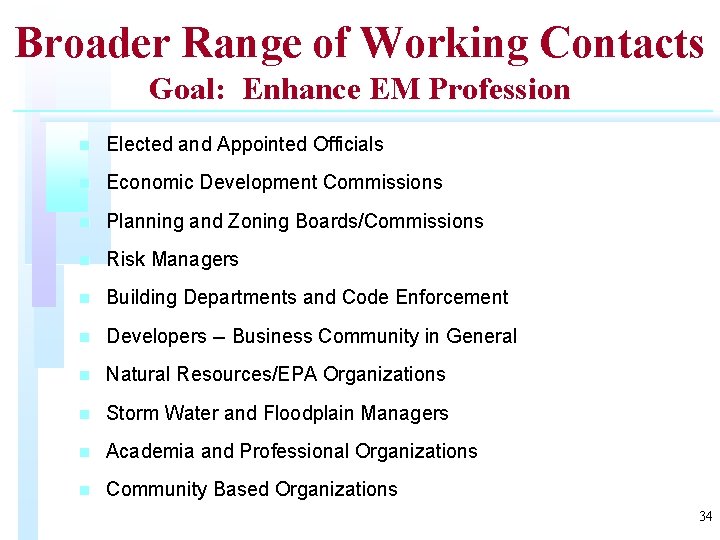
Broader Range of Working Contacts Goal: Enhance EM Profession n Elected and Appointed Officials n Economic Development Commissions n Planning and Zoning Boards/Commissions n Risk Managers n Building Departments and Code Enforcement n Developers -- Business Community in General n Natural Resources/EPA Organizations n Storm Water and Floodplain Managers n Academia and Professional Organizations n Community Based Organizations 34
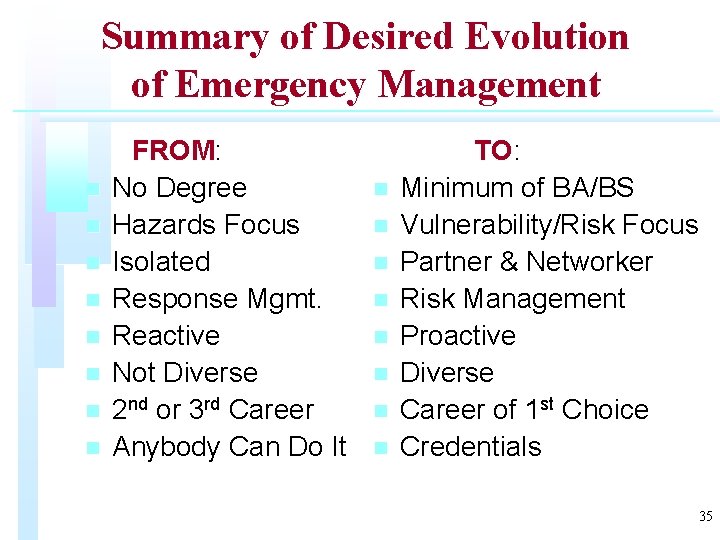
Summary of Desired Evolution of Emergency Management n n n n FROM: No Degree Hazards Focus Isolated Response Mgmt. Reactive Not Diverse 2 nd or 3 rd Career Anybody Can Do It n n n n TO: Minimum of BA/BS Vulnerability/Risk Focus Partner & Networker Risk Management Proactive Diverse Career of 1 st Choice Credentials 35
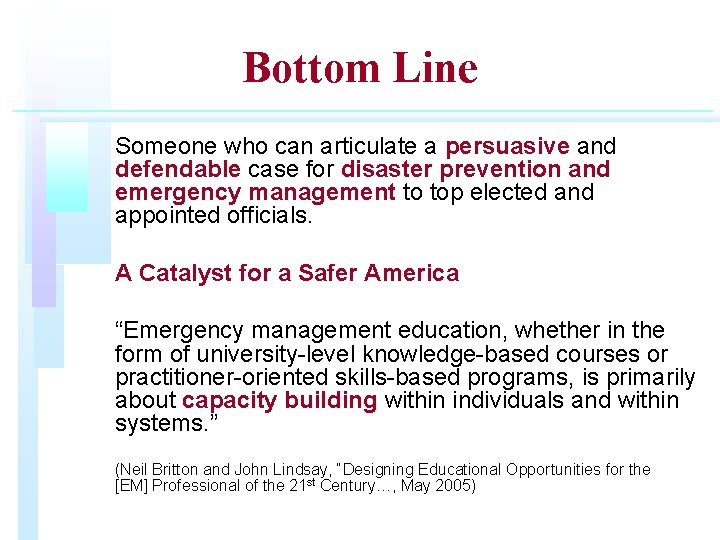
Bottom Line Someone who can articulate a persuasive and defendable case for disaster prevention and emergency management to top elected and appointed officials. A Catalyst for a Safer America “Emergency management education, whether in the form of university-level knowledge-based courses or practitioner-oriented skills-based programs, is primarily about capacity building within individuals and within systems. ” (Neil Britton and John Lindsay, “Designing Educational Opportunities for the [EM] Professional of the 21 st Century…, May 2005)
Audiences n Typical College Students • • n Juniors and Seniors Upon Graduation-- Enter EM Profession Upon Graduation Enter Other Professions Public, Private, and Volunteer Sectors Practitioners • Enhance Professionalism, Advancement n Affiliated Practitioners • Want to Enter the Field • Want Advancement/Knowledge Expansion 37
Philosophical Context Overview n E. M. of the Future, Not E. M. as is Today n Building Disaster Resilient Communities Culture n Balance Technocratic/Vulnerability Models of EM n Three Foundational Building Blocks Needed: • Education • Training • Experience 38
Building Disaster Resilient Communities n Sustainable Development Philosophy n Unconstrained Development = Disaster n Strategic Community Planning • Smart Growth • Long Term View n Respect and Defend the Environment n Network and Partner 39
Building Disaster Resilient Communities Networking and Partnering n BDRC Too Big for One or Small Number n Bring People Together from Variety of Backgrounds and Disciplines to Refract Problems Through Prism of Complementary Minds Allied in Common Purpose n Strengthens Social, Economic, and Environmental Resiliency 40
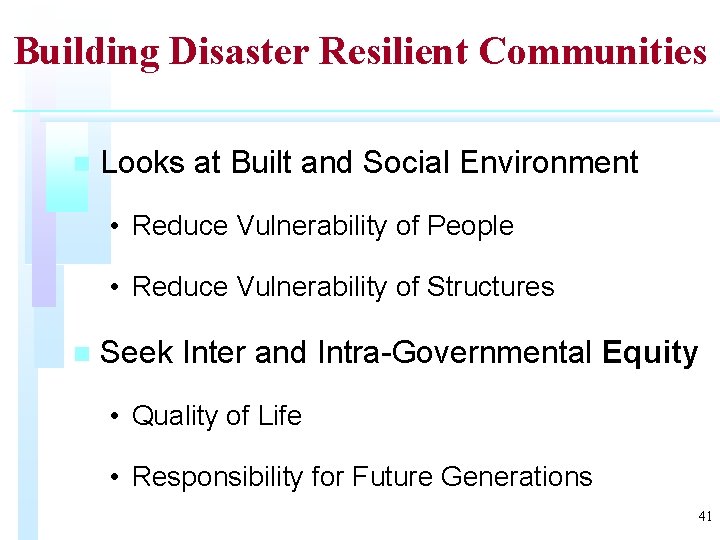
Building Disaster Resilient Communities n Looks at Built and Social Environment • Reduce Vulnerability of People • Reduce Vulnerability of Structures n Seek Inter and Intra-Governmental Equity • Quality of Life • Responsibility for Future Generations 41
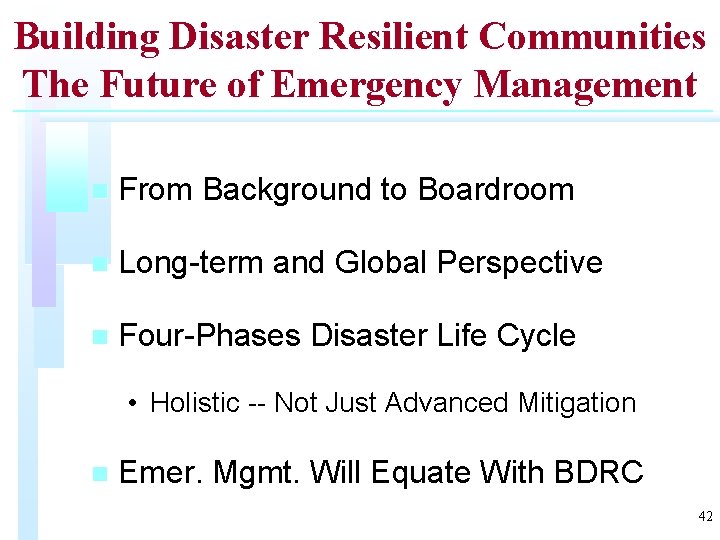
Building Disaster Resilient Communities The Future of Emergency Management n From Background to Boardroom n Long-term and Global Perspective n Four-Phases Disaster Life Cycle • Holistic -- Not Just Advanced Mitigation n Emer. Mgmt. Will Equate With BDRC 42
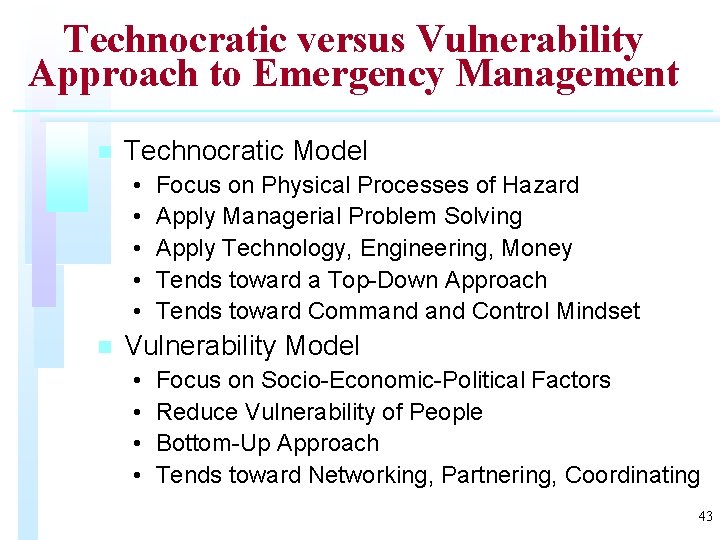
Technocratic versus Vulnerability Approach to Emergency Management n Technocratic Model • • • n Focus on Physical Processes of Hazard Apply Managerial Problem Solving Apply Technology, Engineering, Money Tends toward a Top-Down Approach Tends toward Command Control Mindset Vulnerability Model • • Focus on Socio-Economic-Political Factors Reduce Vulnerability of People Bottom-Up Approach Tends toward Networking, Partnering, Coordinating 43
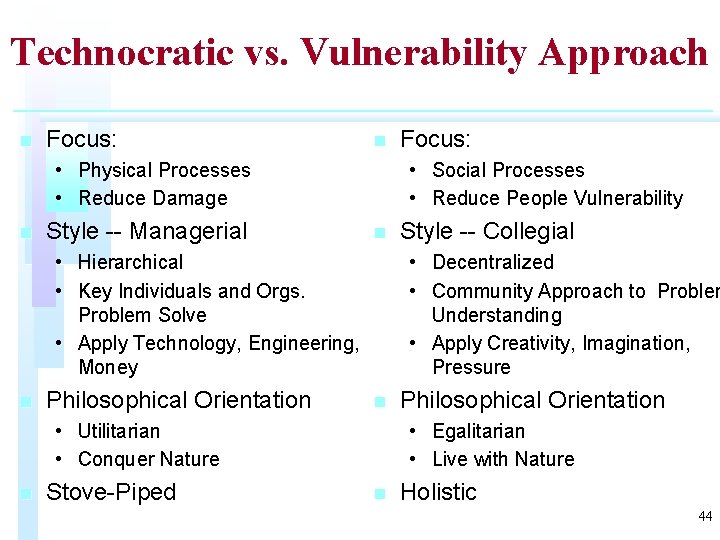
Technocratic vs. Vulnerability Approach n Focus: n • Physical Processes • Reduce Damage n Style -- Managerial • Social Processes • Reduce People Vulnerability n • Hierarchical • Key Individuals and Orgs. Problem Solve • Apply Technology, Engineering, Money n Philosophical Orientation Stove-Piped Style -- Collegial • Decentralized • Community Approach to Problem Understanding • Apply Creativity, Imagination, Pressure n • Utilitarian • Conquer Nature n Focus: Philosophical Orientation • Egalitarian • Live with Nature n Holistic 44
Paradigm Shift? n Paradigm: The overall framework of basic assumptions used to analyze and interpret data, view the world, understand reality. n Anything that we perceive or say about the world is necessarily couched within some frame-worked way of looking at it. 45
Paradigmatic Ways of Looking at the World Religious -- Revelation n Philosophical -- Contemplation n Tribal -- Tradition n Technocratic -- Observation n Vulnerability -- Participative, Interactive n 46
Emergency Management Higher Education Project Activities and Course Information 47
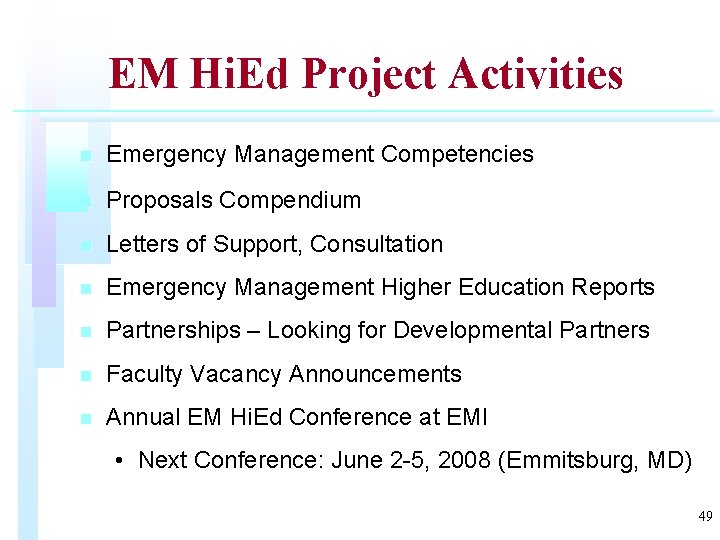
EM Hi. Ed Project Activities n Maintenance of “The College List” n Development of College Courses & Books n Audio-Visual Materials (clips, mini-lectures, interviews) n Make EM Training Courses Available to 2 -Year Schools n Compilation of EM & HS Course Syllabi n Service Learning in EM (Model and Examples) n Intern Opportunities 48
EM Hi. Ed Project Activities n Emergency Management Competencies n Proposals Compendium n Letters of Support, Consultation n Emergency Management Higher Education Reports n Partnerships – Looking for Developmental Partners n Faculty Vacancy Announcements n Annual EM Hi. Ed Conference at EMI • Next Conference: June 2 -5, 2008 (Emmitsburg, MD) 49
Partnerships n Association of Floodplain Managers n Coastal Services Center (DOC/NOAA) n U. S. Army Corps of Engineers (EM Div. ) n National Science Foundation n North Carolina Division of Emer. Mgmt. n Public Entity Risk Institute 50
Types of EM Hi. Ed Project Activities Courses for Colleges n Associate Degree Level • EM and HS-Related Training Courses n Bachelor Degree Level • Contract Developed by Professors – Support Emergency Management Programs – Farmed-Out to Existing Departments n Graduate Level • Support EM Graduate Programs • Incentive to Develop New Certificate Programs 51
EM Hi. Ed Project Courses n Mostly Upper Division, Class-Room Based n Modifiable to Lower Division, Graduate n Developed via Contract by Academics n Academic Education, Not Advanced Training n Seek to Blend Theory and Practice n Ready-To-Teach n More Than Can Be Taught in Semester 52
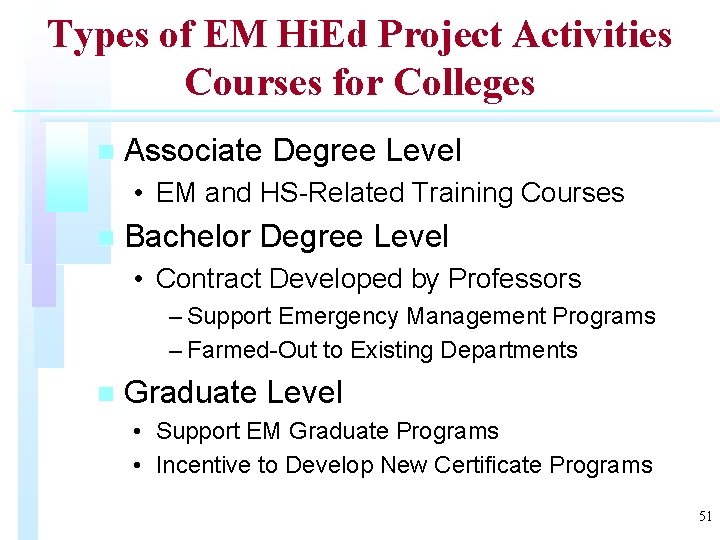
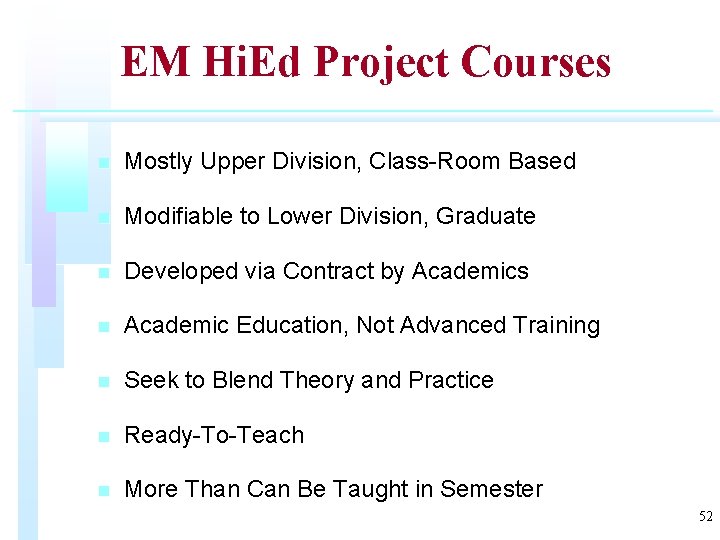
Courses Developed (22) n Building Disaster Resilient Communities n Breaking the Disaster Cycle–New Directions in Hazards Mitigation (Grad) n Business and Industry Crisis Management n Coastal Hazards Management (Graduate Course) n Disaster Response Operations & Management n Earthquake Hazard and Emergency Management n Floodplain Management (Graduate Course) n Hazards Mapping and Modeling n Hazards Mitigation Principles and Practice n Hazards Risk Management n Holistic Disaster Recovery – Creating A More Sustainable Future 53
Courses Developed (continued) n Homeland Security and Emergency Management (short course) n Individual and Community Disaster Education n Political & Policy Basis of Emergency Management n Public Administration and Emergency Management n Research & Analysis Methods in Emergency Management n Social Dimensions of Disaster (2 nd Edition) n Social Vulnerability Approach to Disasters n Sociology of Disaster n Technology and Emergency Management n Terrorism and Emergency Management n Tourism, Travel & Hospitality Mgmt. Industries and Emergency Management 54
“Course Treatments” n Comparative Emergency Management Planning Emergency Management Theory Floodplain Management Principles & Practice Hazards Risk Assessment Methods Images of Disaster in Film Legal/Ethical Basis For Emer. Mgmt. & HLS n At: n n n http: //training. fema. gov/EMIWeb/edu/coursetreat. asp 55
Courses Suggested For Future Development 1. Hazards Survey Course – Overview Course on Current & Emerging Hazards/Threats 2. Hazards Identification/Analysis & Hazards Risk Assessment Process and Methodologies 3. Risk Communication and the Communication of Risk 4. Role of Exercises in Emergency Management 5. Introduction to Hazard and Disaster Planning 6. Contingency Planning 7. Crisis Action Planning 8. Comparative/International Disaster Management 9. Theory of Emergency Management 10. Legal Basis for, and Ethical/Legal Issues in, EM & Homeland Security 11. Psychological Dimensions of Disaster 12. Politics of Emergency Management & Disaster 13. Hazards Engineering for Non-Engineers 14. Logistics Management 56
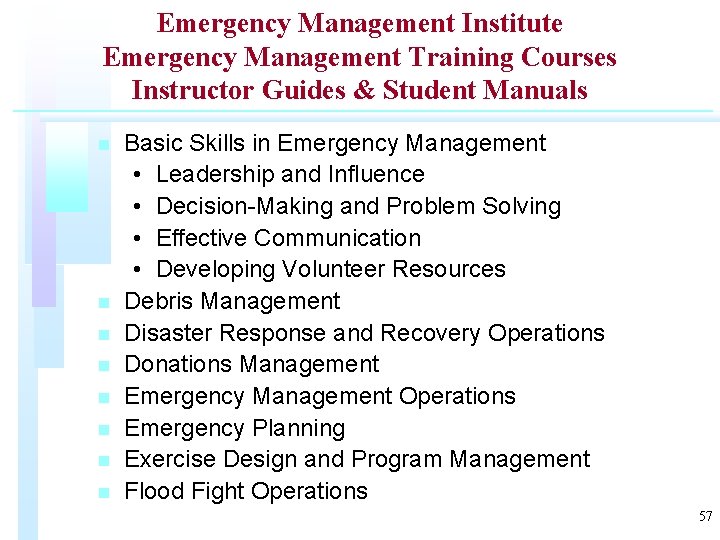
Emergency Management Institute Emergency Management Training Courses Instructor Guides & Student Manuals n n n n Basic Skills in Emergency Management • Leadership and Influence • Decision-Making and Problem Solving • Effective Communication • Developing Volunteer Resources Debris Management Disaster Response and Recovery Operations Donations Management Emergency Management Operations Emergency Planning Exercise Design and Program Management Flood Fight Operations 57
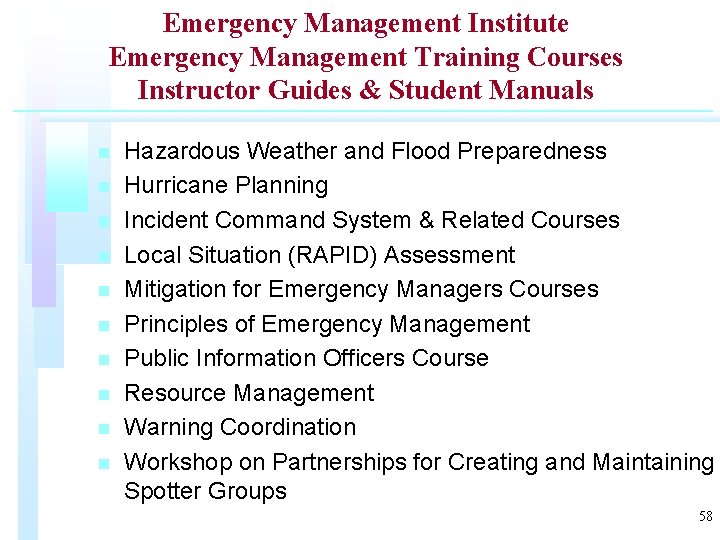
Emergency Management Institute Emergency Management Training Courses Instructor Guides & Student Manuals n n n n n Hazardous Weather and Flood Preparedness Hurricane Planning Incident Command System & Related Courses Local Situation (RAPID) Assessment Mitigation for Emergency Managers Courses Principles of Emergency Management Public Information Officers Course Resource Management Warning Coordination Workshop on Partnerships for Creating and Maintaining Spotter Groups 58
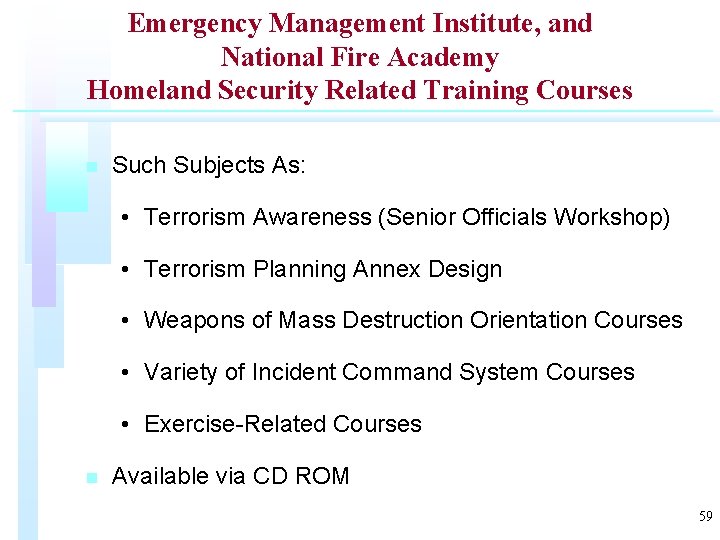
Emergency Management Institute, and National Fire Academy Homeland Security Related Training Courses n Such Subjects As: • Terrorism Awareness (Senior Officials Workshop) • Terrorism Planning Annex Design • Weapons of Mass Destruction Orientation Courses • Variety of Incident Command System Courses • Exercise-Related Courses n Available via CD ROM 59
Books n Disciplines, Disasters, and Emergency Mgmt. n Emergency and Risk Mgmt. Case Studies n Introduction to Emergency Management n Papers From 2005 EM Hi. Ed Conference 60
Materials Developed and Under Development n Hazard & Disaster Film and Video Annotated Bibliography and Clips DVD n Compilation of Articles -- International Journal of Mass Emergencies and Disasters, 1983 -2002, ~ 900 pages n Video Interviews of Participants, June 2004 EM Hi. Ed Conference – on DVD n 2005 EM Hi. Ed Conference Select Panel Presentations – via DVD 61
Course and Book Distribution n Via Internet: http: //training. fema. gov/emiweb/edu • Go to “Free College Courses, Books and Materials, ” and click – – – Courses Completed, Ready to Download, Courses Under Development Materials • “AD-Level EM and Homeland Security-Related Training Courses” – Associate’s Degree Level Courses CD ROM – FEMA Homeland Security Related Courses n n CD ROM Via National Technical Info. Service (Dept. of Commerce) 62
Emergency Management and Related Collegiate Program Information 63
Emergency Management Programs – Late 1994 - Early 1995 n University of North Texas (BS) n Thomas Edison University (BS) n Rochester Institute of Technology (BS) n UCLA Continuing Ed Certificate Program 64
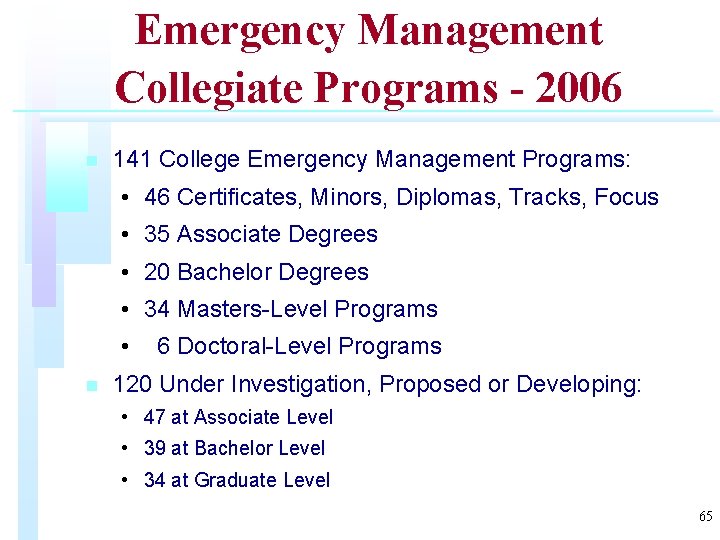
Emergency Management Collegiate Programs - 2006 n 141 College Emergency Management Programs: • 46 Certificates, Minors, Diplomas, Tracks, Focus • 35 Associate Degrees • 20 Bachelor Degrees n • 34 Masters-Level Programs • 6 Doctoral-Level Programs 120 Under Investigation, Proposed or Developing: • 47 at Associate Level • 39 at Bachelor Level • 34 at Graduate Level 65
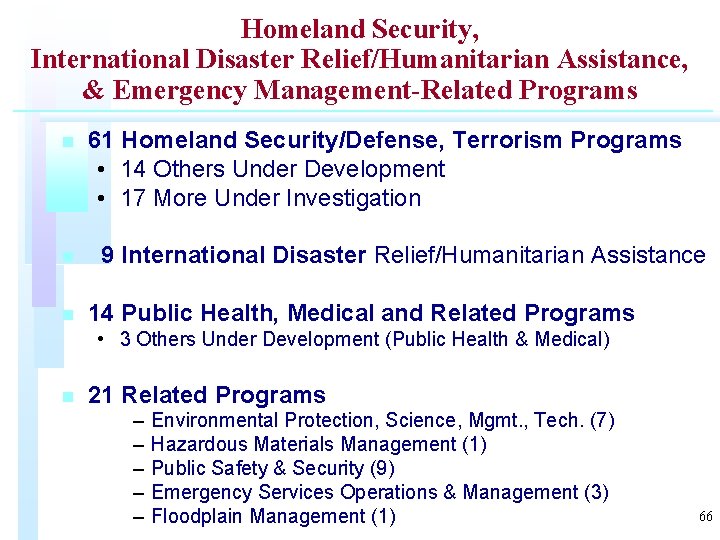
Homeland Security, International Disaster Relief/Humanitarian Assistance, & Emergency Management-Related Programs n n n 61 Homeland Security/Defense, Terrorism Programs • 14 Others Under Development • 17 More Under Investigation 9 International Disaster Relief/Humanitarian Assistance 14 Public Health, Medical and Related Programs • 3 Others Under Development (Public Health & Medical) n 21 Related Programs – – – Environmental Protection, Science, Mgmt. , Tech. (7) Hazardous Materials Management (1) Public Safety & Security (9) Emergency Services Operations & Management (3) Floodplain Management (1) 66
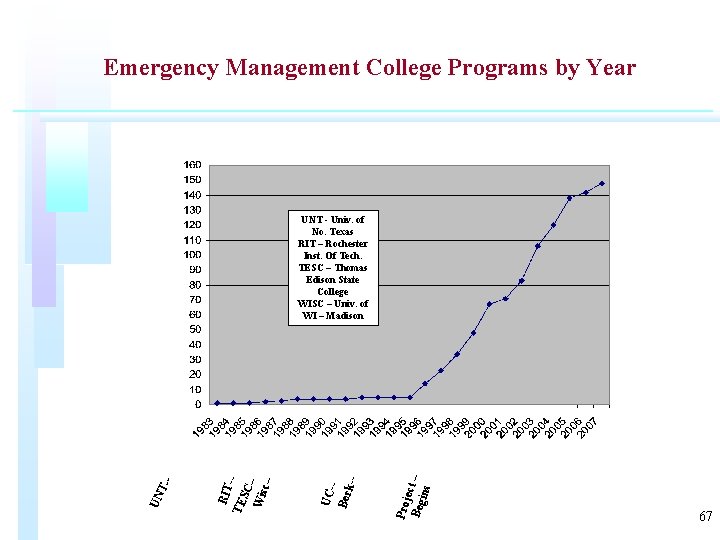
Emergency Management College Programs by Year Pro jec Beg t – ins UCBer k-- RIT -TE SC Wis c-- UN T-- UNT - Univ. of No. Texas RIT – Rochester Inst. Of Tech. TESC – Thomas Edison State College WISC – Univ. of WI – Madison 67
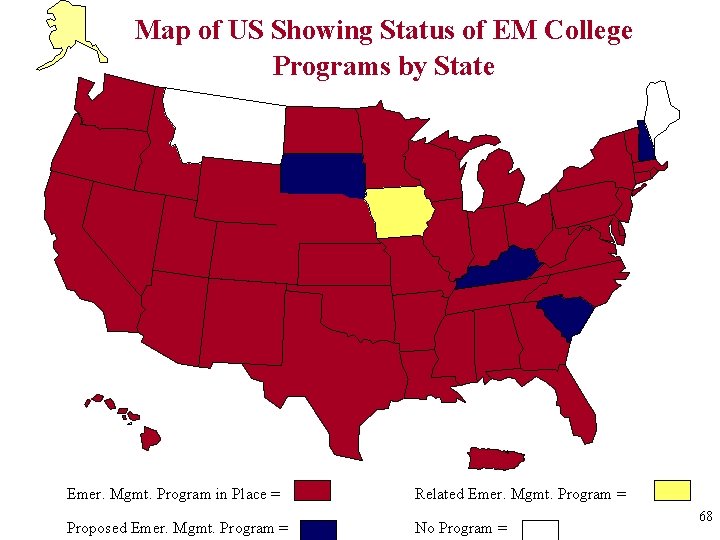
Map of US Showing Status of EM College Programs by State Emer. Mgmt. Program in Place = Related Emer. Mgmt. Program = Proposed Emer. Mgmt. Program = No Program = 68
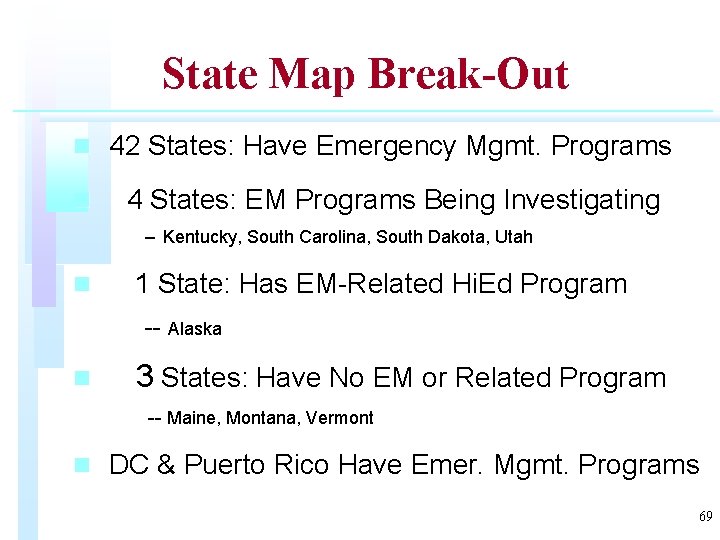
State Map Break-Out n 42 States: Have Emergency Mgmt. Programs n 4 States: EM Programs Being Investigating – Kentucky, South Carolina, South Dakota, Utah n 1 State: Has EM-Related Hi. Ed Program -- Alaska n 3 States: Have No EM or Related Program -- Maine, Montana, Vermont n DC & Puerto Rico Have Emer. Mgmt. Programs 69
Programs Growing In Size As Well As Numbers n The Crisis and Disaster Management Program has steadily grown – to the point that it is now the 2 nd largest in the home department. (Dianna Havner Bryant, CMSU, April 2003) n The MPA EM Concentration program was overwhelmed this year – had to turn students away – more in queue for next semester. (Bill Waugh, GSU, April 2003) 70
Programs Growing In Size n JSU is averaging 30 new graduate EM students per semester. (Brenda Phillips, Feb. 2003) n EM Certificate going so well we’re adding an AD. (Don Beckering, Hennipin TC, March 2003) 71
Programs Growing In Size n “Over the past four years we have seen our student population nearly double [185 declared majors] n …Our credit hour production more than triple… n Contemplating putting a cap on enrollment. ” (Dr. David Mc. Entire, University of North Texas, March 2004) 72
Programs Growing In Size n “The B. S. in Emergency Management is one of the fastest growing four year degrees at the University of Akron. ” n (Drs. David Hoover and Nancy Grant, Co-Directors, Center for Emergency Management and Homeland Security Policy Research, University of Akron, Ohio, March 15, 2004) 73
Programs Growing In Size n “Our MPA EM Concentration is growing steadily and more students in our nonprofit administration concentration are choosing to earn the graduate certificate in disaster management at the same time. n We are also getting more applications for the Ph. D in public policy program with a concentration in disaster management. ” (Dr. William Waugh, Jr. , Dept. of Public Administration, Georgia State University, March 16, 2004) 74
Programs Growing In Size n Graduate enrollment in the Emergency/Disaster Management [EDM] program has increased by 28% in the last five months to 72 students. Under-graduate enrollment…has increased by 54%…to 111 students. n Graduate enrollment in our Homeland Security [HS] program has increased 58%…to 271 students. Undergraduate enrollment…has increased by 32%…to 303 students. (Robert Jaffin, Chair, Public Sector and Critical Infrastructure Studies Dept. , American Public University System, March 16, 2004) 75
Programs Growing In Size n Disaster Managers: A New Profession in Turkey through the ITU Graduate Degree Program! A vision became a reality. n All 13 Graduates were placed in high level government and private sector disaster management positions. n Applications for upcoming program have increased 4 fold. (Dr. Derin Ural, Director, Disaster Management Program, Istanbul Technical University, Turkey, March 18, 2004) 76
Programs Growing In Size “The Master of Science graduate degree in Fire & Emergency Management Administration at Oklahoma State University continues to grow. It is now the second largest of 19 master degree programs in the College of Arts & Sciences at OSU. We are expecting more than a 40% enrollment increase in our courses by the end of this academic year…” (Dr. Anthony Brown, Professor and Director, Fire & Emergency Management Program, Dept. of Political Science, OSU, April 12, 2004) 77
Students Getting Jobs n “One of our problems is that some of our graduate students are being hired out from under us – by merely being enrolled in the Crisis and Emergency Management Program. ” n (Greg Shaw, George Washington University, July 1999) 78
Students Getting Jobs n “EAM program going very well… 70 of 74 graduates landed EM-relevant jobs…$38 to $42 K range. ” (Mary Ann Rollans, Dean, Arkansas Tech University, March 2003) n “At end of Spring 2005 will have graduated 179 students – 98% working in highly specialized positions related directly to field of emergency management. ” (Mary Ann Rollans, Dean, Arkansas Tech University, April 2005) 79
Students Getting Jobs & Experience Relationship “Major industries and government agencies place a high demand on utilizing our students for exercises, internships, and hiring them in positions that surpass entry level due to their extensive experience gained while enrolled in the program…The major challenge facing the program is being able to keep up with the demand for our students to participate in internship and externship activities. ” (Dean Mary Ann Rollans, Arkansas Tech University, Spring 2005) 80
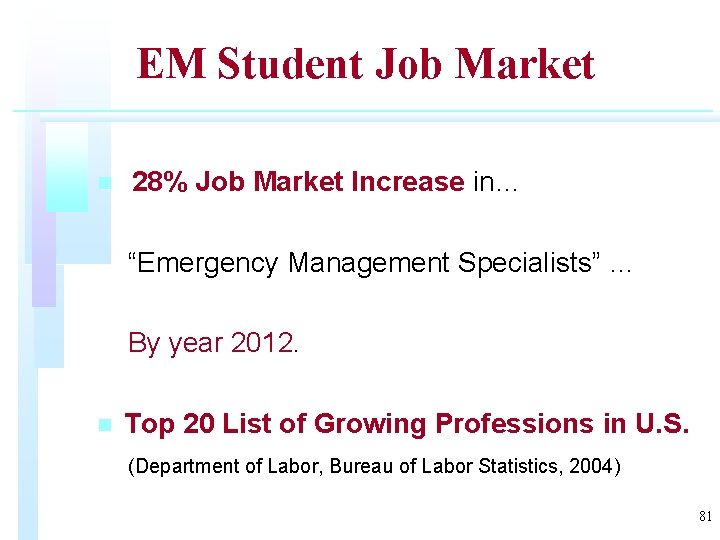
EM Student Job Market n 28% Job Market Increase in… “Emergency Management Specialists” … By year 2012. n Top 20 List of Growing Professions in U. S. (Department of Labor, Bureau of Labor Statistics, 2004) 81
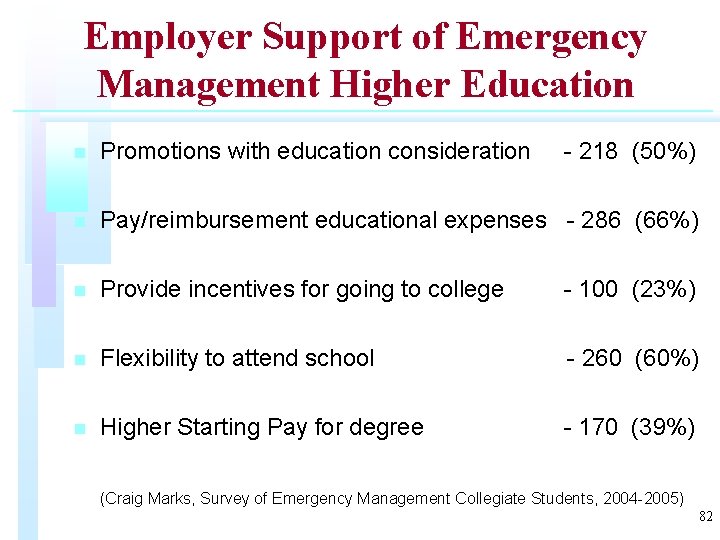
Employer Support of Emergency Management Higher Education n Promotions with education consideration - 218 (50%) n Pay/reimbursement educational expenses - 286 (66%) n Provide incentives for going to college - 100 (23%) n Flexibility to attend school - 260 (60%) n Higher Starting Pay for degree - 170 (39%) (Craig Marks, Survey of Emergency Management Collegiate Students, 2004 -2005) 82
Where Now In Emergency Management Higher Education and Professionalism: Issues, Frictions, Thoughts 83
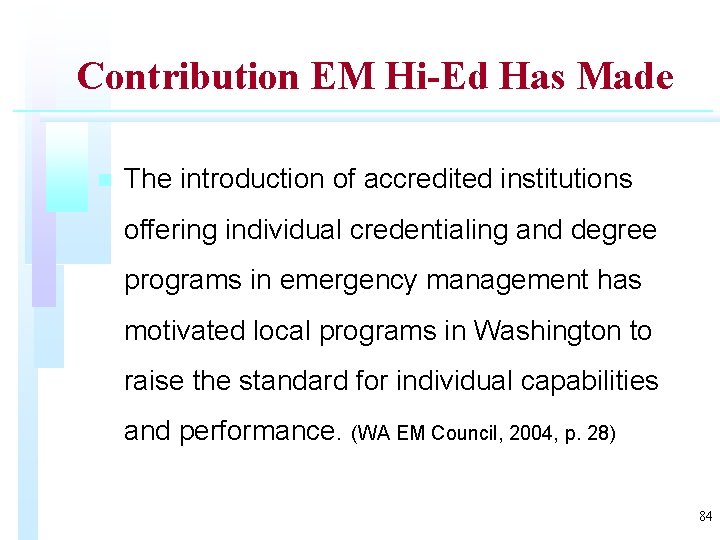
Contribution EM Hi-Ed Has Made n The introduction of accredited institutions offering individual credentialing and degree programs in emergency management has motivated local programs in Washington to raise the standard for individual capabilities and performance. (WA EM Council, 2004, p. 28) 84
Future EM and Professional Development Issues Some Good and Not So Good Signs n n Disaster Losses Projected To Become Worse EM’s Resistant to Change or Catalysts for Change? • View of Education and Academics n n Collegiate EM Program Faculty, Support, Student Issues Gaining Recognition & Only the Qualified are Hired? • Where Planning was 25 Years Ago? n n Revolution or Evolution in EM Needed? Homeland Security Pull and Issues • • • n EM Pulled By Where The Money and Priority Is All-Hazards Approach or Single Hazard Approach? Security and Public Safety Approach? Emergency Services Preparedness & Response Orientation? What Do We Call What We Do? Ready for a Catastrophic Disaster? 85
Disaster Losses – No End In Sight n “Natural disaster costs in this country are still sky-rocketing. ” (Dr. Dennis Mileti, Director (then), Natural Disaster Research and Information Center, University of Colorado, Boulder, 2002) 86
Escalating Disaster Loss - Some Implications n n n n US is very hazardous – leads to disasters US in top list of disaster incidents Disasters produce lots of Lessons Learned produce Prescriptions Lots of Prescriptions means we Basically Know What To Do Losses Nonetheless Escalating Might be that current approaches to hazards are Inadequate Need Redesigned Approach? 87
Issue: Applying Knowledge & Lessons Learned n “We already know how to reduce the losses from natural disasters, but we just not do it. ” (Congressional Natural Hazards Caucus, 2001) 88
Linking EM Practice with Research: On The Bright Side “Introducing university-level knowledge-based programmes is encouraging a more systematic introduction and treatment of risk, hazard, emergency and organisational management theory. It has enabled research findings to directly aid practice. This development has enabled [EM] to be taken as a university/college subject in its own right. Many [EM] agencies are realizing that there are distinct advantages from linking operational effectiveness with empirical research. Moreover, many decision-makers are seeing the benefit of recruiting people who are academically trained and familiar with the research literature that underpins risk, hazard and emergency management. ” (Neil Britton and John Lindsay, “Designing Educational Opportunities for the [EM] Professional of the 21 st Century…, May 2005) 89
Emergency Managers Resistant to Change or Catalysts for Change? n “Emergency management today is a constant educational process, and if the local emergency manager does not wish to continue their education, they will find they have been left behind are ineffective in their community. ” (Jerry Ve. Haun, Past President, International Association of Emergency Managers, Disaster. Com, April 2004) 90
Credentials: The Future of Emergency Management n “…hiring people with degrees and certifications and credentials must be the way of the future…. Stricter hiring requirements are coming to a disaster agency near you…it will happen. ” (Craig Marks, Director, Community Preparedness and Disaster Management Program, University of North Carolina at Chapel Hill, School of Public Health, June 2004, “Eye on Education, ” IAEM Bulletin, p. 3. ) 91
Research and Practice A Positive Projection n “Disaster research and its close companions (hazard research and risk research), and their application in the emergency management context is becoming more multi-disciplinary and multi-national. There is now a greater likelihood that research and practice can better capture the reality of relevant issues, and their particular social contexts. The field is gaining confidence that it can identify relevant universals pertaining to disaster as a phenomenon, and with it, developing more appropriate methods for managing them. ” (Neil Britton and John Lindsay, “Designing Educational Opportunities for the [EM] Professional of the 21 st Century…, May 2005) 92
Evolution of the EM Profession A Positive Projection n “The search for increased public safety and community resilience will place ever-increasing demands on [EM] agencies to provide expertise in areas that the traditional response-oriented approach has not heavily invested in. Technology transfer from specialists to emergency managers, and from them to the community-at-large, will require new base-lines and new programs. These prerequisites will provide fertile ground for innovation in the educational development of the [EM]. Such growth in the education of [EM’s] will accelerate the occupation’s transformation into a profession – a step that will be to the benefit of both individual practitioners and to communities as a whole as theories and practices of emergency management gain recognition and societal commitment. ” (Neil Britton and John Lindsay, “Designing Educational Opportunities for the [EM] Professional of the 21 st Century…, May 2005) 93
And An EM Observation: n At last – emergency management has a front door. (Pete Vogel, Training Specialist, EMI, May 2007. ) 94
Thus: One Emergency Management Future n Analyzes and Applies Disaster Lessons Learned & Disaster Research n Knowledgeable of Full Range of Jurisdiction’s Hazards & Threats n Knowledgeable of Risk Communication and Social Marketing Skills n Makes Persuasive Case for Disaster Reduction & Risk Management n Develops & Manages Comprehensive EM Program/Office n Horizontally/Vertically Integrates EM Intra-Organizationally n Lead Hazard Coordinator, Facilitator, Net-Worker, Problem-Solver n Recognizes/Successfully Operates within Legal/Ethical, Social, Political, Economic, Bureaucratic Contexts for EM, including economic development n Knowledgeable of Technological Tools & Applications n Seeks to Reduce Social Vulnerability & Enhance Resilience 95
Practice vs. Education (Emergency Management Student) Issue: “In my conversations with practitioners, those with the most experience tended to have the least formal education. This group was the most edgy when it came to appreciating educational opportunities. They felt that years of experience trumped the need for education and they were resentful (read fearful) that a push for highly educated emergency managers would push them out of the profession. ” (Craig Marks, Professional Competencies for The Master’s Level Emergency Manager, April 2005) 96
EXPERIENCE VS. EDUCATION "The degree [EM] is a head start on learning the work – 4 years of college gets you the general information, and maybe some experience, that would take many more years of on-the-job experience. Period. So, the college education and training in the new EM programs will drastically shorten the learning curve that many of us went through to get where we are now in EM. “ (Dale A. Currier, CPT, CEM, Ecology and Environment, Inc. , Oswego, NY, IAEM Discussion List Digest, May 3, 2005) 97
Practitioner vs. Academia Issue n "…in the field we (the 'public safety providers‘) tend to do 'stuff' (i. e, how we respond and defend our actions post response) 'from the gut' or even worse 'because we have always done it that way'…and we (public safety) have little (in most cases NO) empirical evidence to base that response on before or after said response occurs. When someone who is an Academic shows with research that we are doing something that is less than or even counter productive we (responders) tend to 'circle the wagons, ' defending our actions with impassioned arguments that again have no science basis…" (Louis N. Molino, Sr. , IAEM Discussion List, April 19, 2005) 98
Experience vs. Education People, organizations, communities, countries make bad decisions all the time based on their experience – Some call this the “preparing to fight the last war” syndrome. (Wayne Blanchard, FEMA EM Hi. Ed Project Manager, 2005) 99
Experience AND Education “We do the profession a great injustice if we only look to the future without extending a hand to the past. The depth and breadth of knowledge in practitioners must be acknowledged, embraced and built upon. To do so is to have the best of both worlds – the open-mind and the learned-soul. ” (Cwiak, Cline & Karlgaard. “Emergency Management Attitudes…” North Dakota State University, 2004) 100
Practitioner vs. Academic Research n “Too many Joes (and Janes) on the street think academic research is: • Some guy who shows up and takes money away from them… • To Study something they don’t care about… • Writes it up in words…nobody understands… • And publishes it somewhere that nobody ever reads. ” (Craig Marks, IAEM Discussion List, May 1, 2005) 101
Friction Area: Theory vs. Practice “Practitioners placed this category higher on the list than academics (14 vs. 17). With new requirements coming from the federal government almost weekly, and the implementation of the National Incident Management System and the National Response Plan, along with the requirement for every first responder to be trained or face the loss of grant monies in FY 2006, I believe the practitioner is ‘feeling the heat’ with regard to advanced training. Programs that can capitalize on ‘bundling’ achievements within their programs (FEMA Professional Development Series, CEM…etc. ) along with college credit will be meeting the needs of their customers better than those who merely see themselves as dispensers of knowledge. ” (Craig Marks, “Professional Competencies For The Master’s Level Emergency Manager, ” April 2005) 102
Theory versus Practice Issue Within EM Academic Programs “My Own experience indicates that most faculty tend to be excellent academics rooted in various schools of methodological and substantive theory. In sharp contrast, others are ‘nuts and bolts’ oriented practitioners who have earned some type of academic credential. Too often they lack much respect for the place of theory in either the profession or any academic discipline. ” (Dr. Thomas Drabek, Western Social Science Association Paper, 2005) 103
ISSUE - CURRENT EM JOB STATUS & EM STUDENT RECRUITS n "We will soon have a glut of educated individuals with no where to use that education. Right now I would bet that nearly 50% of the emergency management offices in this country operate with maybe no more than a coordinator/director and an office assistant or two, if any. These individuals are often overworked, underpaid and many times only do the EM thing on a part-time basis. Second, if there is not a concentrated effort to financially fund these positions at the rates they should be, we will loose many of these educated individuals to other disciplines such as Public Safety or the Federal Government. IAEM [International Association of Emergency Managers] needs to spend more time fostering and lobbying for the recognition of not only knowledge but experience and most importantly why emergency management is important and the benefits to a community that hires only qualified individuals at a salary that is commensurate with that individuals qualifications. “ (Frank Kriz, Regional Planner, Arizona Office of Homeland Security, IAEM Discussion List Digest, May 3, 2005) 104
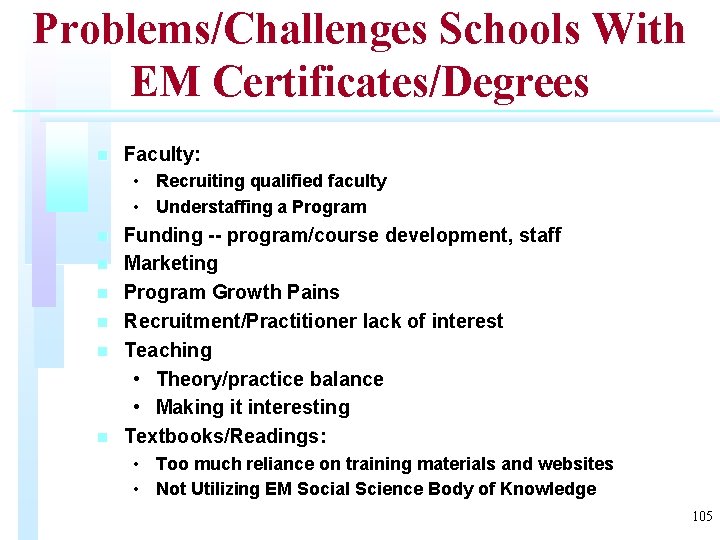
Problems/Challenges Schools With EM Certificates/Degrees n Faculty: • Recruiting qualified faculty • Understaffing a Program n n n Funding -- program/course development, staff Marketing Program Growth Pains Recruitment/Practitioner lack of interest Teaching • Theory/practice balance • Making it interesting Textbooks/Readings: • Too much reliance on training materials and websites • Not Utilizing EM Social Science Body of Knowledge 105
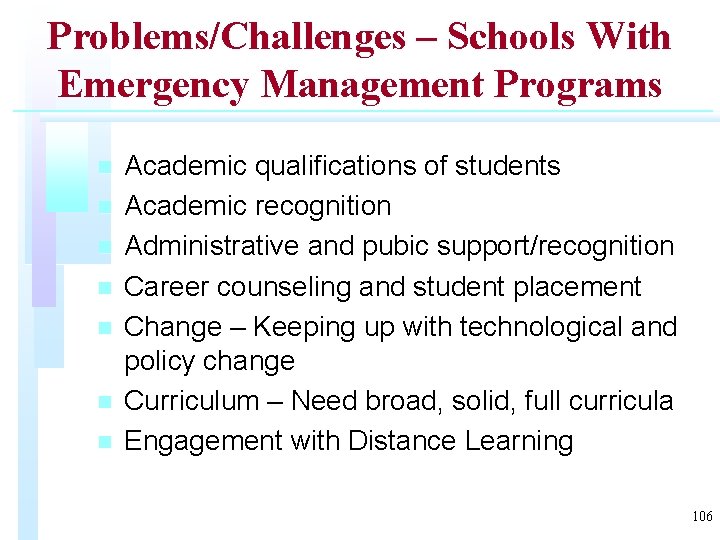
Problems/Challenges – Schools With Emergency Management Programs n n n n Academic qualifications of students Academic recognition Administrative and pubic support/recognition Career counseling and student placement Change – Keeping up with technological and policy change Curriculum – Need broad, solid, full curricula Engagement with Distance Learning 106
Problem Area (If “Emergency Management” is to be Recognized Discipline) “University programs are today located where one or two faculty have had the force of personality to win approval from their university or college to begin a program. ” (Craig Marks, Professional Competencies For The Master’s Level Emergency Manager, ” April 2005) 107
Problem Area: Faculty Credentials n In reference to spurt in growth of emergency management and homeland security programs post 9 -11: “Suddenly, people who couldn’t spell the word ‘fire’ and didn’t know much about emergency management are offering programs. ” (Dr. Nancy Grant, University of Akron, 2003) 108
Faculty Credentials n n n This past year, more than any previous year, have had several faculty, without what I would recognize as an “EM” background or knowledge base, communicate the attitude to me that “just point out a couple/three good books or sources to go to and that would be good enough – after all this isn’t rocket science. ” Reminds me of problem of personnel hired to be EM’s because of who they knew, or some experience in some other profession -- anyone can do EM attitude. (Wayne Blanchard, June 28, 2007) 109
Faculty Credentials n I have had several conversations this past year with faculty who were designing a new EM Program or basic EM Intro course wherein it became painfully obvious that the person I was talking with did not really know Emergency Management – • The Four Phases, what’s that? • Drabek, Dynes, Quarantelli, Mileti, Waugh – who are they? (Wayne Blanchard, June 28, 2007) 110
Faculty Credentials n Several Emergency Management College Program representatives responded to the 2006 EM Body of Knowledge survey that they “did not feel confident or knowledgeable enough to answer a survey about the top ten readings in emergency management”… 111
Class Materials and Presentations n Brenda Phillips in DRC Disaster Research Handbook (2006): n “If disaster research is helping to spawn a new discipline as some suggest…then its work remains incomplete. For a new discipline to emerge, take shape, and become recognized as a substantive field of knowledge, research must infuse the writings and materials used in the classroom. The presumed benefits of doing so include legitimacy and acceptance within the academy; professionalization that generates promotions, higher salaries, and social prestige; and more effective emergency management practice. ” (p. 456) 112
Use of Research Literature in EM Hi-Ed Courses n “Any examination of available syllabi suggests several…conclusions. First, it is clear that many EM educators are not using research extensively in the EM classroom. …” n “For the most part, it appears that EM students are simply not reading published research reports… Rather, technical reports and Internet links represent the lead favorite reading assignment. ” n Brenda Phillips, DRC Handbook 2006, p. 457) 113
Program Quality n “It would serve the nation and the schools well to call into question the quality of the programs, as too many schools set up programs for head count, and not outcomes (what you put in is generally what you get out. ” n (Noah West, Louisiana State University, Eunice, June 27, 2006 email) 114
Possible Problem Area: Public Sector vs. Private Sector Program Focus? “It may be the national push with regard to a vulnerability assessment and planning, or the push for public-private partnerships, or the realization that what keeps America going is not government, but business; however, one of the biggest differences in placement between the two surveys was in business recovery. The academics placed it 21 st on their survey while this group (EM practitioners) placed it 13 th. Programs should seek to see if they have a business recovery/continuity market and then develop classes within that growing area. ” (Craig Marks, Professional Competencies For The Master’s Level Emergency Manager, April 2005) 115
Emergency Management & Homeland Security All-Hazards vs. International Terrorism Focus “What the all-hazards approach can contribute to the effort to deal with terrorism in its many forms is a basic framework for structuring the emergency response, preparing for the response, and recovering from attacks, as well as developing appropriate measures to prevent or reduce the impact of the attacks…. the allhazards approach encourages a broader perspective…. and a broader foundation on which to build effective programs to manage hazards and disasters. ” (Dr. William L. Waugh, Jr. , Journal of Emergency Management, March/April 2005) 116
Emergency Management & Homeland Security All-Hazards vs. Response & Terrorism Focus “Unfortunately…from my perspective, in the post 9 -11 environment, the term emergency management is losing its proactive and all hazards emphasis and is devolving back into a term associated primarily with response and recovery and a focus on terrorism to the exclusion of an all hazards approach. ” (Dr. Greg Shaw, “What Do We Call Ourselves…? , May 2005) 117
Emer. Mgmt. & Homeland Security Issue: All-Hazards, All-Phases vs. Response Focus The job of this office is to prevent terrorism while emergency management’s job is to respond. (Keith Hall, Director, State of Kentucky Office of Homeland Security, The Kentucky Post, May 23, 2005) 118
Issue: Emergency Manager Valued as a Professional n “At least 99. 9% of the people I have known in the emergency management sector have their hearts in the right place. The problem is really that unfortunately most of us are way to far down the food chain to really be listened to by those making decisions. ” (IAEM Discussion List, June 21, 2005) 119
120
121
122
- Slides: 122