
EMDR with Difficult Clients Dyadic Resourcing Philip Manfield








- Slides: 36
EMDR with Difficult Clients: Dyadic Resourcing Philip Manfield, Ph. D. (www. philipmanfield. com) June 13, 2010 Hamburg, Germany A fresh approach to preparing difficult clients for processing of early trauma.
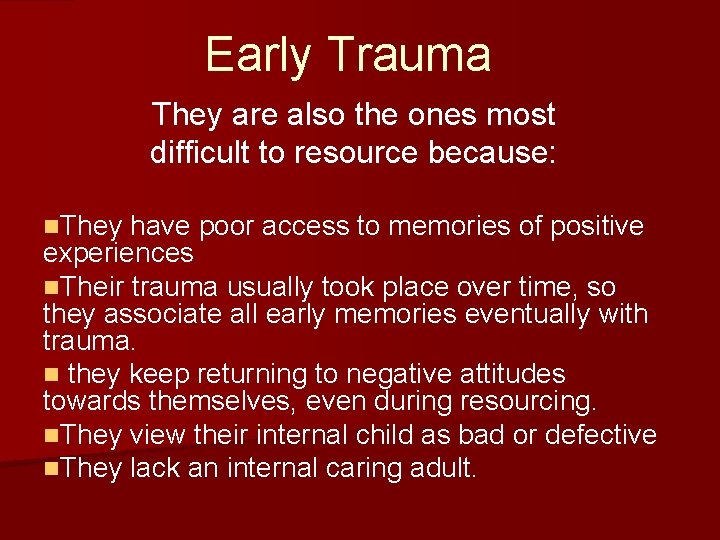
Early Trauma Think of an infant in a crib hearing her parents fighting in the next room Clients with very early trauma are the ones who need resourcing the most because they flood, dissociate or defend when they recall early trauma.
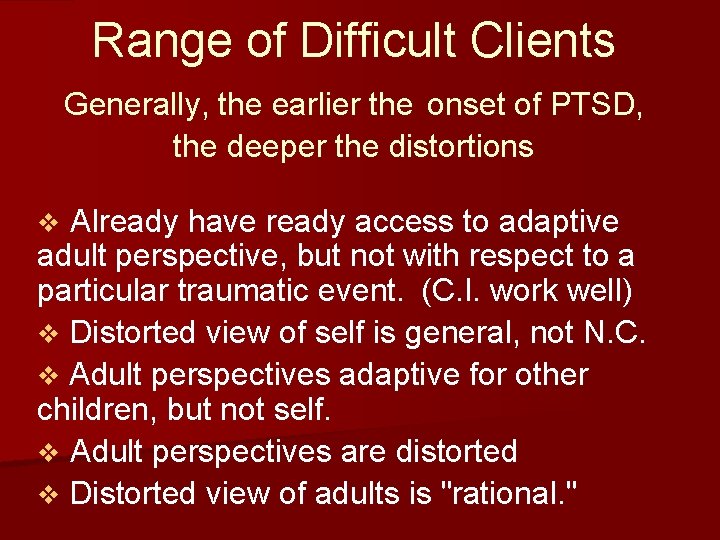
Range of Difficult Clients Generally, the earlier the onset of PTSD, the deeper the distortions Already have ready access to adaptive adult perspective, but not with respect to a particular traumatic event. (C. I. work well) v Distorted view of self is general, not N. C. v Adult perspectives adaptive for other children, but not self. v Adult perspectives are distorted v Distorted view of adults is "rational. " v
Early Trauma They are also the ones most difficult to resource because: n. They have poor access to memories of positive experiences n. Their trauma usually took place over time, so they associate all early memories eventually with trauma. n they keep returning to negative attitudes towards themselves, even during resourcing. n. They view their internal child as bad or defective n. They lack an internal caring adult.
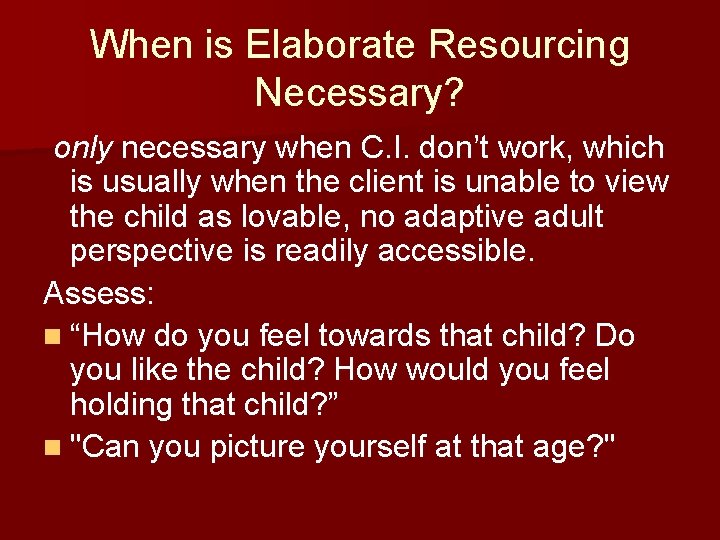
When is Elaborate Resourcing Necessary? only necessary when C. I. don’t work, which is usually when the client is unable to view the child as lovable, no adaptive adult perspective is readily accessible. Assess: n “How do you feel towards that child? Do you like the child? How would you feel holding that child? ” n "Can you picture yourself at that age? "
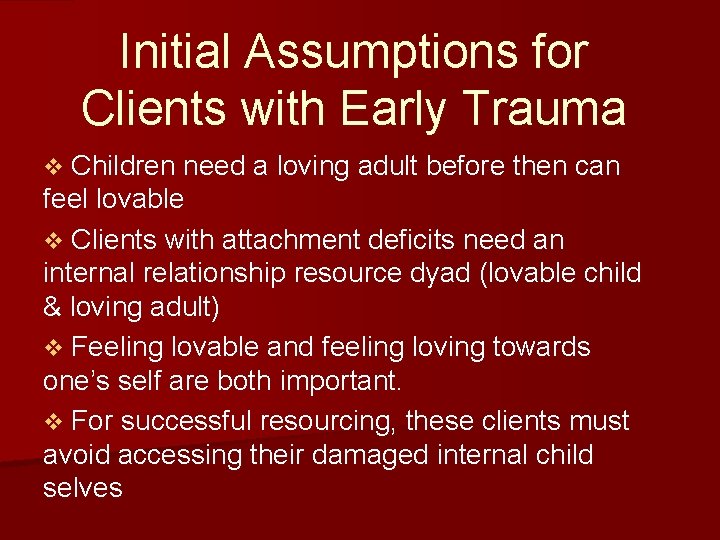
Initial Assumptions for Clients with Early Trauma v Children need a loving adult before then can feel lovable v Clients with attachment deficits need an internal relationship resource dyad (lovable child & loving adult) v Feeling lovable and feeling loving towards one’s self are both important. v For successful resourcing, these clients must avoid accessing their damaged internal child selves
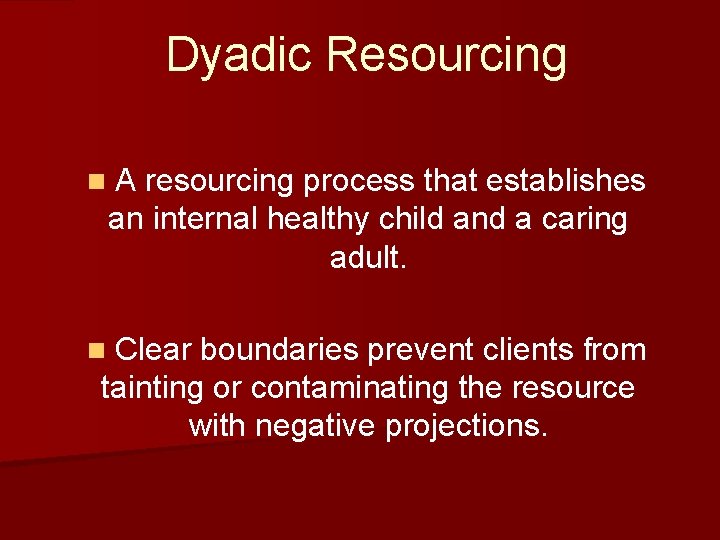
Dyadic Resourcing n A resourcing process that establishes an internal healthy child and a caring adult. Clear boundaries prevent clients from tainting or contaminating the resource with negative projections. n
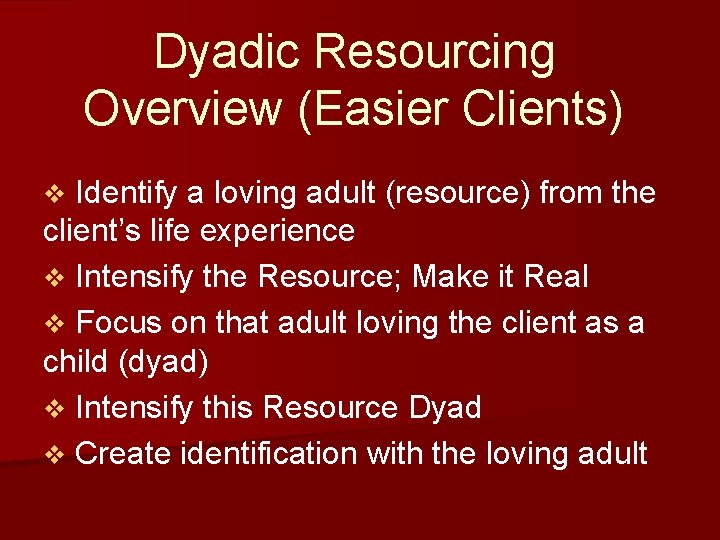
Dyadic Resourcing Overview (Easier Clients) Identify a loving adult (resource) from the client’s life experience v Intensify the Resource; Make it Real v Focus on that adult loving the client as a child (dyad) v Intensify this Resource Dyad v Create identification with the loving adult v
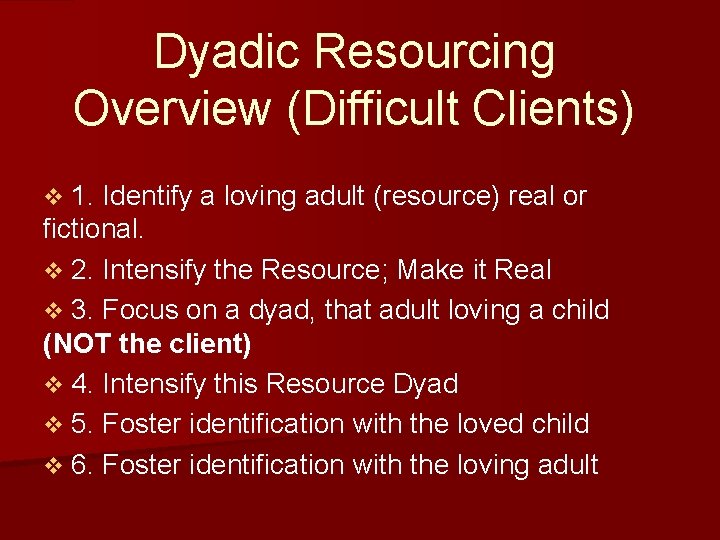
Dyadic Resourcing Overview (Difficult Clients) v 1. Identify a loving adult (resource) real or fictional. v 2. Intensify the Resource; Make it Real v 3. Focus on a dyad, that adult loving a child (NOT the client) v 4. Intensify this Resource Dyad v 5. Foster identification with the loved child v 6. Foster identification with the loving adult
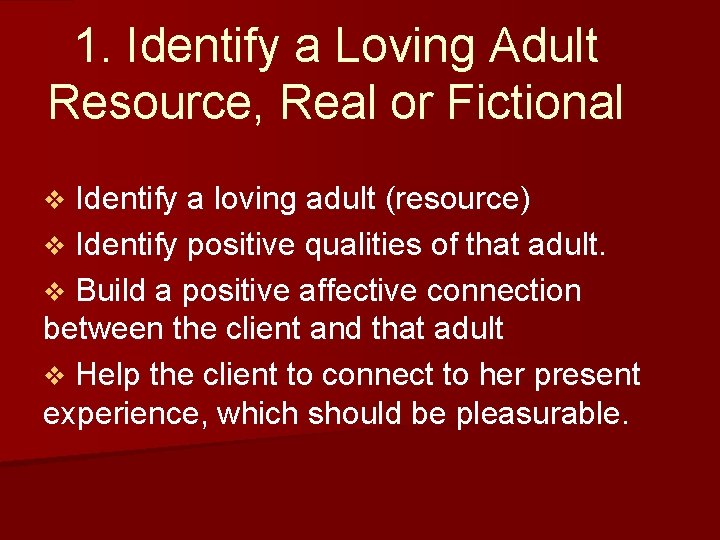
1. Identify a Loving Adult Resource, Real or Fictional Identify a loving adult (resource) v Identify positive qualities of that adult. v Build a positive affective connection between the client and that adult v Help the client to connect to her present experience, which should be pleasurable. v
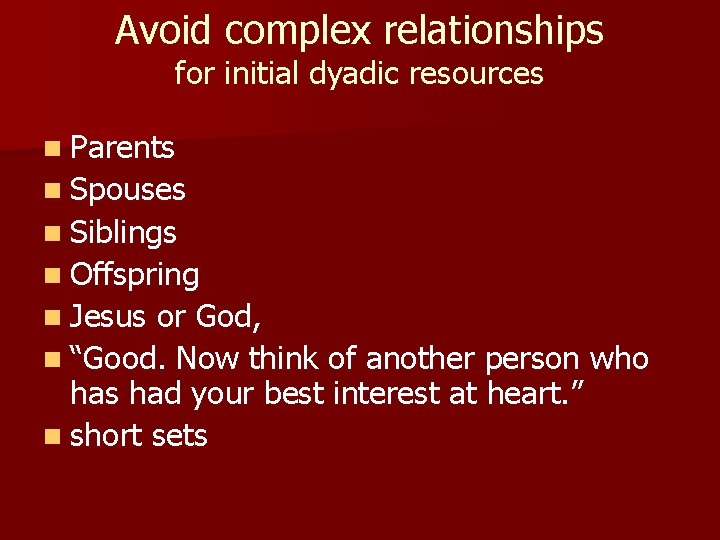
Avoid complex relationships for initial dyadic resources n Parents n Spouses n Siblings n Offspring n Jesus or God, n “Good. Now think of another person who has had your best interest at heart. ” n short sets
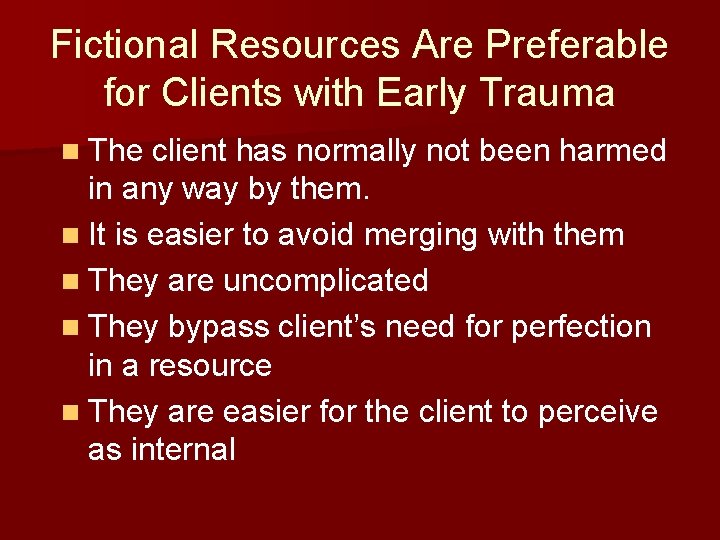
Fictional Resources Are Preferable for Clients with Early Trauma n The client has normally not been harmed in any way by them. n It is easier to avoid merging with them n They are uncomplicated n They bypass client’s need for perfection in a resource n They are easier for the client to perceive as internal
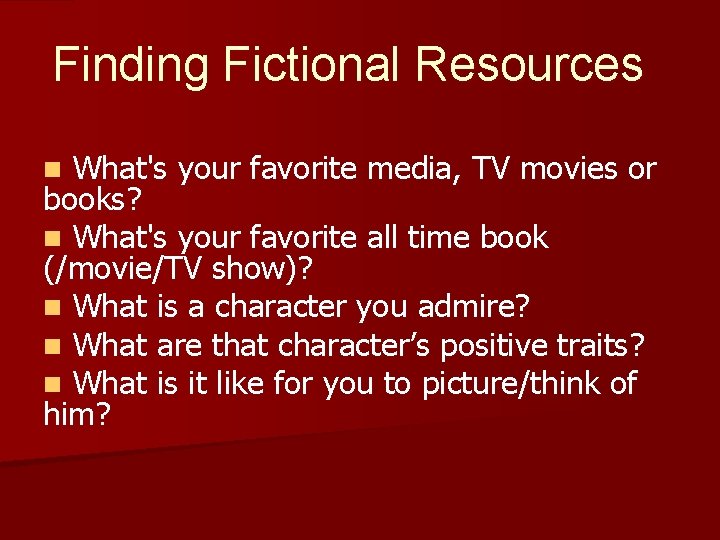
Finding Fictional Resources What's your favorite media, TV movies or books? n What's your favorite all time book (/movie/TV show)? n What is a character you admire? n What are that character’s positive traits? n What is it like for you to picture/think of him? n
2. Make the Resource Real (Eidetic Psychotherapy) n When the client thinks of the resource person, we want her to experience a present “glow. ” n “I’m not asking you to remember. I simply want you to look, and tell me what you are seeing, even if it’s not consistent with the facts as you know them. ”
3. Focus on a dyad (Adult loving a child) Identify or create a child for that adult to nurture (NOT the client) v Adjust the child’s age as needed. v Create a “tableau” of this adult nurturing this child (involving physical contact) v
The Child Need Not be Real n Does this person have children? What kind of a mom do you think she is? n Have you ever seen this person relating to children? n Do you imagine he would be a good dad if he had kids? n Can you imagine what she might have been like when her children were younger?
4. Intensify the Resource Dyad Identify positive details involving all senses v Highlight positive affect whenever it occurs. v Build a positive affective connection between the client and the tableau. v Use visual observation to help maintain adult observer perspective. v
Video (1) Captain Picard
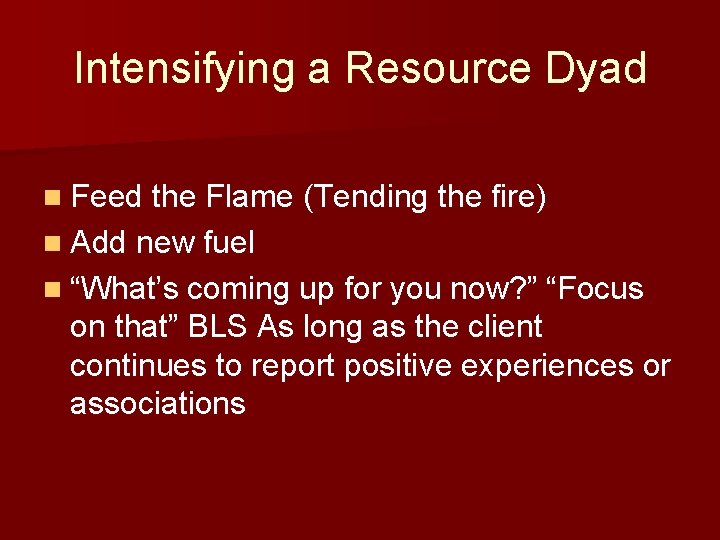
Intensifying a Resource Dyad n Feed the Flame (Tending the fire) n Add new fuel n “What’s coming up for you now? ” “Focus on that” BLS As long as the client continues to report positive experiences or associations
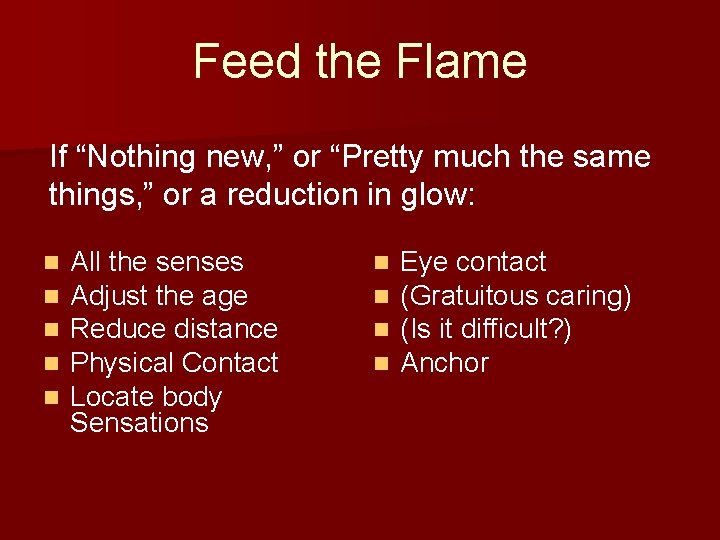
Feed the Flame If “Nothing new, ” or “Pretty much the same things, ” or a reduction in glow: n n n All the senses Adjust the age Reduce distance Physical Contact Locate body Sensations n n Eye contact (Gratuitous caring) (Is it difficult? ) Anchor
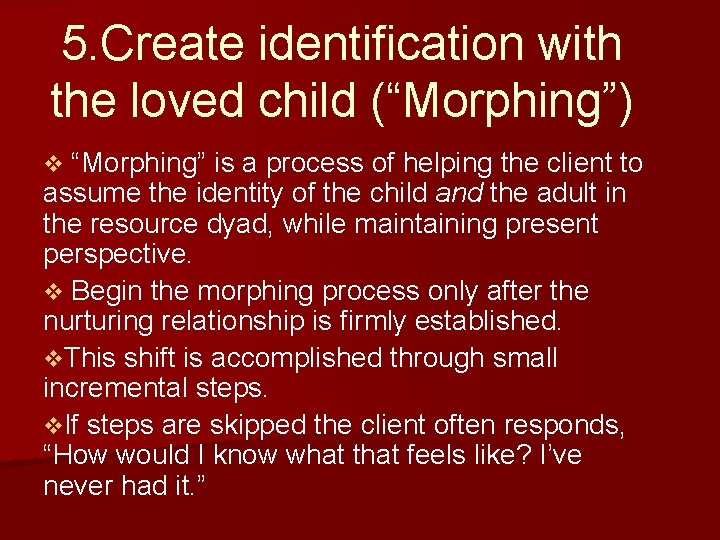
5. Create identification with the loved child (“Morphing”) v “Morphing” is a process of helping the client to assume the identity of the child and the adult in the resource dyad, while maintaining present perspective. v Begin the morphing process only after the nurturing relationship is firmly established. v. This shift is accomplished through small incremental steps. v. If steps are skipped the client often responds, “How would I know what that feels like? I’ve never had it. ”
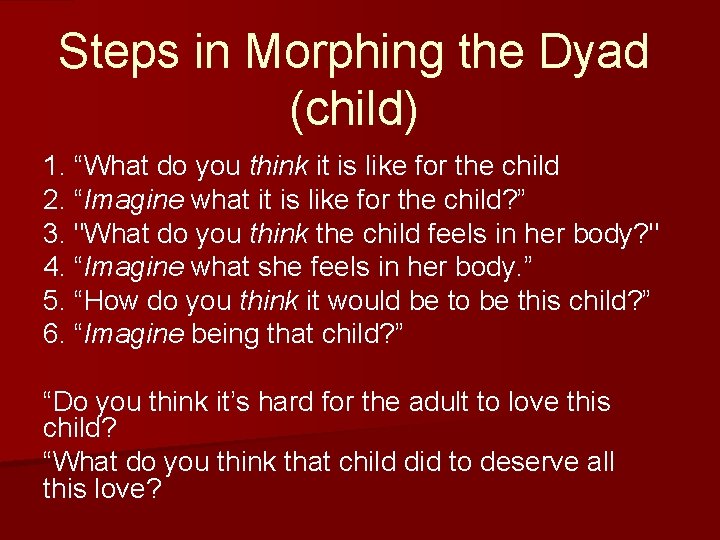
Steps in Morphing the Dyad (child) 1. “What do you think it is like for the child 2. “Imagine what it is like for the child? ” 3. "What do you think the child feels in her body? " 4. “Imagine what she feels in her body. ” 5. “How do you think it would be to be this child? ” 6. “Imagine being that child? ” “Do you think it’s hard for the adult to love this child? “What do you think that child did to deserve all this love?
Video (2) Morphing (Child)
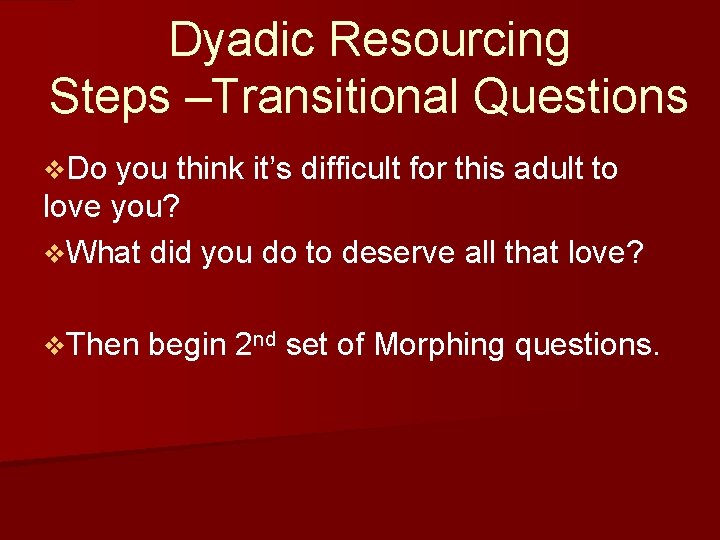
Dyadic Resourcing Steps –Transitional Questions v. Do you think it’s difficult for this adult to love you? v. What did you do to deserve all that love? v. Then begin 2 nd set of Morphing questions.
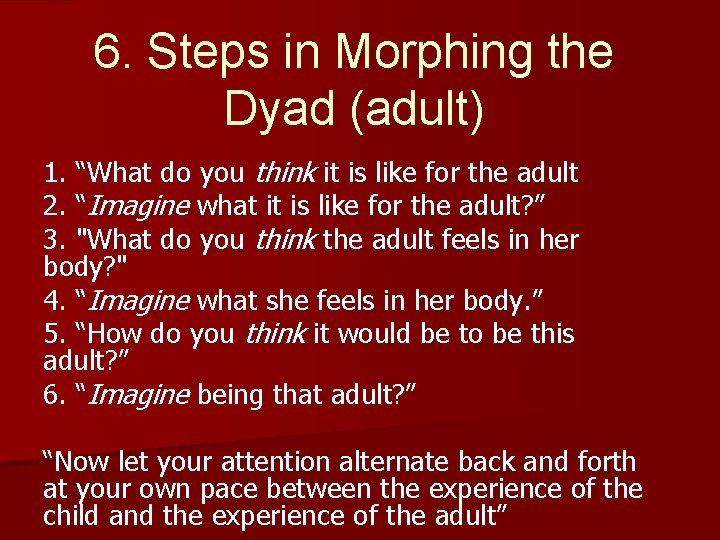
6. Steps in Morphing the Dyad (adult) 1. “What do you think it is like for the adult 2. “Imagine what it is like for the adult? ” 3. "What do you think the adult feels in her body? " 4. “Imagine what she feels in her body. ” 5. “How do you think it would be to be this adult? ” 6. “Imagine being that adult? ” “Now let your attention alternate back and forth at your own pace between the experience of the child and the experience of the adult”
Video (3) Morphing (Adult)
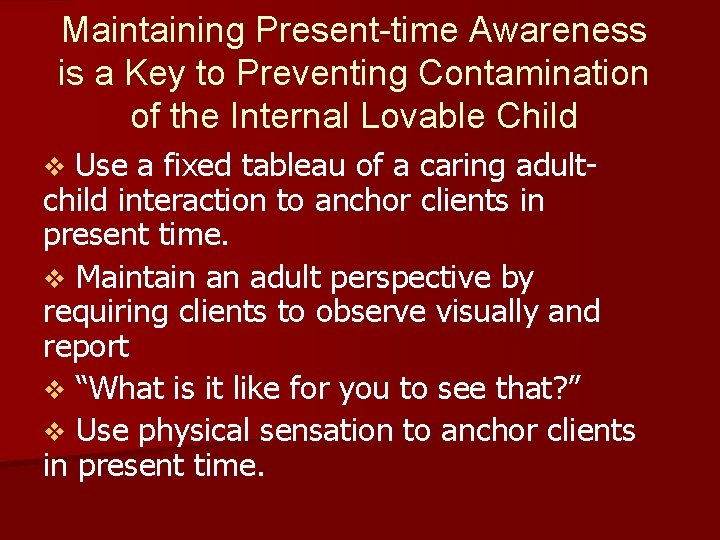
Maintaining Present-time Awareness is a Key to Preventing Contamination of the Internal Lovable Child Use a fixed tableau of a caring adultchild interaction to anchor clients in present time. v Maintain an adult perspective by requiring clients to observe visually and report v “What is it like for you to see that? ” v Use physical sensation to anchor clients in present time. v
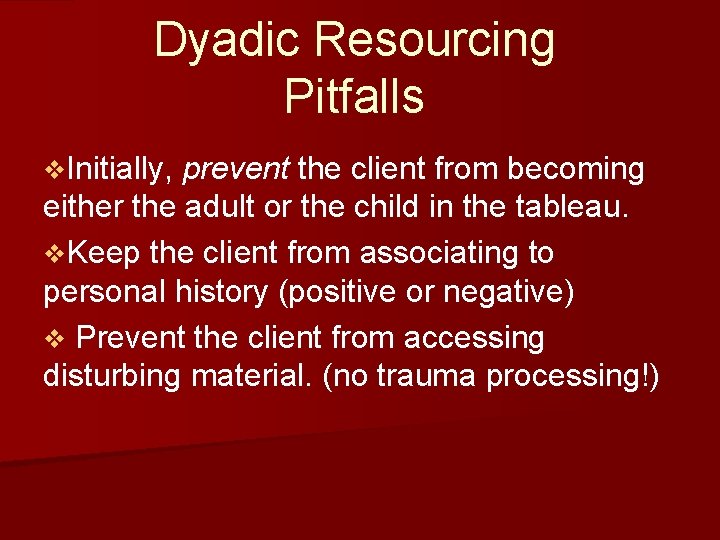
Dyadic Resourcing Pitfalls v. Initially, prevent the client from becoming either the adult or the child in the tableau. v. Keep the client from associating to personal history (positive or negative) v Prevent the client from accessing disturbing material. (no trauma processing!)
Video (4) Difficult Client
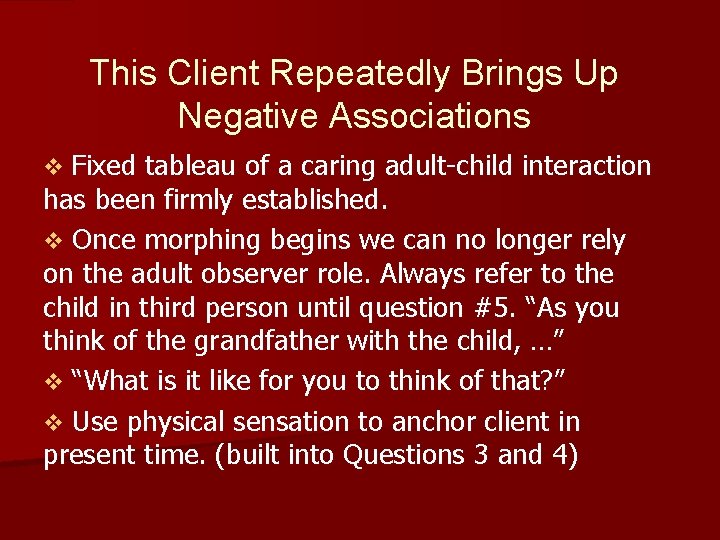
This Client Repeatedly Brings Up Negative Associations Fixed tableau of a caring adult-child interaction has been firmly established. v Once morphing begins we can no longer rely on the adult observer role. Always refer to the child in third person until question #5. “As you think of the grandfather with the child, …” v “What is it like for you to think of that? ” v Use physical sensation to anchor client in present time. (built into Questions 3 and 4) v
Video (5) Morphing (Child)
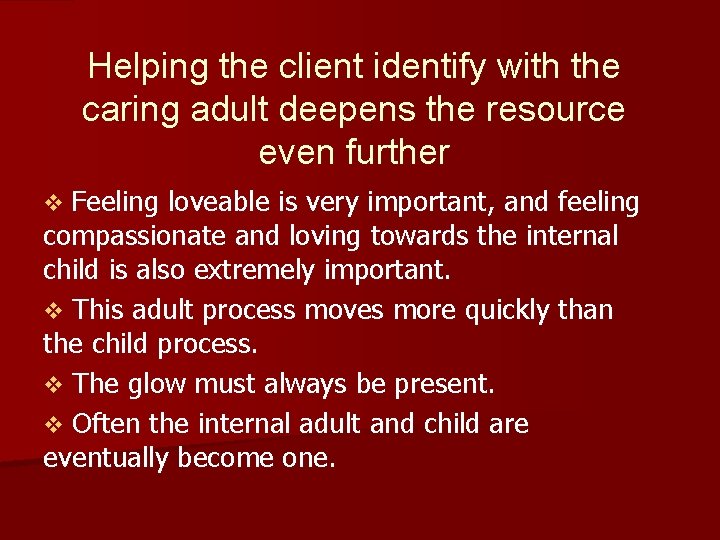
Helping the client identify with the caring adult deepens the resource even further Feeling loveable is very important, and feeling compassionate and loving towards the internal child is also extremely important. v This adult process moves more quickly than the child process. v The glow must always be present. v Often the internal adult and child are eventually become one. v
Video (6) Morphing (Adult)
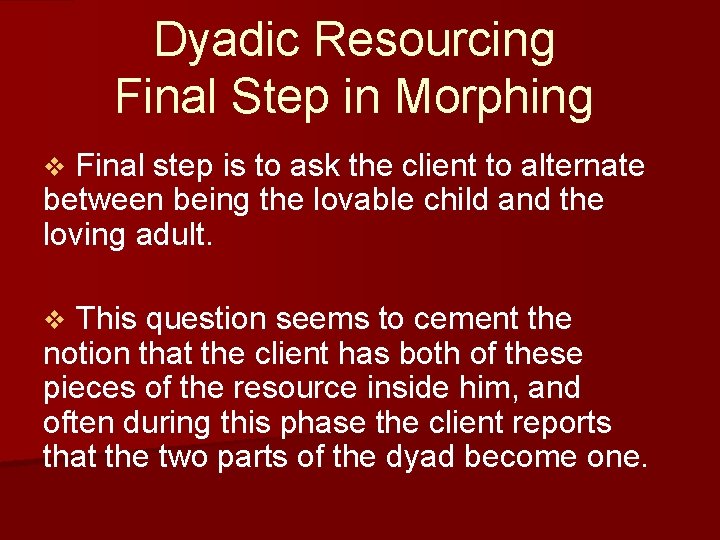
Dyadic Resourcing Final Step in Morphing Final step is to ask the client to alternate between being the lovable child and the loving adult. v This question seems to cement the notion that the client has both of these pieces of the resource inside him, and often during this phase the client reports that the two parts of the dyad become one. v
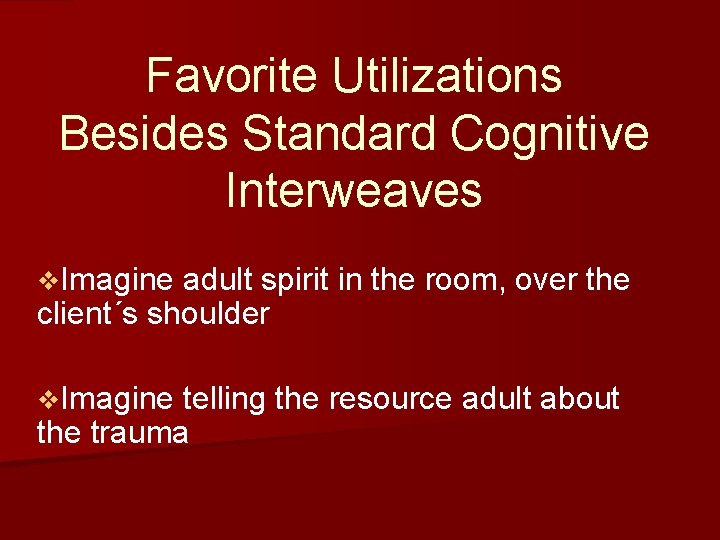
Favorite Utilizations Besides Standard Cognitive Interweaves v. Imagine adult spirit in the room, over the client´s shoulder v. Imagine telling the resource adult about the trauma
Chapters Available to Download Free Chapters 4, 5 and 6 of EMDR Clinical Skills: Case Conceptualization and Dyadic Resourcing are available to download free from: www. philipmanfield. com v v. Click on “Books by Dr. M. ” and then click on the download link.