ELEMEN MESIN TERMINOLOGI PERMESINAN Dr Eng Zefry Darmawan



- Slides: 38
ELEMEN MESIN TERMINOLOGI PERMESINAN Dr. Eng. Zefry Darmawan, ST. , MT Teknik Industri Universitas Brawijaya
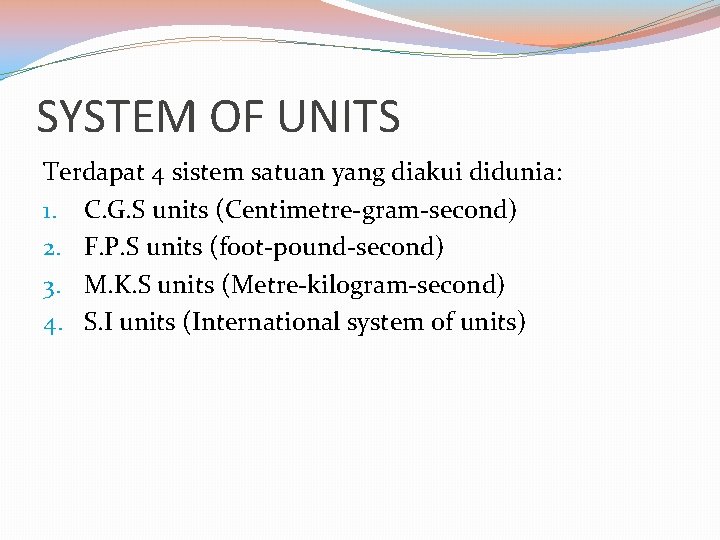
SYSTEM OF UNITS Terdapat 4 sistem satuan yang diakui didunia: 1. C. G. S units (Centimetre-gram-second) 2. F. P. S units (foot-pound-second) 3. M. K. S units (Metre-kilogram-second) 4. S. I units (International system of units)
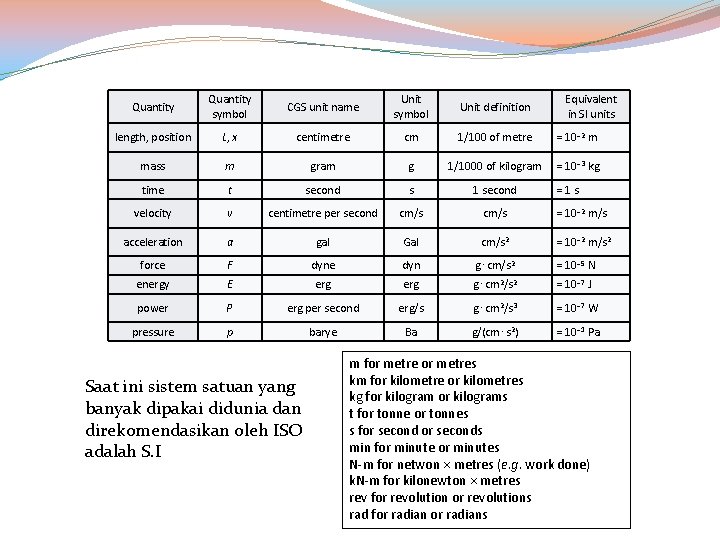
Quantity symbol CGS unit name Unit symbol Unit definition length, position L, x centimetre cm 1/100 of metre = 10− 2 m mass m gram g 1/1000 of kilogram = 10− 3 kg time t second s 1 second velocity v centimetre per second cm/s = 10− 2 m/s acceleration a gal Gal cm/s 2 = 10− 2 m/s 2 force F dyne dyn g⋅cm/s 2 = 10− 5 N energy E erg g⋅cm 2/s 2 = 10− 7 J power P erg per second erg/s g⋅cm 2/s 3 = 10− 7 W pressure p barye Ba g/(cm⋅s 2) = 10− 1 Pa Saat ini sistem satuan yang banyak dipakai didunia dan direkomendasikan oleh ISO adalah S. I Equivalent in SI units = 1 s m for metres km for kilometres kg for kilograms t for tonnes s for seconds min for minutes N-m for netwon × metres (e. g. work done) k. N-m for kilonewton × metres rev for revolutions rad for radians
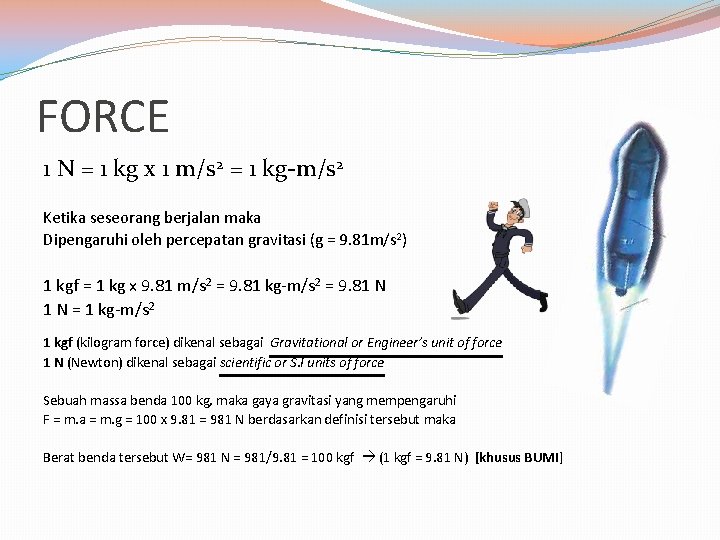
FORCE 1 N = 1 kg x 1 m/s 2 = 1 kg-m/s 2 Ketika seseorang berjalan maka Dipengaruhi oleh percepatan gravitasi (g = 9. 81 m/s 2) 1 kgf = 1 kg x 9. 81 m/s 2 = 9. 81 kg-m/s 2 = 9. 81 N = 1 kg-m/s 2 1 kgf (kilogram force) dikenal sebagai Gravitational or Engineer’s unit of force 1 N (Newton) dikenal sebagai scientific or S. I units of force Sebuah massa benda 100 kg, maka gaya gravitasi yang mempengaruhi F = m. a = m. g = 100 x 9. 81 = 981 N berdasarkan definisi tersebut maka Berat benda tersebut W= 981 N = 981/9. 81 = 100 kgf (1 kgf = 9. 81 N) [khusus BUMI]
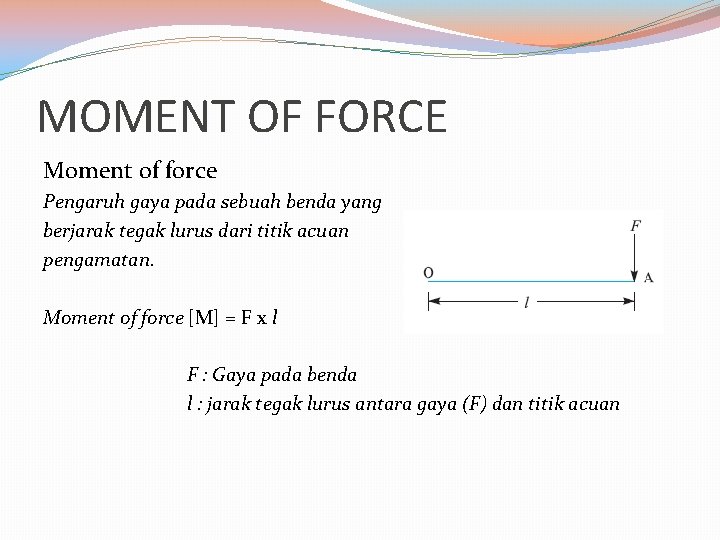
MOMENT OF FORCE Moment of force Pengaruh gaya pada sebuah benda yang berjarak tegak lurus dari titik acuan pengamatan. Moment of force [M] = F x l F : Gaya pada benda l : jarak tegak lurus antara gaya (F) dan titik acuan
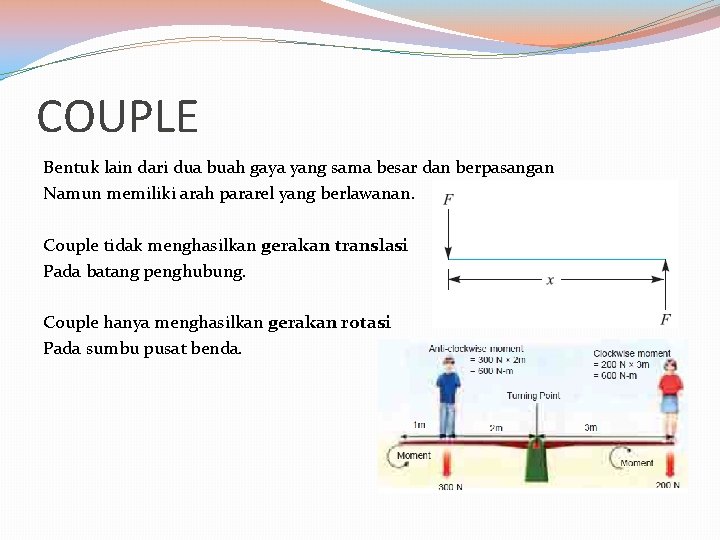
COUPLE Bentuk lain dari dua buah gaya yang sama besar dan berpasangan Namun memiliki arah pararel yang berlawanan. Couple tidak menghasilkan gerakan translasi Pada batang penghubung. Couple hanya menghasilkan gerakan rotasi Pada sumbu pusat benda.
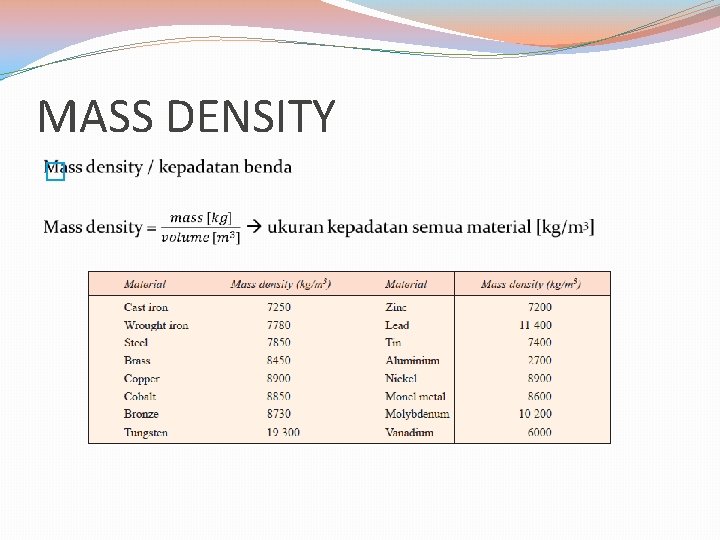
MASS DENSITY �
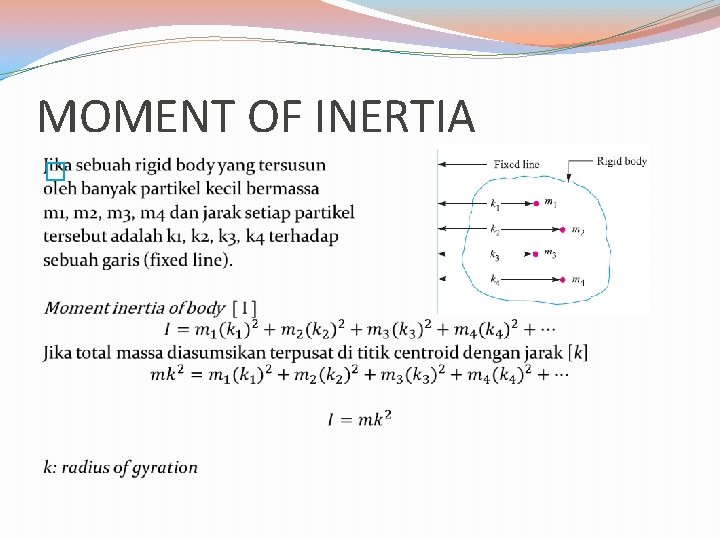
MOMENT OF INERTIA �
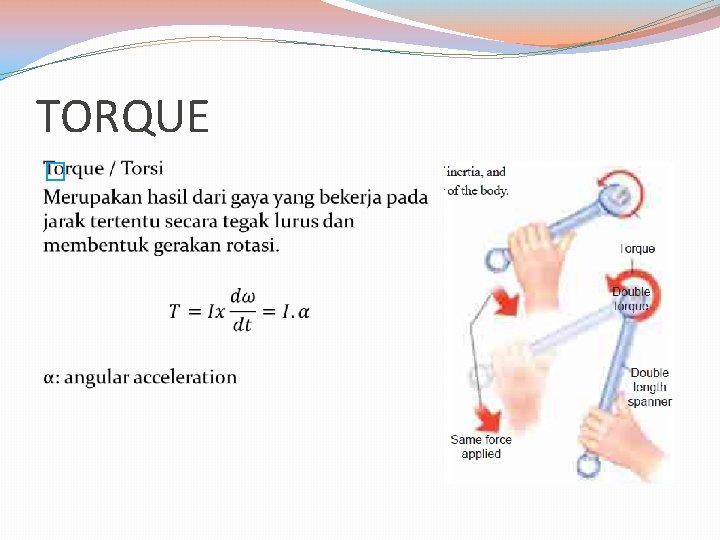
TORQUE �
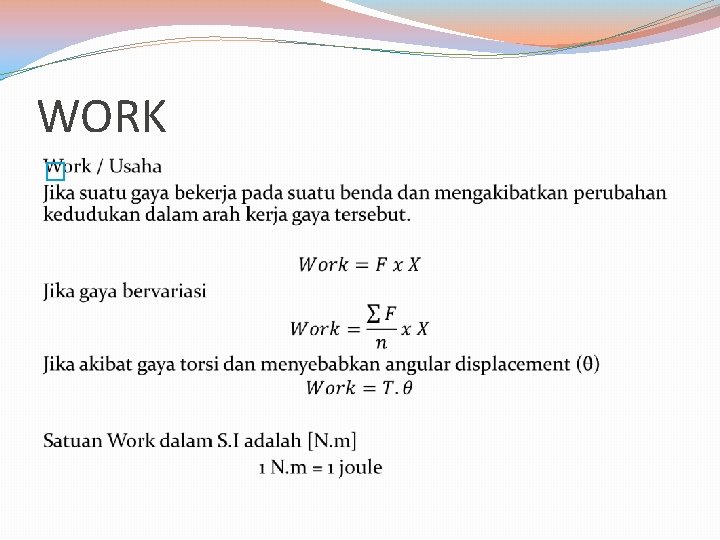
WORK �
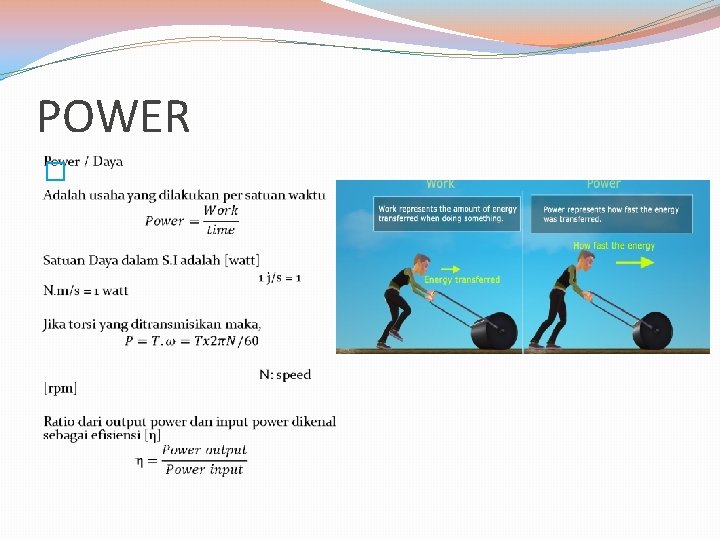
POWER �
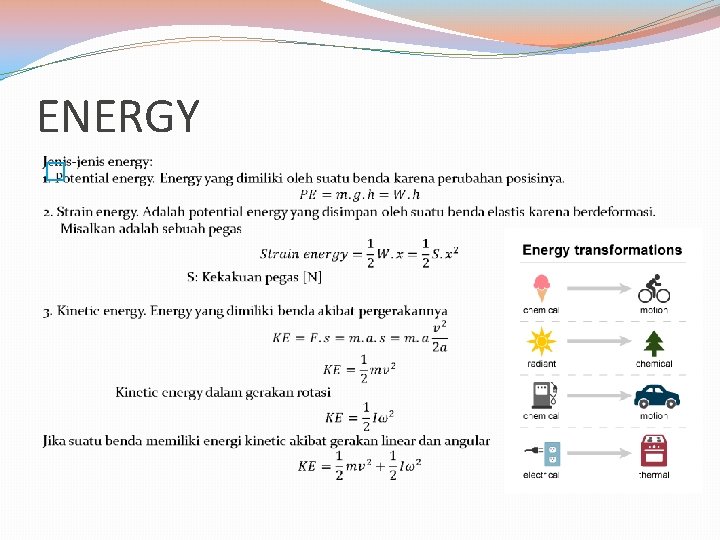
ENERGY �
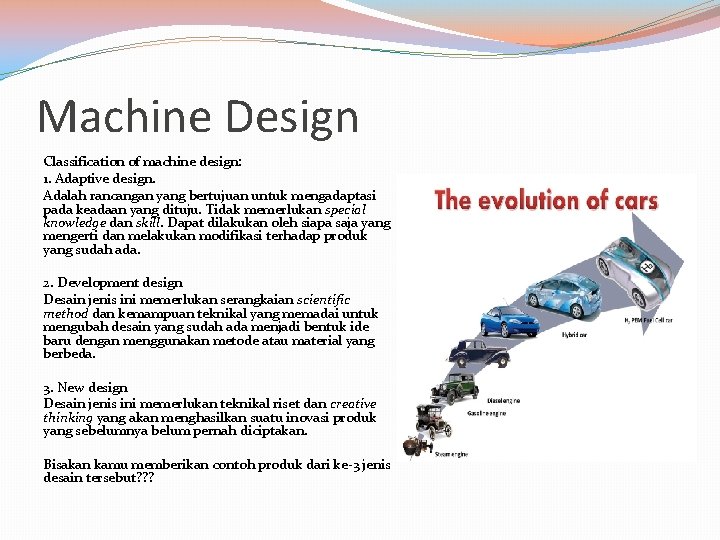
Machine Design Classification of machine design: 1. Adaptive design. Adalah rancangan yang bertujuan untuk mengadaptasi pada keadaan yang dituju. Tidak memerlukan special knowledge dan skill. Dapat dilakukan oleh siapa saja yang mengerti dan melakukan modifikasi terhadap produk yang sudah ada. 2. Development design Desain jenis ini memerlukan serangkaian scientific method dan kemampuan teknikal yang memadai untuk mengubah desain yang sudah ada menjadi bentuk ide baru dengan menggunakan metode atau material yang berbeda. 3. New design Desain jenis ini memerlukan teknikal riset dan creative thinking yang akan menghasilkan suatu inovasi produk yang sebelumnya belum pernah diciptakan. Bisakan kamu memberikan contoh produk dari ke-3 jenis desain tersebut? ? ?
METODA-METODA DALAM DESAIN 1. Rational design. Use mathematical formulae of principle of mechanics. 2. Empirical design. Use empirical formulae based on the practice and past experience. 3. Industrial design. Depends upon the production aspects to manufacture any machine component in the industry. 4. Optimum design. Used for the given objective function under the specified constraints. Achieved by minimising the undesirable effects.
METODA-METODA DALAM DESAIN 5. System design. For any complex mechanical system like a motor car. 6. Element design. For any element of the mechanical system like piston, crankshaft, connecting rod, etc. 7. Computer aided design. Use of computer systems to assist in the creation, modification, analysis and optimization of a design.
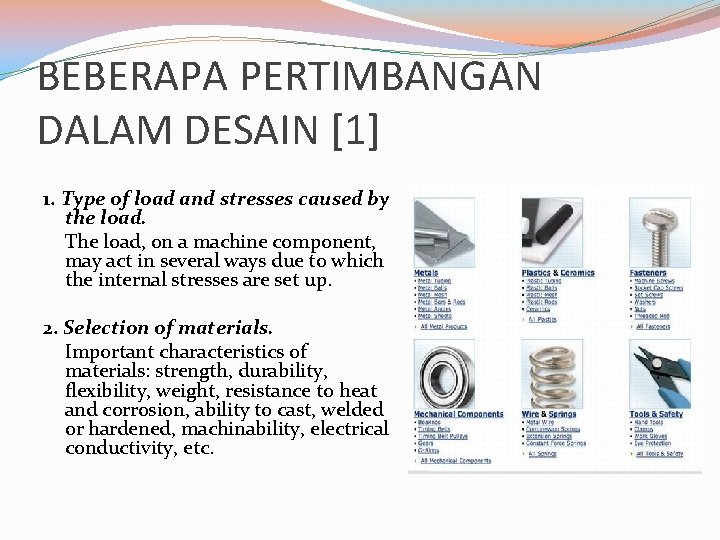
BEBERAPA PERTIMBANGAN DALAM DESAIN [1] 1. Type of load and stresses caused by the load. The load, on a machine component, may act in several ways due to which the internal stresses are set up. 2. Selection of materials. Important characteristics of materials: strength, durability, flexibility, weight, resistance to heat and corrosion, ability to cast, welded or hardened, machinability, electrical conductivity, etc.
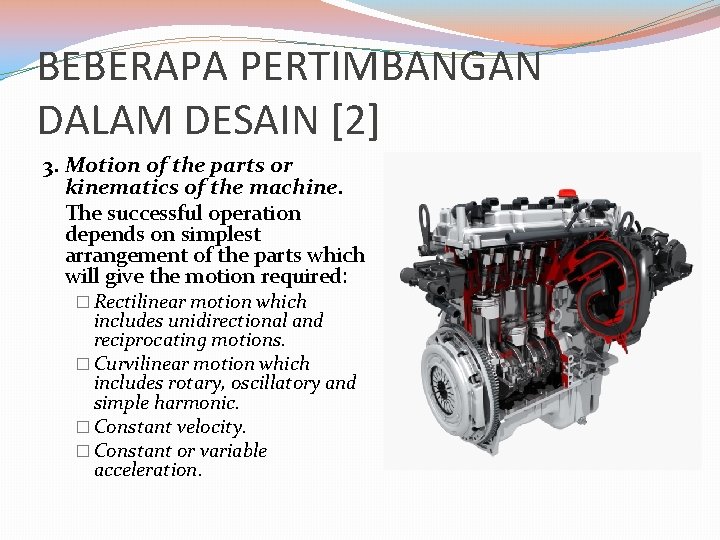
BEBERAPA PERTIMBANGAN DALAM DESAIN [2] 3. Motion of the parts or kinematics of the machine. The successful operation depends on simplest arrangement of the parts which will give the motion required: � Rectilinear motion which includes unidirectional and reciprocating motions. � Curvilinear motion which includes rotary, oscillatory and simple harmonic. � Constant velocity. � Constant or variable acceleration.
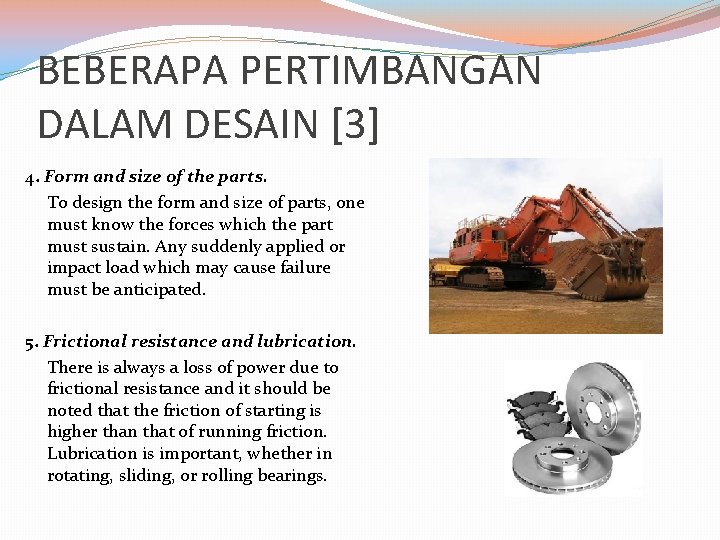
BEBERAPA PERTIMBANGAN DALAM DESAIN [3] 4. Form and size of the parts. To design the form and size of parts, one must know the forces which the part must sustain. Any suddenly applied or impact load which may cause failure must be anticipated. 5. Frictional resistance and lubrication. There is always a loss of power due to frictional resistance and it should be noted that the friction of starting is higher than that of running friction. Lubrication is important, whether in rotating, sliding, or rolling bearings.
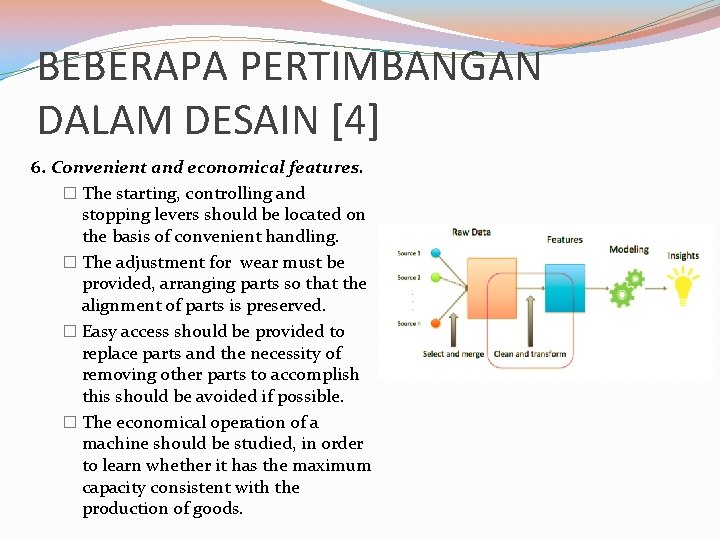
BEBERAPA PERTIMBANGAN DALAM DESAIN [4] 6. Convenient and economical features. � The starting, controlling and stopping levers should be located on the basis of convenient handling. � The adjustment for wear must be provided, arranging parts so that the alignment of parts is preserved. � Easy access should be provided to replace parts and the necessity of removing other parts to accomplish this should be avoided if possible. � The economical operation of a machine should be studied, in order to learn whether it has the maximum capacity consistent with the production of goods.
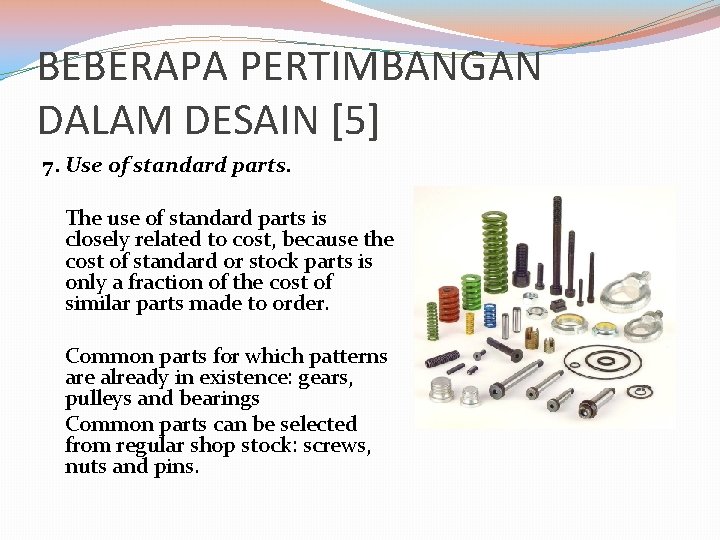
BEBERAPA PERTIMBANGAN DALAM DESAIN [5] 7. Use of standard parts. The use of standard parts is closely related to cost, because the cost of standard or stock parts is only a fraction of the cost of similar parts made to order. Common parts for which patterns are already in existence: gears, pulleys and bearings Common parts can be selected from regular shop stock: screws, nuts and pins.
BEBERAPA PERTIMBANGAN DALAM DESAIN [6] 8. Safety of operation. Any moving part of a machine which is within the zone of a worker is considered an accident hazard and may be the cause of an injury. Designer should always provide safety devices for the safety of the operator. The safety appliances should in no way interfere with operation of the machine.
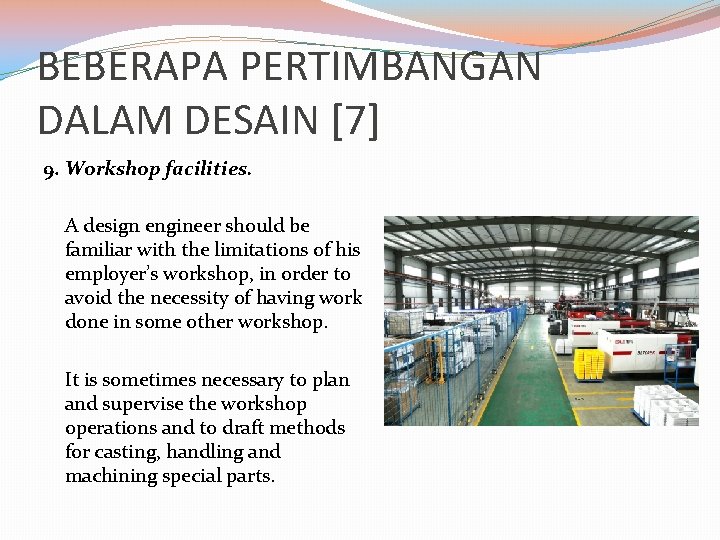
BEBERAPA PERTIMBANGAN DALAM DESAIN [7] 9. Workshop facilities. A design engineer should be familiar with the limitations of his employer’s workshop, in order to avoid the necessity of having work done in some other workshop. It is sometimes necessary to plan and supervise the workshop operations and to draft methods for casting, handling and machining special parts.
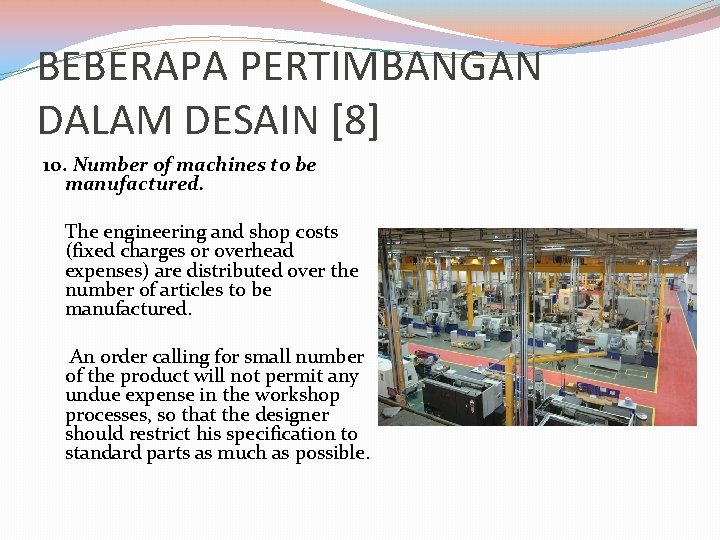
BEBERAPA PERTIMBANGAN DALAM DESAIN [8] 10. Number of machines to be manufactured. The engineering and shop costs (fixed charges or overhead expenses) are distributed over the number of articles to be manufactured. An order calling for small number of the product will not permit any undue expense in the workshop processes, so that the designer should restrict his specification to standard parts as much as possible.
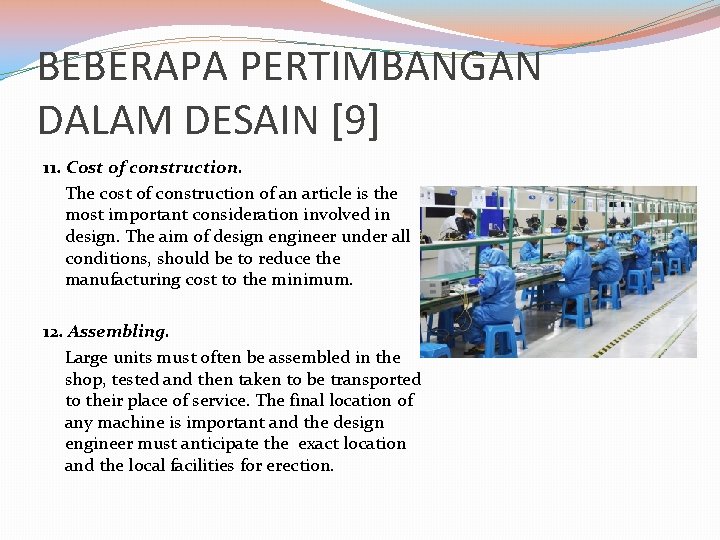
BEBERAPA PERTIMBANGAN DALAM DESAIN [9] 11. Cost of construction. The cost of construction of an article is the most important consideration involved in design. The aim of design engineer under all conditions, should be to reduce the manufacturing cost to the minimum. 12. Assembling. Large units must often be assembled in the shop, tested and then taken to be transported to their place of service. The final location of any machine is important and the design engineer must anticipate the exact location and the local facilities for erection.
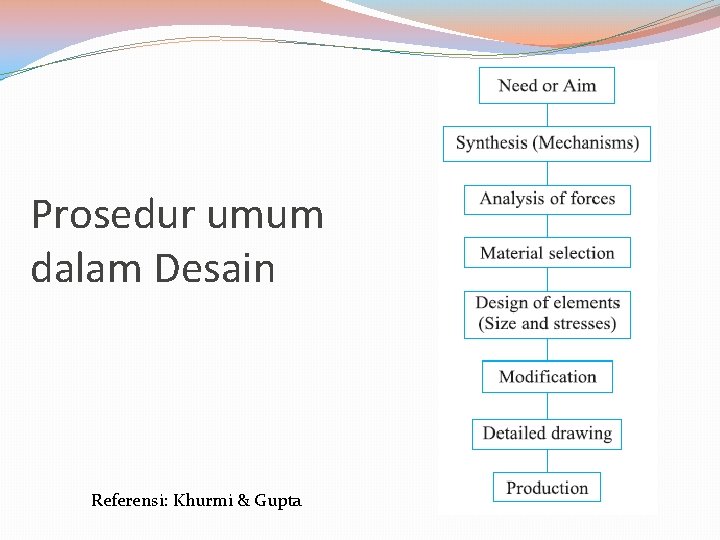
Prosedur umum dalam Desain Referensi: Khurmi & Gupta
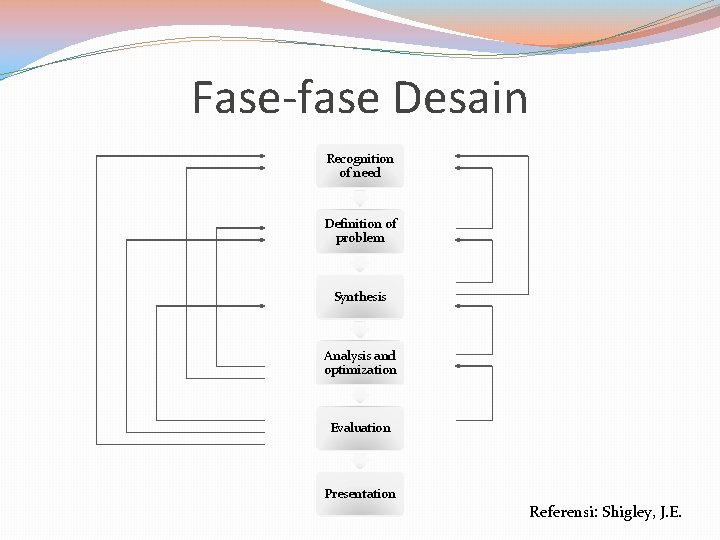
Fase-fase Desain Recognition of need Definition of problem Synthesis Analysis and optimization Evaluation Presentation Referensi: Shigley, J. E.
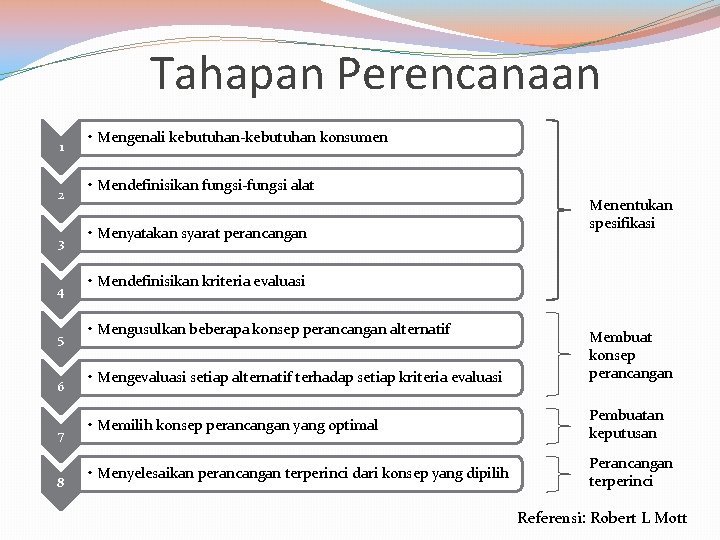
Tahapan Perencanaan 1 2 3 4 5 6 7 8 • Mengenali kebutuhan-kebutuhan konsumen • Mendefinisikan fungsi-fungsi alat • Menyatakan syarat perancangan Menentukan spesifikasi • Mendefinisikan kriteria evaluasi • Mengusulkan beberapa konsep perancangan alternatif • Mengevaluasi setiap alternatif terhadap setiap kriteria evaluasi Membuat konsep perancangan • Memilih konsep perancangan yang optimal Pembuatan keputusan • Menyelesaikan perancangan terperinci dari konsep yang dipilih Perancangan terperinci Referensi: Robert L Mott
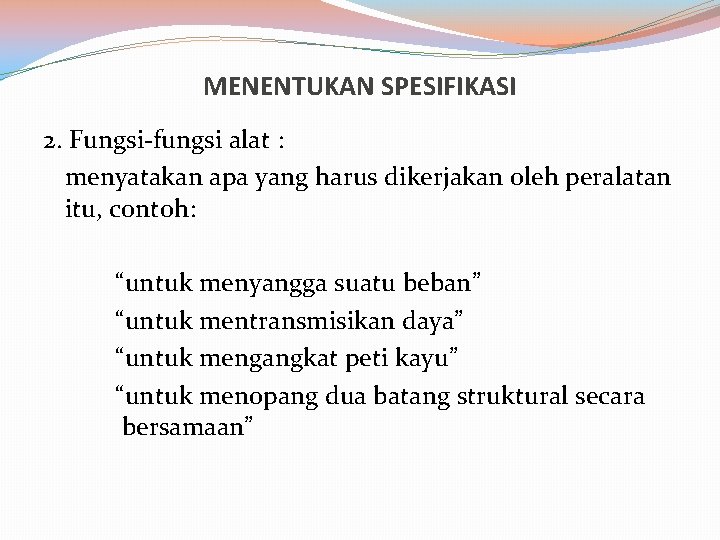
MENENTUKAN SPESIFIKASI 2. Fungsi-fungsi alat : menyatakan apa yang harus dikerjakan oleh peralatan itu, contoh: “untuk menyangga suatu beban” “untuk mentransmisikan daya” “untuk mengangkat peti kayu” “untuk menopang dua batang struktural secara bersamaan”
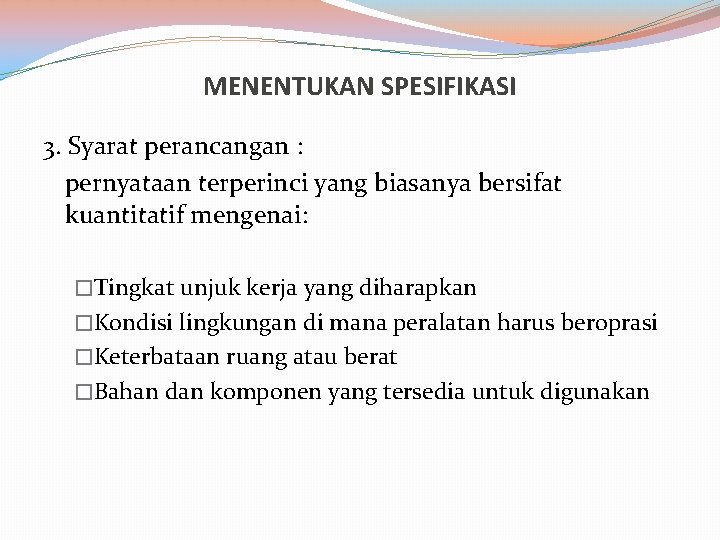
MENENTUKAN SPESIFIKASI 3. Syarat perancangan : pernyataan terperinci yang biasanya bersifat kuantitatif mengenai: �Tingkat unjuk kerja yang diharapkan �Kondisi lingkungan di mana peralatan harus beroprasi �Keterbataan ruang atau berat �Bahan dan komponen yang tersedia untuk digunakan
MENENTUKAN SPESIFIKASI 4. Kriteria evaluasi : pernyataan tentang karakteristik kualitatif yang diharapkan dari perancangan yang membantu perancang dalam memutuskan alternatif perancangan yang optimal (memperbesar manfaat dan mengurangi kerugian)
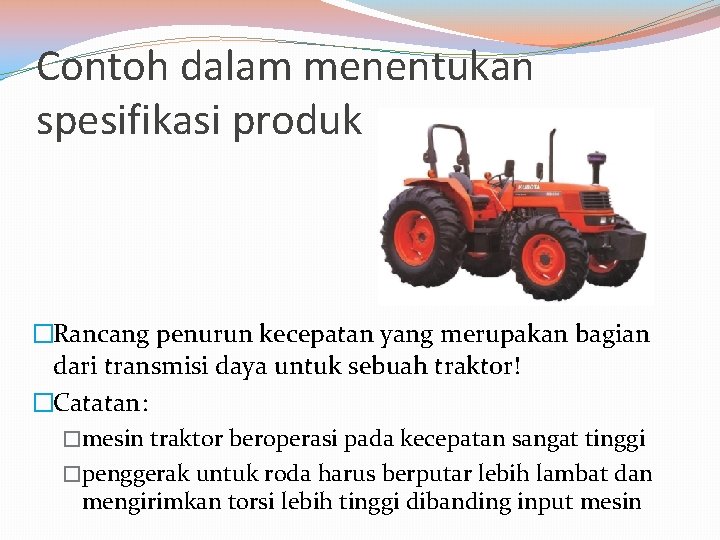
Contoh dalam menentukan spesifikasi produk �Rancang penurun kecepatan yang merupakan bagian dari transmisi daya untuk sebuah traktor! �Catatan: �mesin traktor beroperasi pada kecepatan sangat tinggi �penggerak untuk roda harus berputar lebih lambat dan mengirimkan torsi lebih tinggi dibanding input mesin
Fungsi �Untuk menerima daya dari mesin traktor melalui poros yang berputar �Untuk mengirimkan daya melalui elemen-elemen mesin dengan mengurangi kecepatan putaran pada nilai yang diinginkan �Untuk mengirimkan daya pada kecepatan yang lebih rendah ke poros output yang akhirnya menggerakkan roda-roda traktor
Syarat Perencanaan 1. 2. 3. 4. 5. 6. 7. 8. 9. Penurun kecepatan harus mentransmisikan daya sebesar 15 HP Input berasal dari mesin bensin dua silinder dengan kecepatan putaran 2000 rpm Output memberikan daya pada putaran berkisar 290 -295 rpm Efisiensi mekanis yang dibutuhkan lebih besar dari 95% Kapasitas torsi output minimum dari penurun kecepatan harus sebesar 3050 lb. in Poros input dan output harus sejajar Banyaknya produksi adalah 10000 unit per tahun Semua standar keamanan dari pemerintah harus terpenuhi dll
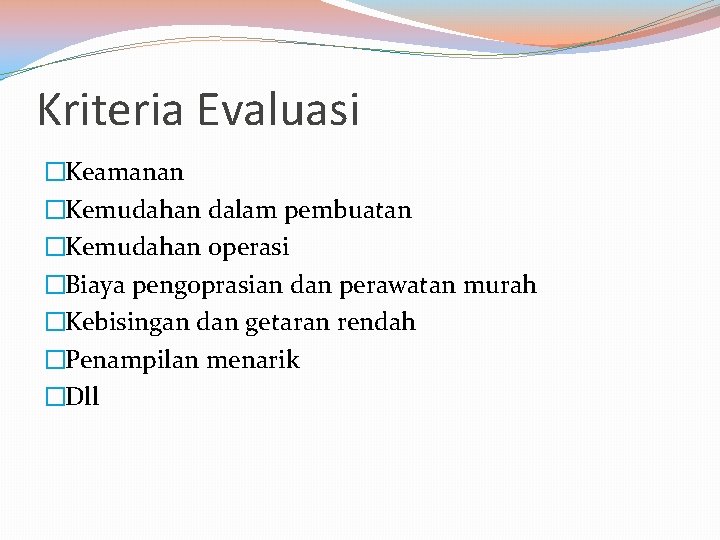
Kriteria Evaluasi �Keamanan �Kemudahan dalam pembuatan �Kemudahan operasi �Biaya pengoprasian dan perawatan murah �Kebisingan dan getaran rendah �Penampilan menarik �Dll
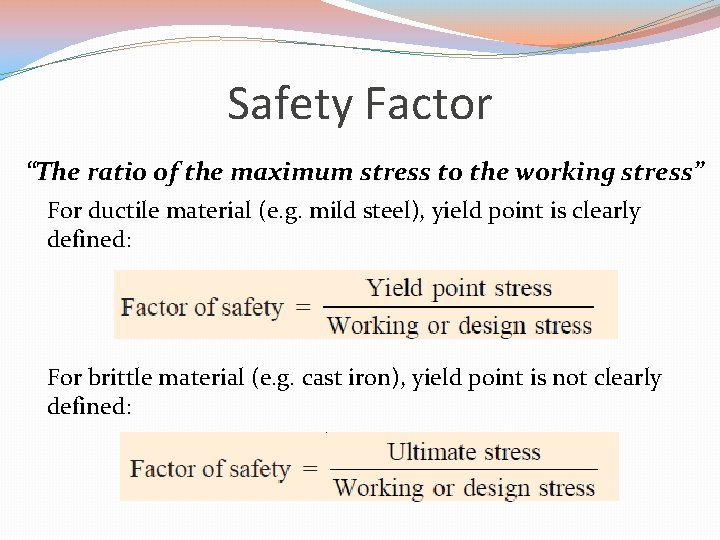
Safety Factor “The ratio of the maximum stress to the working stress” For ductile material (e. g. mild steel), yield point is clearly defined: For brittle material (e. g. cast iron), yield point is not clearly defined:
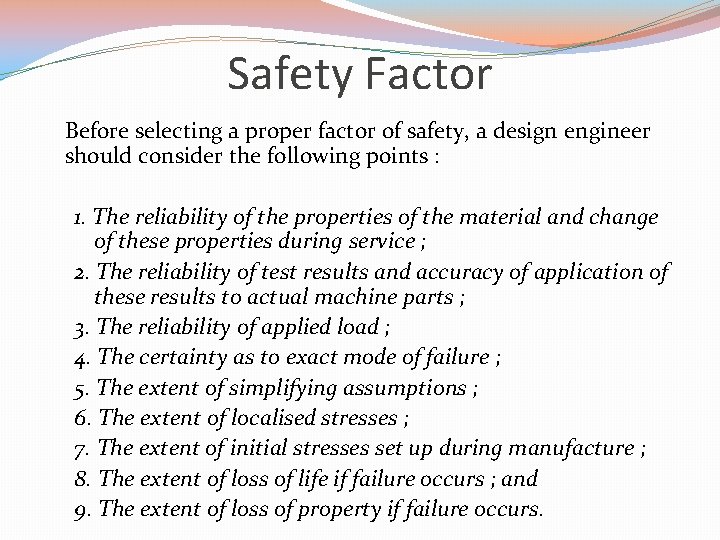
Safety Factor Before selecting a proper factor of safety, a design engineer should consider the following points : 1. The reliability of the properties of the material and change of these properties during service ; 2. The reliability of test results and accuracy of application of these results to actual machine parts ; 3. The reliability of applied load ; 4. The certainty as to exact mode of failure ; 5. The extent of simplifying assumptions ; 6. The extent of localised stresses ; 7. The extent of initial stresses set up during manufacture ; 8. The extent of loss of life if failure occurs ; and 9. The extent of loss of property if failure occurs.
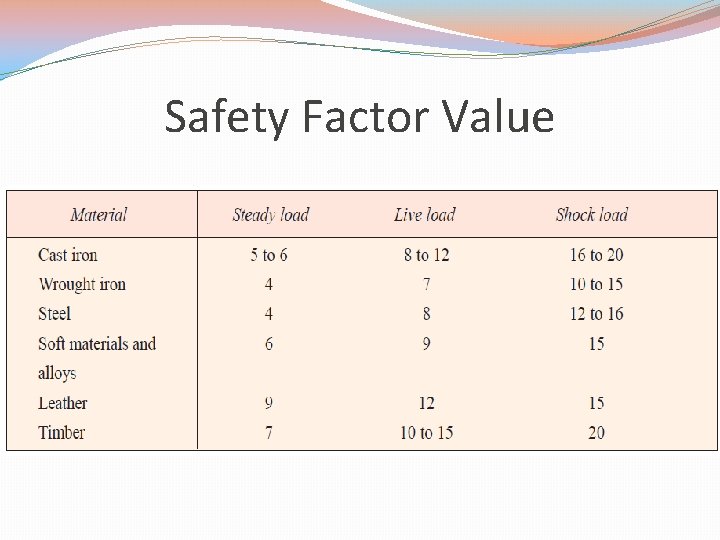
Safety Factor Value
END