Effective Action for Gravity and Dark Energy Sang
- Slides: 24
Effective Action for Gravity and Dark Energy Sang Pyo Kim Kunsan Nat’l Univ. COSMO/Cos. PA, Sept. 30, 2010 U. Tokyo
Outline • Motivation • Classical and Quantum Aspects of de Sitter Space • Polyakov’s Cosmic Laser • Effective Action for Gravity • Conclusion
Dark Energy Models [Copeland, Sami, Tsujikawa, hep-th/0603057] • Cosmological constant w/wo quantum gravity. • Modified gravity: how to reconcile the QG scale with ? – f(R) gravities – DGP model • Scalar field models: where do these fields come from? (origin) – Quintessence – K-essence – Tachyon field – Phantom (ghost) field – Dilatonic dark energy – Chaplygin gas
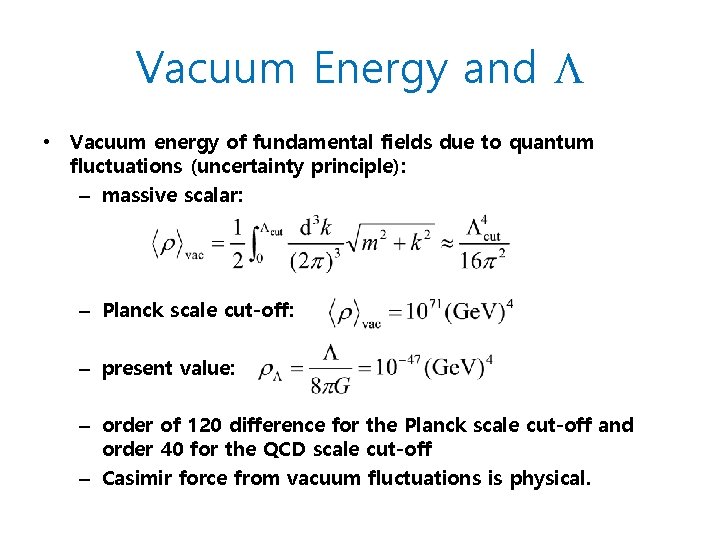
Vacuum Energy and • Vacuum energy of fundamental fields due to quantum fluctuations (uncertainty principle): – massive scalar: – Planck scale cut-off: – present value: – order of 120 difference for the Planck scale cut-off and order 40 for the QCD scale cut-off – Casimir force from vacuum fluctuations is physical.
Why de Sitter Space in Cosmology? • The Universe dominated by dark energy is an asymptotically de Sitter space. • CDM model is consistent with CMB data (WMAP+ACT+) • The Universe with is a pure de Sitter space with the Hubble constant H= ( /3). . • The “cosmic laser” mechanism depletes curvature and may help solving the cosmological constant problem [Polyakov, NPB 834(2010); NPB 797(2008)]. • de Sitter/anti de Sitter spaces are spacetimes where quantum effects, such as IR effects and vacuum structure, may be better understood.
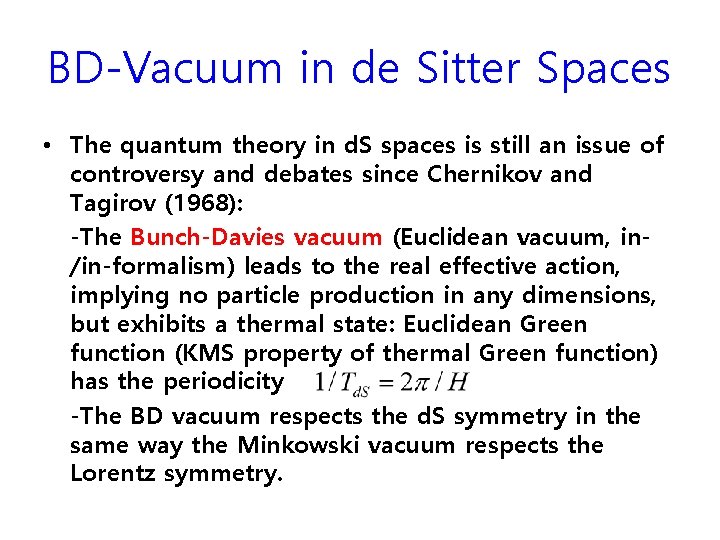
BD-Vacuum in de Sitter Spaces • The quantum theory in d. S spaces is still an issue of controversy and debates since Chernikov and Tagirov (1968): -The Bunch-Davies vacuum (Euclidean vacuum, in/in-formalism) leads to the real effective action, implying no particle production in any dimensions, but exhibits a thermal state: Euclidean Green function (KMS property of thermal Green function) has the periodicity -The BD vacuum respects the d. S symmetry in the same way the Minkowski vacuum respects the Lorentz symmetry.
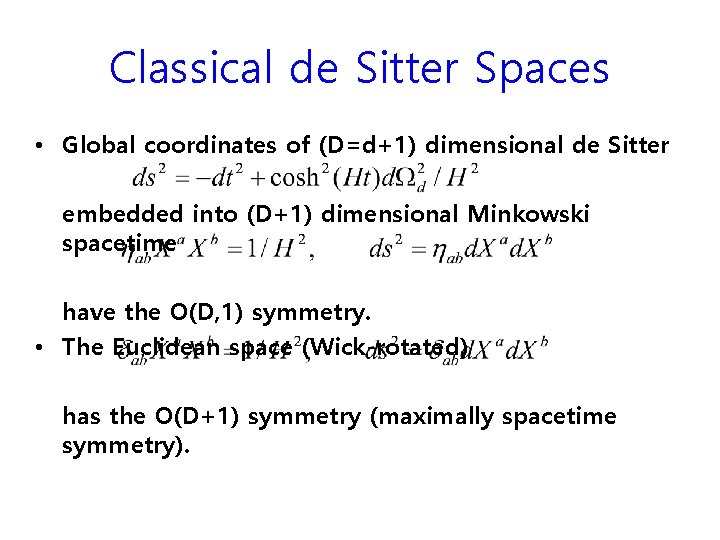
Classical de Sitter Spaces • Global coordinates of (D=d+1) dimensional de Sitter embedded into (D+1) dimensional Minkowski spacetime have the O(D, 1) symmetry. • The Euclidean space (Wick-rotated) has the O(D+1) symmetry (maximally spacetime symmetry).
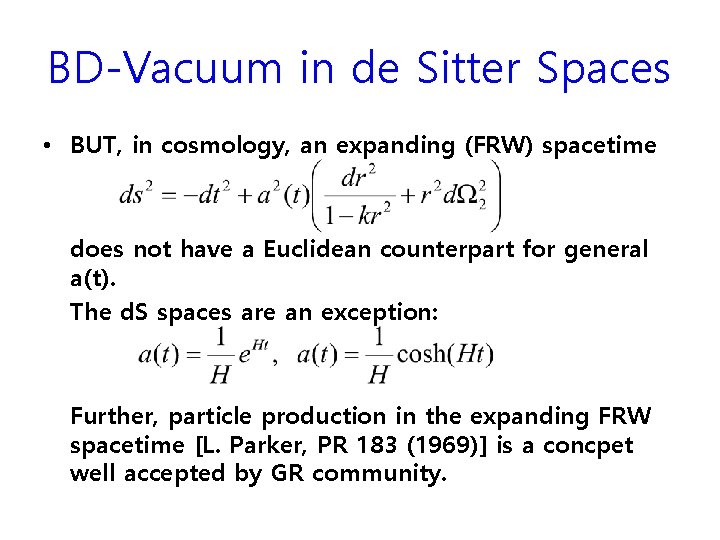
BD-Vacuum in de Sitter Spaces • BUT, in cosmology, an expanding (FRW) spacetime does not have a Euclidean counterpart for general a(t). The d. S spaces are an exception: Further, particle production in the expanding FRW spacetime [L. Parker, PR 183 (1969)] is a concpet well accepted by GR community.
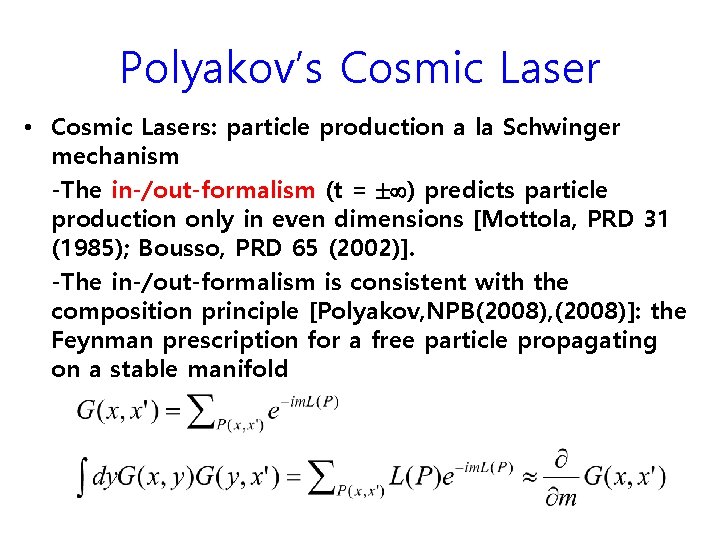
Polyakov’s Cosmic Laser • Cosmic Lasers: particle production a la Schwinger mechanism -The in-/out-formalism (t = ) predicts particle production only in even dimensions [Mottola, PRD 31 (1985); Bousso, PRD 65 (2002)]. -The in-/out-formalism is consistent with the composition principle [Polyakov, NPB(2008), (2008)]: the Feynman prescription for a free particle propagating on a stable manifold
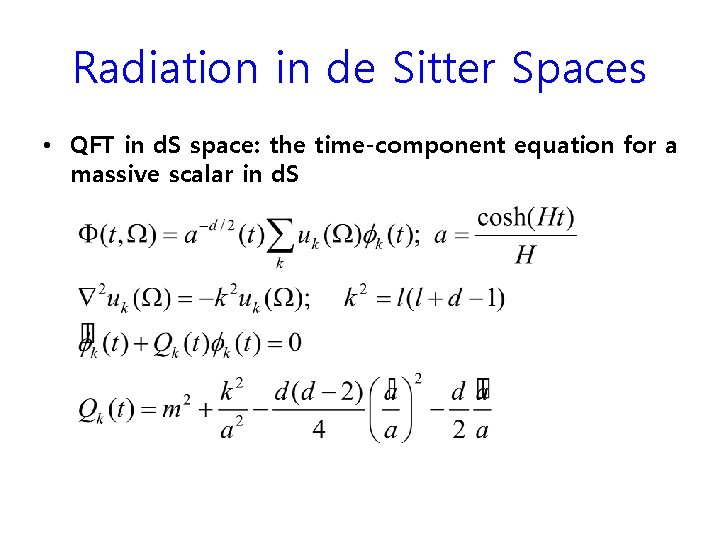
Radiation in de Sitter Spaces • QFT in d. S space: the time-component equation for a massive scalar in d. S
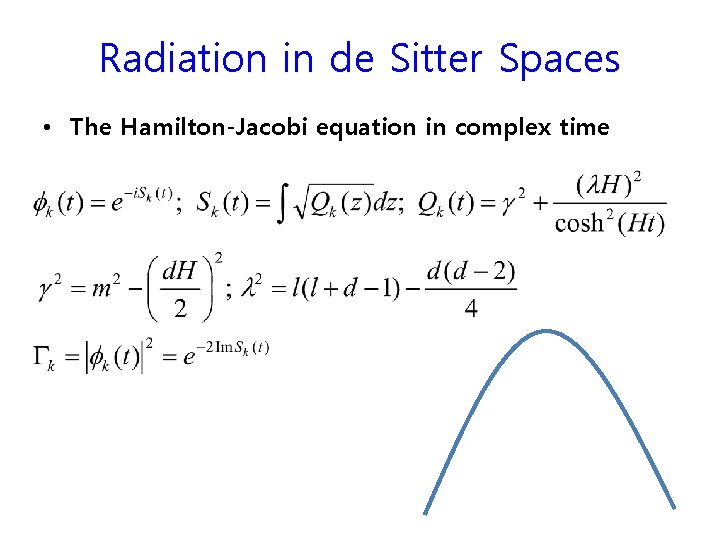
Radiation in de Sitter Spaces • The Hamilton-Jacobi equation in complex time
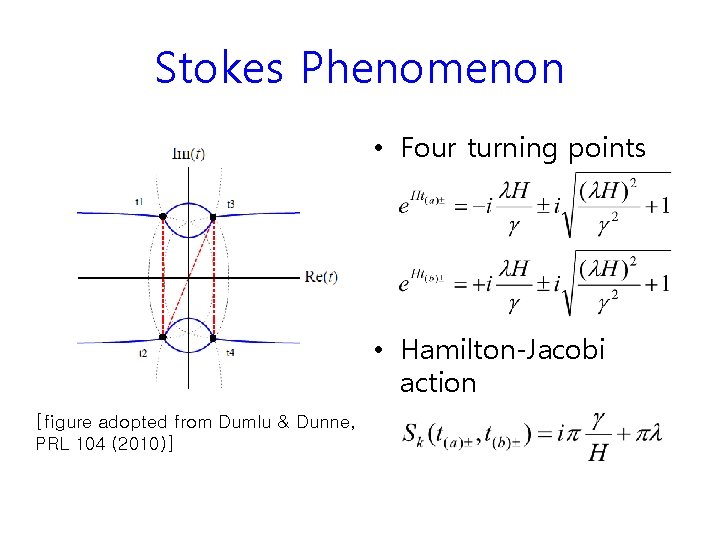
Stokes Phenomenon • Four turning points • Hamilton-Jacobi action [figure adopted from Dumlu & Dunne, PRL 104 (2010)]
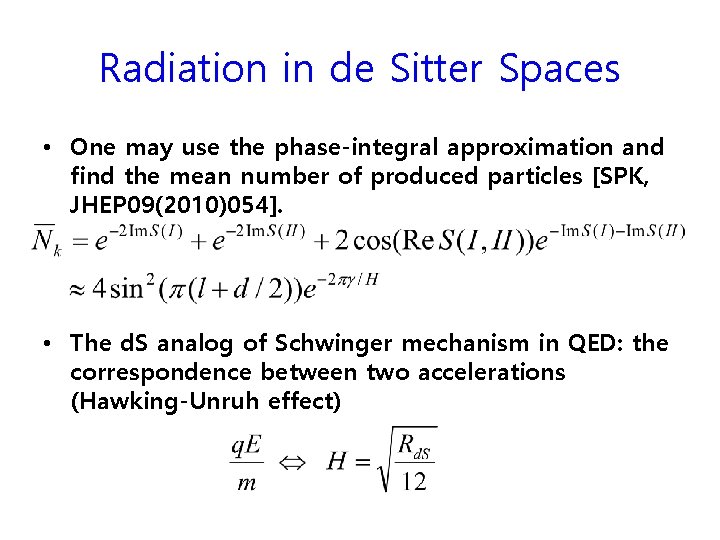
Radiation in de Sitter Spaces • One may use the phase-integral approximation and find the mean number of produced particles [SPK, JHEP 09(2010)054]. • The d. S analog of Schwinger mechanism in QED: the correspondence between two accelerations (Hawking-Unruh effect)
Radiation in de Sitter Spaces • The Stokes phenomenon explains why there is NO particle production in odd dimensional de Sitter spaces - destructive interference between two Stokes’s lines -Polyakov intepreted this as reflectionless scattering of Kd. V equation [NPB 797(2008)]. • In even dimensional de Sitter spaces, two Stokes lines contribute constructively, thus leading to de Sitter radiation.
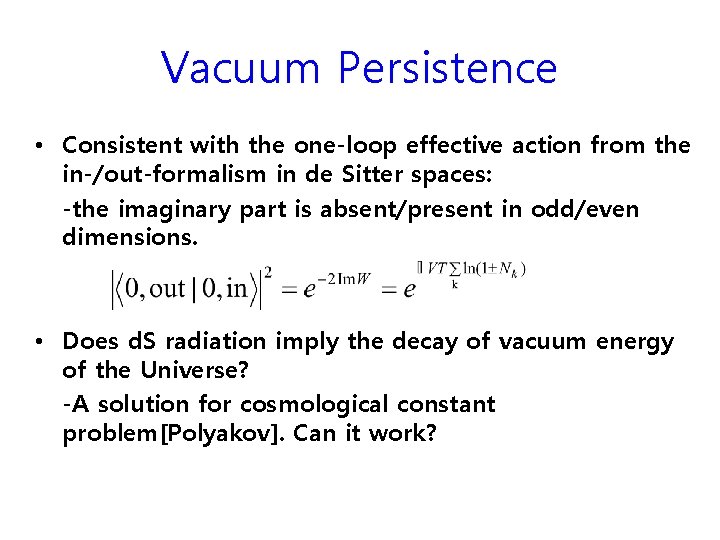
Vacuum Persistence • Consistent with the one-loop effective action from the in-/out-formalism in de Sitter spaces: -the imaginary part is absent/present in odd/even dimensions. • Does d. S radiation imply the decay of vacuum energy of the Universe? -A solution for cosmological constant problem[Polyakov]. Can it work?
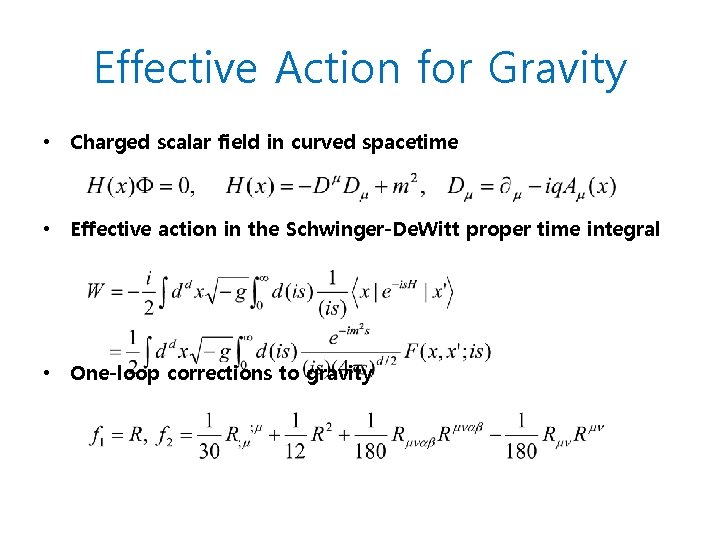
Effective Action for Gravity • Charged scalar field in curved spacetime • Effective action in the Schwinger-De. Witt proper time integral • One-loop corrections to gravity
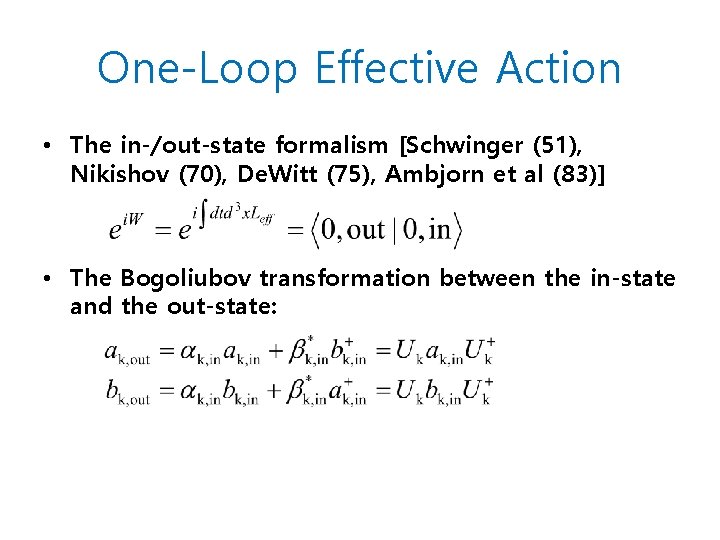
One-Loop Effective Action • The in-/out-state formalism [Schwinger (51), Nikishov (70), De. Witt (75), Ambjorn et al (83)] • The Bogoliubov transformation between the in-state and the out-state:
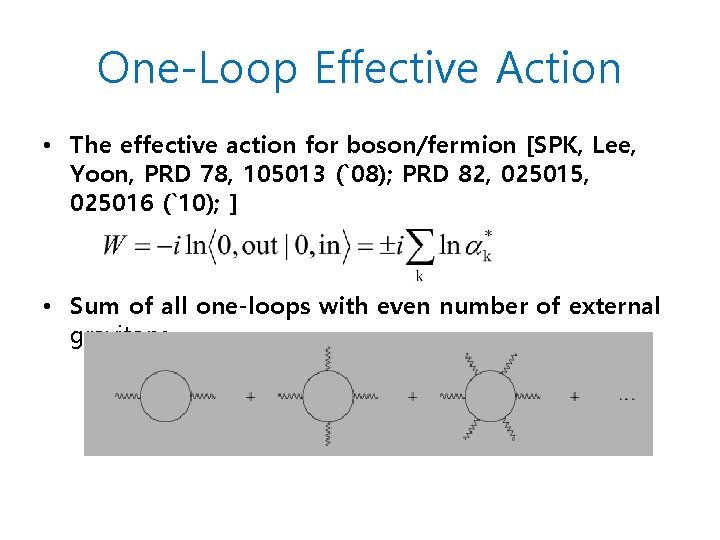
One-Loop Effective Action • The effective action for boson/fermion [SPK, Lee, Yoon, PRD 78, 105013 (`08); PRD 82, 025015, 025016 (`10); ] • Sum of all one-loops with even number of external gravitons
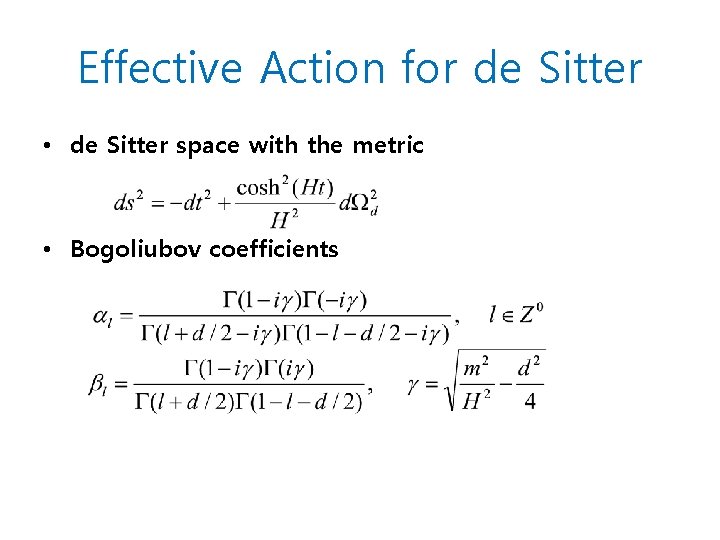
Effective Action for de Sitter • de Sitter space with the metric • Bogoliubov coefficients
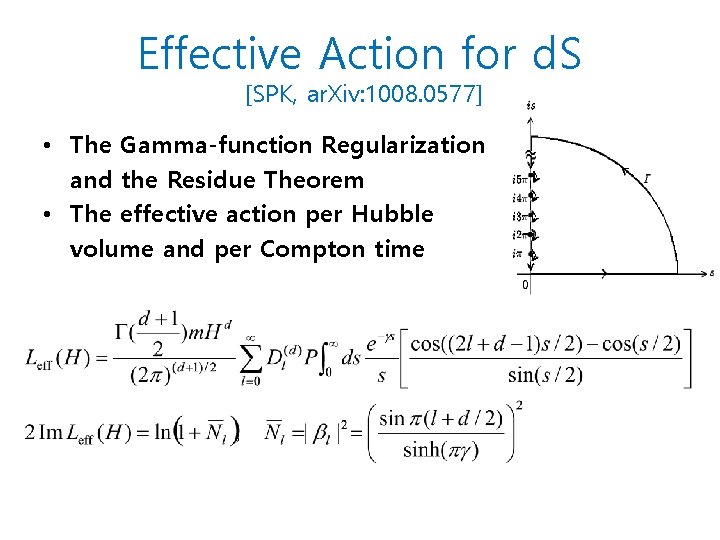
Effective Action for d. S [SPK, ar. Xiv: 1008. 0577] • The Gamma-function Regularization and the Residue Theorem • The effective action per Hubble volume and per Compton time
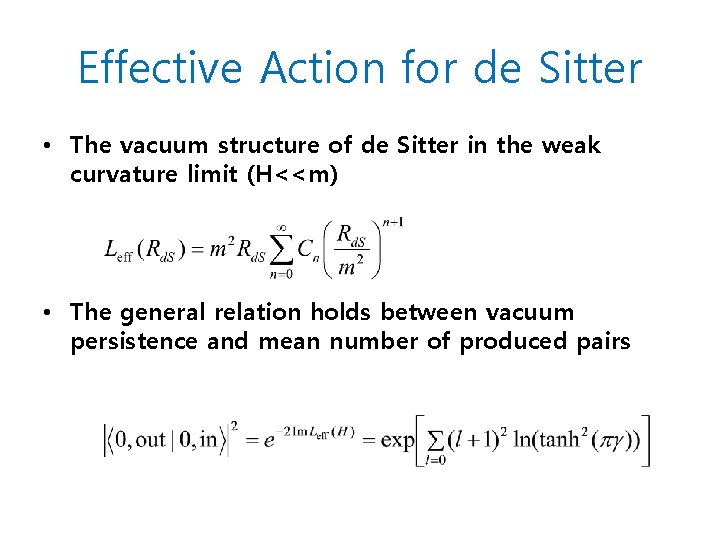
Effective Action for de Sitter • The vacuum structure of de Sitter in the weak curvature limit (H<<m) • The general relation holds between vacuum persistence and mean number of produced pairs
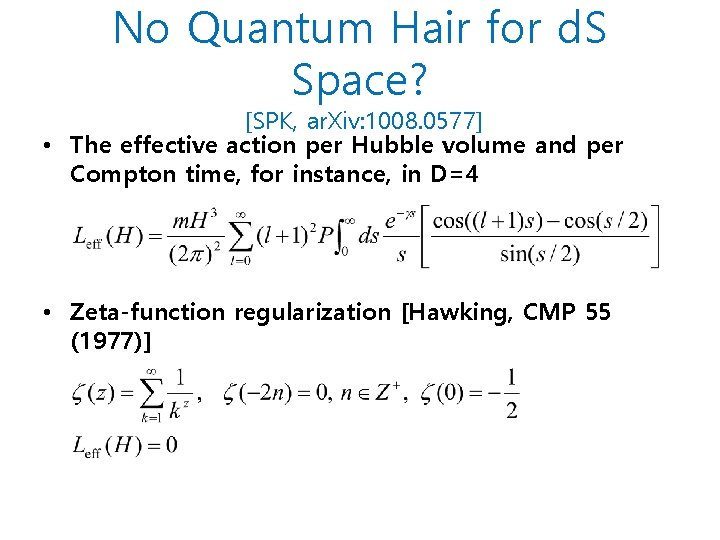
No Quantum Hair for d. S Space? [SPK, ar. Xiv: 1008. 0577] • The effective action per Hubble volume and per Compton time, for instance, in D=4 • Zeta-function regularization [Hawking, CMP 55 (1977)]
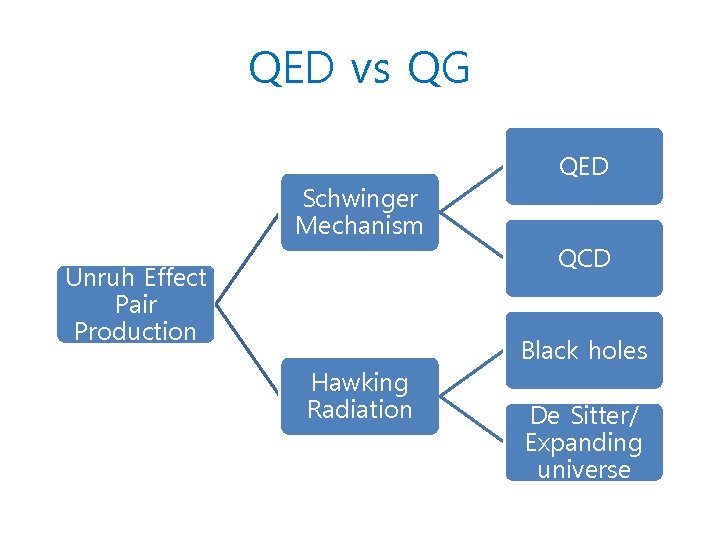
QED vs QG Schwinger Mechanism Unruh Effect Pair Production Hawking Radiation QED QCD Black holes De Sitter/ Expanding universe
Conclusion • The effective action for gravity may provide a clue for the origin of . • Does d. S radiation imply the decay of vacuum energy of the Universe? And is it a solver for cosmological constant problem? [Polyakov] • d. S may not have a quantum hair at one-loop level and be stable for linear perturbations. • What is the vacuum structure at higher loops and/or with interactions? (challenging question)