EECS 583 Class 11 Instruction Scheduling University of

- Slides: 32
EECS 583 – Class 11 Instruction Scheduling University of Michigan October 10, 2018
Announcements & Reading Material v Reminder: HW 2 due Friday » If you are stuck, catch up on piazza posts/answers » Then talk to Ze v Class project meetings » Meeting signup sheet available next Wednes in class » Think about partners/topic! v Today’s class » “The Importance of Prepass Code Scheduling for Superscalar and Superpipelined Processors, ” P. Chang et al. , IEEE Transactions on Computers, 1995, pp. 353 -370. v Next class (next Wednes, Monday is fall break) » “Iterative Modulo Scheduling: An Algorithm for Software Pipelining Loops”, B. Rau, MICRO-27, 1994, pp. 63 -74. - 1 -
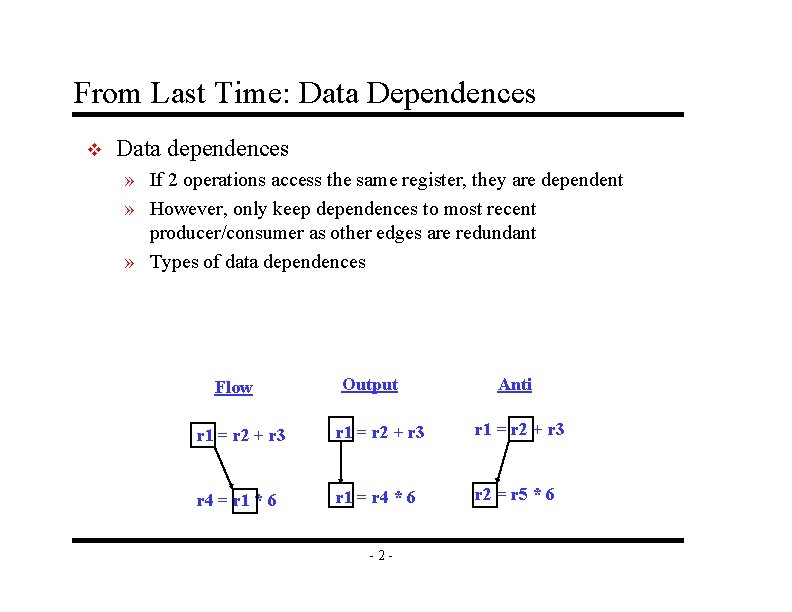
From Last Time: Data Dependences v Data dependences » If 2 operations access the same register, they are dependent » However, only keep dependences to most recent producer/consumer as other edges are redundant » Types of data dependences Flow Output Anti r 1 = r 2 + r 3 r 4 = r 1 * 6 r 1 = r 4 * 6 r 2 = r 5 * 6 - 2 -
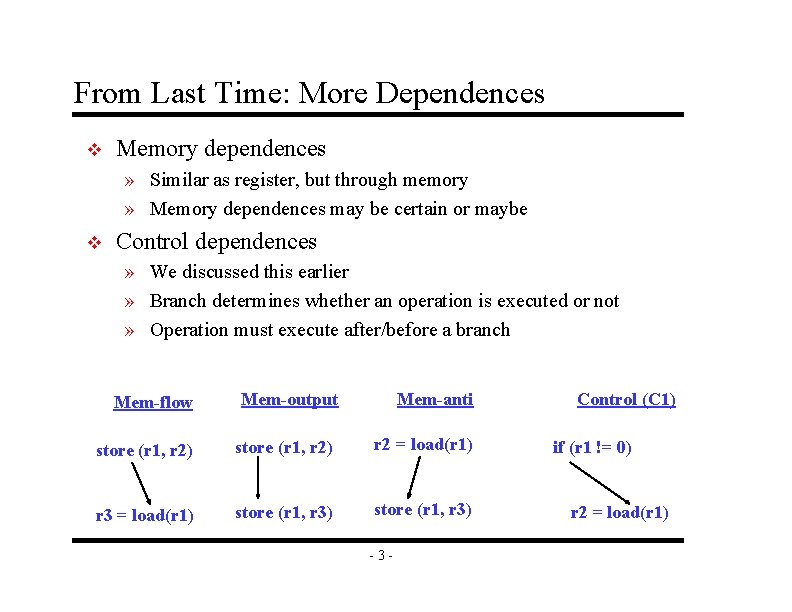
From Last Time: More Dependences v Memory dependences » Similar as register, but through memory » Memory dependences may be certain or maybe v Control dependences » We discussed this earlier » Branch determines whether an operation is executed or not » Operation must execute after/before a branch Mem-flow Mem-output Mem-anti store (r 1, r 2) r 2 = load(r 1) r 3 = load(r 1) store (r 1, r 3) - 3 - Control (C 1) if (r 1 != 0) r 2 = load(r 1)
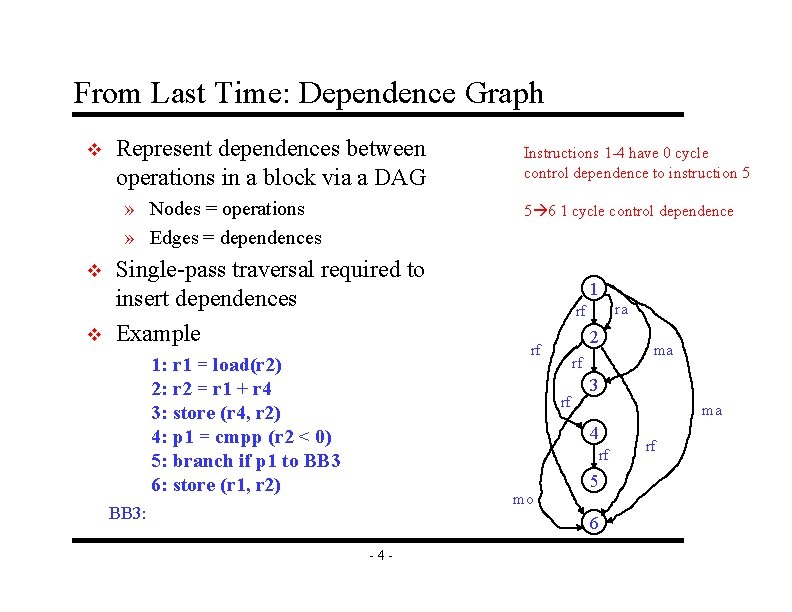
From Last Time: Dependence Graph v Represent dependences between operations in a block via a DAG » Nodes = operations » Edges = dependences v v Instructions 1 -4 have 0 cycle control dependence to instruction 5 5 6 1 cycle control dependence Single-pass traversal required to insert dependences Example 1: r 1 = load(r 2) 2: r 2 = r 1 + r 4 3: store (r 4, r 2) 4: p 1 = cmpp (r 2 < 0) 5: branch if p 1 to BB 3 6: store (r 1, r 2) 1 ra rf 2 rf ma rf rf 3 ma 4 rf mo BB 3: 5 6 - 4 - rf
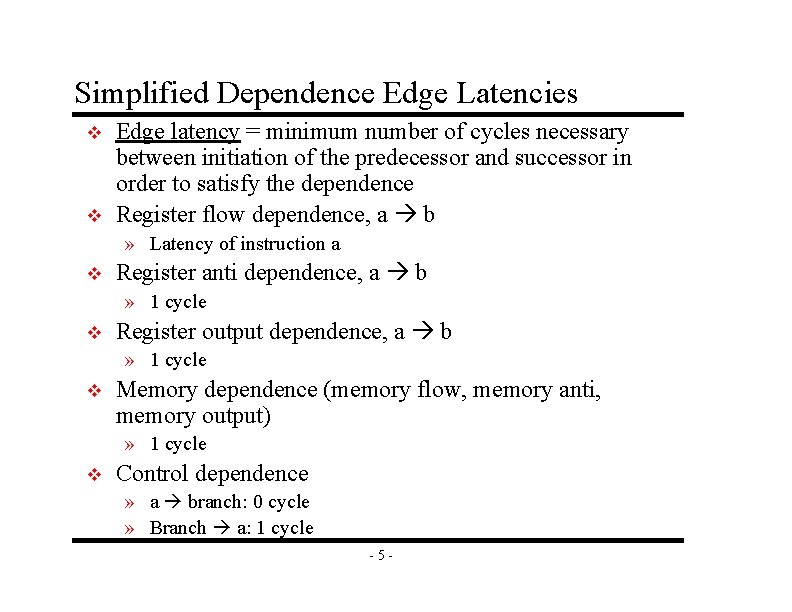
Simplified Dependence Edge Latencies v v Edge latency = minimum number of cycles necessary between initiation of the predecessor and successor in order to satisfy the dependence Register flow dependence, a b » Latency of instruction a v Register anti dependence, a b » 1 cycle v Register output dependence, a b » 1 cycle v Memory dependence (memory flow, memory anti, memory output) » 1 cycle v Control dependence » a branch: 0 cycle » Branch a: 1 cycle - 5 -
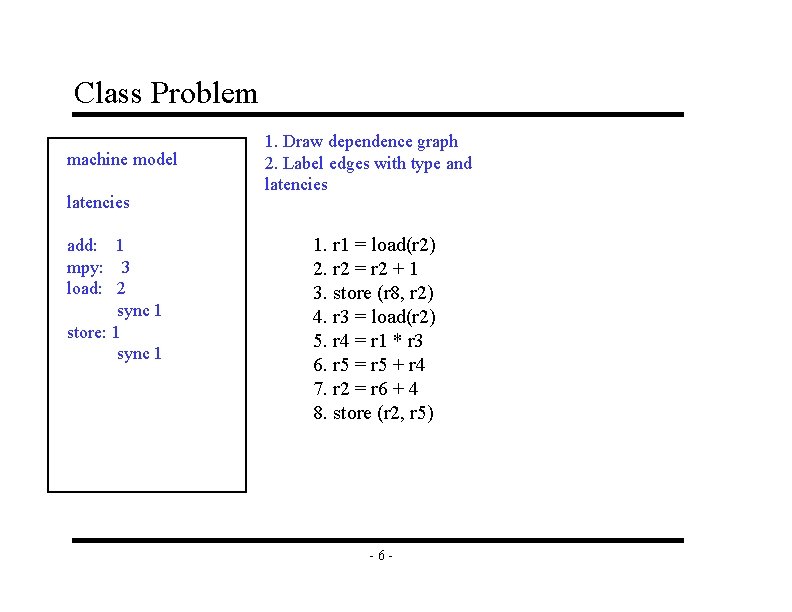
Class Problem machine model latencies add: 1 mpy: 3 load: 2 sync 1 store: 1 sync 1 1. Draw dependence graph 2. Label edges with type and latencies 1. r 1 = load(r 2) 2. r 2 = r 2 + 1 3. store (r 8, r 2) 4. r 3 = load(r 2) 5. r 4 = r 1 * r 3 6. r 5 = r 5 + r 4 7. r 2 = r 6 + 4 8. store (r 2, r 5) - 6 -
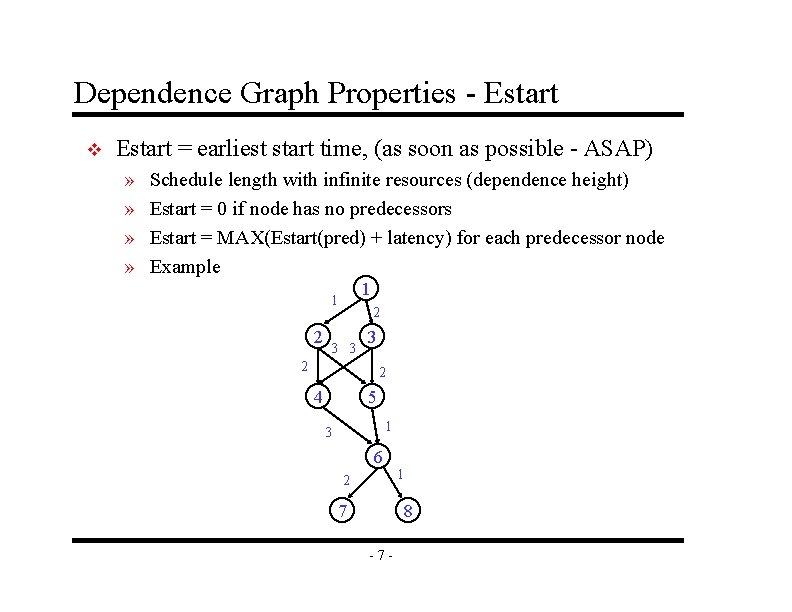
Dependence Graph Properties - Estart v Estart = earliest start time, (as soon as possible - ASAP) » » Schedule length with infinite resources (dependence height) Estart = 0 if node has no predecessors Estart = MAX(Estart(pred) + latency) for each predecessor node Example 1 1 2 2 3 3 3 2 2 4 5 1 3 6 2 7 1 8 - 7 -
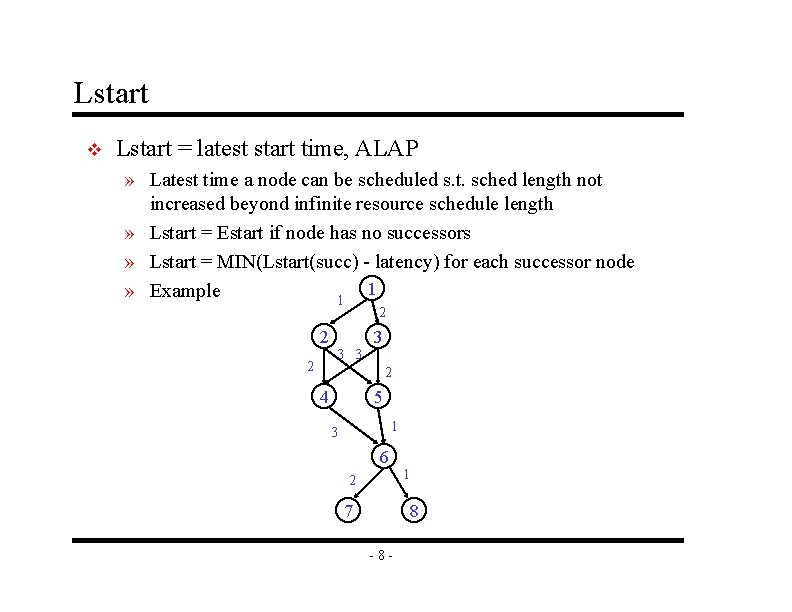
Lstart v Lstart = latest start time, ALAP » Latest time a node can be scheduled s. t. sched length not increased beyond infinite resource schedule length » Lstart = Estart if node has no successors » Lstart = MIN(Lstart(succ) - latency) for each successor node 1 » Example 1 2 2 2 3 3 3 2 4 5 1 3 6 2 7 1 8 -
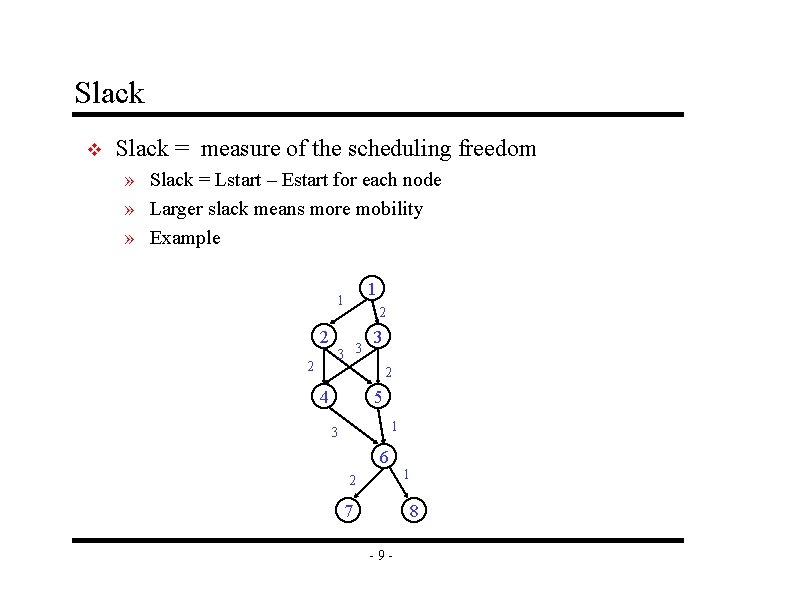
Slack v Slack = measure of the scheduling freedom » Slack = Lstart – Estart for each node » Larger slack means more mobility » Example 1 1 2 2 2 3 3 3 2 4 5 1 3 6 2 7 1 8 - 9 -
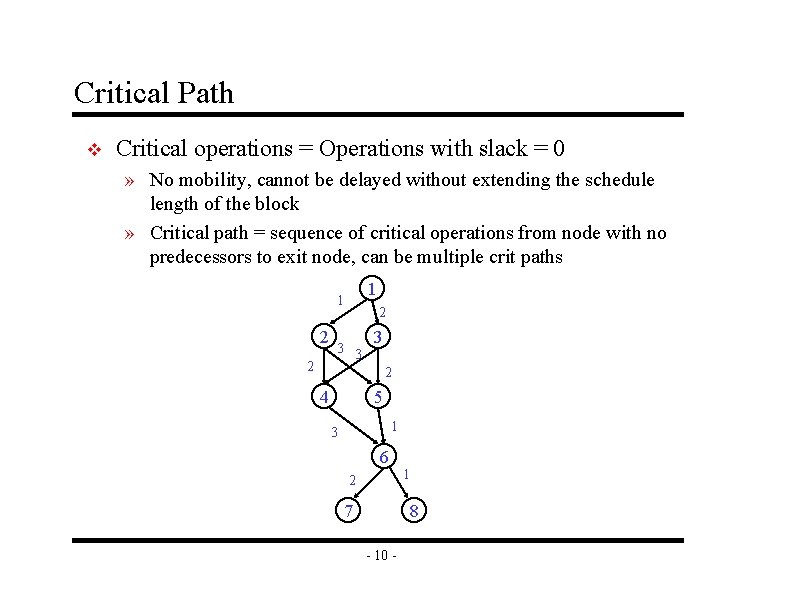
Critical Path v Critical operations = Operations with slack = 0 » No mobility, cannot be delayed without extending the schedule length of the block » Critical path = sequence of critical operations from node with no predecessors to exit node, can be multiple crit paths 1 1 2 2 2 3 3 3 2 4 5 1 3 6 2 7 1 8 - 10 -
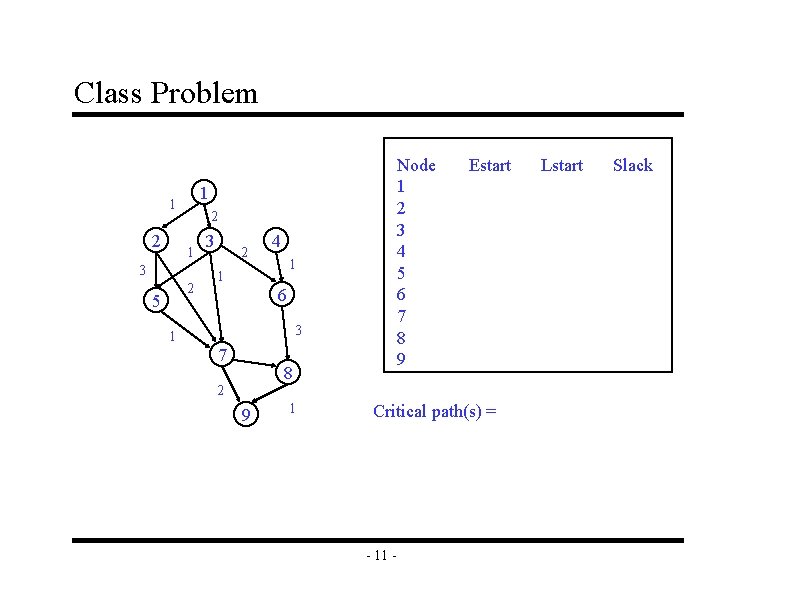
Class Problem 1 1 2 2 1 3 2 5 Node 1 2 3 4 5 6 7 8 9 3 2 4 1 1 6 3 1 7 8 2 9 1 Estart Critical path(s) = - 11 - Lstart Slack
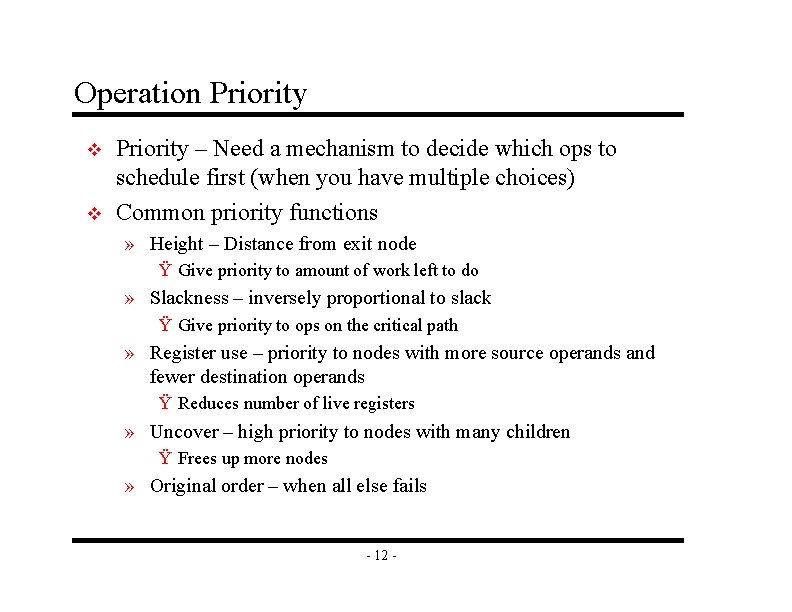
Operation Priority v v Priority – Need a mechanism to decide which ops to schedule first (when you have multiple choices) Common priority functions » Height – Distance from exit node Ÿ Give priority to amount of work left to do » Slackness – inversely proportional to slack Ÿ Give priority to ops on the critical path » Register use – priority to nodes with more source operands and fewer destination operands Ÿ Reduces number of live registers » Uncover – high priority to nodes with many children Ÿ Frees up more nodes » Original order – when all else fails - 12 -
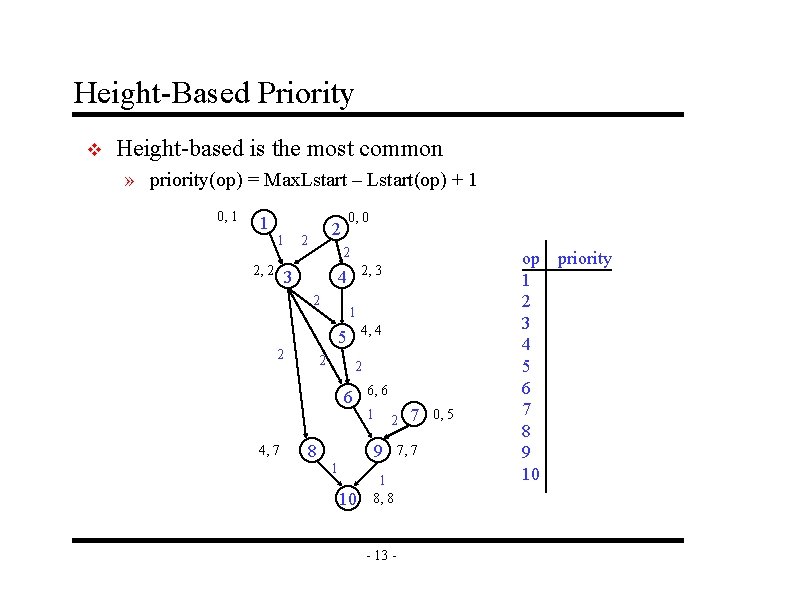
Height-Based Priority v Height-based is the most common » priority(op) = Max. Lstart – Lstart(op) + 1 0, 1 1 1 2, 2 0, 0 2 2 2 3 2, 3 4 2 1 4, 4 5 2 2 2 6 4, 7 8 6, 6 1 2 9 1 10 1 8, 8 - 13 - 7 7, 7 0, 5 op 1 2 3 4 5 6 7 8 9 10 priority
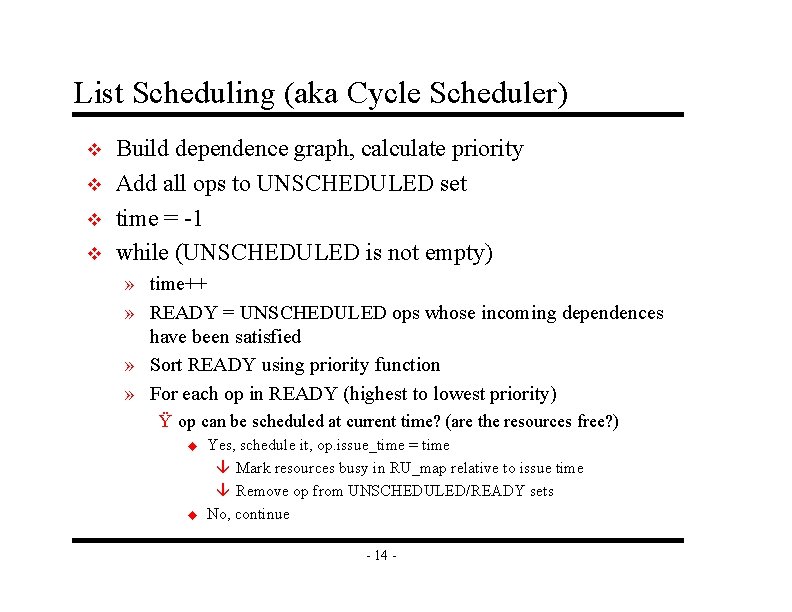
List Scheduling (aka Cycle Scheduler) v v Build dependence graph, calculate priority Add all ops to UNSCHEDULED set time = -1 while (UNSCHEDULED is not empty) » time++ » READY = UNSCHEDULED ops whose incoming dependences have been satisfied » Sort READY using priority function » For each op in READY (highest to lowest priority) Ÿ op can be scheduled at current time? (are the resources free? ) u u Yes, schedule it, op. issue_time = time â Mark resources busy in RU_map relative to issue time â Remove op from UNSCHEDULED/READY sets No, continue - 14 -
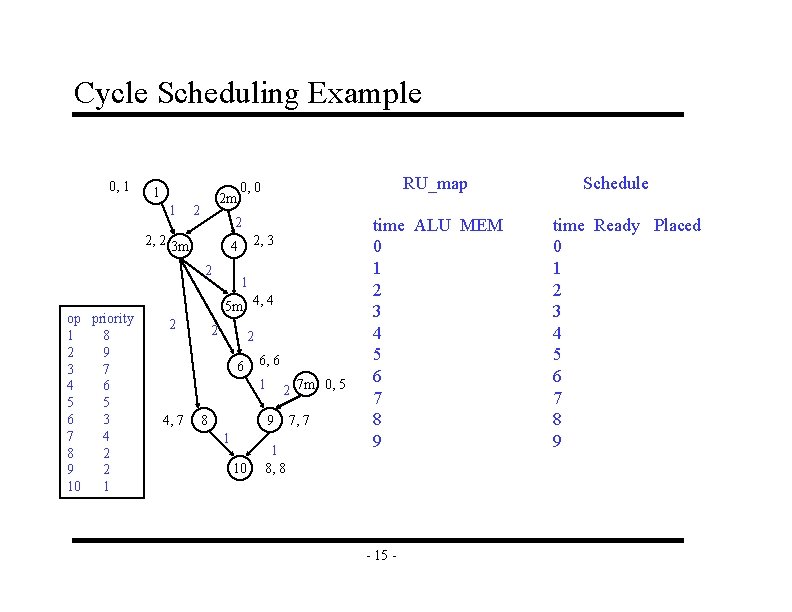
Cycle Scheduling Example 0, 1 1 1 2 m 2 2 2, 2 3 m 2, 3 4 2 op priority 1 8 2 9 3 7 4 6 5 5 6 3 7 4 8 2 9 2 10 1 RU_map 0, 0 1 5 m 4, 4 2 2 2 6 6, 6 1 4, 7 8 2 7 m 0, 5 9 1 10 1 8, 8 7, 7 time ALU MEM 0 1 2 3 4 5 6 7 8 9 - 15 - Schedule time Ready Placed 0 1 2 3 4 5 6 7 8 9
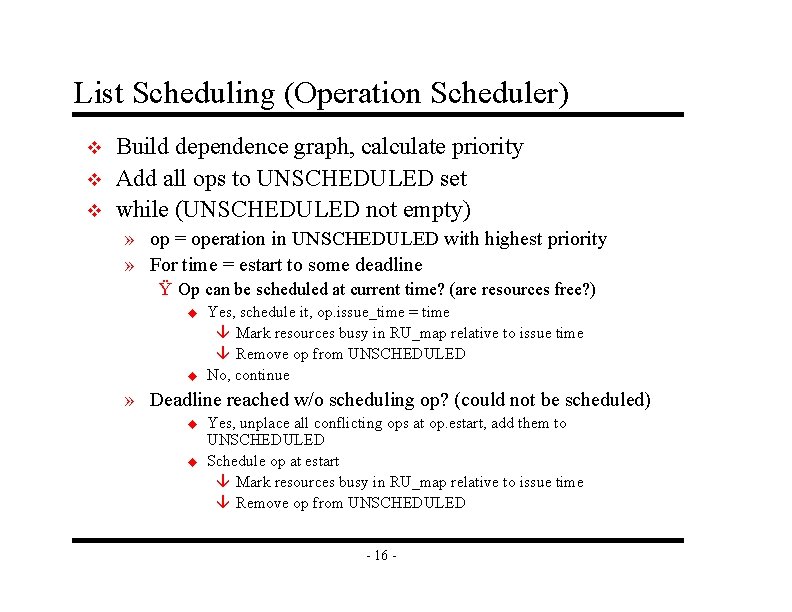
List Scheduling (Operation Scheduler) v v v Build dependence graph, calculate priority Add all ops to UNSCHEDULED set while (UNSCHEDULED not empty) » op = operation in UNSCHEDULED with highest priority » For time = estart to some deadline Ÿ Op can be scheduled at current time? (are resources free? ) u u Yes, schedule it, op. issue_time = time â Mark resources busy in RU_map relative to issue time â Remove op from UNSCHEDULED No, continue » Deadline reached w/o scheduling op? (could not be scheduled) u u Yes, unplace all conflicting ops at op. estart, add them to UNSCHEDULED Schedule op at estart â Mark resources busy in RU_map relative to issue time â Remove op from UNSCHEDULED - 16 -
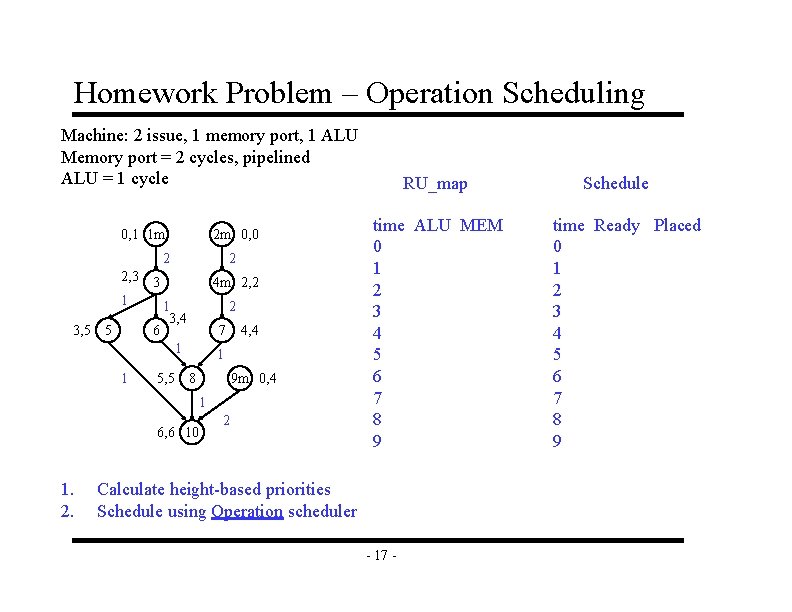
Homework Problem – Operation Scheduling Machine: 2 issue, 1 memory port, 1 ALU Memory port = 2 cycles, pipelined ALU = 1 cycle 0, 1 1 m 2 m 0, 0 2 2 2, 3 3 1 1 3, 4 6 3, 5 5 1 1 4 m 2, 2 2 7 4, 4 1 9 m 0, 4 5, 5 8 1 6, 6 10 1. 2. 2 RU_map time ALU MEM 0 1 2 3 4 5 6 7 8 9 Calculate height-based priorities Schedule using Operation scheduler - 17 - Schedule time Ready Placed 0 1 2 3 4 5 6 7 8 9
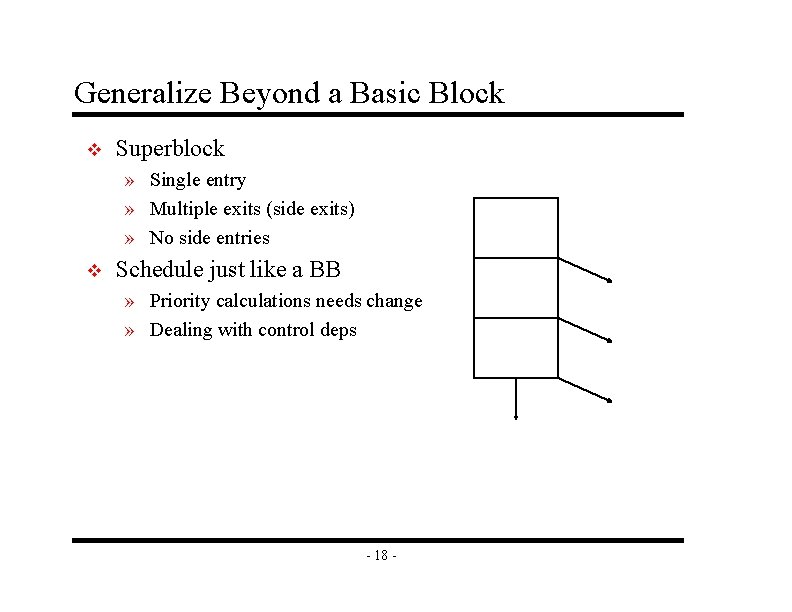
Generalize Beyond a Basic Block v Superblock » Single entry » Multiple exits (side exits) » No side entries v Schedule just like a BB » Priority calculations needs change » Dealing with control deps - 18 -
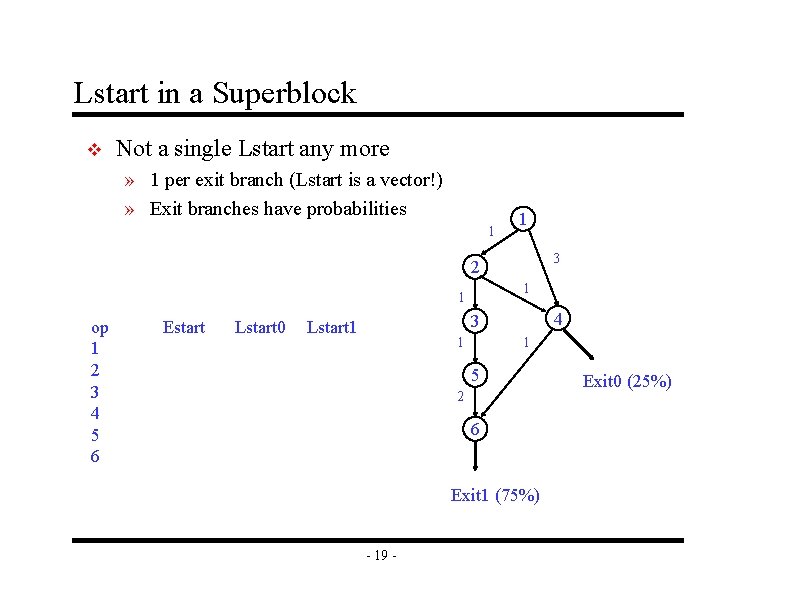
Lstart in a Superblock v Not a single Lstart any more » 1 per exit branch (Lstart is a vector!) » Exit branches have probabilities 1 1 3 2 1 1 op 1 2 3 4 5 6 Estart Lstart 0 4 3 Lstart 1 1 1 5 2 6 Exit 1 (75%) - 19 - Exit 0 (25%)
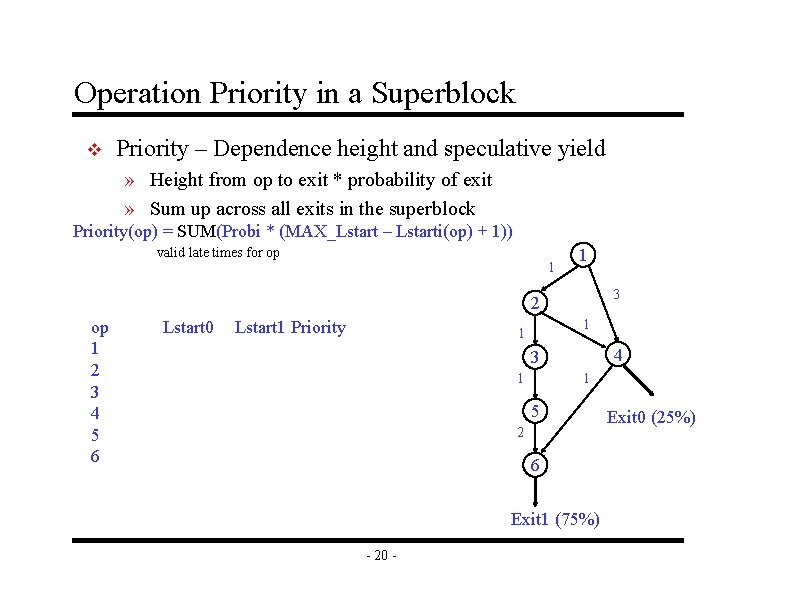
Operation Priority in a Superblock v Priority – Dependence height and speculative yield » Height from op to exit * probability of exit » Sum up across all exits in the superblock Priority(op) = SUM(Probi * (MAX_Lstart – Lstarti(op) + 1)) valid late times for op 1 1 3 2 op 1 2 3 4 5 6 Lstart 0 Lstart 1 Priority 1 1 4 3 1 1 5 2 6 Exit 1 (75%) - 20 - Exit 0 (25%)
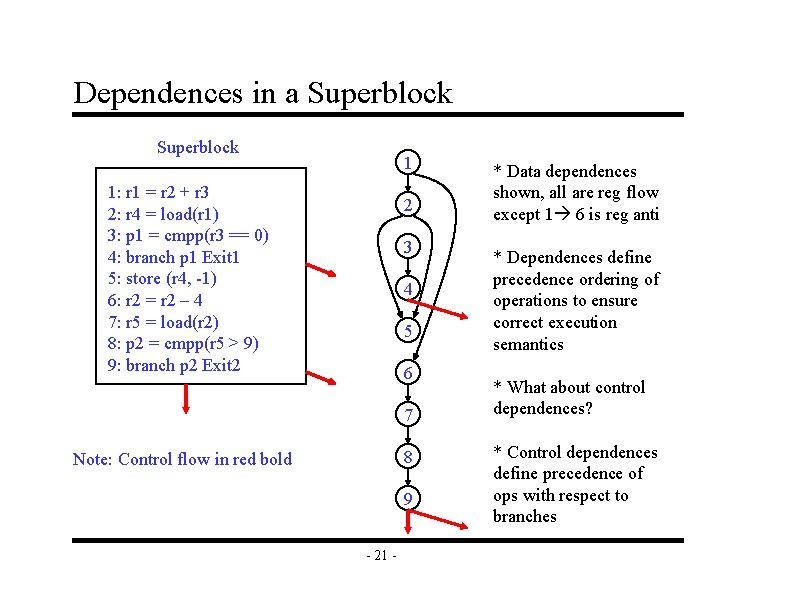
Dependences in a Superblock 1 1: r 1 = r 2 + r 3 2: r 4 = load(r 1) 3: p 1 = cmpp(r 3 == 0) 4: branch p 1 Exit 1 5: store (r 4, -1) 6: r 2 = r 2 – 4 7: r 5 = load(r 2) 8: p 2 = cmpp(r 5 > 9) 9: branch p 2 Exit 2 2 3 4 5 6 7 8 Note: Control flow in red bold 9 - 21 - * Data dependences shown, all are reg flow except 1 6 is reg anti * Dependences define precedence ordering of operations to ensure correct execution semantics * What about control dependences? * Control dependences define precedence of ops with respect to branches
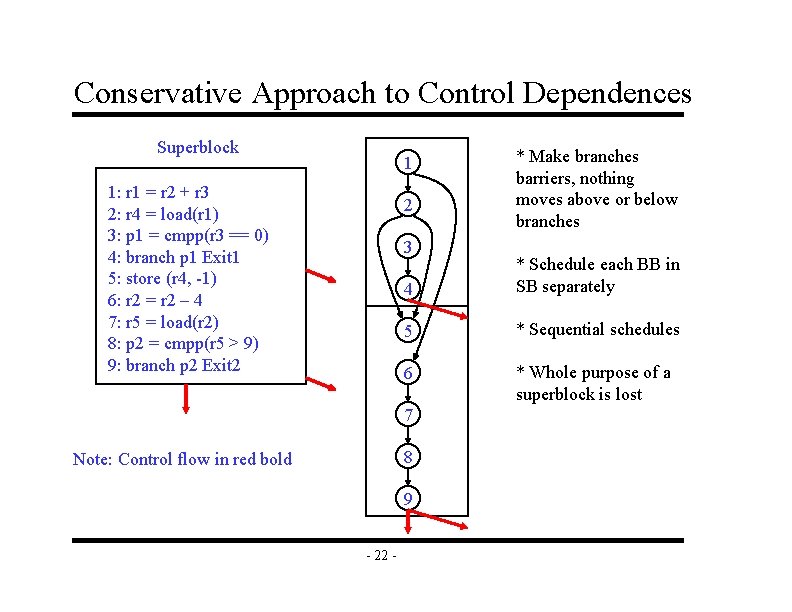
Conservative Approach to Control Dependences Superblock 1 1: r 1 = r 2 + r 3 2: r 4 = load(r 1) 3: p 1 = cmpp(r 3 == 0) 4: branch p 1 Exit 1 5: store (r 4, -1) 6: r 2 = r 2 – 4 7: r 5 = load(r 2) 8: p 2 = cmpp(r 5 > 9) 9: branch p 2 Exit 2 2 3 4 * Schedule each BB in SB separately 5 * Sequential schedules 6 * Whole purpose of a superblock is lost 7 8 Note: Control flow in red bold 9 - 22 - * Make branches barriers, nothing moves above or below branches
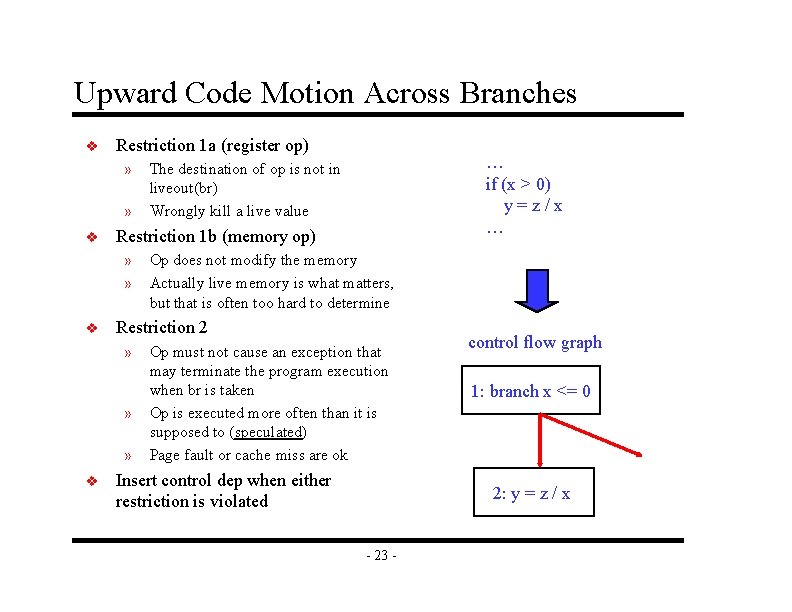
Upward Code Motion Across Branches v Restriction 1 a (register op) » » v Restriction 1 b (memory op) » » v Op does not modify the memory Actually live memory is what matters, but that is often too hard to determine Restriction 2 » » » v … if (x > 0) y = z / x … The destination of op is not in liveout(br) Wrongly kill a live value Op must not cause an exception that may terminate the program execution when br is taken Op is executed more often than it is supposed to (speculated) Page fault or cache miss are ok Insert control dep when either restriction is violated control flow graph 1: branch x <= 0 2: y = z / x - 23 -
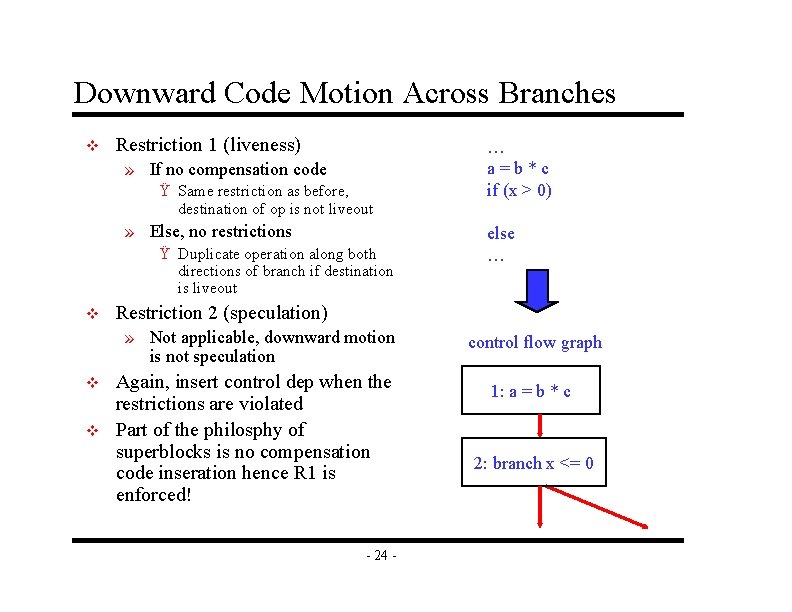
Downward Code Motion Across Branches v Restriction 1 (liveness) » If no compensation code Ÿ Same restriction as before, destination of op is not liveout » Else, no restrictions Ÿ Duplicate operation along both directions of branch if destination is liveout v Restriction 2 (speculation) » Not applicable, downward motion is not speculation v v … a = b * c if (x > 0) else … Again, insert control dep when the restrictions are violated Part of the philosphy of superblocks is no compensation code inseration hence R 1 is enforced! - 24 - control flow graph 1: a = b * c 2: branch x <= 0
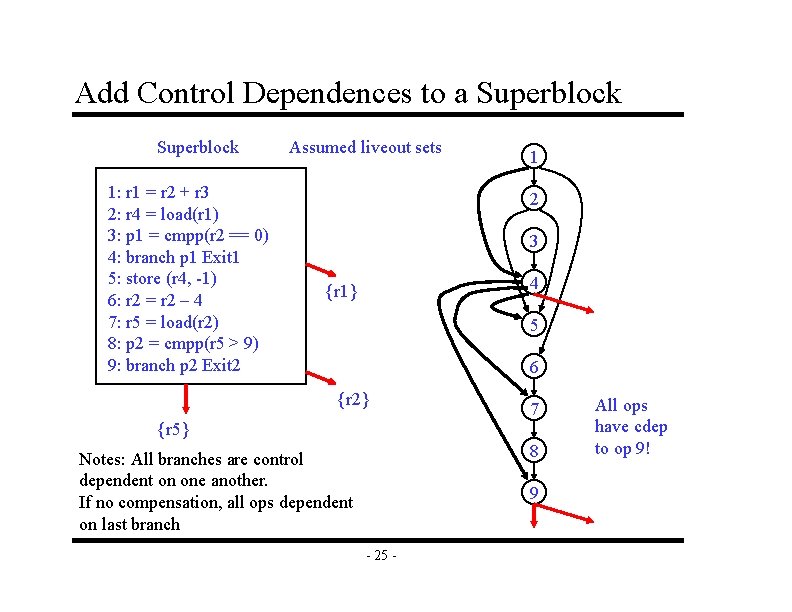
Add Control Dependences to a Superblock 1: r 1 = r 2 + r 3 2: r 4 = load(r 1) 3: p 1 = cmpp(r 2 == 0) 4: branch p 1 Exit 1 5: store (r 4, -1) 6: r 2 = r 2 – 4 7: r 5 = load(r 2) 8: p 2 = cmpp(r 5 > 9) 9: branch p 2 Exit 2 Assumed liveout sets 1 2 3 4 {r 1} 5 6 {r 2} 7 {r 5} 8 Notes: All branches are control dependent on one another. If no compensation, all ops dependent on last branch 9 - 25 - All ops have cdep to op 9!
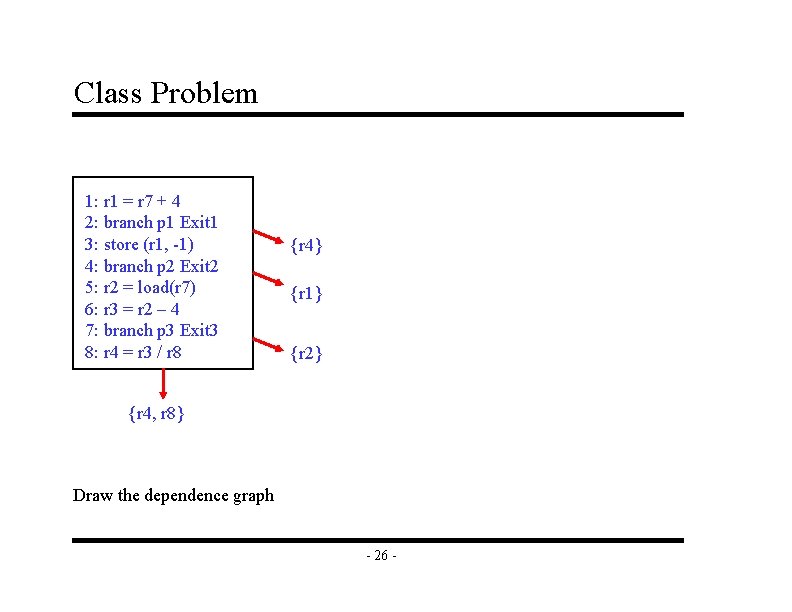
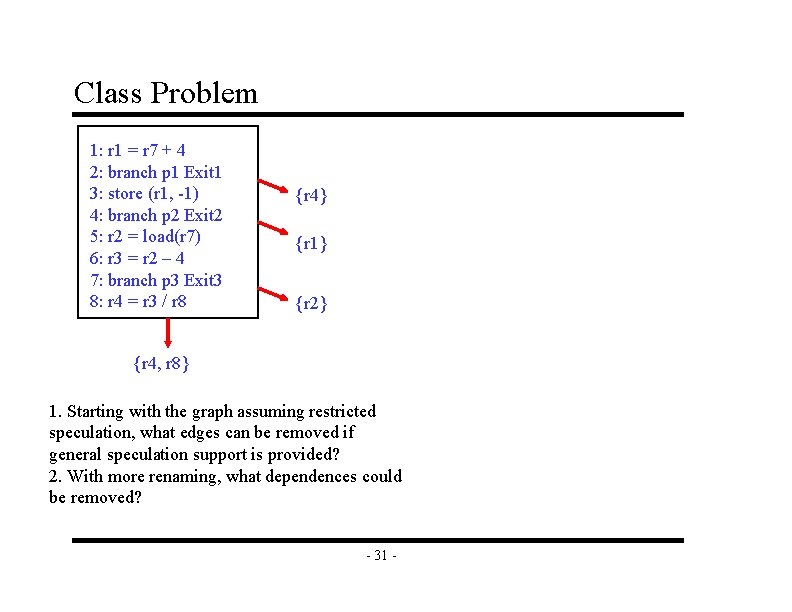
Class Problem 1: r 1 = r 7 + 4 2: branch p 1 Exit 1 3: store (r 1, -1) 4: branch p 2 Exit 2 5: r 2 = load(r 7) 6: r 3 = r 2 – 4 7: branch p 3 Exit 3 8: r 4 = r 3 / r 8 {r 4} {r 1} {r 2} {r 4, r 8} Draw the dependence graph - 26 -
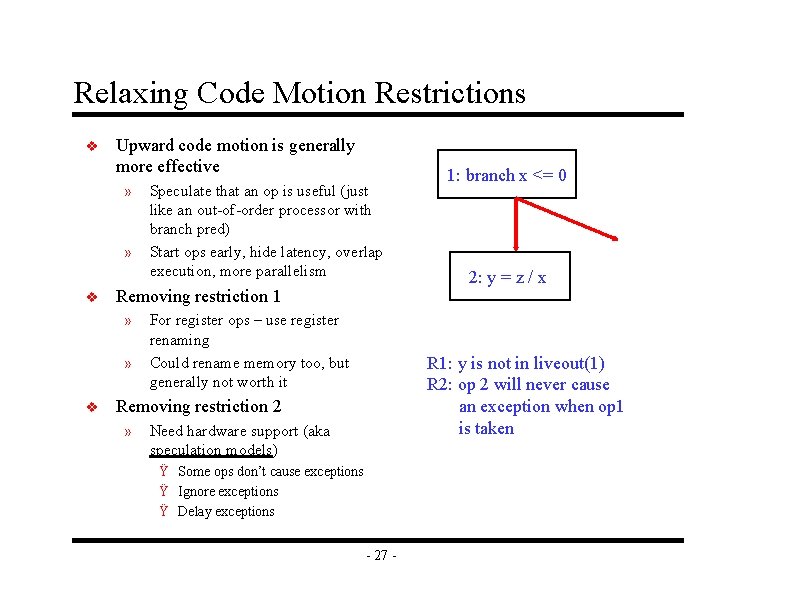
Relaxing Code Motion Restrictions v Upward code motion is generally more effective » » v Removing restriction 1 » » v Speculate that an op is useful (just like an out-of-order processor with branch pred) Start ops early, hide latency, overlap execution, more parallelism For register ops – use register renaming Could rename memory too, but generally not worth it 2: y = z / x R 1: y is not in liveout(1) R 2: op 2 will never cause an exception when op 1 is taken Removing restriction 2 » 1: branch x <= 0 Need hardware support (aka speculation models) Ÿ Some ops don’t cause exceptions Ÿ Ignore exceptions Ÿ Delay exceptions - 27 -
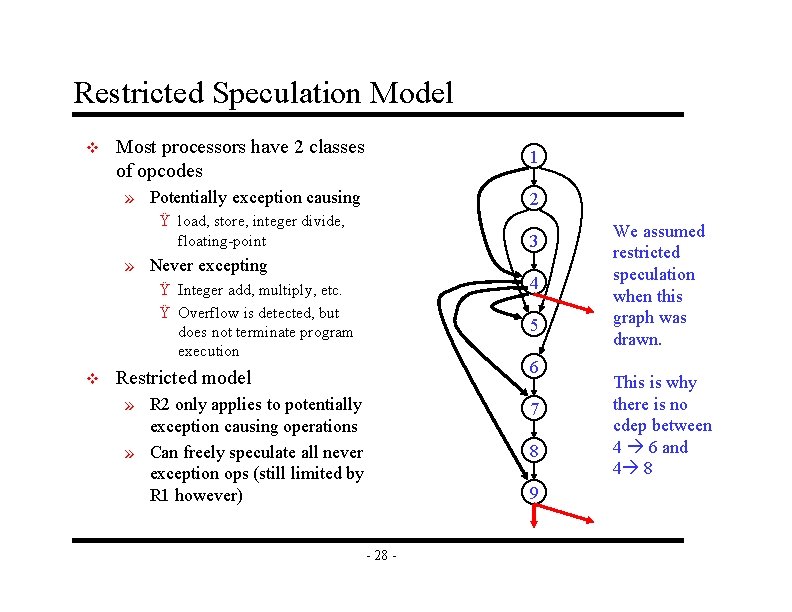
Restricted Speculation Model v Most processors have 2 classes of opcodes 1 » Potentially exception causing 2 Ÿ load, store, integer divide, floating-point 3 » Never excepting 4 Ÿ Integer add, multiply, etc. Ÿ Overflow is detected, but does not terminate program execution v 5 6 Restricted model » R 2 only applies to potentially exception causing operations » Can freely speculate all never exception ops (still limited by R 1 however) - 28 - 7 8 9 We assumed restricted speculation when this graph was drawn. This is why there is no cdep between 4 6 and 4 8
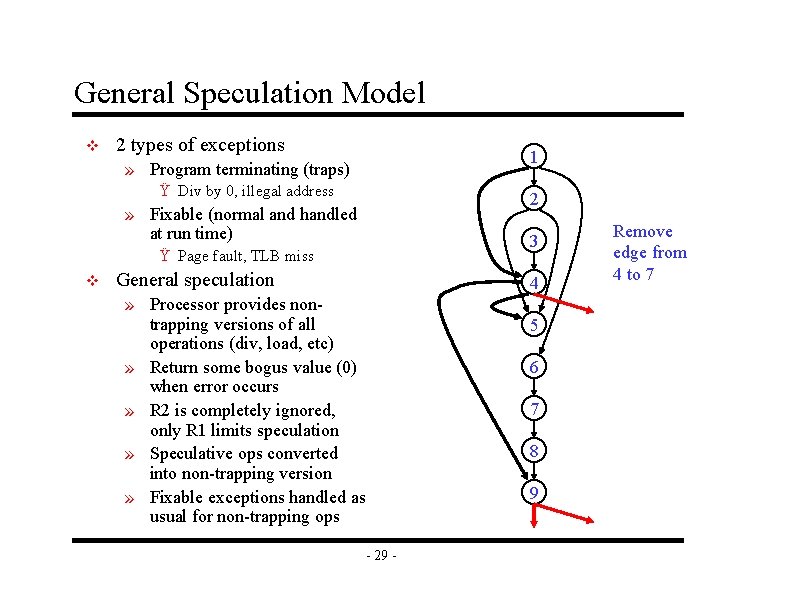
General Speculation Model v 2 types of exceptions 1 » Program terminating (traps) Ÿ Div by 0, illegal address 2 » Fixable (normal and handled at run time) 3 Ÿ Page fault, TLB miss v General speculation 4 » Processor provides nontrapping versions of all operations (div, load, etc) » Return some bogus value (0) when error occurs » R 2 is completely ignored, only R 1 limits speculation » Speculative ops converted into non-trapping version » Fixable exceptions handled as usual for non-trapping ops - 29 - 5 6 7 8 9 Remove edge from 4 to 7
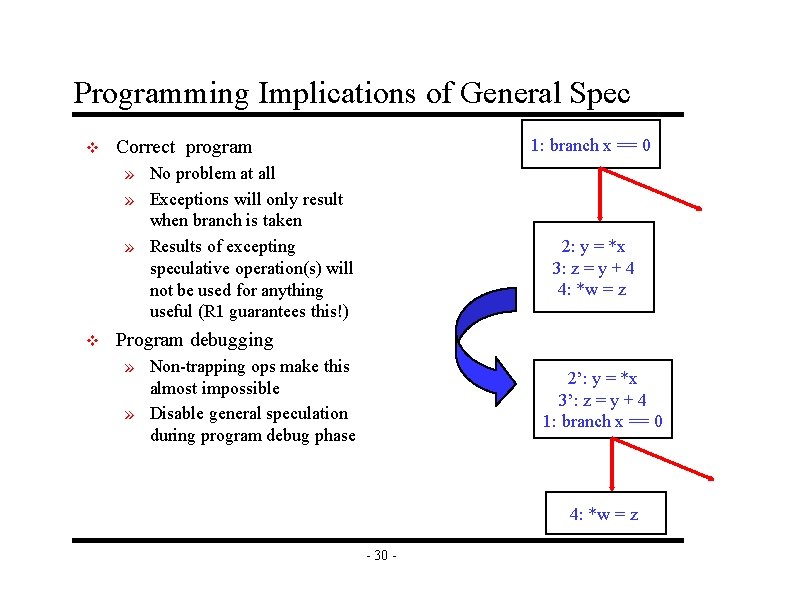
Programming Implications of General Spec v 1: branch x == 0 Correct program » No problem at all » Exceptions will only result when branch is taken » Results of excepting speculative operation(s) will not be used for anything useful (R 1 guarantees this!) v 2: y = *x 3: z = y + 4 4: *w = z Program debugging » Non-trapping ops make this almost impossible » Disable general speculation during program debug phase 2’: y = *x 3’: z = y + 4 1: branch x == 0 4: *w = z - 30 -
Class Problem 1: r 1 = r 7 + 4 2: branch p 1 Exit 1 3: store (r 1, -1) 4: branch p 2 Exit 2 5: r 2 = load(r 7) 6: r 3 = r 2 – 4 7: branch p 3 Exit 3 8: r 4 = r 3 / r 8 {r 4} {r 1} {r 2} {r 4, r 8} 1. Starting with the graph assuming restricted speculation, what edges can be removed if general speculation support is provided? 2. With more renaming, what dependences could be removed? - 31 -