
EECS 583 Class 5 Hyperblocks Control Height Reduction
EECS 583 – Class 5 Hyperblocks, Control Height Reduction University of Michigan September 21, 2011
Reading + Announcements Material v Reminder – HW 1 due Friday at midnight » Submit uniquename_hw 1. tgz file to andrew. eecs. umich. edu: /y/submit/ » Talk to Daya in office hours Thurs or Fri if having trouble v v My office hours today – cancelled due to industry visitors Today’s class » "Effective Compiler Support for Predicated Execution using the Hyperblock", S. Mahlke et al. , MICRO-25, 1992. » "Control CPR: A Branch Height Reduction Optimization for EPIC Processors", M. Schlansker et al. , PLDI-99, 1999. v Material for next Monday » Compilers: Principles, Techniques, and Tools, A. Aho, R. Sethi, and J. Ullman, Addison-Wesley, 1988. (Sections: 10. 5, 10. 6, 10. 9, 10. 10) -1 -
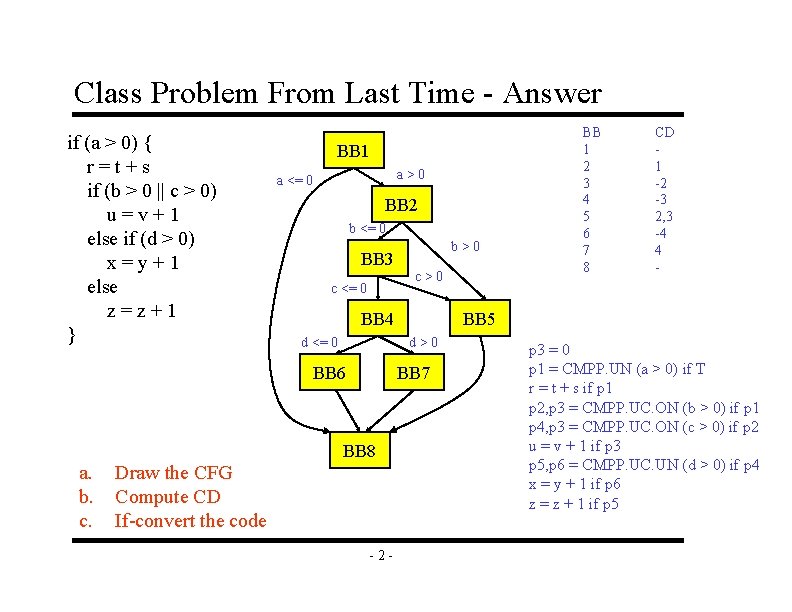
Class Problem From Last Time - Answer if (a > 0) { r=t+s if (b > 0 || c > 0) u=v+1 else if (d > 0) x=y+1 else z=z+1 } BB 1 a>0 a <= 0 BB 2 b <= 0 BB 3 c>0 c <= 0 BB 4 d <= 0 BB 7 BB 8 Draw the CFG Compute CD If-convert the code -2 - CD 1 -2 -3 2, 3 -4 4 - BB 5 d>0 BB 6 a. b. c. b>0 BB 1 2 3 4 5 6 7 8 p 3 = 0 p 1 = CMPP. UN (a > 0) if T r = t + s if p 1 p 2, p 3 = CMPP. UC. ON (b > 0) if p 1 p 4, p 3 = CMPP. UC. ON (c > 0) if p 2 u = v + 1 if p 3 p 5, p 6 = CMPP. UC. UN (d > 0) if p 4 x = y + 1 if p 6 z = z + 1 if p 5
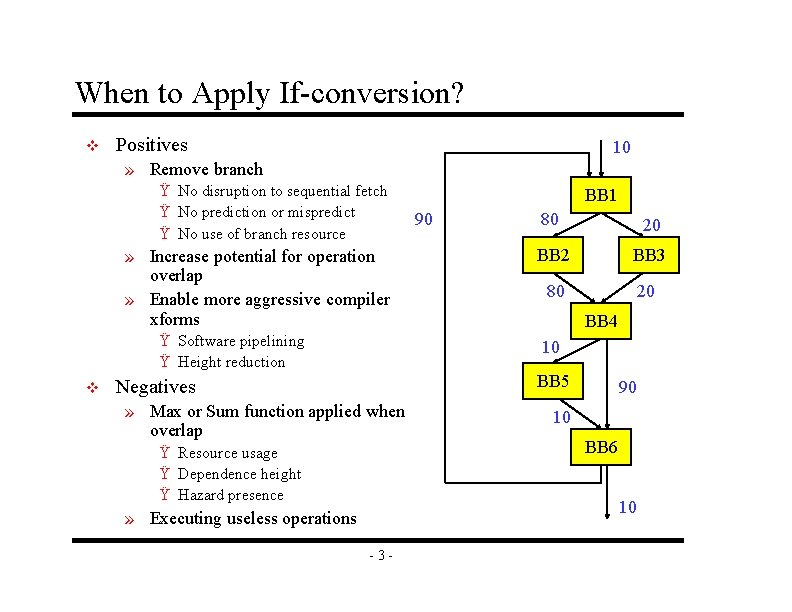
When to Apply If-conversion? v Positives 10 » Remove branch Ÿ No disruption to sequential fetch Ÿ No prediction or mispredict Ÿ No use of branch resource » Increase potential for operation overlap » Enable more aggressive compiler xforms Ÿ Software pipelining Ÿ Height reduction v BB 1 90 80 20 BB 2 BB 3 80 20 BB 4 10 BB 5 Negatives » Max or Sum function applied when overlap Ÿ Resource usage Ÿ Dependence height Ÿ Hazard presence 90 10 BB 6 10 » Executing useless operations -3 -
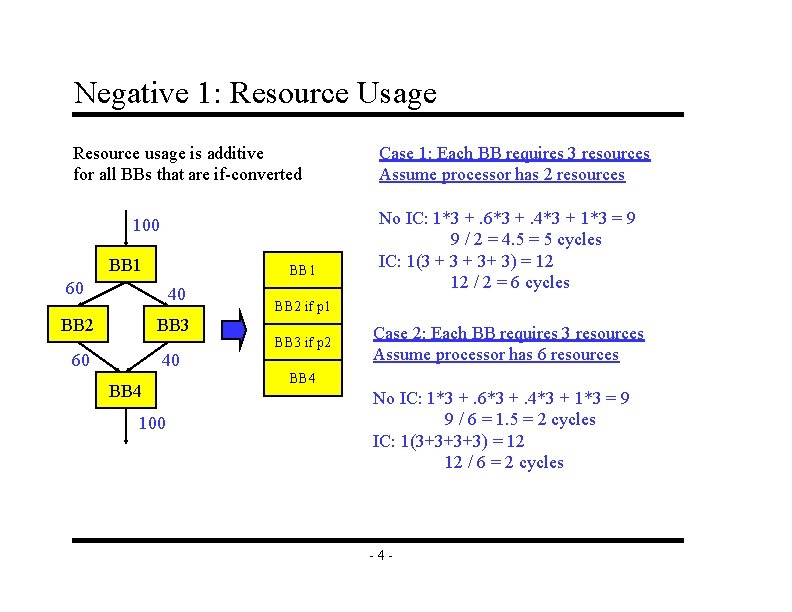
Negative 1: Resource Usage Resource usage is additive for all BBs that are if-converted 100 BB 1 60 40 BB 2 40 BB 4 100 No IC: 1*3 +. 6*3 +. 4*3 + 1*3 = 9 9 / 2 = 4. 5 = 5 cycles IC: 1(3 + 3+ 3) = 12 12 / 2 = 6 cycles BB 2 if p 1 BB 3 60 Case 1: Each BB requires 3 resources Assume processor has 2 resources BB 3 if p 2 Case 2: Each BB requires 3 resources Assume processor has 6 resources BB 4 No IC: 1*3 +. 6*3 +. 4*3 + 1*3 = 9 9 / 6 = 1. 5 = 2 cycles IC: 1(3+3+3+3) = 12 12 / 6 = 2 cycles -4 -
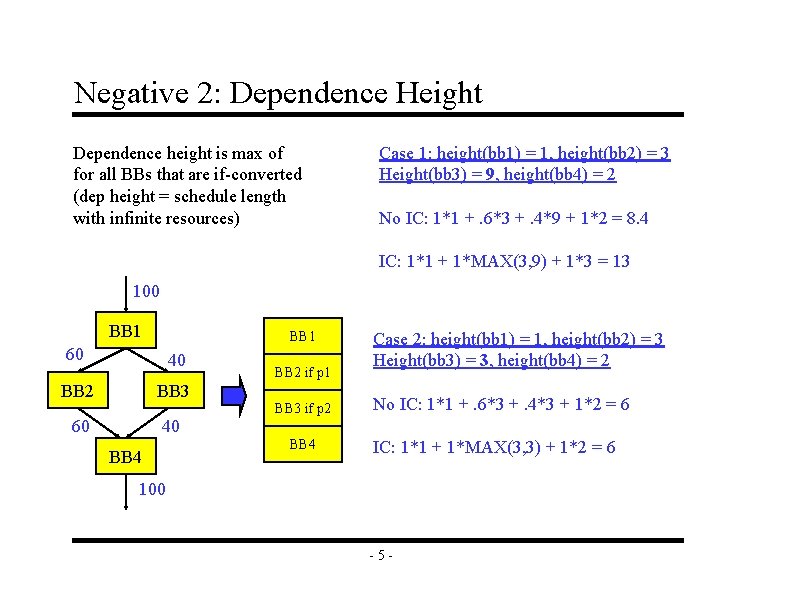
Negative 2: Dependence Height Dependence height is max of for all BBs that are if-converted (dep height = schedule length with infinite resources) Case 1: height(bb 1) = 1, height(bb 2) = 3 Height(bb 3) = 9, height(bb 4) = 2 No IC: 1*1 +. 6*3 +. 4*9 + 1*2 = 8. 4 IC: 1*1 + 1*MAX(3, 9) + 1*3 = 13 100 BB 1 60 40 BB 2 if p 1 BB 3 60 40 BB 4 BB 3 if p 2 BB 4 Case 2: height(bb 1) = 1, height(bb 2) = 3 Height(bb 3) = 3, height(bb 4) = 2 No IC: 1*1 +. 6*3 +. 4*3 + 1*2 = 6 IC: 1*1 + 1*MAX(3, 3) + 1*2 = 6 100 -5 -
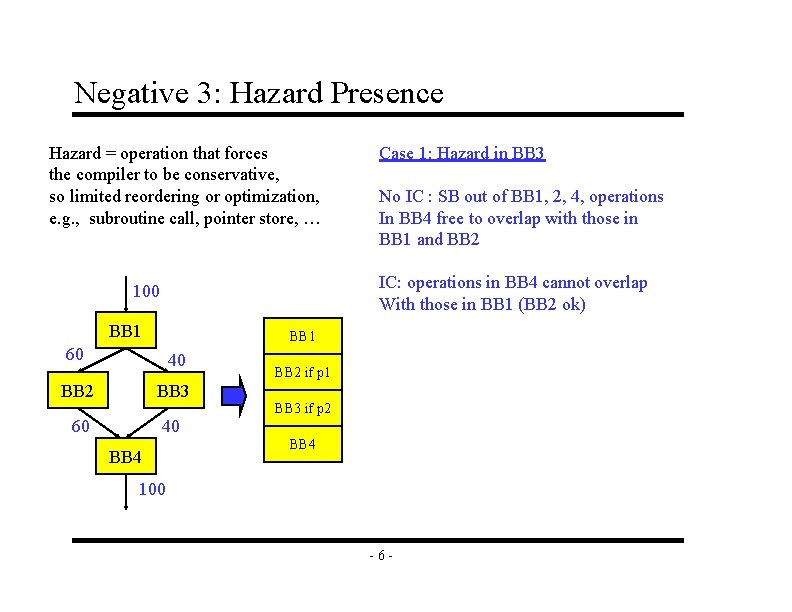
Negative 3: Hazard Presence Hazard = operation that forces the compiler to be conservative, so limited reordering or optimization, e. g. , subroutine call, pointer store, … No IC : SB out of BB 1, 2, 4, operations In BB 4 free to overlap with those in BB 1 and BB 2 IC: operations in BB 4 cannot overlap With those in BB 1 (BB 2 ok) 100 BB 1 60 40 BB 2 Case 1: Hazard in BB 3 BB 2 if p 1 BB 3 60 40 BB 4 BB 3 if p 2 BB 4 100 -6 -
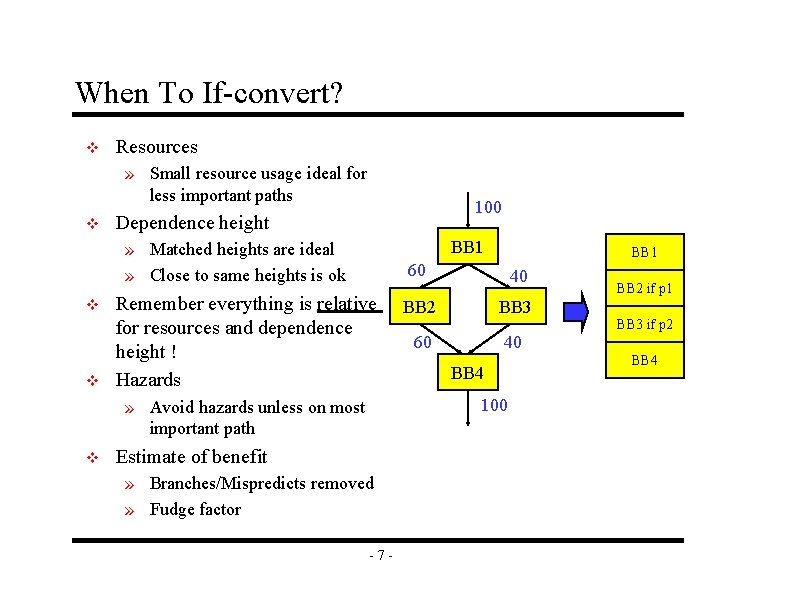
When To If-convert? v Resources » Small resource usage ideal for less important paths v 100 Dependence height BB 1 » Matched heights are ideal » Close to same heights is ok v v 60 Remember everything is relative for resources and dependence height ! Hazards 40 BB 2 Estimate of benefit » Branches/Mispredicts removed » Fudge factor -7 - BB 2 if p 1 BB 3 60 40 BB 4 100 » Avoid hazards unless on most important path v BB 1 BB 3 if p 2 BB 4
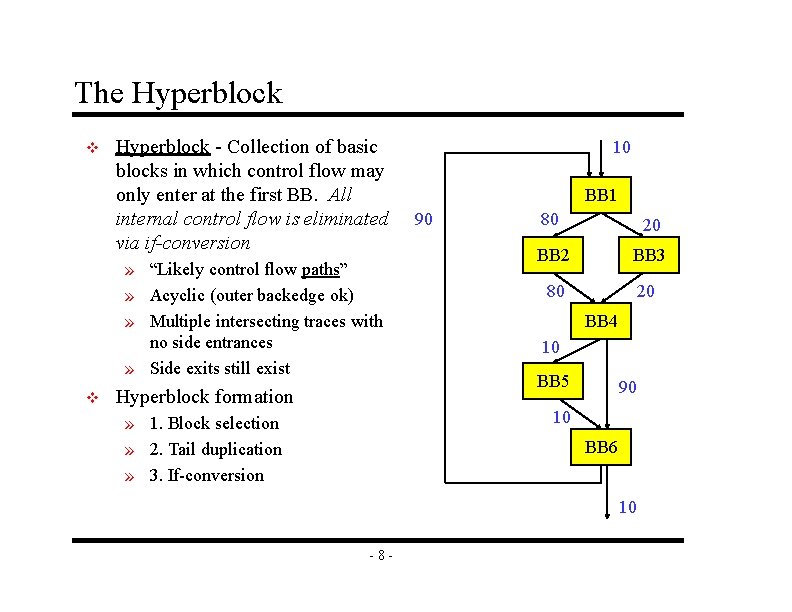
The Hyperblock v Hyperblock - Collection of basic blocks in which control flow may only enter at the first BB. All internal control flow is eliminated via if-conversion » “Likely control flow paths” » Acyclic (outer backedge ok) » Multiple intersecting traces with no side entrances » Side exits still exist v Hyperblock formation 10 BB 1 90 80 20 BB 2 BB 3 80 20 BB 4 10 BB 5 90 10 » 1. Block selection » 2. Tail duplication » 3. If-conversion BB 6 10 -8 -
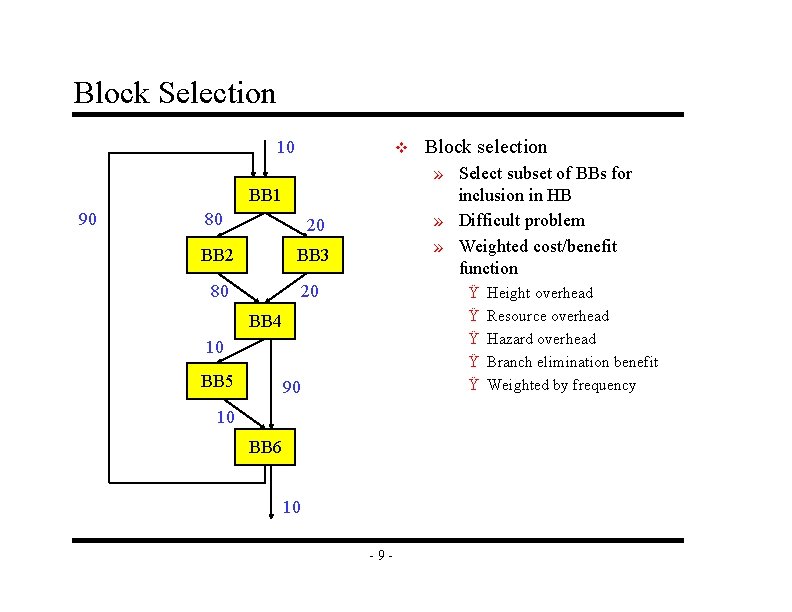
Block Selection 10 v » Select subset of BBs for inclusion in HB » Difficult problem » Weighted cost/benefit function BB 1 90 80 20 BB 2 BB 3 80 20 Ÿ Ÿ Ÿ BB 4 10 BB 5 Block selection 90 10 BB 6 10 -9 - Height overhead Resource overhead Hazard overhead Branch elimination benefit Weighted by frequency
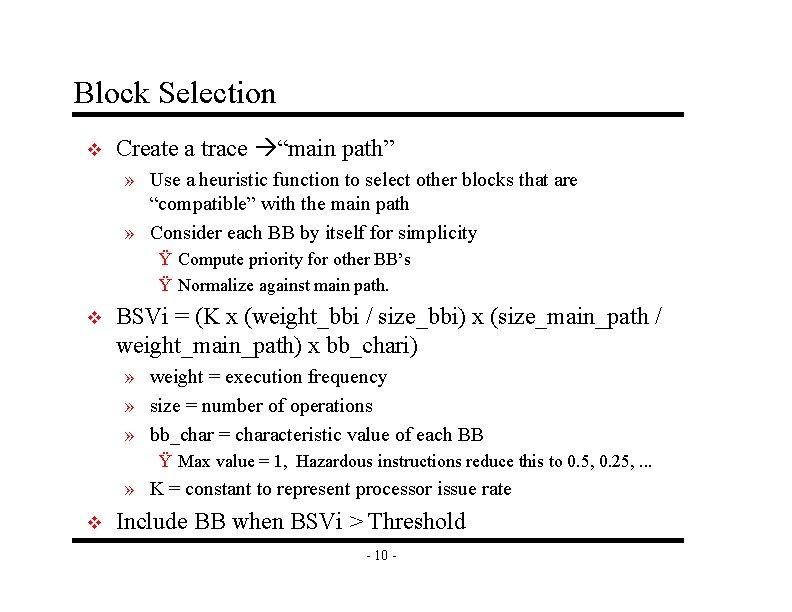
Block Selection v Create a trace “main path” » Use a heuristic function to select other blocks that are “compatible” with the main path » Consider each BB by itself for simplicity Ÿ Compute priority for other BB’s Ÿ Normalize against main path. v BSVi = (K x (weight_bbi / size_bbi) x (size_main_path / weight_main_path) x bb_chari) » weight = execution frequency » size = number of operations » bb_char = characteristic value of each BB Ÿ Max value = 1, Hazardous instructions reduce this to 0. 5, 0. 25, . . . » K = constant to represent processor issue rate v Include BB when BSVi > Threshold - 10 -
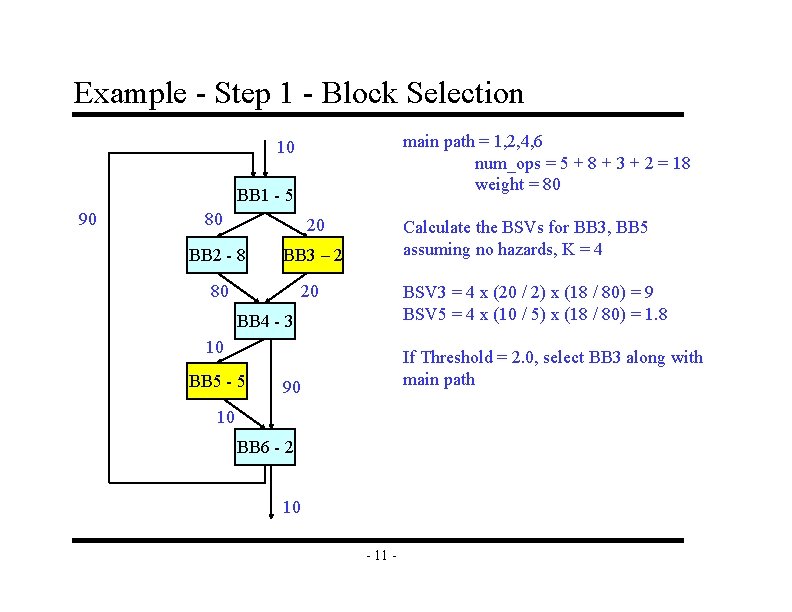
Example - Step 1 - Block Selection main path = 1, 2, 4, 6 num_ops = 5 + 8 + 3 + 2 = 18 weight = 80 10 BB 1 - 5 90 80 20 BB 2 - 8 BB 3 – 2 80 20 Calculate the BSVs for BB 3, BB 5 assuming no hazards, K = 4 BSV 3 = 4 x (20 / 2) x (18 / 80) = 9 BSV 5 = 4 x (10 / 5) x (18 / 80) = 1. 8 BB 4 - 3 10 BB 5 - 5 If Threshold = 2. 0, select BB 3 along with main path 90 10 BB 6 - 2 10 - 11 -

Example - Step 2 - Tail Duplication Tail duplication same as with Superblock formation 10 10 BB 1 80 20 BB 2 BB 3 80 20 BB 1 BB 4 80 20 BB 2 BB 3 80 20 BB 4 10 10 BB 5 90 10 10 BB 6 90 81 10 BB 6’ 9 1 - 12 - 9
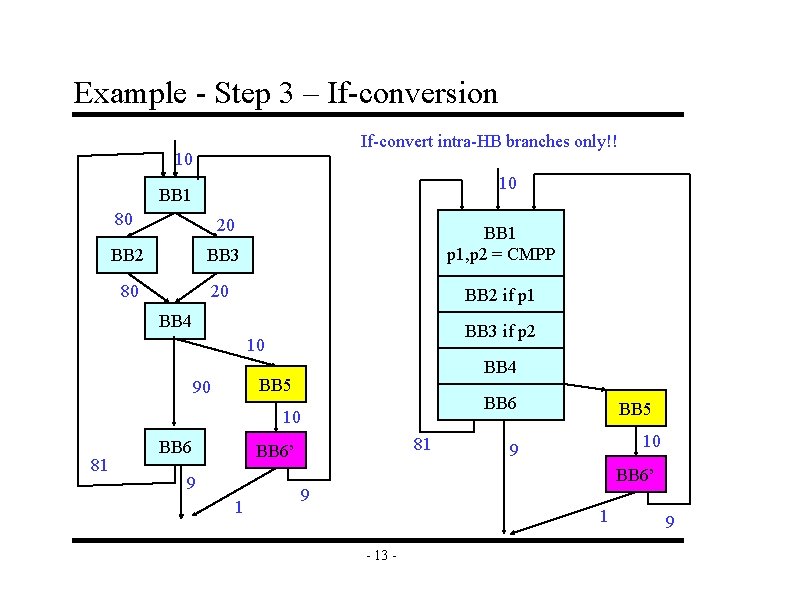
Example - Step 3 – If-conversion If-convert intra-HB branches only!! 10 10 BB 1 80 20 BB 2 BB 3 BB 1 p 1, p 2 = CMPP 80 20 BB 2 if p 1 BB 4 BB 3 if p 2 10 BB 4 BB 5 90 BB 6 10 81 BB 6’ BB 5 10 9 BB 6’ 9 1 - 13 - 9
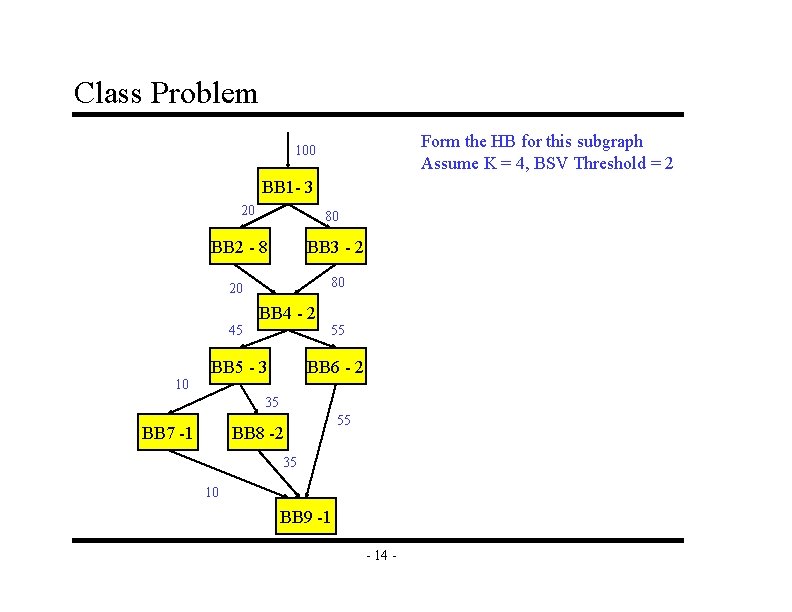
Class Problem Form the HB for this subgraph Assume K = 4, BSV Threshold = 2 100 BB 1 - 3 20 BB 2 - 8 BB 3 - 2 20 80 45 10 80 BB 4 - 2 BB 5 - 3 55 BB 6 - 2 35 BB 7 -1 BB 8 -2 55 35 10 BB 9 -1 - 14 -

Control CPR: A Branch Height Reduction Optimization for EPIC Architectures – PLDI 99 v Dependences limit performance » » v Problem worse wide-issue processors » » » v Data Control Long dependence chains Sequential code High degree hardware parallelism Low degree of program parallelism Resources idle most of the time Height reduction optimizations » » Traditional compilers focus on reducing operation count VLIW compilers need on increasing program parallelism - 15 - Loop: t 1 = *a++; *b++ = t 1; if (*a == 0) break; t 2 = *a++; *b++ = t 2; if (*a == 0) break; t 3 = *a++; *b++ = t 3; if (*a != 0) goto Loop;
Our Approach to Control Height Reduction v Goals » » v Reduce dependence height through a network of branches Reduce number of executed branches Applicable to a large fraction of the program Fit into our existing compiler infrastructure Difficulty » Reducing height while » Not increasing operation count v Irredundant Consecutive Branch Method (ICBM) » Use branch profile information » Optimize likely the important control flow paths » Possibly penalize less important paths - 16 -

Definitions v Superblock » » » v Exit branch » » v branch to allow early transfer out of the superblock compare condition (ai < bi) On-trace » » v single-entry linear sequence of operations containing 1 or more branches Our basic compilation unit Non-speculative operations preferred execution path (E 4) identified by profiling Off-trace » » non-preferred paths (E 1, E 2, E 3) taking an exit branch - 17 -
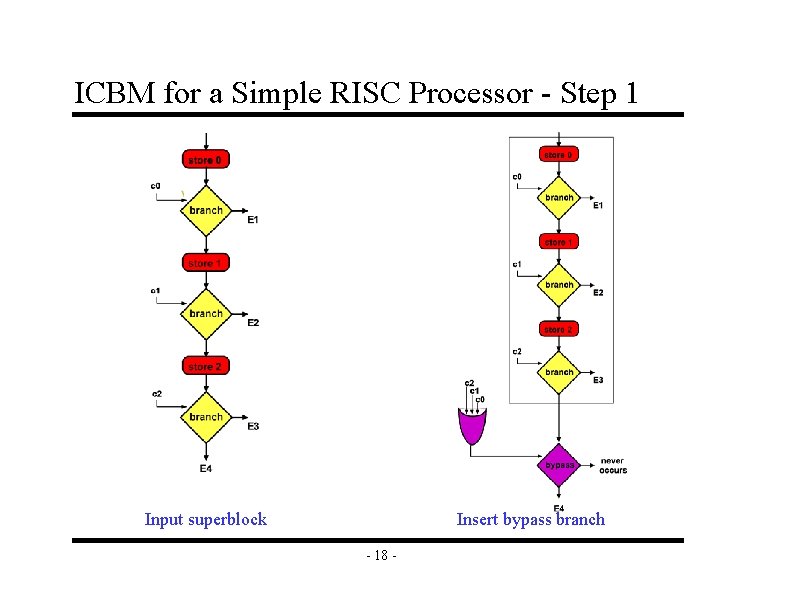
ICBM for a Simple RISC Processor - Step 1 Input superblock Insert bypass branch - 18 -

ICBM for a Simple RISC Processor - Step 2 Superblock with bypass branch Move code down through bypass branch - 19 -
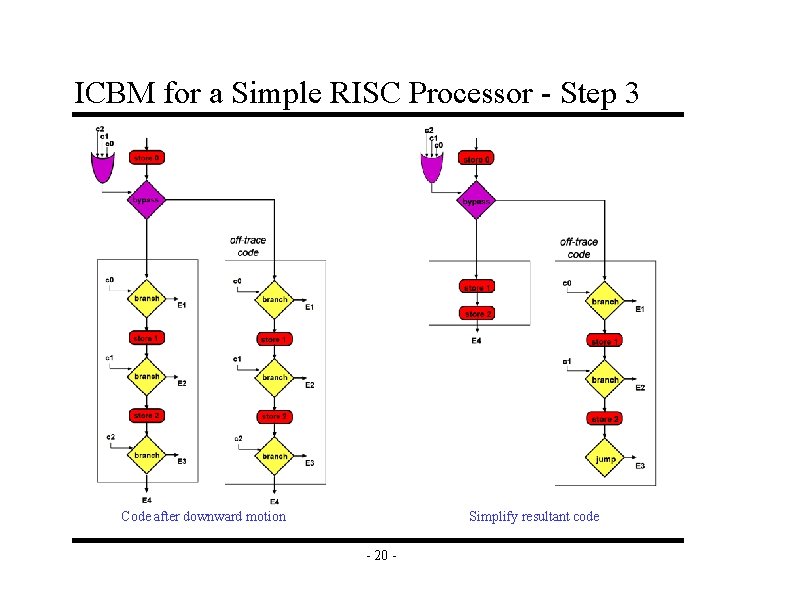
ICBM for a Simple RISC Processor - Step 3 Code after downward motion Simplify resultant code - 20 -
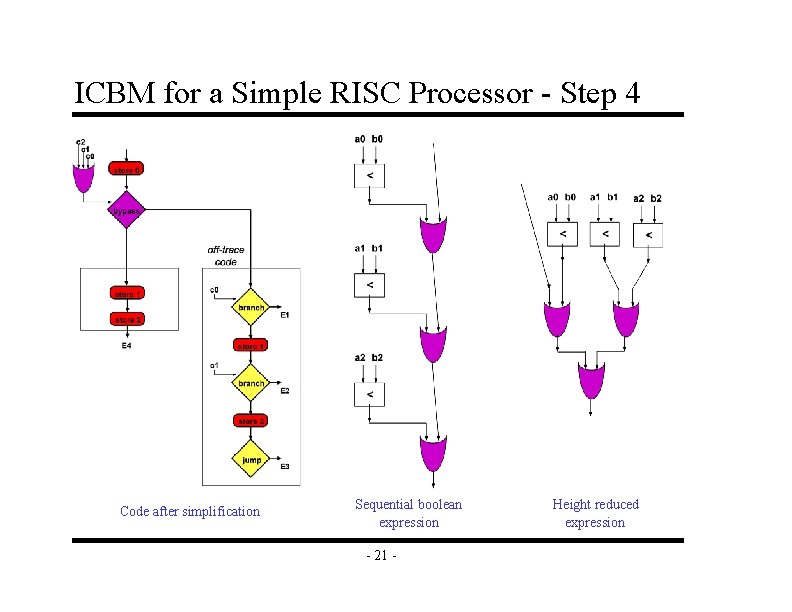
ICBM for a Simple RISC Processor - Step 4 Code after simplification Sequential boolean expression - 21 - Height reduced expression
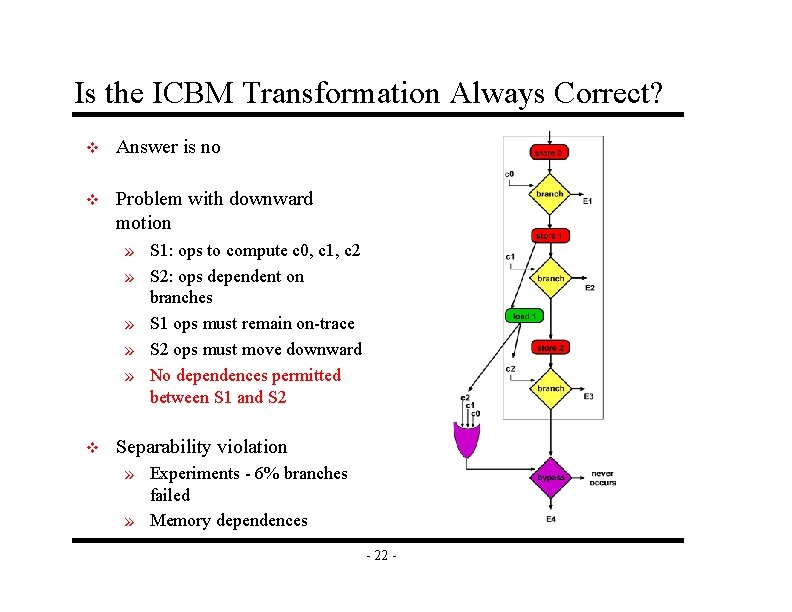
Is the ICBM Transformation Always Correct? v Answer is no v Problem with downward motion » S 1: ops to compute c 0, c 1, c 2 » S 2: ops dependent on branches » S 1 ops must remain on-trace » S 2 ops must move downward » No dependences permitted between S 1 and S 2 v Separability violation » Experiments - 6% branches failed » Memory dependences - 22 -
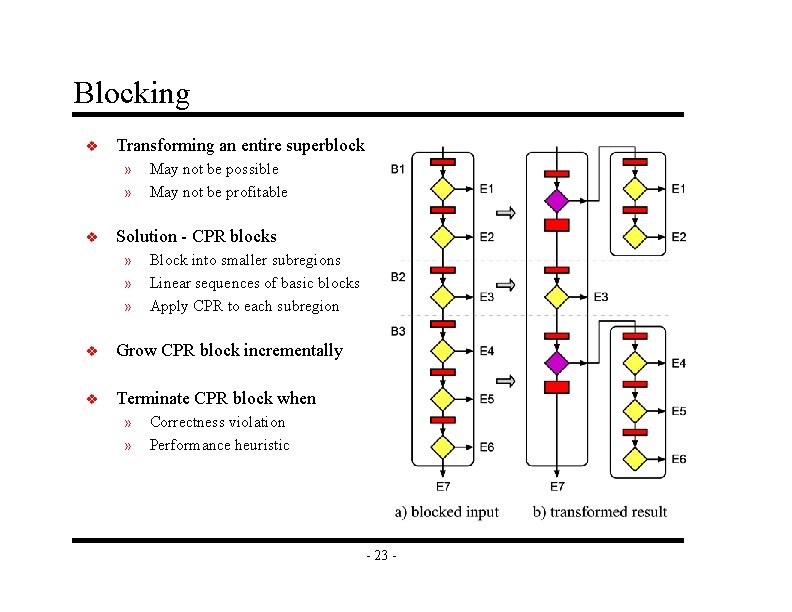
Blocking v Transforming an entire superblock » » v May not be possible May not be profitable Solution - CPR blocks » » » Block into smaller subregions Linear sequences of basic blocks Apply CPR to each subregion v Grow CPR block incrementally v Terminate CPR block when » » Correctness violation Performance heuristic - 23 -
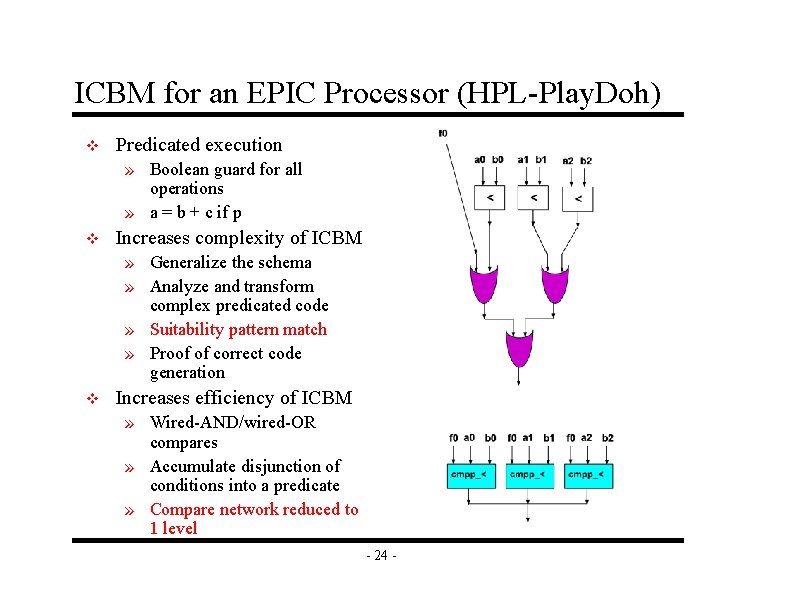
ICBM for an EPIC Processor (HPL-Play. Doh) v Predicated execution » Boolean guard for all operations » a = b + c if p v Increases complexity of ICBM » Generalize the schema » Analyze and transform complex predicated code » Suitability pattern match » Proof of correct code generation v Increases efficiency of ICBM » Wired-AND/wired-OR compares » Accumulate disjunction of conditions into a predicate » Compare network reduced to 1 level - 24 -
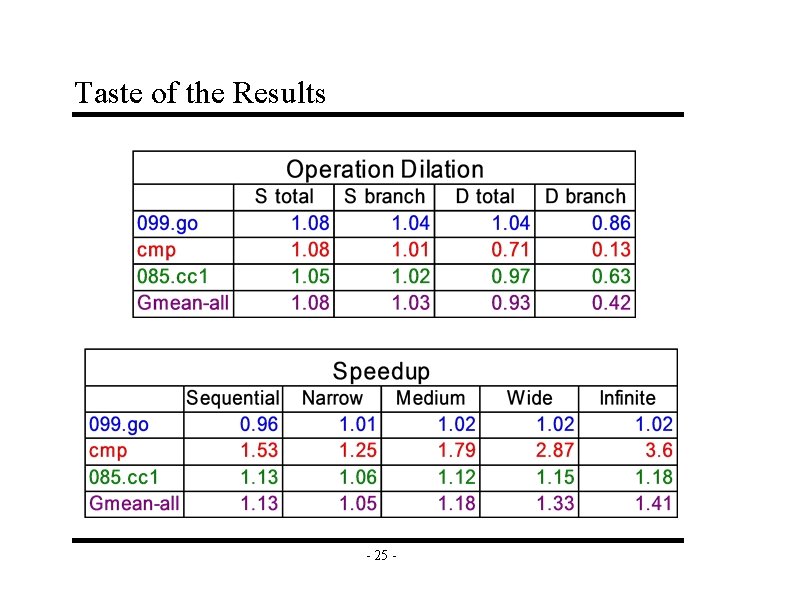
Taste of the Results - 25 -

Next Topic: Dataflow Analysis + Optimization
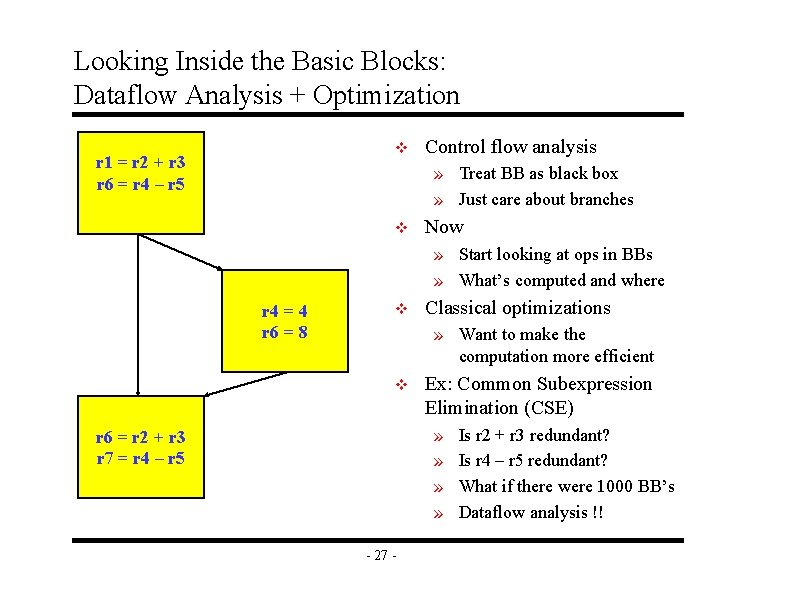
Looking Inside the Basic Blocks: Dataflow Analysis + Optimization v r 1 = r 2 + r 3 r 6 = r 4 – r 5 Control flow analysis » Treat BB as black box » Just care about branches v Now » Start looking at ops in BBs » What’s computed and where r 4 = 4 r 6 = 8 v Classical optimizations » Want to make the computation more efficient v Ex: Common Subexpression Elimination (CSE) » » r 6 = r 2 + r 3 r 7 = r 4 – r 5 - 27 - Is r 2 + r 3 redundant? Is r 4 – r 5 redundant? What if there were 1000 BB’s Dataflow analysis !!
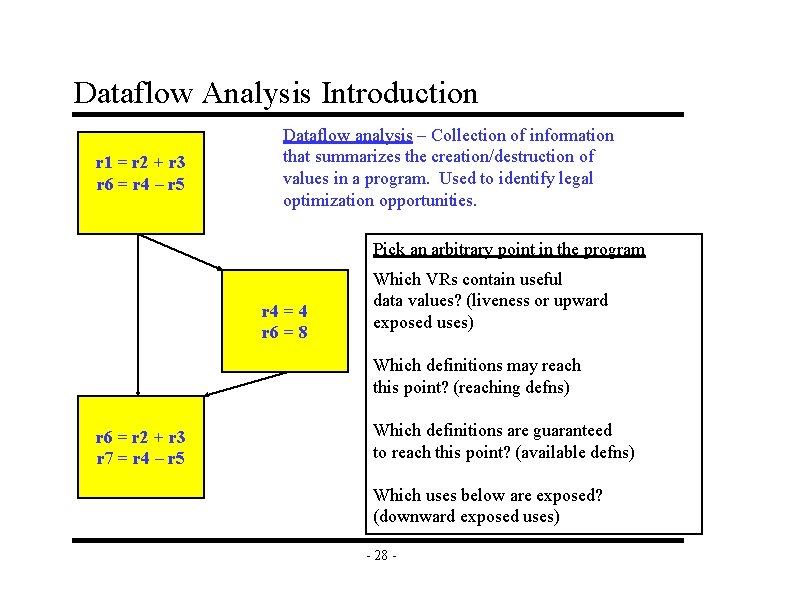
Dataflow Analysis Introduction r 1 = r 2 + r 3 r 6 = r 4 – r 5 Dataflow analysis – Collection of information that summarizes the creation/destruction of values in a program. Used to identify legal optimization opportunities. Pick an arbitrary point in the program r 4 = 4 r 6 = 8 Which VRs contain useful data values? (liveness or upward exposed uses) Which definitions may reach this point? (reaching defns) r 6 = r 2 + r 3 r 7 = r 4 – r 5 Which definitions are guaranteed to reach this point? (available defns) Which uses below are exposed? (downward exposed uses) - 28 -
Live Variable (Liveness) Analysis v v Defn: For each point p in a program and each variable y, determine whether y can be used before being redefined starting at p Algorithm sketch » For each BB, y is live if it is used before defined in the BB or it is live leaving the block » Backward dataflow analysis as propagation occurs from uses upwards to defs v 4 sets » GEN = set of external variables consumed in the BB » KILL = set of external variable uses killed by the BB Ÿ equivalent to set of variables defined by the BB » IN = set of variables that are live at the entry point of a BB » OUT = set of variables that are live at the exit point of a BB - 29 -

Computing GEN/KILL Sets For Each BB for each basic block in the procedure, X, do GEN(X) = 0 KILL(X) = 0 for each operation in reverse sequential order in X, op, do for each destination operand of op, dest, do GEN(X) -= dest KILL(X) += dest endfor each source operand of op, src, do GEN(X) += src KILL(X) -= src endfor - 30 -
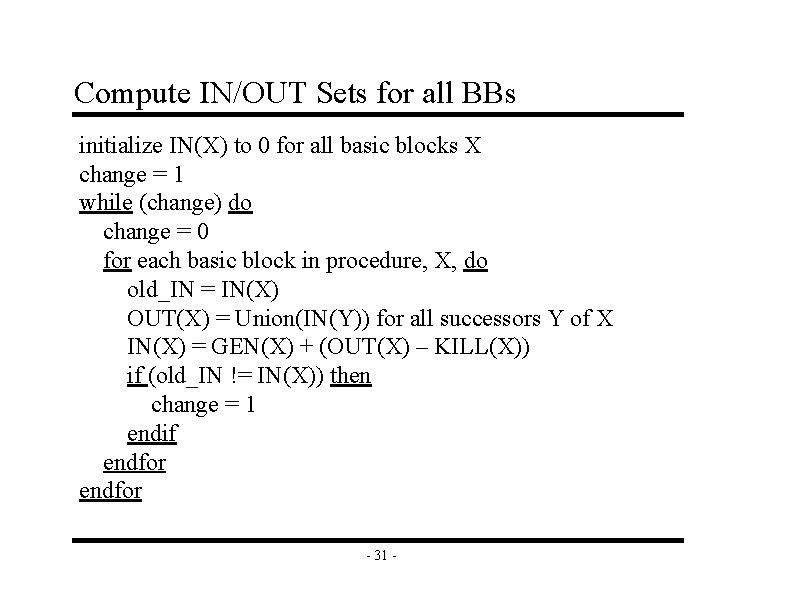
Compute IN/OUT Sets for all BBs initialize IN(X) to 0 for all basic blocks X change = 1 while (change) do change = 0 for each basic block in procedure, X, do old_IN = IN(X) OUT(X) = Union(IN(Y)) for all successors Y of X IN(X) = GEN(X) + (OUT(X) – KILL(X)) if (old_IN != IN(X)) then change = 1 endif endfor - 31 -
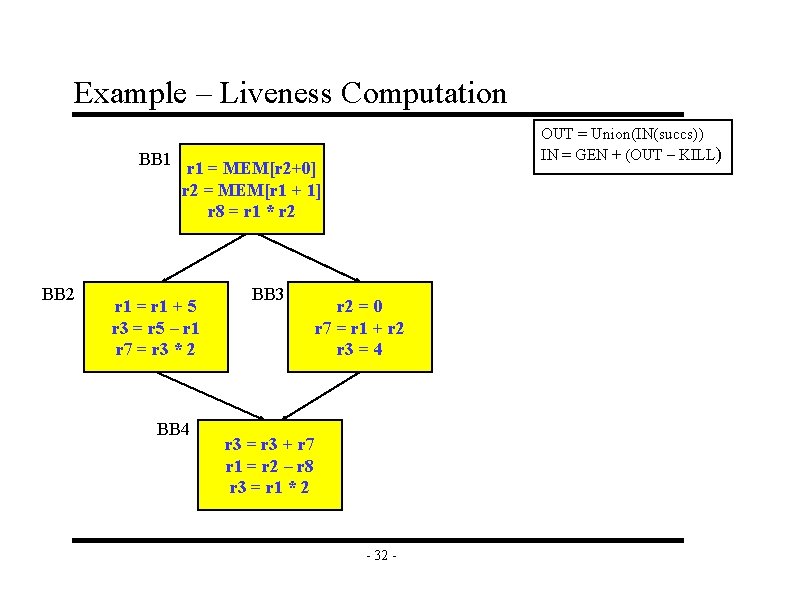
Example – Liveness Computation BB 1 BB 2 OUT = Union(IN(succs)) IN = GEN + (OUT – KILL) r 1 = MEM[r 2+0] r 2 = MEM[r 1 + 1] r 8 = r 1 * r 2 r 1 = r 1 + 5 r 3 = r 5 – r 1 r 7 = r 3 * 2 BB 4 BB 3 r 2 = 0 r 7 = r 1 + r 2 r 3 = 4 r 3 = r 3 + r 7 r 1 = r 2 – r 8 r 3 = r 1 * 2 - 32 -
- Slides: 33