EECS 583 Class 5 Dataflow Analysis University of

- Slides: 17
EECS 583 – Class 5 Dataflow Analysis University of Michigan September 19, 2018
Reading Material + Announcements v Reminder – HW 1 due next Monday at midnight » Submit uniquename_hw 1. tgz file to: Ÿ eecs 583 a. eecs. umich. edu: /hw 1_submissions » Before asking questions: 1) Read all threads on piazza, 2) Think a bit Ÿ Then, post question or talk to Ze if you are stuck v Today’s class » Compilers: Principles, Techniques, and Tools, A. Aho, R. Sethi, and J. Ullman, Addison-Wesley, 1988. (Chapters: 10. 5, 10. 6 Edition 1; Chapters 9. 2 Edition 2) v Material for next Monday » Compilers: Principles, Techniques, and Tools, A. Aho, R. Sethi, and J. Ullman, Addison-Wesley, 1988. (Chapters: 10. 5, 10. 6, 10. 9, 10. 10 Edition 1; Chapters 9. 2, 9. 3 Edition 2) -1 -
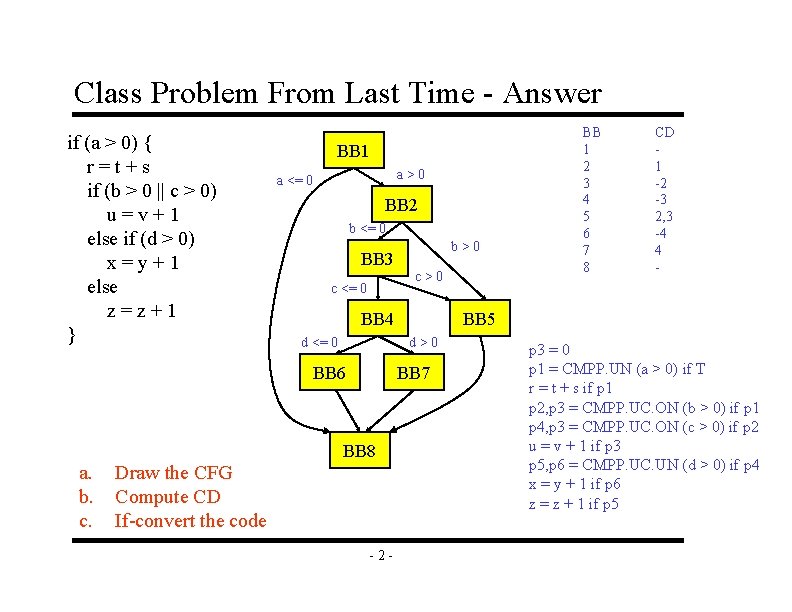
Class Problem From Last Time - Answer if (a > 0) { r=t+s if (b > 0 || c > 0) u=v+1 else if (d > 0) x=y+1 else z=z+1 } BB 1 a>0 a <= 0 BB 2 b <= 0 BB 3 c>0 c <= 0 BB 4 d <= 0 BB 7 BB 8 Draw the CFG Compute CD If-convert the code -2 - CD 1 -2 -3 2, 3 -4 4 - BB 5 d>0 BB 6 a. b. c. b>0 BB 1 2 3 4 5 6 7 8 p 3 = 0 p 1 = CMPP. UN (a > 0) if T r = t + s if p 1 p 2, p 3 = CMPP. UC. ON (b > 0) if p 1 p 4, p 3 = CMPP. UC. ON (c > 0) if p 2 u = v + 1 if p 3 p 5, p 6 = CMPP. UC. UN (d > 0) if p 4 x = y + 1 if p 6 z = z + 1 if p 5
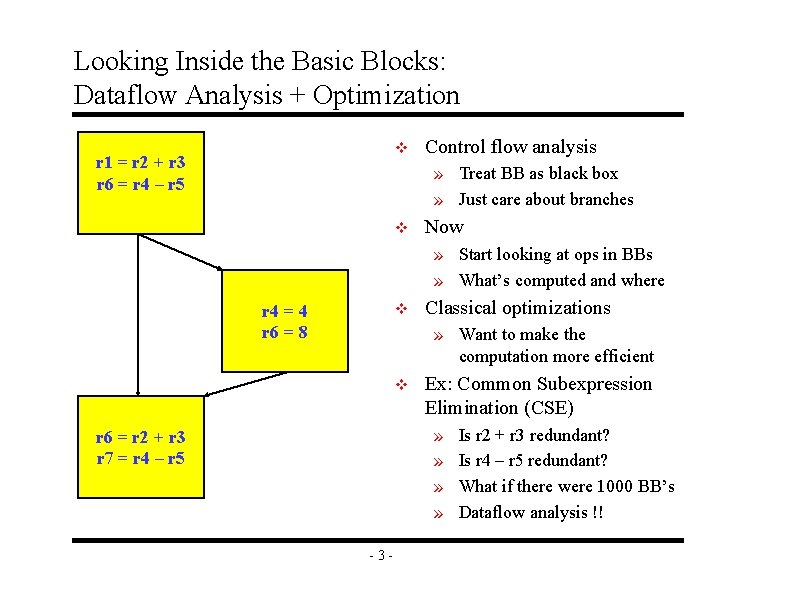
Looking Inside the Basic Blocks: Dataflow Analysis + Optimization v r 1 = r 2 + r 3 r 6 = r 4 – r 5 Control flow analysis » Treat BB as black box » Just care about branches v Now » Start looking at ops in BBs » What’s computed and where v r 4 = 4 r 6 = 8 Classical optimizations » Want to make the computation more efficient v Ex: Common Subexpression Elimination (CSE) » » r 6 = r 2 + r 3 r 7 = r 4 – r 5 -3 - Is r 2 + r 3 redundant? Is r 4 – r 5 redundant? What if there were 1000 BB’s Dataflow analysis !!
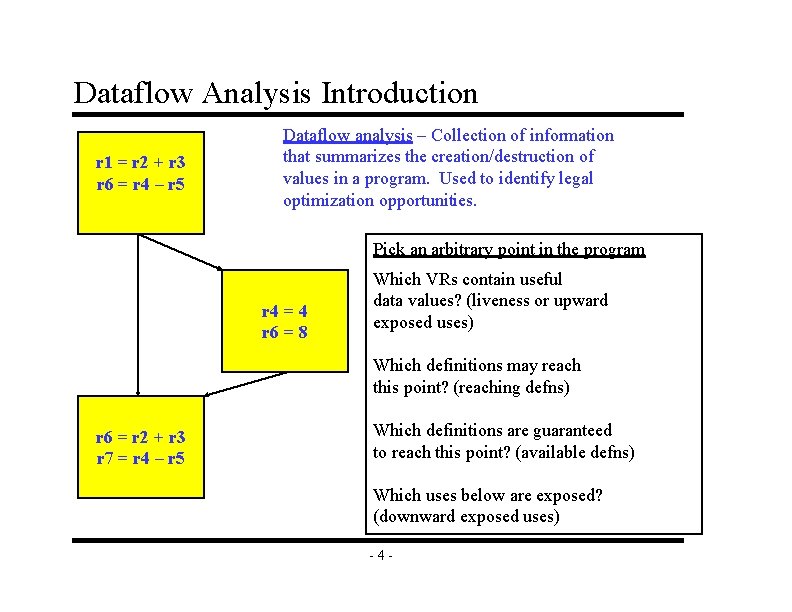
Dataflow Analysis Introduction r 1 = r 2 + r 3 r 6 = r 4 – r 5 Dataflow analysis – Collection of information that summarizes the creation/destruction of values in a program. Used to identify legal optimization opportunities. Pick an arbitrary point in the program r 4 = 4 r 6 = 8 Which VRs contain useful data values? (liveness or upward exposed uses) Which definitions may reach this point? (reaching defns) r 6 = r 2 + r 3 r 7 = r 4 – r 5 Which definitions are guaranteed to reach this point? (available defns) Which uses below are exposed? (downward exposed uses) -4 -
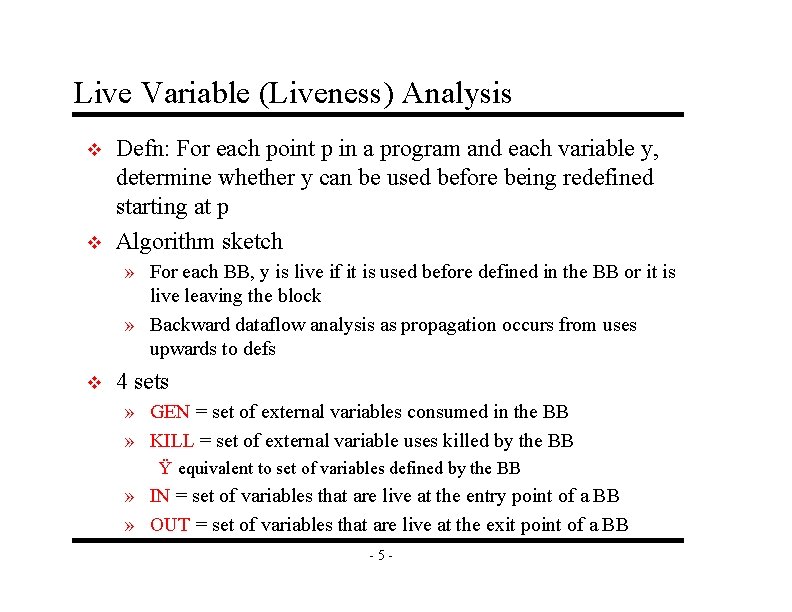
Live Variable (Liveness) Analysis v v Defn: For each point p in a program and each variable y, determine whether y can be used before being redefined starting at p Algorithm sketch » For each BB, y is live if it is used before defined in the BB or it is live leaving the block » Backward dataflow analysis as propagation occurs from uses upwards to defs v 4 sets » GEN = set of external variables consumed in the BB » KILL = set of external variable uses killed by the BB Ÿ equivalent to set of variables defined by the BB » IN = set of variables that are live at the entry point of a BB » OUT = set of variables that are live at the exit point of a BB -5 -
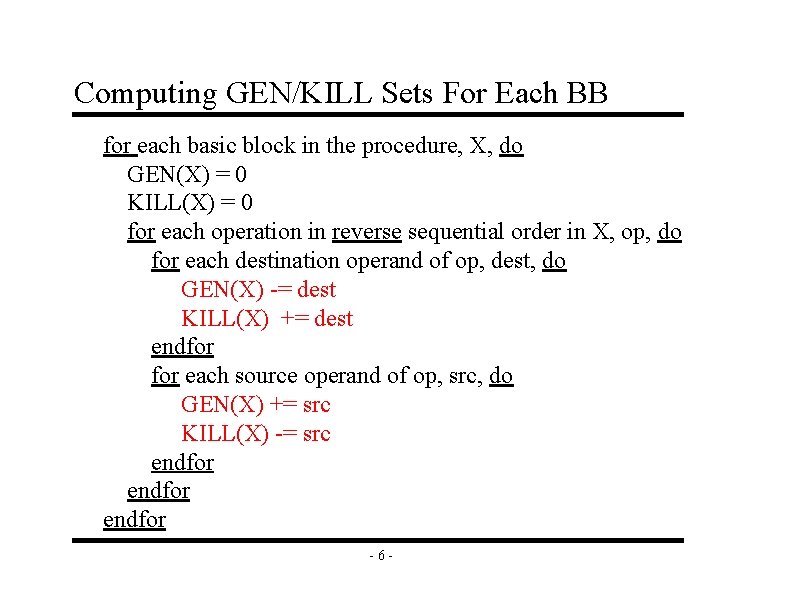
Computing GEN/KILL Sets For Each BB for each basic block in the procedure, X, do GEN(X) = 0 KILL(X) = 0 for each operation in reverse sequential order in X, op, do for each destination operand of op, dest, do GEN(X) -= dest KILL(X) += dest endfor each source operand of op, src, do GEN(X) += src KILL(X) -= src endfor -6 -
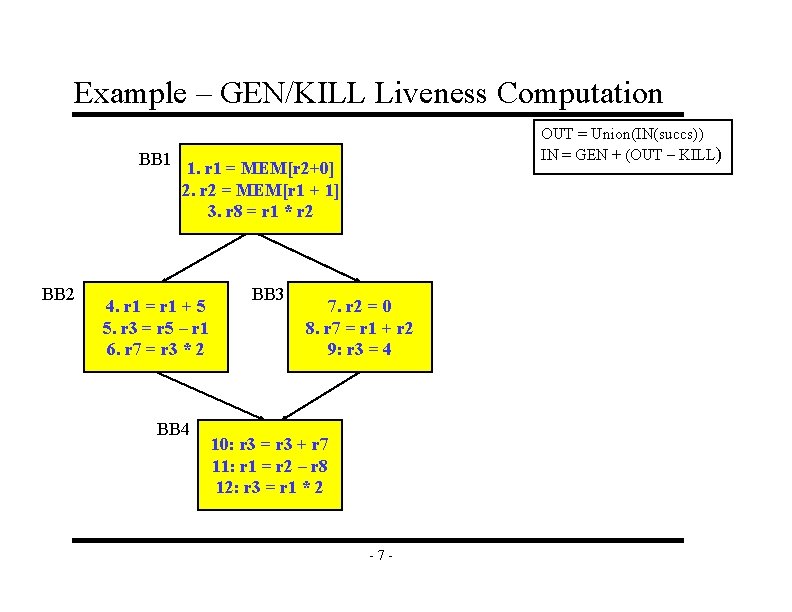
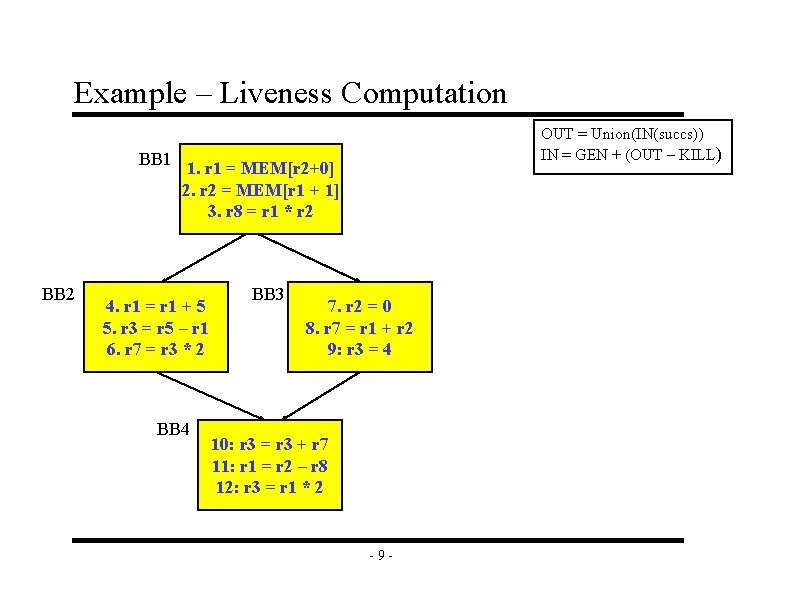
Example – GEN/KILL Liveness Computation BB 1 BB 2 OUT = Union(IN(succs)) IN = GEN + (OUT – KILL) 1. r 1 = MEM[r 2+0] 2. r 2 = MEM[r 1 + 1] 3. r 8 = r 1 * r 2 4. r 1 = r 1 + 5 5. r 3 = r 5 – r 1 6. r 7 = r 3 * 2 BB 4 BB 3 7. r 2 = 0 8. r 7 = r 1 + r 2 9: r 3 = 4 10: r 3 = r 3 + r 7 11: r 1 = r 2 – r 8 12: r 3 = r 1 * 2 -7 -
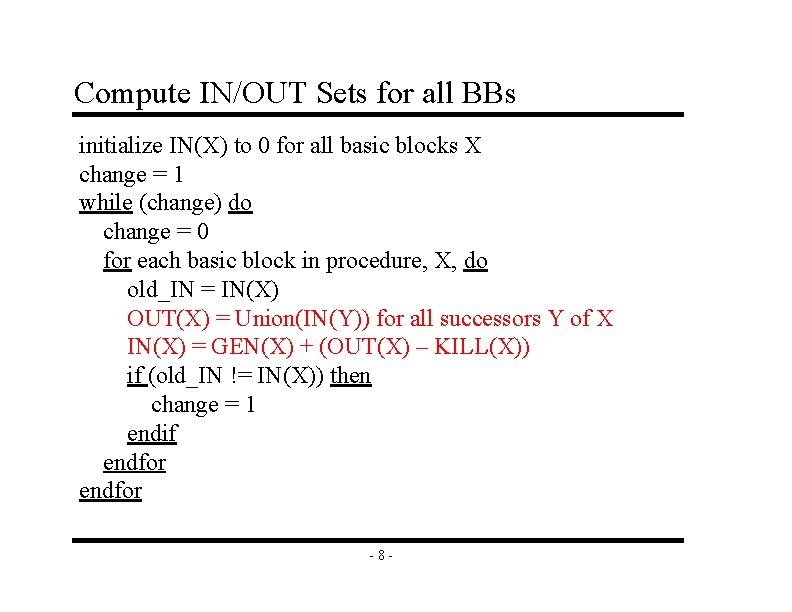
Compute IN/OUT Sets for all BBs initialize IN(X) to 0 for all basic blocks X change = 1 while (change) do change = 0 for each basic block in procedure, X, do old_IN = IN(X) OUT(X) = Union(IN(Y)) for all successors Y of X IN(X) = GEN(X) + (OUT(X) – KILL(X)) if (old_IN != IN(X)) then change = 1 endif endfor -8 -
Example – Liveness Computation BB 1 BB 2 OUT = Union(IN(succs)) IN = GEN + (OUT – KILL) 1. r 1 = MEM[r 2+0] 2. r 2 = MEM[r 1 + 1] 3. r 8 = r 1 * r 2 4. r 1 = r 1 + 5 5. r 3 = r 5 – r 1 6. r 7 = r 3 * 2 BB 4 BB 3 7. r 2 = 0 8. r 7 = r 1 + r 2 9: r 3 = 4 10: r 3 = r 3 + r 7 11: r 1 = r 2 – r 8 12: r 3 = r 1 * 2 -9 -
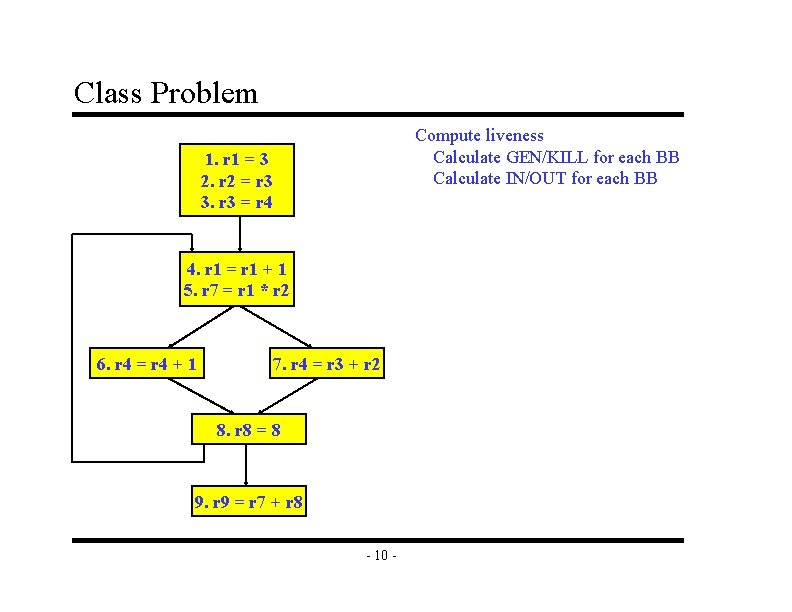
Class Problem Compute liveness Calculate GEN/KILL for each BB Calculate IN/OUT for each BB 1. r 1 = 3 2. r 2 = r 3 3. r 3 = r 4 4. r 1 = r 1 + 1 5. r 7 = r 1 * r 2 6. r 4 = r 4 + 1 7. r 4 = r 3 + r 2 8. r 8 = 8 9. r 9 = r 7 + r 8 - 10 -
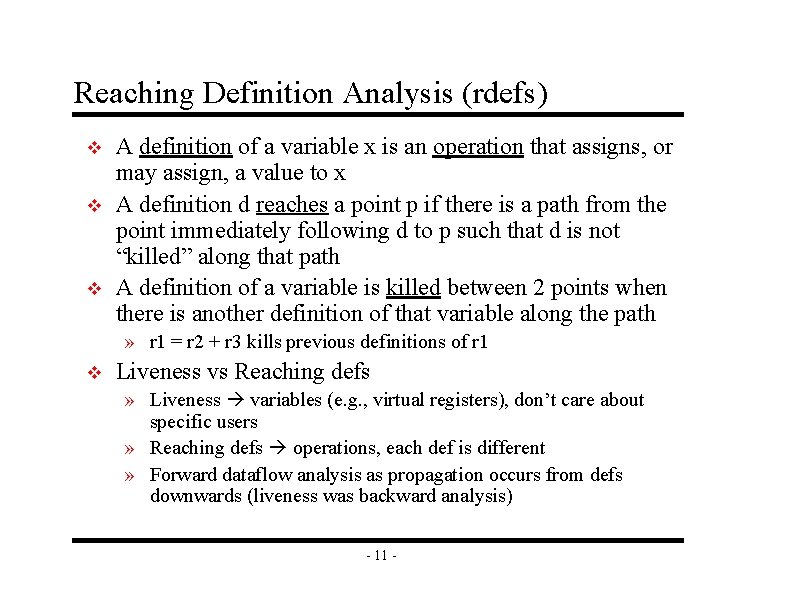
Reaching Definition Analysis (rdefs) v v v A definition of a variable x is an operation that assigns, or may assign, a value to x A definition d reaches a point p if there is a path from the point immediately following d to p such that d is not “killed” along that path A definition of a variable is killed between 2 points when there is another definition of that variable along the path » r 1 = r 2 + r 3 kills previous definitions of r 1 v Liveness vs Reaching defs » Liveness variables (e. g. , virtual registers), don’t care about specific users » Reaching defs operations, each def is different » Forward dataflow analysis as propagation occurs from defs downwards (liveness was backward analysis) - 11 -
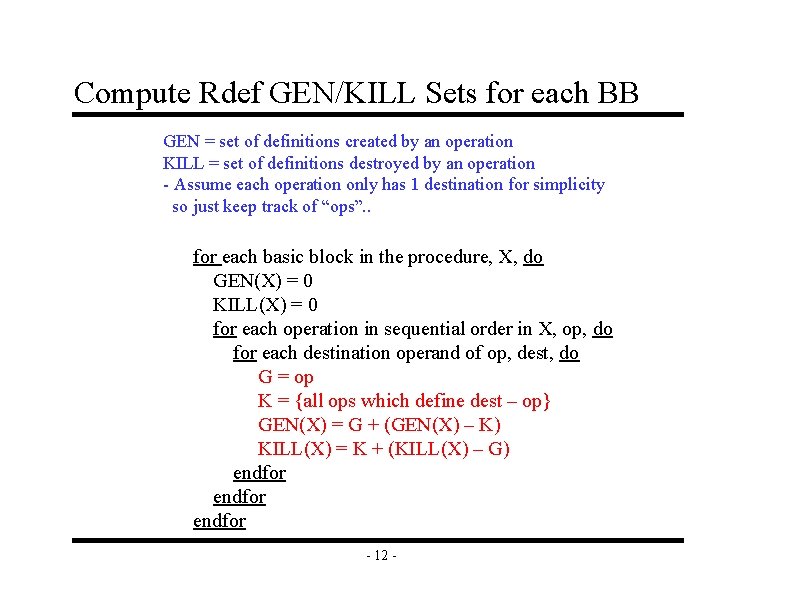
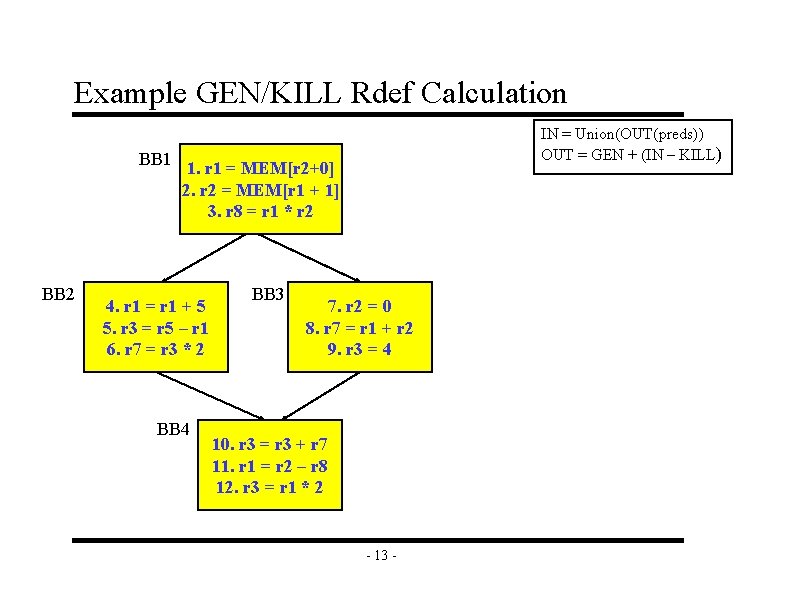
Compute Rdef GEN/KILL Sets for each BB GEN = set of definitions created by an operation KILL = set of definitions destroyed by an operation - Assume each operation only has 1 destination for simplicity so just keep track of “ops”. . for each basic block in the procedure, X, do GEN(X) = 0 KILL(X) = 0 for each operation in sequential order in X, op, do for each destination operand of op, dest, do G = op K = {all ops which define dest – op} GEN(X) = G + (GEN(X) – K) KILL(X) = K + (KILL(X) – G) endfor - 12 -
Example GEN/KILL Rdef Calculation BB 1 BB 2 IN = Union(OUT(preds)) OUT = GEN + (IN – KILL) 1. r 1 = MEM[r 2+0] 2. r 2 = MEM[r 1 + 1] 3. r 8 = r 1 * r 2 4. r 1 = r 1 + 5 5. r 3 = r 5 – r 1 6. r 7 = r 3 * 2 BB 4 BB 3 7. r 2 = 0 8. r 7 = r 1 + r 2 9. r 3 = 4 10. r 3 = r 3 + r 7 11. r 1 = r 2 – r 8 12. r 3 = r 1 * 2 - 13 -
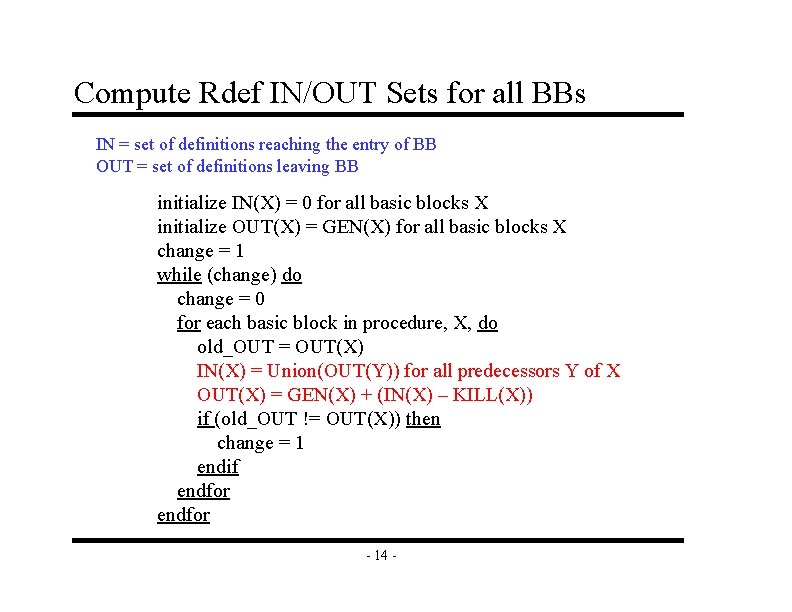
Compute Rdef IN/OUT Sets for all BBs IN = set of definitions reaching the entry of BB OUT = set of definitions leaving BB initialize IN(X) = 0 for all basic blocks X initialize OUT(X) = GEN(X) for all basic blocks X change = 1 while (change) do change = 0 for each basic block in procedure, X, do old_OUT = OUT(X) IN(X) = Union(OUT(Y)) for all predecessors Y of X OUT(X) = GEN(X) + (IN(X) – KILL(X)) if (old_OUT != OUT(X)) then change = 1 endif endfor - 14 -
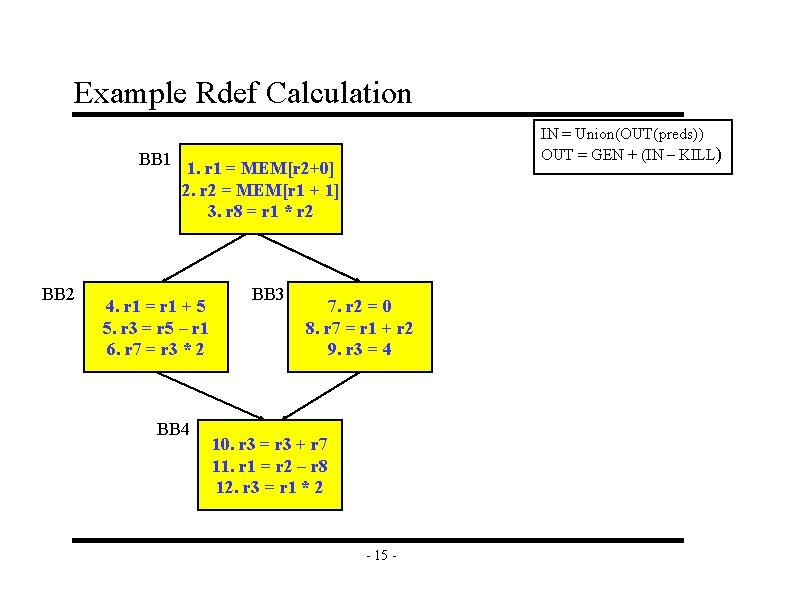
Example Rdef Calculation BB 1 BB 2 IN = Union(OUT(preds)) OUT = GEN + (IN – KILL) 1. r 1 = MEM[r 2+0] 2. r 2 = MEM[r 1 + 1] 3. r 8 = r 1 * r 2 4. r 1 = r 1 + 5 5. r 3 = r 5 – r 1 6. r 7 = r 3 * 2 BB 4 BB 3 7. r 2 = 0 8. r 7 = r 1 + r 2 9. r 3 = 4 10. r 3 = r 3 + r 7 11. r 1 = r 2 – r 8 12. r 3 = r 1 * 2 - 15 -
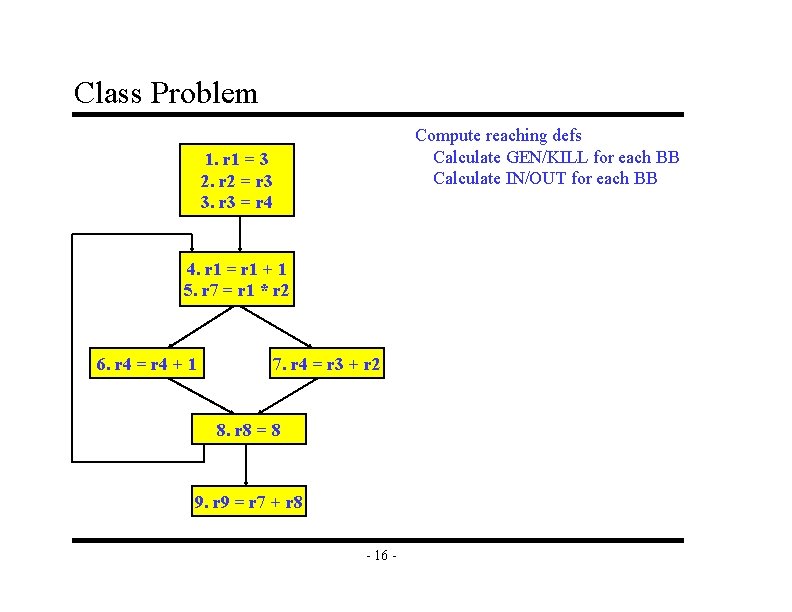
Class Problem Compute reaching defs Calculate GEN/KILL for each BB Calculate IN/OUT for each BB 1. r 1 = 3 2. r 2 = r 3 3. r 3 = r 4 4. r 1 = r 1 + 1 5. r 7 = r 1 * r 2 6. r 4 = r 4 + 1 7. r 4 = r 3 + r 2 8. r 8 = 8 9. r 9 = r 7 + r 8 - 16 -