EE 105 Spring 2007 Microelectronic Devices and Circuits

- Slides: 19
EE 105 - Spring 2007 Microelectronic Devices and Circuits Prof. Ming C. Wu wu@eecs 261 M Cory Hall
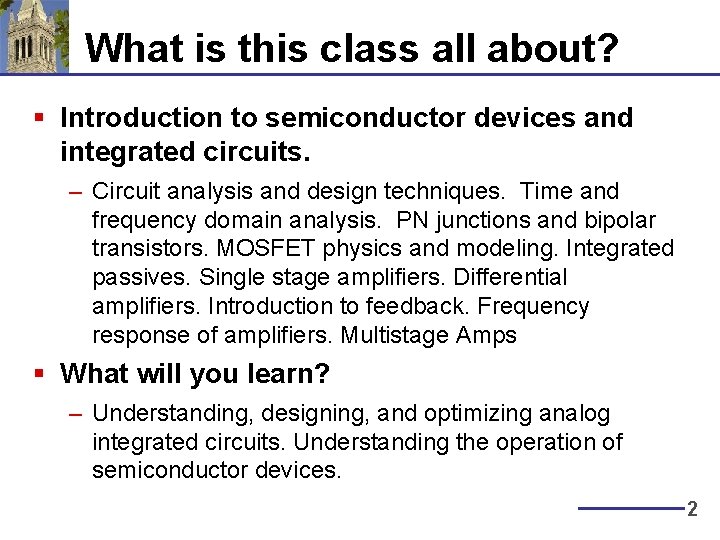
What is this class all about? § Introduction to semiconductor devices and integrated circuits. – Circuit analysis and design techniques. Time and frequency domain analysis. PN junctions and bipolar transistors. MOSFET physics and modeling. Integrated passives. Single stage amplifiers. Differential amplifiers. Introduction to feedback. Frequency response of amplifiers. Multistage Amps § What will you learn? – Understanding, designing, and optimizing analog integrated circuits. Understanding the operation of semiconductor devices. 2
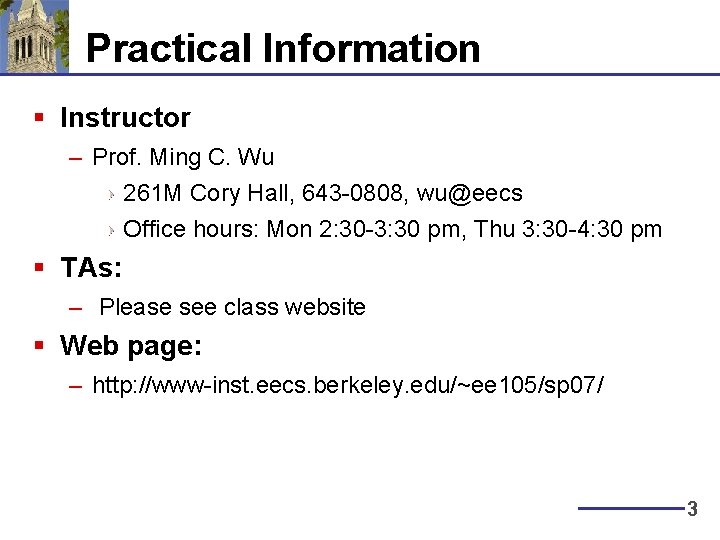
Practical Information § Instructor – Prof. Ming C. Wu 261 M Cory Hall, 643 -0808, wu@eecs Office hours: Mon 2: 30 -3: 30 pm, Thu 3: 30 -4: 30 pm § TAs: – Please see class website § Web page: – http: //www-inst. eecs. berkeley. edu/~ee 105/sp 07/ 3
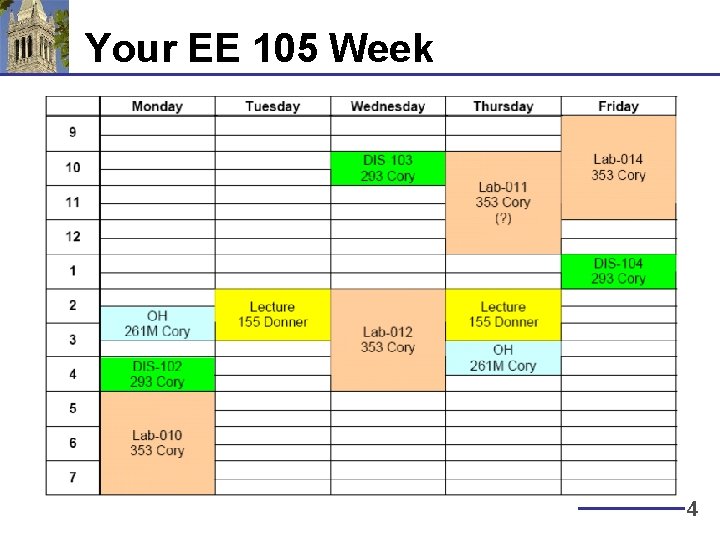
Your EE 105 Week 4
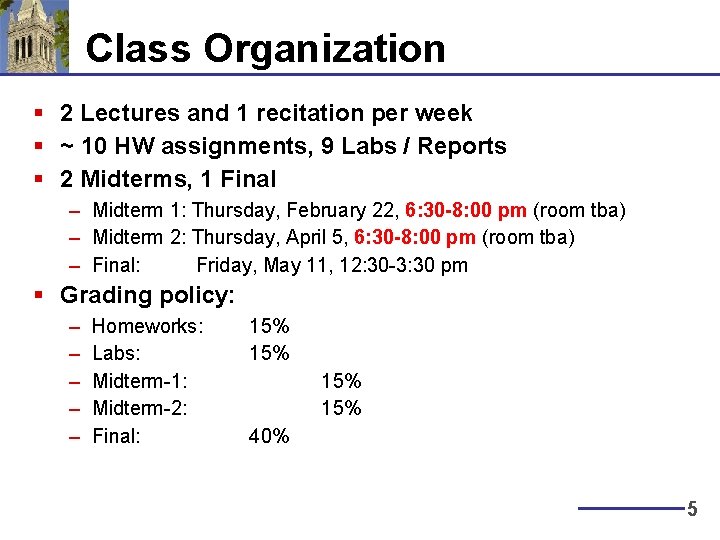
Class Organization § 2 Lectures and 1 recitation per week § ~ 10 HW assignments, 9 Labs / Reports § 2 Midterms, 1 Final – Midterm 1: Thursday, February 22, 6: 30 -8: 00 pm (room tba) – Midterm 2: Thursday, April 5, 6: 30 -8: 00 pm (room tba) – Final: Friday, May 11, 12: 30 -3: 30 pm § Grading policy: – – – Homeworks: Labs: Midterm-1: Midterm-2: Final: 15% 15% 40% 5
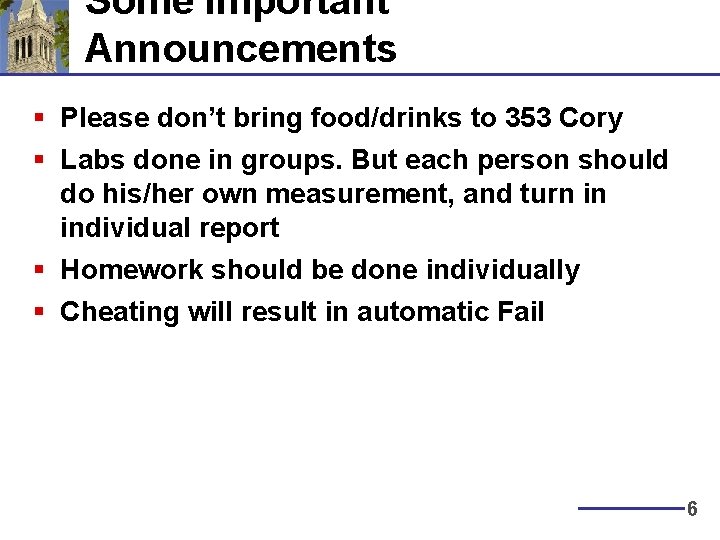
Some Important Announcements § Please don’t bring food/drinks to 353 Cory § Labs done in groups. But each person should do his/her own measurement, and turn in individual report § Homework should be done individually § Cheating will result in automatic Fail 6
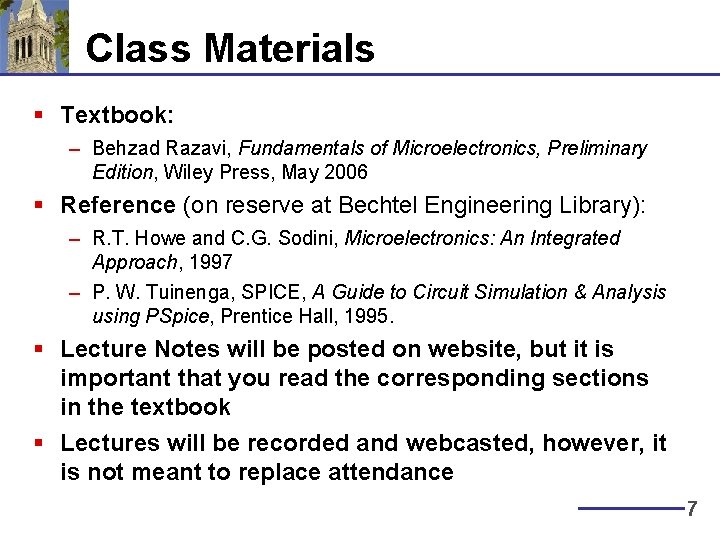
Class Materials § Textbook: – Behzad Razavi, Fundamentals of Microelectronics, Preliminary Edition, Wiley Press, May 2006 § Reference (on reserve at Bechtel Engineering Library): – R. T. Howe and C. G. Sodini, Microelectronics: An Integrated Approach, 1997 – P. W. Tuinenga, SPICE, A Guide to Circuit Simulation & Analysis using PSpice, Prentice Hall, 1995. § Lecture Notes will be posted on website, but it is important that you read the corresponding sections in the textbook § Lectures will be recorded and webcasted, however, it is not meant to replace attendance 7
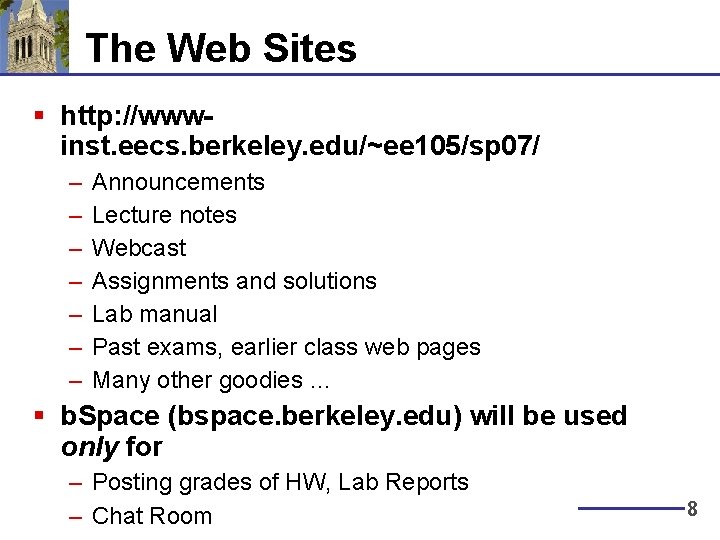
The Web Sites § http: //wwwinst. eecs. berkeley. edu/~ee 105/sp 07/ – – – – Announcements Lecture notes Webcast Assignments and solutions Lab manual Past exams, earlier class web pages Many other goodies … § b. Space (bspace. berkeley. edu) will be used only for – Posting grades of HW, Lab Reports – Chat Room 8
Software § HSPICE – Industry standard – Online tutorials § There are free versions of Win. Spice and PSPICE that you can use at home 9
Getting Started § Assignment 1: – Assigned next Tuesday, Due 1/30 (Tuesday), 5 pm § NO discussion sessions or labs this week. § First discussion sessions in Week 2 § First lab in Week 3 10
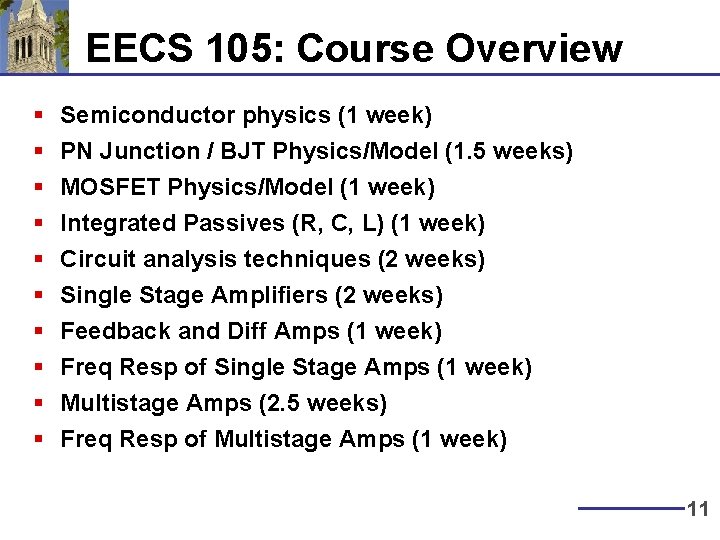
EECS 105: Course Overview § § § § § Semiconductor physics (1 week) PN Junction / BJT Physics/Model (1. 5 weeks) MOSFET Physics/Model (1 week) Integrated Passives (R, C, L) (1 week) Circuit analysis techniques (2 weeks) Single Stage Amplifiers (2 weeks) Feedback and Diff Amps (1 week) Freq Resp of Single Stage Amps (1 week) Multistage Amps (2. 5 weeks) Freq Resp of Multistage Amps (1 week) 11
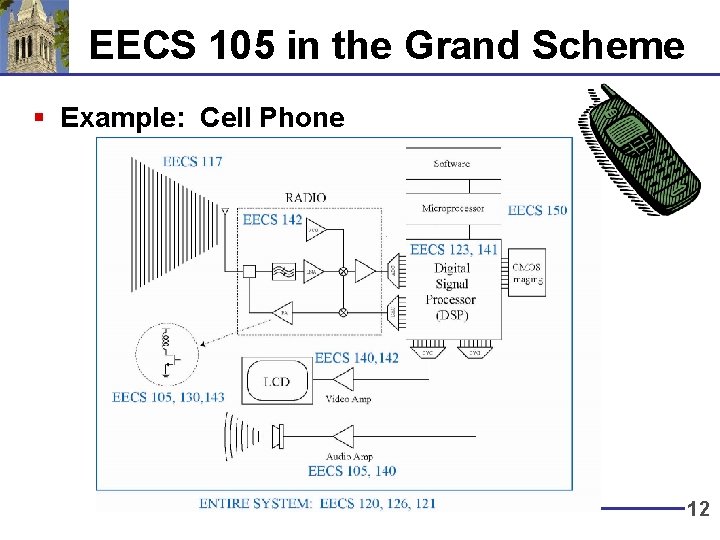
EECS 105 in the Grand Scheme § Example: Cell Phone 12
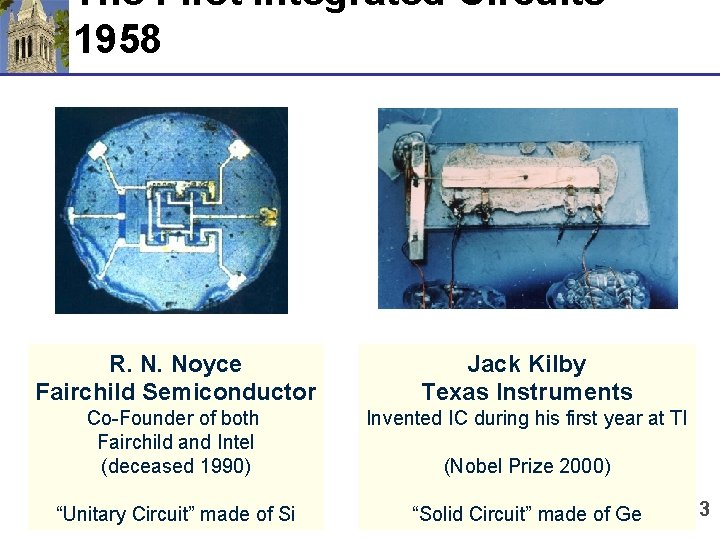
The First Integrated Circuits 1958 R. N. Noyce Fairchild Semiconductor Jack Kilby Texas Instruments Co-Founder of both Fairchild and Intel (deceased 1990) Invented IC during his first year at TI “Unitary Circuit” made of Si “Solid Circuit” made of Ge (Nobel Prize 2000) 13
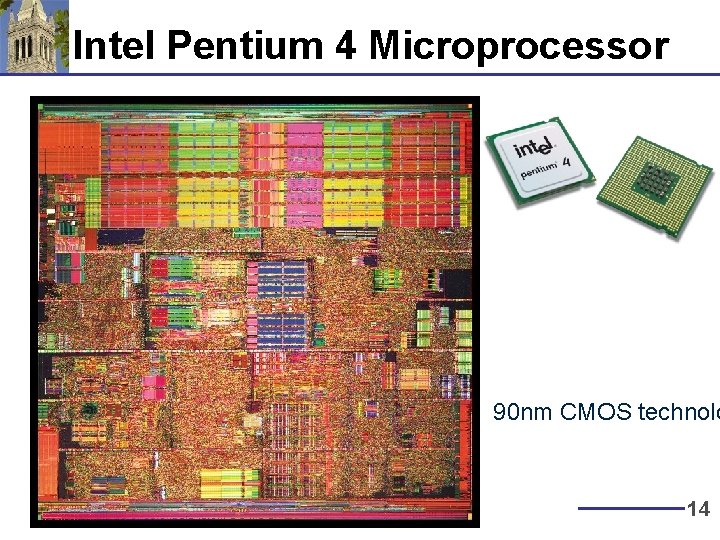
Intel Pentium 4 Microprocessor 90 nm CMOS technolo 14
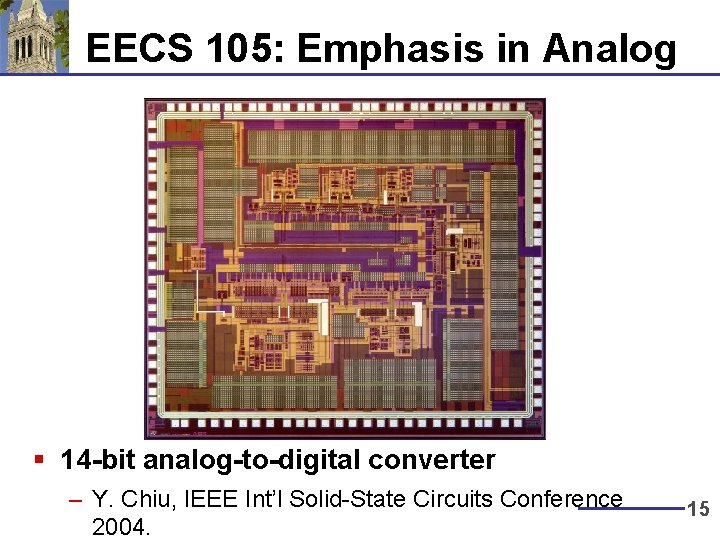
EECS 105: Emphasis in Analog § 14 -bit analog-to-digital converter – Y. Chiu, IEEE Int’l Solid-State Circuits Conference 2004. 15
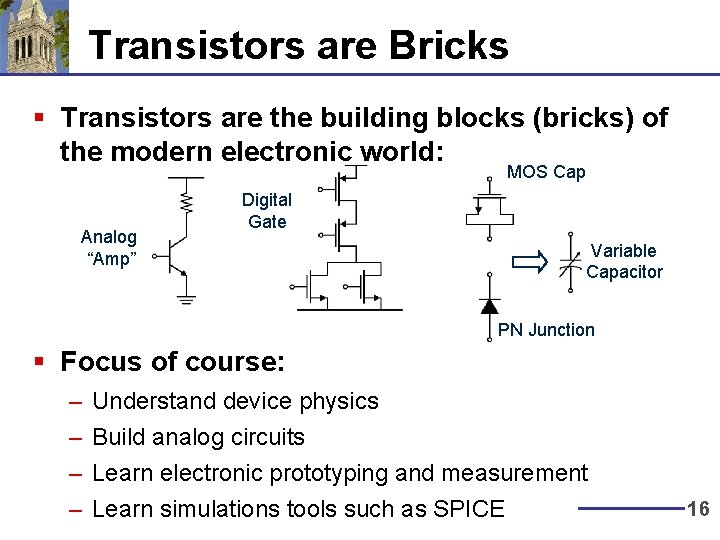
Transistors are Bricks § Transistors are the building blocks (bricks) of the modern electronic world: MOS Cap Analog “Amp” Digital Gate Variable Capacitor PN Junction § Focus of course: – – Understand device physics Build analog circuits Learn electronic prototyping and measurement Learn simulations tools such as SPICE 16
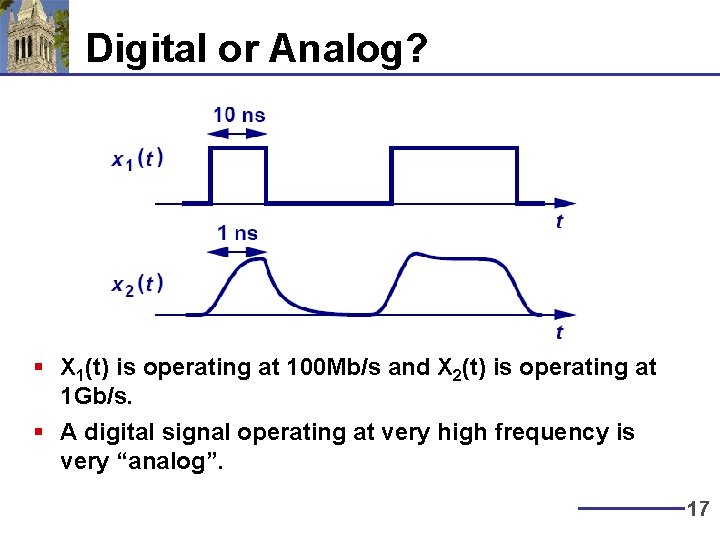
Digital or Analog? § X 1(t) is operating at 100 Mb/s and X 2(t) is operating at 1 Gb/s. § A digital signal operating at very high frequency is very “analog”. 17
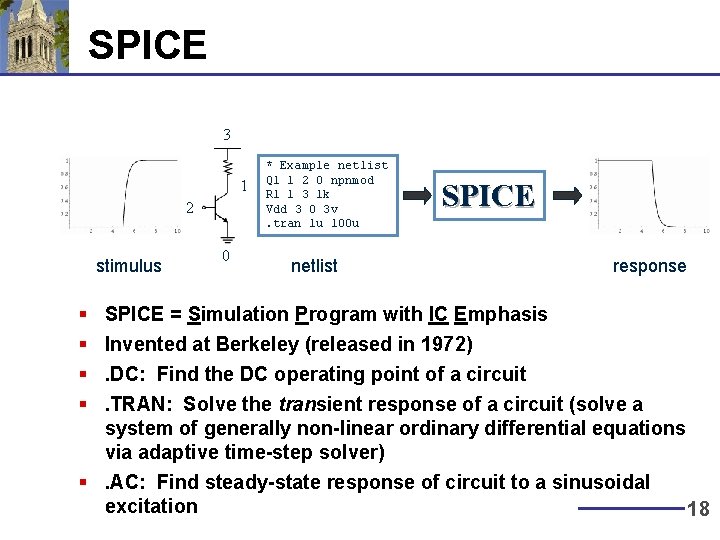
SPICE 3 1 2 stimulus § § 0 * Example netlist Q 1 1 2 0 npnmod R 1 1 3 1 k Vdd 3 0 3 v. tran 1 u 100 u SPICE netlist response SPICE = Simulation Program with IC Emphasis Invented at Berkeley (released in 1972) . DC: Find the DC operating point of a circuit. TRAN: Solve the transient response of a circuit (solve a system of generally non-linear ordinary differential equations via adaptive time-step solver) §. AC: Find steady-state response of circuit to a sinusoidal excitation 18
BSIM § Transistors are complicated. Accurate sim requires 2 D or 3 D numerical sim (TCAD) to solve coupled PDEs (quantum effects, electromagnetics, etc) § This is slow … a circuit with one transistor will take hours to simulation § How do you simulate large circuits (100 s-1000 s of transistors)? § Use compact models. In EECS 105 we will derive the so called “level 1” model for a MOSFET. § The BSIM family of models are the industry standard models for circuit simulation of advanced process transistors. § BSIM = Berkeley Short Channel IGFET Model 19