ECE 546 Lecture 12 MNA and SPICE Spring


- Slides: 37
ECE 546 Lecture -12 MNA and SPICE Spring 2014 Jose E. Schutt-Aine Electrical & Computer Engineering University of Illinois jesa@illinois. edu ECE 546 – Jose Schutt-Aine 1
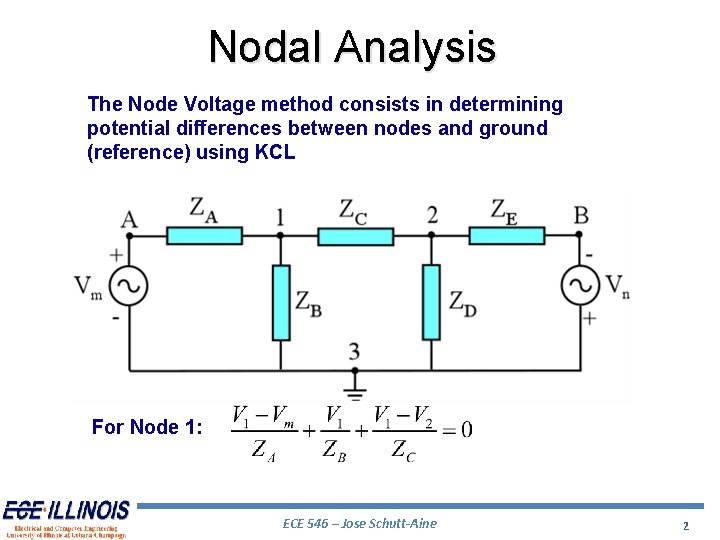
Nodal Analysis The Node Voltage method consists in determining potential differences between nodes and ground (reference) using KCL For Node 1: ECE 546 – Jose Schutt-Aine 2
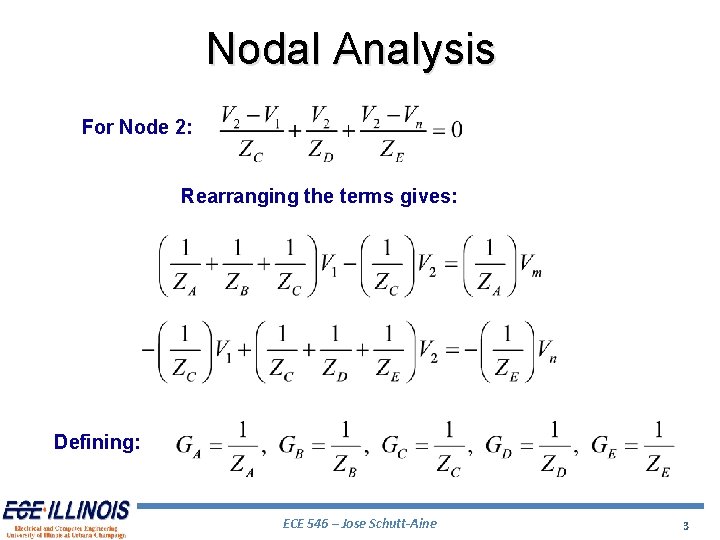
Nodal Analysis For Node 2: Rearranging the terms gives: Defining: ECE 546 – Jose Schutt-Aine 3
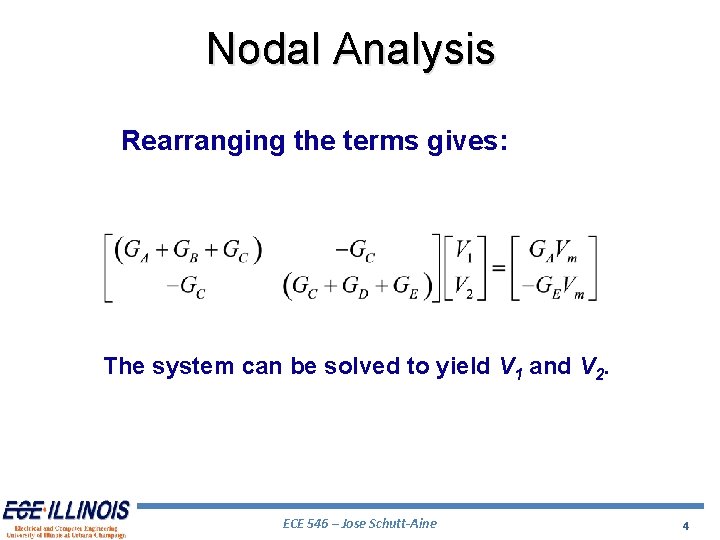
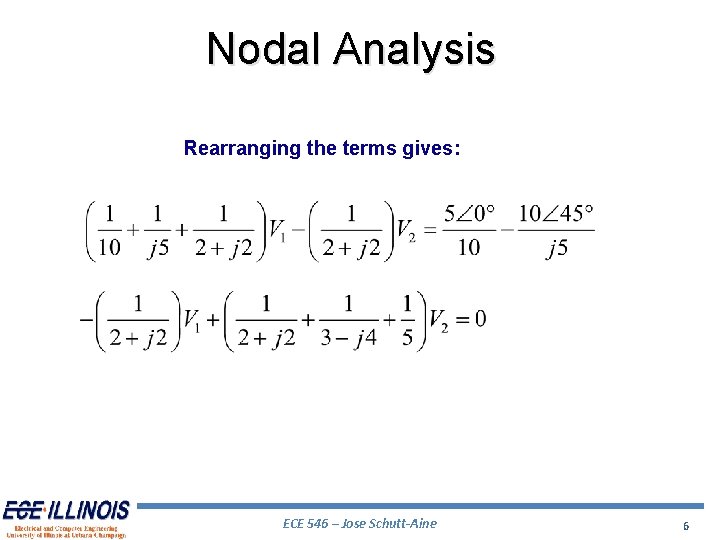
Nodal Analysis Rearranging the terms gives: The system can be solved to yield V 1 and V 2. ECE 546 – Jose Schutt-Aine 4
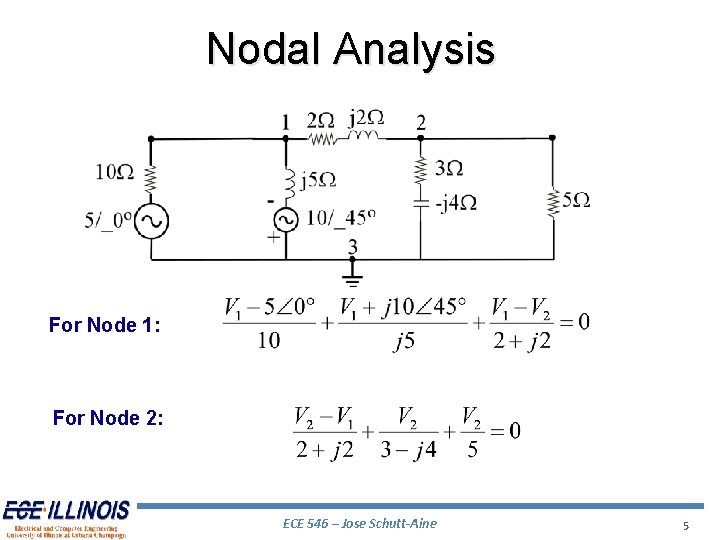
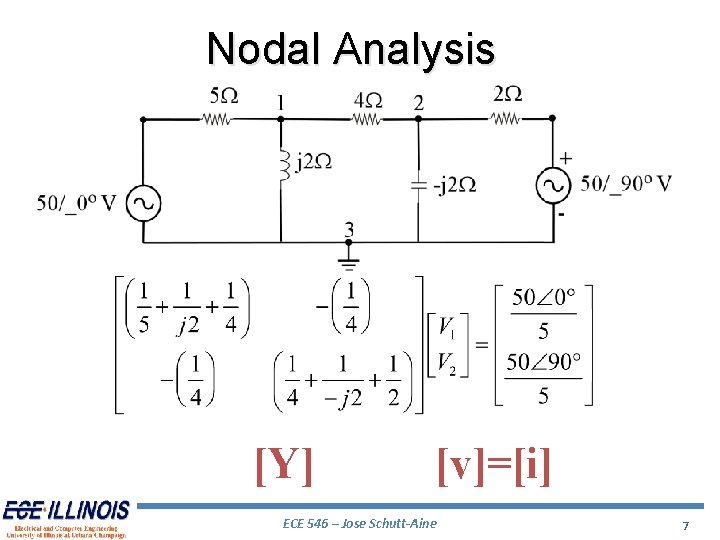
Nodal Analysis For Node 1: For Node 2: ECE 546 – Jose Schutt-Aine 5
Nodal Analysis Rearranging the terms gives: ECE 546 – Jose Schutt-Aine 6
Nodal Analysis [Y] [v]=[i] ECE 546 – Jose Schutt-Aine 7
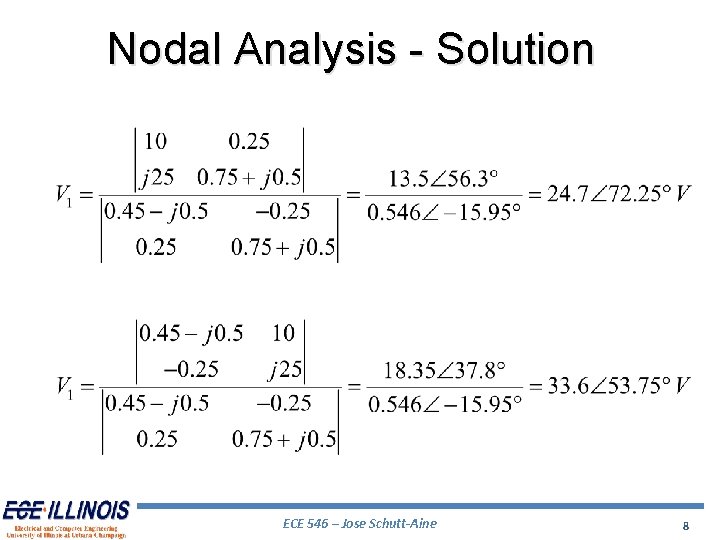
Nodal Analysis - Solution ECE 546 – Jose Schutt-Aine 8
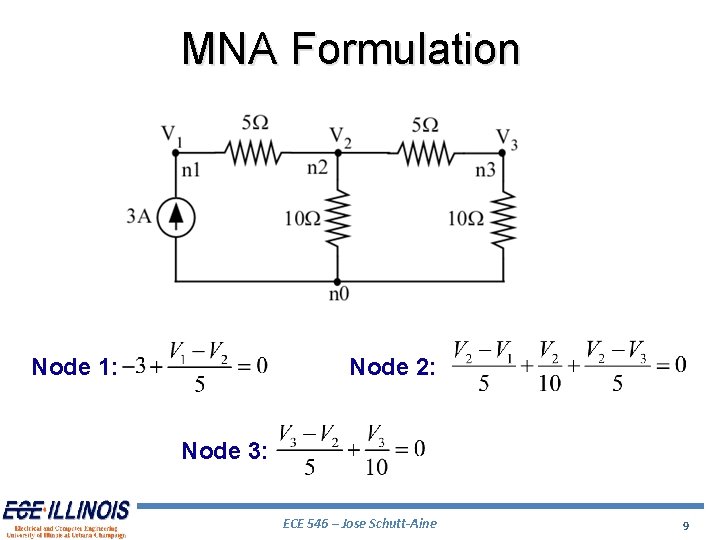
MNA Formulation Node 1: Node 2: Node 3: ECE 546 – Jose Schutt-Aine 9
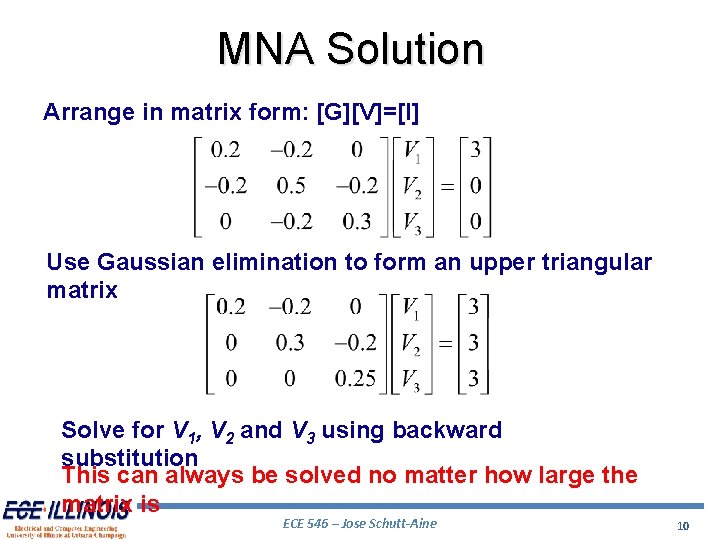
MNA Solution Arrange in matrix form: [G][V]=[I] Use Gaussian elimination to form an upper triangular matrix Solve for V 1, V 2 and V 3 using backward substitution This can always be solved no matter how large the matrix is ECE 546 – Jose Schutt-Aine 10
Why SPICE ? Established platform Powerful engine Source code available for free Extensive libraries of devices New device installation procedure easy ECE 546 – Jose Schutt-Aine 11
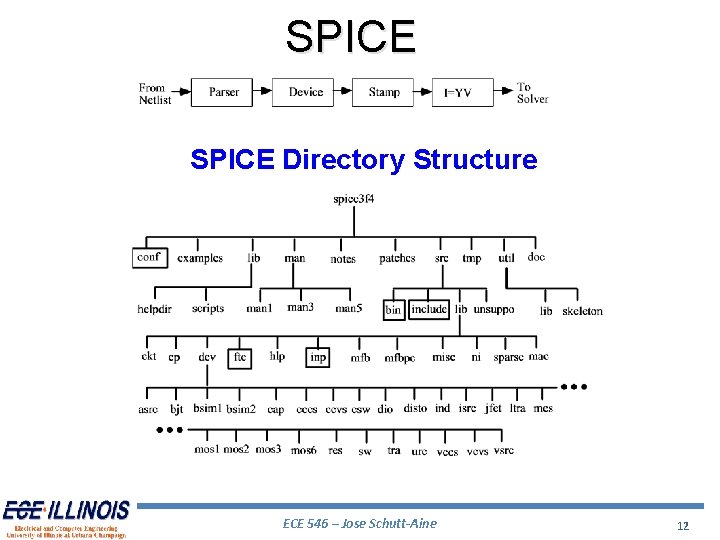
SPICE Directory Structure ECE 546 – Jose Schutt-Aine 12
MOS SPICE Parameters Symbol Description Value Units Ldrawn Device length (drawn) 0. 35 mm Leff Device length (effective) 0. 25 mm tox Gate oxide thickness 70 A Na Density of acceptor ions in NFET channel 1. 0 1017 cm-3 Nd Density of donor ions in PFET channel 2. 5 1017 cm-3 VTn NFET threshold voltage 0. 5 V VTp PFET threshold voltage -0. 5 V l Channel modulation parameter 0. 1 V-1 g Body effect parameter 0. 3 V 1/2 Vsat Saturation velocity 1. 7 105 m/s mn Electron mobility 400 cm 2/Vs mp Hole mobility 100 cm 2/Vs kn NFET process transconductance 200 m. A/V 2 kp PFET process transconductance 50 m. A/V 2 Cox Gate oxide capacitance per unit area 5 f. F/mm 2 CGSO, CGDO Gate source and drain overlap capacitance 0. 1 f. F/mm CJ Junction capacitance 0. 5 f. F/mm 2 CJSW Junction sidewall capacitance 0. 2 f. F/mm Rpoly Gate sheet resistance 4 W/square Rdiff Source and drain sheet resistance 4 W/square ECE 546 – Jose Schutt-Aine 13
Problems • Nonlinear Devices Ø Diodes, transistors cannot be simulated in the frequency domain Ø Capacitors and inductors are best described in the frequency domain Ø Use time-domain representation for reactive elements (capacitors and inductors) • Circuit Size Ø Matrix size becomes prohibitively large ECE 546 – Jose Schutt-Aine 14
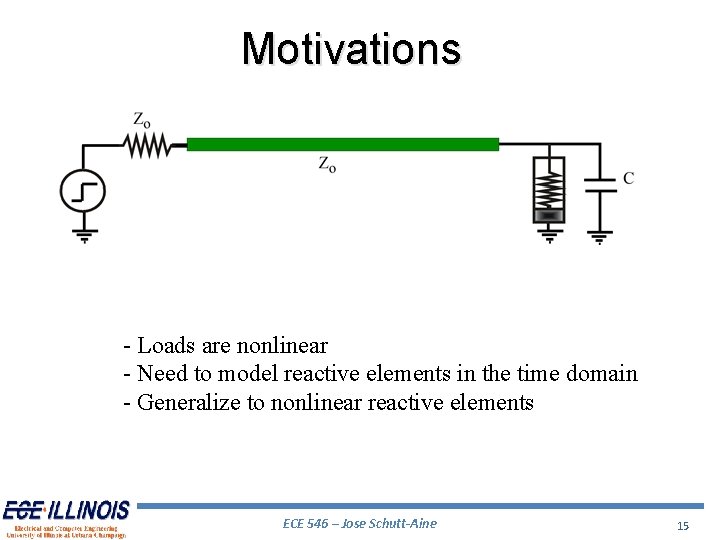
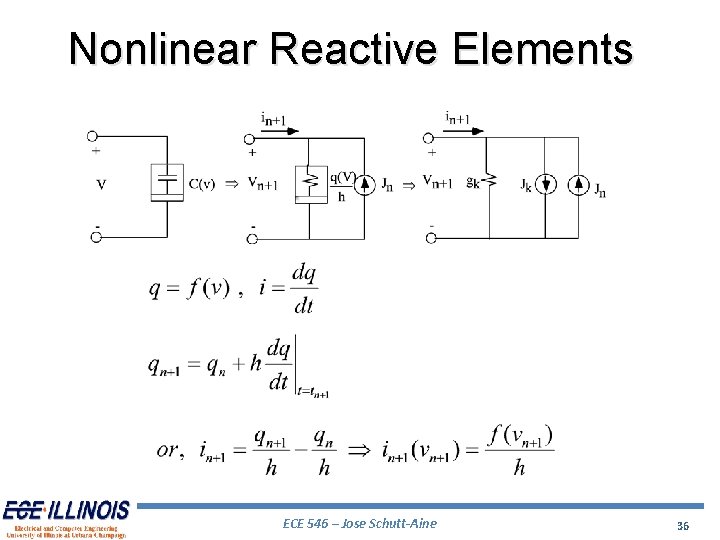
Motivations - Loads are nonlinear - Need to model reactive elements in the time domain - Generalize to nonlinear reactive elements ECE 546 – Jose Schutt-Aine 15
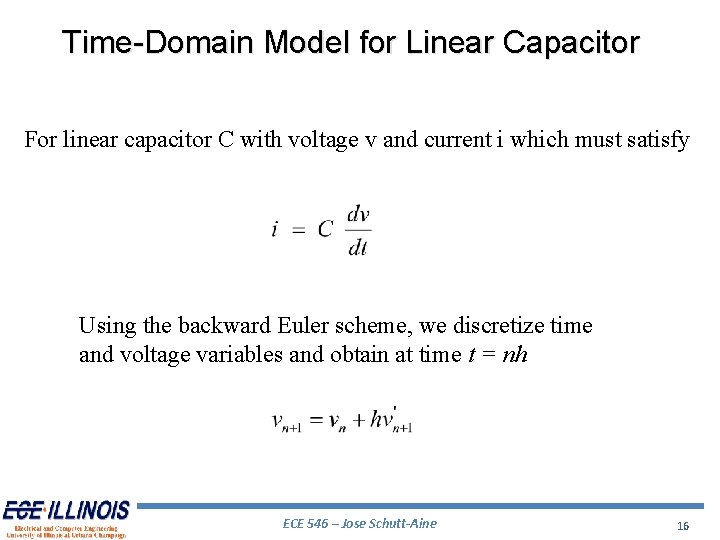
Time-Domain Model for Linear Capacitor For linear capacitor C with voltage v and current i which must satisfy Using the backward Euler scheme, we discretize time and voltage variables and obtain at time t = nh ECE 546 – Jose Schutt-Aine 16
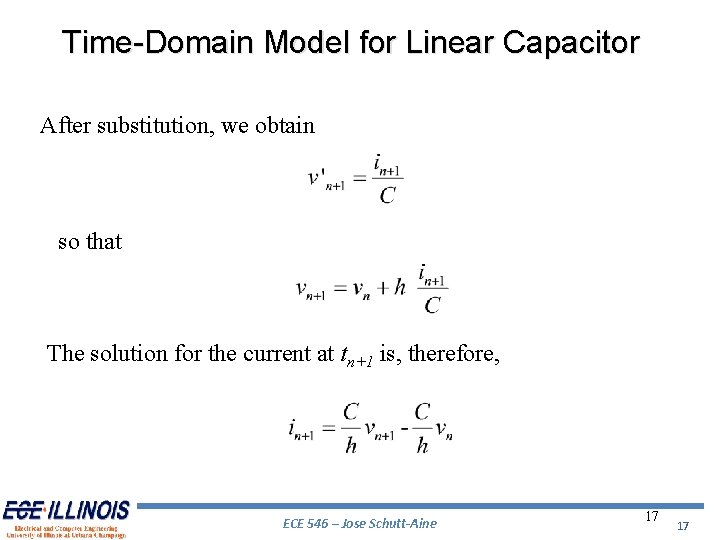
Time-Domain Model for Linear Capacitor After substitution, we obtain so that The solution for the current at tn+1 is, therefore, ECE 546 – Jose Schutt-Aine 17 17
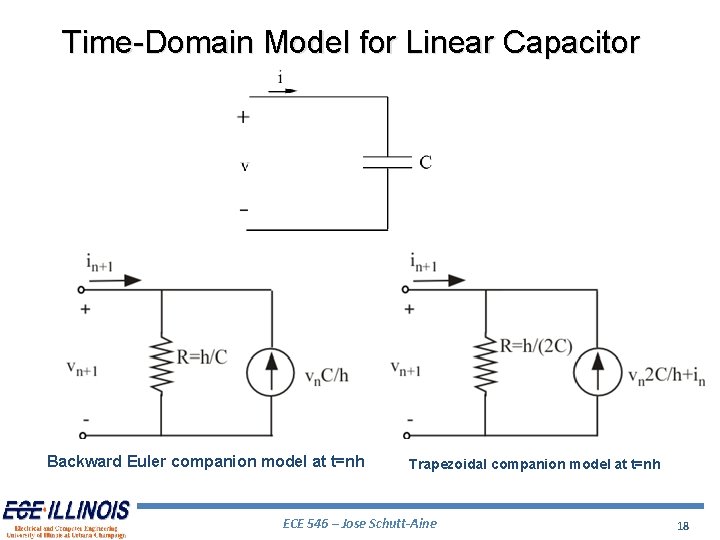
Time-Domain Model for Linear Capacitor Backward Euler companion model at t=nh Trapezoidal companion model at t=nh ECE 546 – Jose Schutt-Aine 18
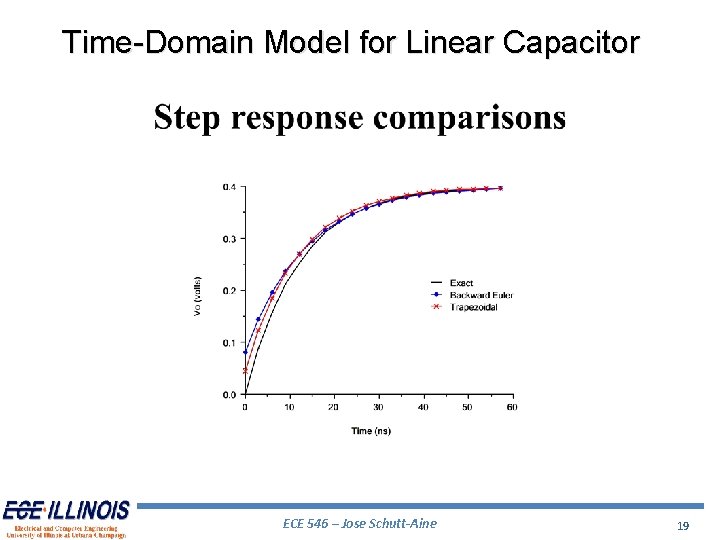
Time-Domain Model for Linear Capacitor ECE 546 – Jose Schutt-Aine 19
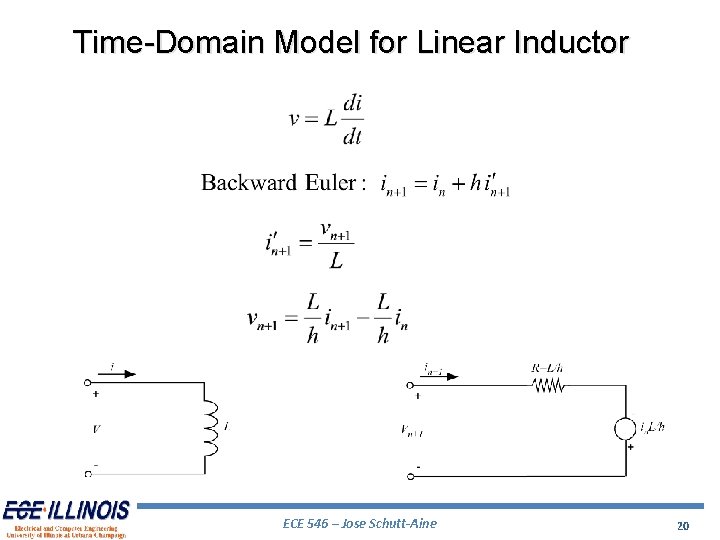
Time-Domain Model for Linear Inductor ECE 546 – Jose Schutt-Aine 20
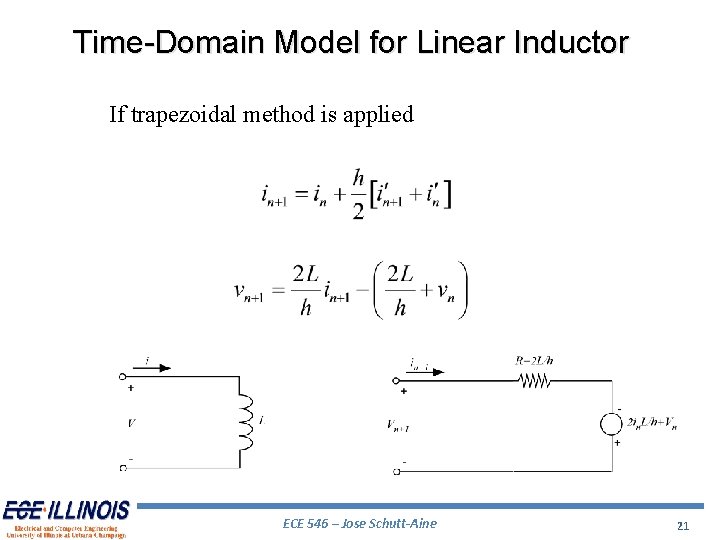
Time-Domain Model for Linear Inductor If trapezoidal method is applied ECE 546 – Jose Schutt-Aine 21
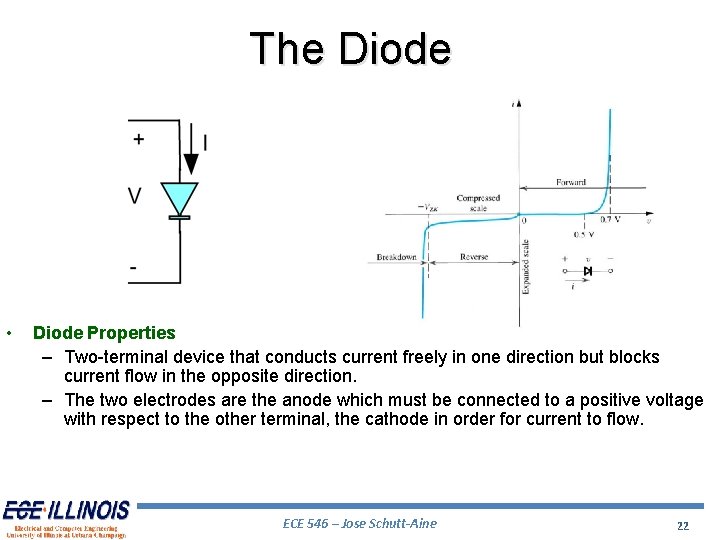
The Diode • Diode Properties – Two-terminal device that conducts current freely in one direction but blocks current flow in the opposite direction. – The two electrodes are the anode which must be connected to a positive voltage with respect to the other terminal, the cathode in order for current to flow. ECE 546 – Jose Schutt-Aine 22
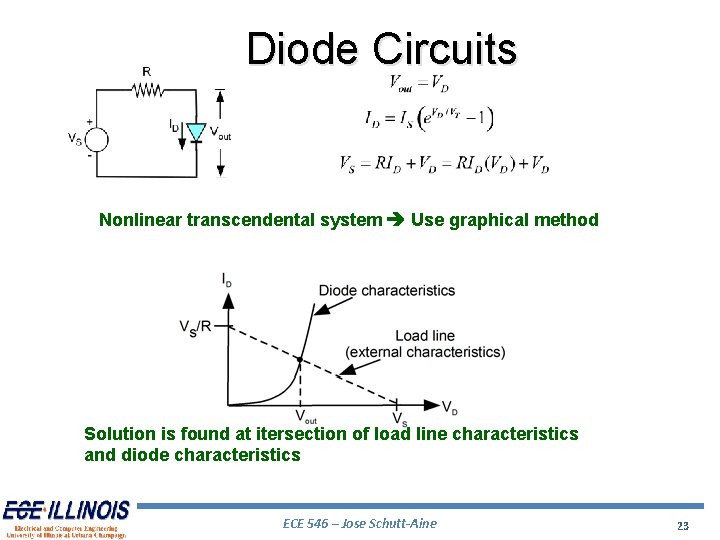
Diode Circuits Nonlinear transcendental system Use graphical method Solution is found at itersection of load line characteristics and diode characteristics ECE 546 – Jose Schutt-Aine 23
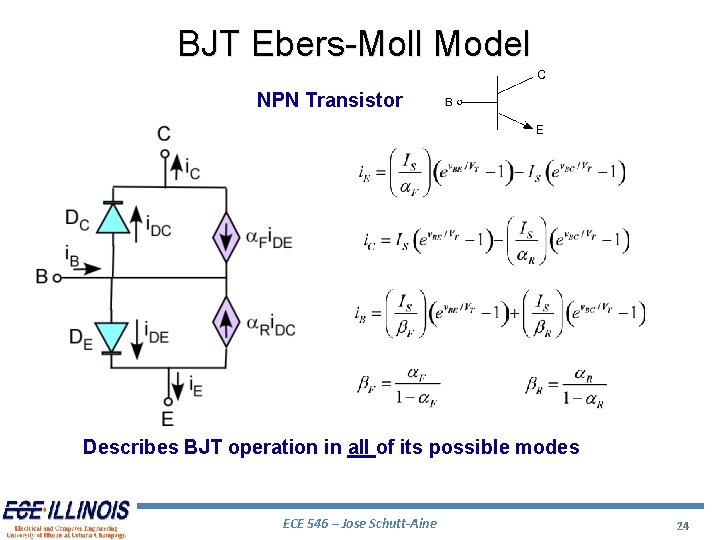
BJT Ebers-Moll Model NPN Transistor Describes BJT operation in all of its possible modes ECE 546 – Jose Schutt-Aine 24
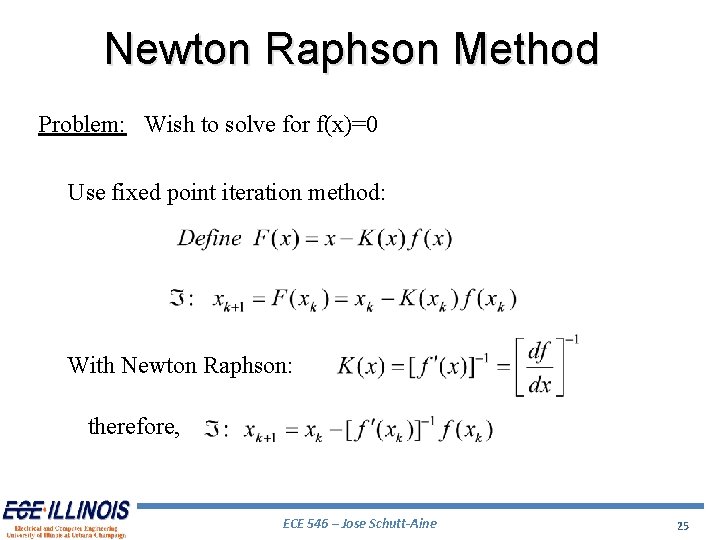
Newton Raphson Method Problem: Wish to solve for f(x)=0 Use fixed point iteration method: With Newton Raphson: therefore, ECE 546 – Jose Schutt-Aine 25
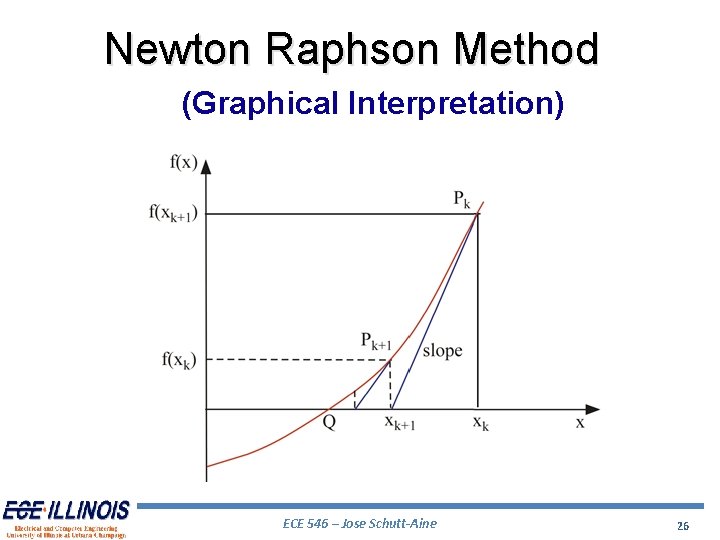
Newton Raphson Method (Graphical Interpretation) ECE 546 – Jose Schutt-Aine 26
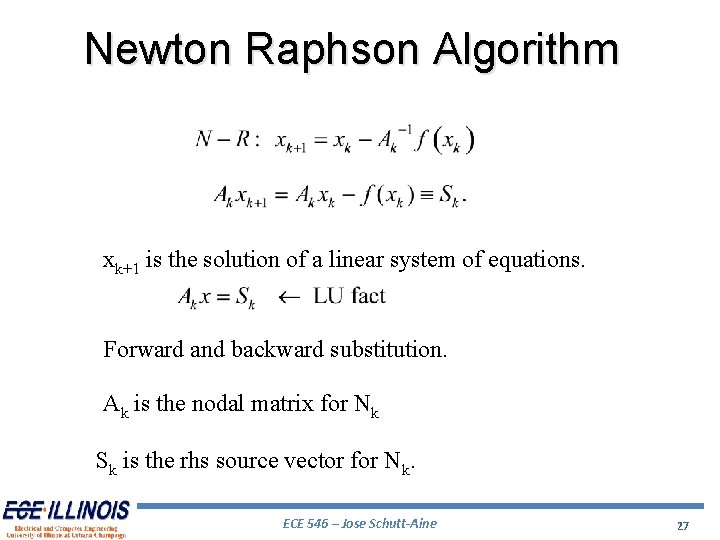
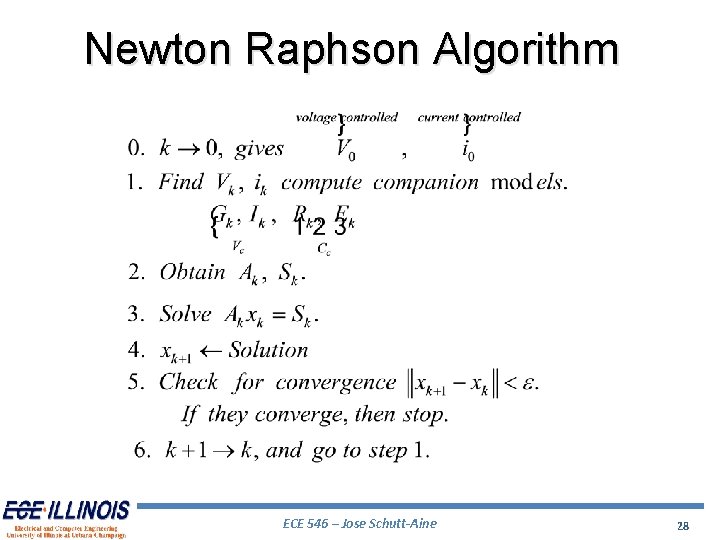
Newton Raphson Algorithm xk+1 is the solution of a linear system of equations. Forward and backward substitution. Ak is the nodal matrix for Nk Sk is the rhs source vector for Nk. ECE 546 – Jose Schutt-Aine 27
Newton Raphson Algorithm ECE 546 – Jose Schutt-Aine 28
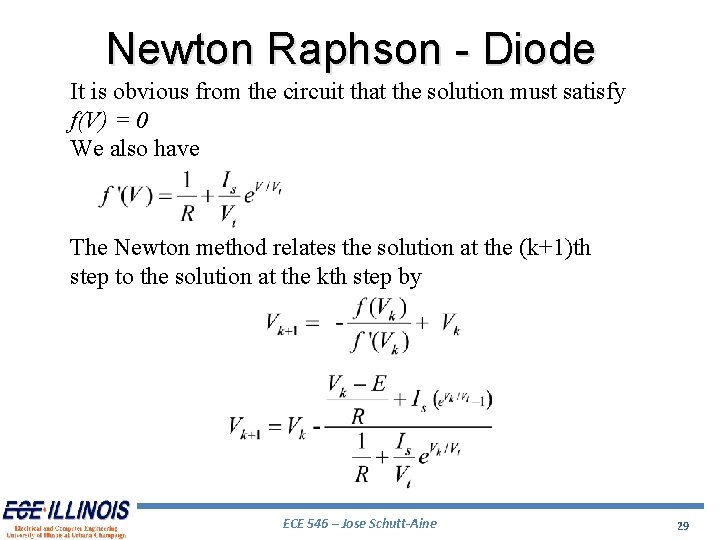
Newton Raphson - Diode It is obvious from the circuit that the solution must satisfy f(V) = 0 We also have The Newton method relates the solution at the (k+1)th step to the solution at the kth step by ECE 546 – Jose Schutt-Aine 29
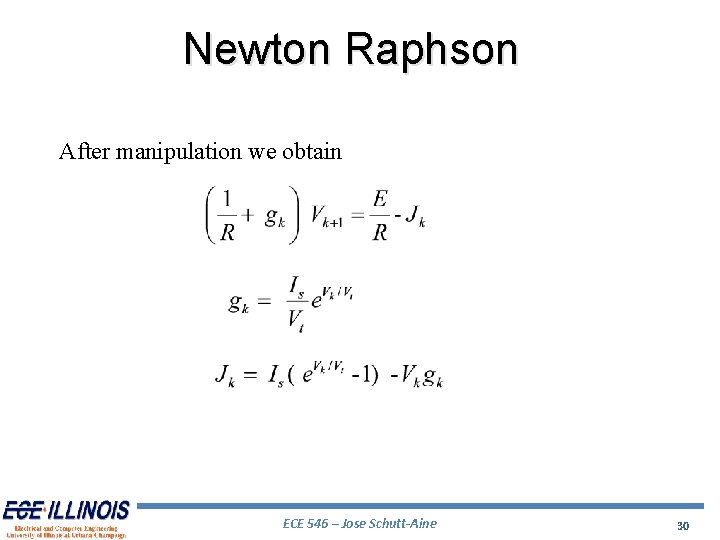
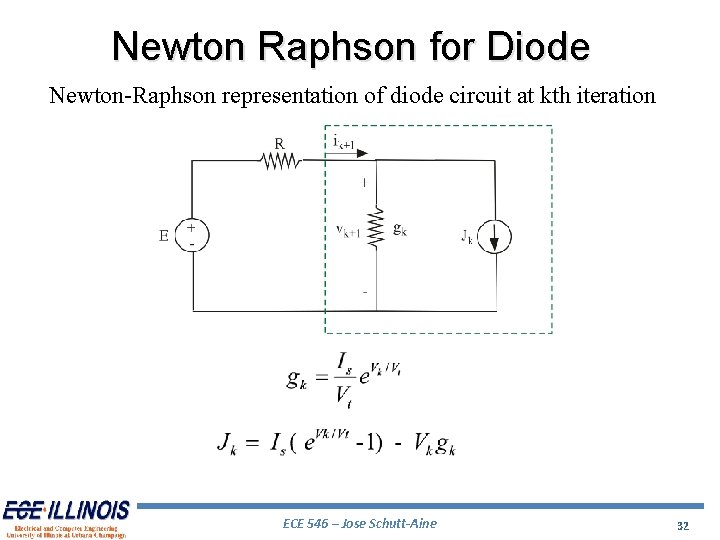
Newton Raphson After manipulation we obtain ECE 546 – Jose Schutt-Aine 30
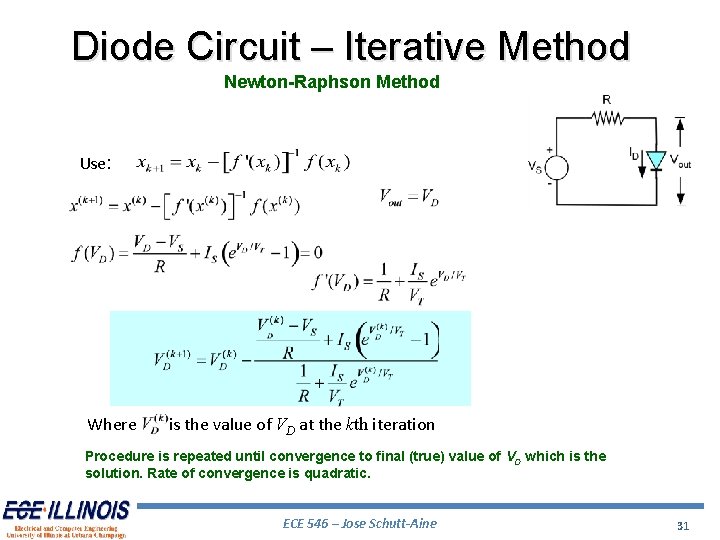
Diode Circuit – Iterative Method Newton-Raphson Method Use: Where is the value of VD at the kth iteration Procedure is repeated until convergence to final (true) value of VD which is the solution. Rate of convergence is quadratic. ECE 546 – Jose Schutt-Aine 31
Newton Raphson for Diode Newton-Raphson representation of diode circuit at kth iteration ECE 546 – Jose Schutt-Aine 32
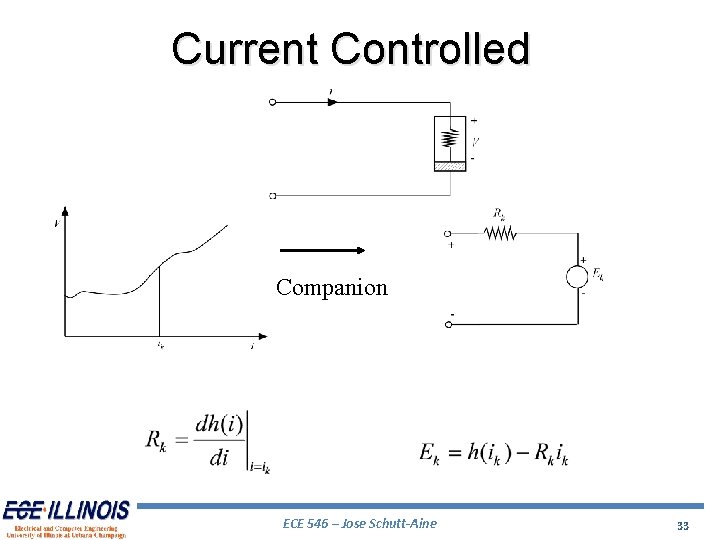
Current Controlled Companion ECE 546 – Jose Schutt-Aine 33
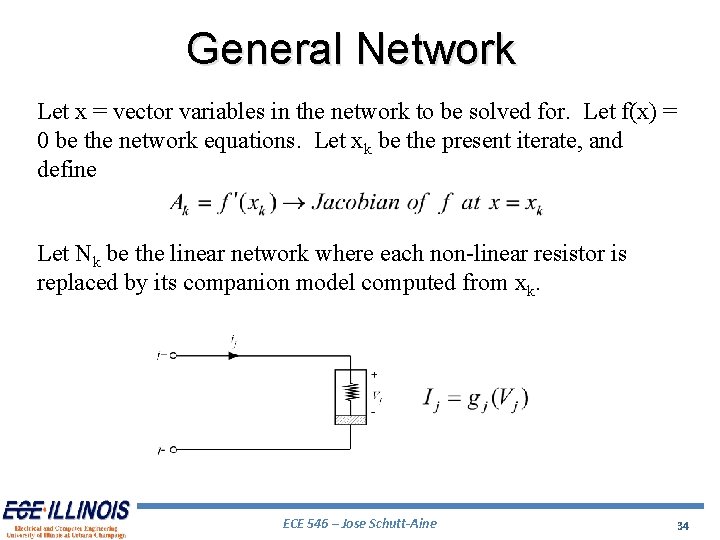
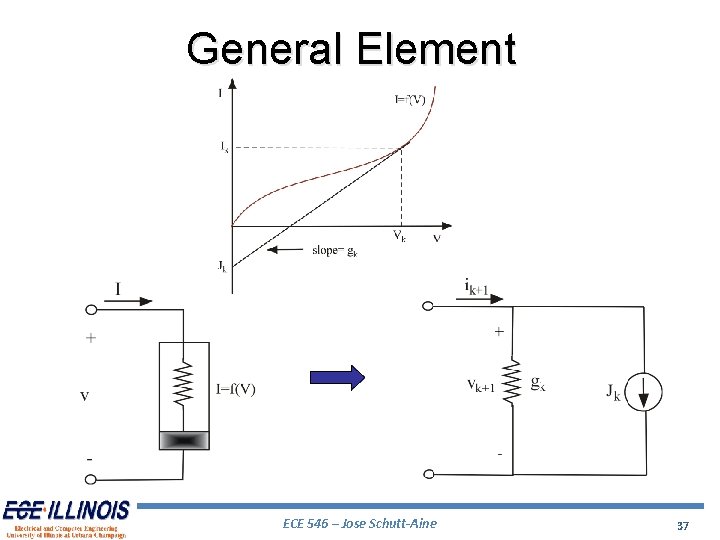
General Network Let x = vector variables in the network to be solved for. Let f(x) = 0 be the network equations. Let xk be the present iterate, and define Let Nk be the linear network where each non-linear resistor is replaced by its companion model computed from xk. ECE 546 – Jose Schutt-Aine 34
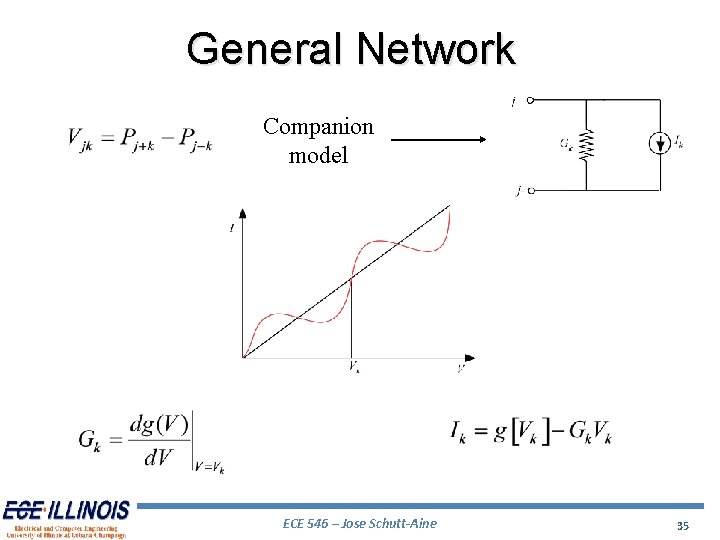
General Network Companion model ECE 546 – Jose Schutt-Aine 35
Nonlinear Reactive Elements ECE 546 – Jose Schutt-Aine 36
General Element ECE 546 – Jose Schutt-Aine 37