
Measurements and Significant Figures Week 2 Chemistry Mr
- Slides: 33
Measurements and Significant Figures Week 2 – Chemistry Mr. Garcia
Review • Who does science? • What does science look like? • How do we know if we are doing science? • What is “good” science? • What is “bad” science?
Review Exercises • Astrology is an example of ______ • English Literature is an example of ______ • The existence of Big Foot is an example of ______ • Studying how light effects plant growth is an example of ____
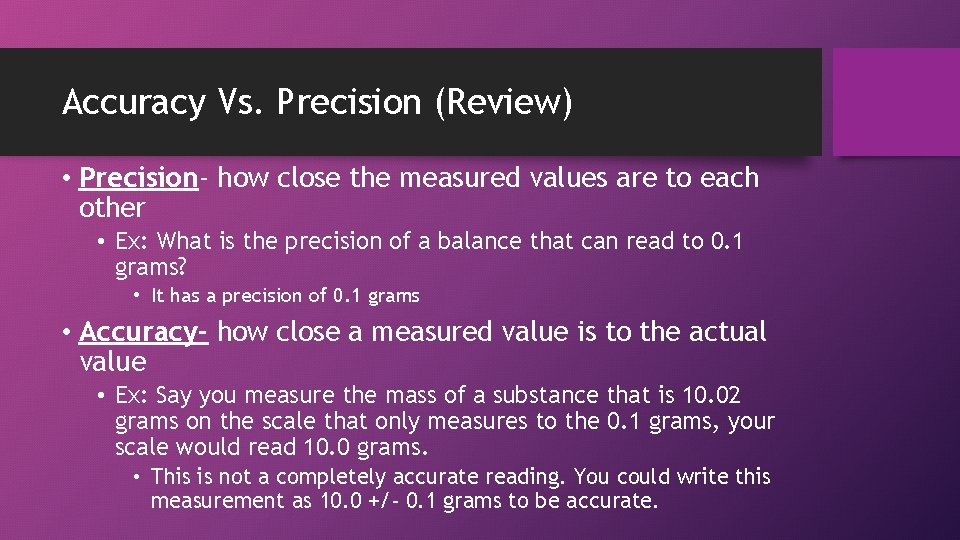
Accuracy Vs. Precision (Review) • Precision- how close the measured values are to each other • Ex: What is the precision of a balance that can read to 0. 1 grams? • It has a precision of 0. 1 grams • Accuracy- how close a measured value is to the actual value • Ex: Say you measure the mass of a substance that is 10. 02 grams on the scale that only measures to the 0. 1 grams, your scale would read 10. 0 grams. • This is not a completely accurate reading. You could write this measurement as 10. 0 +/- 0. 1 grams to be accurate.
What do we Measure • We measure substances to determine properties such as: temperature, mass, volume, time, length, energy, power, pressure, etc. • In Chemistry and all other sciences we use SI units or METRIC SYSTEM • ALWAYS specify the unit when measuring (I will mark off points on any assignments or quizzes with no units)
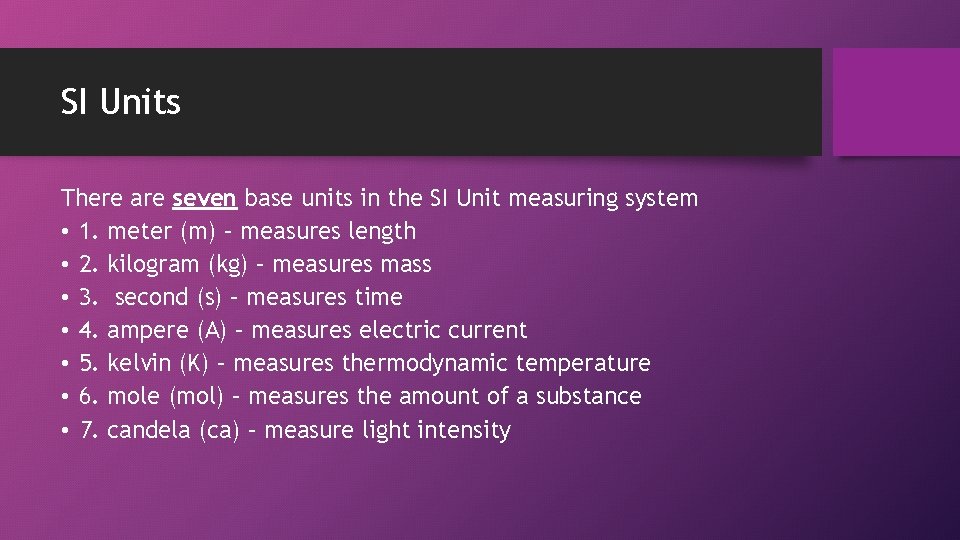
SI Units There are seven base units in the SI Unit measuring system • 1. meter (m) – measures length • 2. kilogram (kg) – measures mass • 3. second (s) – measures time • 4. ampere (A) – measures electric current • 5. kelvin (K) – measures thermodynamic temperature • 6. mole (mol) – measures the amount of a substance • 7. candela (ca) – measure light intensity
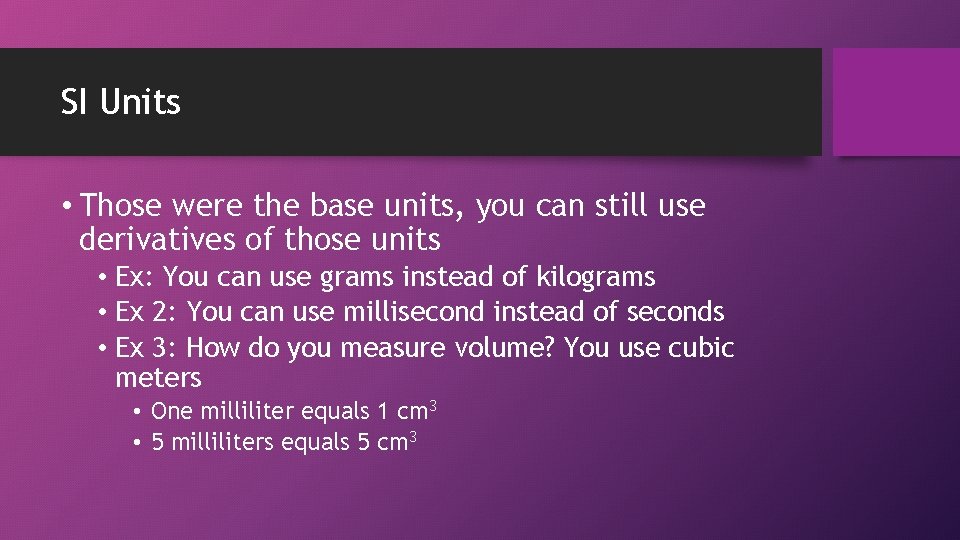
SI Units • Those were the base units, you can still use derivatives of those units • Ex: You can use grams instead of kilograms • Ex 2: You can use millisecond instead of seconds • Ex 3: How do you measure volume? You use cubic meters • One milliliter equals 1 cm 3 • 5 milliliters equals 5 cm 3
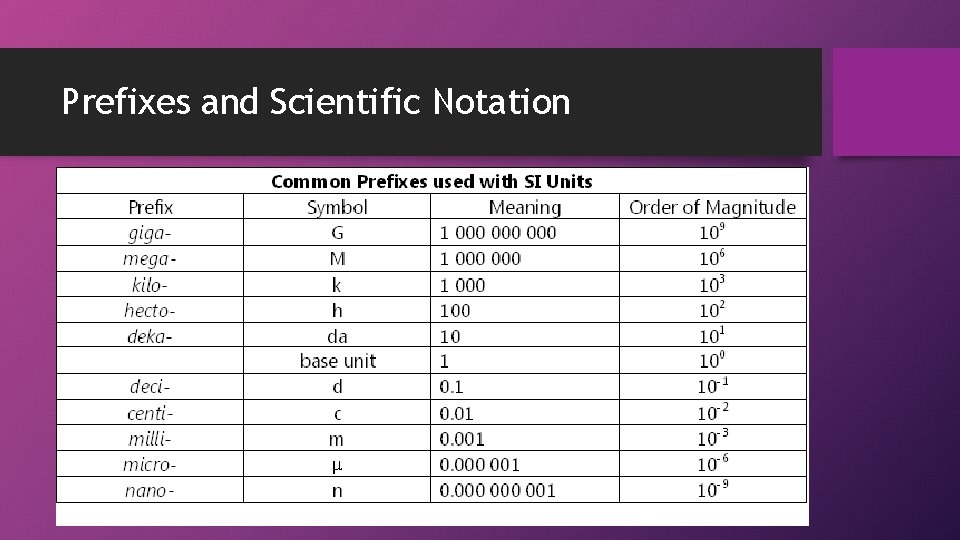
Prefixes and Scientific Notation
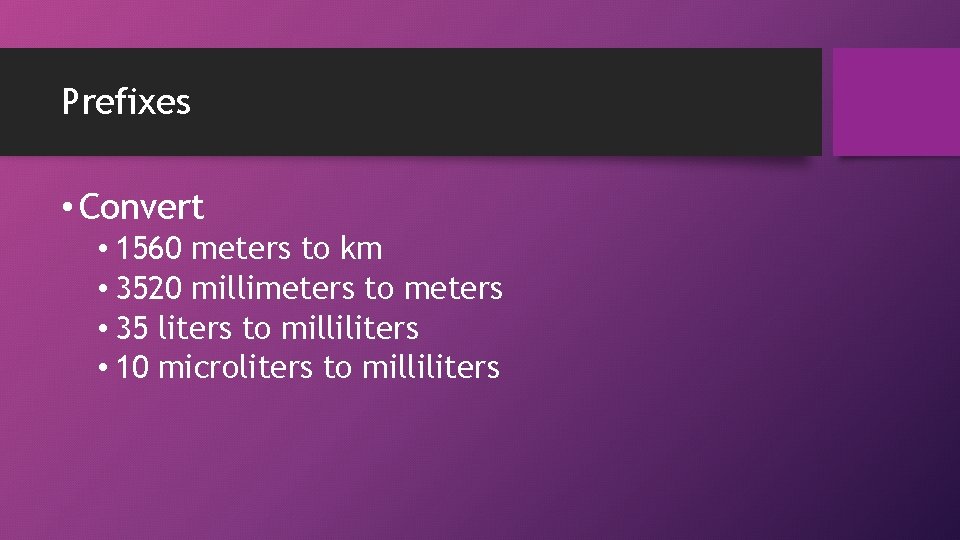
Prefixes • Convert • 1560 meters to km • 3520 millimeters to meters • 35 liters to milliliters • 10 microliters to milliliters
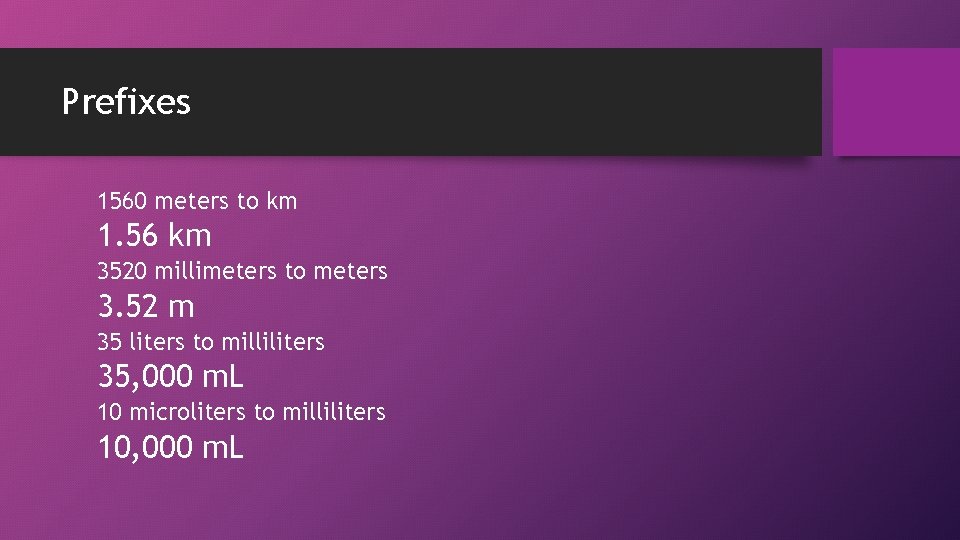
Prefixes 1560 meters to km 1. 56 km 3520 millimeters to meters 3. 52 m 35 liters to milliliters 35, 000 m. L 10 microliters to milliliters 10, 000 m. L
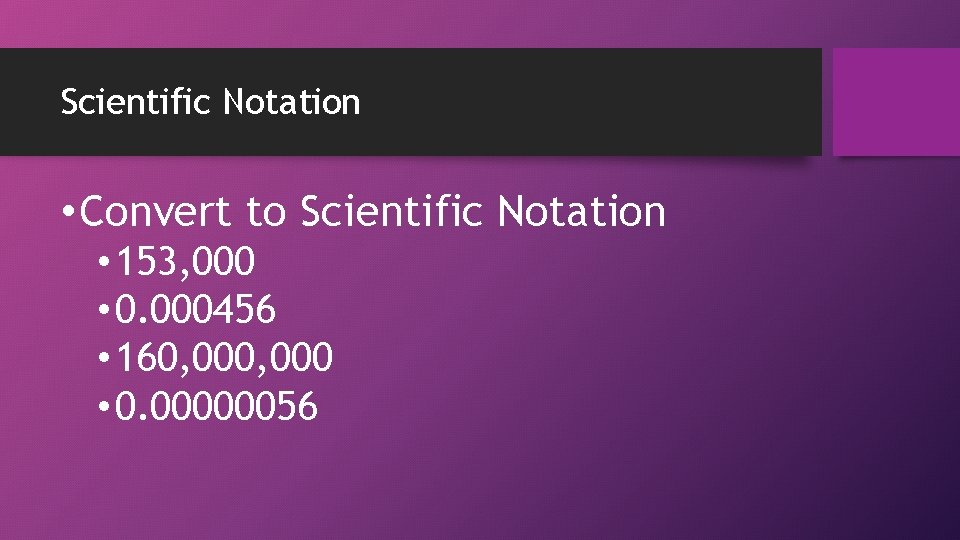
Scientific Notation • Convert to Scientific Notation • 153, 000 • 0. 000456 • 160, 000 • 0. 00000056
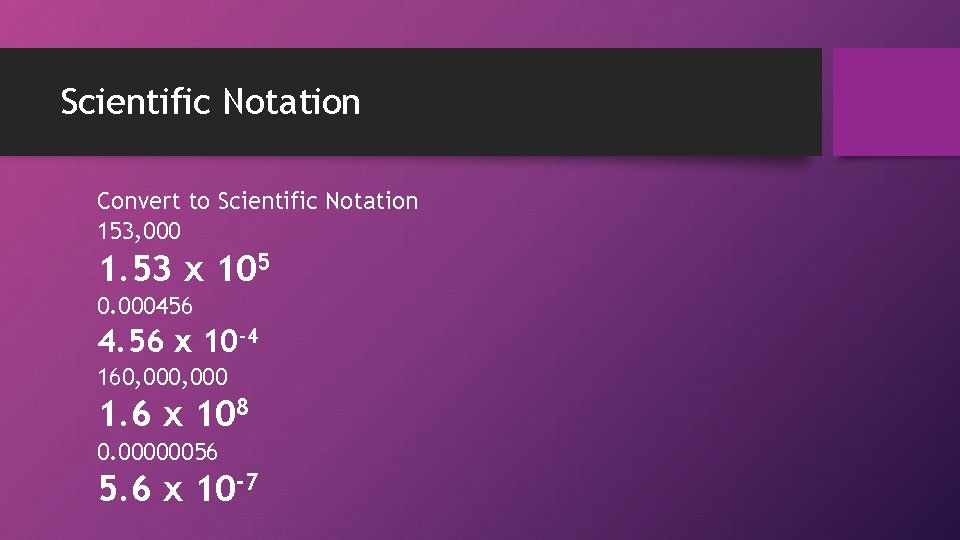
Scientific Notation Convert to Scientific Notation 153, 000 1. 53 x 105 0. 000456 4. 56 x 10 -4 160, 000 1. 6 x 10⁸ 0. 00000056 5. 6 x 10 -7
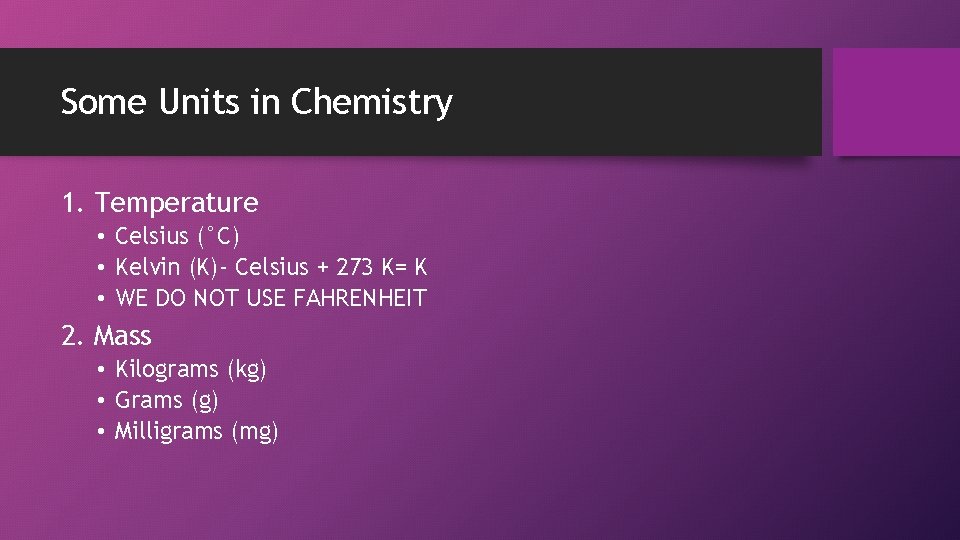
Some Units in Chemistry 1. Temperature • Celsius (°C) • Kelvin (K)- Celsius + 273 K= K • WE DO NOT USE FAHRENHEIT 2. Mass • Kilograms (kg) • Grams (g) • Milligrams (mg)
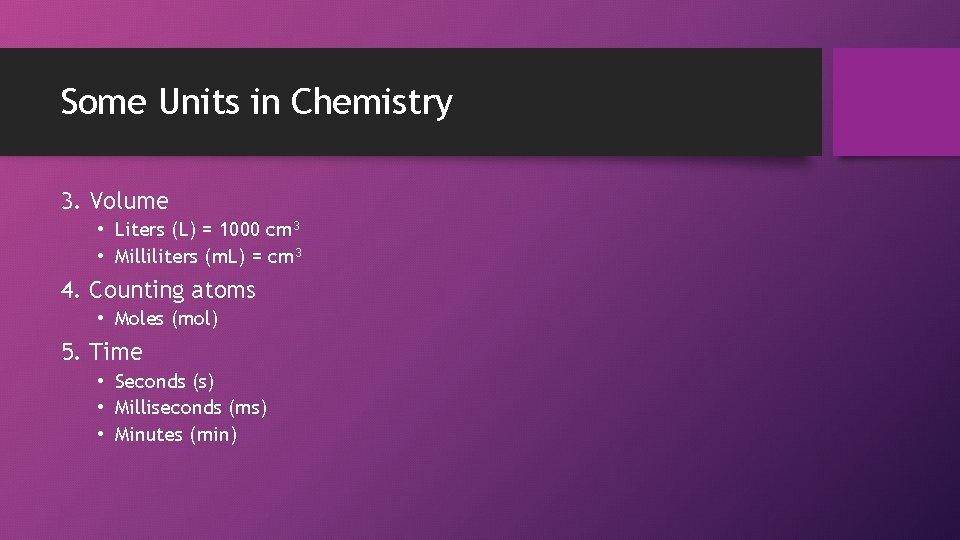
Some Units in Chemistry 3. Volume • Liters (L) = 1000 cm 3 • Milliliters (m. L) = cm 3 4. Counting atoms • Moles (mol) 5. Time • Seconds (s) • Milliseconds (ms) • Minutes (min)
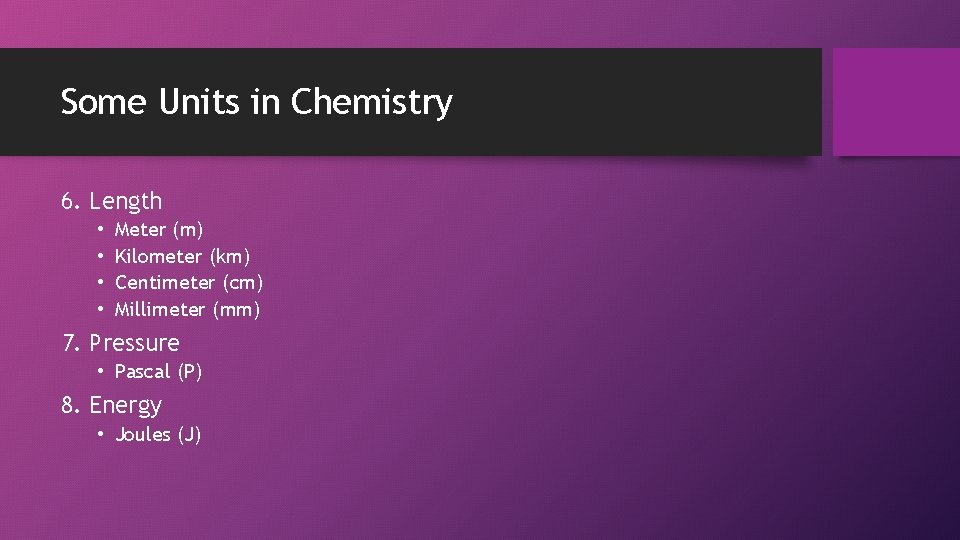
Some Units in Chemistry 6. Length • • Meter (m) Kilometer (km) Centimeter (cm) Millimeter (mm) 7. Pressure • Pascal (P) 8. Energy • Joules (J)
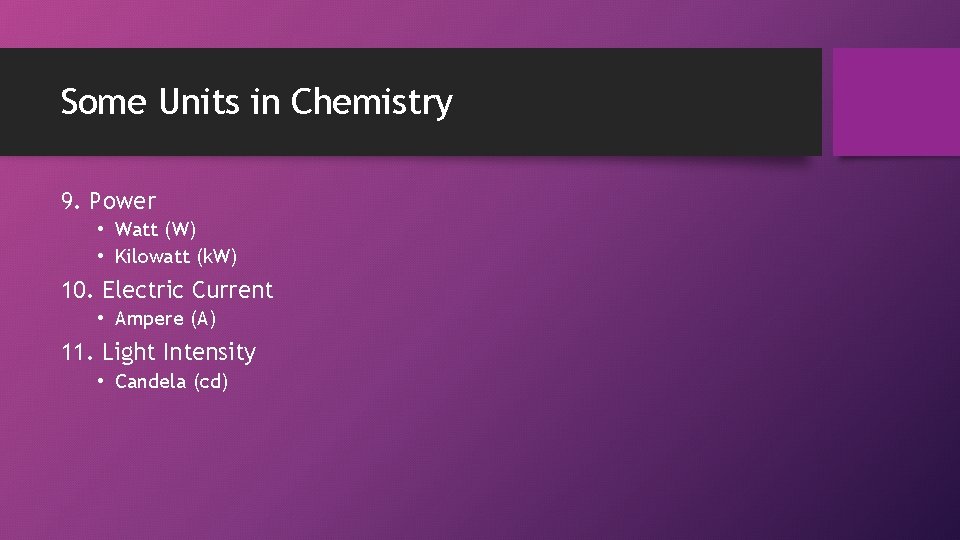
Some Units in Chemistry 9. Power • Watt (W) • Kilowatt (k. W) 10. Electric Current • Ampere (A) 11. Light Intensity • Candela (cd)
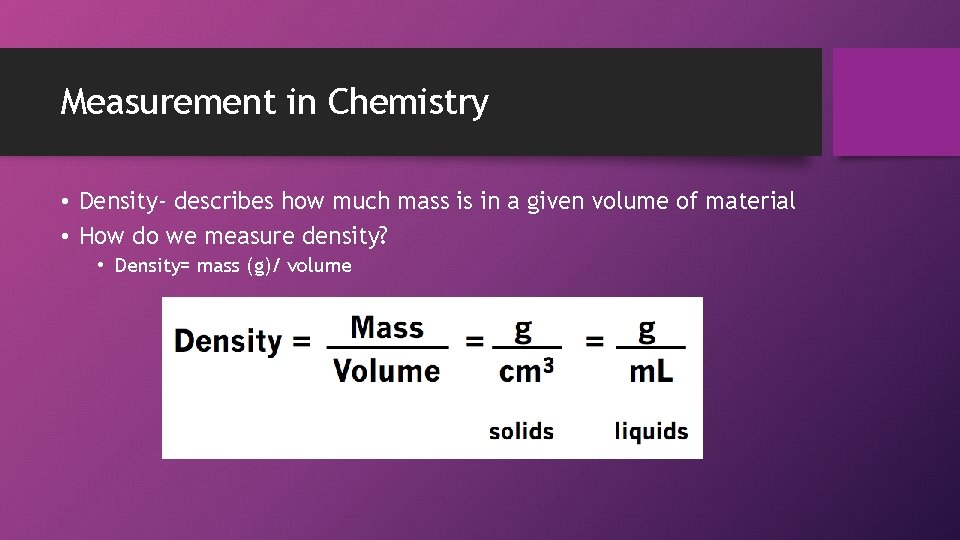
Measurement in Chemistry • Density- describes how much mass is in a given volume of material • How do we measure density? • Density= mass (g)/ volume
Measurements in Chemistry • Example: One cubic centimeter of Iron weighs 7. 8 grams • The density is 7. 8 g/cm 3 Example: What is the density of a 1 cm 3 block of plastic that has a mass of 500 mg First, convert 500 mg to grams 500 mg = 0. 5 grams 0. 5 g/cm 3
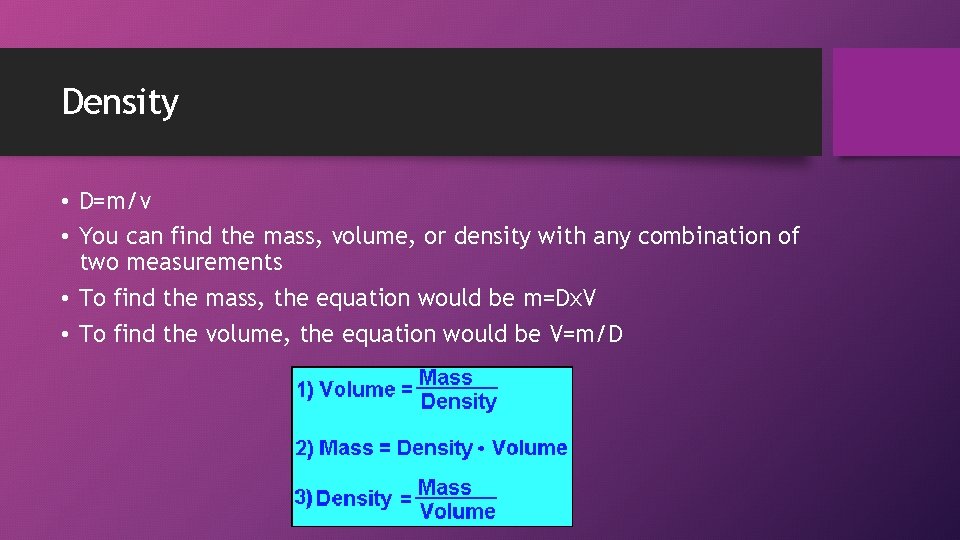
Density • D=m/v • You can find the mass, volume, or density with any combination of two measurements • To find the mass, the equation would be m=Dx. V • To find the volume, the equation would be V=m/D
Significant Figures- a way of writing data to show precise a measurement is. Significant figures are of all the digits known with certainty as well as ONE estimated, or uncertain, digit. NOTE: A calculator does not round the result to the correct number of significant figures. By using Significant Figures scientist do NOT have to write +/- to show accuracy. All the numbers measured in significant figures are accurate!
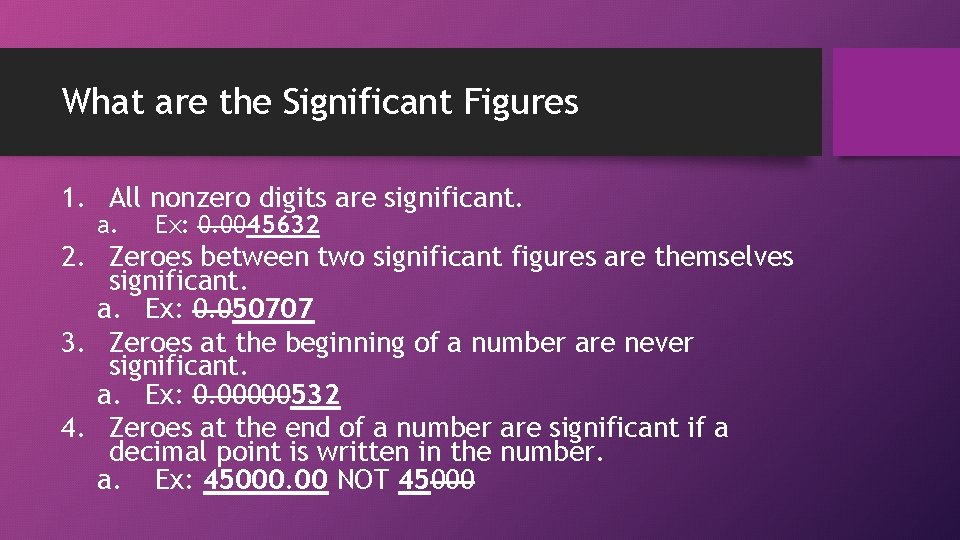
What are the Significant Figures 1. All nonzero digits are significant. a. Ex: 0. 0045632 2. Zeroes between two significant figures are themselves significant. a. Ex: 0. 050707 3. Zeroes at the beginning of a number are never significant. a. Ex: 0. 00000532 4. Zeroes at the end of a number are significant if a decimal point is written in the number. a. Ex: 45000. 00 NOT 45000
Exceptions to the Rule • Unlimited number of significant figures in COUNTING. If you count 10 oranges, there is an unlimited number of significant figures. The degree of certainty is infinite because you are counting not measuring.
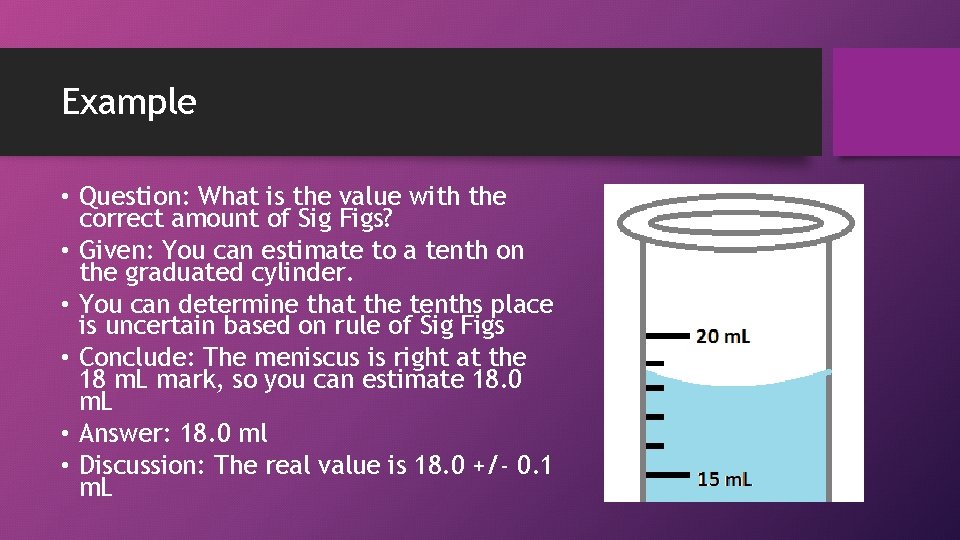
Example • Question: What is the value with the correct amount of Sig Figs? • Given: You can estimate to a tenth on the graduated cylinder. • You can determine that the tenths place is uncertain based on rule of Sig Figs • Conclude: The meniscus is right at the 18 m. L mark, so you can estimate 18. 0 m. L • Answer: 18. 0 ml • Discussion: The real value is 18. 0 +/- 0. 1 m. L
Lab Example • You measure a cube of sugar and record your measurement as 10 grams. The first digit (1) is assumed to be certain but the last digit has an uncertainty of +/- 1. Therefore, the actual value can be 10 +/- 1, which means your precise measurement could be 9 to 11 • Now, if you did your measurement as 10. 0 grams. The first two digits (10) are certain but the last digit is uncertain at 0. 1 +/-. Therefore, the reader can assume the result is between 9. 9 and 10. 1
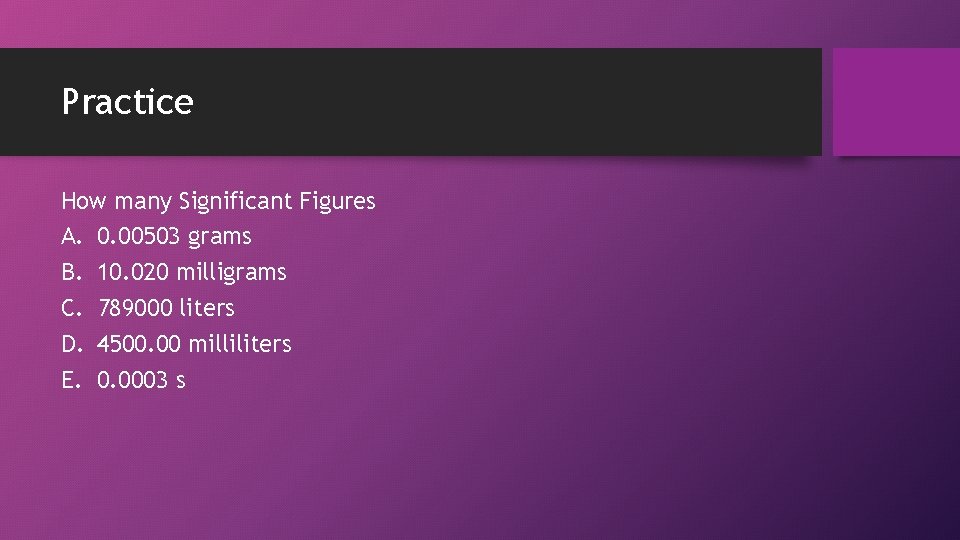
Practice How many Significant Figures A. 0. 00503 grams B. 10. 020 milligrams C. 789000 liters D. 4500. 00 milliliters E. 0. 0003 s
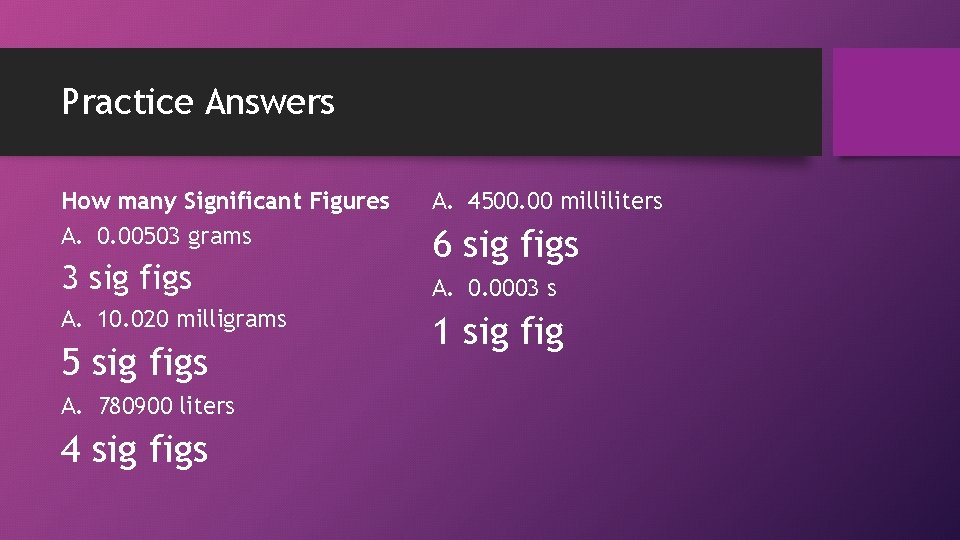
Practice Answers How many Significant Figures A. 0. 00503 grams 3 sig figs A. 10. 020 milligrams 5 sig figs A. 780900 liters 4 sig figs A. 4500. 00 milliliters 6 sig figs A. 0. 0003 s 1 sig fig
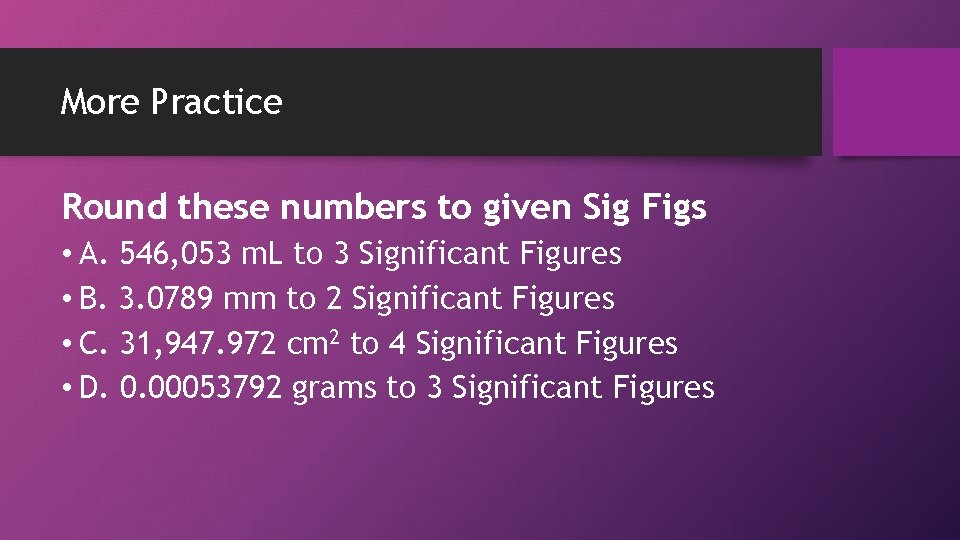
More Practice Round these numbers to given Sig Figs • A. 546, 053 m. L to 3 Significant Figures • B. 3. 0789 mm to 2 Significant Figures • C. 31, 947. 972 cm 2 to 4 Significant Figures • D. 0. 00053792 grams to 3 Significant Figures
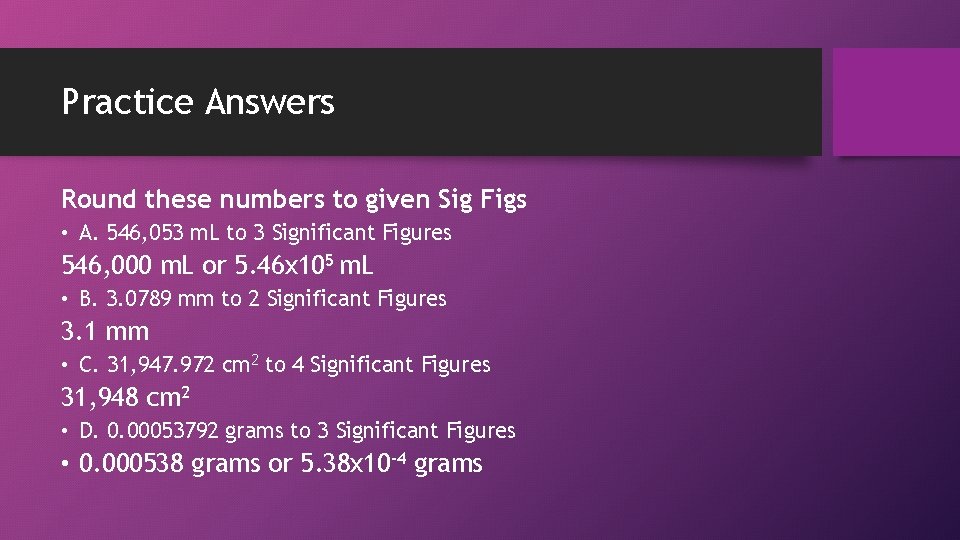
Practice Answers Round these numbers to given Sig Figs • A. 546, 053 m. L to 3 Significant Figures 546, 000 m. L or 5. 46 x 105 m. L • B. 3. 0789 mm to 2 Significant Figures 3. 1 mm • C. 31, 947. 972 cm 2 to 4 Significant Figures 31, 948 cm 2 • D. 0. 00053792 grams to 3 Significant Figures • 0. 000538 grams or 5. 38 x 10 -4 grams
MORE RULES? ! • There are rules on how many Sig Figs to use when multiplying, dividing, adding, and subtracting • Multiplication and Division: the answer cannot have more significant figures than the measurement with the smallest number of significant figures. • Addition & Subtraction: this rule has NOTHING to do with how many sig figs are in each of the individual numbers that are being added or subtracted!
Multiplying and Dividing Multiplication and Division: • the answer cannot have more significant figures than the measurement with the smallest number of significant figures. • Example: 2. 3456 cm x 56 cm = ? • • • 2. 3456 has 5 sig figs 56 has 2 sig figs Your answer must have only 2 sig figs Calculator answer: 131. 3536 Your answer with correct sig figs: 130 cm 2
Multiplying and Dividing • Example: 56. 0/2. 3456 = ? • 2. 3456 has 5 sig figs • 56 has 3 sig figs • Your answer must have only 3 sig figs • Calculator answer: 23. 8744 • Your answer with correct sig figs: 23. 9
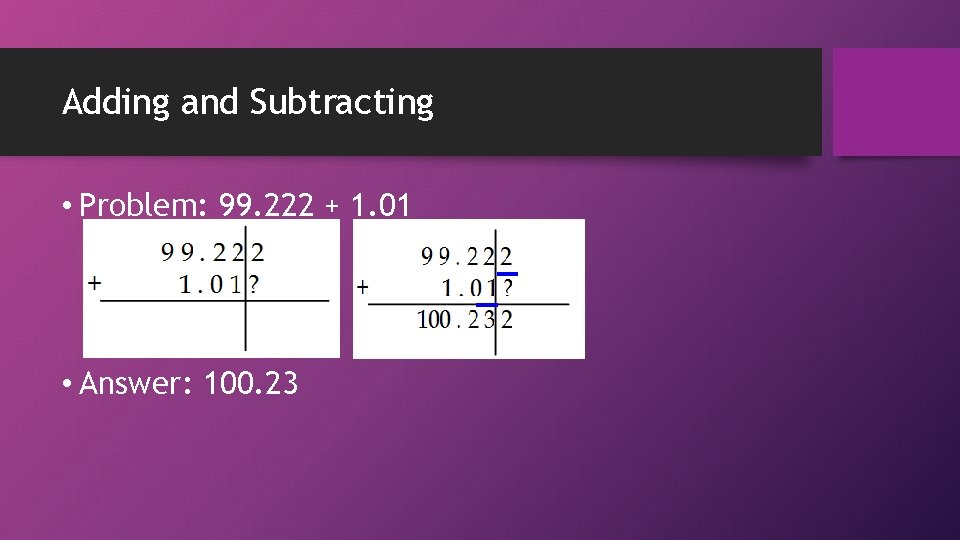
Adding and Subtracting in Sig Figs Addition & Subtraction: • this rule has NOTHING to do with how many sig figs are in each of the individual numbers that are being added or subtracted! 1. Line your numbers up vertically 2. Underline the last significant digit in each number. 3. Draw a line after the significant digit farthest to the LEFT. This is the last place you keep. 4. Round your answer to this place.
Adding and Subtracting • Problem: 99. 222 + 1. 01 • Answer: 100. 23