
The Malta Experience in the SPICES Project Sandro
- Slides: 14
The Malta Experience in the SPICES Project Sandro Caruana University of Malta
n Introduction n The Malta intercultural experience (the SPICES Project) n Data n Suggestions and queries n Conclusion
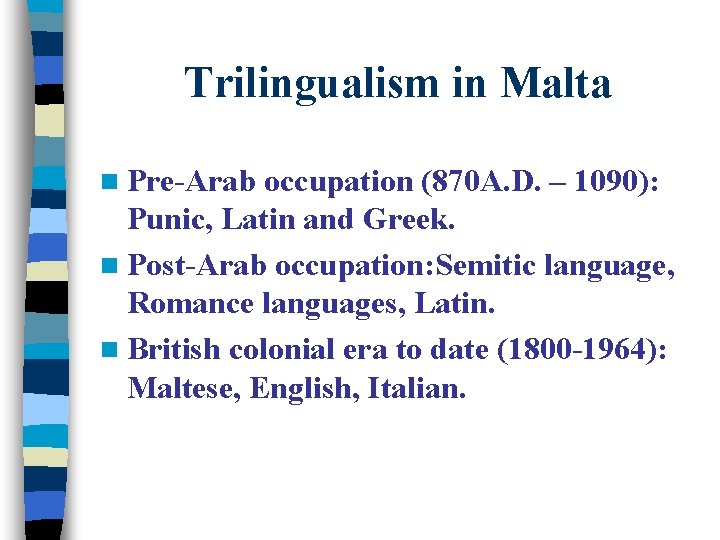
Trilingualism in Malta n Pre-Arab occupation (870 A. D. – 1090): Punic, Latin and Greek. n Post-Arab occupation: Semitic language, Romance languages, Latin. n British colonial era to date (1800 -1964): Maltese, English, Italian.
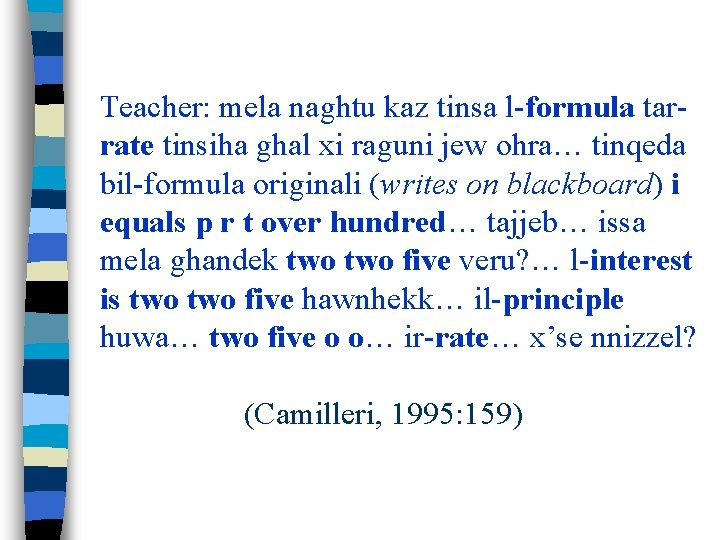
Teacher: mela naghtu kaz tinsa l-formula tarrate tinsiha ghal xi raguni jew ohra… tinqeda bil-formula originali (writes on blackboard) i equals p r t over hundred… tajjeb… issa mela ghandek two five veru? … l-interest is two five hawnhekk… il-principle huwa… two five o o… ir-rate… x’se nnizzel? (Camilleri, 1995: 159)
n ‘. . . he brought us the form and told us this is your future, your life: so fill this and we know who you are and what you want’. (excerpt from an interview to an asylum seeker, March 2006) n ‘I want to forget everything. I am finally where I belong – after all, my skin is white, my hair is blond and my eyes are green. This is my new home; Europe is my heritage and my future. I was determined to learn everything I could about this new world. I wanted to become a European, wanted to think like them, act like them, and look like them. They were my new tribe’ from ‘Jungle Child’ by Sabine Kuegler (2005: 230)
Components of intercultural communication (Sercu, 2005: 3) Knowledge: culture specific and culture general; of self and other; of interaction… n Skills/behaviour: ability to interpret, relate; to discover, interact; metacognitive strategies to direct own learning… n Attitudes/traits: positive predisposition; value oneself and others; critical engagement with the foreign culture and with one’s own. n
Intercultural communication (ICC) encompasses… recognising differences, similarities within cultural differences; n needs of people with different cultural backgrounds; n what one can gain from intercultural encounters; n individual/social situations; n …. and many other aspects… a ‘complex’ pedagogy is required in order to teach ICC. n
The notion of ‘teachability’ (1): Related to the field of SLA; n Linked to ‘processability’, orignally formulated by Pienemann (1998); n Stems from difficulties that learners encounter, especially in formal settings – guided vs. spontaneous settings – the age factor – use and availability of resources – the ‘durability’ factor n
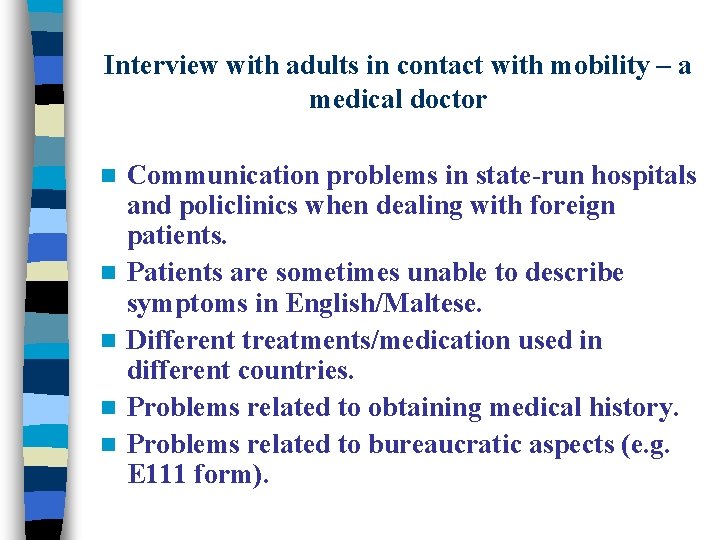
Interview with adults in contact with mobility – a medical doctor n n n Communication problems in state-run hospitals and policlinics when dealing with foreign patients. Patients are sometimes unable to describe symptoms in English/Maltese. Different treatments/medication used in different countries. Problems related to obtaining medical history. Problems related to bureaucratic aspects (e. g. E 111 form).
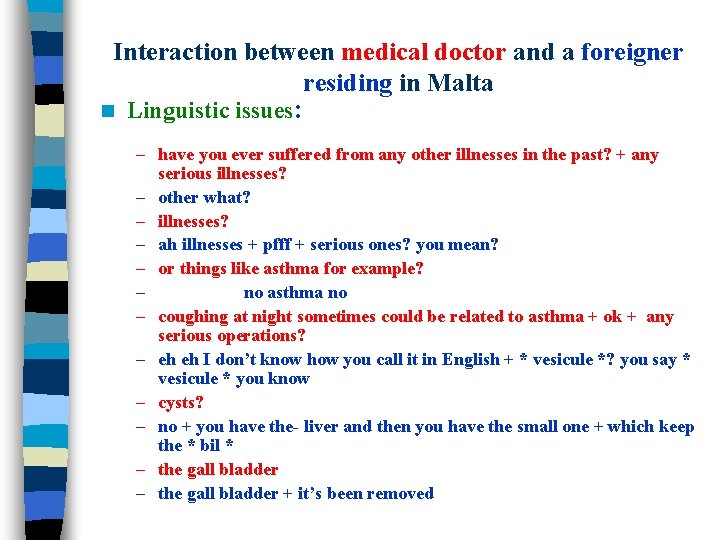
Interaction between medical doctor and a foreigner residing in Malta n Linguistic issues: – have you ever suffered from any other illnesses in the past? + any serious illnesses? – other what? – illnesses? – ah illnesses + pfff + serious ones? you mean? – or things like asthma for example? – no asthma no – coughing at night sometimes could be related to asthma + ok + any serious operations? – eh eh I don’t know how you call it in English + * vesicule *? you say * vesicule * you know – cysts? – no + you have the- liver and then you have the small one + which keep the * bil * – the gall bladder + it’s been removed
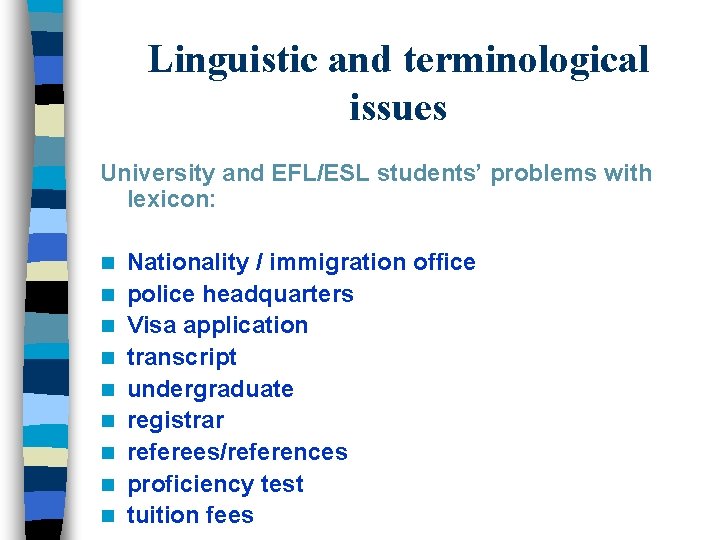
Linguistic and terminological issues University and EFL/ESL students’ problems with lexicon: n n n n n Nationality / immigration office police headquarters Visa application transcript undergraduate registrar referees/references proficiency test tuition fees
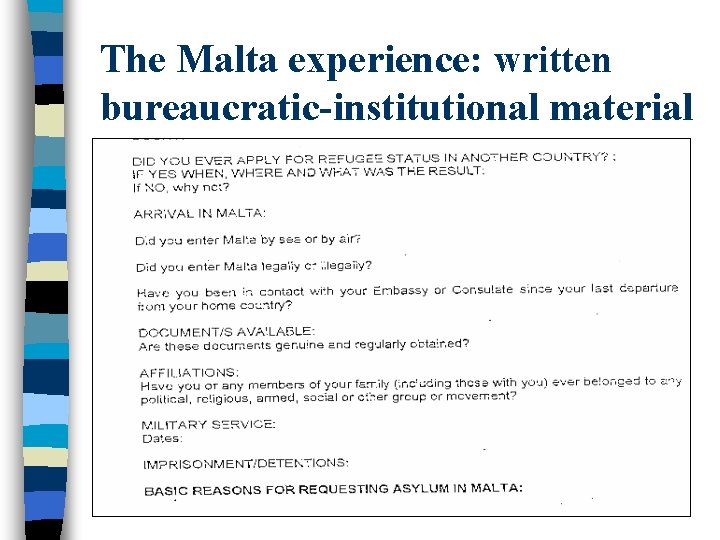
The Malta experience: written bureaucratic-institutional material
Conclusions: n just like in L 2 teaching ICC requires careful planning; a specific pedagogy; positive attitudes; dynamism and readiness to change. n ICC becomes ‘teachable’ if its very nature is analysed and if various components are taught systematically.
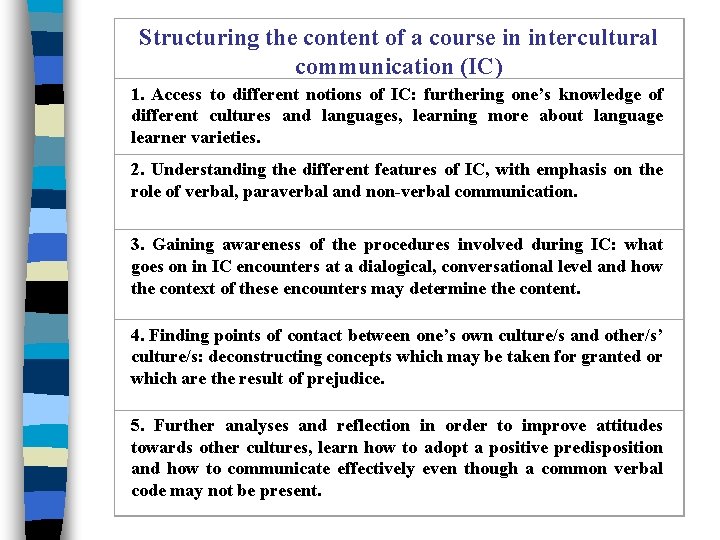
Structuring the content of a course in intercultural communication (IC) 1. Access to different notions of IC: furthering one’s knowledge of different cultures and languages, learning more about language learner varieties. 2. Understanding the different features of IC, with emphasis on the role of verbal, paraverbal and non-verbal communication. 3. Gaining awareness of the procedures involved during IC: what goes on in IC encounters at a dialogical, conversational level and how the context of these encounters may determine the content. 4. Finding points of contact between one’s own culture/s and other/s’ culture/s: deconstructing concepts which may be taken for granted or which are the result of prejudice. 5. Further analyses and reflection in order to improve attitudes towards other cultures, learn how to adopt a positive predisposition and how to communicate effectively even though a common verbal code may not be present.