Doc IEEE 802 11 17 1308 00 az
- Slides: 38
Doc. : IEEE 802. 11 -17 -1308 -00 az Collaborative Time of Arrival (CTo. A) Date: 2017 -09 -10 Submission Slide 1 Bar-Shalom, et al, Intel Corporation
Doc. : IEEE 802. 11 -17 -1308 -00 az Presentation Outline • • • What is CTo. A? The CTo. A Basics Position estimation using CTo. A Simulation Performance Summary & Conclusions Submission Slide 2 Bar-Shalom, et al, Intel Corporation
Doc. : IEEE 802. 11 -17 -1308 -00 az WHAT IS CTOA? Submission Slide 3 Bar-Shalom, et al, Intel Corporation
Doc. : IEEE 802. 11 -17 -1308 -00 az What is Collaborative Time of Arrival (CTo. A)? • Scalable geolocation method that leverages on Wi-Fi fine timing measurement (FTM) capabilities. • Two concurrent modes of operation: – Client mode – “GPS-like”, client self positioning • Unlimited number of clients, navigating indoors/outdoors simultaneously. • Client only receives => ensures client privacy • Client initiated, centric & terminated. – Network mode – large scale asset tracking, analytics • Server can track a large number of clients simultaneously – limited only by the server’s computational capacity • Client only transmits sporadically to enable the NW to estimate its position • Designed for “thin client” (e. g. smart tag/e-Tag) => low power, minimal HW resources • Network initiated, centric & terminated Submission Slide 4 Bar-Shalom, et al, Intel Corporation
Doc. : IEEE 802. 11 -17 -1308 -00 az What is Collaborative Time of Arrival (CTo. A)? – cont’d • Broadcast-based transmission of timing measurement messages. – No retransmissions => robust, simple interop. • An unmanaged network => no scheduling protocol is required. • Designed to work with units with cheap/low-quality crystal oscillators (XO) • The material included in this presentation is also described in a whitepaper available online Submission Slide 5 Bar-Shalom, et al, Intel Corporation
Doc. : IEEE 802. 11 -17 -1308 -00 az THE CTOA BASICS Submission Slide 6 Bar-Shalom, et al, Intel Corporation
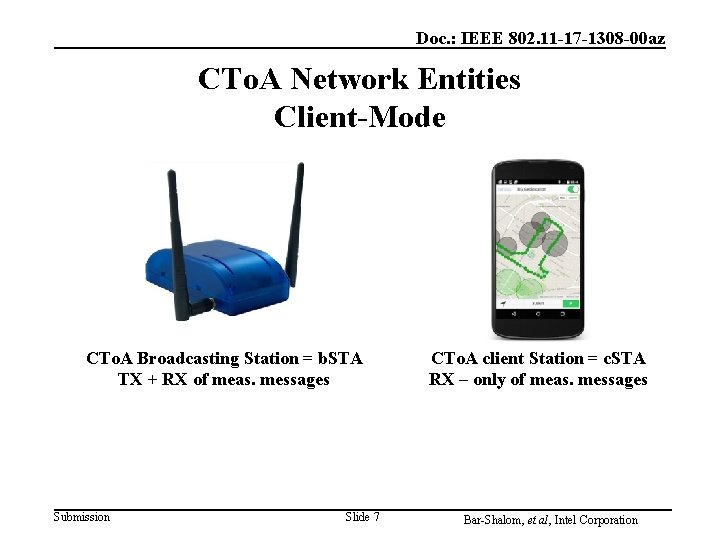
Doc. : IEEE 802. 11 -17 -1308 -00 az CTo. A Network Entities Client-Mode CTo. A Broadcasting Station = b. STA TX + RX of meas. messages Submission Slide 7 CTo. A client Station = c. STA RX – only of meas. messages Bar-Shalom, et al, Intel Corporation
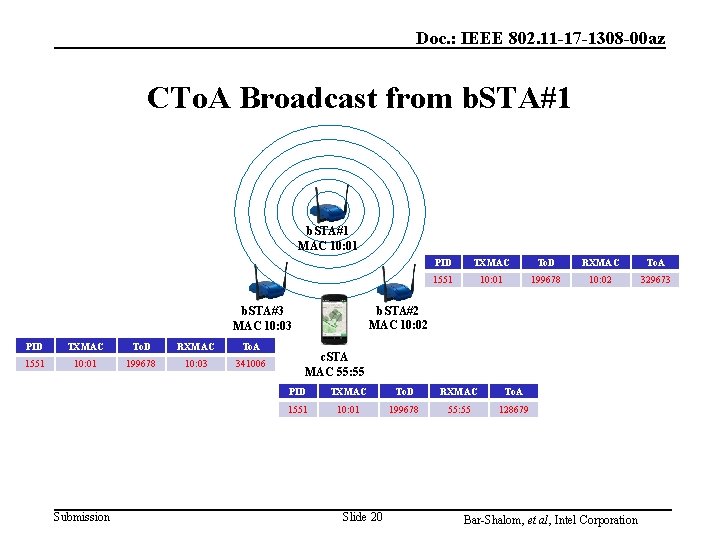
Doc. : IEEE 802. 11 -17 -1308 -00 az CTo. A b. STA Operation Principles • Each b. STA is an independent, network detached unit. • Could also be implemented as part of a standard 802. 11 AP. • The b. STAs are unsynchronized. • Each b. STA periodically broadcasts CTo. A measurement message, and measures and announces the To. D of that message. • Each b. STA receives the CTo. A measurement message transmitted by its neighbor b. STA and measures the To. A of that message. • Each b. STA publishes its To. A & To. D measurements of its neighbor b. STAs measurement messages. Submission Slide 8 Bar-Shalom, et al, Intel Corporation
Doc. : IEEE 802. 11 -17 -1308 -00 az CTo. A c. STA Operation Principles • CTo. A c. STA – only receive, and do not need to transmit • Similar to b. STA, each c. STA listens to the measurement messages and measures their To. A. • The c. STA collects the To. A & To. D measured & published by the b. STAs. • The c. STA uses all the information to calculate its own position. Submission Slide 9 Bar-Shalom, et al, Intel Corporation
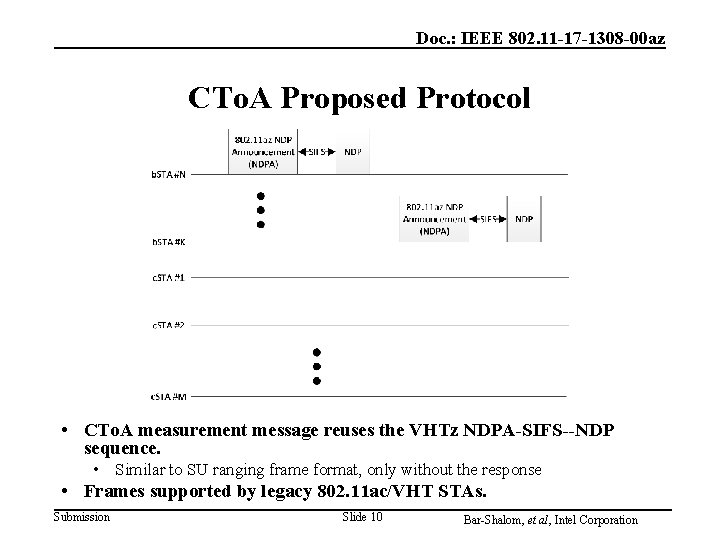
Doc. : IEEE 802. 11 -17 -1308 -00 az CTo. A Proposed Protocol • CTo. A measurement message reuses the VHTz NDPA-SIFS--NDP sequence. • Similar to SU ranging frame format, only without the response • Frames supported by legacy 802. 11 ac/VHT STAs. Submission Slide 10 Bar-Shalom, et al, Intel Corporation
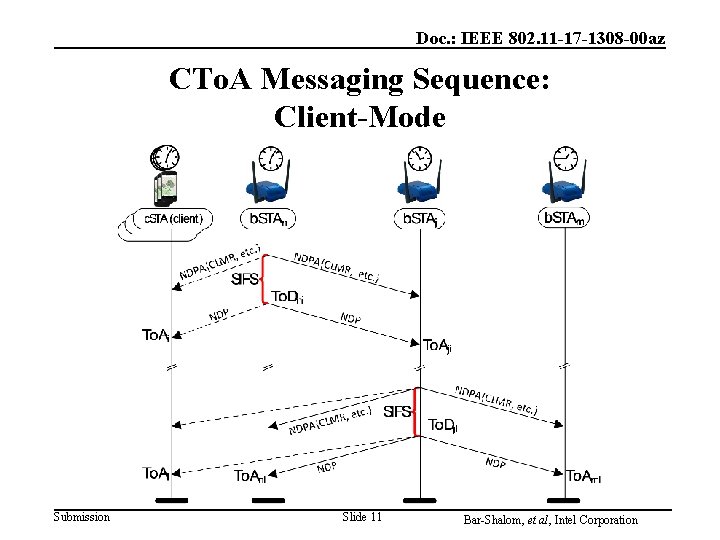
Doc. : IEEE 802. 11 -17 -1308 -00 az CTo. A Messaging Sequence: Client-Mode Submission Slide 11 Bar-Shalom, et al, Intel Corporation
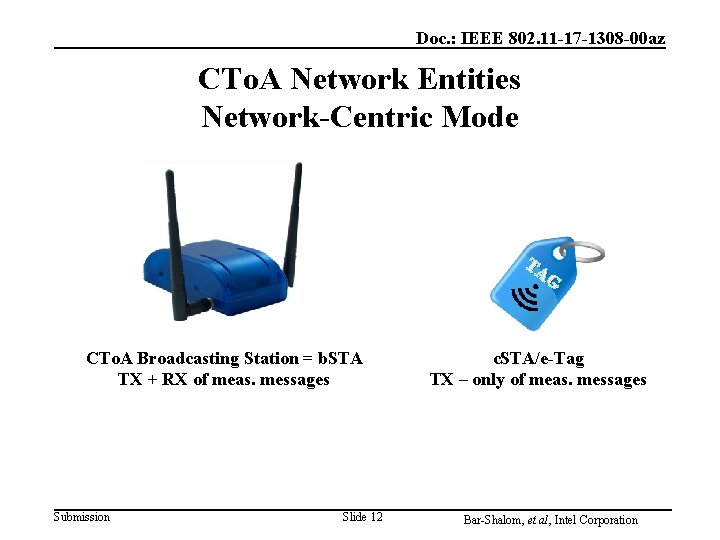
Doc. : IEEE 802. 11 -17 -1308 -00 az CTo. A Network Entities Network-Centric Mode TA G CTo. A Broadcasting Station = b. STA TX + RX of meas. messages Submission Slide 12 c. STA/e-Tag TX – only of meas. messages Bar-Shalom, et al, Intel Corporation
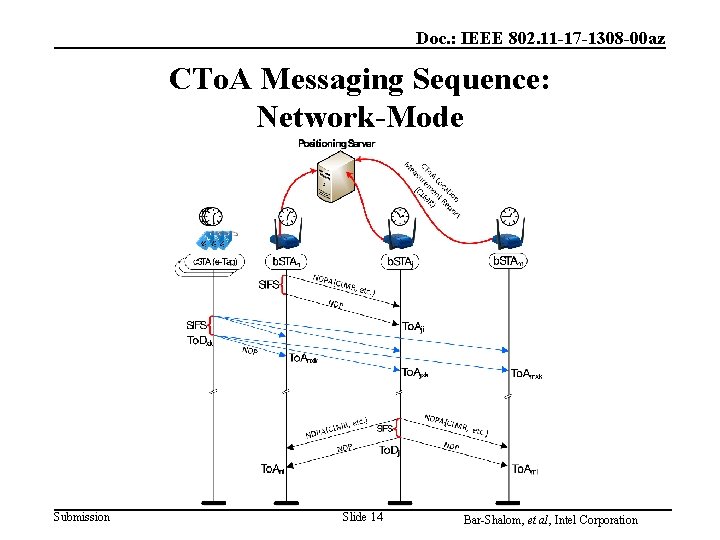
Doc. : IEEE 802. 11 -17 -1308 -00 az CTo. A c. STA/e-Tag Operation Principles • Simple 802. 11 STA: – Low cost; low computation and memory requirements. – Power-conscious device; minimized OTA activity. – Supports only a limited subset of waveforms and frame formats (e. g. , NDPA, NDP, discovery frames). • Transmissions are infrequent – Large variance in client position refresh rate (second/s to minutes) • Only broadcasts CTo. A measurement messages (incl. To. D) – Does not need to receive b. STA (or other) broadcasts – Does not need to make any timing measurements Submission Slide 13 Bar-Shalom, et al, Intel Corporation
Doc. : IEEE 802. 11 -17 -1308 -00 az CTo. A Messaging Sequence: Network-Mode Submission Slide 14 Bar-Shalom, et al, Intel Corporation
Doc. : IEEE 802. 11 -17 -1308 -00 az CLIENT POSITION ESTIMATION USING CTOA Submission Slide 15 Bar-Shalom, et al, Intel Corporation
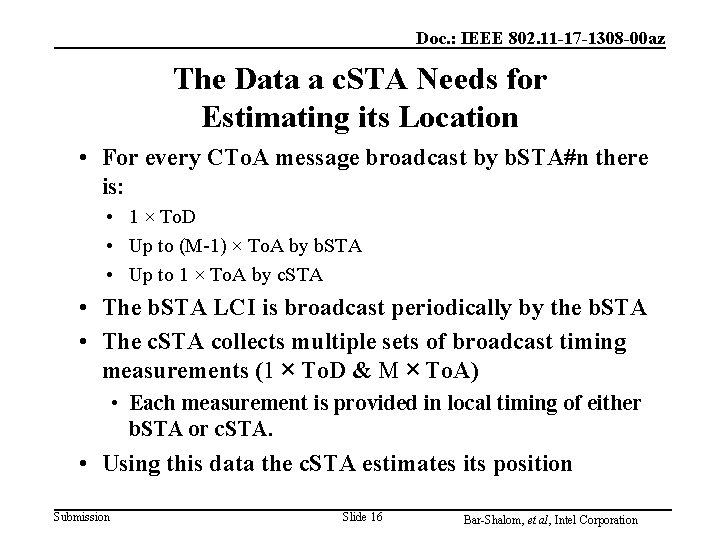
Doc. : IEEE 802. 11 -17 -1308 -00 az The Data a c. STA Needs for Estimating its Location • For every CTo. A message broadcast by b. STA#n there is: • 1 × To. D • Up to (M-1) × To. A by b. STA • Up to 1 × To. A by c. STA • The b. STA LCI is broadcast periodically by the b. STA • The c. STA collects multiple sets of broadcast timing measurements (1 × To. D & M × To. A) • Each measurement is provided in local timing of either b. STA or c. STA. • Using this data the c. STA estimates its position Submission Slide 16 Bar-Shalom, et al, Intel Corporation
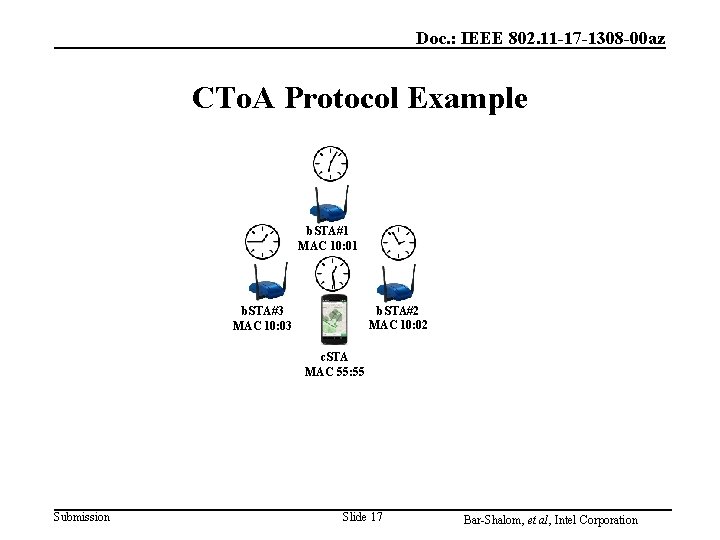
Doc. : IEEE 802. 11 -17 -1308 -00 az CTo. A Protocol Example b. STA#1 MAC 10: 01 b. STA#2 MAC 10: 02 b. STA#3 MAC 10: 03 c. STA MAC 55: 55 Submission Slide 17 Bar-Shalom, et al, Intel Corporation
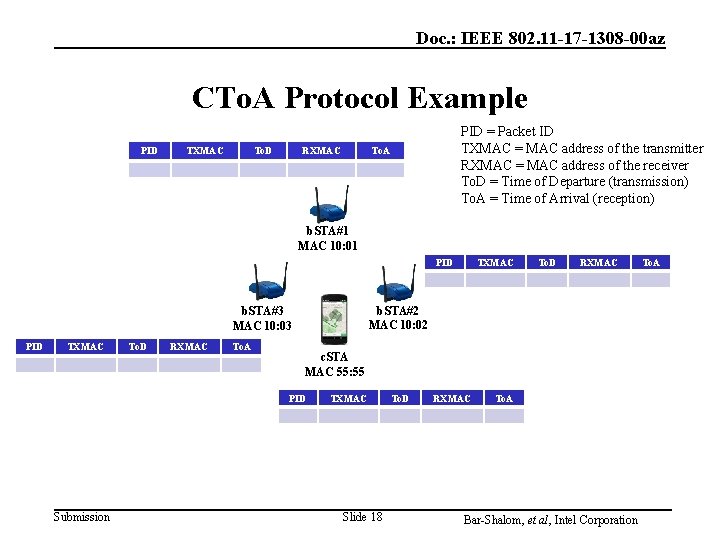
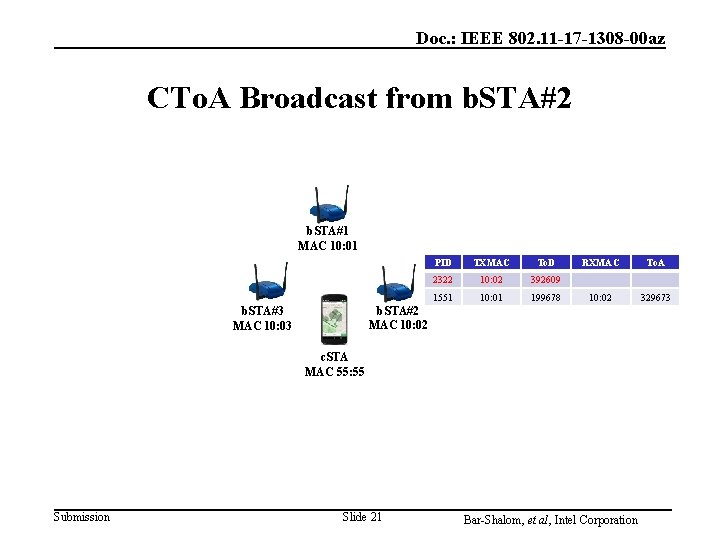
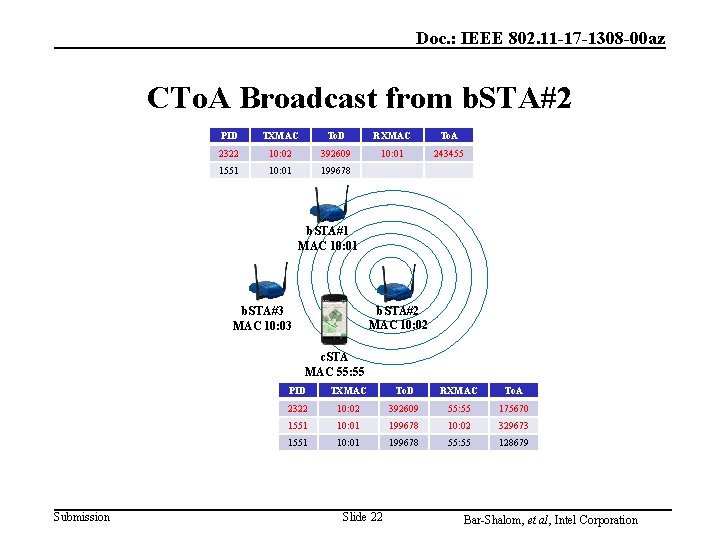
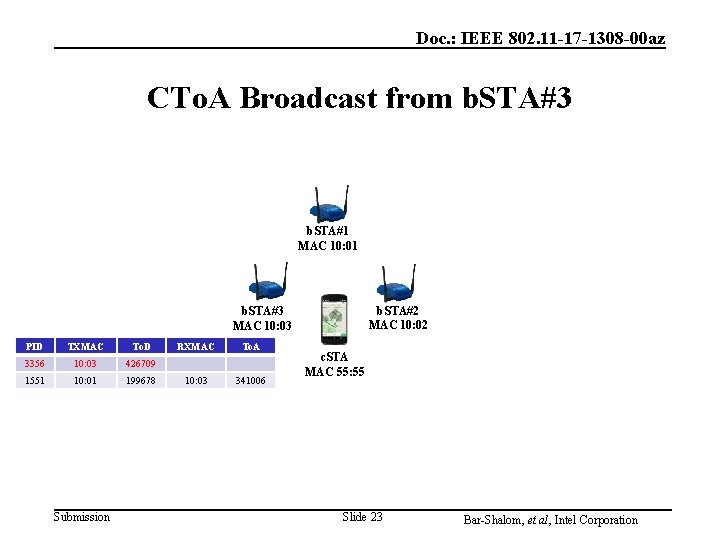
Doc. : IEEE 802. 11 -17 -1308 -00 az CTo. A Protocol Example PID TXMAC To. D RXMAC PID = Packet ID TXMAC = MAC address of the transmitter RXMAC = MAC address of the receiver To. D = Time of Departure (transmission) To. A = Time of Arrival (reception) To. A b. STA#1 MAC 10: 01 PID TXMAC To. D RXMAC To. A RXMAC c. STA MAC 55: 55 PID Submission To. D b. STA#2 MAC 10: 02 b. STA#3 MAC 10: 03 PID TXMAC Slide 18 To. D RXMAC To. A Bar-Shalom, et al, Intel Corporation To. A
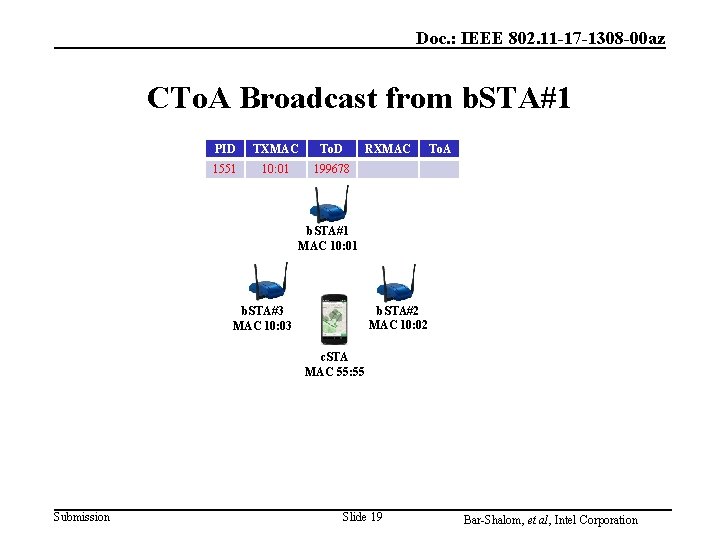
Doc. : IEEE 802. 11 -17 -1308 -00 az CTo. A Broadcast from b. STA#1 PID TXMAC To. D RXMAC 1551 10: 01 199678 To. A b. STA#1 MAC 10: 01 b. STA#2 MAC 10: 02 b. STA#3 MAC 10: 03 c. STA MAC 55: 55 Submission Slide 19 Bar-Shalom, et al, Intel Corporation
Doc. : IEEE 802. 11 -17 -1308 -00 az CTo. A Broadcast from b. STA#1 MAC 10: 01 TXMAC To. D RXMAC To. A 1551 10: 01 199678 10: 03 341006 Submission TXMAC To. D RXMAC To. A 1551 10: 01 199678 10: 02 329673 b. STA#2 MAC 10: 02 b. STA#3 MAC 10: 03 PID c. STA MAC 55: 55 PID TXMAC To. D RXMAC To. A 1551 10: 01 199678 55: 55 128679 Slide 20 Bar-Shalom, et al, Intel Corporation
Doc. : IEEE 802. 11 -17 -1308 -00 az CTo. A Broadcast from b. STA#2 b. STA#1 MAC 10: 01 PID TXMAC To. D 2322 10: 02 392609 1551 10: 01 199678 RXMAC To. A 10: 02 329673 b. STA#2 MAC 10: 02 b. STA#3 MAC 10: 03 c. STA MAC 55: 55 Submission Slide 21 Bar-Shalom, et al, Intel Corporation
Doc. : IEEE 802. 11 -17 -1308 -00 az CTo. A Broadcast from b. STA#2 PID TXMAC To. D RXMAC To. A 2322 10: 02 392609 10: 01 243455 1551 10: 01 199678 b. STA#1 MAC 10: 01 b. STA#2 MAC 10: 02 b. STA#3 MAC 10: 03 c. STA MAC 55: 55 Submission PID TXMAC To. D RXMAC To. A 2322 10: 02 392609 55: 55 175670 1551 10: 01 199678 10: 02 329673 1551 10: 01 199678 55: 55 128679 Slide 22 Bar-Shalom, et al, Intel Corporation
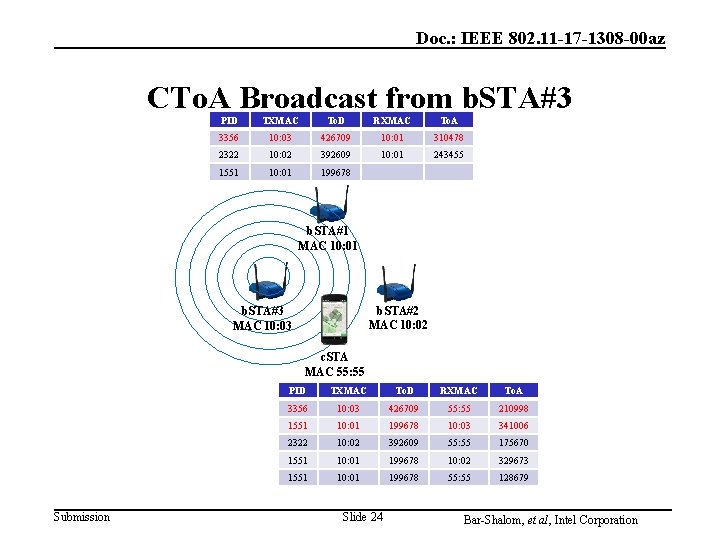
Doc. : IEEE 802. 11 -17 -1308 -00 az CTo. A Broadcast from b. STA#3 b. STA#1 MAC 10: 01 b. STA#2 MAC 10: 02 b. STA#3 MAC 10: 03 PID TXMAC To. D 3356 10: 03 426709 1551 10: 01 199678 Submission RXMAC To. A 10: 03 341006 c. STA MAC 55: 55 Slide 23 Bar-Shalom, et al, Intel Corporation
Doc. : IEEE 802. 11 -17 -1308 -00 az CTo. A Broadcast from b. STA#3 PID TXMAC To. D RXMAC To. A 3356 10: 03 426709 10: 01 310478 2322 10: 02 392609 10: 01 243455 1551 10: 01 199678 b. STA#1 MAC 10: 01 b. STA#2 MAC 10: 02 b. STA#3 MAC 10: 03 c. STA MAC 55: 55 Submission PID TXMAC To. D RXMAC To. A 3356 10: 03 426709 55: 55 210998 1551 10: 01 199678 10: 03 341006 2322 10: 02 392609 55: 55 175670 1551 10: 01 199678 10: 02 329673 1551 10: 01 199678 55: 55 128679 Slide 24 Bar-Shalom, et al, Intel Corporation
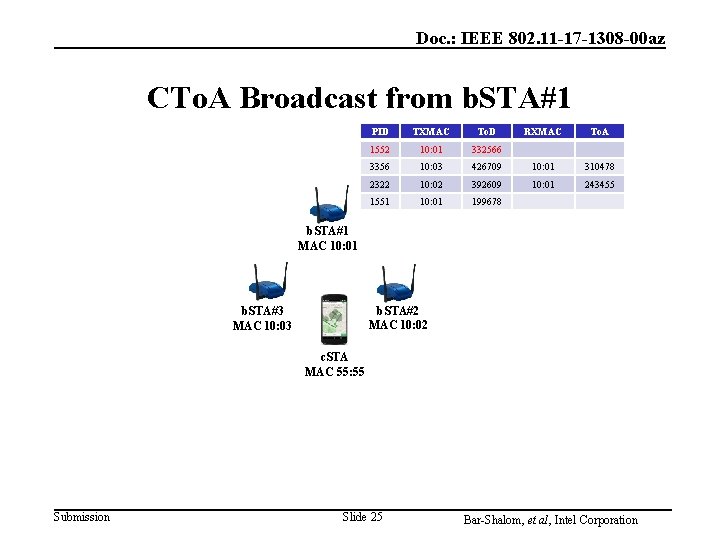
Doc. : IEEE 802. 11 -17 -1308 -00 az CTo. A Broadcast from b. STA#1 PID TXMAC To. D RXMAC To. A 1552 10: 01 332566 3356 10: 03 426709 10: 01 310478 2322 10: 02 392609 10: 01 243455 1551 10: 01 199678 b. STA#1 MAC 10: 01 b. STA#2 MAC 10: 02 b. STA#3 MAC 10: 03 c. STA MAC 55: 55 Submission Slide 25 Bar-Shalom, et al, Intel Corporation
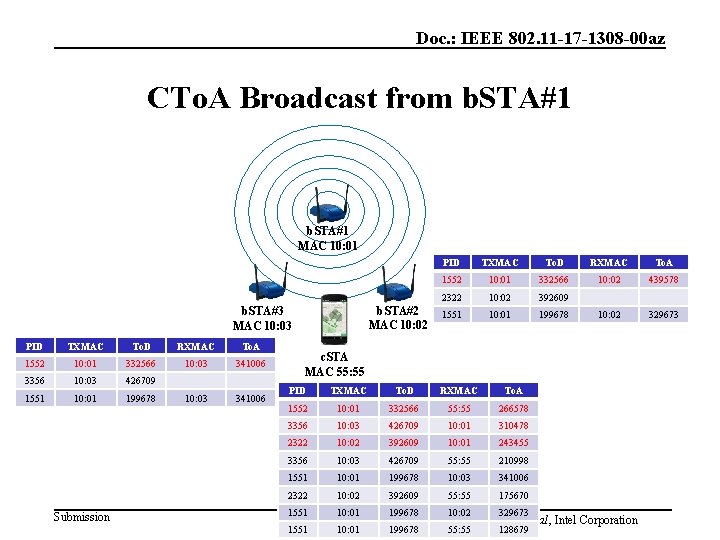
Doc. : IEEE 802. 11 -17 -1308 -00 az CTo. A Broadcast from b. STA#1 MAC 10: 01 b. STA#2 MAC 10: 02 b. STA#3 MAC 10: 03 PID TXMAC To. D RXMAC To. A 1552 10: 01 332566 10: 03 341006 3356 10: 03 426709 1551 10: 01 199678 10: 03 341006 Submission PID TXMAC To. D RXMAC To. A 1552 10: 01 332566 10: 02 439578 2322 10: 02 392609 1551 10: 01 199678 10: 02 329673 c. STA MAC 55: 55 PID TXMAC To. D RXMAC To. A 1552 10: 01 332566 55: 55 266578 3356 10: 03 426709 10: 01 310478 2322 10: 02 392609 10: 01 243455 3356 10: 03 426709 55: 55 210998 1551 10: 01 199678 10: 03 341006 2322 10: 02 392609 55: 55 175670 1551 10: 01 Slide 26 199678 10: 02 329673 1551 10: 01 55: 55 128679 199678 Bar-Shalom, et al, Intel Corporation
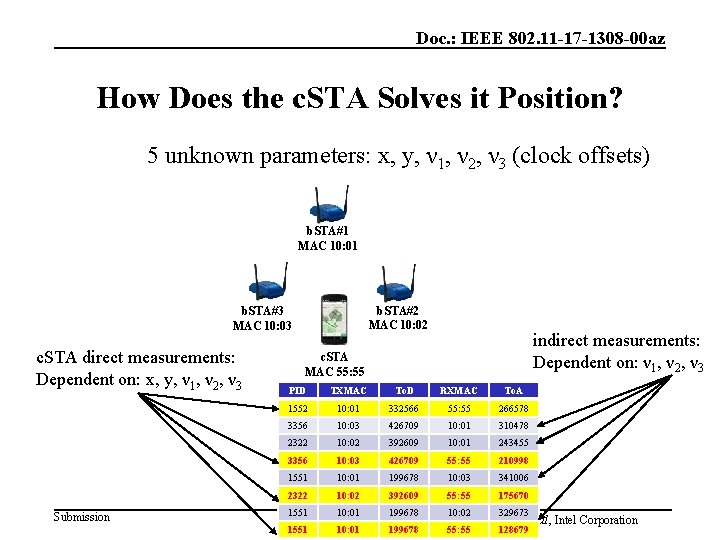
Doc. : IEEE 802. 11 -17 -1308 -00 az How Does the c. STA Solves it Position? 5 unknown parameters: x, y, ν 1, ν 2, ν 3 (clock offsets) b. STA#1 MAC 10: 01 b. STA#2 MAC 10: 02 b. STA#3 MAC 10: 03 c. STA direct measurements: Dependent on: x, y, ν 1, ν 2, ν 3 Submission indirect measurements: Dependent on: ν 1, ν 2, ν 3 c. STA MAC 55: 55 PID TXMAC To. D RXMAC To. A 1552 10: 01 332566 55: 55 266578 3356 10: 03 426709 10: 01 310478 2322 10: 02 392609 10: 01 243455 3356 10: 03 426709 55: 55 210998 1551 10: 01 199678 10: 03 341006 2322 10: 02 392609 55: 55 175670 1551 10: 01 Slide 27 199678 10: 02 329673 1551 10: 01 55: 55 128679 199678 Bar-Shalom, et al, Intel Corporation
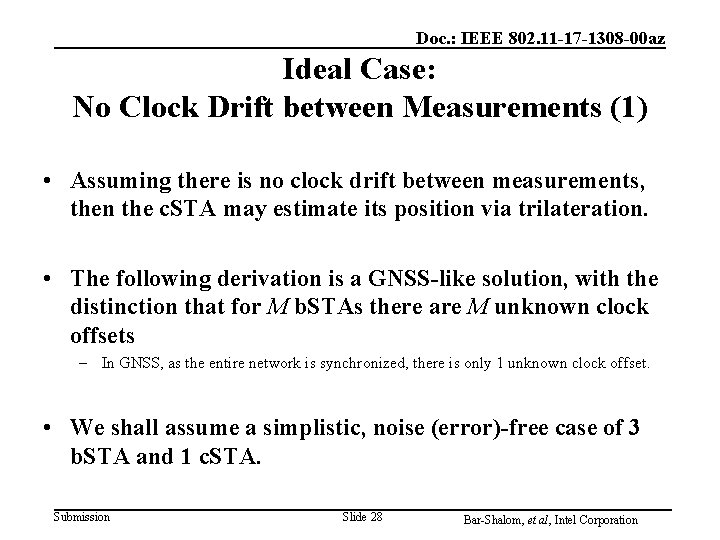
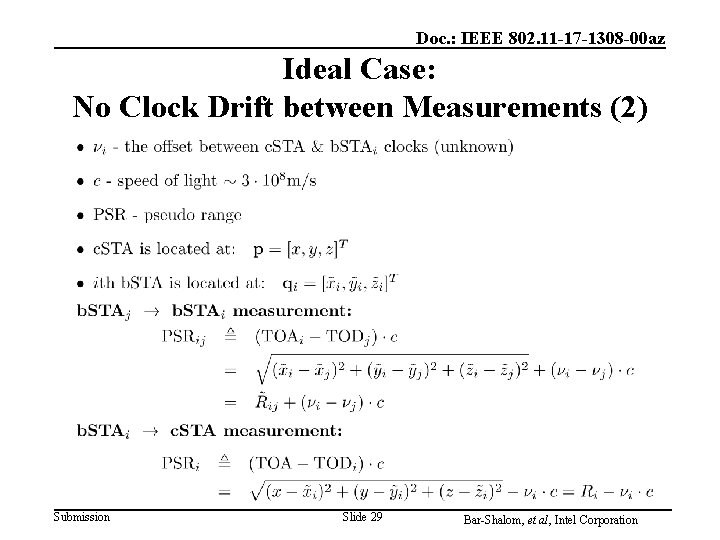
Doc. : IEEE 802. 11 -17 -1308 -00 az Ideal Case: No Clock Drift between Measurements (1) • Assuming there is no clock drift between measurements, then the c. STA may estimate its position via trilateration. • The following derivation is a GNSS-like solution, with the distinction that for M b. STAs there are M unknown clock offsets – In GNSS, as the entire network is synchronized, there is only 1 unknown clock offset. • We shall assume a simplistic, noise (error)-free case of 3 b. STA and 1 c. STA. Submission Slide 28 Bar-Shalom, et al, Intel Corporation
Doc. : IEEE 802. 11 -17 -1308 -00 az Ideal Case: No Clock Drift between Measurements (2) Submission Slide 29 Bar-Shalom, et al, Intel Corporation
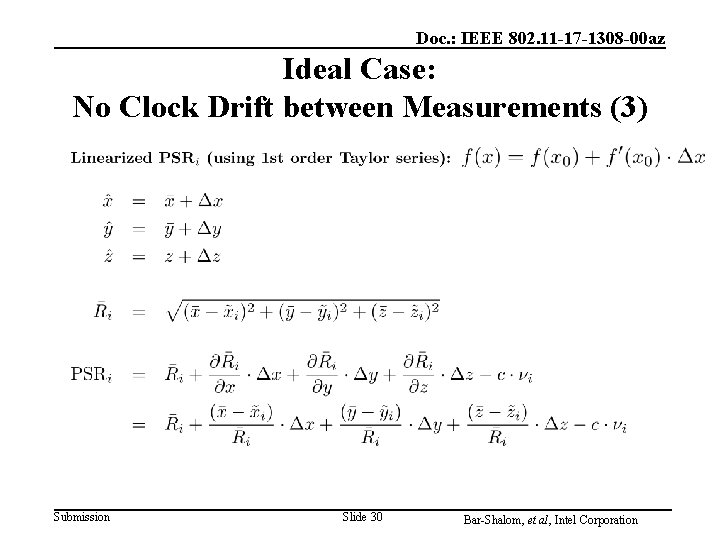
Doc. : IEEE 802. 11 -17 -1308 -00 az Ideal Case: No Clock Drift between Measurements (3) Submission Slide 30 Bar-Shalom, et al, Intel Corporation
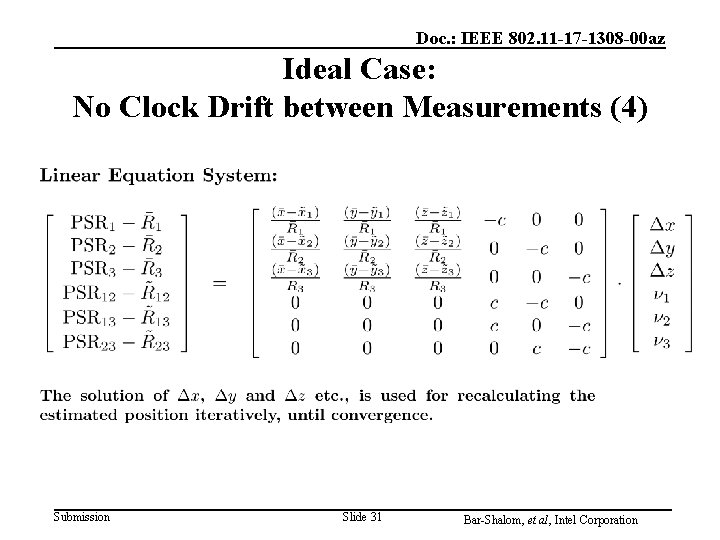
Doc. : IEEE 802. 11 -17 -1308 -00 az Ideal Case: No Clock Drift between Measurements (4) Submission Slide 31 Bar-Shalom, et al, Intel Corporation
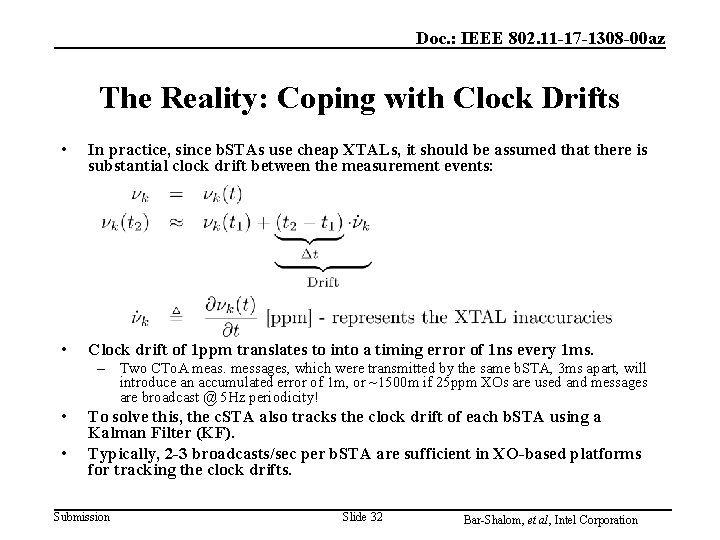
Doc. : IEEE 802. 11 -17 -1308 -00 az The Reality: Coping with Clock Drifts • In practice, since b. STAs use cheap XTALs, it should be assumed that there is substantial clock drift between the measurement events: • Clock drift of 1 ppm translates to into a timing error of 1 ns every 1 ms. – Two CTo. A meas. messages, which were transmitted by the same b. STA, 3 ms apart, will introduce an accumulated error of 1 m, or ~1500 m if 25 ppm XOs are used and messages are broadcast @ 5 Hz periodicity! • • To solve this, the c. STA also tracks the clock drift of each b. STA using a Kalman Filter (KF). Typically, 2 -3 broadcasts/sec per b. STA are sufficient in XO-based platforms for tracking the clock drifts. Submission Slide 32 Bar-Shalom, et al, Intel Corporation
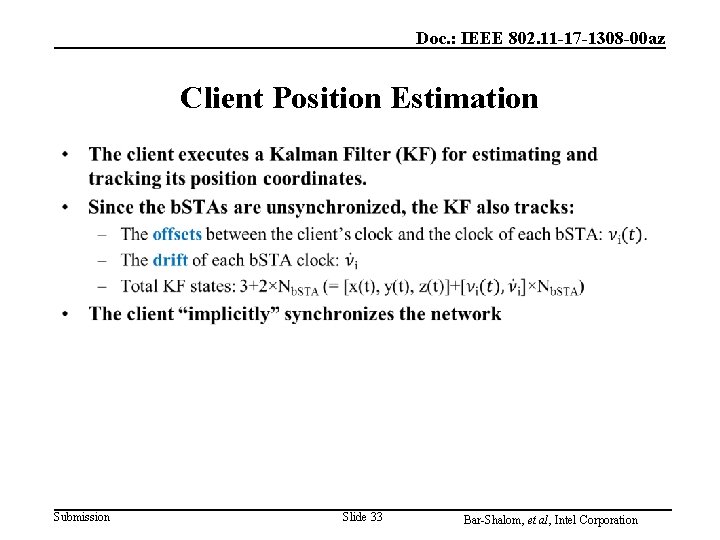
Doc. : IEEE 802. 11 -17 -1308 -00 az Client Position Estimation • Submission Slide 33 Bar-Shalom, et al, Intel Corporation
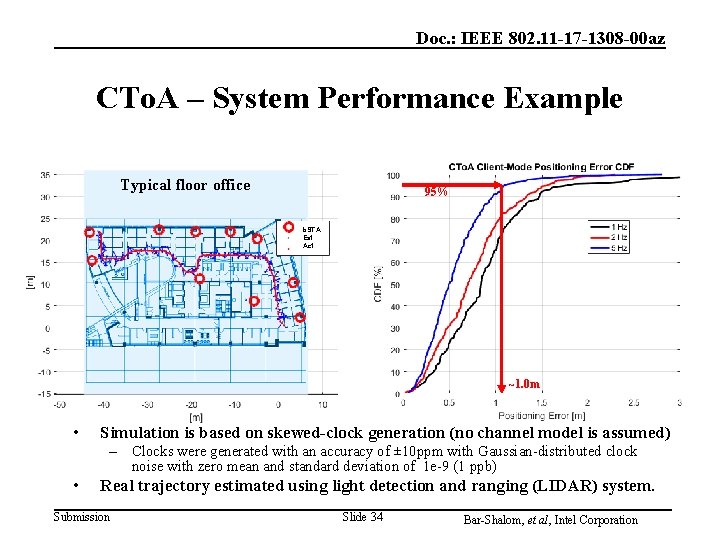
Doc. : IEEE 802. 11 -17 -1308 -00 az CTo. A – System Performance Example Typical floor office 95% b. STA Est. Act. ~1. 0 m • Simulation is based on skewed-clock generation (no channel model is assumed) – Clocks were generated with an accuracy of ± 10 ppm with Gaussian-distributed clock noise with zero mean and standard deviation of 1 e-9 (1 ppb) • Real trajectory estimated using light detection and ranging (LIDAR) system. Submission Slide 34 Bar-Shalom, et al, Intel Corporation
Doc. : IEEE 802. 11 -17 -1308 -00 az SUMMARY & CONCLUSIONS Submission Slide 35 Bar-Shalom, et al, Intel Corporation
Doc. : IEEE 802. 11 -17 -1308 -00 az Summary & Conclusions • Two concurrent modes of operation: – Client mode – “GPS-like”, client self positioning • Unlimited number of clients • Maintains clients’ privacy – Network mode – large scale asset tracking, analytics • Simple 802. 11 STA-based e-Tag clients • Based on broadcasting of timing measurement messages. – No retransmissions => robust, simple interop. • Designed to work with units with cheap/low-quality crystal oscillators (XO) • Accuracy is equivalent to REVmc-based FTM. Submission Slide 36 Bar-Shalom, et al, Intel Corporation
Doc. : IEEE 802. 11 -17 -1308 -00 az References 1. IEEE 802. 11 -17 -1387 R 0 CTo. A Whitepaper Submission Slide 37 Bar-Shalom, et al, Intel Corporation
Doc. : IEEE 802. 11 -17 -1308 -00 az THANK YOU FOR YOUR ATTENTION! Submission Slide 38 Bar-Shalom, et al, Intel Corporation