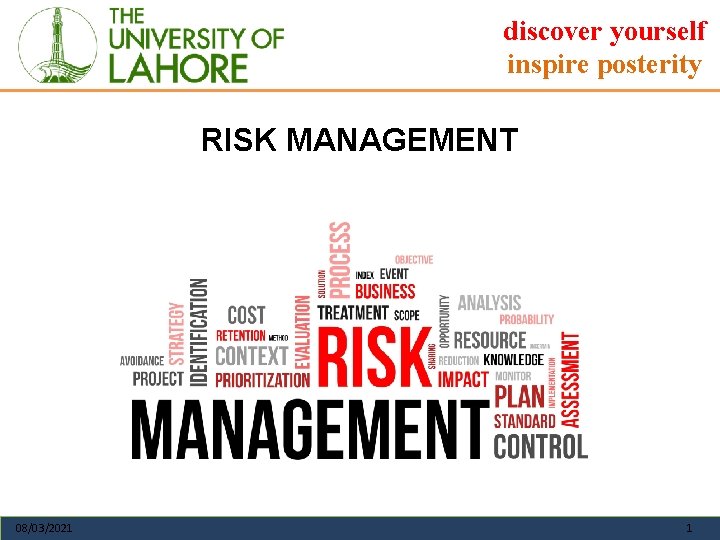
discover yourself inspire posterity RISK MANAGEMENT 08032021 1
- Slides: 36
discover yourself inspire posterity RISK MANAGEMENT 08/03/2021 1
discover yourself inspire posterity Definition of Risk A risk is a potential problem – it might happen and it might not Conceptual definition of risk Risk concerns future happenings Risk involves change in mind, opinion, actions, etc. Two characteristics of risk Uncertainty – the risk may or may not happen, that is, there are no 100% risks (those, instead, are called constraints) Loss – the risk becomes a reality and unwanted consequences or losses occur 08/03/2021 2
discover yourself inspire posterity Risk • Uncertain event that has a positive or negative effect on at least one of the project objectives (scope, schedule, budget, quality). 08/03/2021 3
discover yourself inspire posterity Threat • A project risk that has a negative effect. • Project Managers will look for ways to eliminate or reduce the effects of a threat. 08/03/2021 4
discover yourself inspire posterity Opportunity • A project risk that has a positive effect. • Project Managers will look for ways to enhance, exploit, or share the effects of an opportunity. 08/03/2021 5
discover yourself inspire posterity What is Risk Management? ? “Series of systematic steps that helps software team to understand manage uncertainty or risk is called Risk Management” 08/03/2021 6
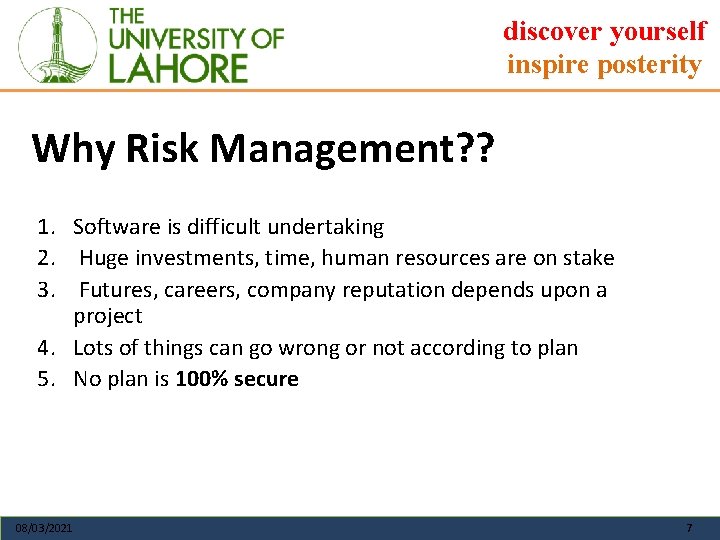
discover yourself inspire posterity Why Risk Management? ? 1. Software is difficult undertaking 2. Huge investments, time, human resources are on stake 3. Futures, careers, company reputation depends upon a project 4. Lots of things can go wrong or not according to plan 5. No plan is 100% secure 08/03/2021 7
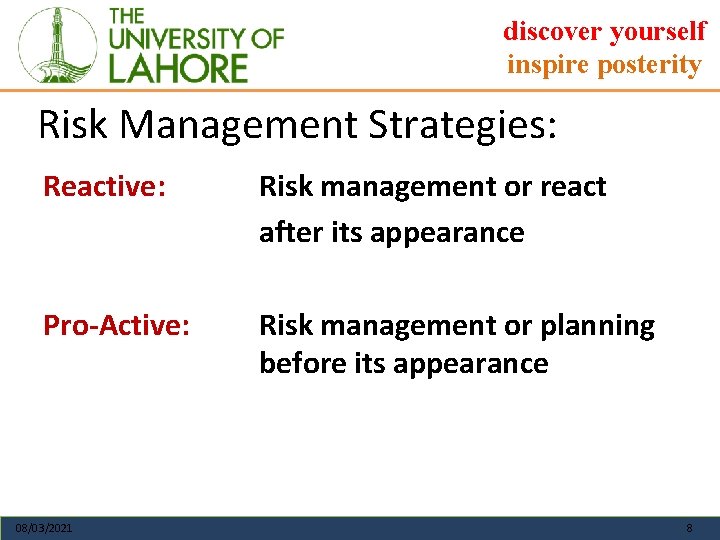
discover yourself inspire posterity Risk Management Strategies: Reactive: Risk management or react after its appearance Pro-Active: Risk management or planning before its appearance 08/03/2021 8
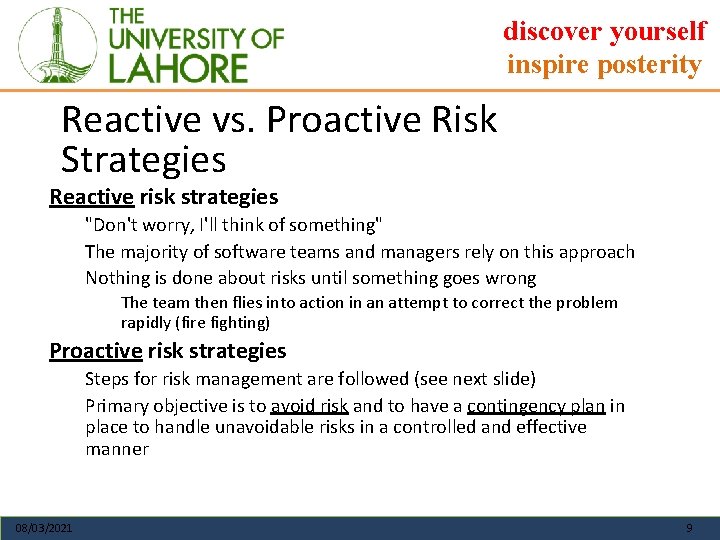
discover yourself inspire posterity Reactive vs. Proactive Risk Strategies Reactive risk strategies "Don't worry, I'll think of something" The majority of software teams and managers rely on this approach Nothing is done about risks until something goes wrong The team then flies into action in an attempt to correct the problem rapidly (fire fighting) Proactive risk strategies Steps for risk management are followed (see next slide) Primary objective is to avoid risk and to have a contingency plan in place to handle unavoidable risks in a controlled and effective manner 08/03/2021 9
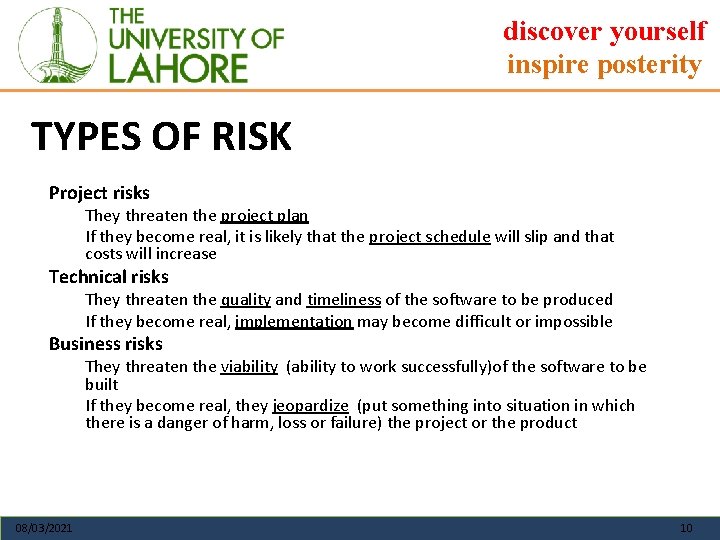
discover yourself inspire posterity TYPES OF RISK Project risks They threaten the project plan If they become real, it is likely that the project schedule will slip and that costs will increase Technical risks They threaten the quality and timeliness of the software to be produced If they become real, implementation may become difficult or impossible Business risks They threaten the viability (ability to work successfully)of the software to be built If they become real, they jeopardize (put something into situation in which there is a danger of harm, loss or failure) the project or the product 08/03/2021 10
discover yourself inspire posterity Project Risks: Threaten project plans 1. May cause project over budget and cross delivery deadlines 2. Identify budgetary, schedule, personal (staff), resource, etc 3. Change in clients requirements, technology, etc with respect to time and there impact on software life cycle 08/03/2021 11
discover yourself inspire posterity Technical Risks: Threaten quality of software product 1. If any technical risk becomes reality implementation becomes almost impossible 2. Identify design, code, implementation, interface and maintenance issues 3. Technical risks mostly arises when we consider a problem easy to implement but in reality its not. 08/03/2021 12
discover yourself inspire posterity Business Risks: Threaten product from business point of view 1. Sale/Marketing of Product 2. End Users feedback 3. All tangible expectations from project 08/03/2021 13
discover yourself inspire posterity Sub-categories of Business risks Market risk – building an excellent product or system that no one really wants Strategic risk – building a product that no longer fits into the overall business strategy for the company Sales risk – building a product that the sales force doesn't understand how to sell Management risk – losing the support of senior management due to a change in focus or a change in people Budget risk – losing budgetary or personnel commitment 08/03/2021 14
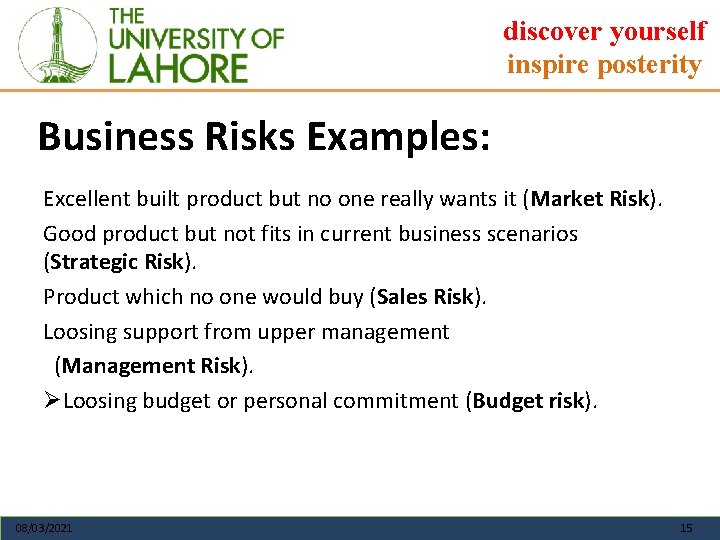
discover yourself inspire posterity Business Risks Examples: Excellent built product but no one really wants it (Market Risk). Good product but not fits in current business scenarios (Strategic Risk). Product which no one would buy (Sales Risk). Loosing support from upper management (Management Risk). ØLoosing budget or personal commitment (Budget risk). 08/03/2021 15
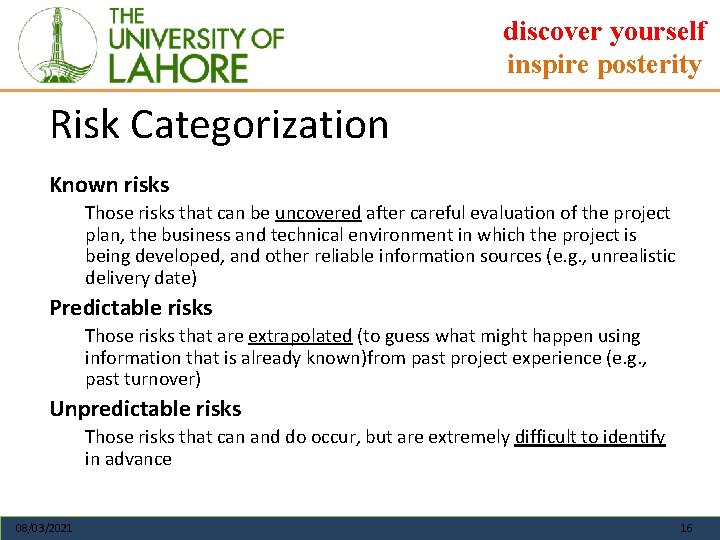
discover yourself inspire posterity Risk Categorization Known risks Those risks that can be uncovered after careful evaluation of the project plan, the business and technical environment in which the project is being developed, and other reliable information sources (e. g. , unrealistic delivery date) Predictable risks Those risks that are extrapolated (to guess what might happen using information that is already known)from past project experience (e. g. , past turnover) Unpredictable risks Those risks that can and do occur, but are extremely difficult to identify in advance 08/03/2021 16
discover yourself inspire posterity Predictable Risks: Explored from past experiences, for e. g. poor communication with customers, working in new or unfamiliar domain, poor staff efforts etc. Un-Predictable Risks: They may occur extremely difficult to identify predict in advance, only flexible pre-planning is the way to handle them. 08/03/2021 17
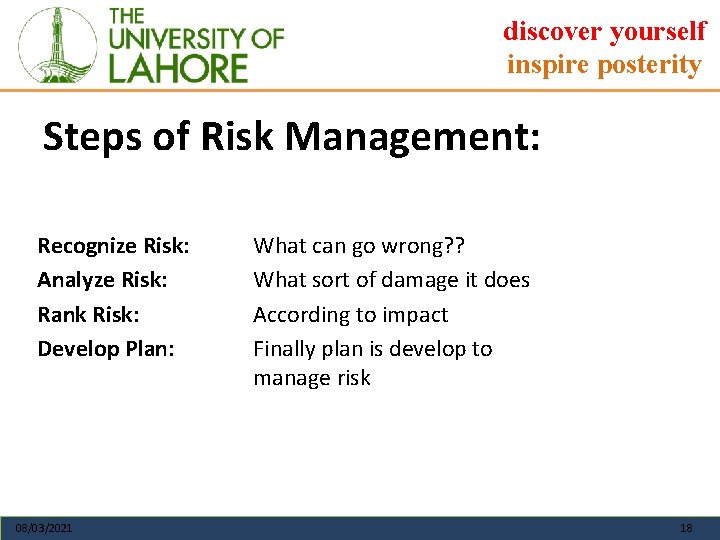
discover yourself inspire posterity Steps of Risk Management: Recognize Risk: Analyze Risk: Rank Risk: Develop Plan: 08/03/2021 What can go wrong? ? What sort of damage it does According to impact Finally plan is develop to manage risk 18
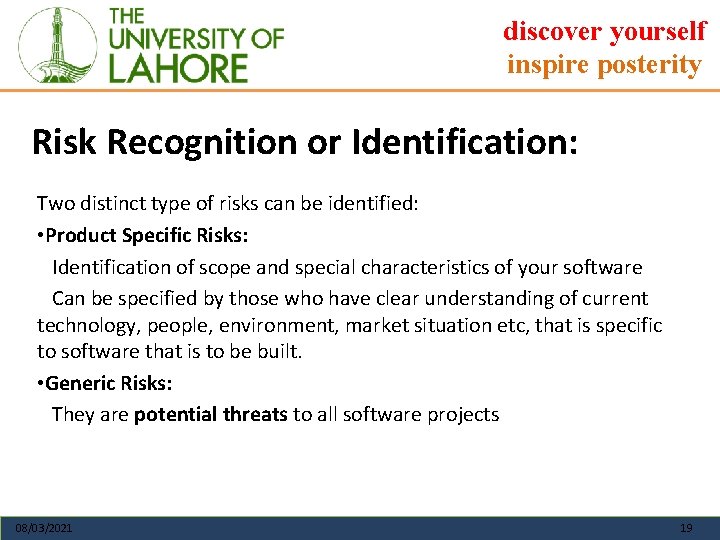
discover yourself inspire posterity Risk Recognition or Identification: Two distinct type of risks can be identified: • Product Specific Risks: Identification of scope and special characteristics of your software Can be specified by those who have clear understanding of current technology, people, environment, market situation etc, that is specific to software that is to be built. • Generic Risks: They are potential threats to all software projects 08/03/2021 19
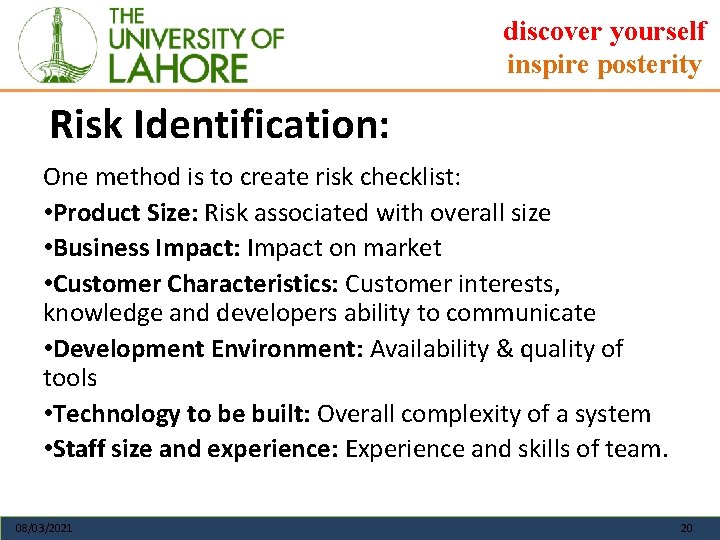
discover yourself inspire posterity Risk Identification: One method is to create risk checklist: • Product Size: Risk associated with overall size • Business Impact: Impact on market • Customer Characteristics: Customer interests, knowledge and developers ability to communicate • Development Environment: Availability & quality of tools • Technology to be built: Overall complexity of a system • Staff size and experience: Experience and skills of team. 08/03/2021 20
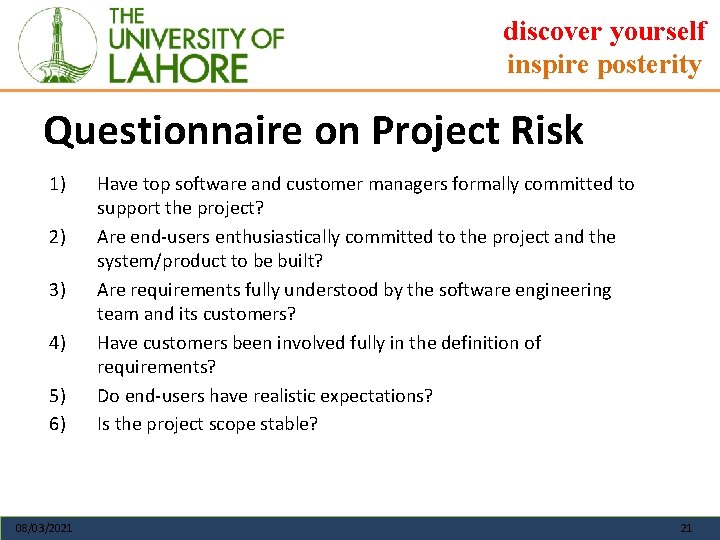
discover yourself inspire posterity Questionnaire on Project Risk 1) 2) 3) 4) 5) 6) 08/03/2021 Have top software and customer managers formally committed to support the project? Are end-users enthusiastically committed to the project and the system/product to be built? Are requirements fully understood by the software engineering team and its customers? Have customers been involved fully in the definition of requirements? Do end-users have realistic expectations? Is the project scope stable? 21
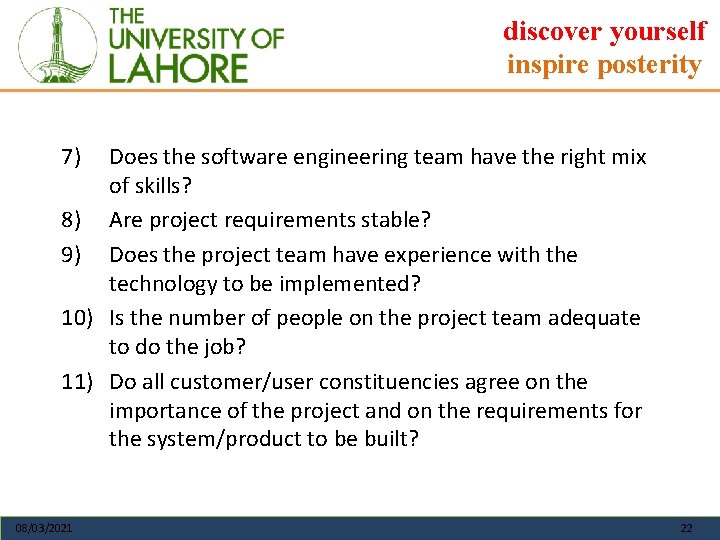
discover yourself inspire posterity 7) Does the software engineering team have the right mix of skills? 8) Are project requirements stable? 9) Does the project team have experience with the technology to be implemented? 10) Is the number of people on the project team adequate to do the job? 11) Do all customer/user constituencies agree on the importance of the project and on the requirements for the system/product to be built? 08/03/2021 22
discover yourself inspire posterity Risk Components and Drivers The project manager identifies the risk drivers that affect the following risk components Performance risk - the degree of uncertainty that the product will meet its requirements and be fit for its intended use Cost risk - the degree of uncertainty that the project budget will be maintained Support risk - the degree of uncertainty that the resultant software will be easy to correct, adapt, and enhance Schedule risk - the degree of uncertainty that the project schedule will be maintained and that the product will be delivered on time The impact of each risk driver on the risk component is divided into one of four impact levels Negligible, marginal, critical, and catastrophic 08/03/2021 23
discover yourself inspire posterity Risk Analysis or Projection: Also called risk estimation or risk analysis Attempt to specify each risk in two ways: • Probability that risk is real • Consequences or Impact of risk Planners & technical staff perform risk projection in four steps: 1. Establish scale of risk 2. Explain the consequences of risk 3. Estimate the impact on project 4. Note overall accuracy of risk projection 08/03/2021 24
Risk Rank: discover yourself inspire posterity 1. Establish scale of risk Impact Values: 4 ----- Catastrophic 3 ----- Critical 2 ----- Marginal 1 ------ Negligible R. E = Probability * Category 08/03/2021 25
discover yourself inspire posterity Risk Analysis or Projection: 2 - Delineate (indicate the exact position) the consequences of risk “Assign probability of to each risk according to the general possibility of occurrence” For e. g. : Technology will not meet the requirement 30% Customer will change the requirements 70% 08/03/2021 26
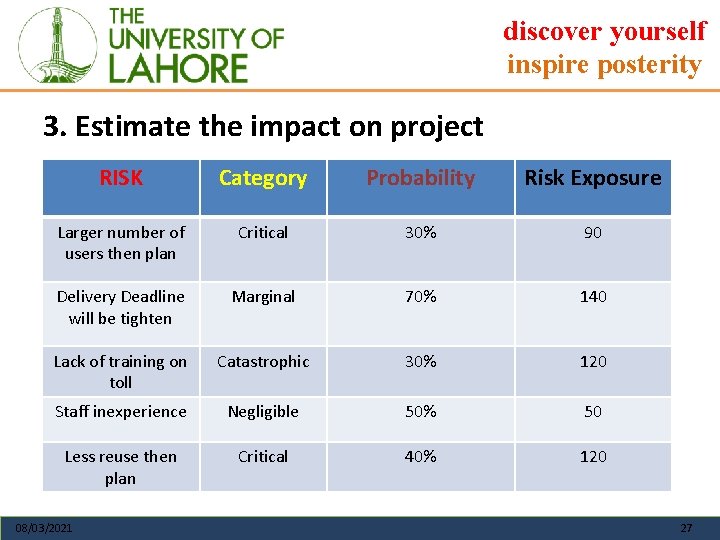
discover yourself inspire posterity 3. Estimate the impact on project RISK Category Probability Risk Exposure Larger number of users then plan Critical 30% 90 Delivery Deadline will be tighten Marginal 70% 140 Lack of training on toll Catastrophic 30% 120 Staff inexperience Negligible 50% 50 Less reuse then plan Critical 40% 120 08/03/2021 27
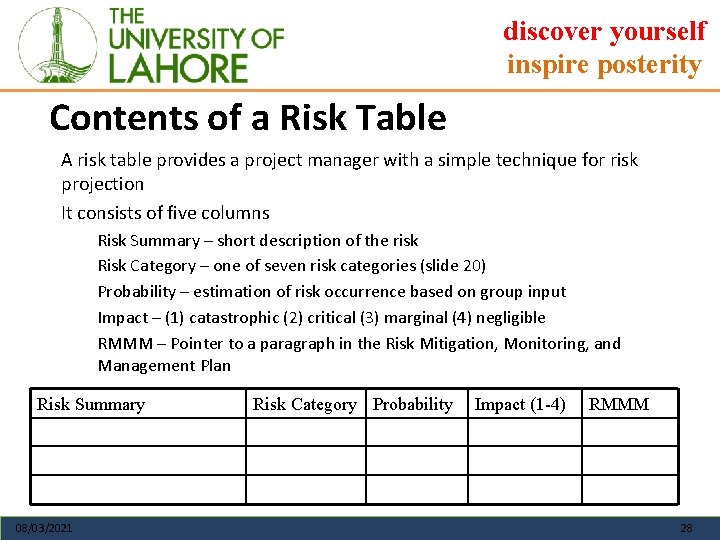
discover yourself inspire posterity Contents of a Risk Table A risk table provides a project manager with a simple technique for risk projection It consists of five columns Risk Summary – short description of the risk Risk Category – one of seven risk categories (slide 20) Probability – estimation of risk occurrence based on group input Impact – (1) catastrophic (2) critical (3) marginal (4) negligible RMMM – Pointer to a paragraph in the Risk Mitigation, Monitoring, and Management Plan Risk Summary 08/03/2021 Risk Category Probability Impact (1 -4) RMMM 28
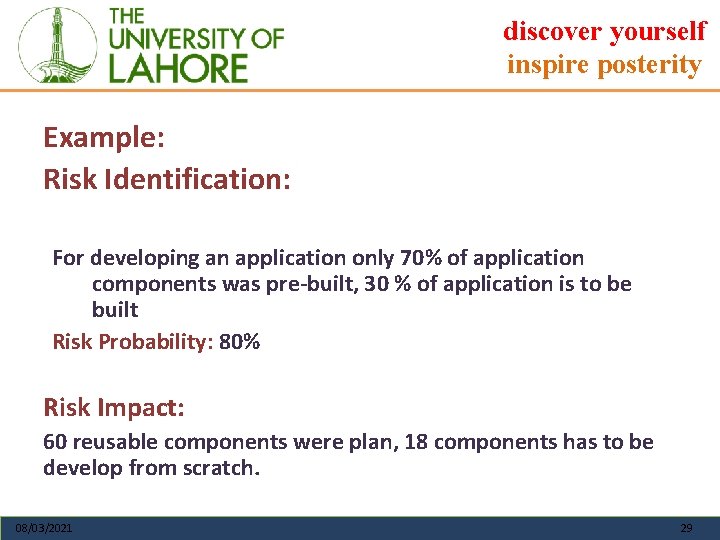
discover yourself inspire posterity Example: Risk Identification: For developing an application only 70% of application components was pre-built, 30 % of application is to be built Risk Probability: 80% Risk Impact: 60 reusable components were plan, 18 components has to be develop from scratch. 08/03/2021 29
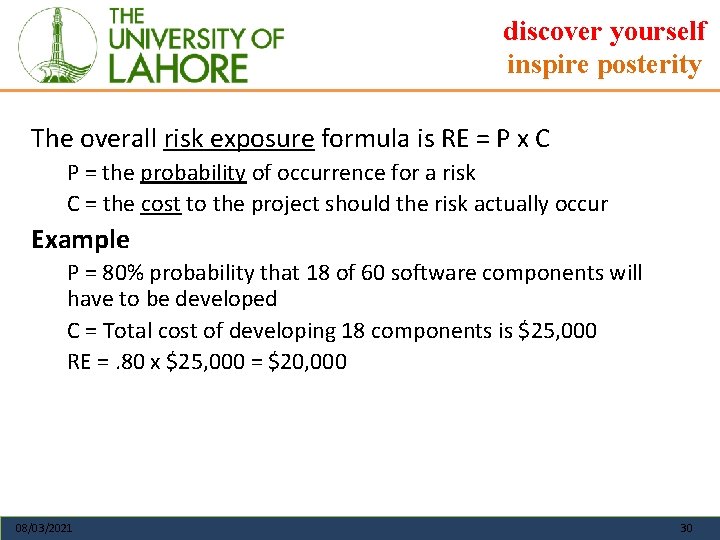
discover yourself inspire posterity The overall risk exposure formula is RE = P x C P = the probability of occurrence for a risk C = the cost to the project should the risk actually occur Example P = 80% probability that 18 of 60 software components will have to be developed C = Total cost of developing 18 components is $25, 000 RE =. 80 x $25, 000 = $20, 000 08/03/2021 30
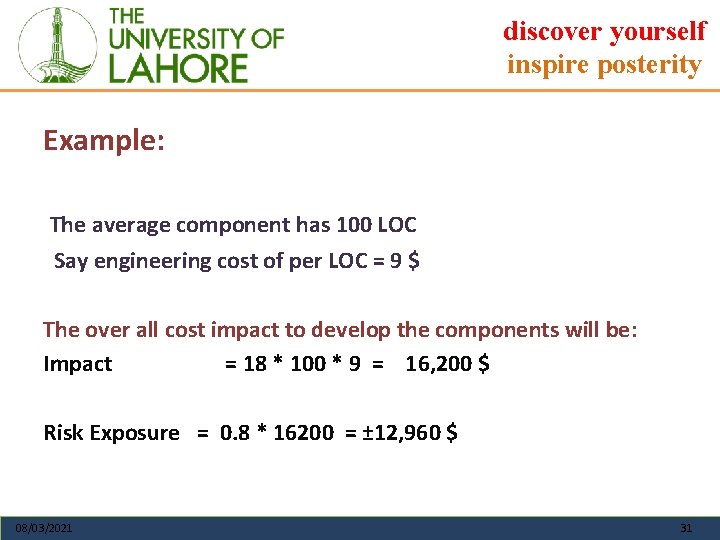
discover yourself inspire posterity Example: The average component has 100 LOC Say engineering cost of per LOC = 9 $ The over all cost impact to develop the components will be: Impact = 18 * 100 * 9 = 16, 200 $ Risk Exposure = 0. 8 * 16200 = ± 12, 960 $ 08/03/2021 31
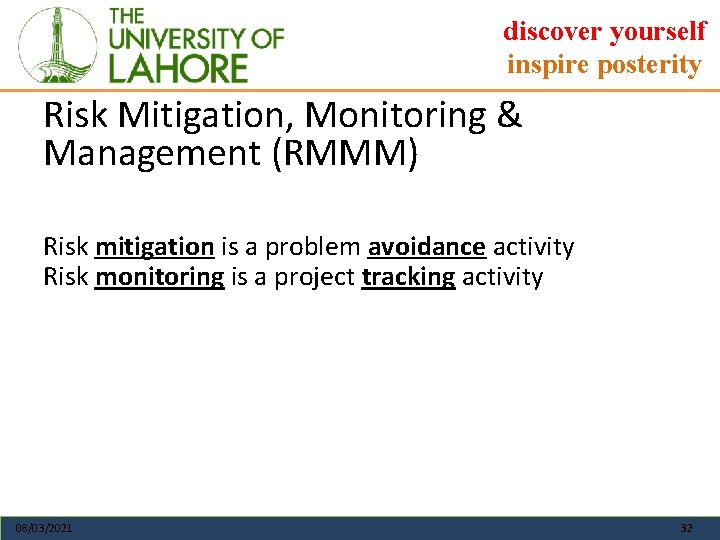
discover yourself inspire posterity Risk Mitigation, Monitoring & Management (RMMM) Risk mitigation is a problem avoidance activity Risk monitoring is a project tracking activity 08/03/2021 32
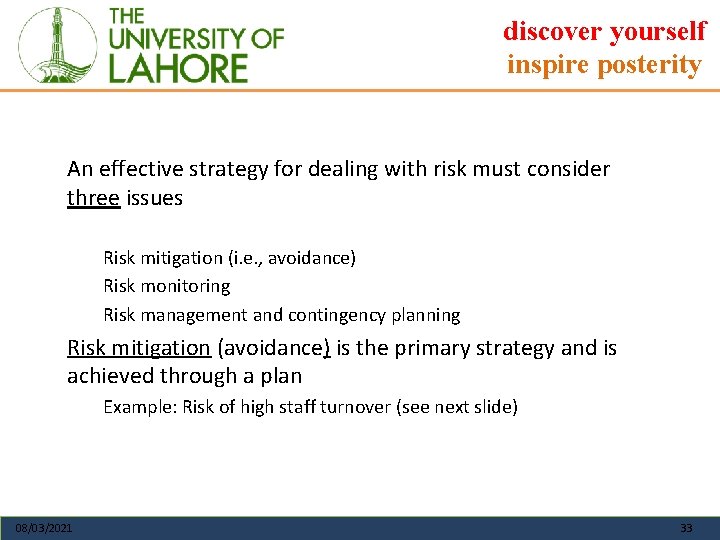
discover yourself inspire posterity An effective strategy for dealing with risk must consider three issues Risk mitigation (i. e. , avoidance) Risk monitoring Risk management and contingency planning Risk mitigation (avoidance) is the primary strategy and is achieved through a plan Example: Risk of high staff turnover (see next slide) 08/03/2021 33
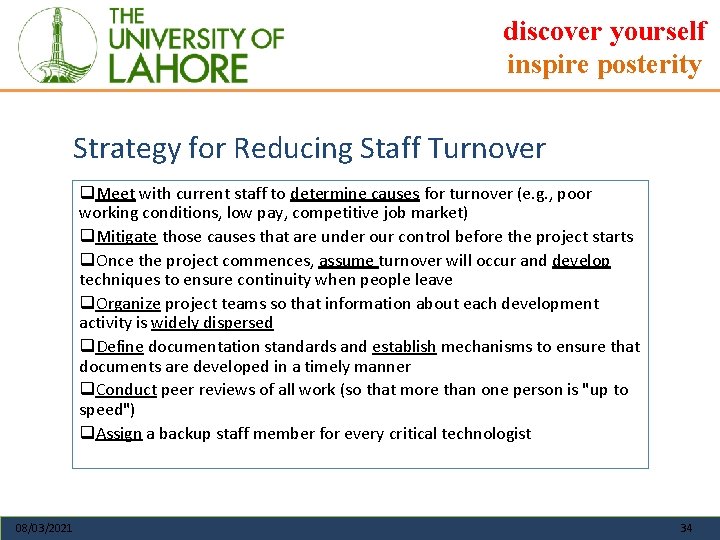
discover yourself inspire posterity Strategy for Reducing Staff Turnover q. Meet with current staff to determine causes for turnover (e. g. , poor working conditions, low pay, competitive job market) q. Mitigate those causes that are under our control before the project starts q. Once the project commences, assume turnover will occur and develop techniques to ensure continuity when people leave q. Organize project teams so that information about each development activity is widely dispersed q. Define documentation standards and establish mechanisms to ensure that documents are developed in a timely manner q. Conduct peer reviews of all work (so that more than one person is "up to speed") q. Assign a backup staff member for every critical technologist 08/03/2021 34
discover yourself inspire posterity Risk monitoring has three objectives To assess whether predicted risks do, in fact, occur To ensure that risk aversion steps defined for the risk are being properly applied To collect information that can be used for future risk analysis The findings from risk monitoring may allow the project manager to ascertain what risks caused which problems throughout the project 08/03/2021 35
discover yourself inspire posterity Seven Principles of Risk Management Maintain a global perspective View software risks within the context of a system and the business problem that is intended to solve Take a forward-looking view Think about risks that may arise in the future; establish contingency plans Encourage open communication Encourage all stakeholders and users to point out risks at any time Integrate risk management Integrate the consideration of risk into the software process Emphasize a continuous process of risk management Modify identified risks as more becomes known and add new risks as better insight is achieved Develop a shared product vision A shared vision by all stakeholders facilitates better risk identification and assessment Encourage teamwork when managing risk Pool the skills and experience of all stakeholders when conducting risk management activities 08/03/2021 36