DIR Floortime Dr Stanley Greenspan Maude Le Roux


- Slides: 34
® DIR Floortime Dr. Stanley Greenspan Maude Le Roux, OTR/L Do not use or distribute without written permission.
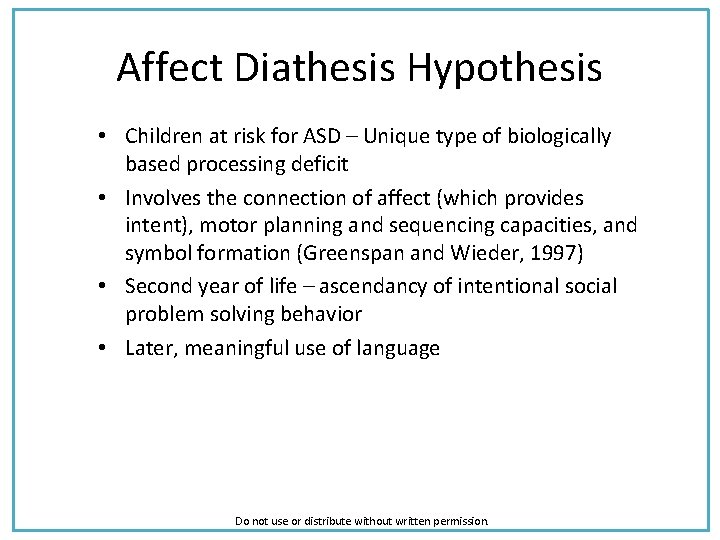
Affect Diathesis Hypothesis • Children at risk for ASD – Unique type of biologically based processing deficit • Involves the connection of affect (which provides intent), motor planning and sequencing capacities, and symbol formation (Greenspan and Wieder, 1997) • Second year of life – ascendancy of intentional social problem solving behavior • Later, meaningful use of language Do not use or distribute without written permission.
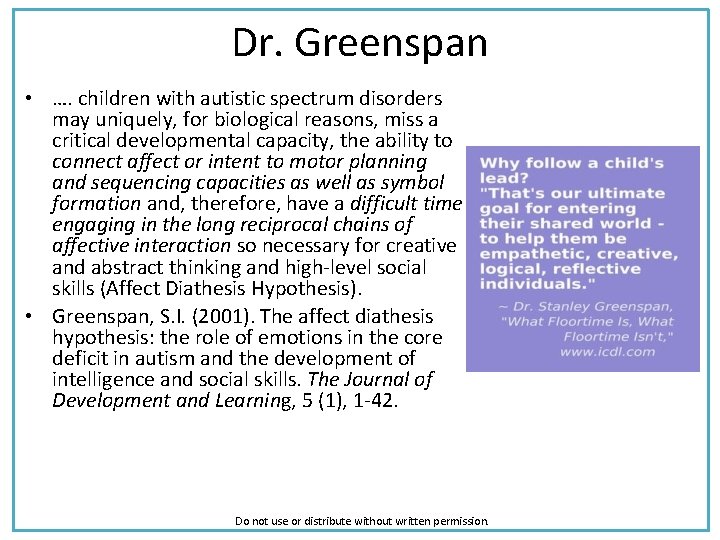
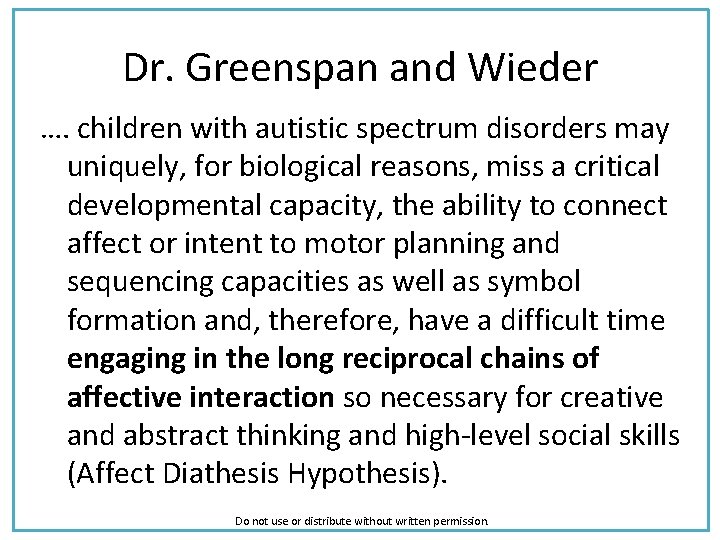
Dr. Greenspan • …. children with autistic spectrum disorders may uniquely, for biological reasons, miss a critical developmental capacity, the ability to connect affect or intent to motor planning and sequencing capacities as well as symbol formation and, therefore, have a difficult time engaging in the long reciprocal chains of affective interaction so necessary for creative and abstract thinking and high-level social skills (Affect Diathesis Hypothesis). • Greenspan, S. I. (2001). The affect diathesis hypothesis: the role of emotions in the core deficit in autism and the development of intelligence and social skills. The Journal of Development and Learning, 5 (1), 1 -42. Do not use or distribute without written permission.
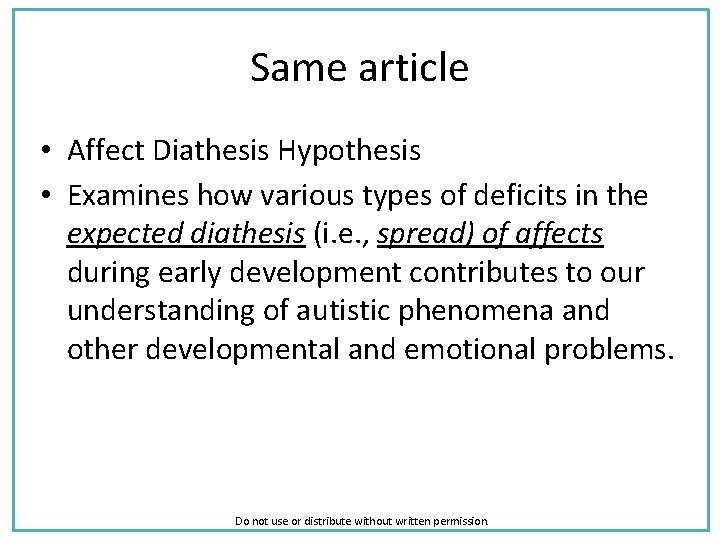
Same article • Affect Diathesis Hypothesis • Examines how various types of deficits in the expected diathesis (i. e. , spread) of affects during early development contributes to our understanding of autistic phenomena and other developmental and emotional problems. Do not use or distribute without written permission.
Dr. Greenspan and Wieder …. children with autistic spectrum disorders may uniquely, for biological reasons, miss a critical developmental capacity, the ability to connect affect or intent to motor planning and sequencing capacities as well as symbol formation and, therefore, have a difficult time engaging in the long reciprocal chains of affective interaction so necessary for creative and abstract thinking and high-level social skills (Affect Diathesis Hypothesis). Do not use or distribute without written permission.
DIR® / Floortime • • Comprehensive framework of understanding • D – Developmental milestones • I – Individual Differences • R – Relationship-based Help client master the building blocks of relating, communicating, and thinking, rather than on symptoms alone Do not use or distribute without written permission.
Research 2016 • Raham, A. , Divan, G. , Hamdami, S. U. , Vajaratkar, V. , Taylor, C. , Leadbitter, K. , Aldred, C. , Minhas, A. , Cardozo, P. , Emsley, R. , Patel, V. & Green, J. (2016) Effectiveness of the parent-mediated intervention for children with autism spectrum disorder in South Asia in India and Pakistan: A randomized controlled trial. Lancet, 3(2), 128 -136. Do not use or distribute without written permission.
Research 2014 • Siller, M. , Swanson, M. , Gerber, A. , Hutman, T. & Sigman, M. (2014) A parent-mediated intervention that targets responsive parental behaviors increases attachment behaviors in children with ASD: Results from a randomized, clinical trial. Journal of Autism and Developmental Disorders, 44: 1720 -1732 • Solomon R, Van Egeren L, Mahoney G, Quon. Huber M, Zimmerman P. (2014) PLAY Project Home Consultation Intervention Program for Young Children with Autism Spectrum Disorders: A Randomized Controlled Trial. J Dev Beh Pediatrics. 35(8): 475 -485. Do not use or distribute without written permission.
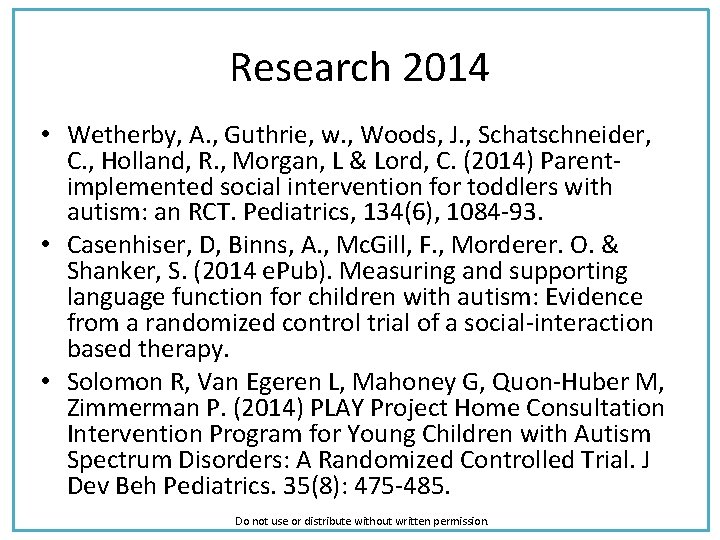
Research 2014 • Wetherby, A. , Guthrie, w. , Woods, J. , Schatschneider, C. , Holland, R. , Morgan, L & Lord, C. (2014) Parentimplemented social intervention for toddlers with autism: an RCT. Pediatrics, 134(6), 1084 -93. • Casenhiser, D, Binns, A. , Mc. Gill, F. , Morderer. O. & Shanker, S. (2014 e. Pub). Measuring and supporting language function for children with autism: Evidence from a randomized control trial of a social-interaction based therapy. • Solomon R, Van Egeren L, Mahoney G, Quon-Huber M, Zimmerman P. (2014) PLAY Project Home Consultation Intervention Program for Young Children with Autism Spectrum Disorders: A Randomized Controlled Trial. J Dev Beh Pediatrics. 35(8): 475 -485. Do not use or distribute without written permission.
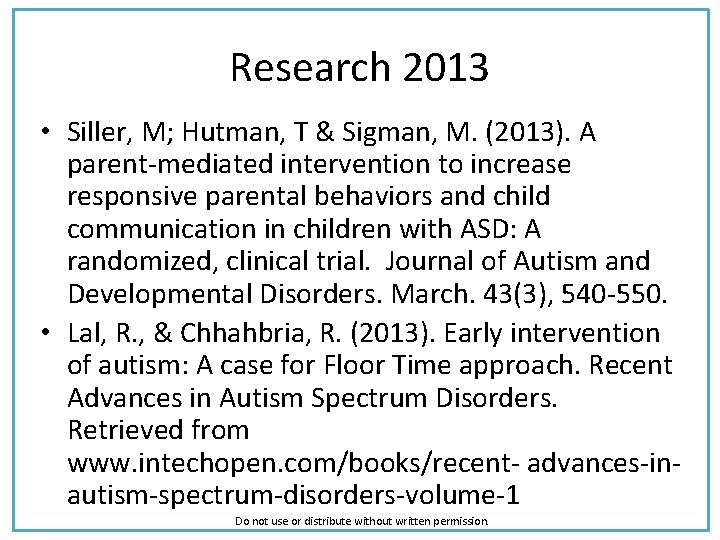
Research 2013 • Siller, M; Hutman, T & Sigman, M. (2013). A parent-mediated intervention to increase responsive parental behaviors and child communication in children with ASD: A randomized, clinical trial. Journal of Autism and Developmental Disorders. March. 43(3), 540 -550. • Lal, R. , & Chhahbria, R. (2013). Early intervention of autism: A case for Floor Time approach. Recent Advances in Autism Spectrum Disorders. Retrieved from www. intechopen. com/books/recent- advances-inautism-spectrum-disorders-volume-1 Do not use or distribute without written permission.
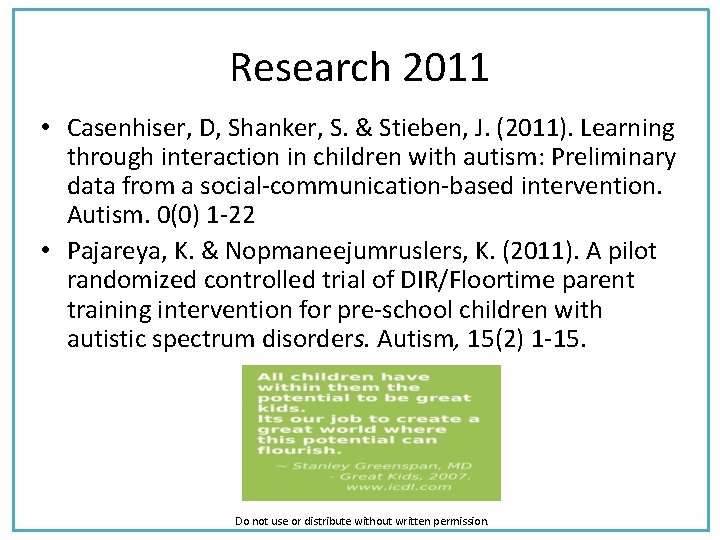
Research 2011 • Casenhiser, D, Shanker, S. & Stieben, J. (2011). Learning through interaction in children with autism: Preliminary data from a social-communication-based intervention. Autism. 0(0) 1 -22 • Pajareya, K. & Nopmaneejumruslers, K. (2011). A pilot randomized controlled trial of DIR/Floortime parent training intervention for pre-school children with autistic spectrum disorders. Autism, 15(2) 1 -15. Do not use or distribute without written permission.
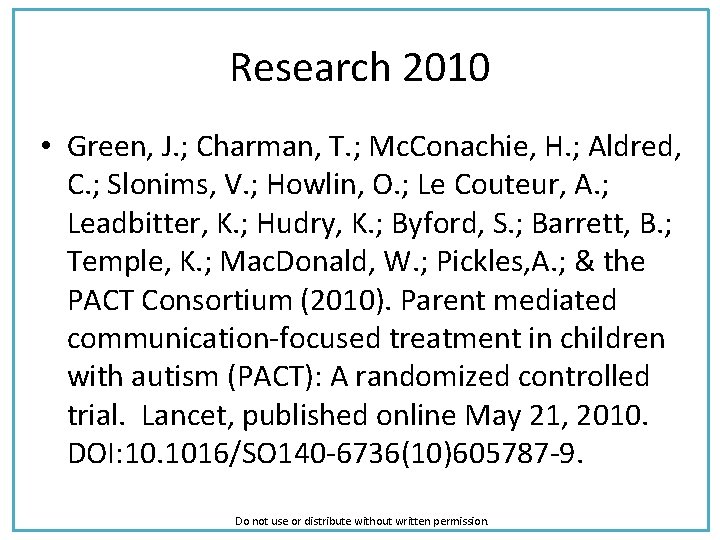
Research 2010 • Green, J. ; Charman, T. ; Mc. Conachie, H. ; Aldred, C. ; Slonims, V. ; Howlin, O. ; Le Couteur, A. ; Leadbitter, K. ; Hudry, K. ; Byford, S. ; Barrett, B. ; Temple, K. ; Mac. Donald, W. ; Pickles, A. ; & the PACT Consortium (2010). Parent mediated communication-focused treatment in children with autism (PACT): A randomized controlled trial. Lancet, published online May 21, 2010. DOI: 10. 1016/SO 140 -6736(10)605787 -9. Do not use or distribute without written permission.
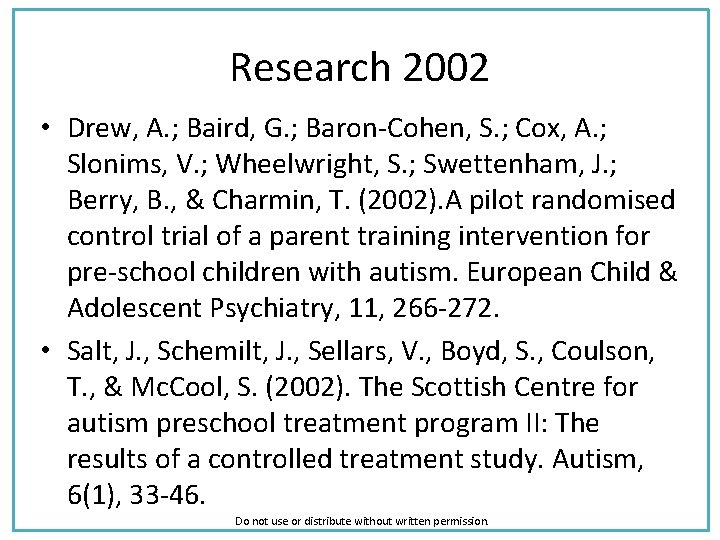
Research 2002 • Drew, A. ; Baird, G. ; Baron-Cohen, S. ; Cox, A. ; Slonims, V. ; Wheelwright, S. ; Swettenham, J. ; Berry, B. , & Charmin, T. (2002). A pilot randomised control trial of a parent training intervention for pre-school children with autism. European Child & Adolescent Psychiatry, 11, 266 -272. • Salt, J. , Schemilt, J. , Sellars, V. , Boyd, S. , Coulson, T. , & Mc. Cool, S. (2002). The Scottish Centre for autism preschool treatment program II: The results of a controlled treatment study. Autism, 6(1), 33 -46. Do not use or distribute without written permission.
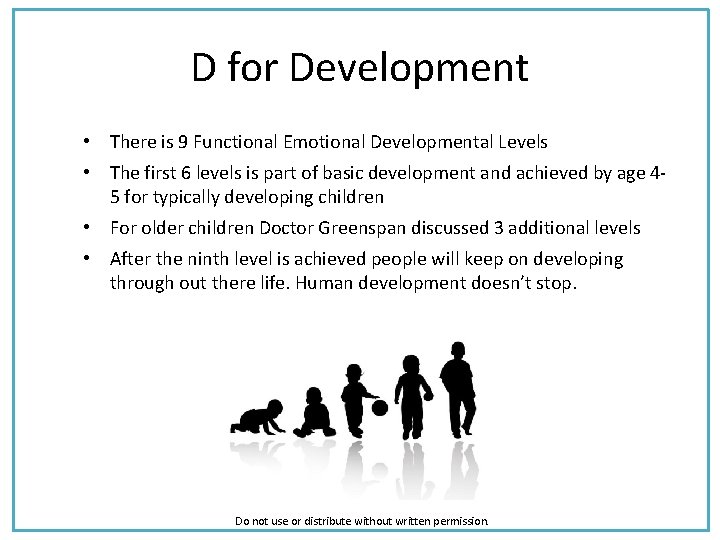
D for Development • There is 9 Functional Emotional Developmental Levels • The first 6 levels is part of basic development and achieved by age 45 for typically developing children • For older children Doctor Greenspan discussed 3 additional levels • After the ninth level is achieved people will keep on developing through out there life. Human development doesn’t stop. Do not use or distribute without written permission.
Functional Emotional Developmental Capacities (FEDC) • Developmental puzzle consists of these basic stages • Each layers new abilities onto those prior stages • Each of these stages marks a major turning point in the life of a child • It is like puzzle pieces falling into place to reveal the bigger picture Do not use or distribute without written permission.
I for Individual Differences • • Each client is unique in how he experiences the world. Receiving and responding Sensory Profile is basic to development Inadequate processing mechanism can inhibit the client’s ability to relate, communicate, and think. Do not use or distribute without written permission.
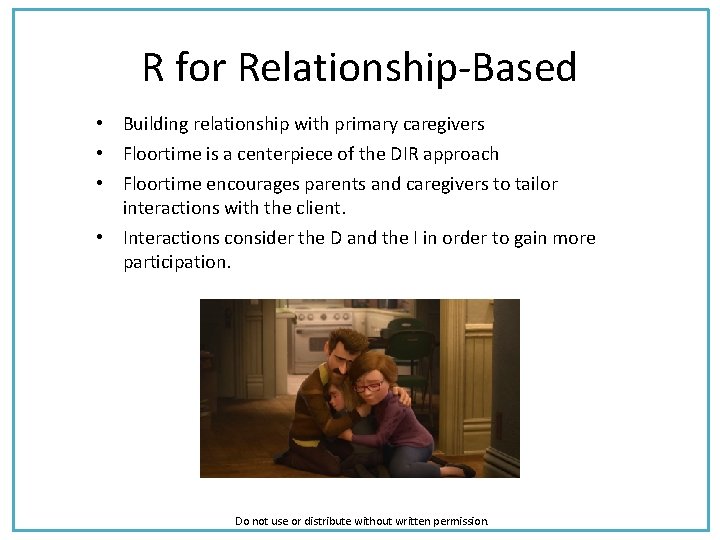
R for Relationship-Based • Building relationship with primary caregivers • Floortime is a centerpiece of the DIR approach • Floortime encourages parents and caregivers to tailor interactions with the client. • Interactions consider the D and the I in order to gain more participation. Do not use or distribute without written permission.
Six Core Developmental Levels - Level 1 • The first level is the ability of regulation and shared attention. • Foundational to all aspects of development, including sensory processing and the bonding of the human relationship on an emotional level. Do not use or distribute without written permission.
Level 1 Continued • • Co-Regulation Alert, ready to communicate Not interested vs. not being able Intrinsic Motivation Keep analyzing origin of behavior Child’s Agenda, not our goals Child must feel in control • Using senses to make sense of the world • Each sensory profile is unique • Over responsive to sensory stimulation • Under responsive to sensory stimulation • Interaction rather than stimulation Do not use or distribute without written permission.
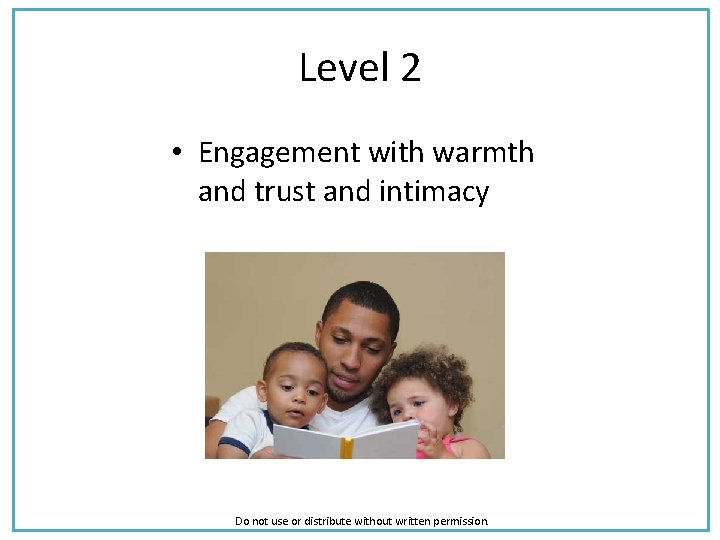
Level 2 • Engagement with warmth and trust and intimacy Do not use or distribute without written permission.
Level 2 Continued • • Making child want to have you around Join child in his play Engagement first, then conceptual learning Entertainment vs. Engagement • Human relationship and intimacy with primary care giver is love / bonding • Babies have to learn intimacy • Many children have difficulty making a loving connection. They confuse it as scary or painful. React with an adrenalin response – fight/flight / freeze • Going for the gleam in the eye Do not use or distribute without written permission.
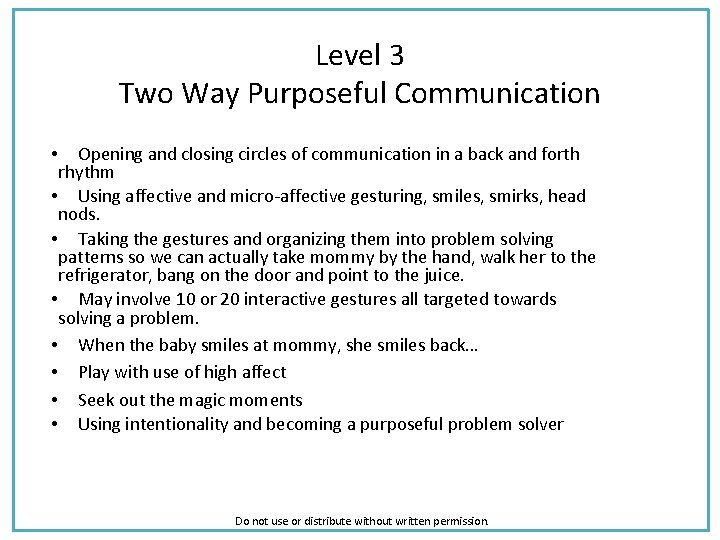
Level 3 Two Way Purposeful Communication Opening and closing circles of communication in a back and forth rhythm • Using affective and micro-affective gesturing, smiles, smirks, head nods. • Taking the gestures and organizing them into problem solving patterns so we can actually take mommy by the hand, walk her to the refrigerator, bang on the door and point to the juice. • May involve 10 or 20 interactive gestures all targeted towards solving a problem. • When the baby smiles at mommy, she smiles back… • Play with use of high affect • Seek out the magic moments • Using intentionality and becoming a purposeful problem solver • Do not use or distribute without written permission.
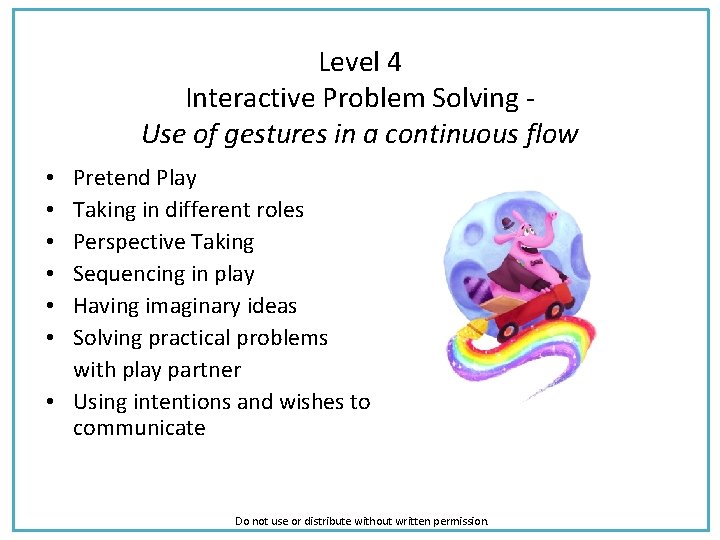
Level 4 Interactive Problem Solving - Use of gestures in a continuous flow Pretend Play Taking in different roles Perspective Taking Sequencing in play Having imaginary ideas Solving practical problems with play partner • Using intentions and wishes to communicate • • • Do not use or distribute without written permission.
Level 4 Continued • • • Abstract Thinking Visual Processing – Visualization Auditory Processing – building language Connect learning to intrinsic motivation Starter Ideas Real Life experiences count Do not use or distribute without written permission.
Level 5 Functional use of ideas Symbolic Thinking • • Adding emotional themes to play Processing the meaning of different emotions Good guy, bad guy themes Deepening the plot of the play Forming ideas through play – more ideas more words Symbolic meaning is starting to form. Make-believe play opens the door to more practice but in a safe setting. Do not use or distribute without written permission.
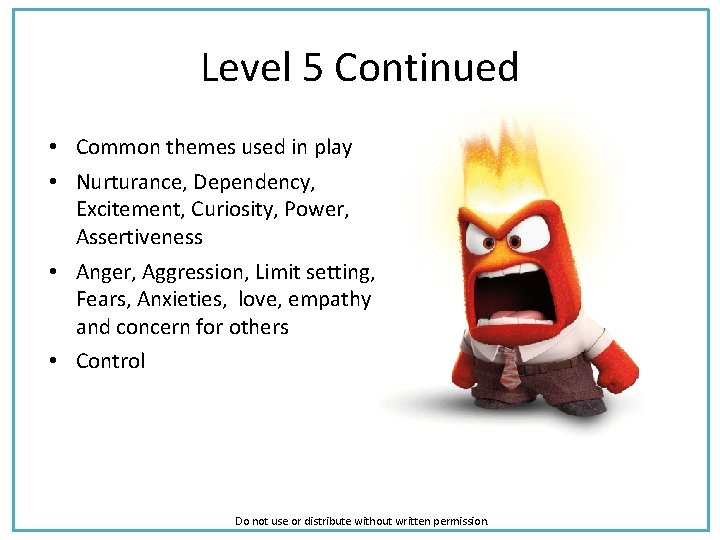
Level 5 Continued • Common themes used in play • Nurturance, Dependency, Excitement, Curiosity, Power, Assertiveness • Anger, Aggression, Limit setting, Fears, Anxieties, love, empathy and concern for others • Control Do not use or distribute without written permission.
Level 6 Building Bridges between Ideas • Using language logically and realistically and shifting gears between reality and fantasy. • Answering why questions • Logical use of ideas supporting imaginative play and negotiating and problem solving with the world • Debates, having problem solving discussions at the symbolic level. • Connecting the islands of expression, ideas and feelings. • • • (building bridges) Start to understand some concepts of space and time in a personal emotional way. Connect ideas to solve spatial and verbal problem solving. ”W” Questions – higher levels of abstract thinking Do not use or distribute without written permission.
Practical Considerations • Dr. Greenspan wanted 20 to 30 minutes of Floortime interactions 7 to 8 times daily. • Once a week session with therapist and caregiver both working together. • Once a week session with therapist coaching caregiver from the sidelines. • Play Project does one time monthly home visits with written and DVD report. • Applied Floortime Do not use or distribute without written permission.
Eric Shyman “Besieged by Behavioral Analysis for Autism Spectrum Disorder” “A treatise for comprehensive educational approaches” Do not use or distribute without written permission.
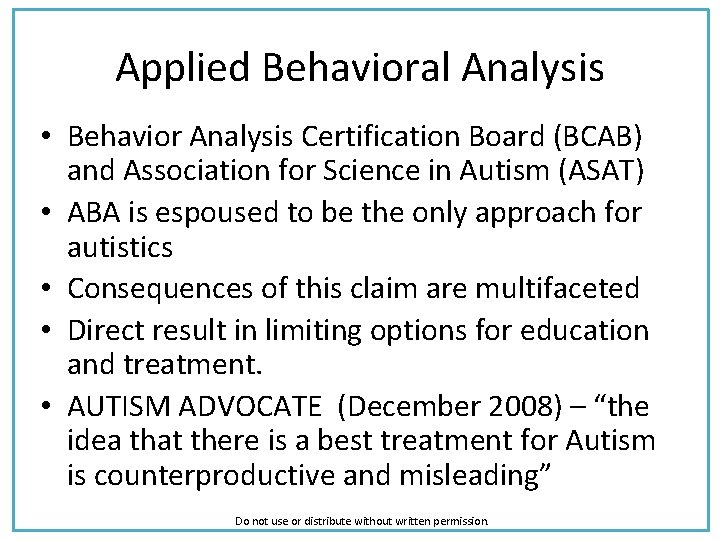
Applied Behavioral Analysis • Behavior Analysis Certification Board (BCAB) and Association for Science in Autism (ASAT) • ABA is espoused to be the only approach for autistics • Consequences of this claim are multifaceted • Direct result in limiting options for education and treatment. • AUTISM ADVOCATE (December 2008) – “the idea that there is a best treatment for Autism is counterproductive and misleading” Do not use or distribute without written permission.
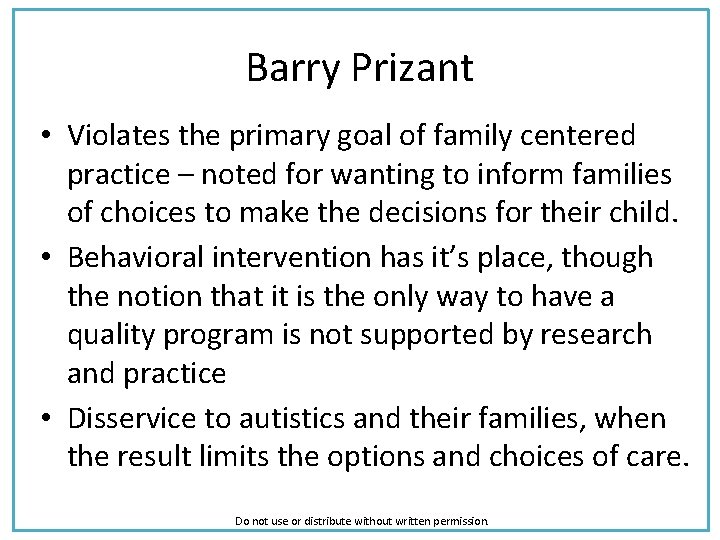
Barry Prizant • Violates the primary goal of family centered practice – noted for wanting to inform families of choices to make the decisions for their child. • Behavioral intervention has it’s place, though the notion that it is the only way to have a quality program is not supported by research and practice • Disservice to autistics and their families, when the result limits the options and choices of care. Do not use or distribute without written permission.
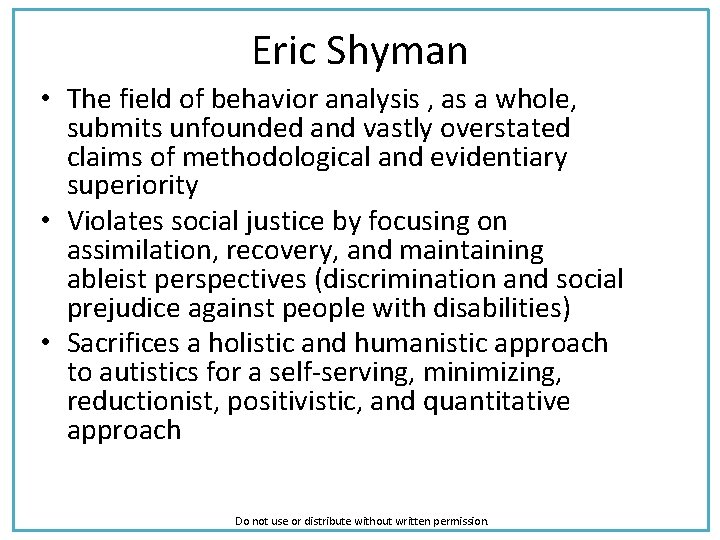
Eric Shyman • The field of behavior analysis , as a whole, submits unfounded and vastly overstated claims of methodological and evidentiary superiority • Violates social justice by focusing on assimilation, recovery, and maintaining ableist perspectives (discrimination and social prejudice against people with disabilities) • Sacrifices a holistic and humanistic approach to autistics for a self-serving, minimizing, reductionist, positivistic, and quantitative approach Do not use or distribute without written permission.
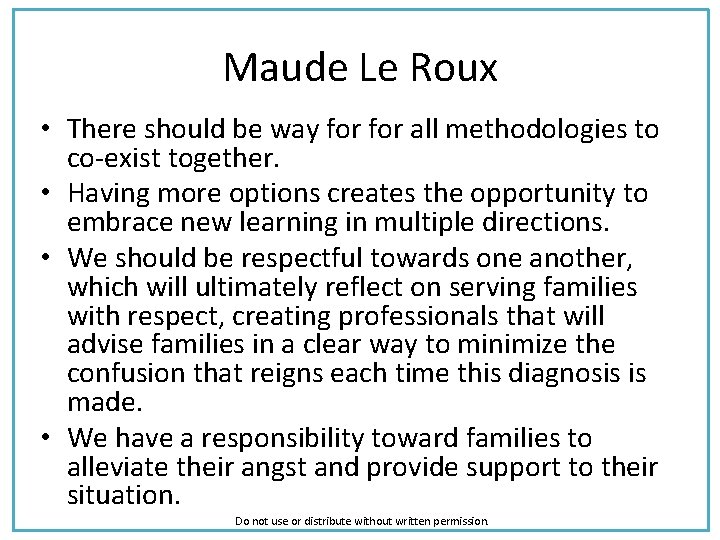
Maude Le Roux • There should be way for all methodologies to co-exist together. • Having more options creates the opportunity to embrace new learning in multiple directions. • We should be respectful towards one another, which will ultimately reflect on serving families with respect, creating professionals that will advise families in a clear way to minimize the confusion that reigns each time this diagnosis is made. • We have a responsibility toward families to alleviate their angst and provide support to their situation. Do not use or distribute without written permission.
9 Lacrue Avenue, Suite 103 Glen Mills, PA 19342 Maude Le Roux, OTR/L, SIPT, IMC Website www. atotalapproach. com Facebook https: //www. facebook. com/ATAMaude. Leroux. OT/ Linked. In https: //www. linkedin. com/company/a-total-approach Blog http: //www. maude-leroux. com/ Do not use or distribute without written permission.