CSE 373 Introduction to Parallel Algorithms reading Grossman
- Slides: 27
CSE 373 Introduction to Parallel Algorithms reading: Grossman slides created by Marty Stepp http: //www. cs. washington. edu/373/ © University of Washington, all rights reserved. 1
Changing our assumptions • So far most or all of your study of computer science has assumed that only one thing happens at a time in a given program. § sequential programming: Each statement executes in sequence. • Removing this assumption creates challenges and opportunities: § Programming: How can we divide work among threads of execution and coordinate (synchronize) among them? § Algorithms: How can activities in parallel speed-up a program? • (more throughput: work done per unit time) § Data structures: May need to support concurrent access (multiple threads operating on data at the same time). 2
Brief arch. history • CPU: Central Processing Unit. The brain of a computer. § From ~1980 -2005, CPU speed (GHz) got exponentially faster. § Roughly doubled every 1. 5 years ("Moore's Law"). • But we are reaching limits of classic CPU design. § Increasing speeds further generates too much heat. § Any single CPU over ~3 -4 GHz crashes or burns out in normal usage. • Current work-around: Use multiple processors. § Or, more recently, produce one CPU containing many processors in it. § core: A processor-within-a-processor. • A "multi-core" processor is one with several cores inside. 3
Using many cores • What can you do with multiple CPUs (or cores)? § Run multiple different programs at the same time (processes). • Example: Core 1 runs Firefox; Core 2 runs i. Tunes; Core 3 runs Eclipse. . . • Technically, programs receive "time slices" of attention from cores. • Your OS (Windows, OSX, Linux) already does this for you. • Do multiple things at once within the same program (threads). § This will be our focus. More difficult; must be done manually. § Requires rethinking everything about our algorithms, from how to implement data-structure operations, to Big-Oh, to. . . • Writing correct/fast parallel code is much harder than sequential. § Especially in common languages like Java and C. 4
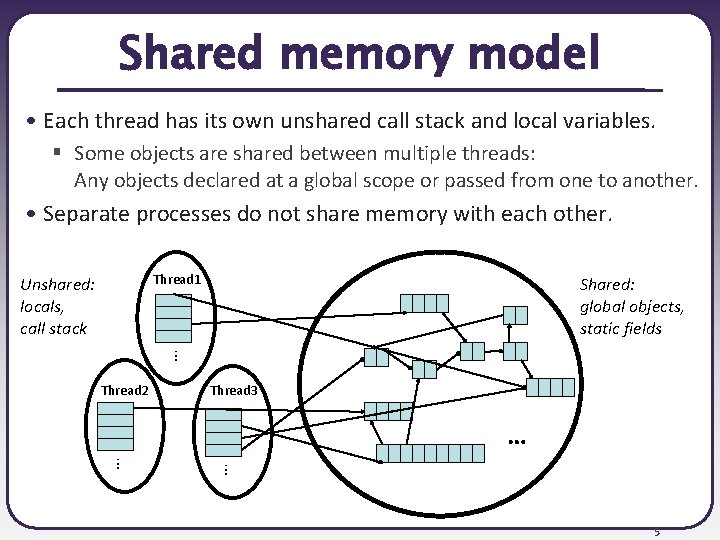
Shared memory model • Each thread has its own unshared call stack and local variables. § Some objects are shared between multiple threads: Any objects declared at a global scope or passed from one to another. • Separate processes do not share memory with each other. Thread 1 Unshared: locals, call stack Shared: global objects, static fields … Thread 2 Thread 3 … … … 5
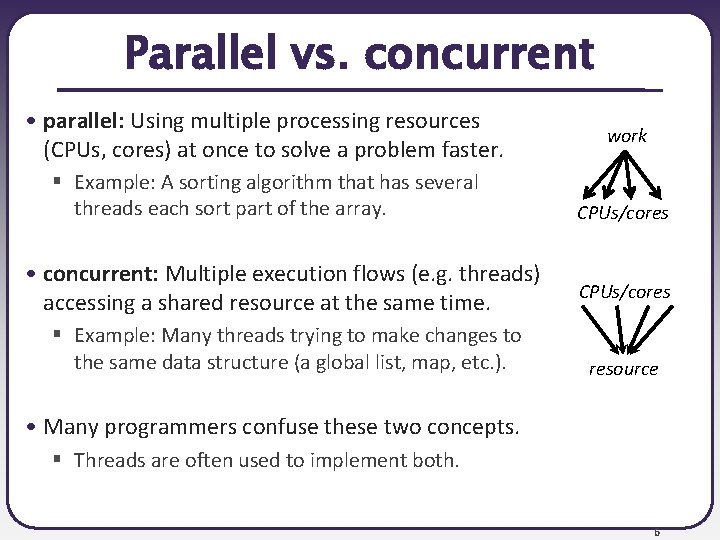
Parallel vs. concurrent • parallel: Using multiple processing resources (CPUs, cores) at once to solve a problem faster. § Example: A sorting algorithm that has several threads each sort part of the array. • concurrent: Multiple execution flows (e. g. threads) accessing a shared resource at the same time. § Example: Many threads trying to make changes to the same data structure (a global list, map, etc. ). work CPUs/cores resource • Many programmers confuse these two concepts. § Threads are often used to implement both. 6
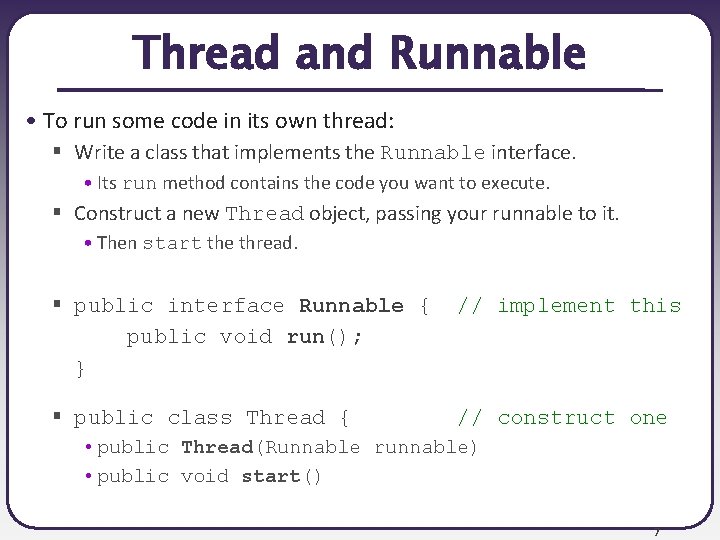
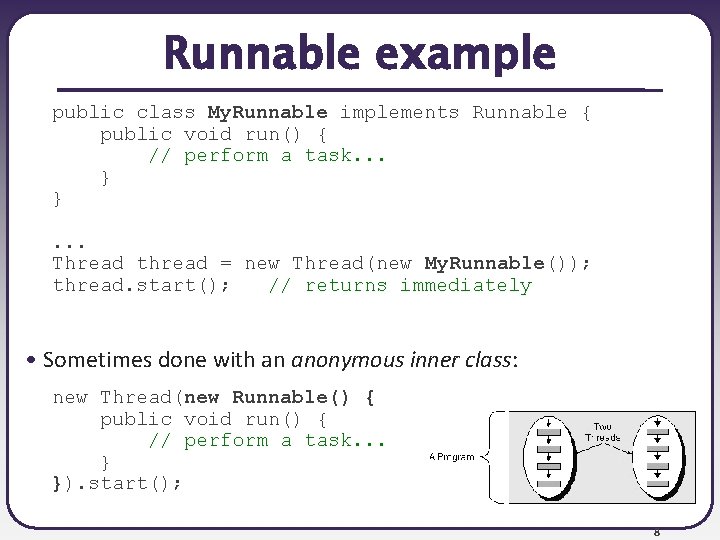
Thread and Runnable • To run some code in its own thread: § Write a class that implements the Runnable interface. • Its run method contains the code you want to execute. § Construct a new Thread object, passing your runnable to it. • Then start the thread. § public interface Runnable { public void run(); } // implement this § public class Thread { // construct one • public Thread(Runnable runnable) • public void start() 7
Runnable example public class My. Runnable implements Runnable { public void run() { // perform a task. . . } }. . . Thread thread = new Thread(new My. Runnable()); thread. start(); // returns immediately • Sometimes done with an anonymous inner class: new Thread(new Runnable() { public void run() { // perform a task. . . } }). start(); 8
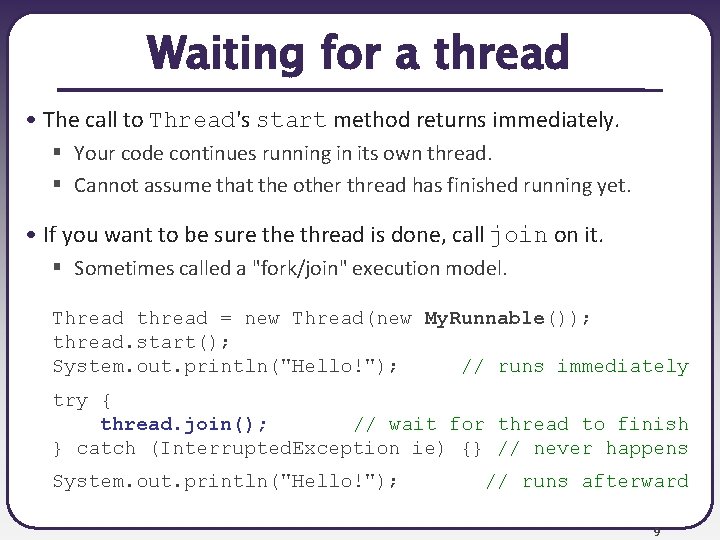
Waiting for a thread • The call to Thread's start method returns immediately. § Your code continues running in its own thread. § Cannot assume that the other thread has finished running yet. • If you want to be sure thread is done, call join on it. § Sometimes called a "fork/join" execution model. Thread thread = new Thread(new My. Runnable()); thread. start(); System. out. println("Hello!"); // runs immediately try { thread. join(); // wait for thread to finish } catch (Interrupted. Exception ie) {} // never happens System. out. println("Hello!"); // runs afterward 9
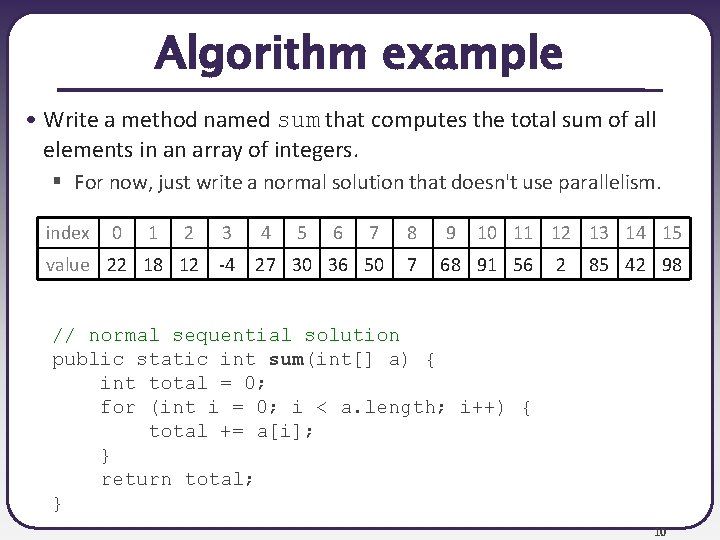
Algorithm example • Write a method named sum that computes the total sum of all elements in an array of integers. § For now, just write a normal solution that doesn't use parallelism. index 0 1 2 3 4 5 6 7 8 9 10 11 12 13 14 15 value 22 18 12 -4 27 30 36 50 7 68 91 56 2 85 42 98 // normal sequential solution public static int sum(int[] a) { int total = 0; for (int i = 0; i < a. length; i++) { total += a[i]; } return total; } 10
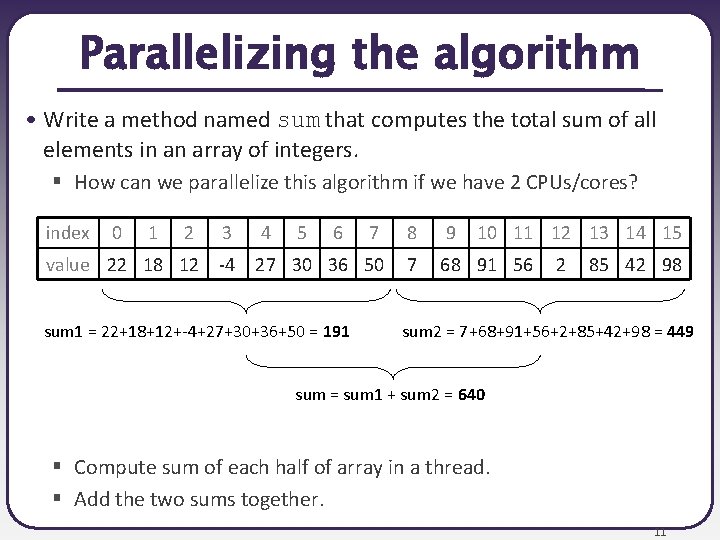
Parallelizing the algorithm • Write a method named sum that computes the total sum of all elements in an array of integers. § How can we parallelize this algorithm if we have 2 CPUs/cores? index 0 1 2 3 4 5 6 7 8 9 10 11 12 13 14 15 value 22 18 12 -4 27 30 36 50 7 68 91 56 sum 1 = 22+18+12+-4+27+30+36+50 = 191 sum 2 = 7+68+91+56+2+85+42+98 = 449 2 85 42 98 sum = sum 1 + sum 2 = 640 § Compute sum of each half of array in a thread. § Add the two sums together. 11
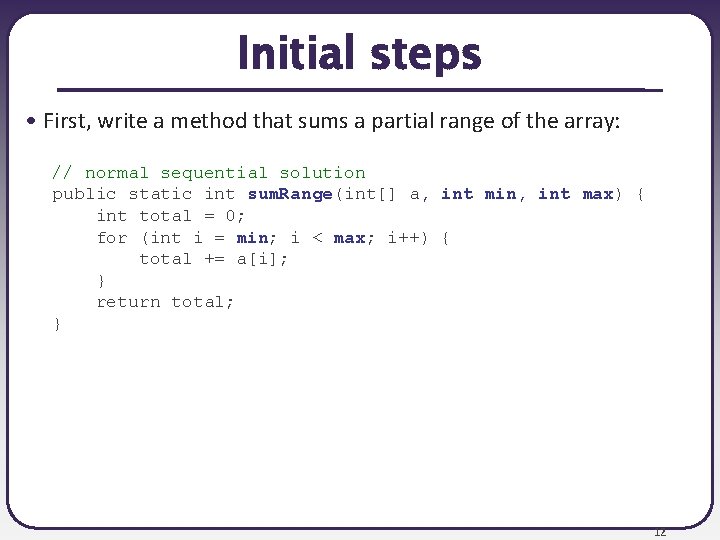
Initial steps • First, write a method that sums a partial range of the array: // normal sequential solution public static int sum. Range(int[] a, int min, int max) { int total = 0; for (int i = min; i < max; i++) { total += a[i]; } return total; } 12
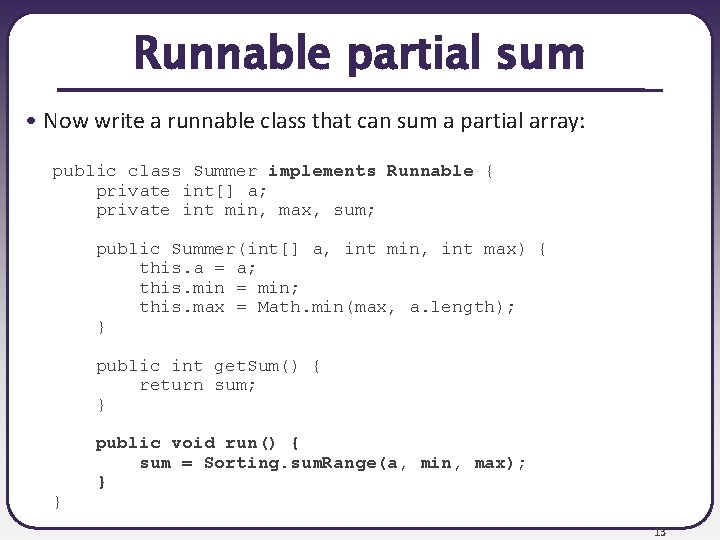
Runnable partial sum • Now write a runnable class that can sum a partial array: public class Summer implements Runnable { private int[] a; private int min, max, sum; public Summer(int[] a, int min, int max) { this. a = a; this. min = min; this. max = Math. min(max, a. length); } public int get. Sum() { return sum; } } public void run() { sum = Sorting. sum. Range(a, min, max); } 13
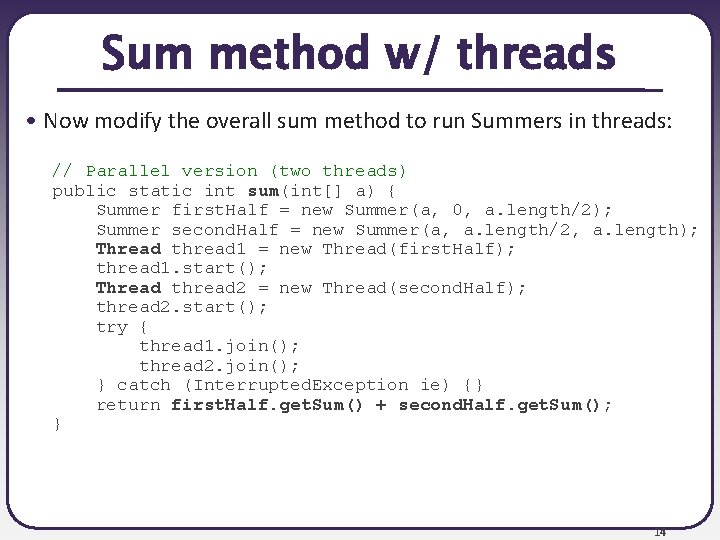
Sum method w/ threads • Now modify the overall sum method to run Summers in threads: // Parallel version (two threads) public static int sum(int[] a) { Summer first. Half = new Summer(a, 0, a. length/2); Summer second. Half = new Summer(a, a. length/2, a. length); Thread thread 1 = new Thread(first. Half); thread 1. start(); Thread thread 2 = new Thread(second. Half); thread 2. start(); try { thread 1. join(); thread 2. join(); } catch (Interrupted. Exception ie) {} return first. Half. get. Sum() + second. Half. get. Sum(); } 14
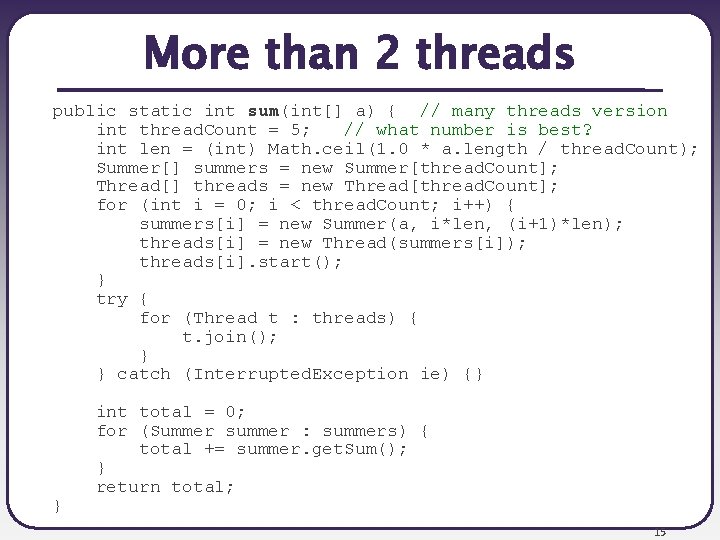
More than 2 threads public static int sum(int[] a) { // many threads version int thread. Count = 5; // what number is best? int len = (int) Math. ceil(1. 0 * a. length / thread. Count); Summer[] summers = new Summer[thread. Count]; Thread[] threads = new Thread[thread. Count]; for (int i = 0; i < thread. Count; i++) { summers[i] = new Summer(a, i*len, (i+1)*len); threads[i] = new Thread(summers[i]); threads[i]. start(); } try { for (Thread t : threads) { t. join(); } } catch (Interrupted. Exception ie) {} } int total = 0; for (Summer summer : summers) { total += summer. get. Sum(); } return total; 15
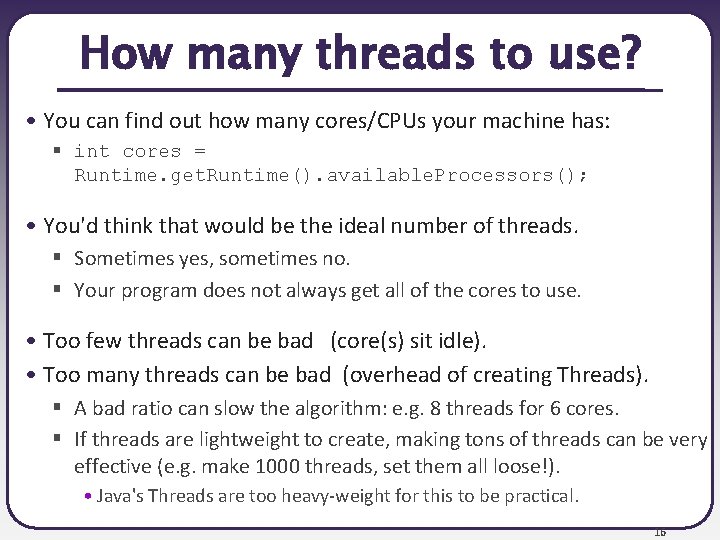
How many threads to use? • You can find out how many cores/CPUs your machine has: § int cores = Runtime. get. Runtime(). available. Processors(); • You'd think that would be the ideal number of threads. § Sometimes yes, sometimes no. § Your program does not always get all of the cores to use. • Too few threads can be bad (core(s) sit idle). • Too many threads can be bad (overhead of creating Threads). § A bad ratio can slow the algorithm: e. g. 8 threads for 6 cores. § If threads are lightweight to create, making tons of threads can be very effective (e. g. make 1000 threads, set them all loose!). • Java's Threads are too heavy-weight for this to be practical. 16
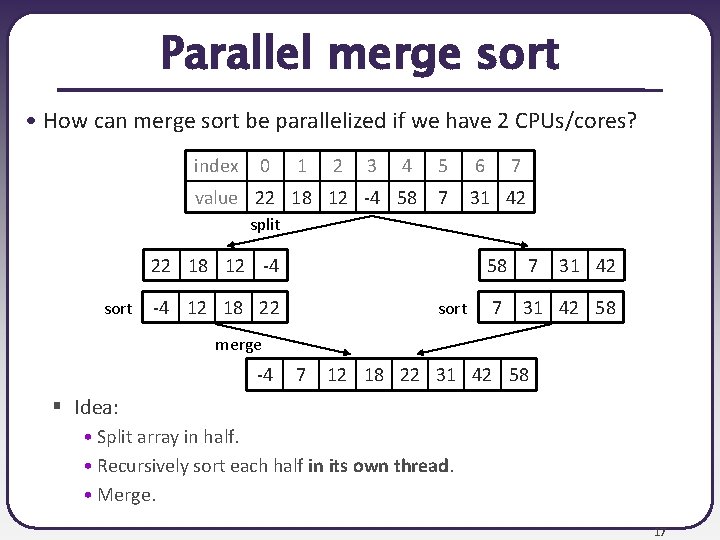
Parallel merge sort • How can merge sort be parallelized if we have 2 CPUs/cores? index 0 1 2 3 4 5 6 7 value 22 18 12 -4 58 7 31 42 split 22 18 12 -4 sort -4 12 18 22 sort 58 7 31 42 58 merge -4 7 12 18 22 31 42 58 § Idea: • Split array in half. • Recursively sort each half in its own thread. • Merge. 17
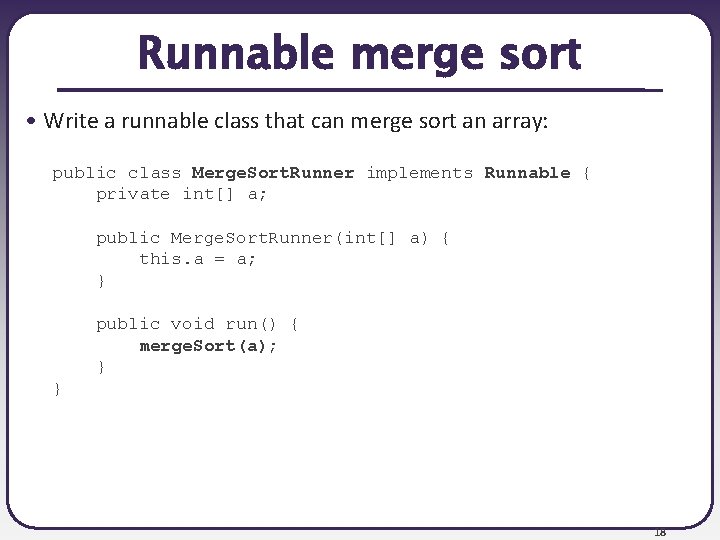
Runnable merge sort • Write a runnable class that can merge sort an array: public class Merge. Sort. Runner implements Runnable { private int[] a; public Merge. Sort. Runner(int[] a) { this. a = a; } public void run() { merge. Sort(a); } } 18
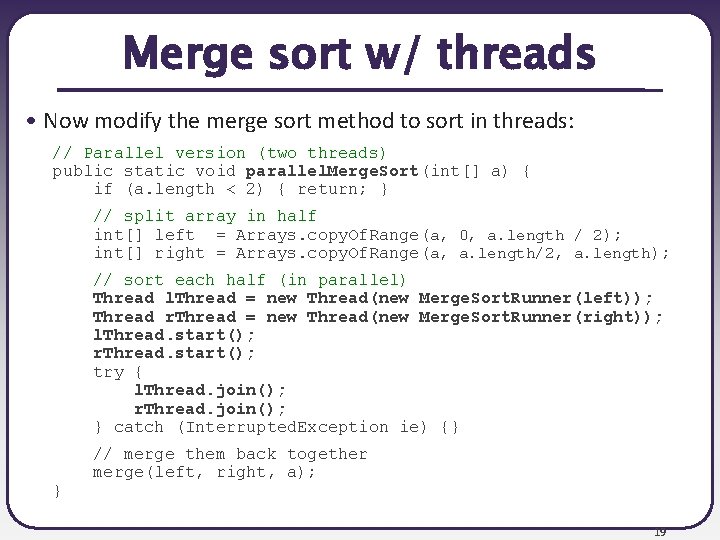
Merge sort w/ threads • Now modify the merge sort method to sort in threads: // Parallel version (two threads) public static void parallel. Merge. Sort(int[] a) { if (a. length < 2) { return; } // split array in half int[] left = Arrays. copy. Of. Range(a, 0, a. length / 2); int[] right = Arrays. copy. Of. Range(a, a. length/2, a. length); // sort each half (in parallel) Thread l. Thread = new Thread(new Merge. Sort. Runner(left)); Thread r. Thread = new Thread(new Merge. Sort. Runner(right)); l. Thread. start(); r. Thread. start(); try { l. Thread. join(); r. Thread. join(); } catch (Interrupted. Exception ie) {} } // merge them back together merge(left, right, a); 19
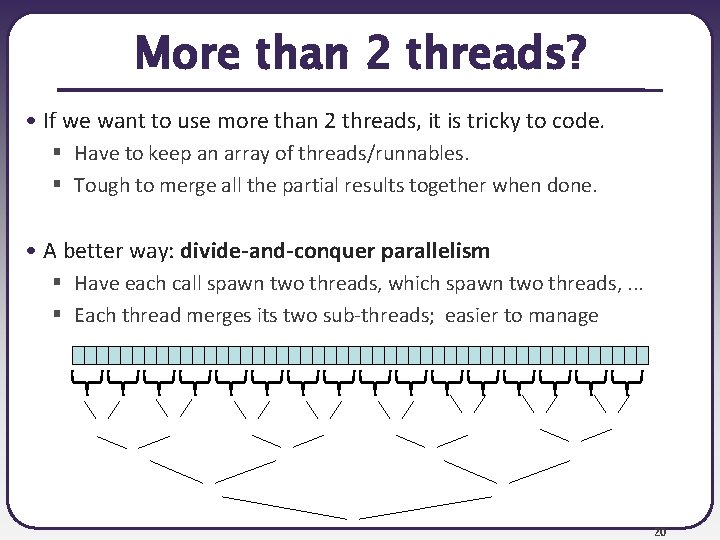
More than 2 threads? • If we want to use more than 2 threads, it is tricky to code. § Have to keep an array of threads/runnables. § Tough to merge all the partial results together when done. • A better way: divide-and-conquer parallelism § Have each call spawn two threads, which spawn two threads, . . . § Each thread merges its two sub-threads; easier to manage 20
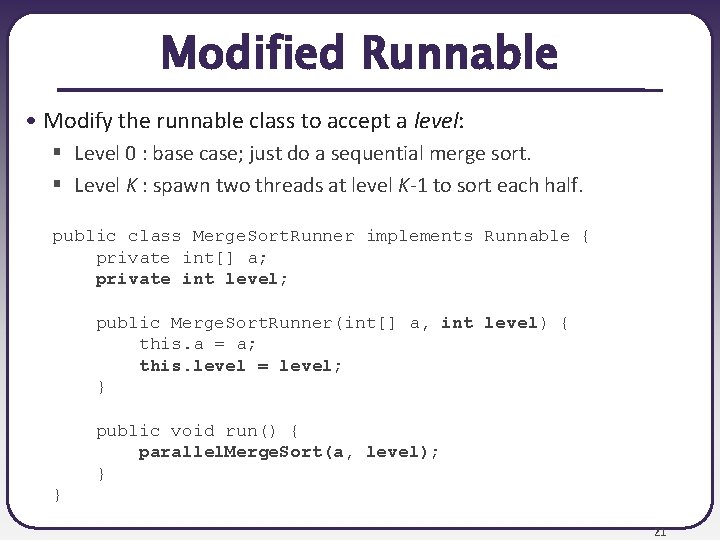
Modified Runnable • Modify the runnable class to accept a level: § Level 0 : base case; just do a sequential merge sort. § Level K : spawn two threads at level K-1 to sort each half. public class Merge. Sort. Runner implements Runnable { private int[] a; private int level; public Merge. Sort. Runner(int[] a, int level) { this. a = a; this. level = level; } public void run() { parallel. Merge. Sort(a, level); } } 21
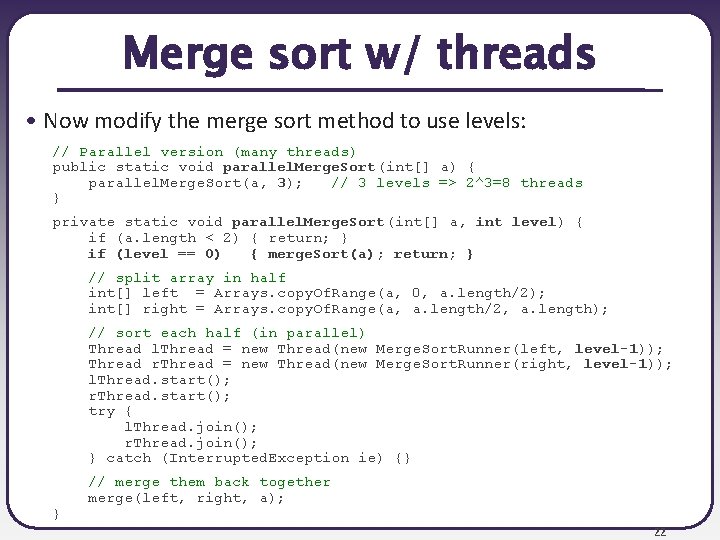
Merge sort w/ threads • Now modify the merge sort method to use levels: // Parallel version (many threads) public static void parallel. Merge. Sort(int[] a) { parallel. Merge. Sort(a, 3); // 3 levels => 2^3=8 threads } private static void parallel. Merge. Sort(int[] a, int level) { if (a. length < 2) { return; } if (level == 0) { merge. Sort(a); return; } // split array in half int[] left = Arrays. copy. Of. Range(a, 0, a. length/2); int[] right = Arrays. copy. Of. Range(a, a. length/2, a. length); // sort each half (in parallel) Thread l. Thread = new Thread(new Merge. Sort. Runner(left, level-1)); Thread r. Thread = new Thread(new Merge. Sort. Runner(right, level-1)); l. Thread. start(); r. Thread. start(); try { l. Thread. join(); r. Thread. join(); } catch (Interrupted. Exception ie) {} } // merge them back together merge(left, right, a); 22
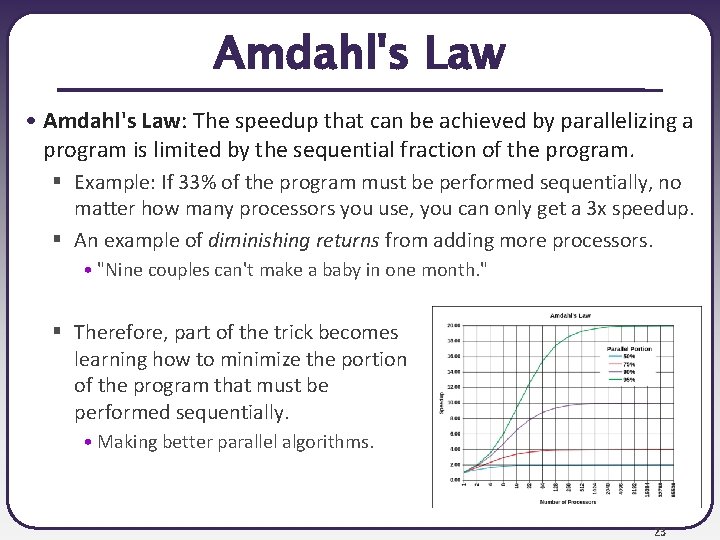
Amdahl's Law • Amdahl's Law: The speedup that can be achieved by parallelizing a program is limited by the sequential fraction of the program. § Example: If 33% of the program must be performed sequentially, no matter how many processors you use, you can only get a 3 x speedup. § An example of diminishing returns from adding more processors. • "Nine couples can't make a baby in one month. " § Therefore, part of the trick becomes learning how to minimize the portion of the program that must be performed sequentially. • Making better parallel algorithms. 23
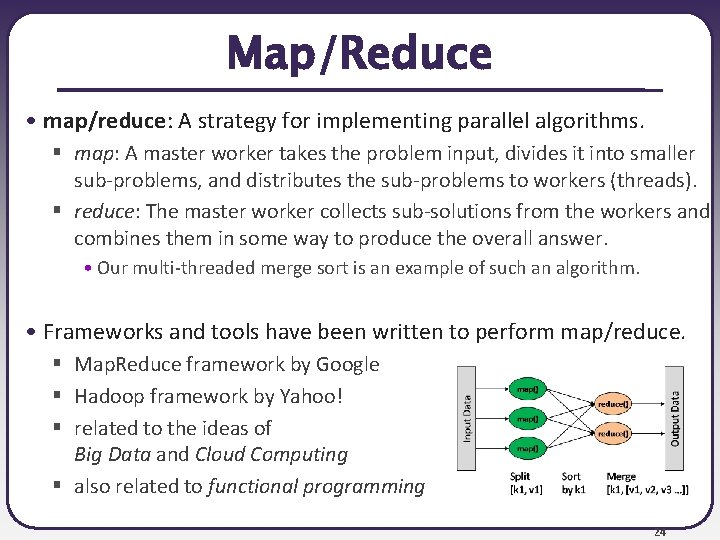
Map/Reduce • map/reduce: A strategy for implementing parallel algorithms. § map: A master worker takes the problem input, divides it into smaller sub-problems, and distributes the sub-problems to workers (threads). § reduce: The master worker collects sub-solutions from the workers and combines them in some way to produce the overall answer. • Our multi-threaded merge sort is an example of such an algorithm. • Frameworks and tools have been written to perform map/reduce. § Map. Reduce framework by Google § Hadoop framework by Yahoo! § related to the ideas of Big Data and Cloud Computing § also related to functional programming 24
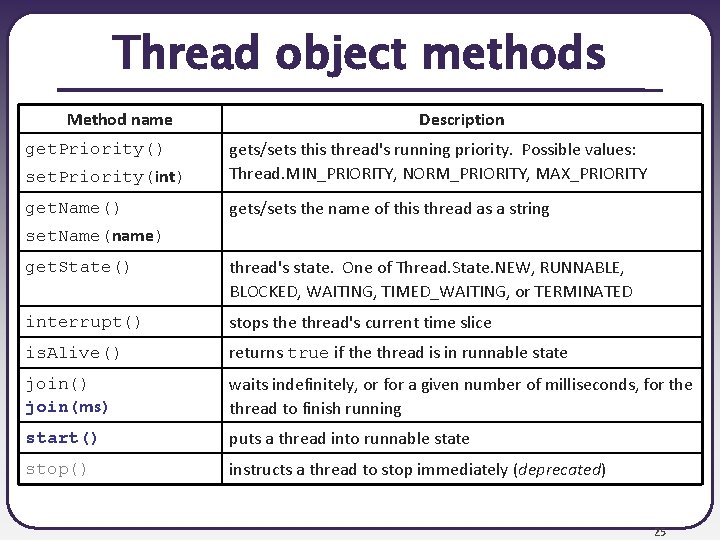
Thread object methods Method name Description set. Priority(int) gets/sets this thread's running priority. Possible values: Thread. MIN_PRIORITY, NORM_PRIORITY, MAX_PRIORITY get. Name() gets/sets the name of this thread as a string get. Priority() set. Name(name) get. State() thread's state. One of Thread. State. NEW, RUNNABLE, BLOCKED, WAITING, TIMED_WAITING, or TERMINATED interrupt() stops the thread's current time slice is. Alive() returns true if the thread is in runnable state join() join(ms) waits indefinitely, or for a given number of milliseconds, for the thread to finish running start() puts a thread into runnable state stop() instructs a thread to stop immediately (deprecated) 25
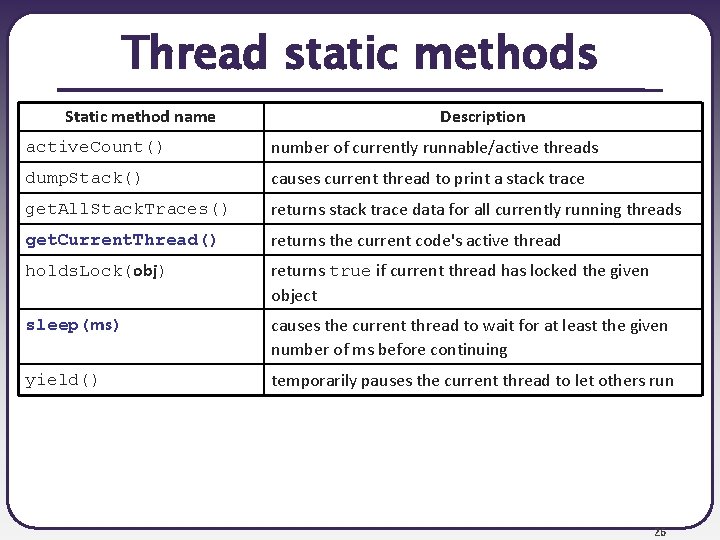
Thread static methods Static method name Description active. Count() number of currently runnable/active threads dump. Stack() causes current thread to print a stack trace get. All. Stack. Traces() returns stack trace data for all currently running threads get. Current. Thread() returns the current code's active thread holds. Lock(obj) returns true if current thread has locked the given object sleep(ms) causes the current thread to wait for at least the given number of ms before continuing yield() temporarily pauses the current thread to let others run 26
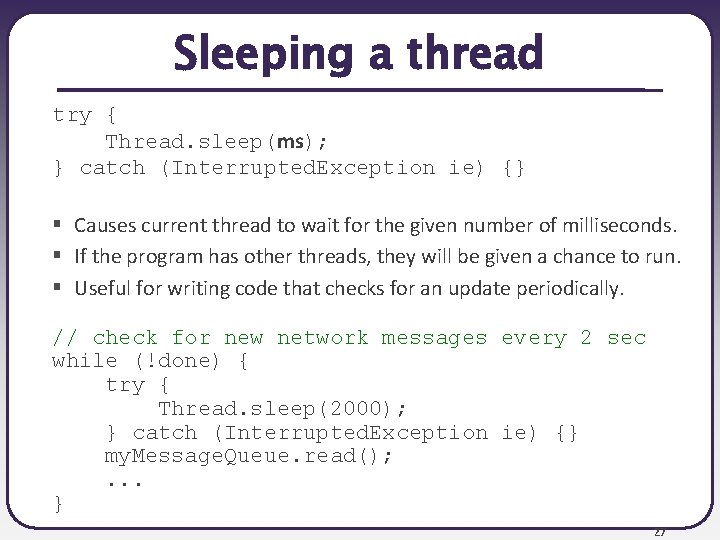
Sleeping a thread try { Thread. sleep(ms); } catch (Interrupted. Exception ie) {} § Causes current thread to wait for the given number of milliseconds. § If the program has other threads, they will be given a chance to run. § Useful for writing code that checks for an update periodically. // check for new network messages every 2 sec while (!done) { try { Thread. sleep(2000); } catch (Interrupted. Exception ie) {} my. Message. Queue. read(); . . . } 27