
Precontractual Liability Contracts March 1 2016 Precontractual Liability
Precontractual Liability Contracts March 1, 2016
“Precontractual Liability” Mapping the common law onto commonplace business transactions
Precontractual Liability Generally • Why is this an issue?
Precontractual Liability Generally What theories have aggrieved negotiating parties relied on?
Precontractual Liability Generally • What theories have aggrieved negotiating parties relied on? • (1) Breach of a duty to negotiate in good faith. • (2) Restitution of benefits conferred during the negotiations • (3) Misrepresentation during the negotiations • (4) Reliance on a specific promise made during the negotiations. • (5) Agreement to negotiate in good faith.
DIXON V. WELLS FARGO N. A. (p. 241) • Frank and Deanna Dixon (the Dixons) “orally agreed with Wells Fargo to take the steps necessary to enter into a mortgage loan modification. ” • As part of this agreement, Wells Fargo instructed the Dixons to stop making payments on their loan. • It was contemplated that the unpaid payments would be added to the note as modified. . .
DIXON V. WELLS FARGO N. A. (p. 241) • In addition, Wells Fargo re-quested certain financial information, which the Dixons promptly supplied. • Notwithstanding the Dixons’ diligent efforts and reliance on Wells Fargo’s promise, Wells Fargo has failed, and effectively refused, to abide by the oral agreement to modify the existing mortgage loan. • [Subsequently] the Dixons received notice … that Wells Fargo was proceeding with a foreclosure on their home. ”
DIXON V. WELLS FARGO N. A. (p. 241) • What about application of Section 90? • The promise itself was too indefinite to support enforcement under Massachusetts law or, it would seems, section 90. • However, note emphasis the court places on the “words or conduct [ ] designed to take advantage of the promise. ” • That is, by its imposition on the Dixons, Judge Young found Wells Fargo’s indefinite promise was sufficient for liability.
DIXON V. WELLS FARGO N. A. (p. 241) • If Dixons prevail at trial, what will their remedy be? • reliance damages: putting the Dixons in the same position they would have been in had they not relied on the promise by Wells Fargo in the first place. • At the same time the relief is sort of injunctive: court reinstates their loan so that it isn't in default.
DIXON V. WELLS FARGO N. A. (p. 241) • What would specific performance entail? • “[d]uring the course of opposing Wells Fargo's motion to dismiss[, ] the Dixons have made clear that they do not seek specific performance of a promised loan modification. ” See Pls. ' Supplemental Mem. Opp'n 1 -2.
DIXON V. WELLS FARGO N. A. (p. 241) • They admit that there was no guarantee of a modification by Wells Fargo, only a verbal commitment to determine their eligibility for a modification if they followed the bank's prescribed steps. ” • Specific performance would then seem to require Wells Fargo to make a good faith effort to consider the Dixons’ loan modification.
DIXON V. WELLS FARGO N. A. (p. 241) • Can the courts solve or at least address the foreclosure crisis? • How?
CYBERCHRON CORP. V. CALLDATA SYSTEMS DEVELOPMENT, INC. (p. 247). • Cyberchron spent a couple of years negotiating with Calldata/Grumman (“Calldata”) but could not agree on the weight provisions. • Although Cyberchron never agreed to the terms of the Purchase Order, it had previously commenced production. • But no equipment was delivered and Cyberchron was not paid. • In mid-July, a Calldata representative directed Cyberchron to proceed with production of the Equipment as if there had been agreement on the weight issue, asserting that the terms of the purchase order would be resolved later.
CYBERCHRON CORP. V. CALLDATA SYSTEMS DEVELOPMENT, INC. (p. 247). • In August, Calldata began negotiations with Codar Technology and on September 26 made a contract for computer equipment that surprisingly appears to have been inferior to and heavier than the Cyberchron equipment. • During September, Calldata and Cyberchron exchanged letters resulting in Calldata’s “termination” of the Purchase Order on September 25. • Cyberchron’s claim under the termination liability provision (TLP) of the Purchase Order failed because the Purchase Order was not a contract due to the absence of agreement on the weights of the components and the weight penalties. (There was no Tribune I contract. )
CYBERCHRON CORP. V. CALLDATA SYSTEMS DEVELOPMENT, INC. (p. 247). • consider other possible claims by referring to the list of five possible bases set out above. • There is, of course, no implied duty to negotiate in good faith and there was no express agreement to do so. • So the relevant bases are (2), (3), and (4).
CYBERCHRON CORP. V. CALLDATA SYSTEMS DEVELOPMENT, INC. (p. 247). (2) Restitution of benefits conferred during the negotiations. • The trial court dismissed Cyberchron’s claim "in view of the lack of any benefit to the defendant, the failure by the plaintiff to fully perform, and the absence of any unjust enrichment by the defendant. "
CYBERCHRON CORP. V. CALLDATA SYSTEMS DEVELOPMENT, INC. (p. 247). (3) Misrepresentation during the negotiations. • conceivable that Cyberchron had a claim of misrepresentation by nondisclosure, grounded in a contention that Calldata no longer had an intent to conclude a contract with Cyberchron after it began negotiations with Codar. • But damages would be limited to reliance on that misrepresentation during the few weeks before the Codar contract in September.
CYBERCHRON CORP. V. CALLDATA SYSTEMS DEVELOPMENT, INC. (p. 247). (4) Reliance on a specific promise made during the negotiations. • Wilhelm, speaking for Calldata, “directed Cyberchron's Paul ‘to proceed 'as if the new set of weights was approved. . . and we would work out the definitization of the purchase order later. '” • When Paul asked Wilhelm to put this in writing, Wilhelm refused. • Paul then stated, “If I have your assurance that we will resolve the issues in the very near future. . . we will proceed, ” • Wilhelm responded, “You should proceed. ”
CYBERCHRON CORP. V. CALLDATA SYSTEMS DEVELOPMENT, INC. (p. 247). • From this the district court determined that starting in mid-July, there was “a clear and unambiguous promise” and that Cyberchron’s reliance on that promise resulted in promissory estoppel. • But it is unclear what that promise was. • Was it a promise to reimburse Cyberchron for its expenses in producing the equipment in the event that the deal fell through? • Or was it a promise to negotiate with Cyberchron in good faith?
CYBERCHRON CORP. V. CALLDATA SYSTEMS DEVELOPMENT, INC. (p. 247). • The difference is that under a promise to negotiate with Cyberchron in good faith it would be incumbent on Cyberchron to prove bad faith. • The court does not discuss this and unfortunately does not tell us which promise it has in mind.
CYBERCHRON CORP. V. CALLDATA SYSTEMS DEVELOPMENT, INC. (p. 247). • Recovery by Cyberchron is limited to “direct labor and materials costs incurred in reliance upon statements and conduct of Calldata. . . After July 15, 1990 and before the termination of negotiations on September 25, 1990. ” • The court rejects Cyberchron's argument that estoppel recovery should be extended to the periods prior to the mid-July promise. • Reasonable overhead costs are allowable “as long as they are normally allocated to specific projects in accordance with Cyberchron's standard cost accounting practices. ”
CYBERCHRON CORP. V. CALLDATA SYSTEMS DEVELOPMENT, INC. (p. 247). • What was the scope of the promise that was enforceable on the ground of PE? • Did Cyberchron have to prove that Grumman/Calldata negotiated in bad faith? • As to why Cyberchron could not recover under the TLP “under a theory of promissory estoppel, ” one cannot justify reliance on an offer that one was expected to accept. The same principle applies here. • If the promise were simply one of reimbursement it would not be necessary for Cyberchron to show that Calldata negotiated in bad faith.
PRELIMINARY BINDING AGREEMENTS/PRELIMINARY BINDING COMMITMENTS CHANNEL HOME CENTERS V. GROSSMAN (p. 252). • This is a leading case on the enforceability of an agreement to negotiate in good faith • even though it just remands the case to the district court for trial, leaving the matter of damages entirely open • Given common law’s lack of an implied duty of good faith in negotiations, power of the parties to contract for such a duty has obvious importance.
CHANNEL HOME CENTERS V. GROSSMAN (p. 252). • After negotiating with Channel Home Centers and signing a letter of intent, the Grossmans “unilaterally terminat[ed] negotiations with Channel and precipitously enter[ed] into a lease agreement with Mr. Good Buys. ” • Channel argues that this was bad faith and a breach of the promise in the letter of intent to "withdraw the Store from the rental market and only negotiate the above -described leasing transaction to completion. " • The court agrees that there was an enforceable agreement to negotiate in good faith and remands the case for further proceedings – without having to decide what amounts to bad faith or what remedy would be appropriate.
CHANNEL HOME CENTERS V. GROSSMAN (p. 252). (1) Where is the promise to negotiate in good faith? All the letter of intent says is that the Grossmans will “withdraw the Store from the rental market, and only negotiate the above described leasing transaction to completion. ” • Nevertheless, the court concludes that “the letter of intent and the circumstances surrounding its adoption both support a finding that the parties intended to be bound by an agreement to negotiate in good faith. ”
CHANNEL HOME CENTERS V. GROSSMAN (p. 252). (2) Was the promise sufficiently definite? • The court decides that the promise, “viewed in the context of the detailed letter of intent (which covers most significant lease terms. . . ), is sufficiently definite to be specifically enforced. ” This seems a particularly easy conclusion with respect to the Grossman's promise to "withdraw the Store from the rental market and only negotiate the above - described leasing transaction to completion. "
CHANNEL HOME CENTERS V. GROSSMAN (p. 252). (3) Was there consideration for the Grossmans’ promise? • The court finds it by concluding “that the execution and tender of the letter of intent by Channel was of substantial value to Frank Grossman, ” who “was in the process of obtaining financing for his purchase of the mall. ” • The letter of intent “could be shown to ‘other people, banks or whatever with a view to getting permanent financing. ’” The record supported “a finding that Channel's execution and tender of the letter of intent conferred a bargained for benefit on Grossman. ”
CHANNEL HOME CENTERS V. GROSSMAN (p. 252). Can there be an enforceable obligation to negotiate in good faith? • The court answers “yes”. • It supports its answer by explaining that “the jurisdictions that have considered the issue have held that such an agreement, if otherwise meeting the requisites of a contract, is an enforceable contract. ” • Although the court says that the agreement “is sufficiently definite to be specifically enforced, ” it seems likely that by the time the case got to retrial it would be too late for such a remedy.
CHANNEL HOME CENTERS V. GROSSMAN (p. 252). • If the Grossmans were liable upon remand, how would Channel’s damages be measured? • Probably limited to their reliance, since there is no way to know what the terms of the ultimate contract would be and so no way to calculate damages under that contract. • Damages based on lost opportunities would seem appropriate in a proper case but not compelling here. – First, if no recovery of lost expectation is possible, damages based on lost opportunities would not deprive the court of a middle ground – short of expectation. – Second, if the lost opportunity can be established, the argument that such recovery is too speculative disappears.
SECTION 7. THE REQUIREMENT OF DEFINITENESS (p. 258) TOYS, INC. V. F. M. BURLINGTON COMPANY (p. 254).
TOYS, INC. V. F. M. BURLINGTON COMPANY (p. 254). • Facts • A lease renewal agreement is held to establish a sufficiently definable rent from the language: “[T]he fixed minimum rental shall be renegotiated to then prevailing rate within the mall. ”
TOYS, INC. V. F. M. BURLINGTON COMPANY (p. 254). Note 1 (p. 261). • What consideration supported the option? What did the exercise of the option require? Could the parties have drafted the rent term more clearly? • The parties could have drafted a clearer rent term. The word “minimum” and the reference to renegotiation are signs of imperfect drafting. • Even if the action had been one for specific performance, the reference point probably would have been held to be clear enough. Cf. Laclede Gas (p. 630). • The fact that the provision was part of a five-year contract, otherwise fully performed, puts special force behind the court’s observation, “We must construe the option agreement in a way to give it binding effect if possible” (p. 260).
TOYS, INC. V. F. M. BURLINGTON COMPANY (p. 254). Note 2 (p. 261). • What would you expect if the option provision in Toys had been “. . . At annual rents to be agreed upon”? • In contrast to the option term in Toys, the phrase “annual rents to be agreed upon” gives no indication of what the parties intended a future rent to be. • In finding the contested phrase too indefinite, the court in Joseph Martin suggested what would have worked: a methodology for determining the rent found within the four corners of the lease, or “recourse to an objective extrinsic event, condition or standard on which the amount was made to depend”
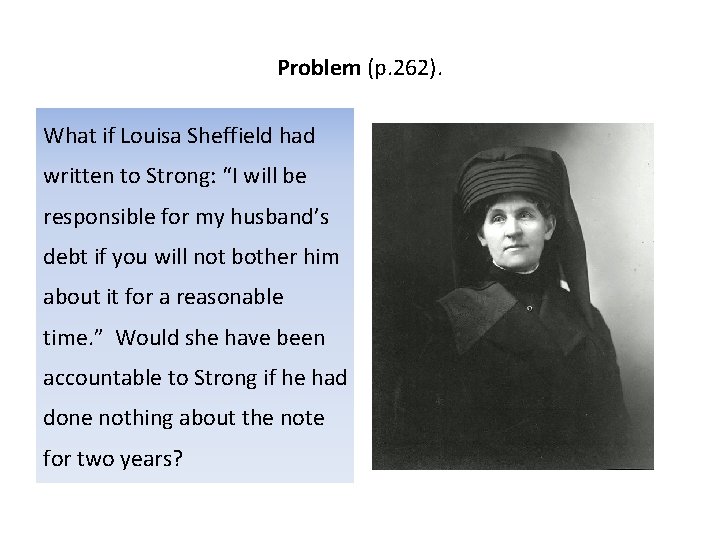
Problem (p. 262). What if Louisa Sheffield had written to Strong: “I will be responsible for my husband’s debt if you will not bother him about it for a reasonable time. ” Would she have been accountable to Strong if he had done nothing about the note for two years?
- Slides: 34