CSCI 5922 Neural Networks and Deep Learning Representation



- Slides: 26
CSCI 5922 Neural Networks and Deep Learning: Representation Mike Mozer Department of Computer Science and Institute of Cognitive Science University of Colorado at Boulder
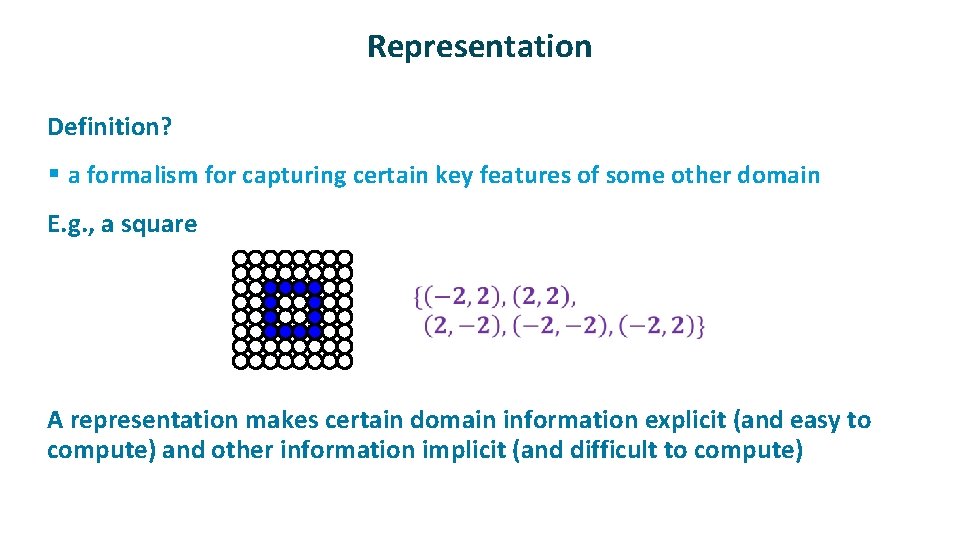
Representation ü Definition? § a formalism for capturing certain key features of some other domain ü E. g. , a square ü A representation makes certain domain information explicit (and easy to compute) and other information implicit (and difficult to compute)
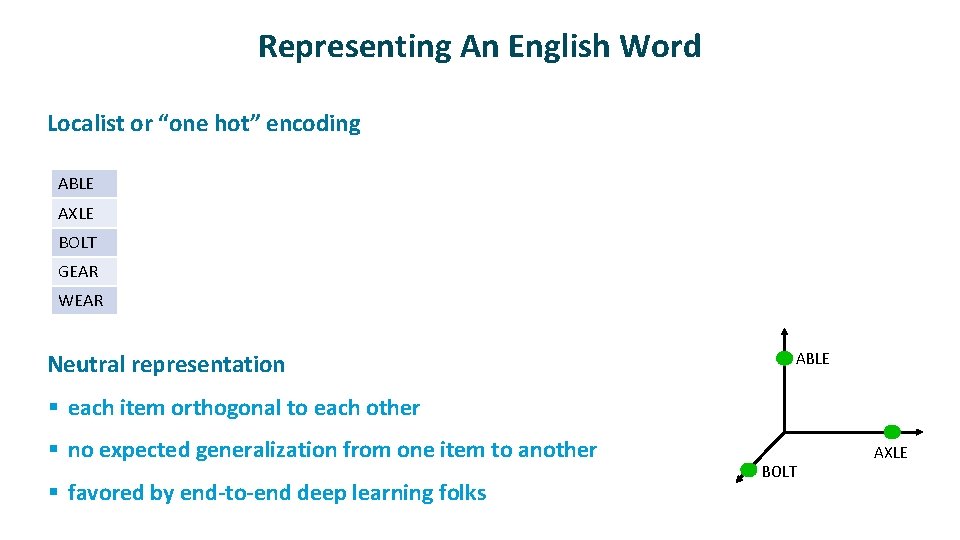
Representing An English Word ü ü Localist or “one hot” encoding ABLE 1 0 0 0 AXLE 0 1 0 0 0 BOLT 0 0 0 1 0 0 0 0 0 GEAR 0 0 0 1 0 0 0 WEAR 0 0 0 0 0 1 0 0 0 Neutral representation ABLE § each item orthogonal to each other § no expected generalization from one item to another § favored by end-to-end deep learning folks BOLT AXLE
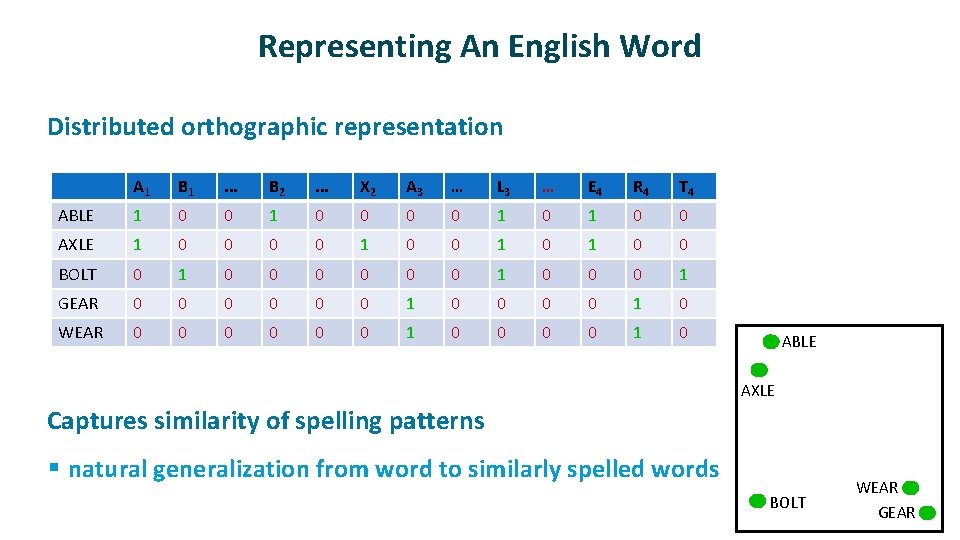
Representing An English Word ü Distributed orthographic representation A 1 B 1 . . . B 2 . . . X 2 A 3 … L 3 … E 4 R 4 T 4 ABLE 1 0 0 0 0 1 0 0 AXLE 1 0 0 1 0 0 BOLT 0 1 0 0 0 1 GEAR 0 0 0 1 0 WEAR 0 0 0 1 0 ABLE AXLE ü Captures similarity of spelling patterns § natural generalization from word to similarly spelled words BOLT WEAR GEAR
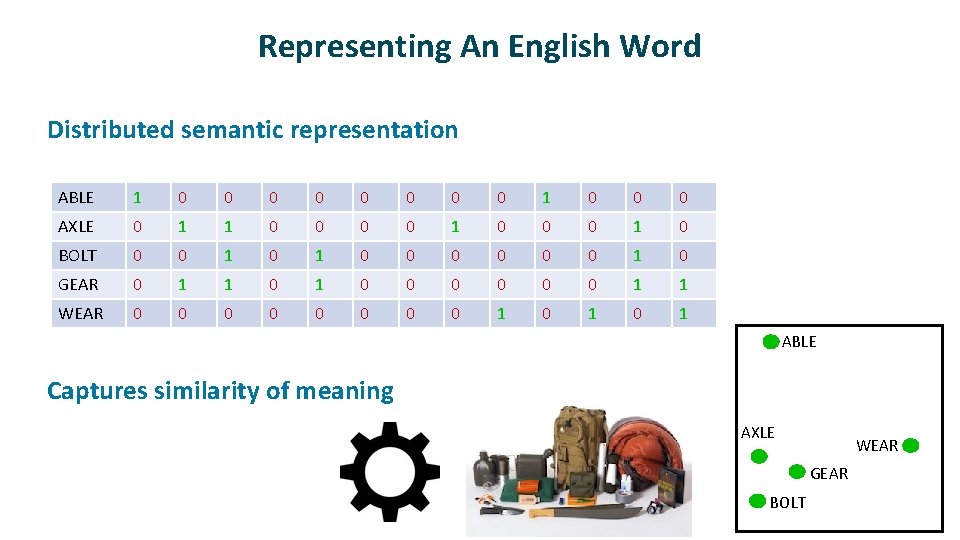
Representing An English Word ü Distributed semantic representation ABLE 1 0 0 0 0 1 0 0 0 AXLE 0 1 1 0 0 0 1 0 BOLT 0 0 1 0 GEAR 0 1 1 0 0 0 0 1 1 WEAR 0 0 0 0 1 0 1 ABLE ü Captures similarity of meaning AXLE WEAR GEAR BOLT
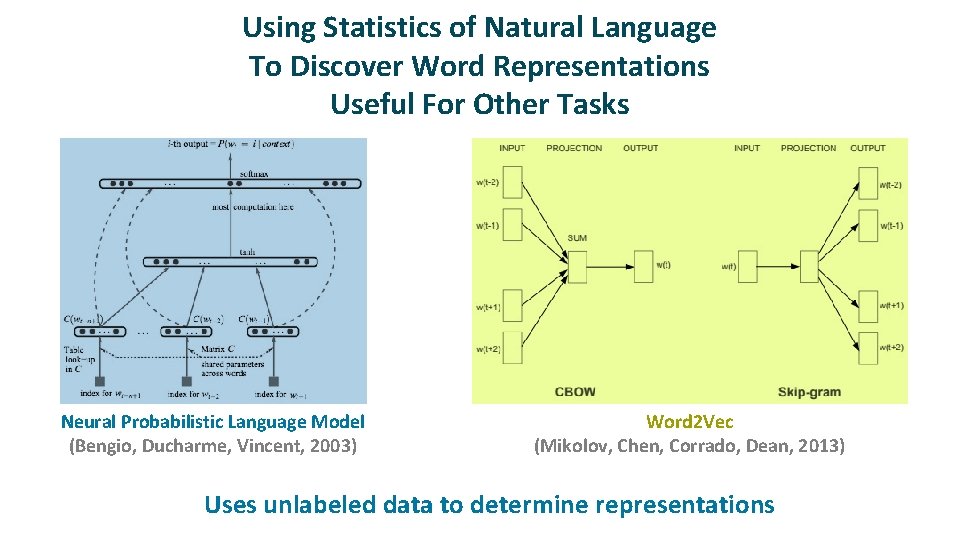
Using Statistics of Natural Language To Discover Word Representations Useful For Other Tasks Neural Probabilistic Language Model (Bengio, Ducharme, Vincent, 2003) Word 2 Vec (Mikolov, Chen, Corrado, Dean, 2013) Uses unlabeled data to determine representations
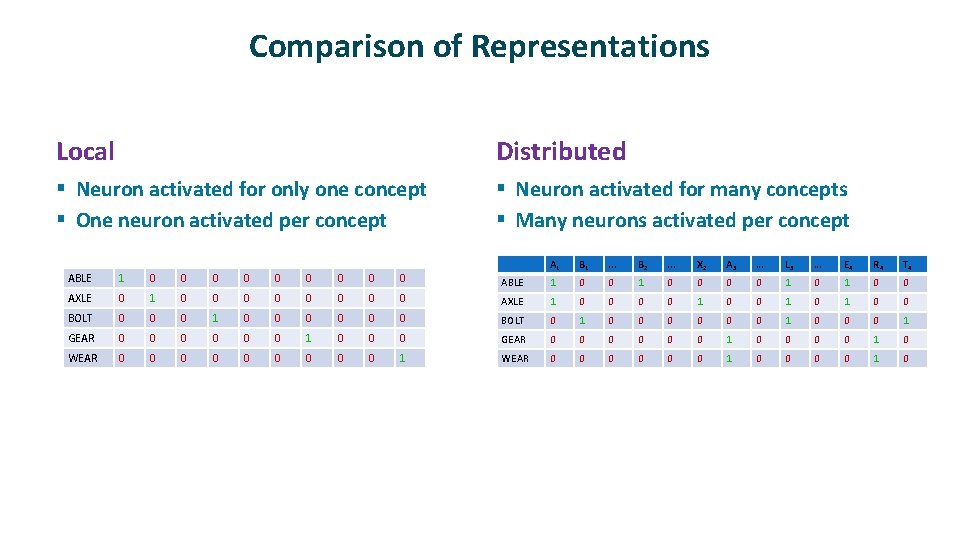
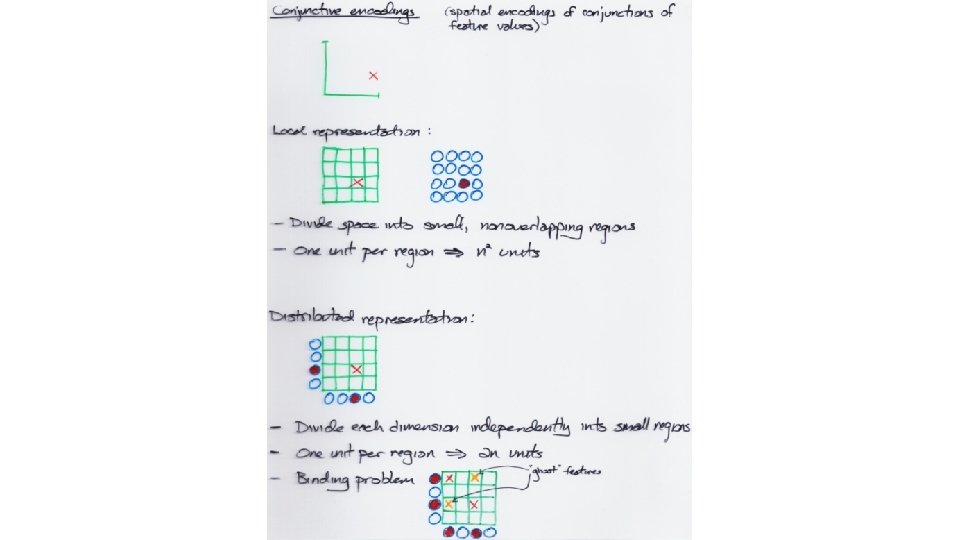
Comparison of Representations Local Distributed § Neuron activated for only one concept § One neuron activated per concept § Neuron activated for many concepts § Many neurons activated per concept A 1 B 1 . . . B 2 . . . X 2 A 3 … L 3 … E 4 R 4 T 4 ABLE 1 0 0 0 0 0 ABLE 1 0 0 0 0 1 0 0 AXLE 0 1 0 0 0 0 AXLE 1 0 0 1 0 0 BOLT 0 0 0 1 0 0 0 BOLT 0 1 0 0 0 1 GEAR 0 0 0 1 0 0 0 0 1 0 WEAR 0 0 0 0 0 1 WEAR 0 0 0 1 0
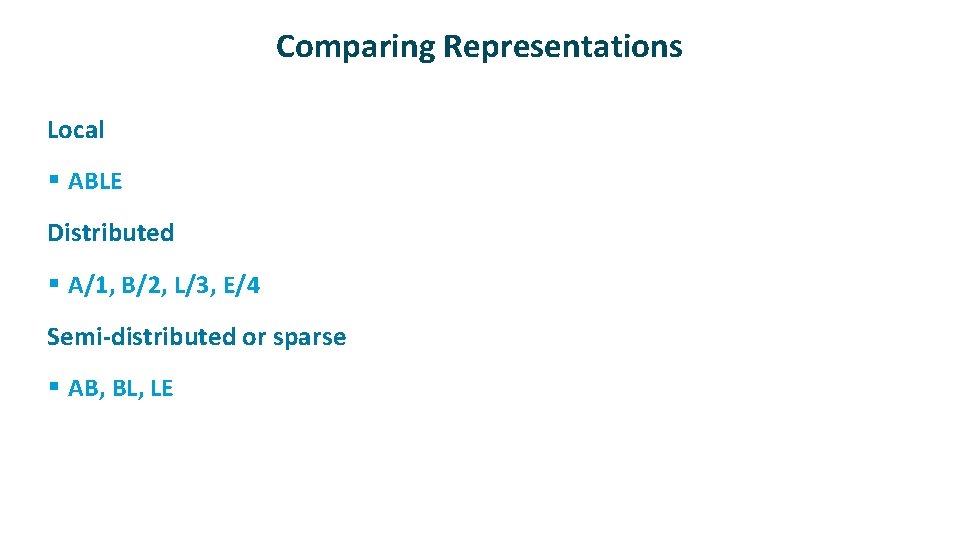
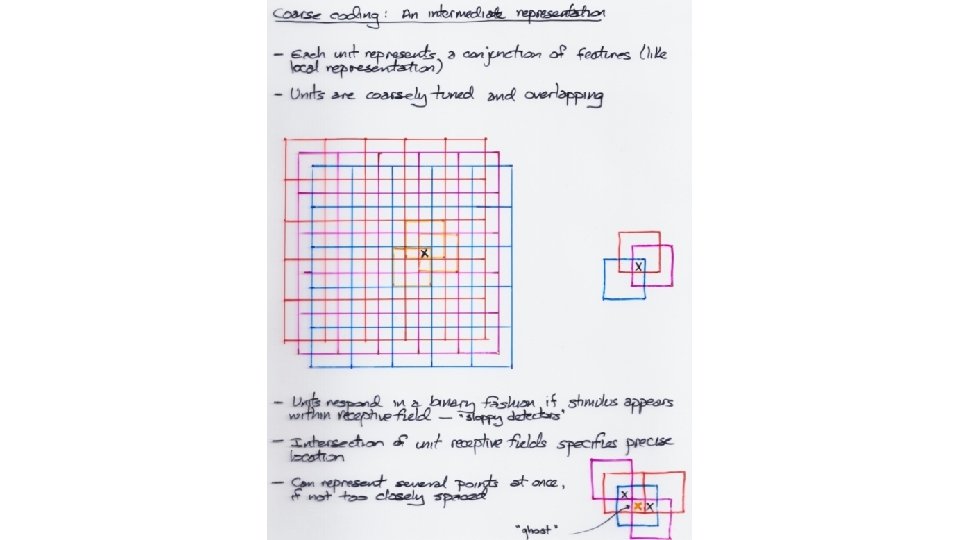
Comparing Representations ü Local § ABLE ü Distributed § A/1, B/2, L/3, E/4 ü Semi-distributed or sparse § AB, BL, LE
How Many Concepts Can Be Represented Simultaneously? ü Local ü § all of them ü § ABLE, GEAR, WEAN Distributed § one § binding problem ü § A/1, G/1, B/2, E/2, A/3, L/3, E/4, R/4 ü Semi-distributed § AB, AR, BL, EA, GE, LE § depends on similarity § AN, AR, EA, GE, WE
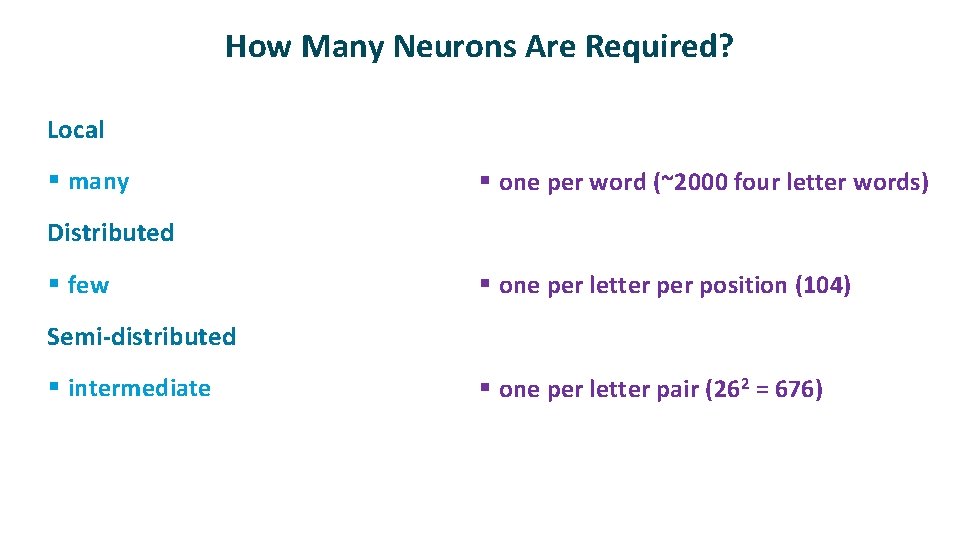
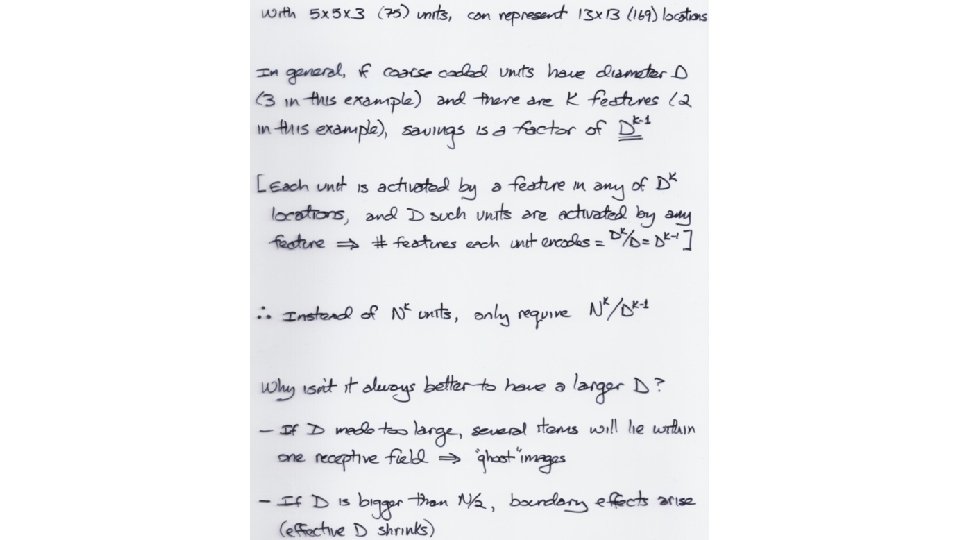
How Many Neurons Are Required? ü Local § many ü § one per word (~2000 four letter words) Distributed § few ü ü § one per letter position (104) Semi-distributed § intermediate § one per letter pair (262 = 676)
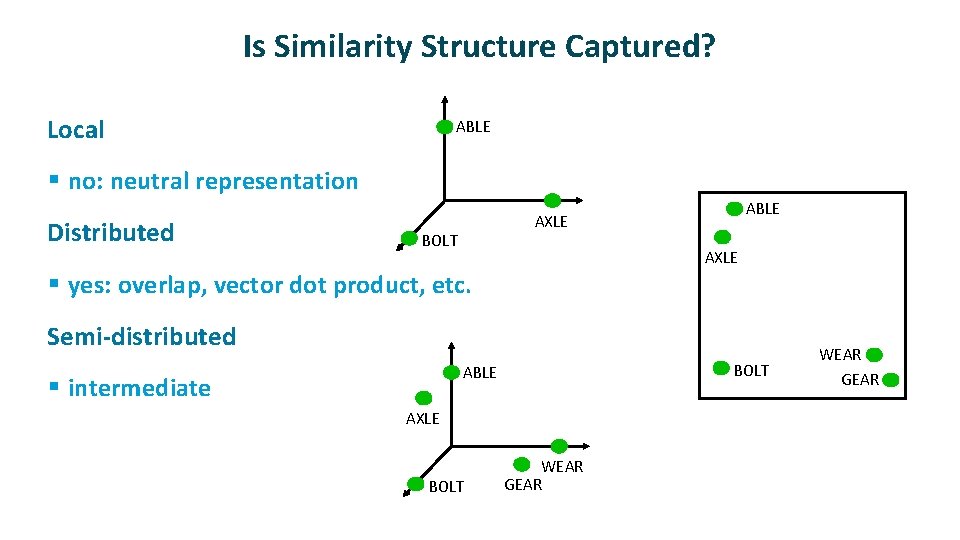
Is Similarity Structure Captured? ü Local ABLE § no: neutral representation ü Distributed BOLT AXLE § yes: overlap, vector dot product, etc. ü ABLE AXLE Semi-distributed BOLT ABLE § intermediate AXLE BOLT WEAR GEAR
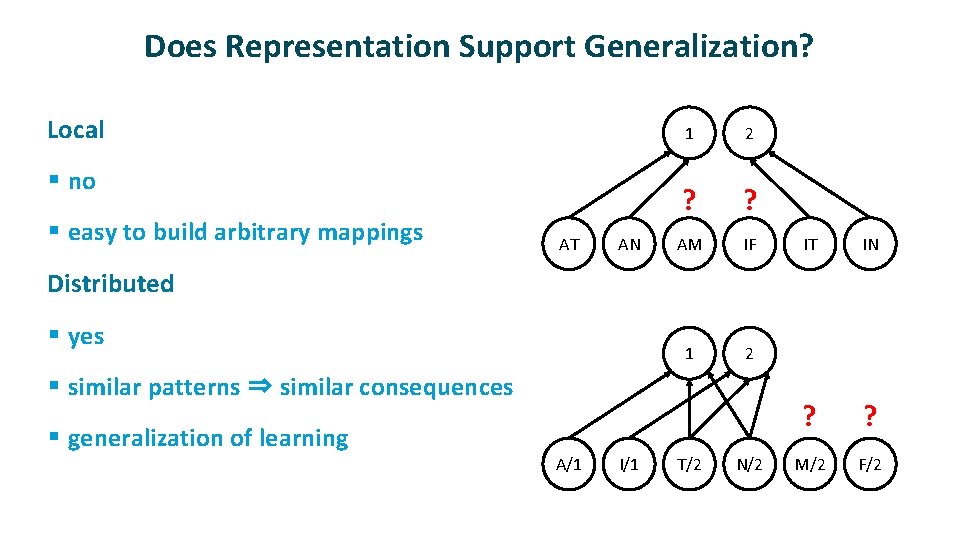
Does Representation Support Generalization? ü Local § no § easy to build arbitrary mappings ü AT AN 1 2 ? ? AM IF 1 2 IT IN ? ? M/2 F/2 Distributed § yes § similar patterns ⇒ similar consequences § generalization of learning A/1 I/1 T/2 N/2
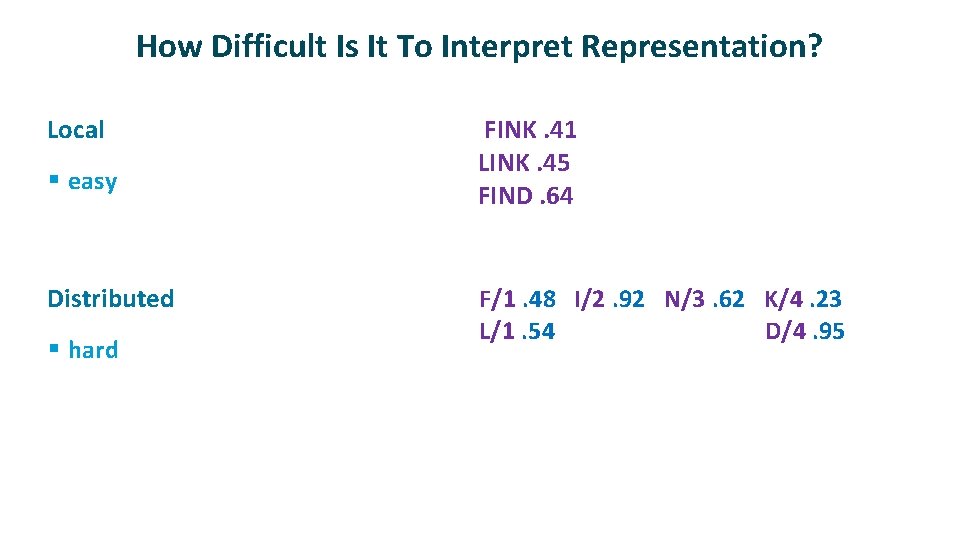
How Difficult Is It To Interpret Representation? ü Local § easy ü FINK. 41 LINK. 45 FIND. 64 ü Distributed § hard F/1. 48 I/2. 92 N/3. 62 K/4. 23 L/1. 54 D/4. 95
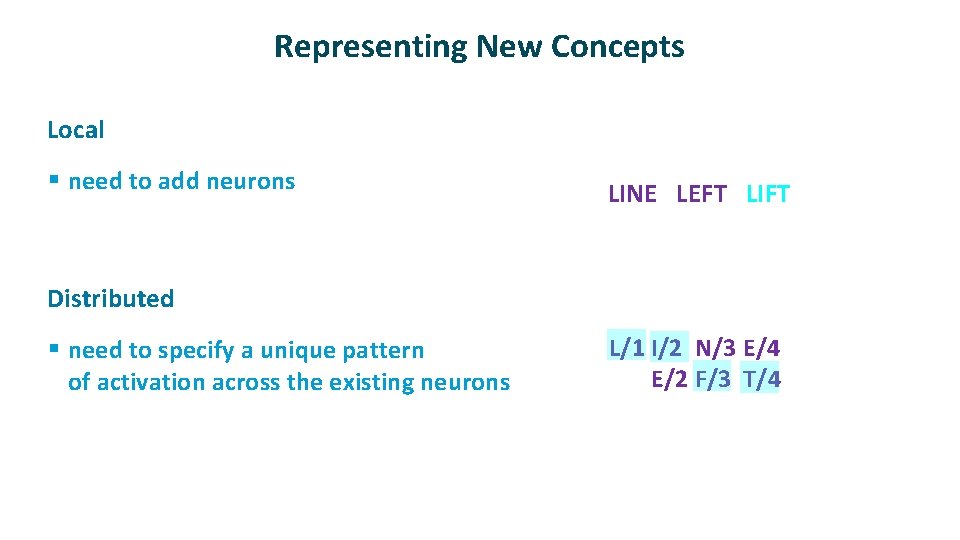
Representing New Concepts ü Local § need to add neurons ü LINE LEFT LIFT ü Distributed § need to specify a unique pattern of activation across the existing neurons L/1 I/2 N/3 E/4 E/2 F/3 T/4
Tensor Product Representation (Smolensky, 1990) letter ü position 1 2 3 4 5 6 7 … 1 0 0 0 … A 0 0 0 0 … B 0 0 0 0 … C 1 1 0 0 0 … D 0 0 0 0 … E 0 0 0 0 … F 0 0 0 0 … … … X 0 0 0 0 … Y 0 0 0 0 … Z 0 0 0 0 …
Representing Multiple Role-Filler Pairs position letter ü 1 2 3 4 5 6 7 … A 0 1 0 0 0 … B 0 0 1 0 0 … C 1 0 0 0 … D 0 0 0 0 … E 0 0 0 0 … F 0 0 0 0 … … … … … X 0 0 0 0 … Y 0 0 0 0 … Z 0 0 0 0 …
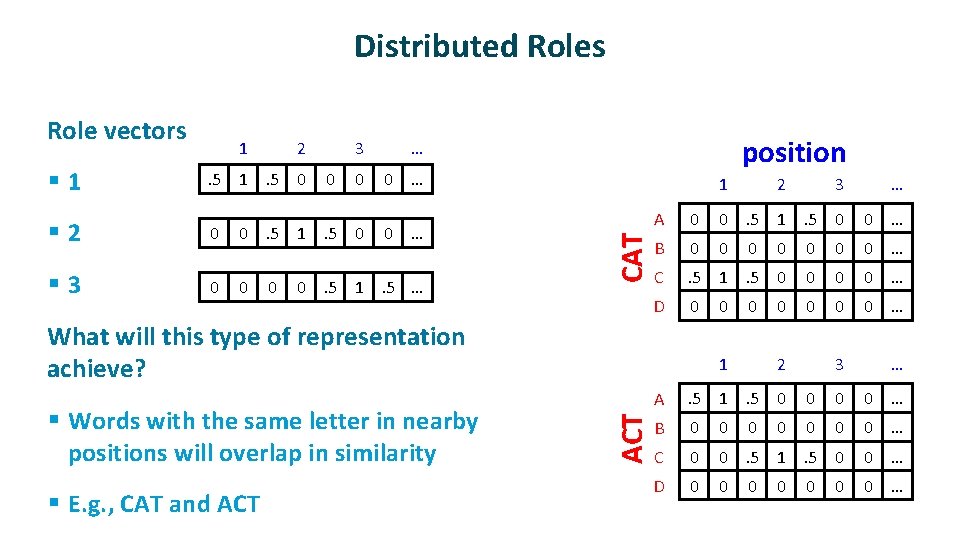
Distributed Roles ü 1 2 3 § 1 . 5 1. 5 0 0 … § 2 0 0. 5 1. 5 0 0 … § 3 0 0 0 position … 0. 5 1. 5 … 1 CAT Role vectors § Words with the same letter in nearby positions will overlap in similarity § E. g. , CAT and ACT 2 3 … A 0 0. 5 1. 5 0 0 … B 0 0 0 … C . 5 1. 5 0 0 … D 0 0 … 3 … What will this type of representation achieve? 0 0 0 1 ACT ü 0 2 A . 5 1. 5 0 0 … B 0 0 0 … C 0 0. 5 1. 5 0 0 … D 0 0 0 … 0 0 0
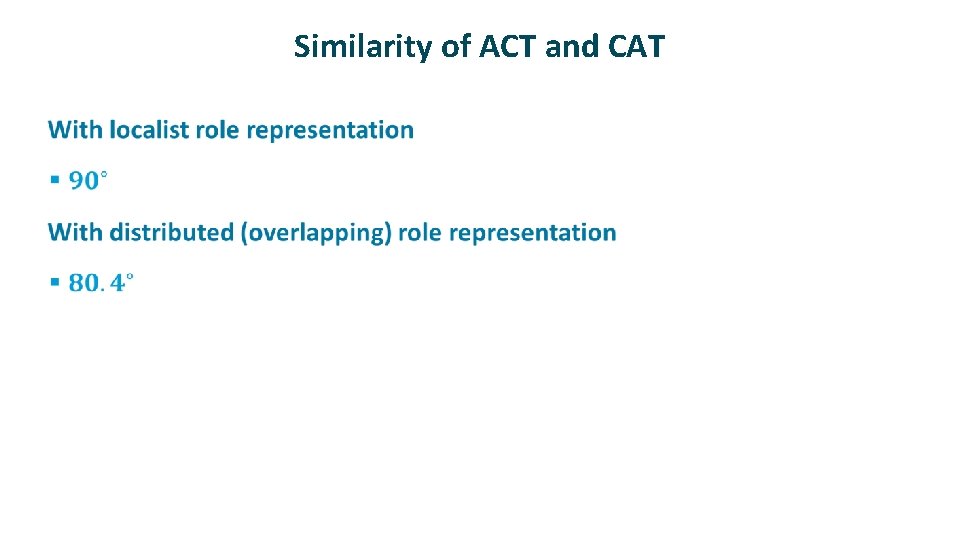
Similarity of ACT and CAT ü
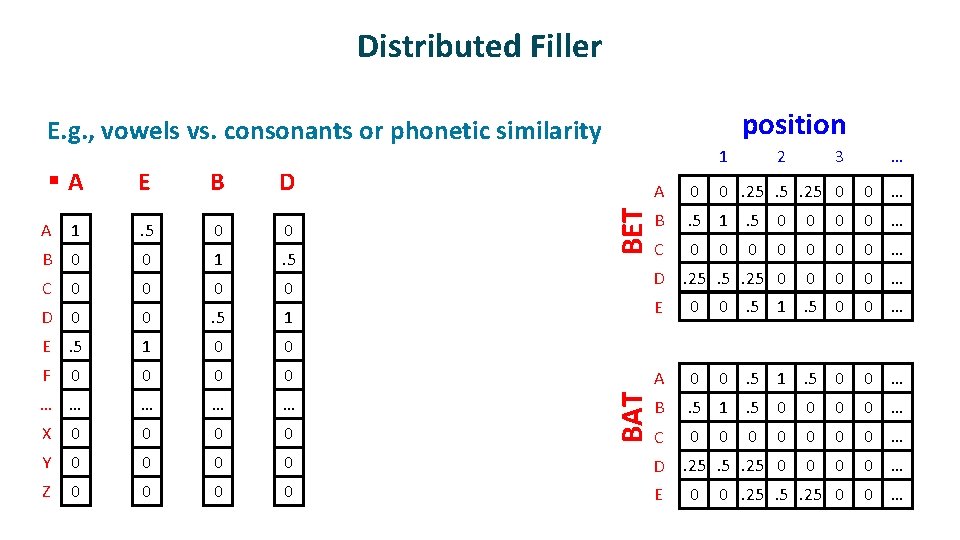
Distributed Filler ü position E. g. , vowels vs. consonants or phonetic similarity 1 BET § A E B D 2 3 … 0. 25. 5. 25 0 0 … A 0 B . 5 1. 5 0 0 … C 0 0 0 … . 25. 5. 25 0 0 … 0. 5 1. 5 0 0 … A 1 . 5 0 0 B 0 0 1 . 5 C 0 0 D 0 0 . 5 1 E. 5 1 0 0 F 0 0 … … … X 0 0 Y 0 0 D Z 0 0 E D E 0 0 0 BAT A 0 B . 5 1. 5 0 0 C 0 0 . 25. 5. 25 0 0 0. 5 1. 5 0 0 … 0. 25. 5. 25 0 0 … 0 0
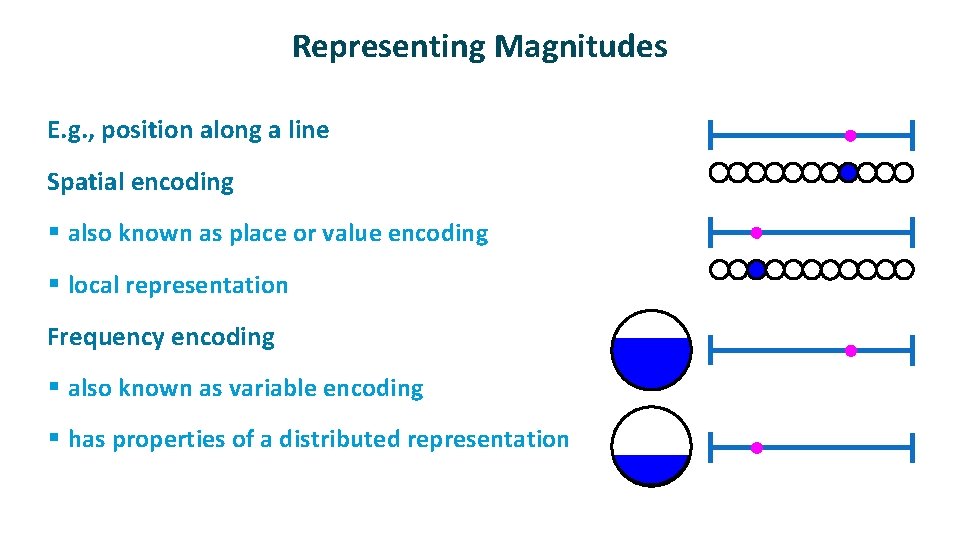
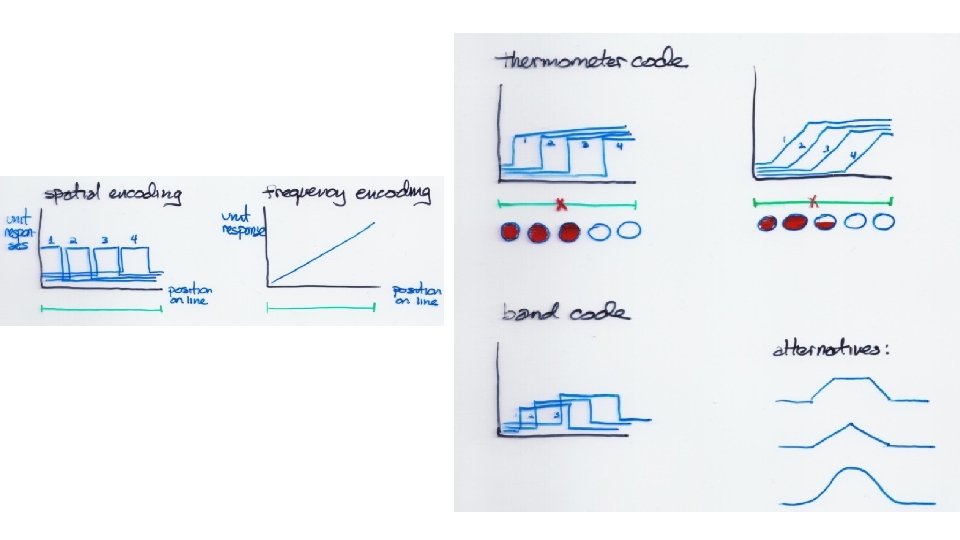
Representing Magnitudes ü ü E. g. , position along a line Spatial encoding § also known as place or value encoding § local representation ü Frequency encoding § also known as variable encoding § has properties of a distributed representation
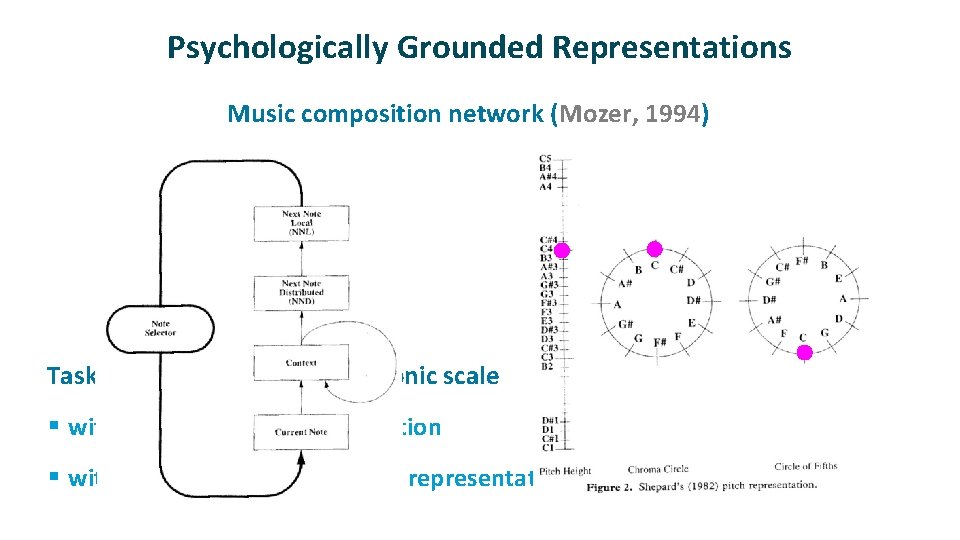
Psychologically Grounded Representations ü ü Music composition network (Mozer, 1994) Task: predict next pitch in diatonic scale § with one-hot pitch representation 54. 5% accuracy § with psychologically grounded representation 98. 4% accuracy
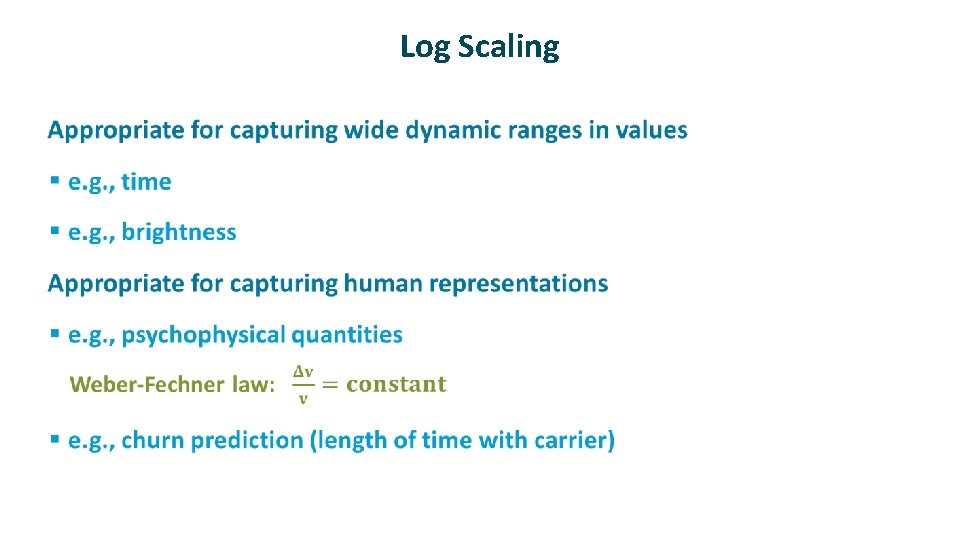
Log Scaling ü