CSC 330 ECommerce Teacher Ahmed Mumtaz Mustehsan GMIT

- Slides: 38
CSC 330 E-Commerce Teacher Ahmed Mumtaz Mustehsan GM-IT CIIT Islamabad Virtual Campus, CIIT COMSATS Institute of Information Technology T 1 -Lecture-2
E Commerce: Chapter-1 T 1 -Lecture-2 For Lecture Material/Slides Thanks to: Copyright © 2010 Pearson Education, Inc
Objectives Classification of computers. Computer network. Introduction to internet, growth of internet. Introduction to web and growth of web. Internet and Web gave birth to e- commerce. Understand the evolution from internet to e-commerce. Define e-commerce and describe how it differs from e-business. Identify and describe the unique features of e-commerce technology and discuss their business significance. Describe the major types of e-commerce. Evolution of e-commerce. Discuss the origins and growth of e-commerce. Identify the factors that will define the future of e-commerce. Describe the major themes underlying the study of e-commerce. Identify the major academic disciplines contributing to ecommerce. T 1 -Lecture-2 CSC 330 E Commerce Ahmed Mumtaz Mustehsan Copyright © 2010 Pearson Education, Inc 1 -3
Computer classifications Mainframes: - term for very large computers - used to handle large amount of data or complex processes - main advantage is reliability Midrange: - medium sized, less expensive and smaller - usually a server Micro-computer: - work stations with computing capabilities - single-users systems linked to form a network T 1 -Lecture-2 CSC 330 E Commerce Ahmed Mumtaz Mustehsan Copyright © 2010 Pearson Education, Inc 1 -4
What is a network Series of points or nodes interconnected by communication paths Node is a connection point for transmitting data Network can interconnect with other networks to form global networks T 1 -Lecture-2 CSC 330 E Commerce Ahmed Mumtaz Mustehsan Copyright © 2010 Pearson Education, Inc 1 -5
Benefits of a network Facilitates resource sharing Provides reliability Cost effective Provide a powerful medium across geographical divide T 1 -Lecture-2 CSC 330 E Commerce Ahmed Mumtaz Mustehsan Copyright © 2010 Pearson Education, Inc 1 -6
when internet born Worldwide network of computer networks built on common standards Created in late 1960 s (1969) when terminals were connected with mainframe computers. The purpose was to create a net that can function even if one center is destroyed in a military attack. ◦ Network can continue to be functional even if some nodes are destroyed, as long as information can pass through other nodes. Services include the Web, e-mail, file transfers, etc. T 1 -Lecture-2 CSC 330 E Commerce Ahmed Mumtaz Mustehsan Copyright © 2010 Pearson Education, Inc 1 -7
In the 1980´s Personal computers or terminals were connected to a server. The server was a mainframe, or connected to a mainframe computer. The mainframe was connected to another mainframe of the company in another location via dedicated lines. Only large companies could afford the expense and investment in equipment. T 1 -Lecture-2 CSC 330 E Commerce Ahmed Mumtaz Mustehsan Copyright © 2010 Pearson Education, Inc 1 -8
Geographical Distance Local area network (LAN): small area, share a single server Metropolitan area network (MAN): a wider network, can bridge several LAN’s Wide area network (WAN): a broader area covered, can include several MAN’s T 1 -Lecture-2 CSC 330 E Commerce Ahmed Mumtaz Mustehsan Copyright © 2010 Pearson Education, Inc 1 -9
Network crossed boundaries Internet: a network of networks that covers the entire globe Connections across countries and continents made through dedicated fast lines. A company may have one local network (LAN) in NY, which is connected to the Internet through a Regional network. Well established in North America, Europe and certain Asian countries T 1 -Lecture-2 CSC 330 E Commerce Ahmed Mumtaz Mustehsan Copyright © 2010 Pearson Education, Inc 110
When The Web born Most popular Internet service Developed in early 1990 s Provides access to Web pages ◦ HTML documents that may include text, graphics, animations, music, videos Web content has grown exponentially ◦ 2 billion Web pages in 2000 ◦ At least 40– 50 billion pages today (2010) ◦ Now ? (Crossed Trillian) T 1 -Lecture-2 CSC 330 E Commerce Education, Inc Ahmed Mumtaz Mustehsan Copyright © 2010 Pearson 111
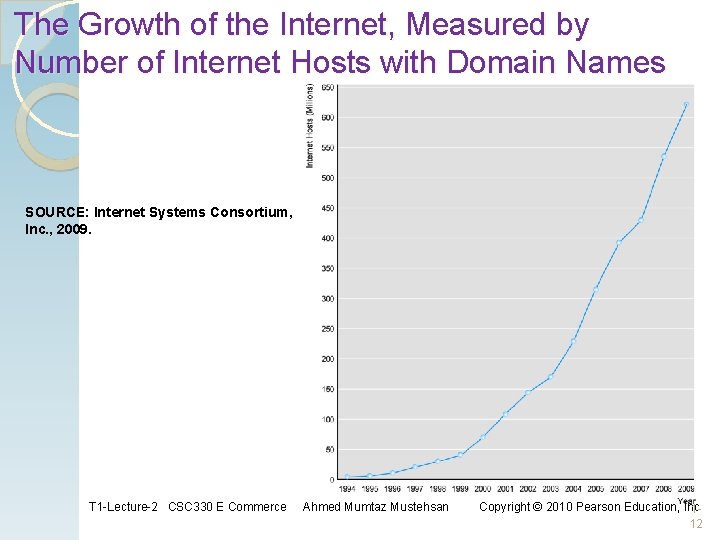
The Growth of the Internet, Measured by Number of Internet Hosts with Domain Names SOURCE: Internet Systems Consortium, Inc. , 2009. T 1 -Lecture-2 CSC 330 E Commerce Ahmed Mumtaz Mustehsan Copyright © 2010 Pearson Education, Inc 112
web to web 2. 0 ; another evolution e-commerce, internet, set of applications and social media brought together the evolution of web usually called web 2. 0; The Applications and Technologies allowed the users to: Create and share content, preferences, bookmarks, and online personas, participate in virtual lives, build online communities Examples ◦ You. Tube, Photobucket, Flickr, Google, i. Phone, My. Space, Facebook, Linked. In, Second Life, Wikipedia T 1 -Lecture-2 CSC 330 E Commerce Ahmed Mumtaz Mustehsan Copyright © 2010 Pearson Education, Inc 13
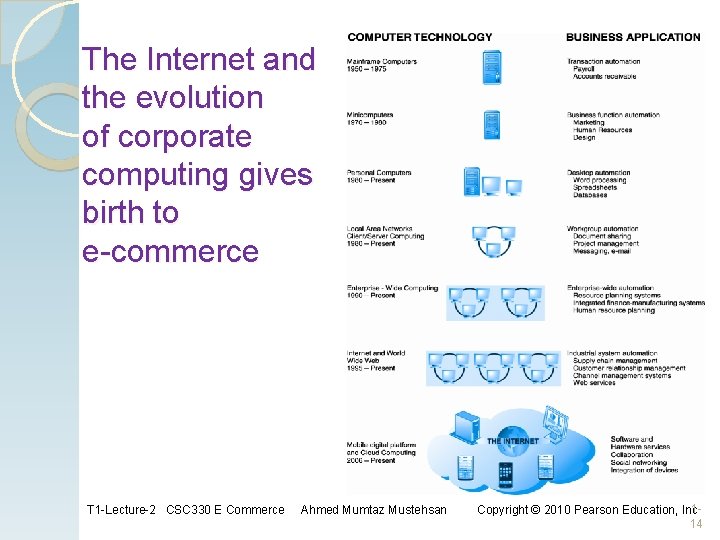
The Internet and the evolution of corporate computing gives birth to e-commerce T 1 -Lecture-2 CSC 330 E Commerce Ahmed Mumtaz Mustehsan 1 Copyright © 2010 Pearson Education, Inc 14
What is E-commerce? Use of Internet and Web for business transection. More formally: ◦ Digitally enabled commercial transactions between and among organizations and individuals. T 1 -Lecture-2 CSC 330 E Commerce Ahmed Mumtaz Mustehsan Copyright © 2010 Pearson Education, Inc 115
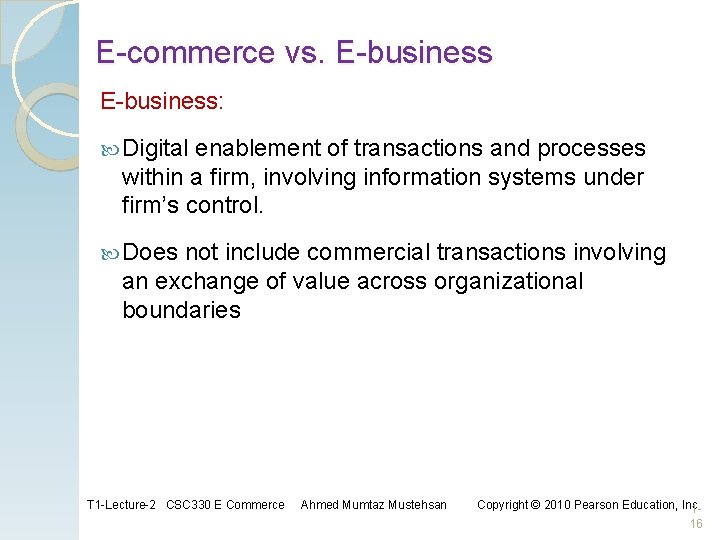
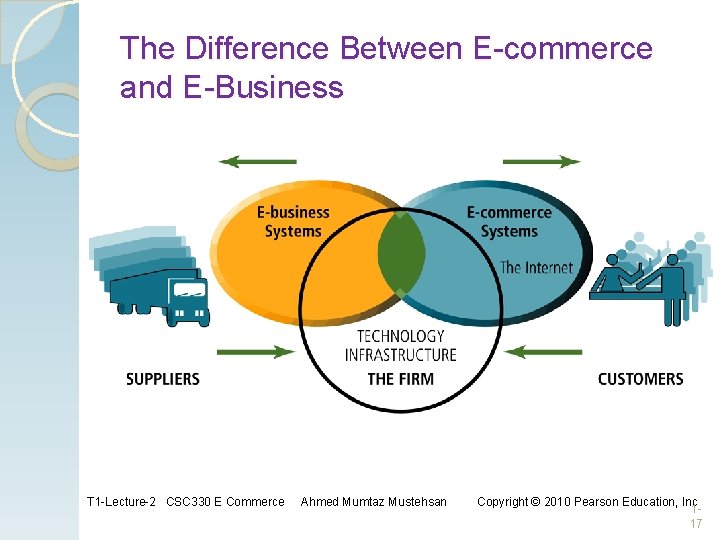
E-commerce vs. E-business: Digital enablement of transactions and processes within a firm, involving information systems under firm’s control. Does not include commercial transactions involving an exchange of value across organizational boundaries T 1 -Lecture-2 CSC 330 E Commerce Ahmed Mumtaz Mustehsan Copyright © 2010 Pearson Education, Inc 116
The Difference Between E-commerce and E-Business T 1 -Lecture-2 CSC 330 E Commerce Ahmed Mumtaz Mustehsan Copyright © 2010 Pearson Education, Inc 117
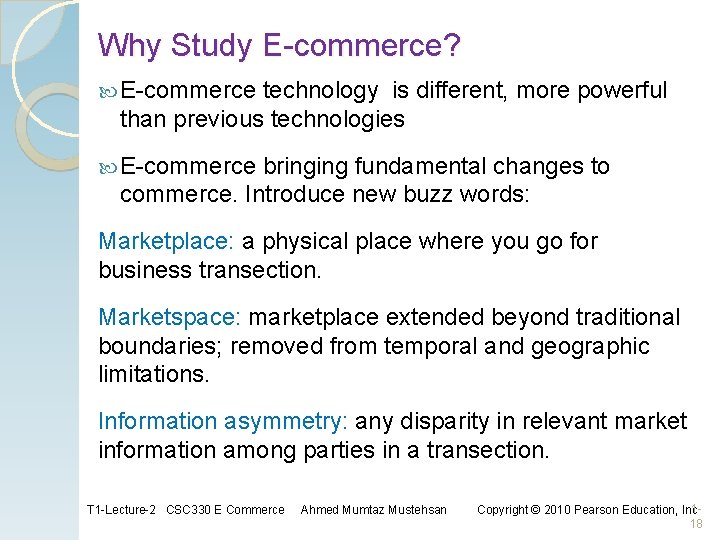
Why Study E-commerce? E-commerce technology is different, more powerful than previous technologies E-commerce bringing fundamental changes to commerce. Introduce new buzz words: Marketplace: a physical place where you go for business transection. Marketspace: marketplace extended beyond traditional boundaries; removed from temporal and geographic limitations. Information asymmetry: any disparity in relevant market information among parties in a transection. T 1 -Lecture-2 CSC 330 E Commerce Ahmed Mumtaz Mustehsan 1 Copyright © 2010 Pearson Education, Inc 18
Unique Features of E-commerce Technology Ubiquity: available everywhere anytime, i. e. Internet/Web technology is available everywhere; at work, at home, and elsewhere via mobile devices and round the clock (anytime). 2. Global reach: the total number of users or customers an ecommerce business can obtain is a measure of its reach. The technology reaches across cultural and national boundaries, round the globe. 3. Universal standards: technical standard of conducting ecommerce. There is one set of technology standards, namely Internet standards as compared to different standards followed by different nations. 4. Information richness: complexity of the content of a message. Unlimited information of a product is available through video, audio, and text messages at internet and social media. 1. T 1 -Lecture-2 CSC 330 E Commerce Ahmed Mumtaz Mustehsan Copyright © 2010 Pearson Education, Inc 119
Unique Features of E-commerce Technology Interactivity: The technology works through interaction with the user. One shopkeeper can handle large number of clients simultaneously at internet. 6. Information density: the total amount of information available to all market stakeholders. the technology reduces information collection costs and raises quality through social media. 7. Personalization/customization: Personalization: The targeting of marketing messages to specific individuals by adjusting the message to a person's name, interests, and past purchases. (Customization) delivery of product or service based on a user's preferences or prior behavior 8. Social technology: user content generation and social networking. The e-commerce technologies have evolved users to create and generate contents in the form of web, Facebook pages, text, video, music and photos with worldwide communities. 5. T 1 -Lecture-2 CSC 330 E Commerce Ahmed Mumtaz Mustehsan 1 Copyright © 2010 Pearson Education, Inc 20
Types of E-commerce Classified by Market Relationship Business-to-Consumer (B 2 C) ◦ e-commerce online businesses attempt to reach individual consumers. Business-to-Business (B 2 B) ◦ e-commerce online businesses selling to other businesses Consumer-to-Consumer (C 2 C) ◦ e-commerce consumers selling to other consumers T 1 -Lecture-2 CSC 330 E Commerce Ahmed Mumtaz Mustehsan Copyright © 2010 Pearson Education, Inc 121
Types of E-commerce Classified by Technology used Peer-to-Peer (P 2 P) ◦ e-commerce use of peer-to-peer technology, which enables Internet users to share files and computer resources directly without having to go through a central Web server, (example sharing videos through Torrents) Mobile commerce (M-commerce) ◦ m-commerce use of wireless digital devices to enable transactions on the Web T 1 -Lecture-2 CSC 330 E Commerce Ahmed Mumtaz Mustehsan Copyright © 2010 Pearson Education, Inc 122
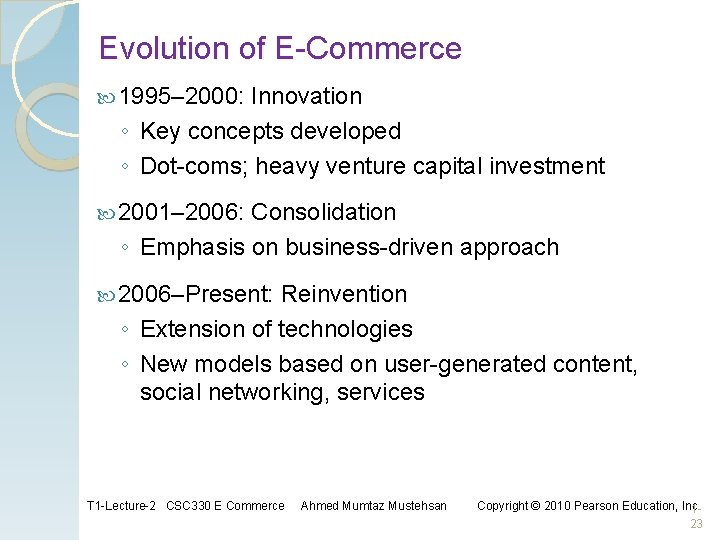
Evolution of E-Commerce 1995– 2000: Innovation ◦ Key concepts developed ◦ Dot-coms; heavy venture capital investment 2001– 2006: Consolidation ◦ Emphasis on business-driven approach 2006–Present: Reinvention ◦ Extension of technologies ◦ New models based on user-generated content, social networking, services T 1 -Lecture-2 CSC 330 E Commerce Ahmed Mumtaz Mustehsan Copyright © 2010 Pearson Education, Inc 123
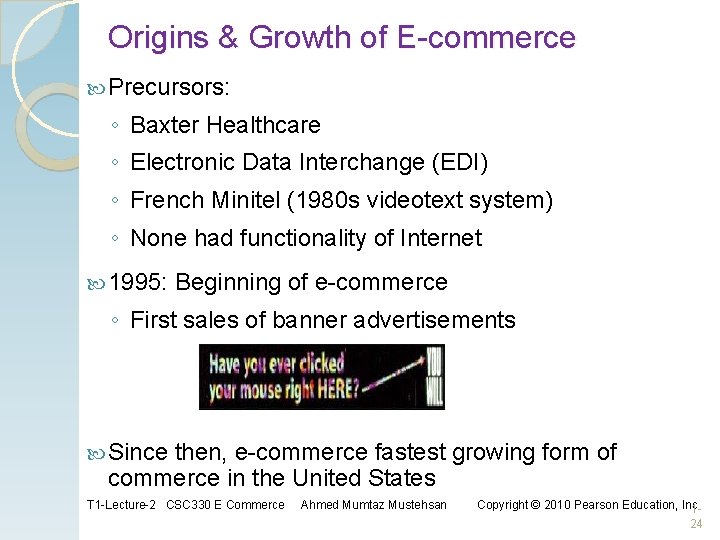
Origins & Growth of E-commerce Precursors: ◦ Baxter Healthcare ◦ Electronic Data Interchange (EDI) ◦ French Minitel (1980 s videotext system) ◦ None had functionality of Internet 1995: Beginning of e-commerce ◦ First sales of banner advertisements Since then, e-commerce fastest growing form of commerce in the United States T 1 -Lecture-2 CSC 330 E Commerce Ahmed Mumtaz Mustehsan Copyright © 2010 Pearson Education, Inc 124
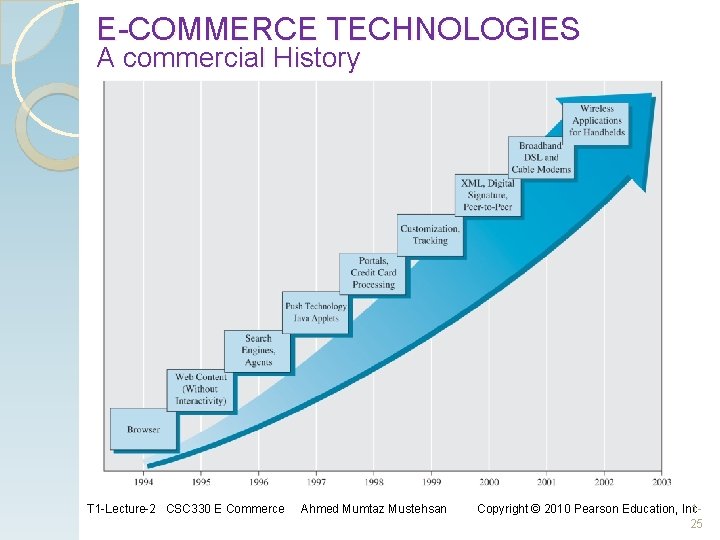
E-COMMERCE TECHNOLOGIES A commercial History T 1 -Lecture-2 CSC 330 E Commerce Ahmed Mumtaz Mustehsan Copyright © 2010 Pearson Education, Inc 125
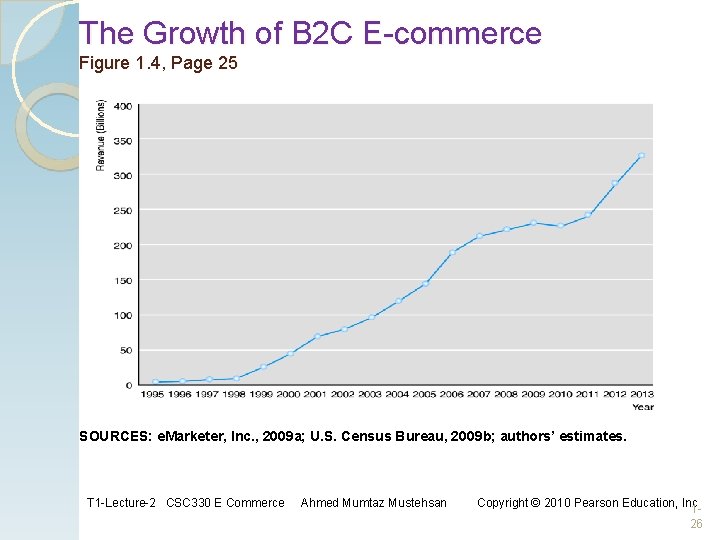
The Growth of B 2 C E-commerce Figure 1. 4, Page 25 SOURCES: e. Marketer, Inc. , 2009 a; U. S. Census Bureau, 2009 b; authors’ estimates. T 1 -Lecture-2 CSC 330 E Commerce Ahmed Mumtaz Mustehsan Copyright © 2010 Pearson Education, Inc 126
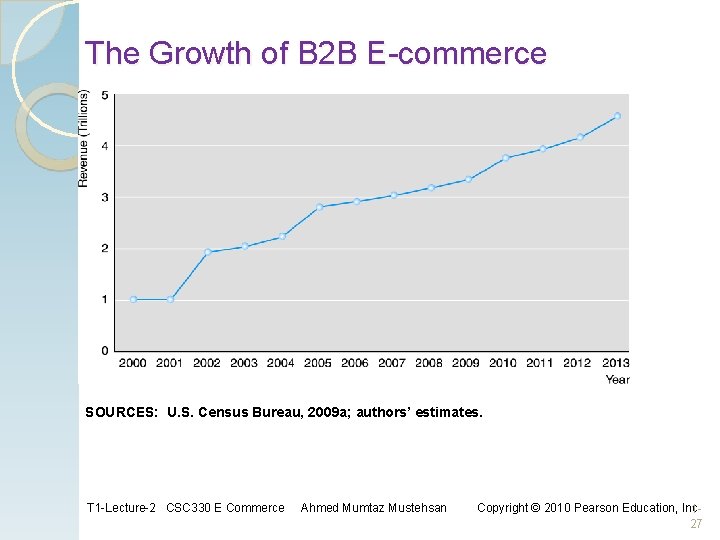
The Growth of B 2 B E-commerce SOURCES: U. S. Census Bureau, 2009 a; authors’ estimates. T 1 -Lecture-2 CSC 330 E Commerce Ahmed Mumtaz Mustehsan Copyright © 2010 Pearson Education, Inc 127
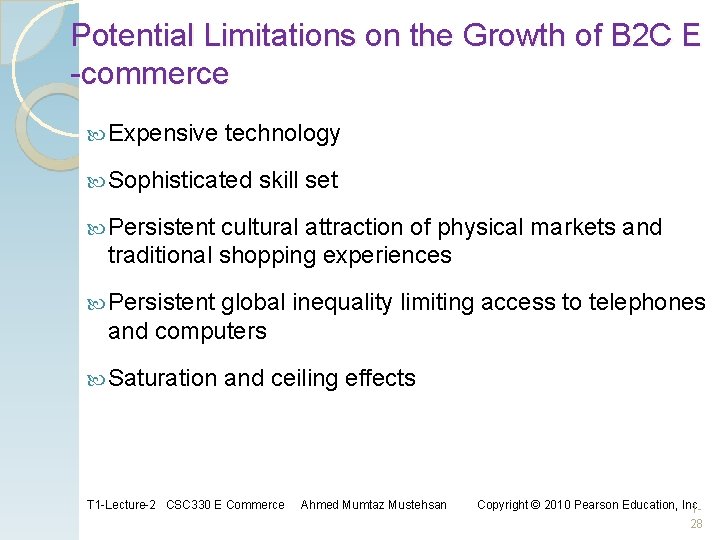
Potential Limitations on the Growth of B 2 C E -commerce Expensive technology Sophisticated skill set Persistent cultural attraction of physical markets and traditional shopping experiences Persistent global inequality limiting access to telephones and computers Saturation and ceiling effects T 1 -Lecture-2 CSC 330 E Commerce Ahmed Mumtaz Mustehsan Copyright © 2010 Pearson Education, Inc 128
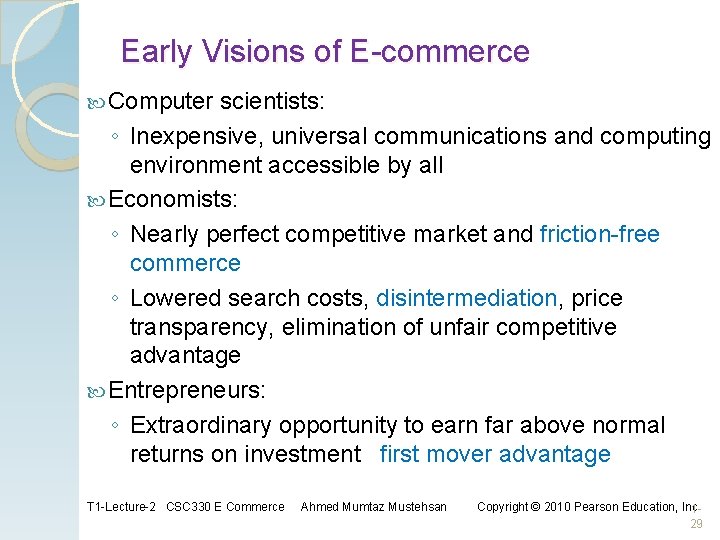
Early Visions of E-commerce Computer scientists: ◦ Inexpensive, universal communications and computing environment accessible by all Economists: ◦ Nearly perfect competitive market and friction-free commerce ◦ Lowered search costs, disintermediation, price transparency, elimination of unfair competitive advantage Entrepreneurs: ◦ Extraordinary opportunity to earn far above normal returns on investment first mover advantage T 1 -Lecture-2 CSC 330 E Commerce Ahmed Mumtaz Mustehsan Copyright © 2010 Pearson Education, Inc 129
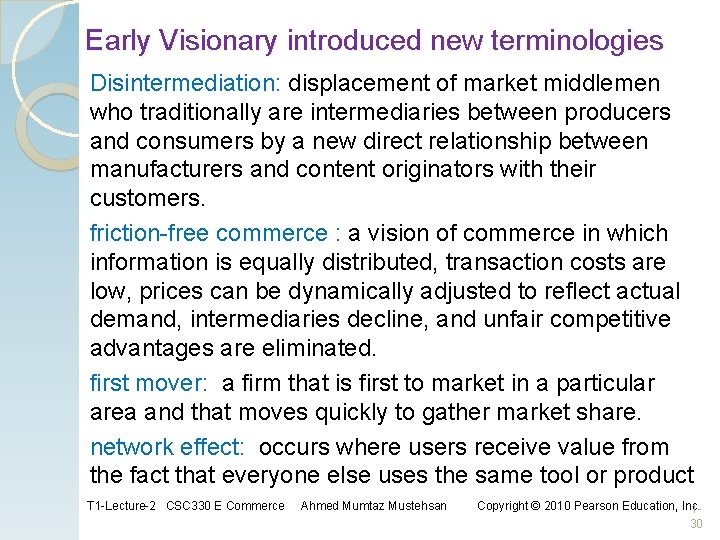
Early Visionary introduced new terminologies Disintermediation: displacement of market middlemen who traditionally are intermediaries between producers and consumers by a new direct relationship between manufacturers and content originators with their customers. friction-free commerce : a vision of commerce in which information is equally distributed, transaction costs are low, prices can be dynamically adjusted to reflect actual demand, intermediaries decline, and unfair competitive advantages are eliminated. first mover: a firm that is first to market in a particular area and that moves quickly to gather market share. network effect: occurs where users receive value from the fact that everyone else uses the same tool or product T 1 -Lecture-2 CSC 330 E Commerce Ahmed Mumtaz Mustehsan Copyright © 2010 Pearson Education, Inc 130
Assessing e-commerce Many early visions not fulfilled Friction-free commerce Consumers less price sensitive Considerable price dispersion Perfect competition Information asymmetries persist Disintermediation Smart people/ firms buy and sell goods using their expertise, end-user is still paying more. First mover advantage Fast-followers often overtake first movers T 1 -Lecture-2 CSC 330 E Commerce Ahmed Mumtaz Mustehsan 1 Copyright © 2010 Pearson Education, Inc 31
Advantages and Disadvantages of Commerce Disadvantages: Perishable It products are difficult to sell online is difficult to: ◦ Calculate return on investment ◦ Integrate existing databases and transactionprocessing software into software that enables e -commerce Cultural and legal obstacles exist. T 1 -Lecture-2 CSC 330 E Commerce Ahmed Mumtaz Mustehsan Copyright © 2010 Pearson Education, Inc 133
Predictions for the Future Technology Prices will propagate through all commercial activity will rise to cover the real cost of doing business E-commerce retailers margins and profits will rise to levels all Cast of players will change ◦ Traditional Fortune 500 companies will play dominant role ◦ New startup ventures will emerge with new products, services Number of successful pure online stores will remain smaller than integrated offline/online stores Growth of regulatory activity worldwide Influence of cost of energy T 1 -Lecture-2 CSC 330 E Commerce Ahmed Mumtaz Mustehsan Copyright © 2010 Pearson Education, Inc 134
Understanding E-commerce: Organizing Themes Technology: ◦ Development and mastery of digital computing and communications technology Business: ◦ New technologies present businesses with new ways of organizing production and transacting business Society: ◦ Intellectual property, individual privacy, public welfare policy T 1 -Lecture-2 CSC 330 E Commerce Ahmed Mumtaz Mustehsan Copyright © 2010 Pearson Education, Inc 135
Academic Disciplines Concern with e-commerce Technical approach Computer science Development of computer Hardware, software, and Tele-communication systems, standard of encryption and database design. Management science Mathematical model of business processes, optimization of processes, opportunity to exploited Internet technology T 1 -Lecture-2 CSC 330 E Commerce Ahmed Mumtaz Mustehsan Copyright © 2010 Pearson Education, Inc 136
Academic Disciplines Concern with e-commerce Behavioral approach Information systems Data mining, Search engine design and AI. Economics Consumer behavior, pricing, and features of ecommerce market. Marketing Brand development and extension, consumer behavior on web sites, using web technology target different segment consumer groups Management Entrepreneurial behavior and challenges faced by young firms. Finance/accounting Valuation and accounting practices. Sociology/ psychology Internet usage, the role social inequalities, use of web as a social network and group communications. T 1 -Lecture-2 CSC 330 E Commerce Ahmed Mumtaz Mustehsan Copyright © 2010 Pearson Education, Inc 137
Points of Discussions. 1. What techniques of privacy invasion are prevailing through social media? 2. How do you protect your privacy on the Web? 3. Is e-commerce any different than traditional markets with respect to privacy? Don’t merchants always want to know their customer? 4. What impact has created by OLX in our society? What type of risk is involved? 5. Why do you think investors today would be interested in investing in or purchasing e-commerce companies? Would you invest in an e-commerce company today? T 1 -Lecture-2 CSC 330 E Commerce Ahmed Mumtaz Mustehsan Copyright © 2010 Pearson Education, Inc 138
The end chapter-1 Thank You