CS 61 C Great Ideas in Computer Architecture
- Slides: 39
CS 61 C: Great Ideas in Computer Architecture Introduction to Machine Language Instructors: Krste Asanovic Randy H. Katz http: //inst. eecs. Berkeley. edu/~cs 61 c/fa 12 11/10/2020 Fall 2012 -- Lecture #6 1
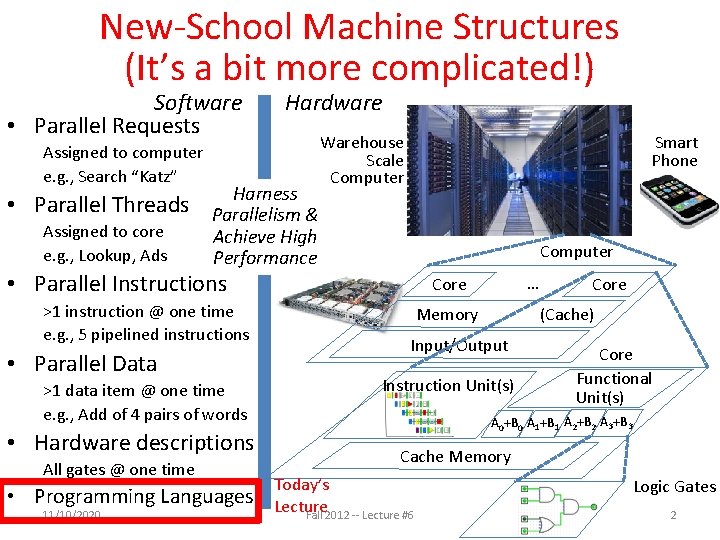
New-School Machine Structures (It’s a bit more complicated!) Software • Parallel Requests Assigned to computer e. g. , Search “Katz” • Parallel Threads Assigned to core e. g. , Lookup, Ads Hardware Harness Parallelism & Achieve High Performance Smart Phone Warehouse Scale Computer • Parallel Instructions >1 instruction @ one time e. g. , 5 pipelined instructions • Parallel Data >1 data item @ one time e. g. , Add of 4 pairs of words • Hardware descriptions All gates @ one time • Programming Languages 11/10/2020 … Core Memory Core (Cache) Input/Output Instruction Unit(s) Core Functional Unit(s) A 0+B 0 A 1+B 1 A 2+B 2 A 3+B 3 Cache Memory Today’s Lecture Fall 2012 -- Lecture #6 Logic Gates 2
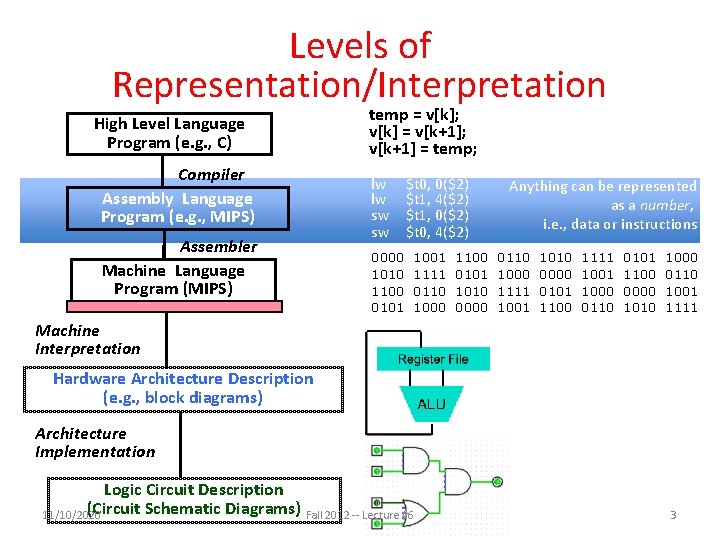
Levels of Representation/Interpretation High Level Language Program (e. g. , C) Compiler Assembly Language Program (e. g. , MIPS) Assembler Machine Language Program (MIPS) temp = v[k]; v[k] = v[k+1]; v[k+1] = temp; lw lw sw sw 0000 1010 1100 0101 $t 0, 0($2) $t 1, 4($2) $t 1, 0($2) $t 0, 4($2) 1001 1111 0110 1000 1100 0101 1010 0000 Anything can be represented as a number, i. e. , data or instructions 0110 1000 1111 1001 1010 0000 0101 1100 1111 1000 0110 0101 1100 0000 1010 1000 0110 1001 1111 Machine Interpretation Hardware Architecture Description (e. g. , block diagrams) Architecture Implementation Logic Circuit Description (Circuit Schematic Diagrams) Fall 2012 -- Lecture #6 11/10/2020 3
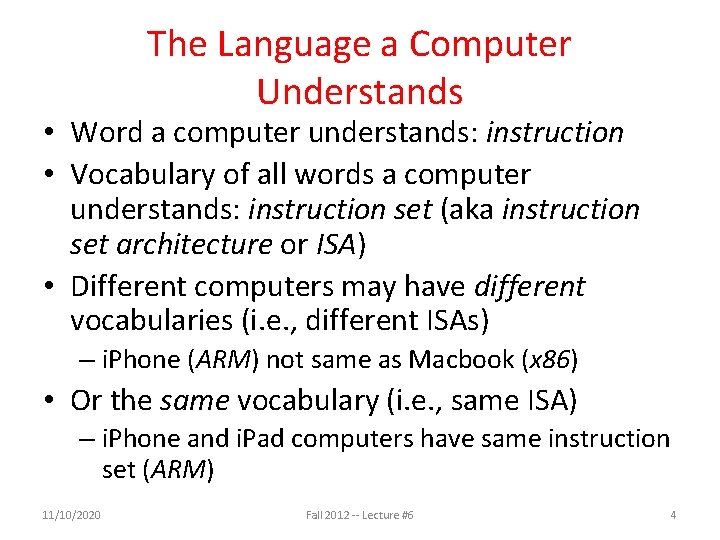
The Language a Computer Understands • Word a computer understands: instruction • Vocabulary of all words a computer understands: instruction set (aka instruction set architecture or ISA) • Different computers may have different vocabularies (i. e. , different ISAs) – i. Phone (ARM) not same as Macbook (x 86) • Or the same vocabulary (i. e. , same ISA) – i. Phone and i. Pad computers have same instruction set (ARM) 11/10/2020 Fall 2012 -- Lecture #6 4
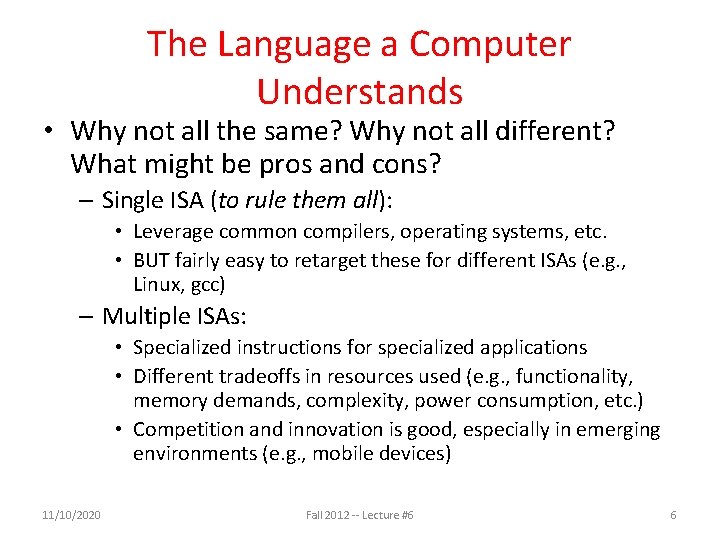
The Language a Computer Understands • Why not all the same? Why not all different? What might be pros and cons? – Single ISA (to rule them all): • Leverage common compilers, operating systems, etc. • BUT fairly easy to retarget these for different ISAs (e. g. , Linux, gcc) – Multiple ISAs: • Specialized instructions for specialized applications • Different tradeoffs in resources used (e. g. , functionality, memory demands, complexity, power consumption, etc. ) • Competition and innovation is good, especially in emerging environments (e. g. , mobile devices) 11/10/2020 Fall 2012 -- Lecture #6 6
MIPS: Instruction Set for CS 61 C • MIPS is a real-world ISA (see www. mips. com) – Standard instruction set for networking equipment – Was also used in original Nintendo-64! • Elegant example of a Reduced Instruction Set Computer (RISC) instruction set • Invented by John Hennessy @ Stanford – Why not Berkeley/Sun RISC invented by Dave Patterson? Ask him! 11/10/2020 Fall 2012 -- Lecture #6 7
RISC Design Principles • Basic RISC principle: “A simpler CPU (the hardware that interprets machine language) is a faster CPU” (CPU Core) • Focus of the RISC design is reduction of the number and complexity of instructions in the ISA • A number of the more common strategies include: – Fixed instruction length, generally a single word; Simplifies process of fetching instructions from memory – Simplified addressing modes; Simplifies process of fetching operands from memory – Fewer and simpler instructions in the instruction set; Simplifies process of executing instructions – Only load and store instructions access memory; E. g. , no add memory to register, add memory to memory, etc. – Let the compiler do it. Use a good compiler to break complex high-level language statements into a number of simple assembly language statements 11/10/2020 Fall 2012 -- Lecture #6 8
Mainstream ISAs • ARM (Advanced RISC Machine) is most popular RISC – In every smart phone-like device (e. g. , i. Phone, i. Pad, i. Pod, …) • Intel 80 x 86 is another popular ISA and is used in Macbook and PCs (Core i 3, Core i 5, Core i 7, …) – x 86 is a Complex Instruction Set Computer (CISC) – 20 x ARM sold vs. 80 x 86 (i. e. , 5 billion vs. 0. 3 billion) 11/10/2020 Fall 2012 -- Lecture #6 9
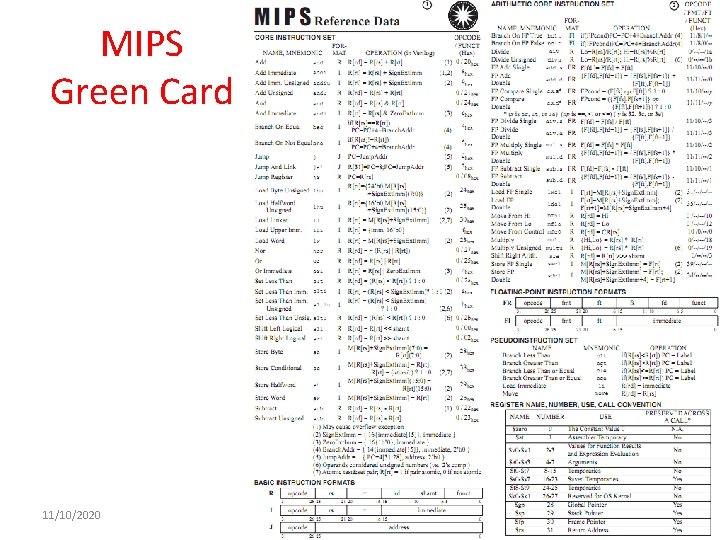
MIPS Green Card 11/10/2020 Fall 2012 -- Lecture #6 10
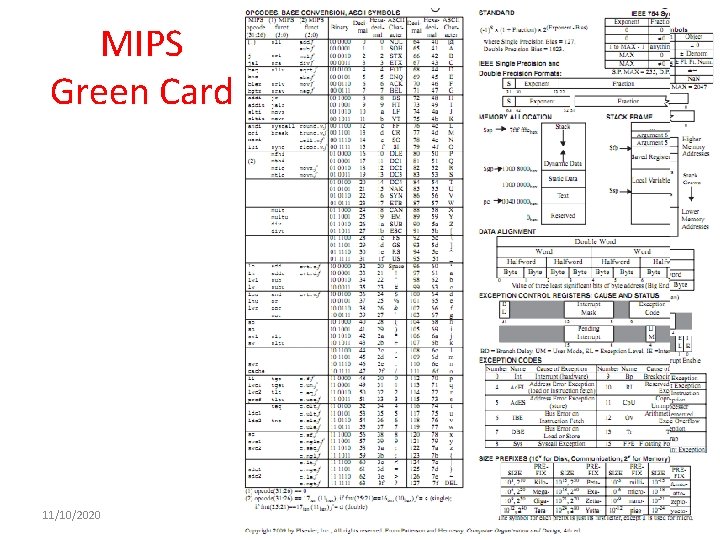
MIPS Green Card 11/10/2020 Fall 2012 -- Lecture #6 11
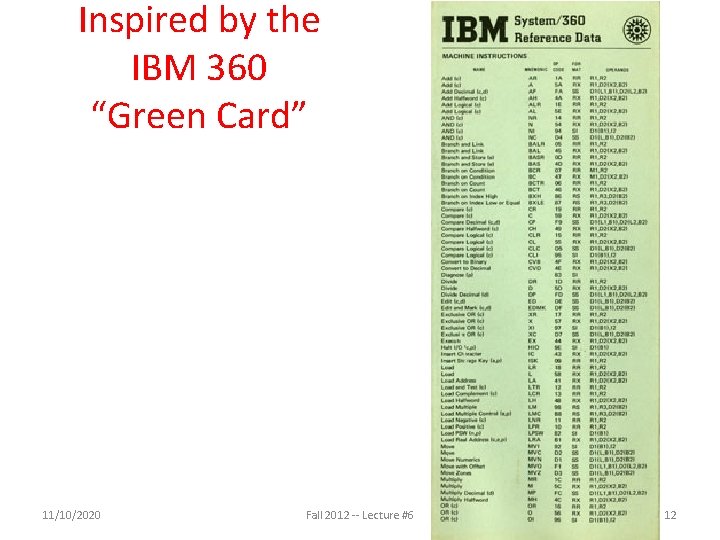
Inspired by the IBM 360 “Green Card” 11/10/2020 Fall 2012 -- Lecture #6 12
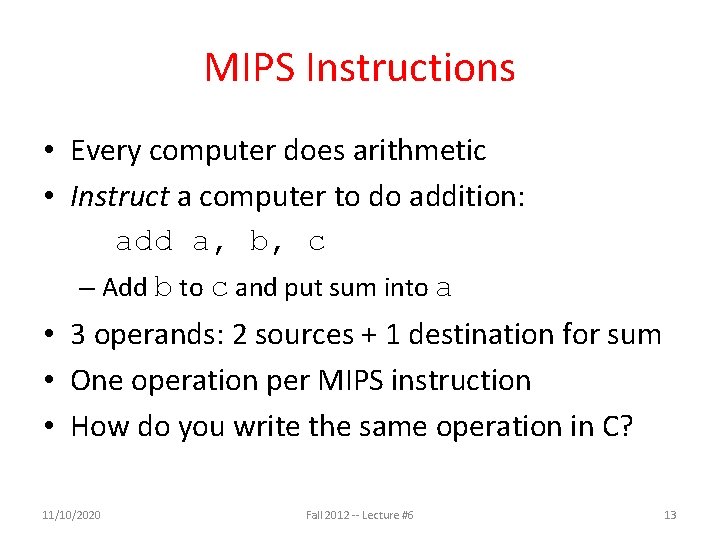
MIPS Instructions • Every computer does arithmetic • Instruct a computer to do addition: add a, b, c – Add b to c and put sum into a • 3 operands: 2 sources + 1 destination for sum • One operation per MIPS instruction • How do you write the same operation in C? 11/10/2020 Fall 2012 -- Lecture #6 13
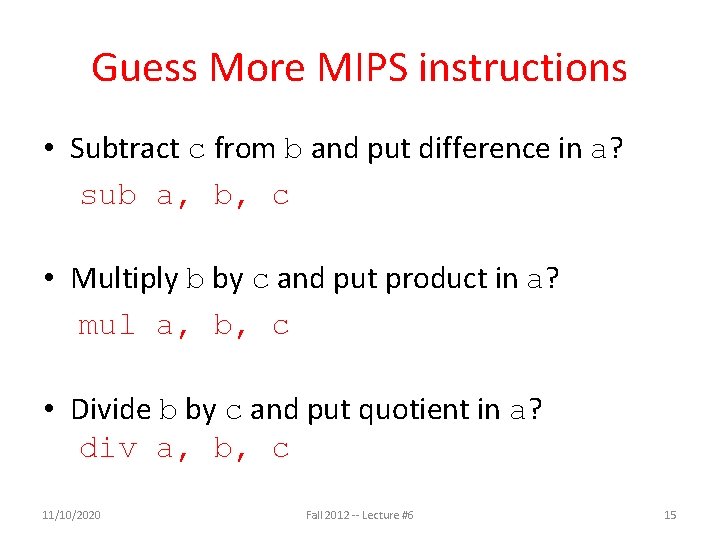
Guess More MIPS instructions • Subtract c from b and put difference in a? sub a, b, c • Multiply b by c and put product in a? mul a, b, c • Divide b by c and put quotient in a? div a, b, c 11/10/2020 Fall 2012 -- Lecture #6 15
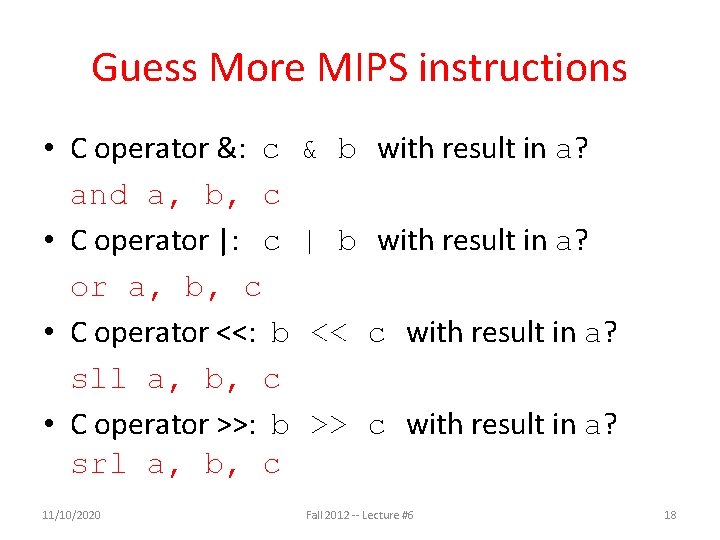
Guess More MIPS instructions • C operator &: c & b and a, b, c • C operator |: c | b or a, b, c • C operator <<: b << sll a, b, c • C operator >>: b >> srl a, b, c 11/10/2020 with result in a? c with result in a? Fall 2012 -- Lecture #6 18
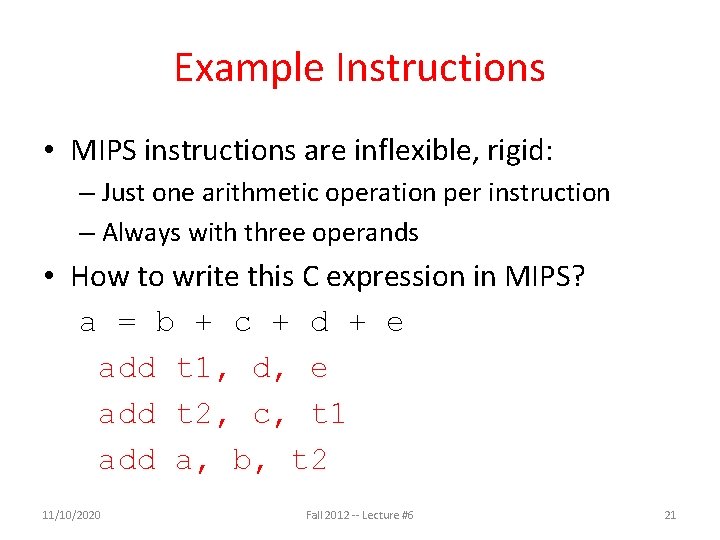
Example Instructions • MIPS instructions are inflexible, rigid: – Just one arithmetic operation per instruction – Always with three operands • How to write this C expression in MIPS? a = b + c + d + e add t 1, d, e add t 2, c, t 1 add a, b, t 2 11/10/2020 Fall 2012 -- Lecture #6 21
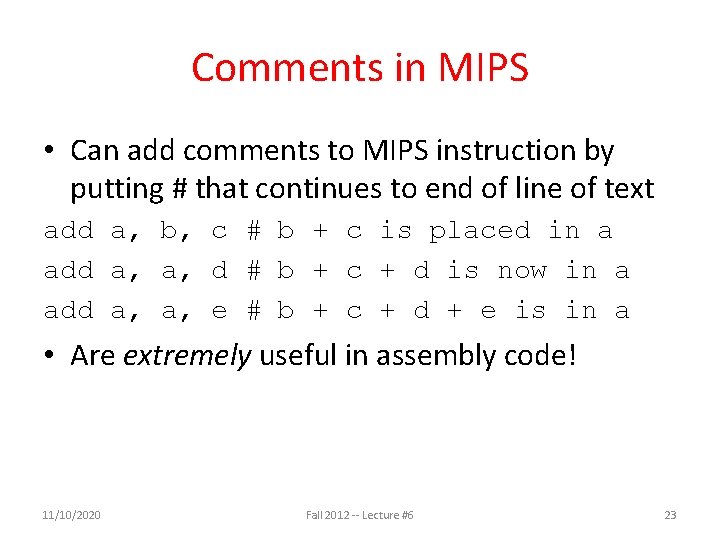
Comments in MIPS • Can add comments to MIPS instruction by putting # that continues to end of line of text add a, b, c # b + c is placed in a add a, a, d # b + c + d is now in a add a, a, e # b + c + d + e is in a • Are extremely useful in assembly code! 11/10/2020 Fall 2012 -- Lecture #6 23
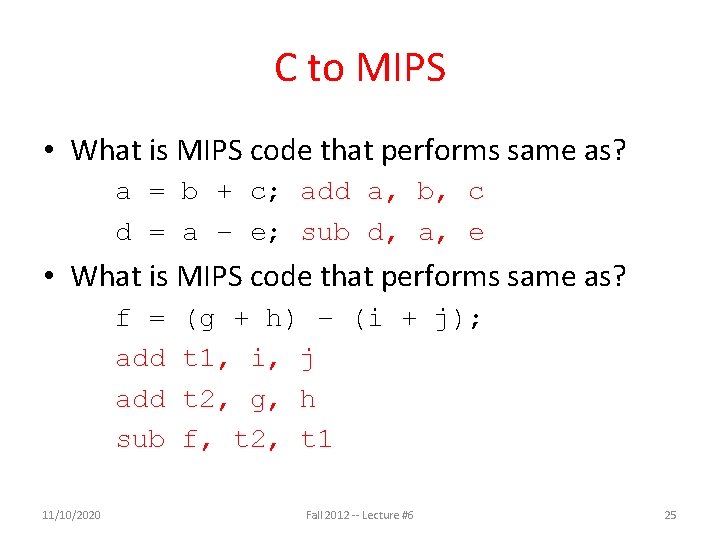
C to MIPS • What is MIPS code that performs same as? a = b + c; add a, b, c d = a – e; sub d, a, e • What is MIPS code that performs same as? f = add sub 11/10/2020 (g + h) – (i + j); t 1, i, j t 2, g, h f, t 2, t 1 Fall 2012 -- Lecture #6 25
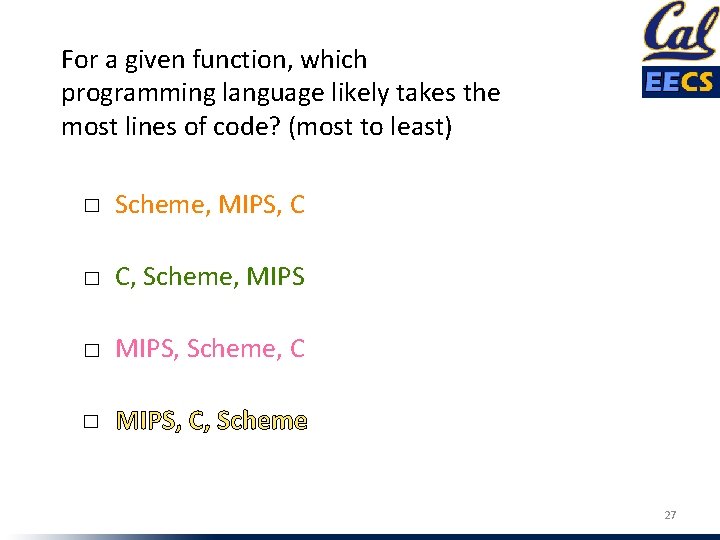
For a given function, which programming language likely takes the most lines of code? (most to least) ☐ Scheme, MIPS, C ☐ C, Scheme, MIPS ☐ MIPS, Scheme, C ☐ MIPS, C, Scheme 27
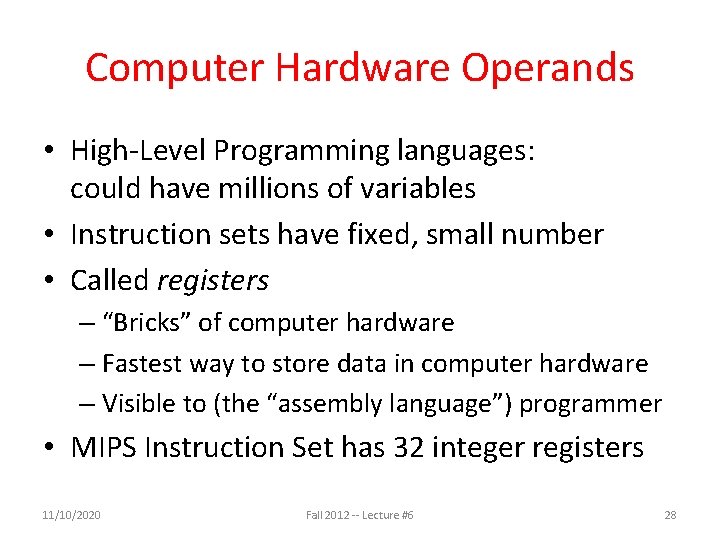
Computer Hardware Operands • High-Level Programming languages: could have millions of variables • Instruction sets have fixed, small number • Called registers – “Bricks” of computer hardware – Fastest way to store data in computer hardware – Visible to (the “assembly language”) programmer • MIPS Instruction Set has 32 integer registers 11/10/2020 Fall 2012 -- Lecture #6 28
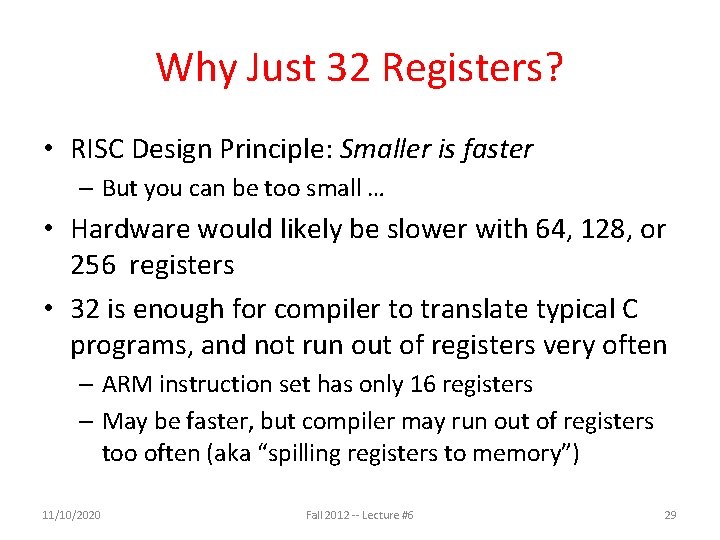
Why Just 32 Registers? • RISC Design Principle: Smaller is faster – But you can be too small … • Hardware would likely be slower with 64, 128, or 256 registers • 32 is enough for compiler to translate typical C programs, and not run out of registers very often – ARM instruction set has only 16 registers – May be faster, but compiler may run out of registers too often (aka “spilling registers to memory”) 11/10/2020 Fall 2012 -- Lecture #6 29
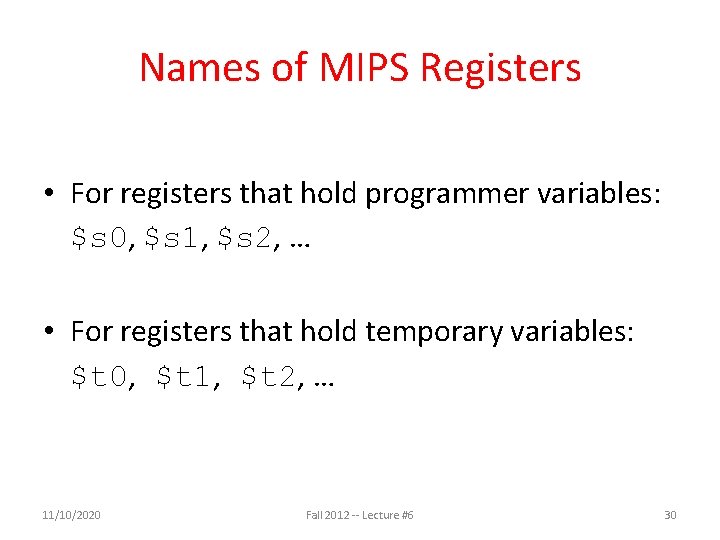
Names of MIPS Registers • For registers that hold programmer variables: $s 0, $s 1, $s 2, … • For registers that hold temporary variables: $t 0, $t 1, $t 2, … 11/10/2020 Fall 2012 -- Lecture #6 30
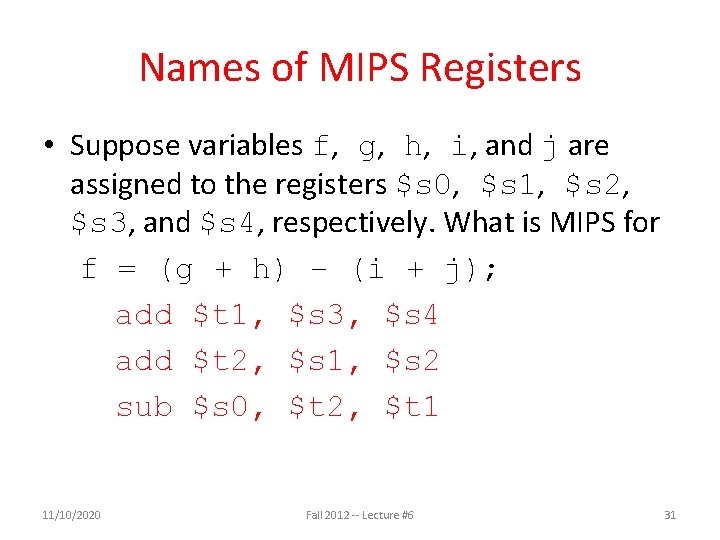
Names of MIPS Registers • Suppose variables f, g, h, i, and j are assigned to the registers $s 0, $s 1, $s 2, $s 3, and $s 4, respectively. What is MIPS for f = (g + h) – (i + j); add $t 1, $s 3, $s 4 add $t 2, $s 1, $s 2 sub $s 0, $t 2, $t 1 11/10/2020 Fall 2012 -- Lecture #6 31
Size of Registers • Bit is the atom of Computer Hardware: contains either 0 or 1 – True “alphabet” of computer hardware is 0, 1 – Will eventually express MIPS instructions as combinations of 0 s and 1 s (in Machine Language) • MIPS registers are 32 bits wide • MIPS calls this quantity a word – Some computers use 16 -bit or 64 -bit wide words – E. g. , Intel 8086 (16 -bit), MIPS 64 (64 -bit) 11/10/2020 Fall 2012 -- Lecture #6 33
Administrivia • If on wait list, have to add class by Monday or will be dropped from wait list – 4 lab sections have open space (including W 911 pm) 11/10/2020 Fall 2012 -- Lecture #6 34
Technology Break 11/10/2020 Fall 2012 -- Lecture #6 35
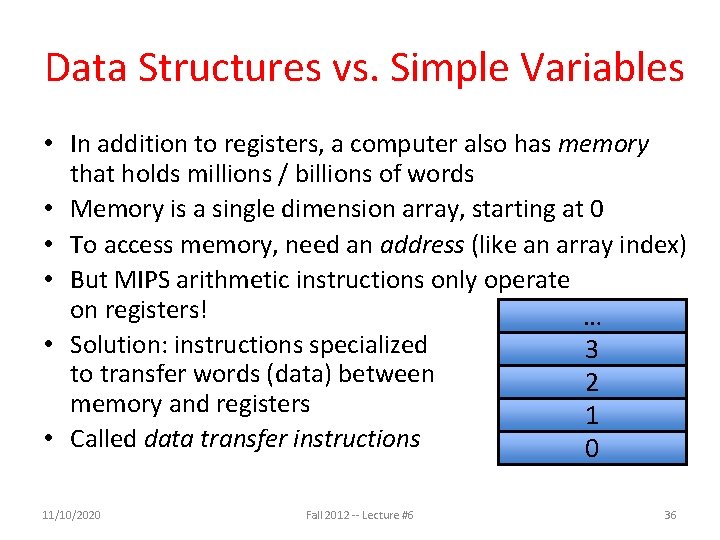
Data Structures vs. Simple Variables • In addition to registers, a computer also has memory that holds millions / billions of words • Memory is a single dimension array, starting at 0 • To access memory, need an address (like an array index) • But MIPS arithmetic instructions only operate on registers! … • Solution: instructions specialized 3 to transfer words (data) between 2 memory and registers 1 • Called data transfer instructions 0 11/10/2020 Fall 2012 -- Lecture #6 36
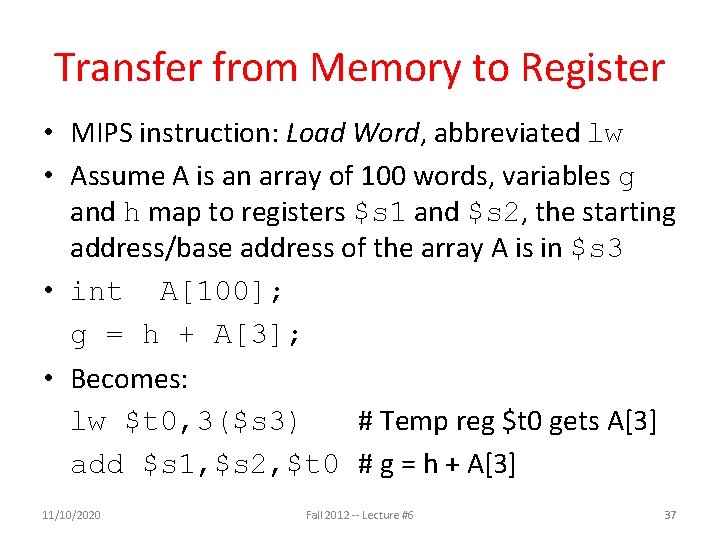
Transfer from Memory to Register • MIPS instruction: Load Word, abbreviated lw • Assume A is an array of 100 words, variables g and h map to registers $s 1 and $s 2, the starting address/base address of the array A is in $s 3 • int A[100]; g = h + A[3]; • Becomes: lw $t 0, 3($s 3) # Temp reg $t 0 gets A[3] add $s 1, $s 2, $t 0 # g = h + A[3] 11/10/2020 Fall 2012 -- Lecture #6 37
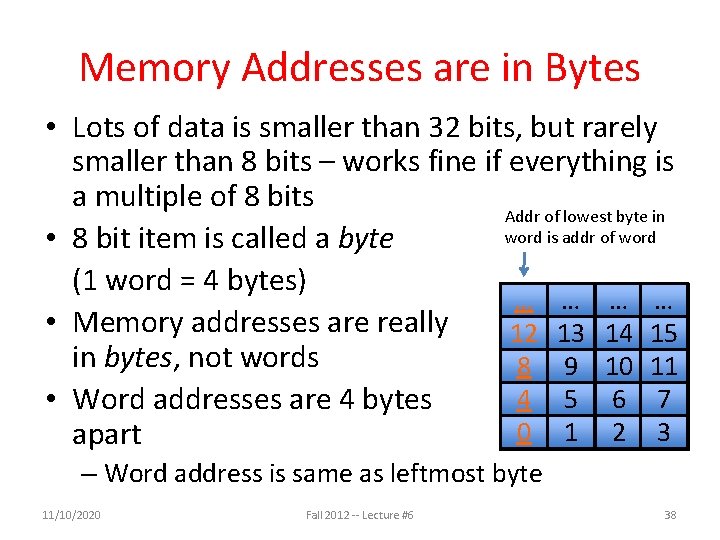
Memory Addresses are in Bytes • Lots of data is smaller than 32 bits, but rarely smaller than 8 bits – works fine if everything is a multiple of 8 bits Addr of lowest byte in word is addr of word • 8 bit item is called a byte (1 word = 4 bytes) … …… … … • Memory addresses are really 12 13 3 14 15 in bytes, not words 8 9 2 10 11 4 516 7 • Word addresses are 4 bytes 0 102 3 apart – Word address is same as leftmost byte 11/10/2020 Fall 2012 -- Lecture #6 38
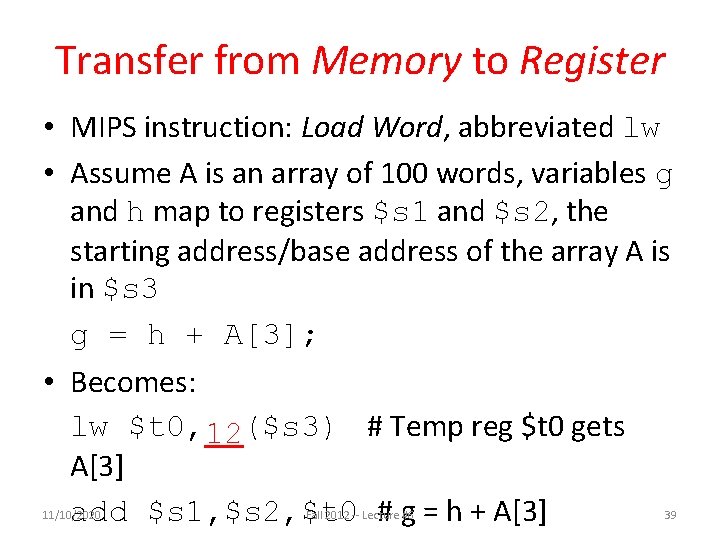
Transfer from Memory to Register • MIPS instruction: Load Word, abbreviated lw • Assume A is an array of 100 words, variables g and h map to registers $s 1 and $s 2, the starting address/base address of the array A is in $s 3 g = h + A[3]; • Becomes: lw $t 0, 12 3($s 3) # Temp reg $t 0 gets A[3] add $s 1, $s 2, $t 0 # g = h + A[3] 11/10/2020 Fall 2012 -- Lecture #6 39
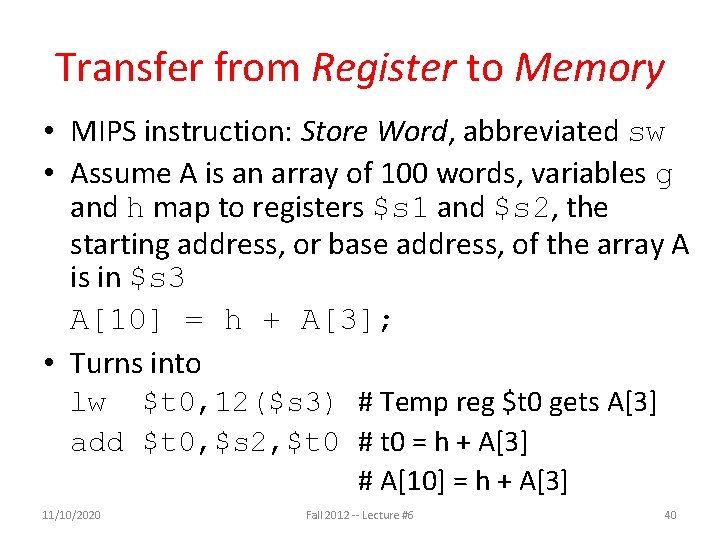
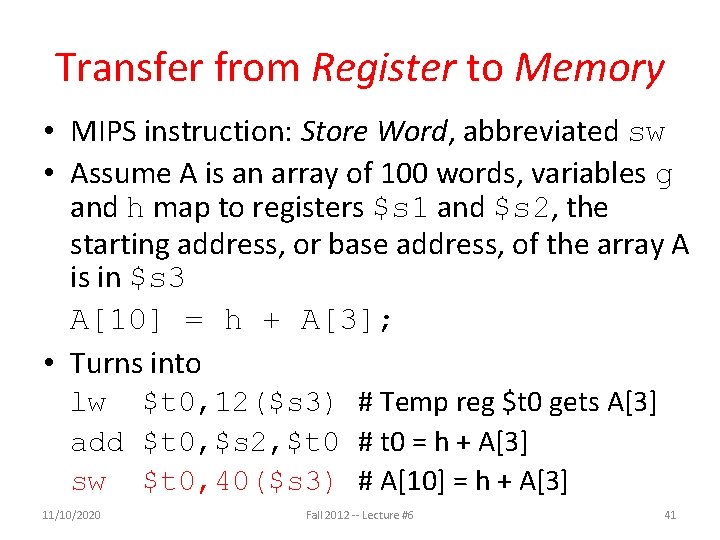
Transfer from Register to Memory • MIPS instruction: Store Word, abbreviated sw • Assume A is an array of 100 words, variables g and h map to registers $s 1 and $s 2, the starting address, or base address, of the array A is in $s 3 A[10] = h + A[3]; • Turns into lw $t 0, 12($s 3) # Temp reg $t 0 gets A[3] add $t 0, $s 2, $t 0 # t 0 = h + A[3] # A[10] = h + A[3] 11/10/2020 Fall 2012 -- Lecture #6 40
Transfer from Register to Memory • MIPS instruction: Store Word, abbreviated sw • Assume A is an array of 100 words, variables g and h map to registers $s 1 and $s 2, the starting address, or base address, of the array A is in $s 3 A[10] = h + A[3]; • Turns into lw $t 0, 12($s 3) # Temp reg $t 0 gets A[3] add $t 0, $s 2, $t 0 # t 0 = h + A[3] sw $t 0, 40($s 3) # A[10] = h + A[3] 11/10/2020 Fall 2012 -- Lecture #6 41
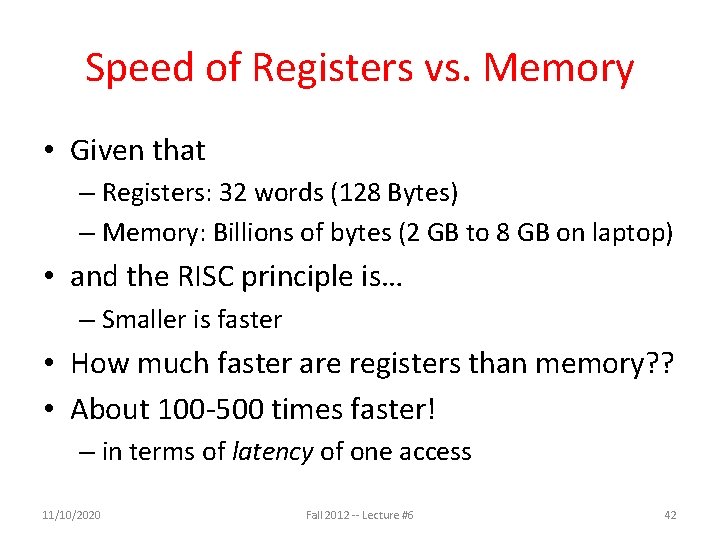
Speed of Registers vs. Memory • Given that – Registers: 32 words (128 Bytes) – Memory: Billions of bytes (2 GB to 8 GB on laptop) • and the RISC principle is… – Smaller is faster • How much faster are registers than memory? ? • About 100 -500 times faster! – in terms of latency of one access 11/10/2020 Fall 2012 -- Lecture #6 42
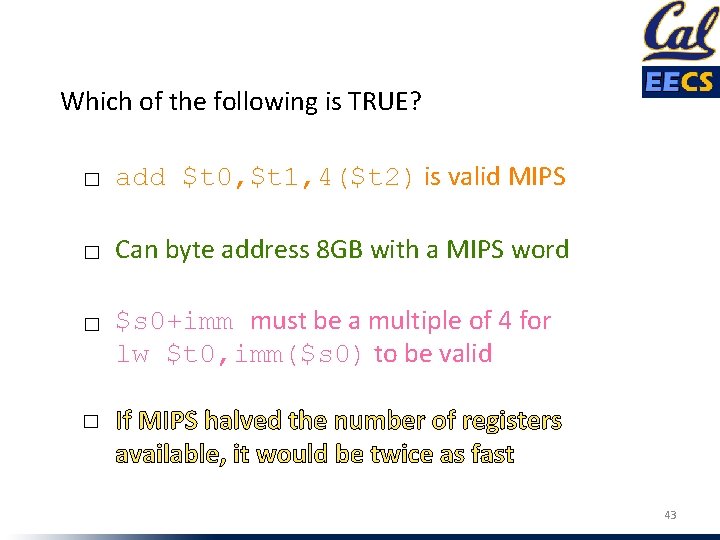
Which of the following is TRUE? ☐ add $t 0, $t 1, 4($t 2) is valid MIPS ☐ Can byte address 8 GB with a MIPS word ☐ ☐ $s 0+imm must be a multiple of 4 for lw $t 0, imm($s 0) to be valid If MIPS halved the number of registers available, it would be twice as fast 43
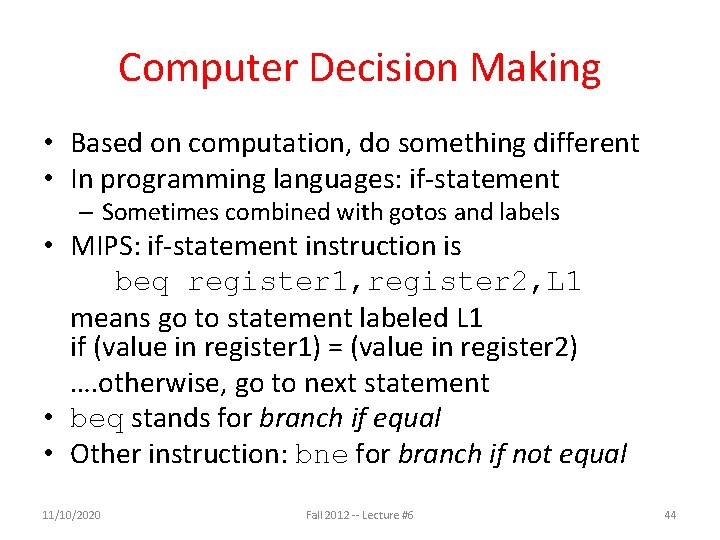
Computer Decision Making • Based on computation, do something different • In programming languages: if-statement – Sometimes combined with gotos and labels • MIPS: if-statement instruction is beq register 1, register 2, L 1 means go to statement labeled L 1 if (value in register 1) = (value in register 2) …. otherwise, go to next statement • beq stands for branch if equal • Other instruction: bne for branch if not equal 11/10/2020 Fall 2012 -- Lecture #6 44
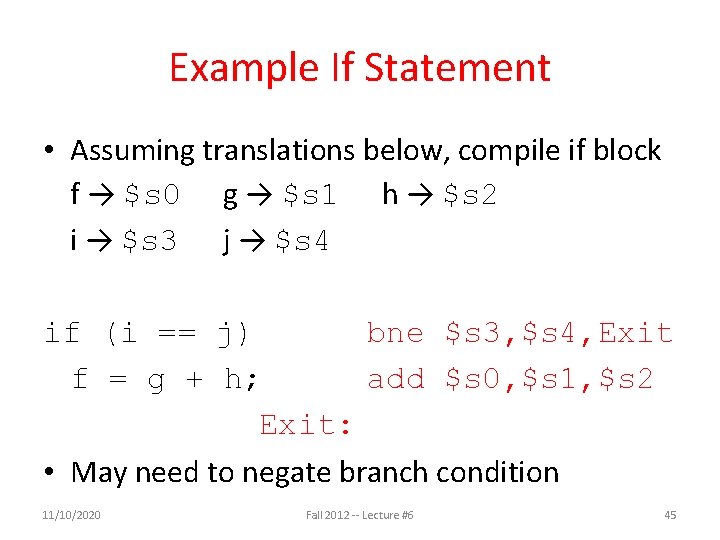
Example If Statement • Assuming translations below, compile if block f → $s 0 g → $s 1 h → $s 2 i → $s 3 j → $s 4 if (i == j) bne $s 3, $s 4, Exit f = g + h; add $s 0, $s 1, $s 2 Exit: • May need to negate branch condition 11/10/2020 Fall 2012 -- Lecture #6 45
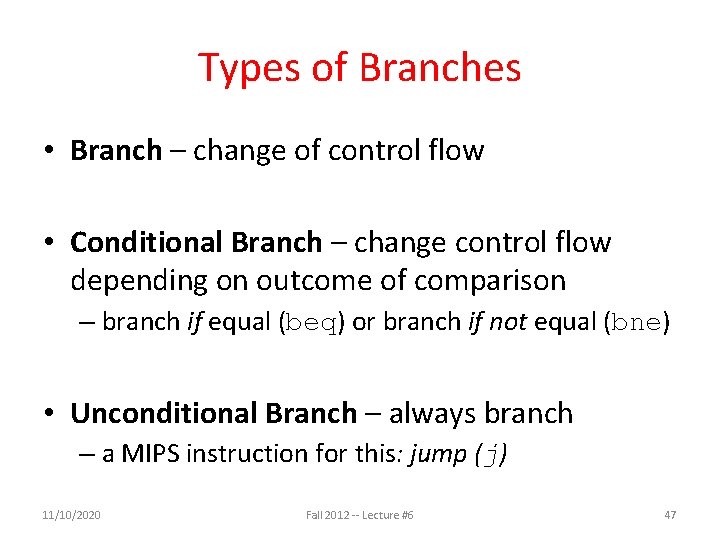
Types of Branches • Branch – change of control flow • Conditional Branch – change control flow depending on outcome of comparison – branch if equal (beq) or branch if not equal (bne) • Unconditional Branch – always branch – a MIPS instruction for this: jump (j) 11/10/2020 Fall 2012 -- Lecture #6 47
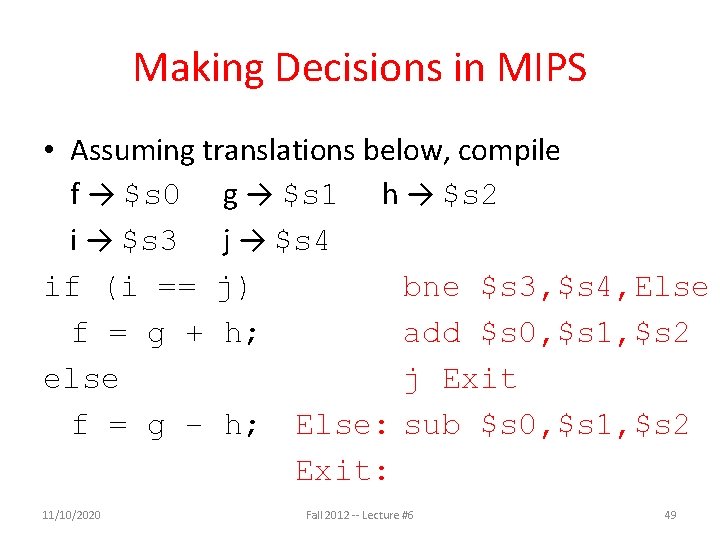
Making Decisions in MIPS • Assuming translations below, compile f → $s 0 g → $s 1 h → $s 2 i → $s 3 j → $s 4 if (i == j) bne $s 3, $s 4, Else f = g + h; add $s 0, $s 1, $s 2 else j Exit f = g – h; Else: sub $s 0, $s 1, $s 2 Exit: 11/10/2020 Fall 2012 -- Lecture #6 49
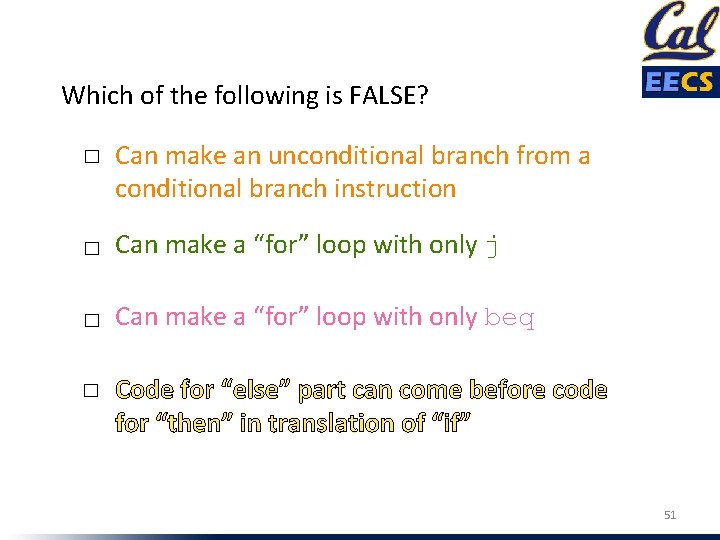
Which of the following is FALSE? ☐ Can make an unconditional branch from a conditional branch instruction ☐ Can make a “for” loop with only j ☐ Can make a “for” loop with only beq ☐ Code for “else” part can come before code for “then” in translation of “if” 51
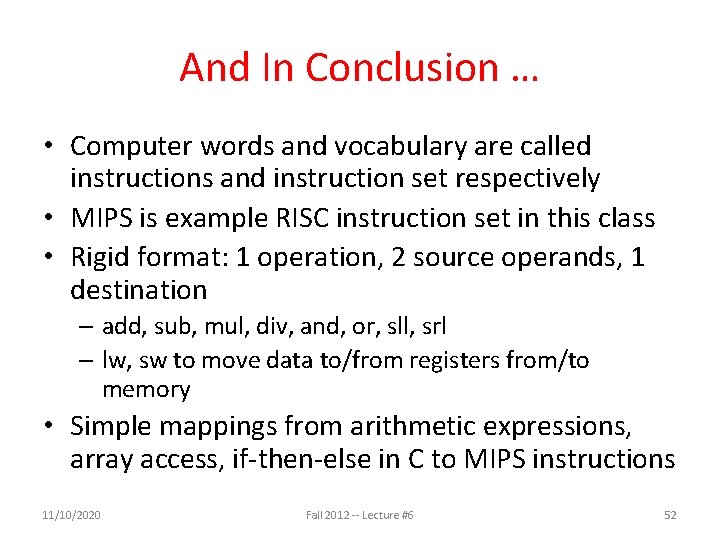
And In Conclusion … • Computer words and vocabulary are called instructions and instruction set respectively • MIPS is example RISC instruction set in this class • Rigid format: 1 operation, 2 source operands, 1 destination – add, sub, mul, div, and, or, sll, srl – lw, sw to move data to/from registers from/to memory • Simple mappings from arithmetic expressions, array access, if-then-else in C to MIPS instructions 11/10/2020 Fall 2012 -- Lecture #6 52